A Nation Blocks Chips, a Giant Buys a Nuclear Power Plant: Why It's Time to Seriously Consider DeAI

marsbitPublicado em 2026-06-04Última atualização em 2026-06-04

Resumo

**Title: Great Powers Blockade Chips, Giants Buy Nuclear Plants: Why It's Time to Seriously Consider DeAI** In May 2026, the US closed loopholes for Chinese firms to acquire advanced NVIDIA chips via overseas subsidiaries. That same month, Kenya halted a $1B geothermal data center project involving Microsoft, fearing its immense energy consumption. Meanwhile, Huawei announced mass production of its Ascend AI chip. These disparate events underscore a new reality: the competition for computing power ("compute") has escalated beyond the tech industry, becoming a geopolitical and infrastructural battleground. A new era of oligopoly is forming, with control over the AI stack—from GPU chips (NVIDIA) and cloud platforms (AWS, Azure, Google Cloud) to foundational models (OpenAI, Anthropic)—concentrating in a few Western "AI Octopus" corporations. This centralization creates systemic risks: pricing power and platform lock-in for users, infrastructure fragility, and a widening "compute divide" that threatens to marginalize nations without independent AI capacity. An "AI Iron Curtain" is deepening through export controls. In response, some nations like Saudi Arabia and the UAE are investing heavily to buy compute power, aiming to transition from oil to AI economies. The EU seeks to triple its compute capacity by 2030 to reduce dependency. However, the spending gap is vast, with four US tech giants alone planning ~$750B in AI capex for 2026. The race is increasingly constrained by ene...

Authored by: Conflux

On May 31, 2026, the U.S. Department of Commerce issued new export control guidance: the channel for Chinese companies to purchase NVIDIA's advanced chips through overseas subsidiaries in places like Malaysia was officially closed.

In the same month, the President of Kenya halted a $1 billion geothermal data center project involving Microsoft—because once completed, it would consume one-third of the nation's electricity. President Ruto's exact words were: "It's like shutting down half the country."

Meanwhile, Huawei announced last week that its Ascend 950PR chip has entered mass production, with full-year AI chip revenue expected to reach $12 billion.

Three events, three continents, three completely different news stories. Yet they point to the same emerging reality: the competition for computing power is no longer just an internal matter for the tech industry.

A New Era of Oligopoly is Forming

Over the past two years, there has been a frequently overlooked reality in the AI industry: while it appears vibrant on the surface, the underlying resources are becoming increasingly concentrated.

The current AI industry chain can be roughly divided into four layers: GPU chips, cloud computing platforms, foundational models, and application ecosystems. In each layer, control is consolidating into the hands of a few players: in the GPU field, NVIDIA has become almost the sole choice; in cloud computing, AWS, Microsoft Azure, and Google Cloud dominate; at the model layer, OpenAI and Anthropic already hold the vast majority of the high-end model market.

In other words: the same set of companies is simultaneously controlling chips, cloud platforms, models, and distribution channels. University of Chicago law professor Eric Posner refers to this phenomenon as the "AI Octopus"—meaning these companies' tentacles cover the entire AI supply chain.

This differs from the platform monopolies of the internet era—internet platforms controlled traffic, while AI platforms control intelligence itself. This "oligopolistic monopoly" brings profound systemic risks:

  • Concentrated Control and Pricing Power: A handful of companies control AI's pricing, API access permissions, and content moderation standards. Developers and businesses face severe "platform lock-in" risks, as giants can change rules or cut off access at any time.
  • Infrastructure Fragility: Highly centralized computing power is prone to single points of failure that can affect the entire system (such as widespread cloud service outages) and places unsustainable pressure on regional power grids and energy supplies.
  • Geopolitics and Compute Hegemony: Computing power is shifting from a neutral infrastructure to a strategic bargaining chip. Due to export control restrictions, countries without independent computing capacity (especially in the Global South) face the risk of being marginalized and experiencing a widening technological gap.

In the future, more and more enterprises will rely on AI for development, operations, customer service, marketing, and even decision-making. Once intelligence becomes a production tool, the importance of its control will far surpass that of search engines and social media.

The Deepening "AI Iron Curtain"

Over the past two years, U.S. actions on chip export controls have become increasingly fragmented. The Biden administration established an "AI diffusion rule," dividing global cooperation into three tiers; after taking office, Trump scrapped this rule, shifting to case-by-case approvals and temporary bans. Responses to this iron curtain vary significantly among nations.

Saudi Arabia directly declared 2026 its "Year of Artificial Intelligence": through the sovereign wealth fund's company HUMAIN, Saudi Arabia invested $3 billion in Musk's xAI, with one condition being the establishment of AI data centers with over 500 megawatts of capacity in Saudi Arabia. The UAE is building a 5-gigawatt AI campus in Abu Dhabi—reportedly the largest outside the U.S.—with the first phase launching this year. In May, the UAE received its first shipment of NVIDIA's latest chips exported from the U.S.

The logic of Gulf nations is straightforward enough: the last era relied on selling oil; this era relies on buying compute power.

EU anxiety stems from another direction: official data shows that over 80% of Europe's digital services run on non-EU infrastructure. The proposed "Cloud Computing and AI Development Act" (CADA) aims to triple Europe's computing capacity by 2030. France's Mistral published a strategic document in April titled "European AI: A Playbook to Own It."

The most difficult situation is for economies that barely have the qualifications to even participate in the competition: Kenya's $1 billion data center was halted; Malaysia allocated approximately $490 million to build a sovereign AI cloud. India is subsidizing researchers' GPU usage fees; Indonesia is preparing a domestic large language model—these investments are significant within their respective economic scales.

However, this year, the combined AI capital expenditures of just four companies—Microsoft, Google, Amazon, and Meta—total around $750 billion. This scale gap is itself part of the problem.

And the endgame of the compute power competition increasingly points to a more fundamental variable: electricity. The energy consumption of a single AI inference task can be up to 1000 times that of a traditional web search. To cope with the projected global data center energy consumption reaching 1050 terawatt-hours in 2026, tech companies have even started directly purchasing nuclear power plants.

Is There a Possibility to "Not Take Sides"?

It is precisely against this backdrop that Decentralized AI (DeAI) is beginning to gain attention. It attempts to answer a question: Besides entrusting the future to a handful of tech giants or a few nations, is there a third possibility?

If the internet can connect global networks through open protocols, can AI also connect global compute power through an open network? Can idle GPUs worldwide, independent developers, research institutions, and corporate data centers form an open AI infrastructure network?

The core idea of DeAI is not complicated: through open protocols, coordinate independent participants to create AI systems without a single controlling power center. By combining blockchain technology, cryptoeconomic incentives, and cryptographic verification mechanisms, it addresses the trust problem in anonymous networks, directly responding to the pain points of centralized AI:

  • Breaking Market Concentration: Establish a network of distributed compute power, data, and model providers, forming a free-market pricing mechanism.
  • Alleviating Physical Constraints: Distribute massive energy demands across power grids worldwide.
  • Escaping Geopolitical Dependence: Build an infrastructure layer that transcends any single jurisdiction, offering possibilities for "sovereign AI."
  • Improving Verification Transparency: Use provable technical means to replace blind trust in the corporate reputations of tech giants.

Proponents argue that this model can reduce dependence on single suppliers, enhance system resilience, and provide opportunities for participation by smaller nations and enterprises.

Meanwhile, institutional investor attitudes are shifting from curiosity to substantial investment. Venture capital firms (like DCG, a16z) are injecting hundreds of millions of dollars into DeAI protocols; traditional enterprises (like Deutsche Telekom) are beginning to participate in networks as validators; moreover, some national governments (like Kazakhstan) are exploring connecting their idle national supercomputing resources to decentralized compute markets.

Conclusion

As noted in the "State of DeAI 2026" report, the core value proposition of DeAI does not lie in immediately surpassing centralized systems in performance today, but in offering an underlying architecture that resists monopolies, rejects censorship, and disperses power.

With the declining cost of specialized AI hardware (ASIC) and the continued flourishing of open-source models, the time window for DeAI to solve operational challenges is opening. The work of building the DeAI foundation is just beginning.

Of course, DeAI still has a long way to go before becoming mainstream. Whether in terms of performance, stability, or business models, it remains in its early stages. But its significant meaning may not lie in immediately challenging OpenAI, but in providing an alternative.

Historical experience tells us: when an industry has only one choice, the question is often not *if* power will be abused, but *when*.

And the very existence of competition is itself a form of checks and balances.

Perguntas relacionadas

QWhat is 'AI Octopus' as mentioned in the article, and what risks does it pose?

AThe term 'AI Octopus' refers to the phenomenon where a small group of companies simultaneously control the key layers of the AI industry chain, including GPU chips, cloud platforms, foundational models, and distribution channels. The risks it poses include centralized control leading to pricing power and platform lock-in for developers, infrastructure vulnerability due to single points of failure, and the geopolitical risk of 'compute hegemony' where access to AI technology becomes a strategic tool, potentially marginalizing nations without independent compute capabilities.

QAccording to the article, what is the fundamental challenge driving countries like Kenya and the EU to act regarding AI infrastructure?

AThe fundamental challenge is the immense and centralized demand for computational power (compute) and its associated energy consumption. For countries like Kenya, a large-scale data center project was halted because its projected energy use would consume a third of the nation's electricity. For the EU, the anxiety stems from over-dependence on non-EU infrastructure for digital services. Both scenarios highlight the physical and strategic limitations of centralized AI development, pushing nations to seek greater sovereignty over their AI and computational resources.

QWhat is Decentralized AI (DeAI), and how does it propose to address the problems of centralized AI?

ADecentralized AI (DeAI) is a proposed model that uses open protocols to coordinate independent participants—such as idle GPUs, developers, and data centers globally—to form an AI infrastructure network without a single controlling authority. It addresses centralized AI's problems by: 1) Breaking market concentration through a distributed network of compute and model providers, 2) Alleviating physical grid strain by dispersing energy demands globally, 3) Reducing geopolitical dependency by creating an infrastructure layer that transcends single jurisdictions, and 4) Enhancing transparency through cryptographic verification instead of reliance on corporate reputation.

QWhat evidence does the article provide to show that investment in DeAI is moving beyond curiosity?

AThe article provides several pieces of evidence: Venture capital firms like DCG and a16z are injecting hundreds of millions of dollars into DeAI protocols. Traditional enterprises, such as Deutsche Telekom, are beginning to participate as validators in these networks. Furthermore, some national governments, like Kazakhstan's, are exploring the integration of their idle state supercomputing resources into decentralized compute markets.

QWhat is the core value proposition of DeAI as stated in the 'State of DeAI 2026' report cited in the article?

AAccording to the cited 'State of DeAI 2026' report, the core value proposition of DeAI is not necessarily outperforming centralized systems in terms of raw performance today. Instead, its value lies in providing a foundational architecture designed to resist monopoly, reject censorship, and disperse power. It offers an alternative and competitive framework, which in itself acts as a crucial check and balance in the AI industry.

Leituras Relacionadas

ByteDance Adopts Arm CPUs, Jensen Huang: So Sad I Didn't Buy Arm

**Summary:** At Computex 2026, Arm CEO Rene Haas announced that ByteDance and Oracle have adopted Arm's self-designed Arm AGI data center CPU. The company expects significant revenue growth from this product, projecting $20 billion in demand for the 2027/2028 fiscal years. Haas noted that restricting AI-capable CPUs from the US to China is nearly impossible due to their widespread applications. Arm's stock has surged dramatically this year, notably rising 16% after NVIDIA's Arm-based Vera CPU and RTX Spark announcements. A highlight was the informal, humorous on-stage conversation between Haas and NVIDIA CEO Jensen Huang. Huang joked about NVIDIA's failed attempt to acquire Arm and playfully lamented selling his Arm shares. Both executives showed a clear sense of camaraderie and shared regret over the missed merger. Key technical topics were discussed: 1. **AI PC Design:** Huang explained NVIDIA's RTX Spark superchip (with a 20-core Arm CPU) is designed for future AI agents that will autonomously run and use tools on PCs, blending local and cloud processing. 2. **Agent vs. OS:** Huang emphasized the operating system remains crucial, as AI agents rely on its APIs and tools to function. 3. **Growth Constraints:** He identified the shift to "useful AI" that generates profitable tokens as a primary driver for immense, almost limitless, computational demand. Haas outlined Arm's strategy across PC and data centers. For PCs, Arm collaborates with partners like NVIDIA and MediaTek, offering its compute subsystem (CSS) for custom SoCs. In data centers, its Arm AGI CPU (built on TSMC's 3nm process) has gained major partners including OpenAI, Meta, and now ByteDance and Oracle. Arm presented a multi-year roadmap for its in-house CPU line. The article concludes that while GPUs dominated the AI training race, the explosion of AI agents is shifting significant focus to CPUs for inference, state management, and tool orchestration. The industry is trending towards vertical integration, with companies like cloud providers designing chips and chip/IP firms offering full solutions, all competing to deliver more efficient computing per watt.

marsbitHá 12m

ByteDance Adopts Arm CPUs, Jensen Huang: So Sad I Didn't Buy Arm

marsbitHá 12m

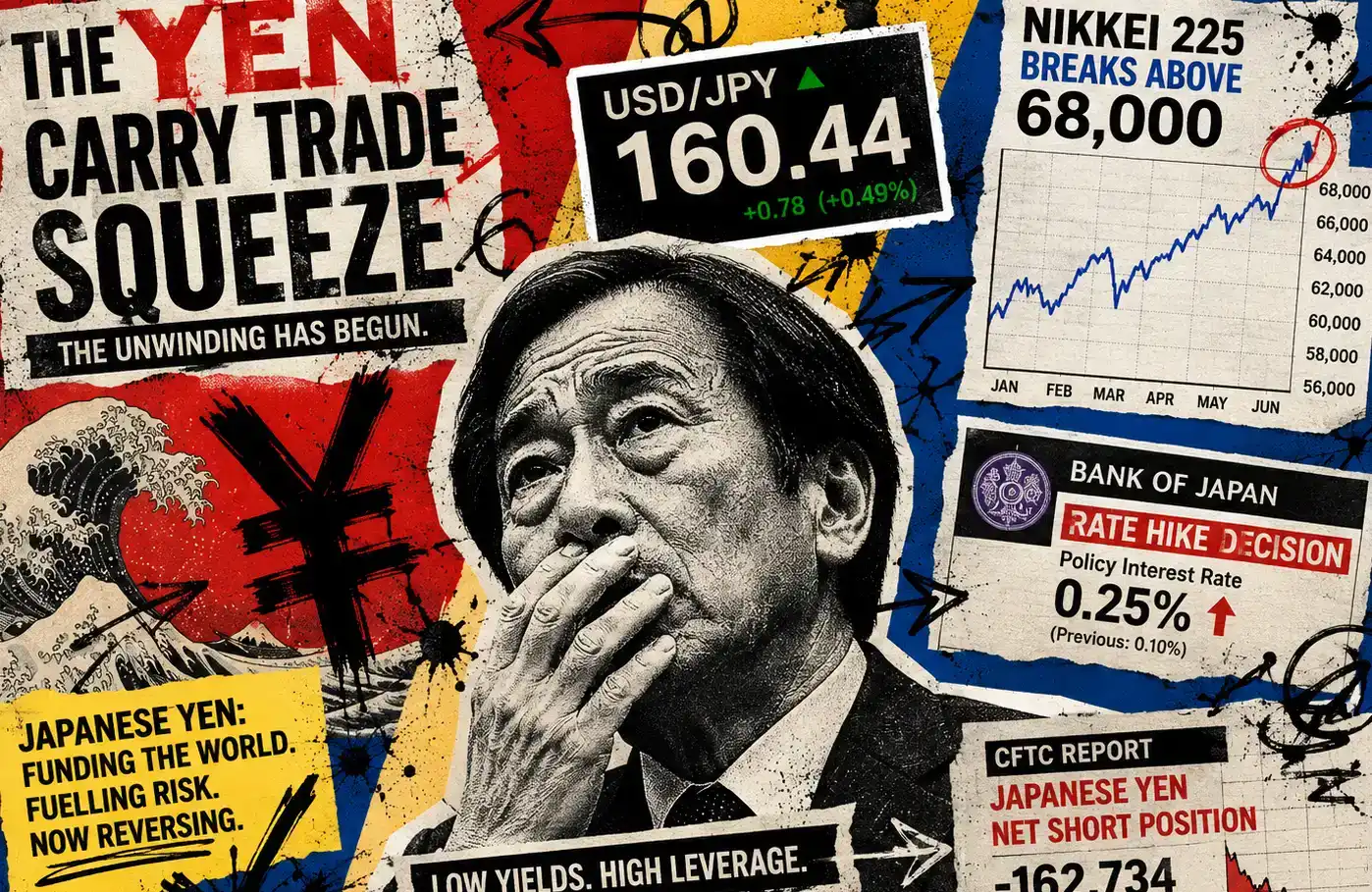
New Wall Street Play: Yen Shorts Still Adding, But Japan Stocks Don't Rely on Carry Trade Unwinding

On June 3rd, USD/JPY hit 160.44, its highest level since July 2024, while the Nikkei 225 surged past 68,000 points. Contrary to popular narratives of an imminent "carry trade unwind" akin to August 2024, data reveals a more complex picture. Speculative net short positions in yen futures have actually increased, reaching -114,667 contracts by late May, suggesting traders are doubling down rather than retreating. Meanwhile, Japan's Finance Ministry conducted its largest-ever single-round FX intervention (11.73 trillion yen) in April-May but failed to hold the 160 yen line. The Nikkei's rally is not driven by carry trade dynamics. Foreign investors are aggressively buying Japanese stocks, with net purchases in 2026 running nearly 16 times higher than 2025 levels. This inflow is concentrated in AI and semiconductor-related stocks like SoftBank and Socionext, fueled by positive sector outlooks, rather than being a flight from unwinding yen shorts. Furthermore, the Nikkei has continued climbing despite the Bank of Japan's (BOJ) rate hikes to 0.75%. This disconnect exists because the current equity boom is fueled by AI-driven foreign investment, not reliant on cheap yen funding. However, this relationship remains fragile. Should the BOJ hike rates further (e.g., to 1.0%) while dollar weakness increases carry trade costs, the trajectories of the yen and Japanese stocks could reconverge, potentially triggering volatility.

marsbitHá 17m

New Wall Street Play: Yen Shorts Still Adding, But Japan Stocks Don't Rely on Carry Trade Unwinding

marsbitHá 17m

Broadcom's Q3 Guidance Misses Expectations by $12 Billion, After-Hours Trading Plummets Over 13%, AI Narrative "Cooling"?

On June 3, Broadcom released record Q2 FY26 results with revenue of $22.19B, up 48% YoY, and AI chip sales of $10.8B, up 143%. Adjusted EPS of $2.44 beat estimates. However, its Q3 AI semiconductor revenue guidance of $16B, while up over 200% YoY, fell roughly $1.2B (7%) short of analyst consensus expectations of $17.2B. This miss, coupled with slightly weaker-than-expected software revenue, triggered a severe market reaction. CEO Hock Tan maintained the FY26 AI revenue outlook of over $100B but did not raise it, disappointing investors who had priced in more robust growth. The stock plummeted over 13% in after-hours trading, erasing roughly $270B in market cap. The sell-off extended to peers like Marvell. A key concern for markets, particularly for Chinese optical module suppliers, was Tan's comment that the contribution of AI networking (e.g., Ethernet switches, optical interconnect chips) to AI revenue, currently near 40%, is expected to normalize to around 30% over time, signaling a potential peak in growth for that segment. Despite the guidance shortfall, Tan reiterated that AI demand remains "insatiable" and reaffirmed the long-term target of exceeding $100B in AI revenue by FY27. The reaction highlights the heightened sensitivity and premium valuation placed on AI-exposed stocks, where anything less than stellar guidance can prompt significant profit-taking. The broader question is whether this represents a cooling AI narrative or a correction in overstretched valuations.

marsbitHá 17m

Broadcom's Q3 Guidance Misses Expectations by $12 Billion, After-Hours Trading Plummets Over 13%, AI Narrative "Cooling"?

marsbitHá 17m

Trading

Spot
Futuros
活动图片