a16z crypto Partner: Cash Flow Is the True Moat

Foresight NewsPublicado em 2026-06-11Última atualização em 2026-06-11

Resumo

Title: a16z Crypto Partner: Capital Flow is the True Moat In business history, enduringly successful enterprises often share a core logic: capturing value by facilitating its creation and transfer within an ecosystem, taking a share of the proceeds. The scale of value flowing through the ecosystem directly correlates with the company's growth. Cryptography is the first modern technology natively suited to this commercial logic. Startups that don't leverage this framework in product design and business model construction miss significant opportunities. Stablecoins enable internet-speed, 24/7 global settlement of value with end-to-end programmability. With open underlying channels for capital flow and transparent unit economics, every circulating dollar globally represents potential flow in this arena. Blockchain is inherently a network business model. All transactions are recorded on a shared ledger, and each new participant strengthens this foundational system for future developers. More users and applications increase the network's value for all. Crypto entrepreneurs start with built-in network effects, unlike traditional businesses that spend years building them on legacy infrastructure. Network tokens amplify this advantage. A well-designed token system aligns users, developers, service providers, and validators around a common goal—network growth—while distributing rewards based on contribution. All proceeds flow back to ecosystem participants, creating a virtuous cyc...


Author: Jason Rosenthal, Operating Partner at a16z crypto

Compiled by: Chopper, Foresight News


Throughout business history, the success logic of many enduring enterprises has been inseparable from the link of capital flow: undertaking businesses that create and transfer value within the ecosystem and extracting revenue from them. The larger the volume of value flowing through the ecosystem, the larger the scale of the enterprise tends to be.


Cryptographic technology is the first modern technology inherently suited to this business logic. If a startup does not base its product design and business model architecture on this logic during the planning stages, it misses out on tremendous opportunities. The proliferation of stablecoins has endowed capital and value with internet-level transfer speeds, enabling 24/7 global settlement with end-to-end programmability. Now, the underlying channels for capital flow are fully open, unit economic models are transparent, and every circulating dollar globally represents potential flow in this arena.


Underlying Business Logic


Blockchain is fundamentally a network-based business model. All transactions are uniformly recorded on a shared ledger, and each new participant reinforces this underlying system for subsequent developers. The more people who use the ecosystem and build applications, the greater the value of the entire network for all users.


Most traditional enterprises spend years building network effects on top of outdated infrastructure; whereas entrepreneurs in the crypto space start with inherent network effects from the outset.


Network tokens further amplify this advantage. A well-designed token system can bind users, developers, service providers, node validators, and the protocol ecosystem to a common goal—driving network growth—while distributing revenue according to each party's contributions. The revenue generated by the protocol ultimately belongs to all ecosystem participants. There are no secret rebates, no special deals, only the formation of a positive feedback loop: value circulates within the system, and returns flow back to everyone building the ecosystem.


This business logic is not new; it's just that the crypto industry is the first to enable startups to implement and scale it more easily.


The profit core of railroad companies was never selling locomotives, but charging a toll for every freight train transporting grain, coal, or steel. Standard Oil, U.S. Steel, and AT&T were all giants rooted in the links of value flow. Google and Meta replaced traditional print and television media not merely because their advertising formats were better, but because they occupied the critical node where attention converts into commercial transactions, taking a cut from trillions of dollars in commercial flow. Amazon Web Services occupies the central position for computing resources.
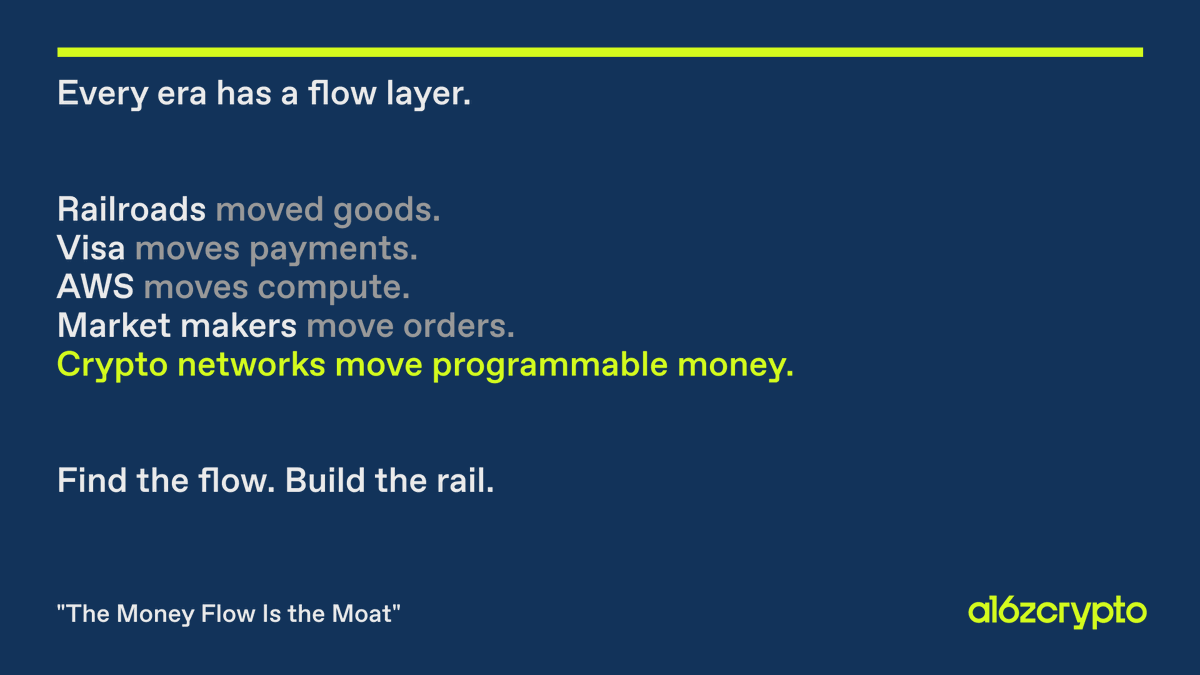


The pattern remains consistent: find the core path of value flow and occupy a key position within it.


This logic is vividly reflected in financial markets. In fiscal year 2024, Visa processed payment volumes totaling $15.7 trillion, generating net revenue of $35.9 billion. The well-known market maker Jane Street's trading net revenue reached $20.5 billion last year, surpassing Citibank and Bank of America. The top five market makers in the US handled 87% of order flow payments: they don't predict market ups and downs, they just need to reside in the flow path of every order; the higher the trading volume, the greater their earnings.


Such enterprises share another commonality: powerful network effects. The more merchants that accept Visa cards, the more valuable the card is to cardholders; conversely, the more cardholders, the more merchants are attracted to offer the service. The order flow market is similar: the more brokers connected, the narrower the bid-ask spread, which in turn attracts more brokers, bringing even larger order flow.


Cash flow coupled with network effects is one of the most robust business models in the commercial world.


Your Margin Is My Opportunity


Jeff Bezos once proposed a classic viewpoint: "Your margin is my opportunity." This statement originally targeted the retail industry, but it fits even more aptly in the traditional financial services sector—the industry with the largest scale of profit capture globally. This holds true across subsectors like payments, asset custody, lending, foreign exchange, asset securitization, trade settlement, and market making.


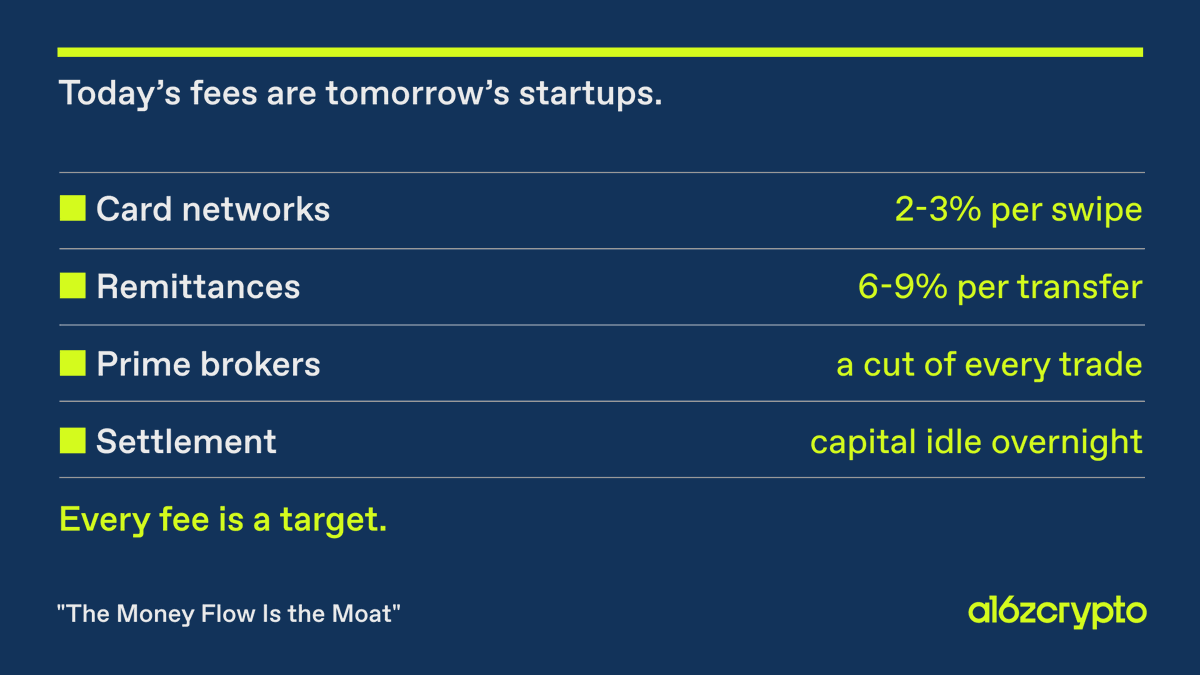
Visa and Mastercard, based on networks built in the 1960s, charge transaction fees of 2% to 3%; cross-border remittance channels have fees as high as 6% to 9%; prime brokers and asset custodians take a cut from every securities transaction. Even though the US shortened the securities settlement cycle to T+1 in 2024, funds can still sit idle overnight, which constitutes a structural cost borne by all market participants.


The existing profit margins in these industries are all potential entry points for disruption. Reducing transaction costs, improving capital flow efficiency, and potentially further expanding the overall market size. Stripe and Square have proven this model works in payments.


Entrepreneurs in the crypto industry have the opportunity to build the next-generation infrastructure: programmable, transactions settled instantly, globally accessible services, and rooted in the capital flow chain from its inception.


The opportunities also extend far beyond financial services. Markets for computing power and GPU trading, storage chips, AI training data, energy, robotics, aerospace, rare earth metals, and more are all on the verge of experiencing large-scale global value flow, for which existing traditional channels are completely inadequate.


The aforementioned sectors represent entirely new blue-ocean markets built on programmable infrastructure, centered on the cash flow model. Here, there are no deeply entrenched legacy platforms, no tangled webs of middlemen, and no old structures to defend.


As an entrepreneur, ask yourself a few questions: Is your current business positioned in the core link of value flow? When the transaction volume and value scale of your product ecosystem grow tenfold, can your revenue grow in sync? If you are developing a new product, in your target market, which link has the highest profit capture relative to the value it creates?


Where the answer lies, there lies the opportunity. Compress the costs of the original links, enter new value flow tracks, and then achieve sustained growth by leveraging network effects.


Perguntas relacionadas

QWhat is the core business logic shared by many enduring enterprises throughout business history, according to the article?

AThe core business logic is to occupy a key position in the flow of value, capturing a portion of the value as it moves through an ecosystem. The greater the volume of value flowing, the larger the enterprise typically becomes.

QHow does the article characterize the fundamental nature of blockchain technology in relation to business models?

AThe article characterizes blockchain as fundamentally a network-based business model. All transactions are recorded on a shared ledger, and each new participant strengthens this underlying system for subsequent developers. The more people who use and build on the ecosystem, the more valuable the entire network becomes for all users.

QAccording to the article, what creates one of the most durable business models in the commercial world?

AThe combination of capital flow and network effects creates one of the most durable business models in the commercial world.

QWhat is the meaning of Bezos's quote 'Your margin is my opportunity' in the context of traditional financial services?

AIn the context of traditional financial services, the quote means that the existing profit margins (or high fees) in sectors like payments, asset custody, and cross-border transfers represent opportunities for new, more efficient entrants to disrupt the industry by compressing those costs and capturing market share.

QWhat key questions should entrepreneurs ask themselves to identify opportunities, as suggested by the article?

AEntrepreneurs should ask: 1) Is my current business positioned at the core of a value flow? 2) If the transaction volume and value in my product's ecosystem grow tenfold, will my revenue grow correspondingly? 3) In my target market, which segment has the highest profit margin relative to the value it creates? The answers point to where the opportunities lie.

Leituras Relacionadas

Female Crypto Mogul Survived Mining Crackdown and Market Plunge, but Paid a $60 Million Tuition to a U.S.-Style 'Pig-Butchering' Scam

An 80s-born Chinese entrepreneur, Fiona Lyu (also known as Lv Yongshuang), CEO of the mining firm Chengdu Valarhash Technology, was defrauded of over $9.4 million (approx. RMB 60 million) in the US, according to a Caixin report. Lyu's company once operated the 1THash and Bytepool mining pools, which collectively controlled about 9% of the global Bitcoin hash rate at their peak in early 2020. The scam began in 2021 after China's crackdown on crypto mining forced Lyu to seek overseas relocation for her operations. She was introduced to Zubair Al Zubair, who posed as an "UAE royal family member" with connections to Middle Eastern capital and US local government resources. He and his brother, who impersonated a hedge fund manager, orchestrated a fake contract signing for a mining facility in Ohio, witnessed by local officials. Lyu transferred millions in contract payments. The brothers, both US citizens with fabricated backgrounds, later fraudulently sold 1,067 of her miners for $6.17 million. The scheme involved bribing a mayor's chief of staff for legitimacy. In May 2026, US courts sentenced Zubair to 24 years in prison, his brother to 23 years, and the official to 8 years. Simultaneously, Lyu faced a separate legal battle in China. A subsidiary of listed company ST Zhongchang sued her firm, seeking refunds for a 2021 contract involving Bitcoin mining equipment. Chinese courts ruled the mining contract invalid and ordered a refund of nearly RMB 19.3 million. This dual blow marked a stark downturn for the once-prominent figure in the crypto mining industry.

Foresight NewsHá 8m

Female Crypto Mogul Survived Mining Crackdown and Market Plunge, but Paid a $60 Million Tuition to a U.S.-Style 'Pig-Butchering' Scam

Foresight NewsHá 8m

Trade.xyz Pricing Controversy Exposes Fatal Weakness of Pre-IPO Perpetual Contracts

The Trade.xyz pricing controversy surrounding its SPCX (SpaceX) pre-IPO perpetual contract on Hyperliquid has exposed a critical vulnerability in decentralized finance (DeFi) platforms offering such instruments. The dispute erupted after SpaceX's updated filing revealed its total shares outstanding were approximately 10% higher than market estimates. While centralized exchanges (CEXs) paused trading and repriced contracts based on the new data, Trade.xyz maintained its position that its "IPOP" contract tracks market expectations for the per-share price, not the company's fundamental valuation or share count. This discrepancy triggered cross-platform arbitrage and led to significant losses for leveraged long positions on Trade.xyz, as the contract price gaped down without a value-neutral adjustment mechanism. The incident highlights the absence of a "Rebase" function—a mechanism that proportionally adjusts contract prices and user positions to reflect corporate actions like share count changes—within many decentralized perpetual exchanges (Perp DEXs). Unlike CEXs, which can centrally execute such adjustments, implementing Rebase on-chain involves significant technical complexity, gas costs, and potential security risks. Trade.xyz's architecture, which allows independent market deployment, further complicates platform-wide Rebase implementation. The controversy underscores broader challenges for Perp DEXs venturing into real-world assets (RWA) like pre-IPO shares. It raises questions about pricing reliability, transparent rule disclosure, and the ability to handle corporate events, testing user trust and the long-term viability of these synthetic markets for price discovery before official listings.

链捕手Há 25m

Trade.xyz Pricing Controversy Exposes Fatal Weakness of Pre-IPO Perpetual Contracts

链捕手Há 25m

When AI Traffic Surpasses Humans, How Do You Prove You're Human?

As AI-generated web traffic now surpasses human activity, the internet's foundational business models—built on human attention, browsing, and advertising—face severe disruption. AI agents crawl websites at immense scale without generating ad revenue, while AI summaries divert traffic from original content sites. In response, over 2.5 million sites are blocking AI crawlers, and protections like Cloudflare's "honeypot" traps have emerged, though advanced AI can bypass these. The collapse of traditional CAPTCHAs, which assumed machines were weaker than humans, has led to a shift toward behavioral biometrics for human verification. Companies like IBM and BioCatch now analyze unique human patterns—cursor movements, typing rhythms, keystroke dynamics, and even cognitive delays like the Stroop effect—to distinguish real users from bots. These biometric signatures are difficult to fake or alter, offering a new layer of security but raising significant privacy concerns. Two competing visions for a reliable human verification system are emerging. One, exemplified by Sam Altman’s World (formerly Worldcoin), uses centralized iris scanning to generate unique credentials, though it faces bans and criticism over unauthorized data collection. The other employs cryptographic zero-knowledge proofs, allowing users to prove they are human without revealing identity or biometric data, as advocated by Vitalik Buterin. However, decentralized approaches risk exploitation through identity renting in economically unequal regions. The central dilemma is between a scalable but privacy-invasive centralized system that permanently controls users' biometric data, and a privacy-preserving cryptographic system vulnerable to real-world economic manipulation. The author expresses a preference for the cryptographic path, arguing that despite its flaws, it avoids the irreversible biometric surveillance inherent in centralized alternatives.

Foresight NewsHá 33m

When AI Traffic Surpasses Humans, How Do You Prove You're Human?

Foresight NewsHá 33m

Crypto Primary Market Investment and Financing Forward-Looking Weekly Report | Stablecoin Regulation Nears Implementation, ETF Funds Continue to Withdraw, Capital Begins Betting on Payment and Cash Flow

Crypto Market Weekly Report (Jun 1-7, 2026): Capital Shifts Focus to Payments & Cash Flow Market data indicates a significant divergence: while traditional institutional funds continue exiting via BTC and ETH ETFs (recording net outflows of $1.72B and $168M this week, respectively), stablecoin supply continues growing. This suggests capital is shifting from speculative asset allocation toward defensive positioning within on-chain liquidity, awaiting new, concrete opportunities. This trend is reflected in venture capital focus. Weekly fundraising fell 27% to $302M, with investments concentrating on infrastructure with tangible revenue potential: 1. **Stablecoin Infrastructure (28% of funding):** Projects like M0 Protocol ($35M raise) are gaining attention as regulatory clarity (e.g., the GENIUS Act) nears, shifting the focus from legitimacy to building payment and settlement networks. 2. **AI Agent Infrastructure (26%):** Investments are moving from conceptual AI Agents towards the execution and economic layers required for a functional "Agent economy." Key raises include OpenRouter ($40M) and Halliday ($20M). 3. **Real World Assets (RWA) (18%):** The search for on-chain yield and cash flow drives continued interest in RWA platforms like Ondo Finance. Security threats are evolving from smart contract exploits toward key management failures, permission control issues, and regulatory execution risks (e.g., court-ordered asset freezes). **Key Takeaways:** The investment thesis is shifting from narrative-driven bets to revenue and cash-flow-generating protocols. Future attention should be on the progression of stablecoin regulations, the commercial validation of AI Agent economies, and the performance of high-revenue protocols like derivatives platforms.

marsbitHá 40m

Crypto Primary Market Investment and Financing Forward-Looking Weekly Report | Stablecoin Regulation Nears Implementation, ETF Funds Continue to Withdraw, Capital Begins Betting on Payment and Cash Flow

marsbitHá 40m

Trading

Spot
Futuros

Artigos em Destaque

Como comprar FLOW

Bem-vindo à HTX.com!Tornámos a compra de Flow (FLOW) simples e conveniente.Segue o nosso guia passo a passo para iniciar a tua jornada no mundo das criptos.Passo 1: cria a tua conta HTXUtiliza o teu e-mail ou número de telefone para te inscreveres numa conta gratuita na HTX.Desfruta de um processo de inscrição sem complicações e desbloqueia todas as funcionalidades.Obter a minha contaPasso 2: vai para Comprar Cripto e escolhe o teu método de pagamentoCartão de crédito/débito: usa o teu visa ou mastercard para comprar Flow (FLOW) instantaneamente.Saldo: usa os fundos da tua conta HTX para transacionar sem problemas.Terceiros: adicionamos métodos de pagamento populares, como Google Pay e Apple Pay, para aumentar a conveniência.P2P: transaciona diretamente com outros utilizadores na HTX.Mercado de balcão (OTC): oferecemos serviços personalizados e taxas de câmbio competitivas para os traders.Passo 3: armazena teu Flow (FLOW)Depois de comprar o teu Flow (FLOW), armazena-o na tua conta HTX.Alternativamente, podes enviá-lo para outro lugar através de transferência blockchain ou usá-lo para transacionar outras criptomoedas.Passo 4: transaciona Flow (FLOW)Transaciona facilmente Flow (FLOW) no mercado à vista da HTX.Acede simplesmente à tua conta, seleciona o teu par de trading, executa as tuas transações e monitoriza em tempo real.Oferecemos uma experiência de fácil utilização tanto para principiantes como para traders experientes.

255 Visualizações TotaisPublicado em {updateTime}Atualizado em 2026.06.02

Como comprar FLOW

Discussões

Bem-vindo à Comunidade HTX. Aqui, pode manter-se informado sobre os mais recentes desenvolvimentos da plataforma e obter acesso a análises profissionais de mercado. As opiniões dos utilizadores sobre o preço de FLOW (FLOW) são apresentadas abaixo.

活动图片