2-Year Return of 225x? Uncovering Mysterious Researcher Serenity's AI 'Choke Point' Investment Strategy

链捕手Publicado em 2026-05-27Última atualização em 2026-05-27

Resumo

"2 Years, 225x Returns? Decoding Serenity's AI 'Chokepoint' Investment Strategy" This article profiles Serenity (formerly AleaBito on Reddit's WallStreetBets), a pseudonymous researcher known for exceptional returns by applying a "Chokepoint Theory" to AI investments. His methodology involves a bottom-up, reverse-engineering approach of the AI hardware supply chain. He identifies critical, irreplaceable physical bottlenecks (chokepoints) that could cripple entire AI systems if disrupted, bypassing Wall Street's top-down focus on major tech firms. Key examples include pinpointing essential suppliers in the emerging Silicon Photonics and Co-Packaged Optics (CPO) sector—components vital for next-generation AI data center interconnects—such as niche companies providing external laser sources, molecular beam epitaxy equipment, or ultra-pure raw materials. Similarly, he highlights geopolitical "chokepoints" in the humanoid robotics supply chain, where key hardware components and rare earth elements are concentrated in Asia. Serenity validates his investment theses through rigorous adversarial AI debates before publication. He leverages institutional blind spots, directing a sophisticated network of retail followers toward undervalued, under-covered micro-cap stocks across global exchanges, driving significant price movements in names like Sivers ($SIVE), Soitec, and Raspberry Pi ($RPI). While presenting a powerful framework for finding critical system dependencies, the strategy...

Author:BruceBlue , FormerBing Ventures GP

How did the mysterious researcher Serenity achieve over 225 times the return in 2 years?

Using the Checkpoint Theory to identify the irreplaceable physical switches in the AI era.

Employing a bottom-up supply chain reverse engineering mindset to pinpoint the choke points.

Before making any investment hypothesis, engage in fierce debates with various AI models to uncover potential flaws and limitations, comparable to a top-tier investment committee.
Foreword

Over the past few months, if you've been following the secondary market for AI infrastructure, it has been hard to miss a name: Serenity @aleabitoreddit
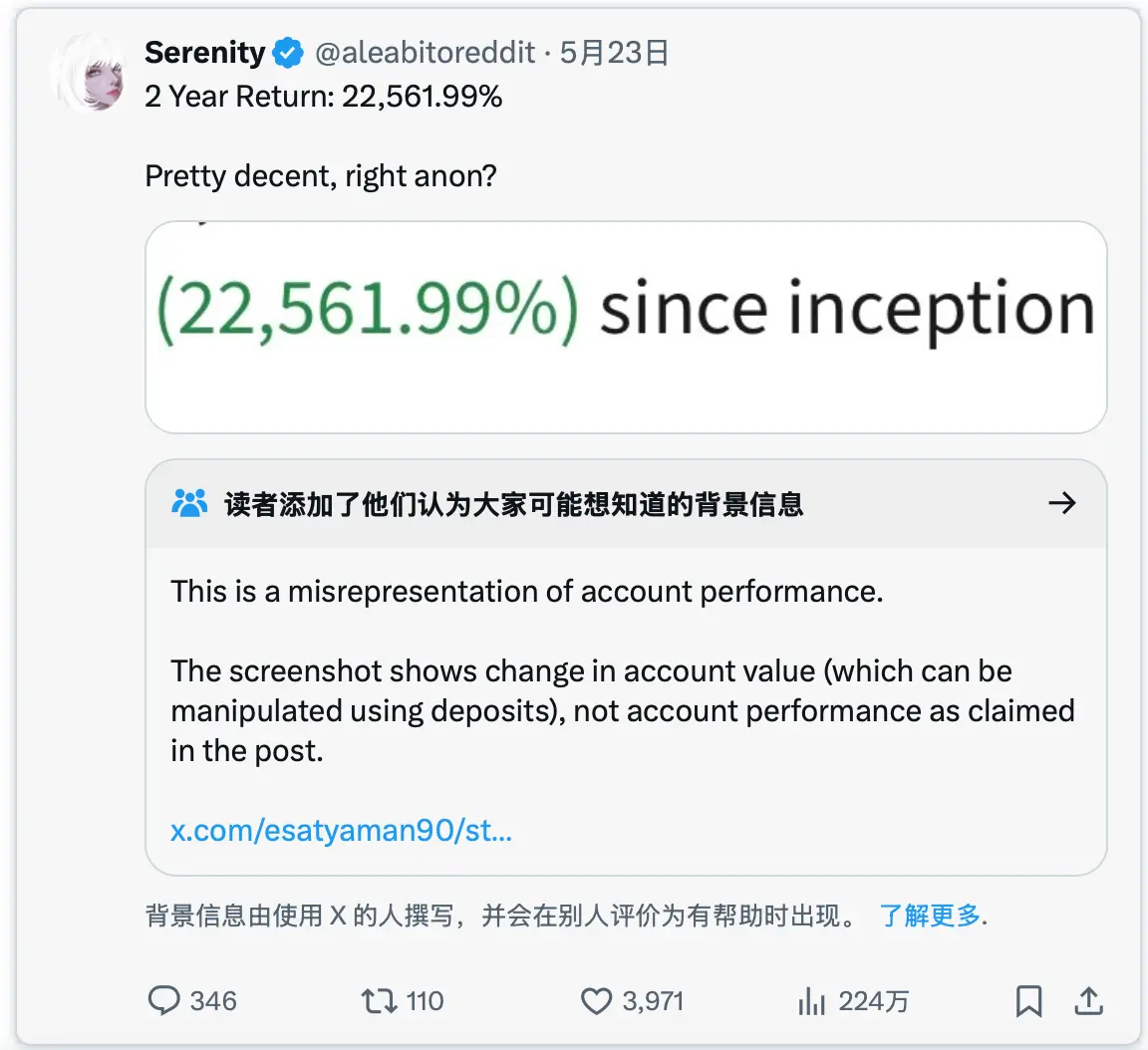
Aformer trader permanently banned by Reddit's WallStreetBets (WSB), he switched platforms, adopted an anime female avatar, and amassed over 300,000 followers in less than a year. One of his tweets can cause a FTSE 250 constituent stock to surge nearly 90% in two days, his research is cited by Bloomberg and Reuters, and some hedge funds engage in his copytrade.

The market marvels at his reported 22,561.99% return over the past two years, or questions his unverifiable background: "former AI research scientist," "Nature paper author," "RISC-V Foundation member," even claiming to have declined an offer to lead Nvidia's AI team around 2018 when its stock price was about $6.
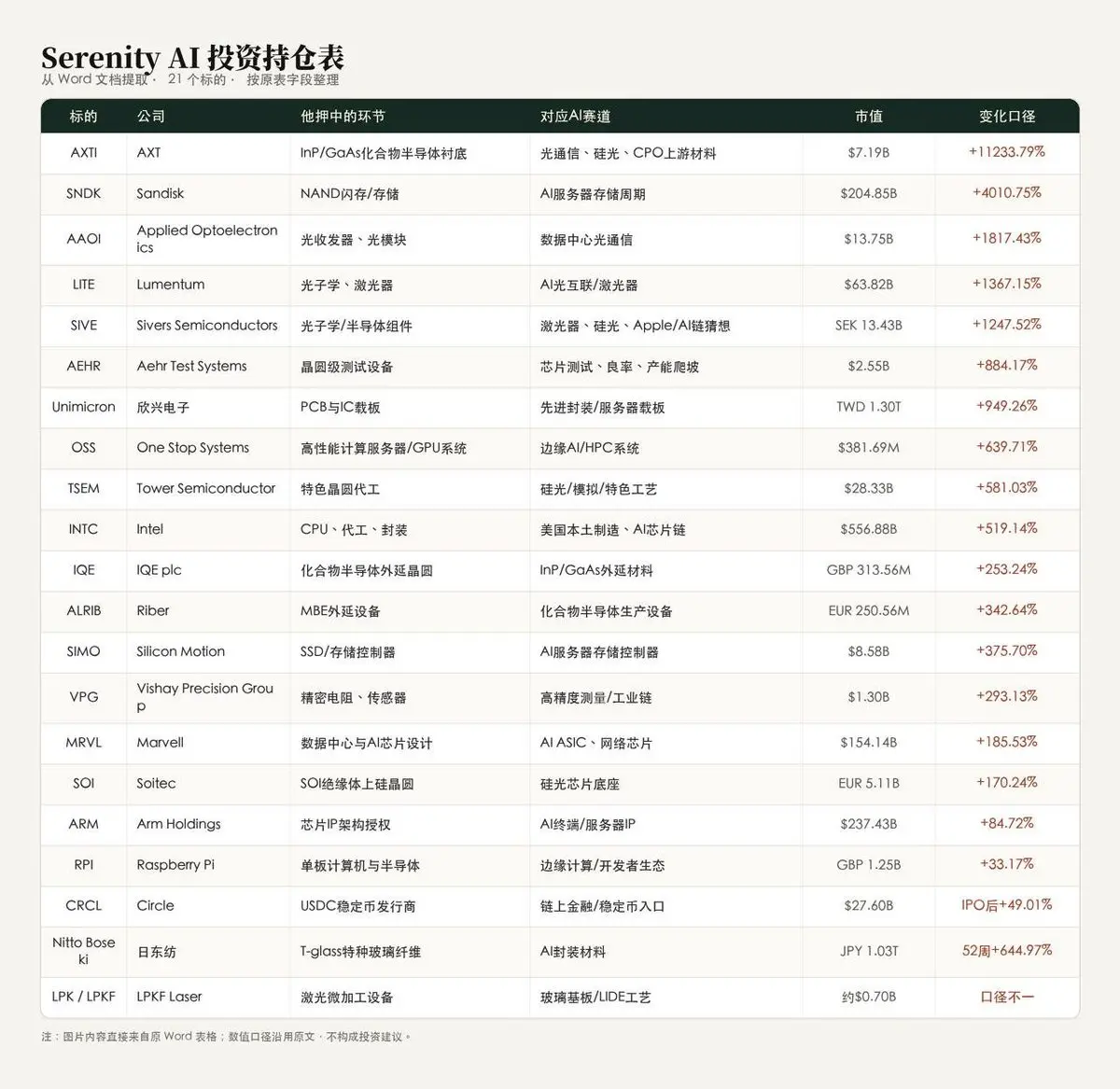
Serenity's AI Portfolio

But what truly matters isn't those dazzling numbers, nor whether he actually published in Nature.

What truly matters is this: He provides a paradigm for reverse engineering the AI era and executes violent arbitrage on information asymmetry within Wall Street's institutional blind spots.

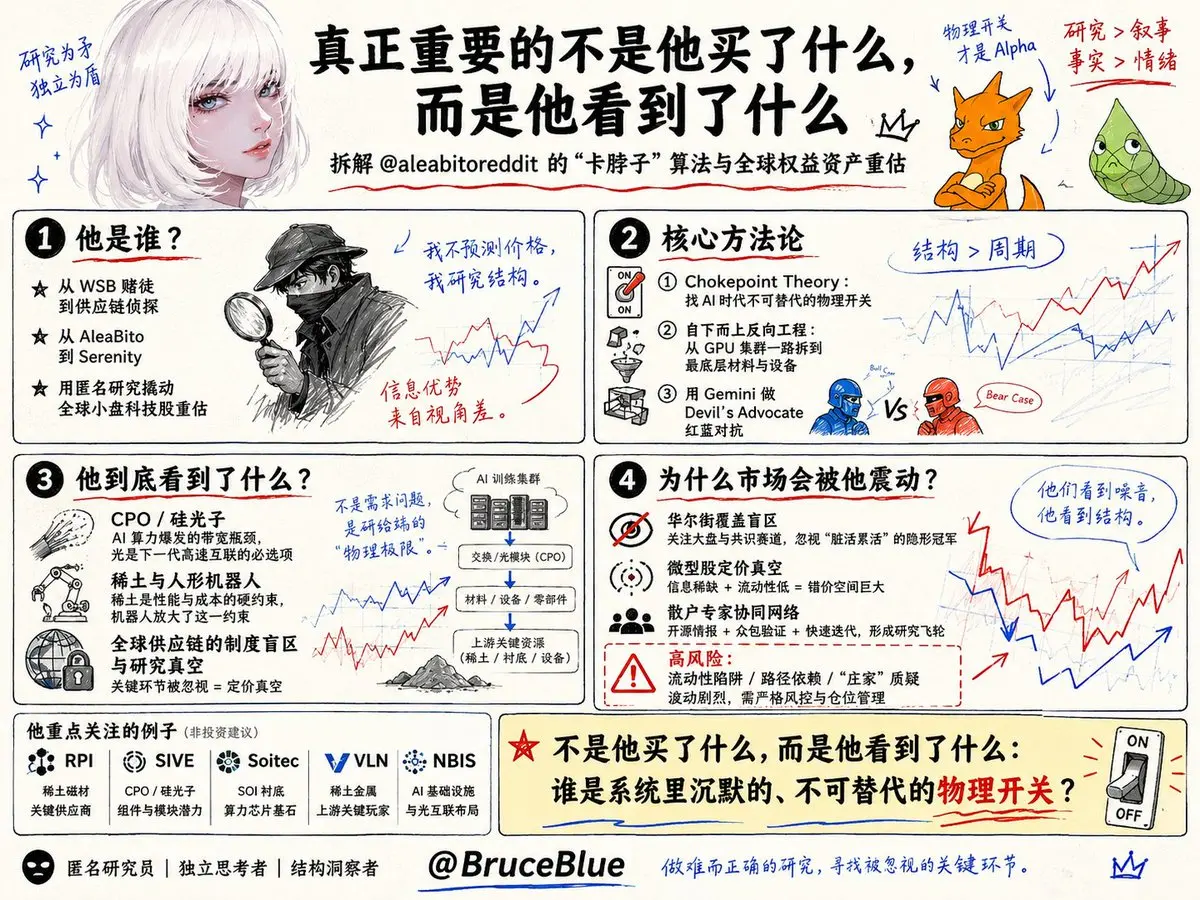
The core of this paradigm is what he calls Chokepoint Theory (Supply Chain Bottleneck Theory).

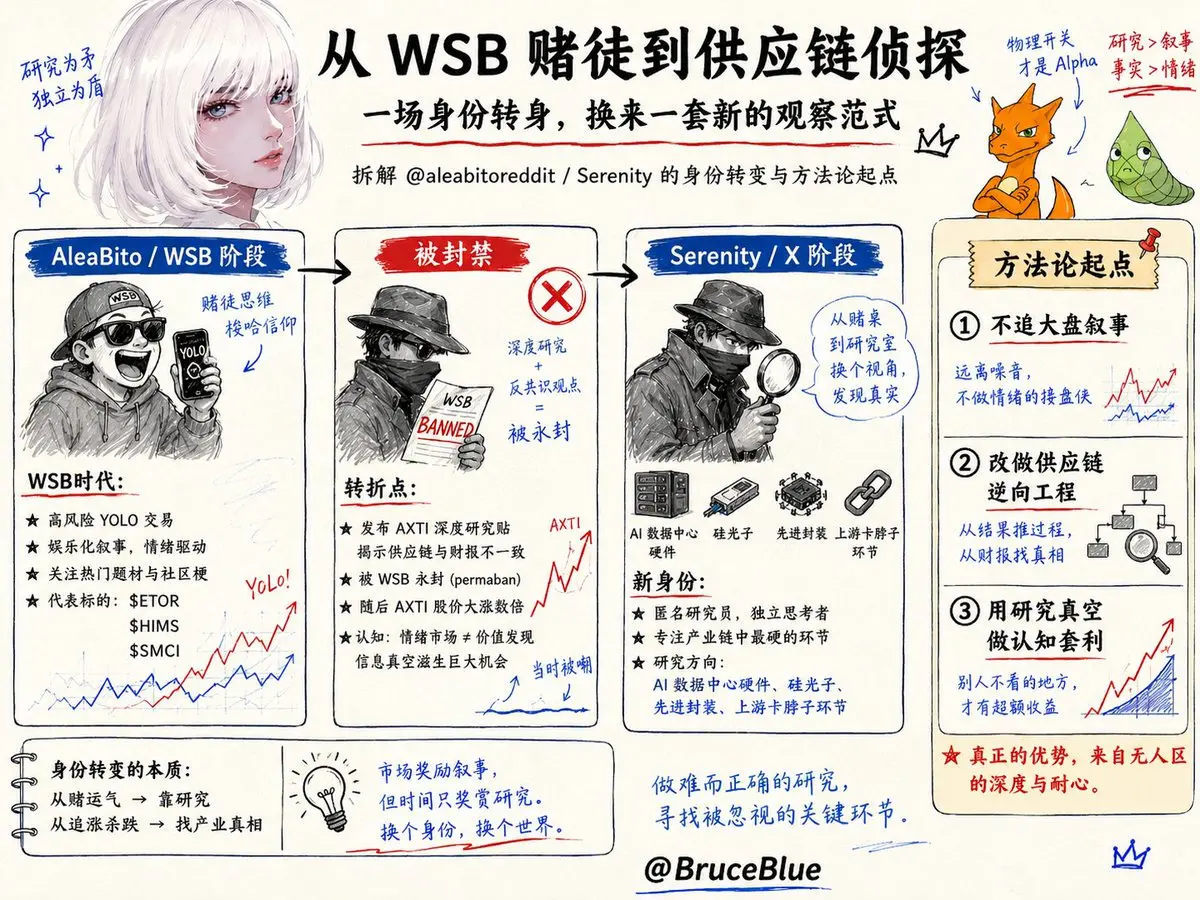
From WSB Gambler to Supply Chain Detective: An Identity Transformation

First, some background. His story began in early 2022 on the famous retail trader subreddit r/wallstreetbets (WSB).

The account then was named AleaBito, bearing the distinct colors of a WSB retail trader, keen on high-leverage, high-risk, and highly entertaining options and IPO plays. He once made a $175,000 single-sided options "YOLO" trade during the eToro ($ETOR) IPO based on the mock logic that its technical chart resembled "Bluefin Tuna Toro." In trading Hims & Hers Health $HIMS, he allocated a $100,000 position based on the "Gym Bro Formation." He also accurately predicted Super Micro Computer $SMCI would break $120 when its stock was near lows, based on developments in liquid cooling technology.

┌────────────────────────────────────────────────────────────────────────┐

│ @aleabitoreddit / Serenity's Evolution Path

├────────────────────────────────────────────────────────────────────────┤

│ Reddit Stage (Pre-2022) : AleaBito

│ Style: Hardcore financial analysis combined with highly entertaining "WSB retail" narrative, preference for high-risk "YOLO"

│ Feats:$ETOR (Tuna Toro), $HIMS (Gym Bro), $SMCI (Low-point prediction of $120 breakout)

│ X Platform Stage (2022-Present) : Serenity

│ Style: Focus on AI data center hardware, silicon photonics, advanced packaging; "bottom-up" supply chain reverse engineering

│ Feats:$RPI, $SIVE, Soitec, $VLN, $NBIS

└────────────────────────────────────────────────────────────────────────┘

The turning point occurred in early 2022. He posted a deep fundamental research report on AXT, Inc. $AXTI, a compound semiconductor substrate manufacturer, on WSB. At the time, $AXTI had a market cap of just $200 million, with a stock price around $12. The report's professional nature clashed with the forum's speculative atmosphere, leading moderators to permanently ban the account on grounds of "deliberate influence" and "pump-and-dump."

Subsequently, $AXTI soared to $70 driven by surging demand for compound semiconductors and optoelectronic substrates, resulting in over 1000% paper gains, becoming the researcher's "defining battle." This ban directly prompted the migration to X, and after renaming to "Serenity," the investment focus was completely locked onto "choke point" segments of semiconductor core hardware and the precision supply chain.
Core Framework: Finding the "Strait of Hormuz" of the AI Era

The vast majority of Wall Street sell-side institutions look at AI from a top-down perspective. They stare at Nvidia, Microsoft, Google, calculating guidance for trillion-dollar Capex, engaging in fierce mathematical modeling games around next quarter's revenue.

Serenity's perspective is bottom-up. He employs a supply chain reverse engineering model.

Using Nvidia's H100, B200, and other GPU supercomputing clusters as the physical origin, he deconstructs layer by layer downwards until uncovering ultra-micro components or raw materials at the physical level that are irreplaceable and monopolized by one or a very few companies. These extremely niche segments operate silently outside the spotlight of trillion-dollar market caps. Yet, if a supply disruption occurs, the entire downstream AI industry cluster faces physical paralysis.

He calls these nodes "Choke Points," likening them to the Strait of Hormuz controlling global oil passageways, or the indispensable yet unnoticed shiso leaf in high-end Ginza kaiseki cuisine.

  • Integration of Physical and Geographic Coordinate Maps

Serenity constructs a precise global semiconductor choke point physical and geopolitical map. This map spans US, Taiwanese, European, and Japanese stocks, integrating the geographic coordinates of production facilities, technical patent barriers, geopolitical risks, and national export control policies for each niche giant in the supply chain. When new geopolitical conflicts, export bans, or earnings reports emerge, he can quickly locate specific physical nodes on the supply chain map and execute high-conviction directional bets using his concentrated stock positions.

  • Adversarial AI Argumentation Testing

Before formally publishing any investment hypothesis, Serenity has a unique "red team/blue team" argumentation process. He inputs research drafts into different large language models, commanding the AI to play the role of an extremely demanding "Devil's Advocate," specifically picking out flaws, technical physical limitations, alternative threats, and potential valuation biases in his investment logic. Only after passing multiple rounds of technical and logical interrogation by AI does he publicly release the report.

The Physical Barriers of Silicon Photonics and Co-Packaged Optics (CPO)

Within Serenity's supply chain map, the physical evolution of data center AI computing power infrastructure is his core investment theme.
As large language model parameters grow exponentially, the interconnection of ten-thousand, hundred-thousand, or even million-card GPU clusters becomes the physical bottleneck for computing power scaling. At extremely high data throughput rates, traditional copper interconnects face insurmountable physical limits: high-frequency electrical signals in copper suffer from high attenuation, uncontrollable electromagnetic interference, and high power consumption and heat dissipation burdens.

To break this "copper wall," the process of converting electrical signals to optical signals for high-bandwidth, low-latency transmission—"optics in, copper out"—has become an inevitable path in AI infrastructure construction. The forefront of this physical layer revolution is the "Co-Packaged Optics" (CPO) architecture led by giants like TSMC and Nvidia.

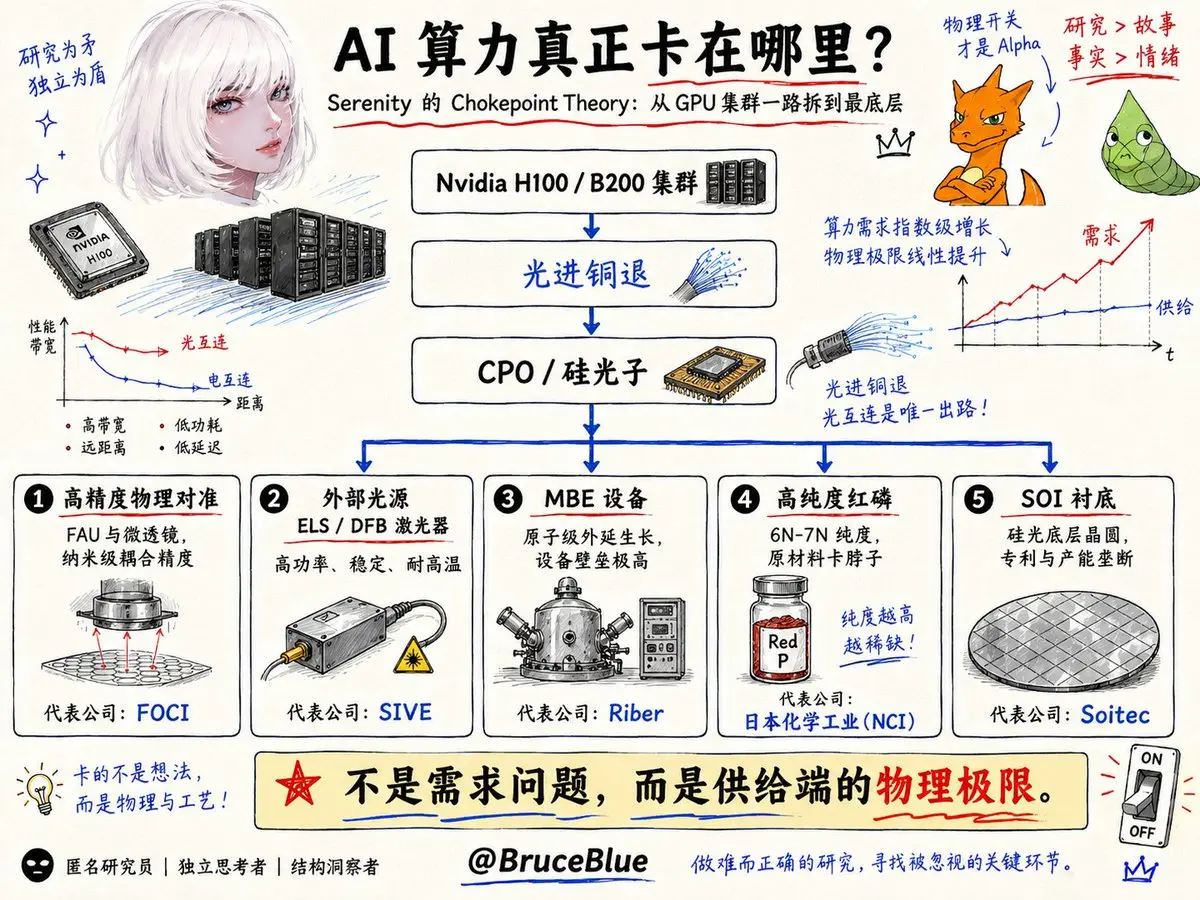
The core idea of CPO is integrating the electro-optical conversion chip directly with the core computing chip on the same multi-chip packaging substrate, shortening the electrical signal transmission distance within the package to the millimeter level. Serenity focuses on five major "choke point" technical and physical barriers in this revolutionary architecture:

Serenity's CPO (Co-Packaged Optics) Reverse Engineering Diagram:

Nvidia H100/B200 Clusters (10k-card interconnection demand)

Optics in, Copper out (Breaking copper cable physical limits: attenuation, power, heat)

┌────────────────────────────────────────────────────────────────────────┐

│ Five Physical Barriers of Silicon Photonics & CPO (Choke Points)

│ 1. High-precision Physical Alignment: Fiber Array Unit (FAU) & Micro-lenses

│ → $FOCI (Browave, Taiwan): Indispensable physical choke point status

│ 2. External Light Source (ELS) & High-Power Continuous Wave (CW) DFB Laser

│ → $SIVE (Sivers, Sweden): Extremely scarce physical asset for 1.6T LRO/CPO

│ 3. Molecular Beam Epitaxy (MBE) Equipment Barrier

│ → $ALRIB (Riber, France): Global monopolist, "choking the capacity neck" of epitaxy vendors

│ 4. High-Purity Red Phosphorus Raw Material (Purity 6N-7N, i.e., 99.9999%+)

│ → NCI (Nippon Chemical Industrial, Japan): Monopolized by very few specialty chemical giants

│ 5. Underlying Wafer: Silicon-on-Insulator (SOI) Substrate Material

│ → Soitec (France): Smart-Cut patent, absolute global technology and capacity monopolist

└────────────────────────────────────────────────────────────────────────┘

  • High-precision Physical Alignment Barrier

Since the optical waveguide dimensions inside silicon photonic chips are typically sub-micron, this requires nano-level physical alignment between the external fiber and the waveguide. Any tiny misalignment leads to severe "optical coupling loss." Serenity was the first in the English-speaking world to systematically anchor Browave (FOCI, 3363.TW), a stock highly focused on by Taiwanese retail investors, to the evolution of global CPO technology.

  • External Light Source (ELS) and High-Power Continuous Wave DFB Laser Barrier

Silicon, as an indirect bandgap semiconductor, cannot achieve efficient light emission under electrical injection. CPO architecture must rely on independent external light sources to provide high-power continuous wave laser. This laser must maintain single longitudinal mode operation in the high-temperature, high-pressure data center environment, with extremely high process requirements. Sweden-listed Sivers Semiconductors $SIVE, due to possessing relevant technology, becomes an extremely scarce physical asset in the CPO external light source supply chain.

  • Molecular Beam Epitaxy (MBE) Equipment Barrier

In the growth of epitaxial wafers for high-power lasers and other compound semiconductors, the core physical process is Molecular Beam Epitaxy (MBE), which allows for atomic-level precision growth of ultra-thin crystalline films. Serenity pinpointed the absolute monopolist of global MBE equipment: French listed company Riber $ALRIB.

  • High-Purity Red Phosphorus Raw Material Barrier

Compound semiconductor (e.g., indium phosphide substrate) manufacturing requires extremely stringent raw material purity. Serenity's reverse engineering leads to the most fundamental chemical element: high-purity red phosphorus (purity 99.9999%+). Capacity is almost entirely monopolized by a very few Japanese giants like Nippon Chemical Industrial Co., Ltd. (NCI). If supply is disrupted, downstream production halts entirely.

  • Silicon-on-Insulator (SOI) Substrate Material Barrier

Silicon photonic chips require SOI wafers as the underlying substrate. French company Soitec, with its exclusively invented Smart-Cut technology, holds absolute global technology and capacity monopoly in the silicon photonics SOI wafer market; even a giant like Japan's Shin-Etsu Chemical must pay it patent licensing fees.

The Geopolitical Game of "Physical Switches" in Humanoid Robots and Rare Earth Resources

In 2026, Serenity further horizontally expanded his "choke point" map to the geopolitical game involving humanoid robots and rare earth elements.

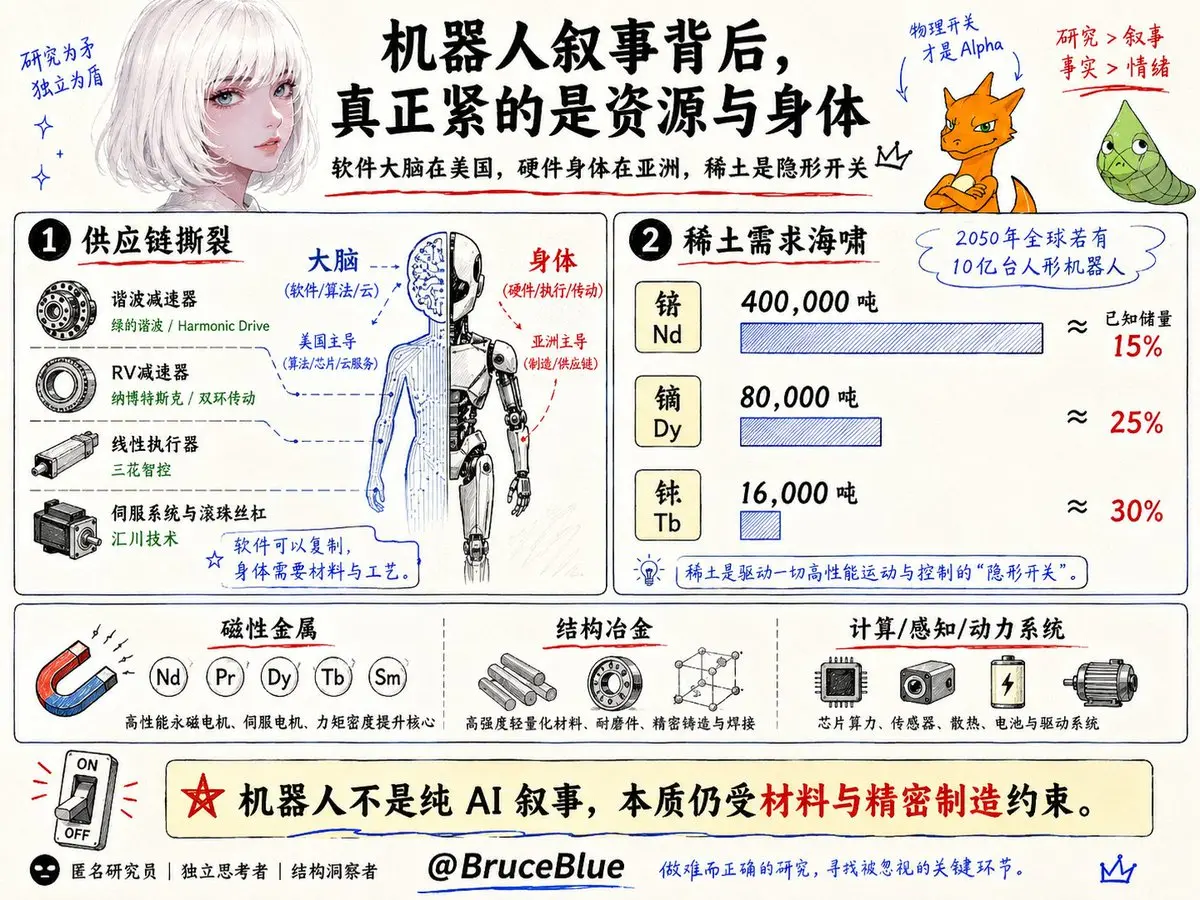
  • Supply Chain Tearing Between Software "Brain" and Hardware "Body"

Most market discussions about Tesla Optimus focus on AI algorithms and large models, overlooking a fatal physical reality: the US is losing the hardware and material manufacturing race for humanoid robots.

The humanoid robot's "brain" remains in the US, but the "body" components responsible for movement (joints, actuators, reducers, etc.) are almost entirely in the hands of Asian manufacturers:

  • Harmonic Reducers: Leader Harmonious Drive Systems (China), Harmonic Drive (Japan)

  • RV Reducers: Nabtesco (Japan), Sihuan Transmission (China)

  • Linear Actuators: Sanhua Intelligent Controls (China)

  • Servo Systems & Ball Screws: Inovance Technology (China)

To reduce costs, US robotics companies have already signed long-term contracts with these Chinese and Japanese component giants. This high dependence means that hardware supply chains face physical shutdown if geopolitical friction occurs.

  • Rare Earth "Demand Tsunami" and the Morgan Stanley Model

Serenity cites Morgan Stanley's demand forecasting model for quantitative extrapolation: if global humanoid robot stock reaches 1 billion units by 2050, its consumption of core rare earth resources will cause a catastrophic "demand tsunami":

  • Neodymium (Nd): Cumulative consumption ~400,000 tons (15% of global known reserves)

  • Dysprosium (Dy): Cumulative consumption ~80,000 tons (25% of global known reserves)

  • Terbium (Tb): Cumulative consumption ~16,000 tons (30% of global known reserves)

These are physical necessities for maintaining permanent magnet motor demagnetization resistance at high temperatures. Serenity emphasizes that if Western capital wants to ensure supply chain security, it must direct tens of billions in heavy capital towards rebuilding a local rare earth refining ecosystem.

Based on this, he lists three physical sectors that must be closely monitored:

  • Magnetic Metals: Light rare earths (Nd, Pr), heavy rare earths (Dy, Tb), specialty magnets (Sm, Co).

  • Structural Metallurgy: Precision gear materials (Ti, V, Mo), high-strength steel additives (Nb, Cr, Ni, Mn), wear-resistant elements (Ce, La).

  • Computing, Perception & Power Systems: Advanced semiconductors (Ga, Ge), batteries & wiring (each unit consumes 2kg Li, 3kg graphite, 6.5kg Cu).
Core Case Studies and Empirical Performance Evaluation

Through keen capture of technical barriers and commercialization inflection points, Serenity has successfully unearthed and led the value revaluation of multiple classic small-to-mid cap technology stocks across different global capital markets.
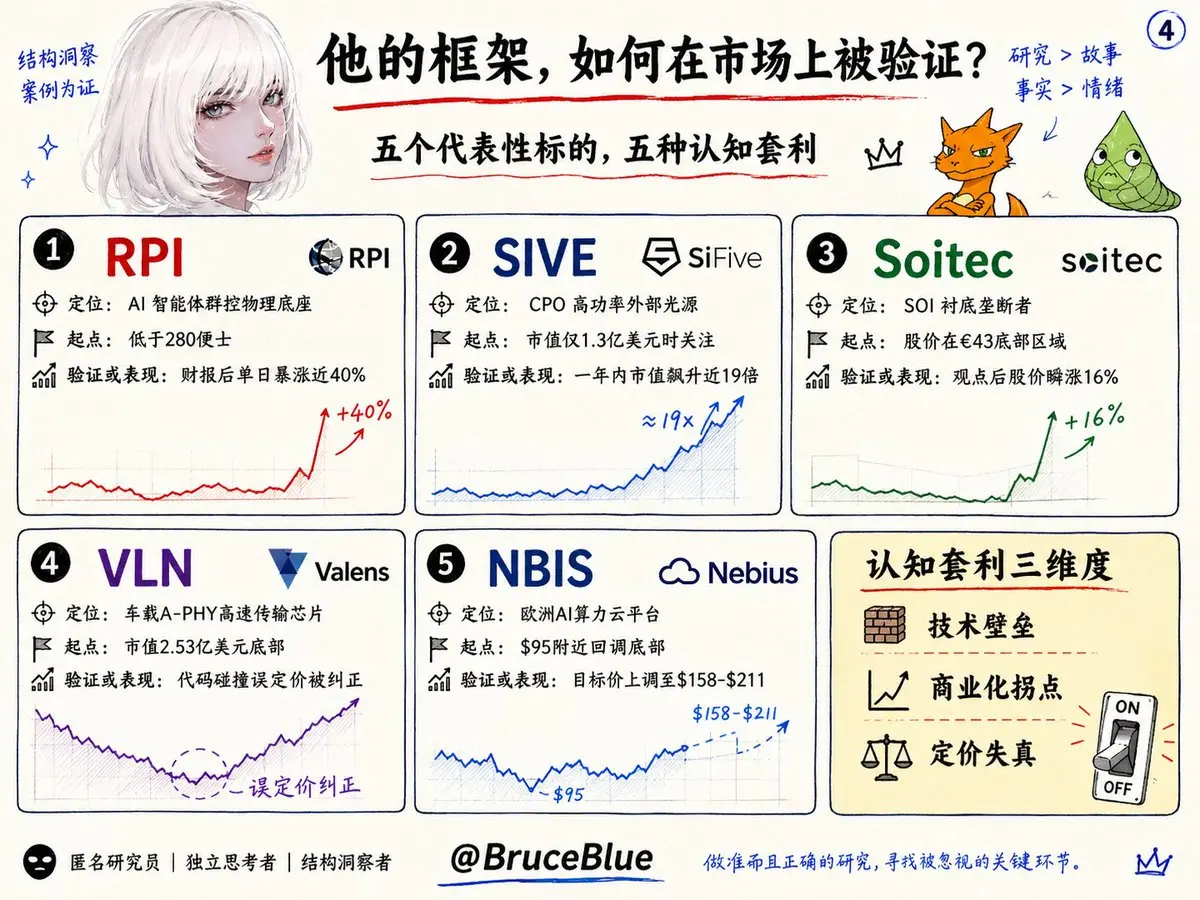
┌────────────────────────────────────────────────────────────────────────┐

│ Serenity Core Investment Picks & Empirical Performance Validation

├────────────────────────────────────────────────────────────────────────┤

│ $RPI (Raspberry Pi) | LSE UK

│ Positioning: Physical base for AI agent swarm control

│ Starting Point: Price below 280 pence (IPO price)

│ Validation: March 2026 annual report disclosed strong profit growth, chip unit sales up 47%, confirming its role as AI base logic

│ Performance: Single-day surge of nearly 40% on earnings, rebounded over 60% from lows

│ $SIVE (Sivers) | Stockholm Sweden

│ Positioning: Core supplier of high-power external light source DFB lasers for silicon photonics CPO

│ Starting Point: Market cap only $130 million when recommended

│ Validation: Secured strategic cooperation with Jabil, received $6.6M support from US CHIPS Act

│ Performance: Market cap soared nearly 19x within a year after recommendation (now over $2.3B)

│ Soitec | Euronext Paris France

│ Positioning: Global patent and capacity absolute monopolist for key silicon photonics SOI substrate material

│ Starting Point: Stock price in bottom area around €43

│ Validation: Listed as a Class 1 exclusive material standard by TSMC and Nvidia

│ Performance: European market stock price instantly surged 16% the day his view was published

│ $VLN (Valens) | NYSE USA

│ Positioning: Automotive A-PHY high-speed transmission chips

│ Starting Point: Market cap $253 million bottom (recommended with $93.5M net cash, zero debt, ~60-62% gross margin guidance)

│ Validation: Pointed out mispricing due to code collision error in scanners

│ Performance: Guided market's mine-sweeping revaluation of this asset by pointing out the "code collision" bug

│ $NBIS (Nebius Group) | NASDAQ USA

│ Positioning: Europe's largest AI GPU/Rubin computing cluster cloud service provider

│ Starting Point: Pullback bottom area around $95

│ Validation: Holding $3.7B net cash (end-2025), backlog of unexecuted contracts nearing $50B

│ Performance: Back on high-growth trajectory, analyst target price raised to $158-$211

└────────────────────────────────────────────────────────────────────────┘

Deep Analysis: Three Dimensions of Cognitive Arbitrage

  • Raspberry Pi$RPI : Relative Value Game Model

When the market viewed Raspberry Pi as a declining educational component maker, Serenity captured a dramatic shift in the AI developer ecosystem: numerous startups rushed to buy Raspberry Pis as physically isolated bases for deploying "AI agent swarm control systems." If buying Apple Mac Minis, such hoarding would be negligible in Apple's $3.7 trillion market cap; but for Raspberry Pi with a market cap of just £500 million, this is a transformative boost.

  • Valens Semiconductor$VLN : Information Arbitrage on Quantitative Code Collision

$VLN had $93.5 million net cash on the books, zero debt, ~60-62% gross margin guidance, secured Mercedes front-end design wins, yet its market cap was only $253 million. Serenity discovered a physical bug: mainstream global quantitative stock screeners had a "ticker code collision error," confusing data for $VLN with energy stock $VLO on the Toronto Exchange, causing key metrics to be severely distorted. He precisely listed the deviations, guiding funds to a "mine-sweeping" revaluation.

  • Nebius Group$NBIS : Deep Bottom Capture Amid Mechanical Panic

As a leading European AI-dedicated cloud service provider, $NBIS saw its stock price plummet to $95 due to mechanical hedging pressure from early-stage complex convertible bond share conversions. Serenity pointed out this was "mechanical panic from non-fundamental factors." At $95, the market gave this company, with 2026 revenue guidance of $30-34 billion (nearly 6x growth) and holding billions in net cash, an utterly absurd discount.

Retail Capital Synergy and Potential Structural Risks

  • Expert Retailer Synergy Network

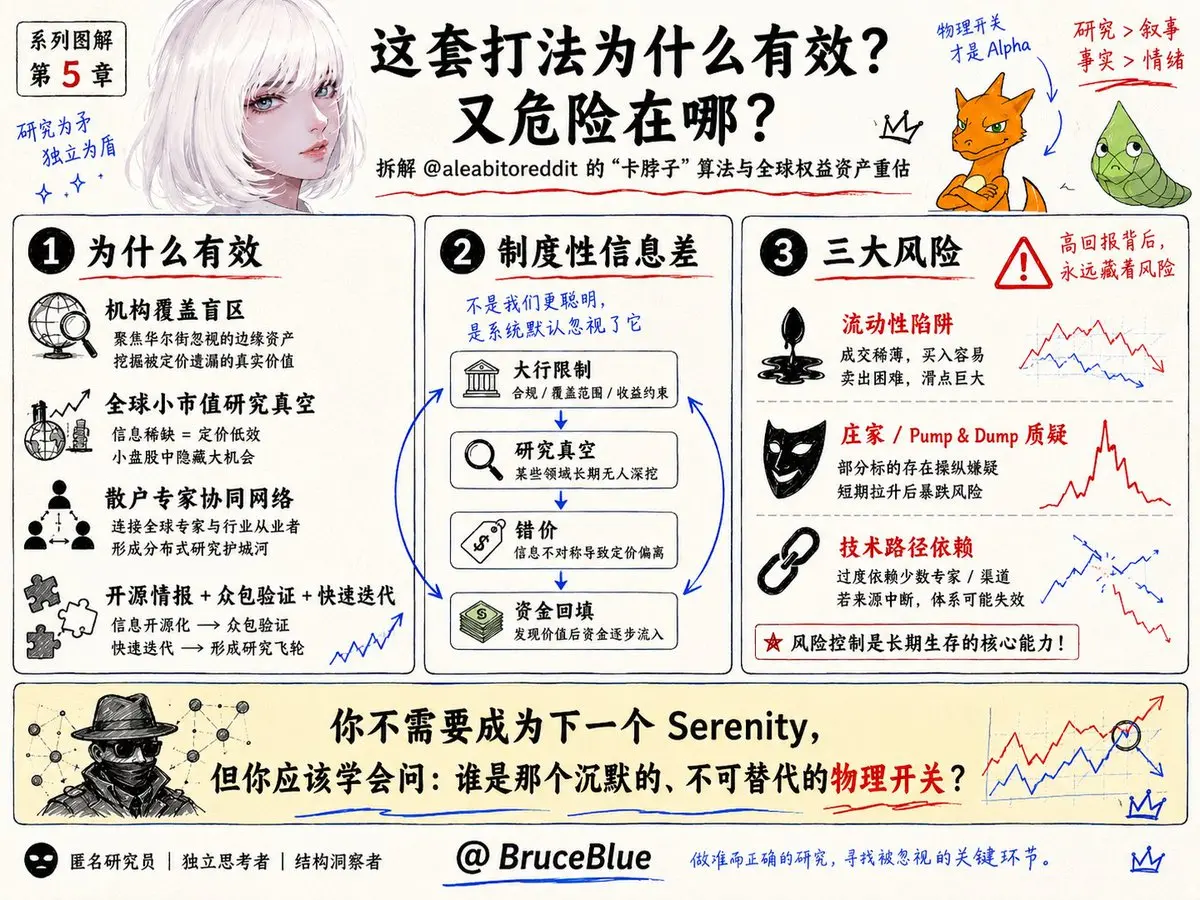
In Serenity's framework, retail traders are no longer mere "dumb money" providing liquidity or blindly following trends but are reshaped into an "Expert Retailer Synergy Network." Traditional WSB relies on short-term options gamma squeezes or emotional memes to drive surges. In contrast, Serenity's completely free, technically high-threshold hardcore analysis subjects followers to a deep "intellectual filtration."

This highly specialized capital synergy enables them to rapidly form combined force in multiple extremely illiquid, remote micro-cap markets that Wall Street banks cannot cover, completing pricing dominance over core assets.

  • Institutional Blind Spots and Information Arbitrage

Analysts at large institutions are constrained by internal compliance, minimum market cap thresholds (e.g., not covering below $1B), and regional specialization (US equity analysts don't write on Sweden or Taiwan). This creates huge research vacuums in the global supply chain. As a completely anonymous independent researcher, Serenity ignores market cap and geographic barriers, directly guiding global long capital to violently refill these vacuums.

  • Structural Risks and Potential Game Dilemmas

However, blindly following this strategy comes with unavoidable fatal risks:

  • Liquidity Traps and Stampede Risk: Micro-cap stocks have extremely low daily trading volume. They surge instantly when the retail synergy rushes in; once technology implementation falls short of expectations, the extremely narrow exit channel leads to severe stampedes.

  • Polarized Public Opinion and "Market Manipulator" Allegations: Veteran shorts sharply criticize it as essentially a "pump and dump with high-IQ academic packaging." Its game characteristics of using massive public voice to attract retail to lift the price keep it long exposed to the shadow of compliance allegations.

  • "Fatal Minefield" of Physical Technology Single-Path Dependency: All of Serenity's core positions are built on the assumptions that "CPO is the only physical evolution path" and "humanoid robots will see a billion-unit explosion." This is a high-stakes gamble. If Nvidia finds CPO has insurmountable engineering dead ends and shifts to advanced thin-film copper cables, or if the West fails to rebuild rare earth separation chains, his entire supply chain empire built on silicon photonics, SOI, MBE equipment, and heavy rare earths could be physically dismantled in an instant.

Conclusion: Using Geek Depth to Beat Financial Breadth

Following Serenity isn't about getting a get-rich-quick stock ticker, but about acquiring an analytical framework that breaks consensus.

In this era of information overload, the most common mistake retail investors make is trying to compete with institutions on the speed of information acquisition or trading macro data that's already fully priced. Serenity demonstrates another possibility: using reverse engineering to deconstruct systems, using AI as a "Devil's Advocate" to challenge one's own logic, to find the truly controlling, silent gears of system operation.

You don't need to be the next Serenity. You don't need to buy any stock he buys.

But you should learn to ask a question like he does:

In this system, who is the silent, irreplaceable physical switch?

If you can answer that question, you already have one more perspective than 99% of market participants. The rest is just waiting for the market to catch up to your cognition.

Disclaimer:

This article does not constitute any investment advice.

All background information about Serenity himself is self-reported and unverified by third parties.

His past performance is not indicative of future results.

Conduct independent research before making any investment decisions.

NFA. DYOR.

Perguntas relacionadas

QWhat is the core investment framework that researcher Serenity uses to identify opportunities in the AI era, as described in the article?

ASerenity's core framework is the 'Chokepoint Theory' or '供应链瓶颈理论' (Supply Chain Bottleneck Theory). It involves a bottom-up, supply chain reverse engineering approach to identify critical, non-replaceable physical components or raw materials (the 'choke points') that are monopolized by a few companies. If these points are disrupted, the entire downstream AI industry cluster faces physical paralysis.

QAccording to the article, what is a unique step in Serenity's research process before publishing an investment thesis?

ABefore publishing any investment hypothesis, Serenity subjects his research drafts to a unique 'red-blue team' adversarial AI argumentation test. He inputs the drafts into different large language models, commanding the AI to act as a highly critical 'Devil's Advocate' to identify logical flaws, technical physical limitations, threats from alternative solutions, and potential valuation biases. He only publishes the report after it withstands multiple rounds of this AI-driven technical and logical cross-examination.

QWhat are the five major physical barriers (or 'choke points') identified in the Silicon Photonics and Co-Packaged Optics (CPO) supply chain?

AThe five major physical barriers in the Silicon Photonics and CPO supply chain are: 1. High-precision physical alignment (e.g., Fiber Array Units, micro-lenses, represented by FOCI), 2. External Light Source (ELS) and high-power Continuous Wave DFB lasers (represented by Sivers Semiconductors, $SIVE), 3. Molecular Beam Epitaxy (MBE) equipment barrier (represented by Riber, $ALRIB), 4. High-purity red phosphorus raw material (99.9999%+ purity, monopolized by Japanese chemical giants like NCI), and 5. Underlying Silicon-On-Insulator (SOI) wafer substrate material (dominated by Soitec with its Smart-Cut patent).

QWhat key risk does the article highlight regarding the humanoid robot supply chain for the United States?

AThe article highlights that the United States is at risk of losing the hardware and materials manufacturing race for humanoid robots. While the AI 'brain' (software and algorithms) remains in the US, critical 'body' components like joints, actuators, and reducers are almost entirely controlled by Asian manufacturers (e.g., Harmonic Drive in Japan,绿的谐波 in China, Nabtesco in Japan). This creates a dangerous dependency, meaning any geopolitical friction could lead to a physical shutdown of the hardware supply chain for US robot companies.

QWhat are some of the structural risks associated with following Serenity's investment strategy, as mentioned in the conclusion?

AKey structural risks include: 1. Liquidity traps and stampede risk in micro-cap stocks with low daily trading volumes, 2. Intense polarization of public opinion and accusations of being a sophisticated 'pump and dump' scheme, 3. Fatal reliance on a single physical technology path. If the foundational assumptions fail (e.g., if CPO faces insurmountable engineering hurdles or if the predicted mass adoption of humanoid robots doesn't materialize), the entire investment thesis built on related supply chains (silicon photonics, SOI, MBE, rare earths) could collapse physically and financially.

Leituras Relacionadas

A Trillion-Dollar Frenzy for Memory Sellers, Halved Profits for Memory Buyers

Summary: A stark divide has emerged in the tech industry. While memory chipmaker Micron's stock soared 19% in a single day, pushing its market cap over $1 trillion, smartphone manufacturer Xiaomi reported a 43% plunge in adjusted net profit. The core driver is a severe supply crunch in memory chips, particularly for AI applications. Wall Street analysts, led by UBS and its unprecedented 204% target price hike for Micron, argue that long-term agreements (LTAs) from AI cloud giants are fundamentally ending the sector's notorious boom-and-bust cycles, justifying a re-rating from cyclical to infrastructure-like valuations. However, the "storage" market is now fragmented into three tiers. The first, AI-grade memory like HBM and server DDR5, faces extreme shortages and soaring prices driven by massive cloud capex. The second, mobile memory for smartphones, is also seeing sharp price hikes as manufacturers like Xiaomi are forced to pay more for remaining capacity, severely squeezing their margins. The third, PC retail channels, shows price declines due to existing inventory. The article questions the sustainability of the "supercycle" narrative. It highlights that Micron's revenue surge is driven almost entirely by price increases, not shipment volumes, making it vulnerable to a potential demand slowdown. While LTAs may dampen volatility, history suggests they are often tested during downturns. The current peak earnings, used to justify high valuations, represent a classic cyclical top. The piece concludes with a note of caution: when the entire Street chants "this time is different," it's wise to remember past bubbles, even as it acknowledges AI demand may indeed be structural.

marsbitHá 12m

A Trillion-Dollar Frenzy for Memory Sellers, Halved Profits for Memory Buyers

marsbitHá 12m

This New Generation of US Stock Trading Gods No Longer Read Financial Reports

The new generation of "stock gods" in the 2026 US AI bull market are not analyzing traditional financial reports. Instead of focusing on giants like NVIDIA, figures like the 22-year-old Leopold Aschenbrenner (who reportedly turned $200M into $14B) and influencers like Serenity on platforms like Reddit's WallStreetBets, X, and Substack are gaining fame and returns by targeting obscure, low-cap "micro-cap" stocks. Their strategy, dubbed "supply chain sniping," involves identifying critical, often monopolistic, bottlenecks in the AI hardware supply chain—such as specific materials or components essential for giants like Google and NVIDIA—that are missed by mainstream Wall Street analysts. Serenity's call on AXTI, a $700M company supplying indium phosphide substrates crucial for photonics and optical interconnects, saw the stock soar from ~$12 to nearly $150. Similarly, accounts like KawzInvests and PhotonCap focus on thematic, supply-chain-driven research in areas like AI infrastructure, optics, and cloud services for SMEs, bypassing traditional valuation metrics. This shift represents a cultural move away from Warren Buffett-style value investing based on deep financial statement analysis. The new approach thrives on low liquidity, early narratives, and strong community propagation on social media, similar to meme stocks or crypto. However, this "attention economy" strategy carries risks: it depends on sustained information gaps, the underlying companies' ability to deliver fundamental results, and the potential for crowded, volatile exits as narratives shift. The trend also shows crypto traders applying their narrative-sensing skills to US micro-caps, marking a significant evolution in trading culture.

marsbitHá 14m

This New Generation of US Stock Trading Gods No Longer Read Financial Reports

marsbitHá 14m

Trillion-Dollar Euphoria for Memory Sellers, Halved Profits for Memory Buyers

Title: The Trillion-Dollar Memory Seller's Carnival vs. The Buyer's Halved Profits On May 26, a stark contrast unfolded. While memory chipmaker Micron's market cap surged past $1 trillion, smartphone maker Xiaomi reported plummeting profits. Xiaomi's Q1 2026 profits fell 43% year-on-year. Executive Lu Weibing cited memory prices quadrupling from last year, adding roughly $210 to a phone's cost. To survive, Xiaomi is cutting entry-level models, sacrificing volume. Micron's stock, however, skyrocketed over 19% in a day, capping an 8x gain in a year. Major banks like UBS and JPMorgan issued bullish reports, raising price targets drastically. Their core thesis: Long-Term Agreements (LTAs) with AI cloud giants (Microsoft, Google, etc.) are eliminating the memory industry's notorious boom-bust cycle. By locking in fixed-price, multi-year contracts for AI-grade memory (HBM, server DDR5), these deals promise stable, utility-like earnings, justifying a higher valuation (20-30x P/E vs. the historical 8-15x). The article reveals a three-tiered memory market in 2026: 1) **AI Storage (HBM/DDR5/Enterprise SSD)**: Extreme shortage, soaring prices, LTAs. This is Micron's story. 2) **Mobile/Embedded Memory**: Also facing sharp price hikes as AI production crowds out capacity, severely pressuring phone makers like Xiaomi. 3) **PC Retail**: Some spot prices are falling due to channel inventory liquidation, creating a divergence from contract markets. The author questions if LTAs truly end the cycle. It hinges on sustained, hyper-growth AI demand. Micron's current profits are at a cycle peak, driven mostly by price hikes, not volume. If AI capital expenditure growth slows, the massive industry capacity expansion (e.g., Micron's $250B+ CapEx plan) could lead to a glut. Historically, using peak-cycle earnings for valuation is a classic trap. While the AI-driven structural shift might be real, the unanimous Wall Street euphoria warrants caution, echoing past bubbles like Cisco's in 2000. The memory seller's trillion-dollar狂欢 (carnival) continues, but the cycle's shadow remains.

链捕手Há 21m

Trillion-Dollar Euphoria for Memory Sellers, Halved Profits for Memory Buyers

链捕手Há 21m

Trading

Spot
Futuros

Artigos em Destaque

O que é $S$

Compreender o SPERO: Uma Visão Abrangente Introdução ao SPERO À medida que o panorama da inovação continua a evoluir, o surgimento de tecnologias web3 e projetos de criptomoeda desempenha um papel fundamental na formação do futuro digital. Um projeto que tem atraído atenção neste campo dinâmico é o SPERO, denotado como SPERO,$$s$. Este artigo tem como objetivo reunir e apresentar informações detalhadas sobre o SPERO, para ajudar entusiastas e investidores a compreender as suas bases, objetivos e inovações nos domínios web3 e cripto. O que é o SPERO,$$s$? O SPERO,$$s$ é um projeto único dentro do espaço cripto que procura aproveitar os princípios da descentralização e da tecnologia blockchain para criar um ecossistema que promove o envolvimento, a utilidade e a inclusão financeira. O projeto é concebido para facilitar interações peer-to-peer de novas maneiras, proporcionando aos utilizadores soluções e serviços financeiros inovadores. No seu núcleo, o SPERO,$$s$ visa capacitar indivíduos ao fornecer ferramentas e plataformas que melhoram a experiência do utilizador no espaço das criptomoedas. Isso inclui a possibilidade de métodos de transação mais flexíveis, a promoção de iniciativas impulsionadas pela comunidade e a criação de caminhos para oportunidades financeiras através de aplicações descentralizadas (dApps). A visão subjacente do SPERO,$$s$ gira em torno da inclusão, visando fechar lacunas dentro das finanças tradicionais enquanto aproveita os benefícios da tecnologia blockchain. Quem é o Criador do SPERO,$$s$? A identidade do criador do SPERO,$$s$ permanece algo obscura, uma vez que existem recursos publicamente disponíveis limitados que fornecem informações detalhadas sobre o(s) seu(s) fundador(es). Esta falta de transparência pode resultar do compromisso do projeto com a descentralização—uma ética que muitos projetos web3 partilham, priorizando contribuições coletivas em vez de reconhecimento individual. Ao centrar as discussões em torno da comunidade e dos seus objetivos coletivos, o SPERO,$$s$ incorpora a essência do empoderamento sem destacar indivíduos específicos. Assim, compreender a ética e a missão do SPERO é mais importante do que identificar um criador singular. Quem são os Investidores do SPERO,$$s$? O SPERO,$$s$ é apoiado por uma diversidade de investidores que vão desde capitalistas de risco a investidores-anjo dedicados a promover a inovação no setor cripto. O foco desses investidores geralmente alinha-se com a missão do SPERO—priorizando projetos que prometem avanço tecnológico social, inclusão financeira e governança descentralizada. Essas fundações de investidores estão tipicamente interessadas em projetos que não apenas oferecem produtos inovadores, mas que também contribuem positivamente para a comunidade blockchain e os seus ecossistemas. O apoio desses investidores reforça o SPERO,$$s$ como um concorrente notável no domínio em rápida evolução dos projetos cripto. Como Funciona o SPERO,$$s$? O SPERO,$$s$ emprega uma estrutura multifacetada que o distingue de projetos de criptomoeda convencionais. Aqui estão algumas das características-chave que sublinham a sua singularidade e inovação: Governança Descentralizada: O SPERO,$$s$ integra modelos de governança descentralizada, capacitando os utilizadores a participar ativamente nos processos de tomada de decisão sobre o futuro do projeto. Esta abordagem promove um sentido de propriedade e responsabilidade entre os membros da comunidade. Utilidade do Token: O SPERO,$$s$ utiliza o seu próprio token de criptomoeda, concebido para servir várias funções dentro do ecossistema. Esses tokens permitem transações, recompensas e a facilitação de serviços oferecidos na plataforma, melhorando o envolvimento e a utilidade gerais. Arquitetura em Camadas: A arquitetura técnica do SPERO,$$s$ suporta modularidade e escalabilidade, permitindo a integração contínua de funcionalidades e aplicações adicionais à medida que o projeto evolui. Esta adaptabilidade é fundamental para manter a relevância no panorama cripto em constante mudança. Envolvimento da Comunidade: O projeto enfatiza iniciativas impulsionadas pela comunidade, empregando mecanismos que incentivam a colaboração e o feedback. Ao nutrir uma comunidade forte, o SPERO,$$s$ pode melhor atender às necessidades dos utilizadores e adaptar-se às tendências do mercado. Foco na Inclusão: Ao oferecer taxas de transação baixas e interfaces amigáveis, o SPERO,$$s$ visa atrair uma base de utilizadores diversificada, incluindo indivíduos que anteriormente podem não ter participado no espaço cripto. Este compromisso com a inclusão alinha-se com a sua missão abrangente de empoderamento através da acessibilidade. Cronologia do SPERO,$$s$ Compreender a história de um projeto fornece insights cruciais sobre a sua trajetória de desenvolvimento e marcos. Abaixo está uma cronologia sugerida que mapeia eventos significativos na evolução do SPERO,$$s$: Fase de Conceituação e Ideação: As ideias iniciais que formam a base do SPERO,$$s$ foram concebidas, alinhando-se de perto com os princípios de descentralização e foco na comunidade dentro da indústria blockchain. Lançamento do Whitepaper do Projeto: Após a fase conceitual, um whitepaper abrangente detalhando a visão, os objetivos e a infraestrutura tecnológica do SPERO,$$s$ foi lançado para atrair o interesse e o feedback da comunidade. Construção da Comunidade e Primeiros Envolvimentos: Esforços ativos de divulgação foram feitos para construir uma comunidade de primeiros adotantes e investidores potenciais, facilitando discussões em torno dos objetivos do projeto e angariando apoio. Evento de Geração de Tokens: O SPERO,$$s$ realizou um evento de geração de tokens (TGE) para distribuir os seus tokens nativos a apoiantes iniciais e estabelecer liquidez inicial dentro do ecossistema. Lançamento da dApp Inicial: A primeira aplicação descentralizada (dApp) associada ao SPERO,$$s$ foi lançada, permitindo que os utilizadores interagissem com as funcionalidades principais da plataforma. Desenvolvimento Contínuo e Parcerias: Atualizações e melhorias contínuas nas ofertas do projeto, incluindo parcerias estratégicas com outros players no espaço blockchain, moldaram o SPERO,$$s$ em um jogador competitivo e em evolução no mercado cripto. Conclusão O SPERO,$$s$ é um testemunho do potencial do web3 e das criptomoedas para revolucionar os sistemas financeiros e capacitar indivíduos. Com um compromisso com a governança descentralizada, o envolvimento da comunidade e funcionalidades inovadoras, abre caminho para um panorama financeiro mais inclusivo. Como em qualquer investimento no espaço cripto em rápida evolução, potenciais investidores e utilizadores são incentivados a pesquisar minuciosamente e a envolver-se de forma ponderada com os desenvolvimentos em curso dentro do SPERO,$$s$. O projeto demonstra o espírito inovador da indústria cripto, convidando a uma exploração mais aprofundada das suas inúmeras possibilidades. Embora a jornada do SPERO,$$s$ ainda esteja a desenrolar-se, os seus princípios fundamentais podem, de facto, influenciar o futuro de como interagimos com a tecnologia, as finanças e uns com os outros em ecossistemas digitais interconectados.

69 Visualizações TotaisPublicado em {updateTime}Atualizado em 2024.12.17

O que é $S$

O que é AGENT S

Agent S: O Futuro da Interação Autónoma no Web3 Introdução No panorama em constante evolução do Web3 e das criptomoedas, as inovações estão constantemente a redefinir a forma como os indivíduos interagem com plataformas digitais. Um projeto pioneiro, o Agent S, promete revolucionar a interação humano-computador através do seu framework aberto e agente. Ao abrir caminho para interações autónomas, o Agent S visa simplificar tarefas complexas, oferecendo aplicações transformadoras em inteligência artificial (IA). Esta exploração detalhada irá aprofundar-se nas complexidades do projeto, nas suas características únicas e nas implicações para o domínio das criptomoedas. O que é o Agent S? O Agent S é um framework aberto e agente, especificamente concebido para abordar três desafios fundamentais na automação de tarefas computacionais: Aquisição de Conhecimento Específico de Domínio: O framework aprende inteligentemente a partir de várias fontes de conhecimento externas e experiências internas. Esta abordagem dupla capacita-o a construir um rico repositório de conhecimento específico de domínio, melhorando o seu desempenho na execução de tarefas. Planeamento ao Longo de Longos Horizontes de Tarefas: O Agent S emprega planeamento hierárquico aumentado por experiência, uma abordagem estratégica que facilita a decomposição e execução eficientes de tarefas intrincadas. Esta característica melhora significativamente a sua capacidade de gerir múltiplas subtarefas de forma eficiente e eficaz. Gestão de Interfaces Dinâmicas e Não Uniformes: O projeto introduz a Interface Agente-Computador (ACI), uma solução inovadora que melhora a interação entre agentes e utilizadores. Utilizando Modelos de Linguagem Multimodais de Grande Escala (MLLMs), o Agent S pode navegar e manipular diversas interfaces gráficas de utilizador de forma fluida. Através destas características pioneiras, o Agent S fornece um framework robusto que aborda as complexidades envolvidas na automação da interação humana com máquinas, preparando o terreno para uma infinidade de aplicações em IA e além. Quem é o Criador do Agent S? Embora o conceito de Agent S seja fundamentalmente inovador, informações específicas sobre o seu criador permanecem elusivas. O criador é atualmente desconhecido, o que destaca ou o estágio nascente do projeto ou a escolha estratégica de manter os membros fundadores em anonimato. Independentemente da anonimidade, o foco permanece nas capacidades e no potencial do framework. Quem são os Investidores do Agent S? Como o Agent S é relativamente novo no ecossistema criptográfico, informações detalhadas sobre os seus investidores e financiadores não estão explicitamente documentadas. A falta de informações disponíveis publicamente sobre as fundações de investimento ou organizações que apoiam o projeto levanta questões sobre a sua estrutura de financiamento e roteiro de desenvolvimento. Compreender o apoio é crucial para avaliar a sustentabilidade do projeto e o seu impacto potencial no mercado. Como Funciona o Agent S? No núcleo do Agent S reside uma tecnologia de ponta que lhe permite funcionar eficazmente em diversos ambientes. O seu modelo operacional é construído em torno de várias características-chave: Interação Humano-Computador Semelhante: O framework oferece planeamento avançado em IA, esforçando-se para tornar as interações com computadores mais intuitivas. Ao imitar o comportamento humano na execução de tarefas, promete elevar as experiências dos utilizadores. Memória Narrativa: Utilizada para aproveitar experiências de alto nível, o Agent S utiliza memória narrativa para acompanhar os históricos de tarefas, melhorando assim os seus processos de tomada de decisão. Memória Episódica: Esta característica fornece aos utilizadores orientações passo a passo, permitindo que o framework ofereça suporte contextual à medida que as tarefas se desenrolam. Suporte para OpenACI: Com a capacidade de funcionar localmente, o Agent S permite que os utilizadores mantenham o controlo sobre as suas interações e fluxos de trabalho, alinhando-se com a ética descentralizada do Web3. Fácil Integração com APIs Externas: A sua versatilidade e compatibilidade com várias plataformas de IA garantem que o Agent S possa integrar-se perfeitamente em ecossistemas tecnológicos existentes, tornando-o uma escolha apelativa para desenvolvedores e organizações. Estas funcionalidades contribuem coletivamente para a posição única do Agent S no espaço cripto, à medida que automatiza tarefas complexas e em múltiplos passos com mínima intervenção humana. À medida que o projeto evolui, as suas potenciais aplicações no Web3 podem redefinir a forma como as interações digitais se desenrolam. Cronologia do Agent S O desenvolvimento e os marcos do Agent S podem ser encapsulados numa cronologia que destaca os seus eventos significativos: 27 de Setembro de 2024: O conceito de Agent S foi lançado num artigo de pesquisa abrangente intitulado “Um Framework Agente Aberto que Usa Computadores como um Humano”, mostrando a base para o projeto. 10 de Outubro de 2024: O artigo de pesquisa foi disponibilizado publicamente no arXiv, oferecendo uma exploração aprofundada do framework e da sua avaliação de desempenho com base no benchmark OSWorld. 12 de Outubro de 2024: Uma apresentação em vídeo foi lançada, proporcionando uma visão visual das capacidades e características do Agent S, envolvendo ainda mais potenciais utilizadores e investidores. Estes marcos na cronologia não apenas ilustram o progresso do Agent S, mas também indicam o seu compromisso com a transparência e o envolvimento da comunidade. Pontos-Chave Sobre o Agent S À medida que o framework Agent S continua a evoluir, várias características-chave destacam-se, sublinhando a sua natureza inovadora e potencial: Framework Inovador: Concebido para proporcionar um uso intuitivo de computadores semelhante à interação humana, o Agent S traz uma abordagem nova à automação de tarefas. Interação Autónoma: A capacidade de interagir autonomamente com computadores através de GUI significa um avanço em direção a soluções computacionais mais inteligentes e eficientes. Automação de Tarefas Complexas: Com a sua metodologia robusta, pode automatizar tarefas complexas e em múltiplos passos, tornando os processos mais rápidos e menos propensos a erros. Melhoria Contínua: Os mecanismos de aprendizagem permitem que o Agent S melhore a partir de experiências passadas, aprimorando continuamente o seu desempenho e eficácia. Versatilidade: A sua adaptabilidade em diferentes ambientes operacionais, como OSWorld e WindowsAgentArena, garante que pode servir uma ampla gama de aplicações. À medida que o Agent S se posiciona no panorama do Web3 e das criptomoedas, o seu potencial para melhorar as capacidades de interação e automatizar processos significa um avanço significativo nas tecnologias de IA. Através do seu framework inovador, o Agent S exemplifica o futuro das interações digitais, prometendo uma experiência mais fluida e eficiente para os utilizadores em diversas indústrias. Conclusão O Agent S representa um ousado avanço na união da IA e do Web3, com a capacidade de redefinir a forma como interagimos com a tecnologia. Embora ainda esteja nas suas fases iniciais, as possibilidades para a sua aplicação são vastas e cativantes. Através do seu framework abrangente que aborda desafios críticos, o Agent S visa trazer interações autónomas para o primeiro plano da experiência digital. À medida que avançamos mais profundamente nos domínios das criptomoedas e da descentralização, projetos como o Agent S desempenharão, sem dúvida, um papel crucial na formação do futuro da tecnologia e da colaboração humano-computador.

649 Visualizações TotaisPublicado em {updateTime}Atualizado em 2025.01.14

O que é AGENT S

Como comprar S

Bem-vindo à HTX.com!Tornámos a compra de Sonic (S) simples e conveniente.Segue o nosso guia passo a passo para iniciar a tua jornada no mundo das criptos.Passo 1: cria a tua conta HTXUtiliza o teu e-mail ou número de telefone para te inscreveres numa conta gratuita na HTX.Desfruta de um processo de inscrição sem complicações e desbloqueia todas as funcionalidades.Obter a minha contaPasso 2: vai para Comprar Cripto e escolhe o teu método de pagamentoCartão de crédito/débito: usa o teu visa ou mastercard para comprar Sonic (S) instantaneamente.Saldo: usa os fundos da tua conta HTX para transacionar sem problemas.Terceiros: adicionamos métodos de pagamento populares, como Google Pay e Apple Pay, para aumentar a conveniência.P2P: transaciona diretamente com outros utilizadores na HTX.Mercado de balcão (OTC): oferecemos serviços personalizados e taxas de câmbio competitivas para os traders.Passo 3: armazena teu Sonic (S)Depois de comprar o teu Sonic (S), armazena-o na tua conta HTX.Alternativamente, podes enviá-lo para outro lugar através de transferência blockchain ou usá-lo para transacionar outras criptomoedas.Passo 4: transaciona Sonic (S)Transaciona facilmente Sonic (S) no mercado à vista da HTX.Acede simplesmente à tua conta, seleciona o teu par de trading, executa as tuas transações e monitoriza em tempo real.Oferecemos uma experiência de fácil utilização tanto para principiantes como para traders experientes.

1.2k Visualizações TotaisPublicado em {updateTime}Atualizado em 2025.03.21

Como comprar S

Discussões

Bem-vindo à Comunidade HTX. Aqui, pode manter-se informado sobre os mais recentes desenvolvimentos da plataforma e obter acesso a análises profissionais de mercado. As opiniões dos utilizadores sobre o preço de S (S) são apresentadas abaixo.

活动图片