Altcoin Season In Q1? Bitcoin, Ethereum Breakdown Maps Out Performance

bitcoinistPublicado em 2026-01-07Última atualização em 2026-01-07

Resumo

A crypto market expert predicts a strong altcoin season in Q1 2026, driven by Bitcoin's bearish consolidation and Ethereum's recovery. Analyst 'ChainHub' notes that Bitcoin's distribution phase ended earlier than expected, with a potential price top around $107,000–$108,000, well below its previous all-time high. While Bitcoin remains bearish, its declining dominance may allow altcoins to lead. Ethereum shows mixed signals but could reach new highs near $5,000–$5,500. The ETH/Silver ratio indicates a shift from precious metals to crypto. Altcoins like Dogecoin and SUI have already found bottoms, with Total3 and others expected to drive the rally, potentially exceeding previous highs from summer 2025.

A crypto market expert has predicted a strong altcoin season in the first quarter of 2026, pointing to recent price action for Bitcoin (BTC) and Ethereum (ETH) as key indicators. The analyst noted that Bitcoin’s steady consolidation and Ethereum’s recovery from price dips are laying the groundwork for a bullish shift in the altcoin market.

Bitcoin And Ethereum Trends Signal Altcoin Season In Q1 2026

A market analyst identified as ‘ChainHub’ on X has announced that the crypto market is showing signs of an altcoin season in Q1 2026. He shared a detailed breakdown of Bitcoin and Ethereum setups that indicate and support a strong altcoin performance in February and March this year.

Compared to 2021, which saw the last altcoin season, this cycle’s rally has been delayed by three months, pushing a potential altseason into Q1 after Bitcoin completed its distribution phase. ChainHub notes that BTC’s price bottom came a little earlier than expected. He highlighted that refined lower-time-frame cycles initially suggested a bottom would form between mid-January and early February in 2026. However, BTC bottomed out by late December 2025.

Notably, the analyst disclosed that while Bitcoin remains extremely bearish, this creates an ideal opportunity for altcoins to lead when BTC dominance weakens. Due to its ongoing bear market, ChainHub has predicted that BTC is unlikely to reach a new all-time high soon. He estimates that the cryptocurrency’s next price top could be around $107,000 to $108,000, representing a more than 15% decline from its ATH above $126,000.
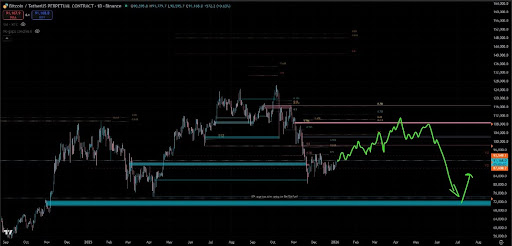
Source: Chart from ChainHub on X

While BTC’s slow performance supports an altcoin season in 2026, Ethereum is showing mixed signals. ChainHub disclosed that on shorter timeframes, the ETH price is less bullish, but longer-term charts point to the potential for a new all-time high near $5,000-$5,500. He revealed that Ethereum bottoming around $2,600- $2,700 is not a reliable indicator of an upcoming altseason. However, its overall bullish nature supports long-term upward momentum.

The analyst also noted that the ETH/Silver ratio points to a rotation from precious metals into cryptocurrencies, signaling renewed investor interest in alts after October 2025’s missed rotation expectations. According to ChainHub, these developments suggest a strong altcoin season in Q1, especially as BTC’s dominance declines and demand for alts rises.

Analyst Sees Alt Rally As Market Strengthens

ChainHub has remained bullish and confident that an altseason will occur in Q1, after setups in Q4 2025, such as Dogecoin and SUI, successfully reversed and found their bottoms. He revealed that Total3 and others are the primary focus of the pump. Because of this, he is targeting filling gaps from October 10, though the altcoin sector’s strength could push prices beyond these levels.

According to ChainHub, some altcoins may even reach their extreme highs from summer 2025, with bullish continuation providing opportunities to buy during price dips. The analyst noted that, since Bitcoin and Ethereum are not performing as well as alts in the current market, he expects a pivot by mid-January. He says this pivot could act as a retest, which could be even more bullish for alts and provide additional fuel for upward moves.

Overall market cap excluding BTC at $1.3 trillion on the 1D chart | Source: TOTAL2 on Tradingview.com

Perguntas relacionadas

QAccording to the analyst ChainHub, when is a strong altcoin season predicted to occur?

AA strong altcoin season is predicted to occur in the first quarter (Q1) of 2026.

QWhat are the two key cryptocurrency indicators that the analyst points to for this prediction?

AThe analyst points to the recent price action of Bitcoin (BTC) and Ethereum (ETH) as the key indicators.

QWhat is the estimated price range for Bitcoin's next top, and how does it compare to its previous all-time high?

ABitcoin's next price top is estimated to be around $107,000 to $108,000, which is a more than 15% decline from its previous all-time high above $126,000.

QWhat potential new all-time high price range does the analyst suggest for Ethereum on longer-term charts?

AOn longer-term charts, the analyst suggests Ethereum has the potential for a new all-time high near $5,000 to $5,500.

QWhat does the ETH/Silver ratio indicate, according to the analysis?

AThe ETH/Silver ratio points to a rotation from precious metals into cryptocurrencies, signaling renewed investor interest in altcoins.

Leituras Relacionadas

Why is Ethereum Urgently Needing ZK-ification?

The article discusses the urgent need for Ethereum to adopt zero-knowledge (ZK) technology as a core narrative for its future development. While Ethereum previously focused on ICOs, DeFi, and being a global financial settlement layer, it now lacks a compelling new narrative. ZK technology is highlighted as a critical solution, with Ethereum being the blockchain most invested in its development. ZK-EVM has reached the Alpha stage, a milestone celebrated by Vitalik Buterin. The primary motivation for ZK integration is to maintain Ethereum’s decentralization while improving scalability. Currently, increasing the Gas limit boosts TPS but raises node operation costs, potentially centralizing the network. ZK proofs allow nodes to verify transactions efficiently without expensive hardware upgrades, similar to automated exam grading versus manual checking. ZK itself doesn’t directly increase TPS but enables future Gas limit hikes with minimal node cost increases. The recent Fusaka upgrade, including PeerDAS, advances this goal. A ZK-powered Ethereum could achieve over 1000 TPS, strengthening its narrative. The article also addresses the role of third-party ZK teams (e.g., Polygon, Scroll, ZKsync, Taiko), which remain crucial for innovation and testing different ZK-EVM types (Type 1 to 4). ZK-VMs, like Brevis, are noted for higher performance and diversity, as they aren’t constrained by EVM compatibility. While ZK L1 may attract some L2 users, it also benefits L2s by reducing costs and improving foundational infrastructure. In summary, Ethereum’s ZK transformation, after years of development, is entering a critical phase, driven by collaborative efforts between Ethereum and external ZK projects.

marsbitHá 46m

Why is Ethereum Urgently Needing ZK-ification?

marsbitHá 46m

BSC Pop-up Store Style Memes: How Can They Compete with Solana?

The crypto market's high-beta phase has reignited the meme coin frenzy, with Solana and Binance Smart Chain (BSC) emerging as two dominant but divergent ecosystems. Solana leverages its high-speed, low-cost infrastructure (0.4s transaction time, ~$0.005 fees) and culture-first approach, epitomized by platforms like pump.fun, where memes evolve from community-driven narratives and often face rapid failure—over 98% of projects eventually collapse. Its top meme tokens, like BONK and WIF, thrive on viral momentum and decentralized innovation, but the ecosystem is highly competitive and transient. BSC, in contrast, relies heavily on central figures like CZ and He Yi, and its EVM compatibility attracts event-driven, sentiment-heavy trading—particularly within Chinese-speaking communities. While BSC memes can achieve rapid, concentrated pumps, they often lack longevity without ongoing influencer support. Data from Dexscreener (as of Jan 12, 2026) highlights key differences: Solana recorded 26.92M transactions ($8.65B volume) vs. BSC’s 5.9M ($7.80B), reflecting Solana’s retail-heavy, high-frequency trading versus BSC’s大户-dominated, narrative-centric rallies. Ultimately, Solana’s strength lies in its resilient, tool-rich culture, while BSC excels in short-term, liquidity-injected opportunities. The choice between chains depends on risk appetite: probability and algorithms on Solana, versus community sentiment and timing on BSC.

比推Há 49m

BSC Pop-up Store Style Memes: How Can They Compete with Solana?

比推Há 49m

Trading

Spot
Futuros

Discussões

Bem-vindo à Comunidade HTX. Aqui, pode manter-se informado sobre os mais recentes desenvolvimentos da plataforma e obter acesso a análises profissionais de mercado. As opiniões dos utilizadores sobre o preço de BTC (BTC) são apresentadas abaixo.

活动图片