The Revived Codex, Carrying OpenAI's Hopes for IPO

marsbitPublicado em 2026-05-24Última atualização em 2026-05-24

Resumo

This article analyzes the intense recent development of OpenAI's Codex, positioning it as a crucial component for OpenAI's impending IPO. Over the past two months, Codex has seen a rapid series of major updates focused on integrating into real enterprise workflows. Key new features include enhanced context capture (Appshots, file previews, built-in browser), long-running task execution ("Goal Mode"), remote operation (phone control, lock-screen access), and enterprise management tools (plugin sharing, access tokens, automated risk review). These updates aim to make Codex a comprehensive AI workbench that can "see the scene, push tasks, and manage risks." The author argues that while ChatGPT proves OpenAI's massive user base and API provides foundational revenue, Codex represents OpenAI's clearest path to demonstrating tangible, high-value commercial viability. It targets developers and engineering teams—a segment already accustomed to paying for efficiency gains in costly software development cycles. This is critical because, despite higher overall revenue, OpenAI's adjusted operating margins remain deeply negative, highlighting the challenge of outrunning immense compute costs. The pressure is amplified by competitor Anthropic's success with Claude Code, which has shown that a focused approach on high-value enterprise and developer workflows can lead to a path toward profitability. Codex's aggressive evolution is thus seen as OpenAI's strategic move to capture a similar en...

Codex's update frequency has been utterly insane recently.

Over the past two months, OpenAI has been cramming new features into Codex almost every few days.

First came plugins, a built-in browser, computer operation, PR review, remote SSH, mobile access... Then on May 21st, Codex had its own "Crazy Thursday," releasing several major features in one go: one-click screen sharing with Codex, letting Codex work persistently on a goal, continued remote use after computer lock, and support for team-shared plugins and usage data viewing.

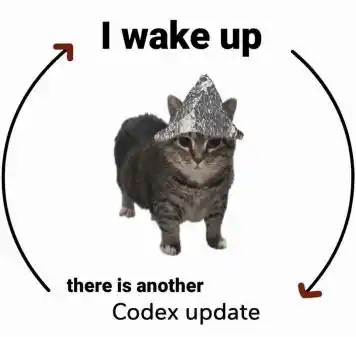
There was a widely circulated meme online before: waking up to see another Claude update. Now Codex is following suit.

It's just that Claude's updates are more "fragmented" and refined, while Codex has released more major features.
Notably, their updates are all heading in the same direction—enterprise entry points and real-world workflows.

Claude Code has already proven the value of this path. Anthropic has even started to make the market believe that frontier model companies don't necessarily have to burn cash forever; they also have a chance to turn their profit statements positive.

Codex is doing the same thing. At this juncture, it's backed by OpenAI, which is preparing for an IPO.

ChatGPT has proven that OpenAI has users, but users do not equal business, and popularity doesn't necessarily bring profits. Especially for a frontier model company, compute costs, training investments, and inference overhead are all significant. OpenAI needs to prove to the market that it's not just good at making hit chatbots, but can also integrate AI into the production processes that enterprises are truly willing to pay for.

Codex's high-frequency updates are precisely filling this gap.

It's not just a development tool; it's the card that most easily articulates commercial value for OpenAI right now.

01

What has Codex been doing these past two months?

We used ChatGPT Images 2.0 to create a chart showing Codex's recent updates over the past two months.
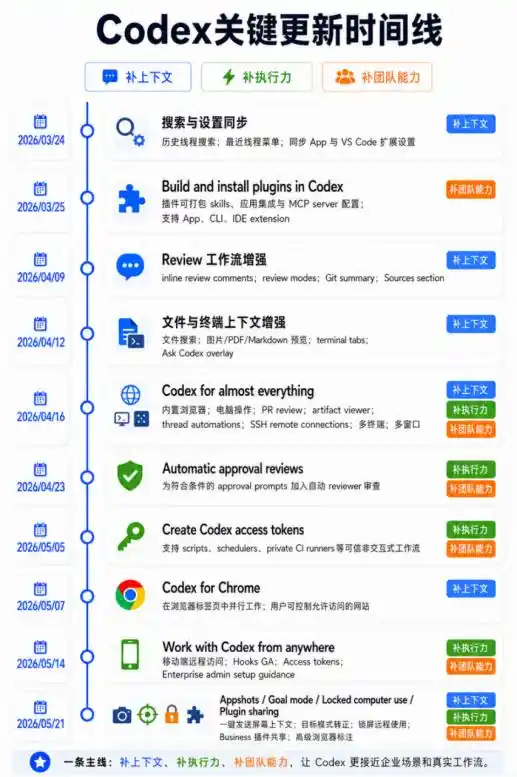
March 24th, Search & Settings Sync.

The Codex App added historical thread search, quick jump to recent threads, and synchronized key settings between the Codex App and VS Code extension. Basically foundational experience optimization: letting users quickly retrieve past tasks and ensuring a more consistent experience between desktop and editor usage.

March 25th, Plugin System Launched.

Codex began supporting plugins. Plugins can package skills, application integrations, and MCP server configurations to reuse workflows, supporting the Codex App, CLI, and IDE extension.

April 9th, Code Review Workflow Enhancement.

The Codex App added collapsible inline review comments, different review modes, Git summaries, and source blocks. Codex started delving deeper into code review and PR collaboration.

April 12th, File & Terminal Context Enhancement.

Codex added file search in the command menu, support for previewing images, PDFs, and Markdown in the sidebar, added a terminal tab for each thread, and supported directly asking Codex about selected text.

April 16th, Codex for almost everything.

This was the first major milestone in the past two months. OpenAI began pushing Codex to become a more comprehensive AI workbench. This wave of updates included a built-in browser, computer operation, thread automation, task sidebar, PR workflows, result previews, SSH remote connections, multi-terminal, multi-window, Intel Mac support, and a batch of new plugins.

April 23rd, Auto-Approve Reviews.

Codex could send eligible approval requests to an auto-review agent for risk assessment first, then display review status and risk level, ultimately leaving the decision to approve or not to the user.

May 5th, Codex Access Tokens Launched.

ChatGPT Enterprise workspace owners and administrators could allow members to create Codex access tokens for use in trusted non-interactive local workflows like scripts, schedulers, and private CI runners. Codex started approaching CI, automation, and enterprise engineering systems.

May 7th, Codex Enters Chrome.

Codex launched a Chrome extension, allowing parallel work in browser tabs without directly taking over the user's browser. Users could also control which websites allow Codex usage. The browser is the entry point for many backend systems, internal tools, and web debugging scenarios. This step brought Codex closer to the real office environment.

May 14th, Codex Supports Phone Control.

OpenAI supported users using Codex from the ChatGPT mobile app, connecting to a Mac running the Codex App. Users could check task progress, approve actions, view code diffs, and test results on their phones. This wave also included Hooks becoming generally available, access tokens, and enterprise admin setup guides. Codex started becoming a work agent that could be monitored remotely.

May 21st, Appshots, Goal Mode, Lock Screen Remote Use, and Plugin Sharing.

This was the second major milestone. Appshots could directly send a screenshot of the current Mac window and available text to Codex; Goal Mode officially launched, allowing users to give Codex a goal and have it work persistently on it for hours or even days; Lock Screen Remote Use allowed Codex to continue operating desktop apps after the Mac was locked, no longer needing to "leave a window open."

Simultaneously, ChatGPT Business began supporting team-shared plugins; the built-in browser's annotation capabilities were further enhanced, allowing direct adjustment of fonts, colors, spacing, and other styles.

The features themselves are important, but the overall update trend is equally noteworthy. Whether it's Appshots or Goal Mode, or the Chrome extension, access tokens, and plugin sharing, they are all filling the basic requirements for entering real workflows: seeing the field, pushing tasks forward, and managing risks.

To see the field, what needs to be complemented is contextual capability.

Real development tasks rarely happen only in code editors. File search, file preview, terminal tabs, built-in browser, browser annotation, Chrome extension, Appshots—essentially, these are all about reducing the user's cost of describing context to the AI.

Previously, you had to tell the AI what the problem was via description or Ctrl+C/V. Now, OpenAI wants Codex to see these things directly.

To push tasks forward, long-running task and remote execution capabilities are crucial.

Goal Mode solves "whether it can keep going." Mobile remote access and lock screen remote use allow tasks to continue even when the user isn't at the computer. Access tokens and Hooks further integrate Codex into enterprise engineering systems like scripts, schedulers, and CI runners.

Managing risks is a matter of enterprise and team management.

For individual developers using tools, the core concern is usability. But enterprise tools involve more complex issues: how to manage permissions, how to distribute plugins, who is using them and how much, how to review risks, whether they can integrate with CI, whether they can be managed uniformly by the team.

Codex has also done a lot of work in this area. The plugin system allows workflows to be packaged and reused; plugin sharing allows teams to distribute tools uniformly; auto-approve reviews are about controlling agent execution risks; access tokens and enterprise admin settings are about integrating Codex into existing enterprise engineering and governance processes.

02

"The Hope of the Whole Village"

Codex's updates have brought it a very impressive user growth rate.

In early March, Codex's weekly active users were around 1.6 million. By May 14th, OpenAI officially mentioned while introducing the mobile version of Codex that over 4 million people use Codex weekly. This means that in about two months, Codex's weekly active user count increased significantly again.

This growth trajectory is inseparable from the underlying model's capabilities. The premise for users being willing to entrust real tasks to Codex more frequently is that it can actually get the job done. Especially after GPT-5.5, Codex's coding, tool use, long-context, and multi-step task capabilities have a better foundation.

But having a model alone isn't enough. The market won't pay just because a model's benchmark improves; it cares more about whether these capabilities can translate into revenue.

This is what OpenAI must clarify before its IPO.

OpenAI holds many cards, but each has its own uncertainties.

ChatGPT is the largest user entry point, proving OpenAI has global users and consumer subscription capabilities. The problem is, the larger the user base, the heavier the inference costs; whether consumer subscriptions can sustain a frontier model company's long-term investments still needs further proof.

API is a fundamental revenue source, selling model capabilities to developers and enterprises. But the API market can easily become a price war, and enterprise clients may not bind themselves to just one model supplier. The more general the model capabilities, the more likely clients are to use multiple models.

ChatGPT Enterprise, Agents, and industry solutions are OpenAI's direct entry into the enterprise market. But these products need time, sales, integration, and industry-specific implementation to truly penetrate enterprise processes.

Looking further ahead, OpenAI also has hardware, data centers, multi-cloud partnerships, and compute infrastructure. These stories have great imaginative potential but are also heavier, more distant, and more capital-intensive. They can support the long-term vision but struggle to immediately explain short-term commercial returns.

In contrast, Codex's commercial value is easier to explain. It targets a very clear group: developers and engineering teams.

This is a group already willing to pay for services. Engineer time is expensive, software project cycles are long, and code maintenance costs are high. Bug fixes, testing, code reviews—each stage has a calculable cost.

Software development itself is also one of the most core production processes for enterprises. Financial companies have risk control and trading systems, retail companies have supply chain and membership systems, healthcare companies have data and compliance systems, media companies have content backends and distribution systems... Even non-tech companies have vast internal tools, data pipelines, automation scripts, and business systems that need maintenance—virtually every company today relies on software systems.

In other words, Codex is cutting into where companies spend money and consume manpower every single day.

In a sense, it's the hope for OpenAI to articulate a compelling IPO narrative. This becomes particularly important as OpenAI prepares to enter the capital markets.

Because in the IPO narrative, OpenAI no longer faces questions like "Does AI have a future?" The truly difficult question to answer is another one: Can a frontier model company find a clear, stable, and profitable enough commercial path beyond massive compute investments?

What's more troublesome is that Anthropic has already taken a step forward on this issue.

03

Anthropic Has Already Taken the Lead

There's another crucial reason Codex must be pushed to the forefront: OpenAI's biggest competitor, Anthropic, has already paved a path on the enterprise side.

Although in terms of revenue scale, OpenAI still leads—The Information reported OpenAI's Q1 2026 revenue at approximately $5.7 billion, higher than Anthropic's $4.8 billion for the same period—the issue now isn't just about revenue size. The real pressure for frontier model companies is whether revenue growth can outpace cost growth.

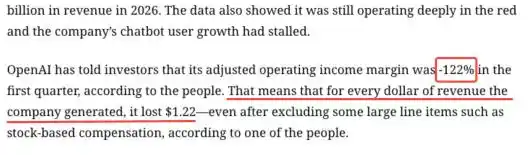
OpenAI's Q1 revenue was high, but its adjusted operating margin was approximately -122%. Calculated on this basis, for every $1 of revenue, adjusted operating costs might be about $2.22, ultimately losing $1.22.
Over the past few years, the outside world has consistently questioned the capital intensity of large model companies: training, inference, GPUs, talent expenses—each is a bottomless pit. The more users, the more calls, the heavier the costs.

The signal recently released by Anthropic has changed the imagination around this issue.

According to The Wall Street Journal, Anthropic expects Q2 2026 revenue to exceed $10.9 billion and is approaching its first quarterly operating profit, estimated at around $559 million.

While this doesn't mean Anthropic has forever escaped the burn problem, it gives the market a very important signal: Frontier model companies don't necessarily have to rely on fundraising to survive forever. As long as the model capabilities are strong enough and the products are close enough to high-value enterprise scenarios, revenue growth can potentially outpace costs.

Anthropic doesn't have a mass-market entry point like ChatGPT, nor does it have as many simultaneous narratives. Its path is narrower and purer: directly enter areas enterprises are willing to pay for, especially high-value scenarios like developers, finance, law, research, data analysis, and internal knowledge work.

Claude Code is the most typical card in this deck. It started as a coveted tool among developers, focusing on programming scenarios. Later, it progressively added long-running tasks, plugins, permissions, team management, and enterprise governance, gradually becoming an important entry point for Anthropic into enterprise workflows. Developers adopt it first, teams follow, eventually turning into enterprise procurement and budgets.

In April 2026, among sample enterprises on the Ramp platform, Anthropic's adoption rate rose to 34.4%, while OpenAI's fell to 32.3%. Although this is only a sample based on enterprise spending on the Ramp platform and not a full-market statistic, this data at least indicates that Anthropic's momentum in enterprise-paid scenarios is strengthening.
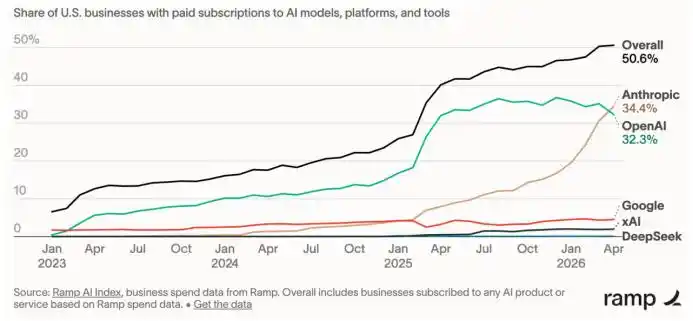
This is precisely where the pressure lies for Codex.

OpenAI's revenue scale still leads, but if it's to enter the capital markets, it can't just talk about user scale or model capabilities. It needs a product closer to enterprise production to prove it can turn AI into stable enterprise revenue.

If Claude Code has proven that developer workflows can become Anthropic's enterprise entry point, then Codex must prove that OpenAI can also walk this path.

Codex lead Tibo Sottiaux recently half-jokingly summarized the company's "master plan": release better, more efficient models, release better products every week, then acquire more compute (and increase time surfing on X).

Better models determine whether Codex can truly work; higher-frequency product updates determine whether Codex can enter real workflows; more compute determines whether all of this can support growing usage.

All of this is very important for the IPO.

In other words, Codex's recent intensive updates aren't just about chasing features; they're also chasing the enterprise-oriented path that Anthropic has already carved out.

ChatGPT has already proven OpenAI has users.

And Codex must prove that OpenAI is a business that can make money.

This article is from WeChat public account "字母AI", author: Yuan Xinyue

Perguntas relacionadas

QWhat is the main role of Codex in OpenAI's current strategic positioning?

ACodex serves as OpenAI's product with the most easily articulated commercial value, aimed at proving OpenAI can integrate AI into genuine, paid enterprise production workflows, which is crucial for its IPO narrative.

QAccording to the article, what are the three core capabilities Codex's recent updates have focused on enhancing?

AThe updates focus on three key capabilities: 1) Contextual Awareness (seeing the work environment), 2) Long-task and Remote Execution (pushing tasks forward), and 3) Enterprise and Team Management (controlling risk and governance).

QWhy is the enterprise/developer market segment specifically important for Codex's commercial success?

ADevelopers and engineering teams represent a segment already willing to pay for productivity tools. Their time is expensive, and software development is a core, costly production环节 in nearly every modern company, making it a high-value, monetizable market for AI tools.

QHow does the competitive pressure from Anthropic relate to Codex's development?

AAnthropic's Claude Code has demonstrated a viable path to profitability by deeply integrating into enterprise developer workflows. Codex's rapid feature development is, in part, a response to prove OpenAI can also successfully capture this lucrative enterprise market segment.

QWhat key financial challenge for frontier AI companies does the article highlight, and how does Codex address it?

AThe challenge is that revenue growth must outpace the heavy costs of compute, training, and inference. Codex addresses this by targeting a specific, high-value enterprise use case (software development) where businesses are accustomed to paying for efficiency gains, aiming to create a clear and stable revenue stream.

Leituras Relacionadas

a16z: 7 Charts to Understand How Tokenization is Changing the Nature of Assets

"a16z: 7 Charts on How Tokenization is Changing the Nature of Assets" Tokenized Assets (or Real-World Assets - RWA) are transforming asset forms, liquidity, and financial system construction. The market recently surpassed $30 billion, stabilizing around $34 billion (excluding stablecoins), representing a tenfold increase in less than two years, driven by clearer regulations, mature institutional infrastructure, and increased financial institution adoption. The primary driver of recent growth is tokenized U.S. Treasury bonds. These offer investors efficient, flexible digital access to yield-bearing assets and improve institutional operations like settlement and collateral management. Other asset classes show varied growth: asset-backed credit leads, followed by niche financial assets (e.g., reinsurance, mining notes), while venture capital took longer to scale. Market segmentation shows high concentration. In commodities, tokenized gold dominates (~$5 billion), as its standardized, storable nature fits tokenization well. Bonds are the largest category ($15.2B), but only ~5% are used in DeFi protocols. Conversely, smaller niches like reinsurance tokens see high (~84%) on-chain utilization, highlighting a core industry divide: most current tokenized assets are merely digitized records for easier holding/transfer, lacking the "composability" (free combination/interaction) that is key to blockchain-native finance. The ecosystem is distributed across multiple blockchains, with Ethereum hosting over half the value ($15.7B), followed by BNB Chain, Solana, and others. Future market size predictions vary widely (e.g., $2-$30 trillion by 2030+), but all indicate massive potential from the current small base. Tokenized assets currently represent minuscule fractions of their global counterparts (e.g., 0.01% of global bonds). The current phase focuses on digitizing straightforward assets. The next challenge is to bring more complex financial components on-chain and deeply integrate tokenized assets into composable, internet-native financial infrastructure.

链捕手Há 30m

a16z: 7 Charts to Understand How Tokenization is Changing the Nature of Assets

链捕手Há 30m

a16z: How Tokenization is Transforming the Nature of Assets in 7 Charts

"Tokenized Assets: How Tokenization Changes the Nature of Assets" by a16z Crypto The market for tokenized assets, excluding stablecoins, has grown from under $3 billion two years ago to over $340 billion today. US Treasury bonds are the primary growth driver, allowing investors to hold yield-bearing assets digitally and enabling more efficient settlement. Other key sectors include private credit (growing fastest), commodities (dominated by gold), and niche financial assets. However, the market remains concentrated in tokenized US Treasuries and gold. A critical insight is that most tokenized assets currently lack "composability." While the total market is large, only a small fraction is actively used within DeFi protocols. For instance, only about 5% of tokenized bonds and a low percentage of tokenized gold are utilized on-chain. In contrast, assets like reinsurance and private credit tokens show much higher on-chain usage rates (84% and 33%, respectively). This highlights a divide: many tokenized assets are merely digital records on a blockchain without enabling new, programmable financial applications. The Pantera Capital Token Native Index indicates over 70% of tokenized assets have minimal on-chain native functionality. Ethereum remains the dominant blockchain for tokenized assets (over $150B), but the ecosystem is diversifying across chains like BNB Chain, Solana, and Stellar, based on factors like cost and compliance. Major institutions forecast massive future growth, with predictions for the tokenized asset market ranging from $2 trillion to over $30 trillion by the early 2030s. However, compared to the global financial system (e.g., ~$140T bonds, multi-trillion dollar gold market), tokenized assets currently represent a tiny fraction (0.01% or less). The conclusion is that while tokenization has begun by digitizing and streamlining settlement for simpler assets, the next phase involves bringing more complex financial instruments on-chain and deeply integrating them into composable, internet-native financial infrastructure.

Odaily星球日报Há 1h

a16z: How Tokenization is Transforming the Nature of Assets in 7 Charts

Odaily星球日报Há 1h

a16z: 7 Charts to Understand How Tokenization Is Changing the Nature of Assets

a16z: 7 Charts on How Tokenization is Transforming the Nature of Assets Tokenized Assets, often referred to as "real-world assets" (RWA), are altering the form, flow, and structure of the financial system. The market recently surpassed $30 billion (excluding stablecoins), driven largely by tokenized U.S. Treasuries. These offer investors digital, yield-bearing assets with efficient settlement. Growth varies significantly by asset class. Asset-backed credit leads in speed, followed by niche financial assets, while venture capital and active strategies took longer to scale. U.S. Treasuries and commodities dominate, holding about two-thirds of the current market share. Within commodities, gold tokenization dominates entirely due to its standardization and historical appeal in crypto. The ecosystem is spread across multiple blockchains. Ethereum holds over half the market, with others like BNB Chain, Solana, and Stellar holding significant shares. However, a key insight is that most tokenized assets currently lack "composability." While the total market is large, only a small fraction (e.g., 5% of tokenized bonds) is used within DeFi protocols. Many tokens are simply digital records of off-chain assets, not natively programmable financial building blocks. In contrast, smaller categories like reinsurance tokens see very high on-chain usage. Looking ahead, forecasts for the tokenized asset market by 2030 range from $2 trillion to over $30 trillion, representing immense potential growth from today's ~$340 billion base. Yet, relative to global markets (e.g., $140T+ in bonds), tokenization's penetration remains minuscule (<0.02%). The current phase focuses on digitizing straightforward assets for efficiency. The next major challenge is bringing more complex financial instruments on-chain and integrating tokenized assets into truly composable, internet-native financial infrastructure.

marsbitHá 2h

a16z: 7 Charts to Understand How Tokenization Is Changing the Nature of Assets

marsbitHá 2h

Trading

Spot
Futuros

Artigos em Destaque

O que é $S$

Compreender o SPERO: Uma Visão Abrangente Introdução ao SPERO À medida que o panorama da inovação continua a evoluir, o surgimento de tecnologias web3 e projetos de criptomoeda desempenha um papel fundamental na formação do futuro digital. Um projeto que tem atraído atenção neste campo dinâmico é o SPERO, denotado como SPERO,$$s$. Este artigo tem como objetivo reunir e apresentar informações detalhadas sobre o SPERO, para ajudar entusiastas e investidores a compreender as suas bases, objetivos e inovações nos domínios web3 e cripto. O que é o SPERO,$$s$? O SPERO,$$s$ é um projeto único dentro do espaço cripto que procura aproveitar os princípios da descentralização e da tecnologia blockchain para criar um ecossistema que promove o envolvimento, a utilidade e a inclusão financeira. O projeto é concebido para facilitar interações peer-to-peer de novas maneiras, proporcionando aos utilizadores soluções e serviços financeiros inovadores. No seu núcleo, o SPERO,$$s$ visa capacitar indivíduos ao fornecer ferramentas e plataformas que melhoram a experiência do utilizador no espaço das criptomoedas. Isso inclui a possibilidade de métodos de transação mais flexíveis, a promoção de iniciativas impulsionadas pela comunidade e a criação de caminhos para oportunidades financeiras através de aplicações descentralizadas (dApps). A visão subjacente do SPERO,$$s$ gira em torno da inclusão, visando fechar lacunas dentro das finanças tradicionais enquanto aproveita os benefícios da tecnologia blockchain. Quem é o Criador do SPERO,$$s$? A identidade do criador do SPERO,$$s$ permanece algo obscura, uma vez que existem recursos publicamente disponíveis limitados que fornecem informações detalhadas sobre o(s) seu(s) fundador(es). Esta falta de transparência pode resultar do compromisso do projeto com a descentralização—uma ética que muitos projetos web3 partilham, priorizando contribuições coletivas em vez de reconhecimento individual. Ao centrar as discussões em torno da comunidade e dos seus objetivos coletivos, o SPERO,$$s$ incorpora a essência do empoderamento sem destacar indivíduos específicos. Assim, compreender a ética e a missão do SPERO é mais importante do que identificar um criador singular. Quem são os Investidores do SPERO,$$s$? O SPERO,$$s$ é apoiado por uma diversidade de investidores que vão desde capitalistas de risco a investidores-anjo dedicados a promover a inovação no setor cripto. O foco desses investidores geralmente alinha-se com a missão do SPERO—priorizando projetos que prometem avanço tecnológico social, inclusão financeira e governança descentralizada. Essas fundações de investidores estão tipicamente interessadas em projetos que não apenas oferecem produtos inovadores, mas que também contribuem positivamente para a comunidade blockchain e os seus ecossistemas. O apoio desses investidores reforça o SPERO,$$s$ como um concorrente notável no domínio em rápida evolução dos projetos cripto. Como Funciona o SPERO,$$s$? O SPERO,$$s$ emprega uma estrutura multifacetada que o distingue de projetos de criptomoeda convencionais. Aqui estão algumas das características-chave que sublinham a sua singularidade e inovação: Governança Descentralizada: O SPERO,$$s$ integra modelos de governança descentralizada, capacitando os utilizadores a participar ativamente nos processos de tomada de decisão sobre o futuro do projeto. Esta abordagem promove um sentido de propriedade e responsabilidade entre os membros da comunidade. Utilidade do Token: O SPERO,$$s$ utiliza o seu próprio token de criptomoeda, concebido para servir várias funções dentro do ecossistema. Esses tokens permitem transações, recompensas e a facilitação de serviços oferecidos na plataforma, melhorando o envolvimento e a utilidade gerais. Arquitetura em Camadas: A arquitetura técnica do SPERO,$$s$ suporta modularidade e escalabilidade, permitindo a integração contínua de funcionalidades e aplicações adicionais à medida que o projeto evolui. Esta adaptabilidade é fundamental para manter a relevância no panorama cripto em constante mudança. Envolvimento da Comunidade: O projeto enfatiza iniciativas impulsionadas pela comunidade, empregando mecanismos que incentivam a colaboração e o feedback. Ao nutrir uma comunidade forte, o SPERO,$$s$ pode melhor atender às necessidades dos utilizadores e adaptar-se às tendências do mercado. Foco na Inclusão: Ao oferecer taxas de transação baixas e interfaces amigáveis, o SPERO,$$s$ visa atrair uma base de utilizadores diversificada, incluindo indivíduos que anteriormente podem não ter participado no espaço cripto. Este compromisso com a inclusão alinha-se com a sua missão abrangente de empoderamento através da acessibilidade. Cronologia do SPERO,$$s$ Compreender a história de um projeto fornece insights cruciais sobre a sua trajetória de desenvolvimento e marcos. Abaixo está uma cronologia sugerida que mapeia eventos significativos na evolução do SPERO,$$s$: Fase de Conceituação e Ideação: As ideias iniciais que formam a base do SPERO,$$s$ foram concebidas, alinhando-se de perto com os princípios de descentralização e foco na comunidade dentro da indústria blockchain. Lançamento do Whitepaper do Projeto: Após a fase conceitual, um whitepaper abrangente detalhando a visão, os objetivos e a infraestrutura tecnológica do SPERO,$$s$ foi lançado para atrair o interesse e o feedback da comunidade. Construção da Comunidade e Primeiros Envolvimentos: Esforços ativos de divulgação foram feitos para construir uma comunidade de primeiros adotantes e investidores potenciais, facilitando discussões em torno dos objetivos do projeto e angariando apoio. Evento de Geração de Tokens: O SPERO,$$s$ realizou um evento de geração de tokens (TGE) para distribuir os seus tokens nativos a apoiantes iniciais e estabelecer liquidez inicial dentro do ecossistema. Lançamento da dApp Inicial: A primeira aplicação descentralizada (dApp) associada ao SPERO,$$s$ foi lançada, permitindo que os utilizadores interagissem com as funcionalidades principais da plataforma. Desenvolvimento Contínuo e Parcerias: Atualizações e melhorias contínuas nas ofertas do projeto, incluindo parcerias estratégicas com outros players no espaço blockchain, moldaram o SPERO,$$s$ em um jogador competitivo e em evolução no mercado cripto. Conclusão O SPERO,$$s$ é um testemunho do potencial do web3 e das criptomoedas para revolucionar os sistemas financeiros e capacitar indivíduos. Com um compromisso com a governança descentralizada, o envolvimento da comunidade e funcionalidades inovadoras, abre caminho para um panorama financeiro mais inclusivo. Como em qualquer investimento no espaço cripto em rápida evolução, potenciais investidores e utilizadores são incentivados a pesquisar minuciosamente e a envolver-se de forma ponderada com os desenvolvimentos em curso dentro do SPERO,$$s$. O projeto demonstra o espírito inovador da indústria cripto, convidando a uma exploração mais aprofundada das suas inúmeras possibilidades. Embora a jornada do SPERO,$$s$ ainda esteja a desenrolar-se, os seus princípios fundamentais podem, de facto, influenciar o futuro de como interagimos com a tecnologia, as finanças e uns com os outros em ecossistemas digitais interconectados.

69 Visualizações TotaisPublicado em {updateTime}Atualizado em 2024.12.17

O que é $S$

O que é AGENT S

Agent S: O Futuro da Interação Autónoma no Web3 Introdução No panorama em constante evolução do Web3 e das criptomoedas, as inovações estão constantemente a redefinir a forma como os indivíduos interagem com plataformas digitais. Um projeto pioneiro, o Agent S, promete revolucionar a interação humano-computador através do seu framework aberto e agente. Ao abrir caminho para interações autónomas, o Agent S visa simplificar tarefas complexas, oferecendo aplicações transformadoras em inteligência artificial (IA). Esta exploração detalhada irá aprofundar-se nas complexidades do projeto, nas suas características únicas e nas implicações para o domínio das criptomoedas. O que é o Agent S? O Agent S é um framework aberto e agente, especificamente concebido para abordar três desafios fundamentais na automação de tarefas computacionais: Aquisição de Conhecimento Específico de Domínio: O framework aprende inteligentemente a partir de várias fontes de conhecimento externas e experiências internas. Esta abordagem dupla capacita-o a construir um rico repositório de conhecimento específico de domínio, melhorando o seu desempenho na execução de tarefas. Planeamento ao Longo de Longos Horizontes de Tarefas: O Agent S emprega planeamento hierárquico aumentado por experiência, uma abordagem estratégica que facilita a decomposição e execução eficientes de tarefas intrincadas. Esta característica melhora significativamente a sua capacidade de gerir múltiplas subtarefas de forma eficiente e eficaz. Gestão de Interfaces Dinâmicas e Não Uniformes: O projeto introduz a Interface Agente-Computador (ACI), uma solução inovadora que melhora a interação entre agentes e utilizadores. Utilizando Modelos de Linguagem Multimodais de Grande Escala (MLLMs), o Agent S pode navegar e manipular diversas interfaces gráficas de utilizador de forma fluida. Através destas características pioneiras, o Agent S fornece um framework robusto que aborda as complexidades envolvidas na automação da interação humana com máquinas, preparando o terreno para uma infinidade de aplicações em IA e além. Quem é o Criador do Agent S? Embora o conceito de Agent S seja fundamentalmente inovador, informações específicas sobre o seu criador permanecem elusivas. O criador é atualmente desconhecido, o que destaca ou o estágio nascente do projeto ou a escolha estratégica de manter os membros fundadores em anonimato. Independentemente da anonimidade, o foco permanece nas capacidades e no potencial do framework. Quem são os Investidores do Agent S? Como o Agent S é relativamente novo no ecossistema criptográfico, informações detalhadas sobre os seus investidores e financiadores não estão explicitamente documentadas. A falta de informações disponíveis publicamente sobre as fundações de investimento ou organizações que apoiam o projeto levanta questões sobre a sua estrutura de financiamento e roteiro de desenvolvimento. Compreender o apoio é crucial para avaliar a sustentabilidade do projeto e o seu impacto potencial no mercado. Como Funciona o Agent S? No núcleo do Agent S reside uma tecnologia de ponta que lhe permite funcionar eficazmente em diversos ambientes. O seu modelo operacional é construído em torno de várias características-chave: Interação Humano-Computador Semelhante: O framework oferece planeamento avançado em IA, esforçando-se para tornar as interações com computadores mais intuitivas. Ao imitar o comportamento humano na execução de tarefas, promete elevar as experiências dos utilizadores. Memória Narrativa: Utilizada para aproveitar experiências de alto nível, o Agent S utiliza memória narrativa para acompanhar os históricos de tarefas, melhorando assim os seus processos de tomada de decisão. Memória Episódica: Esta característica fornece aos utilizadores orientações passo a passo, permitindo que o framework ofereça suporte contextual à medida que as tarefas se desenrolam. Suporte para OpenACI: Com a capacidade de funcionar localmente, o Agent S permite que os utilizadores mantenham o controlo sobre as suas interações e fluxos de trabalho, alinhando-se com a ética descentralizada do Web3. Fácil Integração com APIs Externas: A sua versatilidade e compatibilidade com várias plataformas de IA garantem que o Agent S possa integrar-se perfeitamente em ecossistemas tecnológicos existentes, tornando-o uma escolha apelativa para desenvolvedores e organizações. Estas funcionalidades contribuem coletivamente para a posição única do Agent S no espaço cripto, à medida que automatiza tarefas complexas e em múltiplos passos com mínima intervenção humana. À medida que o projeto evolui, as suas potenciais aplicações no Web3 podem redefinir a forma como as interações digitais se desenrolam. Cronologia do Agent S O desenvolvimento e os marcos do Agent S podem ser encapsulados numa cronologia que destaca os seus eventos significativos: 27 de Setembro de 2024: O conceito de Agent S foi lançado num artigo de pesquisa abrangente intitulado “Um Framework Agente Aberto que Usa Computadores como um Humano”, mostrando a base para o projeto. 10 de Outubro de 2024: O artigo de pesquisa foi disponibilizado publicamente no arXiv, oferecendo uma exploração aprofundada do framework e da sua avaliação de desempenho com base no benchmark OSWorld. 12 de Outubro de 2024: Uma apresentação em vídeo foi lançada, proporcionando uma visão visual das capacidades e características do Agent S, envolvendo ainda mais potenciais utilizadores e investidores. Estes marcos na cronologia não apenas ilustram o progresso do Agent S, mas também indicam o seu compromisso com a transparência e o envolvimento da comunidade. Pontos-Chave Sobre o Agent S À medida que o framework Agent S continua a evoluir, várias características-chave destacam-se, sublinhando a sua natureza inovadora e potencial: Framework Inovador: Concebido para proporcionar um uso intuitivo de computadores semelhante à interação humana, o Agent S traz uma abordagem nova à automação de tarefas. Interação Autónoma: A capacidade de interagir autonomamente com computadores através de GUI significa um avanço em direção a soluções computacionais mais inteligentes e eficientes. Automação de Tarefas Complexas: Com a sua metodologia robusta, pode automatizar tarefas complexas e em múltiplos passos, tornando os processos mais rápidos e menos propensos a erros. Melhoria Contínua: Os mecanismos de aprendizagem permitem que o Agent S melhore a partir de experiências passadas, aprimorando continuamente o seu desempenho e eficácia. Versatilidade: A sua adaptabilidade em diferentes ambientes operacionais, como OSWorld e WindowsAgentArena, garante que pode servir uma ampla gama de aplicações. À medida que o Agent S se posiciona no panorama do Web3 e das criptomoedas, o seu potencial para melhorar as capacidades de interação e automatizar processos significa um avanço significativo nas tecnologias de IA. Através do seu framework inovador, o Agent S exemplifica o futuro das interações digitais, prometendo uma experiência mais fluida e eficiente para os utilizadores em diversas indústrias. Conclusão O Agent S representa um ousado avanço na união da IA e do Web3, com a capacidade de redefinir a forma como interagimos com a tecnologia. Embora ainda esteja nas suas fases iniciais, as possibilidades para a sua aplicação são vastas e cativantes. Através do seu framework abrangente que aborda desafios críticos, o Agent S visa trazer interações autónomas para o primeiro plano da experiência digital. À medida que avançamos mais profundamente nos domínios das criptomoedas e da descentralização, projetos como o Agent S desempenharão, sem dúvida, um papel crucial na formação do futuro da tecnologia e da colaboração humano-computador.

645 Visualizações TotaisPublicado em {updateTime}Atualizado em 2025.01.14

O que é AGENT S

Como comprar S

Bem-vindo à HTX.com!Tornámos a compra de Sonic (S) simples e conveniente.Segue o nosso guia passo a passo para iniciar a tua jornada no mundo das criptos.Passo 1: cria a tua conta HTXUtiliza o teu e-mail ou número de telefone para te inscreveres numa conta gratuita na HTX.Desfruta de um processo de inscrição sem complicações e desbloqueia todas as funcionalidades.Obter a minha contaPasso 2: vai para Comprar Cripto e escolhe o teu método de pagamentoCartão de crédito/débito: usa o teu visa ou mastercard para comprar Sonic (S) instantaneamente.Saldo: usa os fundos da tua conta HTX para transacionar sem problemas.Terceiros: adicionamos métodos de pagamento populares, como Google Pay e Apple Pay, para aumentar a conveniência.P2P: transaciona diretamente com outros utilizadores na HTX.Mercado de balcão (OTC): oferecemos serviços personalizados e taxas de câmbio competitivas para os traders.Passo 3: armazena teu Sonic (S)Depois de comprar o teu Sonic (S), armazena-o na tua conta HTX.Alternativamente, podes enviá-lo para outro lugar através de transferência blockchain ou usá-lo para transacionar outras criptomoedas.Passo 4: transaciona Sonic (S)Transaciona facilmente Sonic (S) no mercado à vista da HTX.Acede simplesmente à tua conta, seleciona o teu par de trading, executa as tuas transações e monitoriza em tempo real.Oferecemos uma experiência de fácil utilização tanto para principiantes como para traders experientes.

1.2k Visualizações TotaisPublicado em {updateTime}Atualizado em 2025.03.21

Como comprar S

Discussões

Bem-vindo à Comunidade HTX. Aqui, pode manter-se informado sobre os mais recentes desenvolvimentos da plataforma e obter acesso a análises profissionais de mercado. As opiniões dos utilizadores sobre o preço de S (S) são apresentadas abaixo.

活动图片