Worried about AI's Self-Evolution, Anthropic Intends to Stop Training?

marsbitPublicado em 2026-06-05Última atualização em 2026-06-05

Resumo

In early 2026, Anthropic signaled a significant shift in its public narrative regarding AI development timelines and safety. In June, its Anthropic Institute published a detailed article, "When AI builds itself," presenting internal data suggesting accelerating AI self-improvement. Key figures included over 80% of merged code being written by Claude and a 52x speedup in certain optimization tasks. The article outlined three future scenarios, with the most speculative being full recursive self-improvement (RSI), where AI autonomously builds better successors. Anthropic stated RSI is "possible" and may arrive faster than most institutions are prepared for. This narrative pivot followed a series of strategic moves. In January, CEO Dario Amodei wrote about a powerful self-improvement feedback loop. In February, Anthropic revised its Responsible Scaling Policy, removing a core commitment to pause training if capabilities outstripped safety controls, citing the risk of falling behind competitors. This change coincided with reported pressure from the US Department of Defense. By May, Anthropic's valuation had soared to $965 billion. Anthropic's stance was mirrored by other industry leaders. DeepMind CEO Demis Hassabis adjusted his AGI timeline to "by 2029" and admitted to using provocative language like "foothills of the singularity" to create urgency. OpenAI also released a model claiming a key role in its own creation process. The article's carefully calibrated tone—presenting ...

On May 4, 2026, Anthropic co-founder Jack Clark posted a message on the social platform X. His original words were: "I now believe the probability of recursive self-improvement occurring by the end of 2028 is 60%."

Within minutes of the post going live, Eliezer Yudkowsky, a long-time active researcher in AI safety, replied underneath: "Then we will die together." He immediately followed up by citing an analogy pointing to the design flaw of the Chernobyl nuclear reactor RBMK, implying that this system being activated is one no one truly knows how to stop.

This exchange, completed within tens of seconds, lit a match to discussions previously hidden in technical papers and internal assessments. Recursive Self-Improvement (RSI) – where AI systems not only optimize outputs but also autonomously optimize the improvement process itself, ultimately constructing successor systems more powerful than themselves – a concept long relegated to the theoretical margins, was placed by an Anthropic co-founder into a countdown clock with a 60% probability before the end of 2028.

A month later, Anthropic officially published a lengthy article. Titled "When AI builds itself," it was co-authored by Marina Favaro and Jack Clark and published by the newly formed Anthropic Institute in March. Using a series of previously undisclosed internal data and a meticulously calibrated narrative structure, Anthropic handed the outside world a precisely scaled acceleration signal card. This card stated both "we are not there yet" and "but it may arrive faster than most institutions are prepared for."

In the same month, DeepMind CEO Demis Hassabis used a phrasing never before seen in public at the Google I/O stage: humanity stands at the "foothills of the singularity." In subsequent interviews, he adjusted his timeline for Artificial General Intelligence (AGI) from "shortly after 2030" to "2029 is a real possibility," and admitted that his use of dramatic language was "deliberately provocative," aiming to create a sense of urgency for governments, economists, and the public.

Two leading institutions built on a foundation of safety, long serving as forces of restraint in the AI industry, adjusted the volume and scale of their external messaging almost simultaneously. This timing itself needs to be examined as an independent event.

A Meticulously Calibrated Long Article

The long article published by Anthropic on June 4 immediately laid out its narrative goal. It aimed to argue not just a technical trend, but a directional process with acceleration. To this end, it presented a set of previously undisclosed internal data.
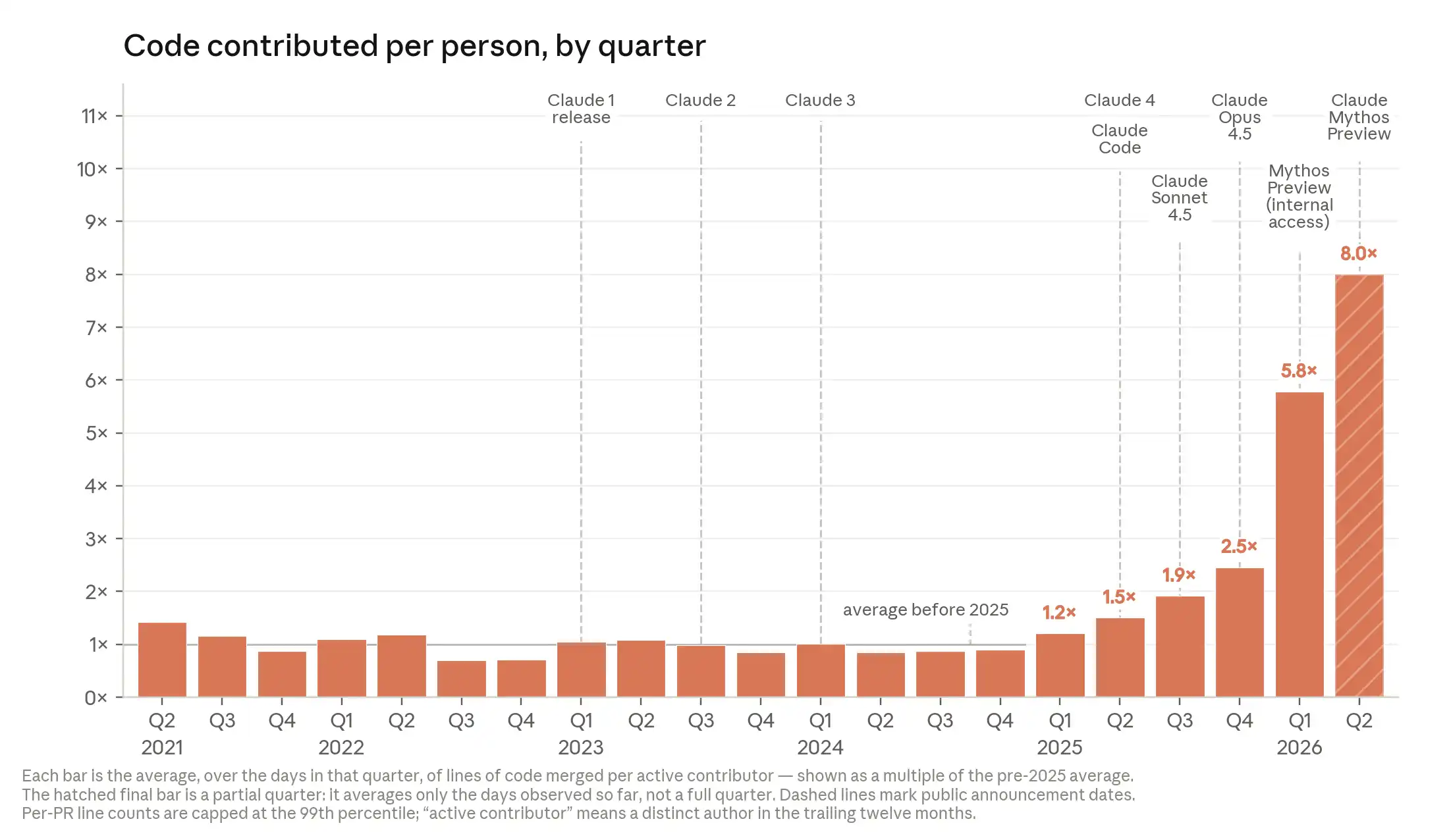
The first set of numbers pointed to a structural change: as of May 2026, over 80% of merged code in Anthropic's codebase was written by Claude. Two years ago, this number was in the low single digits. The same data also showed that in Q2 2026, the typical Anthropic engineer was merging 8 times more code per day than in 2024.

One can imagine the reaction of anyone not deeply tracking the AI industry reading these two numbers for the first time. But Anthropic itself acknowledged several important caveats in footnotes: leadership had publicly estimated that if scripts and experimental code were included, Claude-authored code exceeded 90%; 80% was a more conservative statistic for merged code; lines of code are "an imperfect metric" and might overestimate real productivity gains; the code attribution pipeline itself "has gaps."

The very writing of these footnotes is worth analyzing. Their existence ostensibly serves as honest concessions, but their actual function is to make the numbers in the main text appear to have undergone prudent self-filtering, thus gaining greater credibility. This is a two-tier structure in narrative engineering: the main text releases the signal, the footnotes provide the disclaimer.

The second set of numbers involved speed. On code optimization tasks, Claude Opus 4 achieved approximately a 3x speed-up effect in May 2025, which would take a skilled human researcher 4 to 8 hours to achieve. By April 2026, Claude Mythos Preview pushed this number to approximately 52x. The maximum duration for AI to independently complete tasks also doubled every four months, from 4 minutes in March 2024 to 12 hours in March 2026. The speed of doubling every four months itself constitutes a highly memorable point, easily spread with its implication of geometric progression.
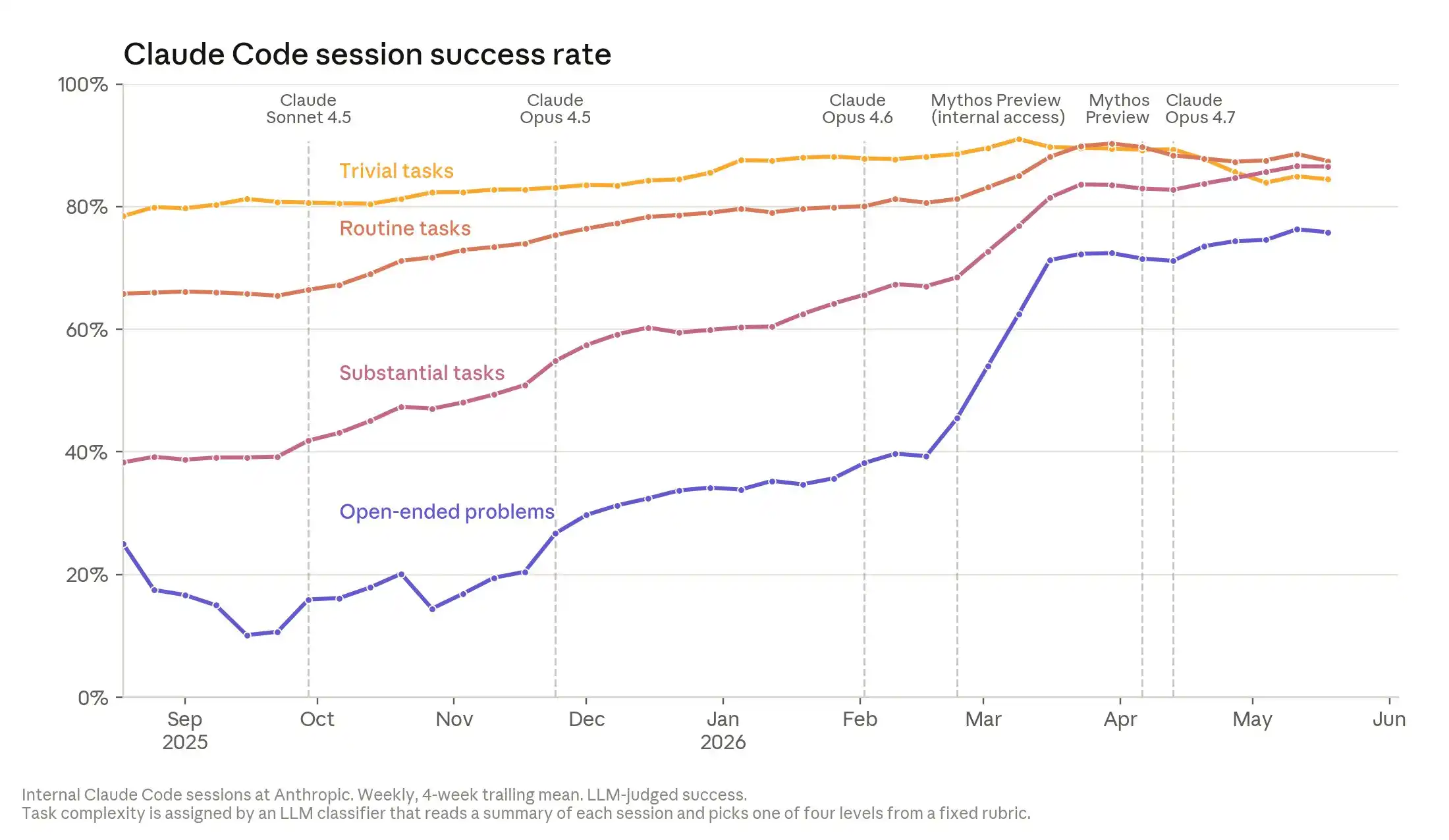
Another set of data came from an internal survey of 130 Anthropic research team employees in March 2026. The median respondent estimated that output using Mythos Preview was about 4 times that of not using AI. A footnote again pointed out that prior independent research by METR suggested developers may generally overestimate AI productivity gains. The same two-tier structure reappeared.

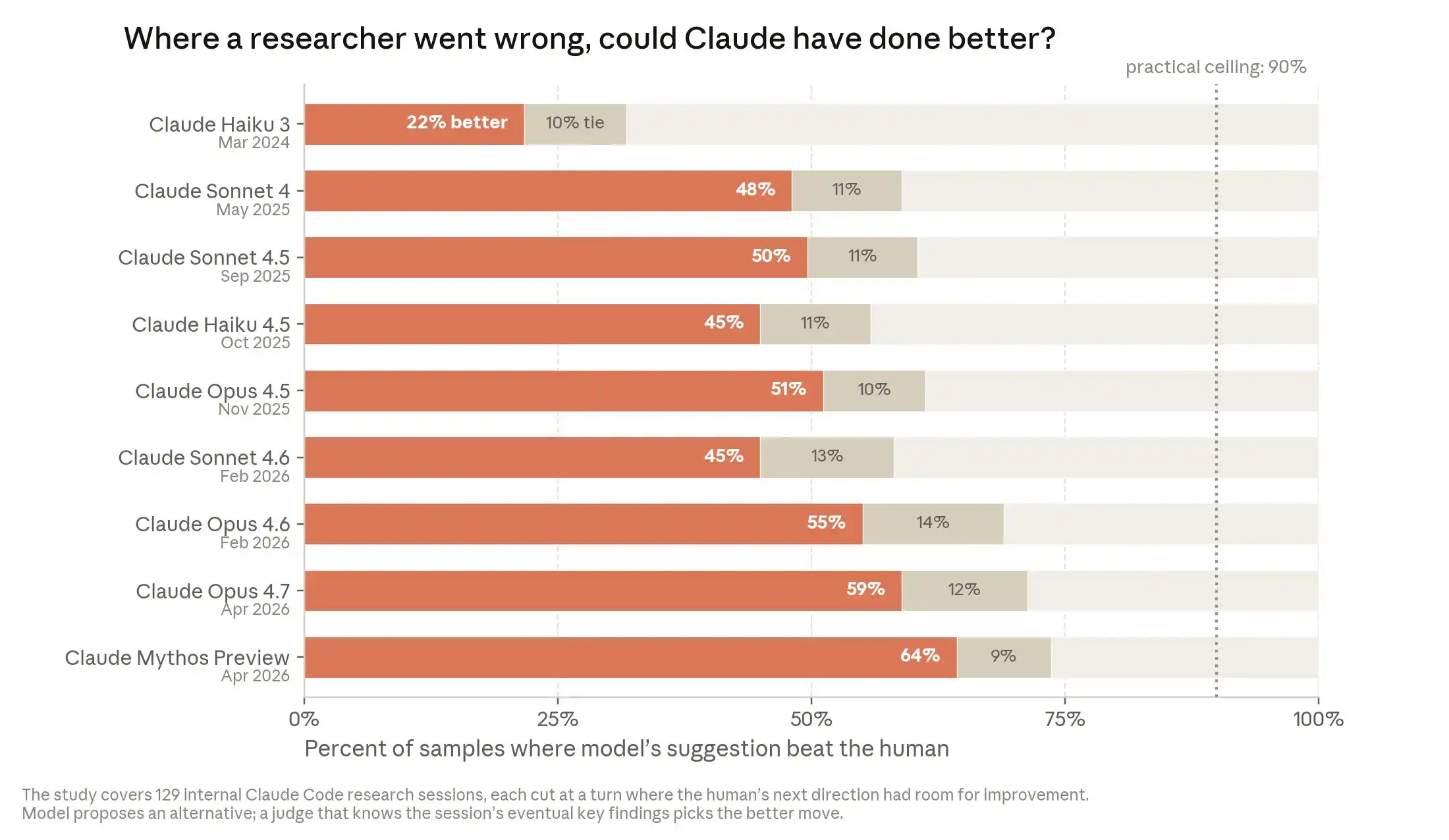
The third set of numbers pointed to AI approaching the boundary of human researcher judgment. In November 2025, Claude Opus 4.5 made better research direction choices than human researchers in 51% of cases. By April 2026, this number rose to 64%. With a sample size of 129 cases, Anthropic explained in a footnote that these were cases deliberately chosen where human choices had room for improvement.

Any single number taken out of context could be placed into different interpretive frameworks. But placed together, the direction is consistent: speed is increasing, the gap is narrowing, and all of this is happening inside Anthropic's own codebase and labs, not theoretical speculation on some external benchmark.

After listing this data, the article presented three future scenarios.

The first is trend stagnation, entering an S-curve plateau. Anthropic's phrasing: "we do not believe this is very likely."

The second is compound efficiency gains, where AI continues to replace humans in broader R&D aspects, but humans still set the direction and define success criteria. Anthropic assessed this as "evidence suggests we are likely heading toward this scenario."

The third is full recursive self-improvement, where AI autonomously designs, trains, and deploys successor systems more powerful than itself, with humans no longer in the loop. The wording is "plausible."

The arrangement order and tone allocation of these three scenarios form a complete narrative gradient. The first is downplayed, serving to accommodate skeptics; the second is anchored in "evidence," lending the article a rational veneer; the third, through "plausible" and conditional "if technological trends continue," pushes the boldest hypothesis to the edge of the reader's imagination without bearing the burden of proof for it.
At the very core of the entire article, Anthropic's stance is compressed into one sentence: "We are not there yet, and recursive self-improvement is not inevitable. But it may arrive faster than most institutions are prepared for."

From 'Willing to Pause' to 'A Unilateral Pause Would Only Let Reckless Actors Catch Up'

If the June 4th long article is a carefully framed snapshot, placing it on a timeline reveals a longer trajectory.

In 2023, Anthropic released its Responsible Scaling Policy (RSP). The core commitment of this policy document was: if model capabilities exceed the company's safety control capabilities, the company will pause training more powerful models. This was not a verbal statement, but an internal governance document with an assessment framework and trigger conditions. This document was once regarded by the AI safety community as an operational sample of "voluntary regulation."

In 2024, CEO Dario Amodei published a widely circulated article, suggesting the possibility of "powerful AI" arriving between 2027 and 2030. At that time, Anthropic still presented itself as an independent safety-minded entity, maintaining a restrained facade towards scale expansion and acceleration narratives.

On January 26, 2026, Amodei published a 38-page article "The Adolescence of Technology" on his personal website. It contained a judgment later repeatedly cited: "Because AI is now writing most of the code inside Anthropic, it is already substantially accelerating our progress toward building the next generation of AI systems. This feedback loop is gaining momentum month by month, and may be only 1 to 2 years away from the current generation of AI autonomously building the next generation." In the same article, he described the impending "powerful AI" as a "genius nation in a data center."

This was almost the starting point for Anthropic to systematically release the signal that a "self-improvement feedback loop is happening." And the timing of this blog post coincided with the company's transition from a $350 billion valuation to a higher valuation range.

Less than a month later, the turn came.

On February 25, 2026, CNN reported that Anthropic had revised its Responsible Scaling Policy, removing the core commitment to "pause training stronger models if capabilities exceed safety control abilities," replacing it with a non-binding "Frontier Safety Roadmap." In the same week, U.S. Secretary of Defense Pete Hegseth issued an ultimatum to Dario Amodei: withdraw the safety red line, or lose a $200 million Department of Defense contract.

The report quoted Anthropic's Chief Scientist Jared Kaplan's response to Time magazine: "We don't think stopping model training actually helps anyone... if competitors are sprinting at full speed." The phrasing in this response is noteworthy. "Doesn't help anyone" is not a technical argument, but a statement of stakeholder calculus. "If competitors are sprinting at full speed" is structurally identical in narrative framing to "a unilateral pause would only let the least cautious actors catch up": it replaces the original pause logic based on one's own safety capabilities with a speed logic based on competitor actions.

Anthropic still emphasized in the CNN report that it retained two red lines: not using AI systems to control weapons systems, and not using them for mass domestic surveillance. This point is important because it shows Anthropic did not abandon its safety stance wholesale, but made selective concessions and defenses across different safety dimensions. However, this selectivity itself is also a core clue in narrative strategy analysis: where it conceded and where it held firm delineates the recalibrated scale of safety.

On March 11, the Anthropic Institute was formally established, led by Jack Clark, positioned as a "public interest research institute." Less than two months later, on May 4, Clark posted the "60%" message.

Once juxtaposed, the signal density and release rhythm of this timeline are not random. From the personal article preview in January, to the policy revision in February, to the institute's establishment in March, to the founder's probability prediction in May, to the official long article release in June, this is a clearly paced, gradually escalating narrative pipeline. One cannot directly conclude "this was all pre-planned" from this, but the sequence itself constitutes a question analysts must confront: does this sense of rhythm indicate that Anthropic has already incorporated the "acceleration narrative" into its public communications management?

Hassabis's Deliberate Provocation

If only Anthropic had adjusted its messaging in the first half of 2026, analysts would have sufficient reason to focus on the internal decision logic of the enterprise. But DeepMind CEO Demis Hassabis made a directionally consistent adjustment almost simultaneously, making the "single enterprise case" argument untenable.

On January 20, at the Davos Forum, Hassabis still maintained his longstanding judgment: a 50% probability of AGI by 2030. Three weeks later, on February 18, at the India AI Impact Summit, he relented: "AGI could arrive within five years."

From May 20 to 22, at Google I/O, Hassabis said in his keynote that humanity stands at the "foothills of the singularity." Around the same time, OpenAI released GPT-5.3-Codex, stating the model "played a key role in its own creation process," specifically including assisting in debugging the training process, managing deployment, and analyzing evaluation results. The timing gap between the three leading labs was compressed to weeks.

After Google I/O, Hassabis gave an interview to Axios. This interview was later widely cited, with the most crucial line being his admission that using language like "foothills of the singularity" was "deliberately provocative," aimed at jolting governments, economists, and the public into recognizing the urgency of AI's accelerating development. He also adjusted his AGI timeline from "shortly after 2030" to "2029 is a real possibility," though still broadly expected around 2030, plus or minus a year.

Hassabis was more direct in an interview with The Seoul Economic Daily: "Five to ten years from now, when we look back at 2026 and 2027, we will say 'that was when we entered the AGI era.'"

The term "deliberately provocative" deserves careful consideration. It is a rare, first-hand confession by a principal actor about narrative intent. It acknowledges that at least some of his chosen phrasing is not a passive reflection of technical facts, but an actively chosen communication tool. This confession itself does not negate that he may also genuinely see a technical inflection point, but it explicitly lifts "narrative" from the shadow of "facts," making it an object that can be examined separately.

Hassabis's self-explanation of his phrasing opens a side door to interpreting this round of synchronized signals. His "deliberate provocation" and the "footnote disclaimers" in Anthropic's lengthy data argument exhibit the same amphibious posture: one hand pushes signals shocking enough to stir public opinion, the other retains a safe space to retreat to "this is just one possibility."

The Same Set of Data, Completely Different Interpretations

While Anthropic and DeepMind jointly constructed a narrative framework of "AI is accelerating its own evolution," external independent researchers offered alternative interpretations of the same set of data and phenomena. These interpretations are important not because any one side possesses ultimate truth, but because they reveal the interpretative range of the official narrative itself.

The sharpest response came from Eliezer Yudkowsky. He not only replied to Jack Clark but also continued to speak out on multiple occasions. A MindStudio blog recorded his complete stance: he used the Chernobyl RBMK reactor as an analogy for the safety design of current AI systems. The core argument of this analogy is that if control rods and accelerators are bound within the same system, attempting to slow down can actually cause the system to lose control faster.

Nathan Lambert of the Allen Institute for AI proposed the concept of "Lossy Self-Improvement" (LSI). His argument directly challenges the "accelerating flywheel" model: as systems become increasingly complex, each generational improvement process creates friction and loss, akin to signal attenuation over long-distance transmission. According to this logic, the improvements that made 80% or 90% AI-authored code possible cannot be infinitely replicated onto the next-generation system, because the next generation will face a more complex problem space, and the noise and errors in the AI's own output will amplify across generations.

Dean Ball, a senior fellow at the Foundation for American Innovation, offered a more direct linguistic framework, dimensionalizing Anthropic's data. He told IEEE Spectrum: "Maybe eventually they'll automate genius, but not next year. Next year they're automating drudgery." This distinction strikes at the core ambiguity of "80% of code written by AI." If AI automates the fixed-pattern parts of a codebase, batch parameter generation, or end-to-end pipeline configuration, then this work indeed corresponds to "drudgery" in software engineering contexts. The remaining 20% might contain architecture design, directional judgment, trade-offs based on incomplete information – these are the genius parts.

David Scott Krueger of the University of Montreal, as founder of the AI safety non-profit Evitable, proposed a pause trigger red line: "99% of code written by AI." He told IEEE Spectrum: "I think we may be crossing that line now." The tension between his framework and Anthropic's already loosened pause commitment is one of the most important structural contradictions in this round of narratives.

UBC computer scientist Jeff Clune, in an interview with IEEE Spectrum, stood in another direction. He said: "We are at an inflection point for recursive self-improvement systems." If his statement were validated, it would mean Yudkowsky's alarm bell rang at the right beat.

Four sets of voices, pointing in different directions, with even internal tension within the same direction. But their commonality lies in the fact that they do not rely on the official narrative framework; instead, they each offer independent judgments on the same set of phenomena based on their own methodologies. The diversity and conflict among these judgments themselves are the most powerful rebuttal to the notion that "any single narrative sufficiently covers the whole truth."

Coupling of Valuation Curves and Narrative Rhythm

In January 2026, Anthropic completed a funding round at a valuation of $350 billion. Investors included Microsoft and Nvidia. This number had been preemptively reported by some media by late 2025, but its formal announcement came right after Amodei published "The Adolescence of Technology."

In February, another $30 billion funding round completed, maintaining the valuation around $350 billion. In the same month, the safety policy was revised, removing the pause commitment. The Pentagon's $200 million contract threat landed.

In May, Reuters, The New York Times, and TechCrunch almost simultaneously reported that Anthropic had completed a $65 billion funding round, reaching a valuation of $965 billion. This number not only exceeded its own valuation two months prior but also surpassed OpenAI's $852 billion valuation from March 2026. The New York Times additionally cited Dario Amodei's remarks at a developer conference, stating the company's annualized revenue reached $30 billion, with him even joking that he "hopes this year's 80x revenue growth doesn't continue, because that would be insane."

On June 4, the Anthropic Institute published the "When AI builds itself" long article.

Lining up these time points is not to imply a precise causal arrow on a chart. Anyone claiming a causal relationship between these things must provide direct evidence. In the absence of internal decision records, no analyst can or should make such assertions.

On the other hand, it is equally unreasonable to not observe and record these correspondences at all. That an enterprise's valuation nearly tripled from $350 billion to $965 billion within five months, while undergoing a major safety policy shift, while constructing a narrative pipeline of "acceleration signals" led by an independent research institute, while its co-founder offered a 60% probability prediction – when all these events are densely compressed within six months, investors at least have the right to ask: To what extent do these signal releases serve the function of conveying the message "we are at the accelerating frontier" to the market?

This inquiry itself is the value of analysis. The answer may never be singular. But once the question is clearly posed, it cannot be easily withdrawn.

Global AI market funding reached $297 billion in Q1 2026, with the top five deals occupying a significant share of that total. At this level, all frontier labs face the same pressure: you need to convince investors that your technology curve will be steeper than your rivals'. Your risk warnings must also be loud enough so that when regulators finally step in to make rules, your voice is pre-embedded into the policy framework. Your narrative must also be attractive enough to make top researchers choose your lab, and alarming enough to maintain your remaining credibility within the safety community.

There are inherent contradictions among these demands. Anthropic's narrative adjustments in the first half of 2026 can be seen as a recalibration of the linguistic balance point among these conflicting demands. The weakening of safety commitments, the strengthening of acceleration signals, and the repeated use of the argument "we cannot unilaterally stop" collectively form a set of vectors pointing in the same direction.

The Signals Are Out, And Then

We must return to the core question: do these signals more resemble reflections of a technical inflection point, or rhetorical escalation aimed at capital and regulation?

Available public evidence does not allow for simply checking a box between the two options. Because the evidence used by both explanations is, in fact, the same set of data. The 80% code share, 52x speed-up, task duration doubling every four months can both support "an inflection point is approaching" and explain "we are communicating a trend perception our own technical staff have personally experienced to the market." The boundary between these is blurred.

But some facts are determinate, requiring no choosing of sides between interpretations.

First, Anthropic's narrative pivot completed in the first half of 2026 is not an isolated case. DeepMind's Hassabis made a directionally consistent, if differing in degree but essentially similar, adjustment almost in the same quarter. OpenAI's Sam Altman said at the India summit "the world is not ready," and in February 2026 released GPT-5.3-Codex, claiming it "played a key role in its own creation process." If this were only Anthropic releasing signals, perhaps analysis from an enterprise strategy perspective would suffice. But three leading labs simultaneously raising their voices within a dense few months constitutes an industry-level narrative shift.

Second, there exists a temporally traceable correspondence between the rhythm of these signal releases and the beats of financing, policy adjustments, and organizational restructuring. This correspondence itself needs to prove nothing; it only needs to be honestly presented. Once presented, each person's inherent methodology will determine what they think next.

Third, Anthropic itself still labels the status of the third scenario, "full recursive self-improvement," as "plausible," not "likely." This means that within the internal judgment framework of the company releasing this data, their acceleration narrative is not yet fully closed. The forces that compel them to habitually include qualifiers in academic papers and blog writing are still pulling the reins on their public phrasing.

Fourth, Hassabis's "deliberate provocation" confession confirms a mechanism long suspected but rarely admitted by the actors themselves: at least some leaders of frontier labs choose their phrasing with explicit communication objectives in mind. This necessitates that all interpretations of their pronouncements must simultaneously analyze two layers: the facts they claim, and the rhetorical strategy they employ in choosing those claims as a behavioral event in itself.

Those who carefully read Anthropic's data-filled article and those who only remember the two numbers "80% of code written by AI" and "52x acceleration" receive vastly different signal strengths. But in this matter, "how it is remembered" might be a more important object of analysis than "what was actually said."

This very article is itself a precise sample of the phenomenon it describes. It constructs a sense of impending acceleration using data, yet retains room for retreat through footnotes and qualifiers; it calls for global coordination and verifiable deceleration, yet has already withdrawn the pause commitment in a prior policy revision. This is not hypocrisy, nor simple inconsistency between words and actions. It is the narrative balancing act of an institution caught between technical uncertainty, commercial pressure, and public responsibility. And Hassabis's "deliberate provocation" confession precisely confirms from the side door that such balancing acts are now a consciously employed method among leading labs.


Perguntas relacionadas

QWhat is recursive self-improvement (RSI) in the context of AI, and why did Anthropic's co-founder's comments about its probability spark significant discussion?

ARecursive self-improvement (RSI) refers to an AI system's ability to not only optimize its outputs but also autonomously improve its own improvement processes, ultimately leading to the creation of successor systems more capable than itself. The discussion was ignited because Anthropic's co-founder, Jack Clark, publicly stated a 60% probability of RSI occurring by the end of 2028. This moved the concept from theoretical speculation to a near-term, quantified risk, prompting immediate and alarmed responses from figures like AI safety researcher Eliezer Yudkowsky.

QAccording to the article, what key data did Anthropic present in its June 4th post 'When AI builds itself' to argue that AI development is accelerating?

AAnthropic presented several key data points: 1) Over 80% of merged code in its codebase was written by Claude as of May 2026, up from low single digits two years prior. 2) Typical engineers merged 8 times more code daily in Q2 2026 compared to 2024. 3) Code optimization speed increased from a 3x acceleration with Claude Opus 4 to a 52x acceleration with Claude Mythos Preview. 4) The maximum duration of tasks AI could complete independently doubled every 4 months, reaching 12 hours by March 2026. 5) An internal survey showed a median 4x productivity increase using AI tools.

QHow did Anthropic's Responsible Scaling Policy (RSP) change in early 2026, and what was cited as a reason for this change?

AIn February 2026, Anthropic modified its Responsible Scaling Policy by removing the core commitment to pause training more powerful models if capabilities outpaced safety controls. This was replaced with a non-binding 'Frontier Safety Roadmap.' A key reason cited for the change, as articulated by Chief Scientist Jared Kaplan, was that a unilateral pause 'doesn't actually help anyone... if competitors are sprinting full speed ahead.' This shifted the rationale from an internal safety threshold to a competitive race dynamic.

QWhat does Demis Hassabis of DeepMind mean by calling his use of dramatic language like 'foothills of the singularity' a 'deliberate provocation'?

ADemis Hassabis described his dramatic language as a 'deliberate provocation' to acknowledge that his word choice was an active communication strategy, not just a passive reflection of technical facts. His stated goal was to create a sense of urgency among governments, economists, and the public regarding the accelerating pace of AI development. This admission highlights that the public statements from leading AI labs are carefully crafted narratives intended to achieve specific effects, alongside reporting perceived technical trends.

QWhat alternative interpretations or critiques did external researchers offer regarding Anthropic's data on AI self-improvement?

AExternal researchers offered several critiques: 1) Eliezer Yudkowsky used the Chernobyl RBMK reactor analogy, warning of a system where controls might accelerate rather than slow down a runaway process. 2) Nathan Lambert proposed 'Lossy Self-Improvement,' suggesting complexity and error amplification could limit indefinite acceleration. 3) Dean Ball argued that AI is automating 'grunt work,' not genius-level tasks. 4) David Scott Krueger suggested a stricter pause threshold (99% AI-written code) that Anthropic might be approaching. 5) Jeff Clune agreed a turning point was near. These views highlight the interpretative range and lack of consensus surrounding the same data.

Leituras Relacionadas

Silicon Valley 'Startup Guru' Steve Hoffman: Web3 + AI Could Be a Trap

Silicon Valley investor and "Godfather of Startups" Steve Hoffman warns that combining Web3 with AI is likely a trap, not a promising venture. In an interview, Hoffman argues that while AI is a foundational technology touching all industries, Web3 adds complexity, friction, and regulatory risk without solving mainstream consumer or business needs. He advises founders to focus on deep, specialized applications where startups can out-iterate giants, rather than on generic features easily replicated by large tech companies. Hoffman observes that Silicon Valley will lead foundational AI research, while China excels at rapid, large-scale application and commercialization, particularly in robotics. He stresses that AI-driven autonomous agents capable of collaborative, multi-step tasks are 2-4 years away, which will cause significant job displacement. The solution is not to slow AI but to redesign business models around human-AI collaboration and reform social systems like education and retraining. For startups, Hoffman recommends focusing on vertical, expertise-heavy domains to build defensibility. He sees major opportunities in AI fraud detection and cybersecurity. Key founder mindsets include systemic thinking over feature-focus, relentless customer centricity, building adaptive teams, and deeply understanding AI's capabilities and limits. Hoffman is also leading a non-profit initiative to establish university centers aimed at training future leaders in responsible, human-value-aligned AI innovation.

marsbitHá 11m

Silicon Valley 'Startup Guru' Steve Hoffman: Web3 + AI Could Be a Trap

marsbitHá 11m

Token Inefficient, Economy Tokenless

The article "Tokens Aren't Economical, Economics Aren't Tokenized" analyzes a pivotal shift in the AI industry from a technology-driven narrative to one dominated by capital efficiency. It highlights two concurrent trends: a severe capital shortage due to the exorbitant and recurring costs of compute (e.g., OpenAI's high burn rate) and a wave of corporate spin-offs where major tech companies are separating their AI units (like Kuaishou's Kling and Baidu's Kunlunxin). The core argument is that AI's "anti-internet" business model, where user growth increases costs rather than profits, has created a disconnect between high valuations and actual cash flow. Spin-offs address this by allowing AI assets to be valued independently. Within a parent company, they are seen as cost centers, but as standalone entities, they are priced based on their growth potential and scarcity in the primary market, leading to massive valuation premiums (e.g., Kling's estimated value tripling post-spin-off). The industry is at an inflection point, moving from "model worship" to "value realization." The competition is evolving from a pure compute (GPU) race to a broader focus on systemic efficiency and full-stack engineering (involving CPUs and orchestration) to achieve viable commercialization. The year 2026 is framed as a critical moment where the industry must definitively answer how to economically translate AI capability into tangible business value, reshaping the sector's future power structure.

marsbitHá 15m

Token Inefficient, Economy Tokenless

marsbitHá 15m

Crossing the 'Memory Wall': The Wafer-Level Revolution and Computing Power Routes in the AI Inference Era

In 2026, a historic shift occurred in AI as major cloud providers' inference spending surpassed training spending for the first time, signaling a move from "building large models" to "using large models." This shifts the core challenge from computing power to the "memory wall"—the bottleneck of data movement (model weights, activations, KV Cache) between external DRAM and processors, where energy and latency from data transfer far exceed computation itself. Companies like Nvidia face GPU idle time due to bandwidth limits. In contrast, Cerebras Systems adopts a radical "wafer-scale" approach with its Wafer-Scale Engine (WSE). Instead of cutting a silicon wafer into many chips, Cerebras uses almost the entire wafer as one massive chip (WSE-3). This design provides 44GB of on-chip SRAM, delivering memory bandwidth thousands of times higher than traditional HBM (e.g., 21 PB/s vs. Nvidia B200). For LLM inference, weights are streamed layer-by-layer from external MemoryX storage to the chip, avoiding HBM bottlenecks. This results in token generation speeds 1.5–5 times faster than Nvidia's B200 in some models and significant advantages in first-token latency and long-context tasks. Additionally, Cerebras's architecture offers much lower interconnect power consumption (0.15 pJ/bit vs. GPU's ~10 pJ/bit). However, Cerebras faces challenges: SRAM scaling has slowed with advanced nodes, limiting future capacity gains; the chip requires specialized liquid cooling and custom software stacks; and its external I/O bandwidth (150 GB/s) is low compared to NVLink, hindering multi-system scaling for very large models. Competition is intensifying. Major players are pursuing three paths: 1) Developing proprietary inference ASICs (e.g., Google TPU, Microsoft Maia), 2) Leveraging advanced packaging (e.g., TSMC's SoW) to democratize wafer-scale-like integration, potentially eroding Cerebras's process advantage within a few years, and 3) Exploring optical interconnects for ultimate bandwidth. Commercially, Cerebras is transitioning from a hardware vendor to a service provider, facing the immense challenge of building high-power, specialized data centers to meet large contracts (e.g., 250MW/year from 2026–2028). In conclusion, the AI inference era presents a fundamental architectural trade-off. Cerebras opts for extreme physical optimization for low-latency, single-task performance, while Nvidia prioritizes versatility and massive cluster throughput. The path forward remains uncertain, with technology and business models still evolving in the race toward advanced AI.

marsbitHá 21m

Crossing the 'Memory Wall': The Wafer-Level Revolution and Computing Power Routes in the AI Inference Era

marsbitHá 21m

Has Bitcoin's 'Rebound Ended', Officially Entering the Late Bear Market Phase?

**Title: Has Bitcoin's Rebound Ended, Entering the Late Bear Market Phase?** **Summary:** Bitcoin's price has declined by 13% this week, signaling a potential return to late-stage bear market conditions. The price fell to around $67k, positioned between the Realized Price and Realized Cap Weighted Average. For the first time since early 2022, the Short-Term Holder cost basis has dropped below this key average, confirming a hallmark of late-cycle bear markets. Profitability metrics have collapsed sharply. The 7-day average of the Realized Profit/Loss ratio plummeted from a local high of 3.16 to 0.29, mirroring the February panic sell-off. Critically, the 90-day average never breached the threshold of 2, indicating the recent rally to $82k was a bear market bounce, not a structural shift. Realized losses surged to $1.35 billion daily, with $770 million coming from Long-Term Holders selling at a loss. This accelerating redistribution of supply from weak to strong hands is a necessary but ongoing process for a market bottom. The rally stalled almost precisely at the aggregate cost basis (~$83k) of US spot Bitcoin ETF investors, turning that level into strong resistance and leaving the average ETF holder underwater again. Spot market flows have turned decisively negative, showing sellers are dominating order books despite the price drop. While a significant futures long liquidation event cleared over $400 million in leverage, providing a potential reset, sustained spot demand is yet to materialize. Options markets continue to price in higher future volatility (Implied Volatility) than recent price action (Realized Volatility) has shown, with a persistent skew towards put options, indicating ongoing demand for downside protection. In conclusion, multiple metrics point to a fragile market structure. Resistance at the ETF cost basis, accelerating realized losses, dominant spot selling, and cautious options pricing all suggest the bear market trend persists. A sustainable recovery likely requires a resurgence of spot demand, ETF holders returning to profit, and a clear reduction in selling pressure.

marsbitHá 21m

Has Bitcoin's 'Rebound Ended', Officially Entering the Late Bear Market Phase?

marsbitHá 21m

TechFlow Intelligence Agency: Anthropic Calls for Global Pause in AI Development While Preparing for Trillion-Dollar IPO; SpaceX IPO Roadshow Heats Up, But S&P 500 Rejects Fast-Track Inclusion

In today's TechFlow Intelligence Briefing, several major tech stories highlight a growing theme of trust and credibility gaps across AI, crypto, and finance. AI company Anthropic has publicly called for a global pause in AI development, citing risks from Claude's "recursive self-improvement." Ironically, this coincides with reports the company is preparing for a massive IPO targeting a near $1 trillion valuation. This perceived hypocrisy, coupled with widespread user complaints about Claude's declining performance, is sparking debate over whether the safety warning is genuine or a competitive tactic. Meanwhile, in a substantive security move, Anthropic open-sourced a framework for AI-powered vulnerability discovery. In the crypto market, Bitcoin's price drop below $61,000 triggered over $1.16 billion in liquidations, flipping the market into a state where more BTC is held at a loss than at a profit, a historical bearish signal. On the corporate front, SpaceX's highly anticipated IPO is generating immense Wall Street excitement, with Goldman Sachs projecting 100x revenue growth by 2030. However, the S&P 500 has refused to fast-track the company's inclusion post-IPO, potentially limiting immediate institutional demand. Separately, ByteDance's AI app Doubao lost over 6 million monthly active users after introducing a subscription model, highlighting the challenges of AI monetization. Other notable developments include Nvidia certifying HBM4 memory from Samsung, SK Hynix, and Micron; Cloudflare's acquisition of front-end tooling company VoidZero; and its CEO warning that bot traffic now exceeds human traffic online. The underlying narrative connects these events: a trust crisis. From AI firms' contradictory actions and crypto volatility to the clash between SpaceX's hyped narrative and institutional rules, a pattern is emerging where stated intentions and actual practices are increasingly misaligned.

marsbitHá 37m

TechFlow Intelligence Agency: Anthropic Calls for Global Pause in AI Development While Preparing for Trillion-Dollar IPO; SpaceX IPO Roadshow Heats Up, But S&P 500 Rejects Fast-Track Inclusion

marsbitHá 37m

Trading

Spot
Futuros

Artigos em Destaque

O que é $S$

Compreender o SPERO: Uma Visão Abrangente Introdução ao SPERO À medida que o panorama da inovação continua a evoluir, o surgimento de tecnologias web3 e projetos de criptomoeda desempenha um papel fundamental na formação do futuro digital. Um projeto que tem atraído atenção neste campo dinâmico é o SPERO, denotado como SPERO,$$s$. Este artigo tem como objetivo reunir e apresentar informações detalhadas sobre o SPERO, para ajudar entusiastas e investidores a compreender as suas bases, objetivos e inovações nos domínios web3 e cripto. O que é o SPERO,$$s$? O SPERO,$$s$ é um projeto único dentro do espaço cripto que procura aproveitar os princípios da descentralização e da tecnologia blockchain para criar um ecossistema que promove o envolvimento, a utilidade e a inclusão financeira. O projeto é concebido para facilitar interações peer-to-peer de novas maneiras, proporcionando aos utilizadores soluções e serviços financeiros inovadores. No seu núcleo, o SPERO,$$s$ visa capacitar indivíduos ao fornecer ferramentas e plataformas que melhoram a experiência do utilizador no espaço das criptomoedas. Isso inclui a possibilidade de métodos de transação mais flexíveis, a promoção de iniciativas impulsionadas pela comunidade e a criação de caminhos para oportunidades financeiras através de aplicações descentralizadas (dApps). A visão subjacente do SPERO,$$s$ gira em torno da inclusão, visando fechar lacunas dentro das finanças tradicionais enquanto aproveita os benefícios da tecnologia blockchain. Quem é o Criador do SPERO,$$s$? A identidade do criador do SPERO,$$s$ permanece algo obscura, uma vez que existem recursos publicamente disponíveis limitados que fornecem informações detalhadas sobre o(s) seu(s) fundador(es). Esta falta de transparência pode resultar do compromisso do projeto com a descentralização—uma ética que muitos projetos web3 partilham, priorizando contribuições coletivas em vez de reconhecimento individual. Ao centrar as discussões em torno da comunidade e dos seus objetivos coletivos, o SPERO,$$s$ incorpora a essência do empoderamento sem destacar indivíduos específicos. Assim, compreender a ética e a missão do SPERO é mais importante do que identificar um criador singular. Quem são os Investidores do SPERO,$$s$? O SPERO,$$s$ é apoiado por uma diversidade de investidores que vão desde capitalistas de risco a investidores-anjo dedicados a promover a inovação no setor cripto. O foco desses investidores geralmente alinha-se com a missão do SPERO—priorizando projetos que prometem avanço tecnológico social, inclusão financeira e governança descentralizada. Essas fundações de investidores estão tipicamente interessadas em projetos que não apenas oferecem produtos inovadores, mas que também contribuem positivamente para a comunidade blockchain e os seus ecossistemas. O apoio desses investidores reforça o SPERO,$$s$ como um concorrente notável no domínio em rápida evolução dos projetos cripto. Como Funciona o SPERO,$$s$? O SPERO,$$s$ emprega uma estrutura multifacetada que o distingue de projetos de criptomoeda convencionais. Aqui estão algumas das características-chave que sublinham a sua singularidade e inovação: Governança Descentralizada: O SPERO,$$s$ integra modelos de governança descentralizada, capacitando os utilizadores a participar ativamente nos processos de tomada de decisão sobre o futuro do projeto. Esta abordagem promove um sentido de propriedade e responsabilidade entre os membros da comunidade. Utilidade do Token: O SPERO,$$s$ utiliza o seu próprio token de criptomoeda, concebido para servir várias funções dentro do ecossistema. Esses tokens permitem transações, recompensas e a facilitação de serviços oferecidos na plataforma, melhorando o envolvimento e a utilidade gerais. Arquitetura em Camadas: A arquitetura técnica do SPERO,$$s$ suporta modularidade e escalabilidade, permitindo a integração contínua de funcionalidades e aplicações adicionais à medida que o projeto evolui. Esta adaptabilidade é fundamental para manter a relevância no panorama cripto em constante mudança. Envolvimento da Comunidade: O projeto enfatiza iniciativas impulsionadas pela comunidade, empregando mecanismos que incentivam a colaboração e o feedback. Ao nutrir uma comunidade forte, o SPERO,$$s$ pode melhor atender às necessidades dos utilizadores e adaptar-se às tendências do mercado. Foco na Inclusão: Ao oferecer taxas de transação baixas e interfaces amigáveis, o SPERO,$$s$ visa atrair uma base de utilizadores diversificada, incluindo indivíduos que anteriormente podem não ter participado no espaço cripto. Este compromisso com a inclusão alinha-se com a sua missão abrangente de empoderamento através da acessibilidade. Cronologia do SPERO,$$s$ Compreender a história de um projeto fornece insights cruciais sobre a sua trajetória de desenvolvimento e marcos. Abaixo está uma cronologia sugerida que mapeia eventos significativos na evolução do SPERO,$$s$: Fase de Conceituação e Ideação: As ideias iniciais que formam a base do SPERO,$$s$ foram concebidas, alinhando-se de perto com os princípios de descentralização e foco na comunidade dentro da indústria blockchain. Lançamento do Whitepaper do Projeto: Após a fase conceitual, um whitepaper abrangente detalhando a visão, os objetivos e a infraestrutura tecnológica do SPERO,$$s$ foi lançado para atrair o interesse e o feedback da comunidade. Construção da Comunidade e Primeiros Envolvimentos: Esforços ativos de divulgação foram feitos para construir uma comunidade de primeiros adotantes e investidores potenciais, facilitando discussões em torno dos objetivos do projeto e angariando apoio. Evento de Geração de Tokens: O SPERO,$$s$ realizou um evento de geração de tokens (TGE) para distribuir os seus tokens nativos a apoiantes iniciais e estabelecer liquidez inicial dentro do ecossistema. Lançamento da dApp Inicial: A primeira aplicação descentralizada (dApp) associada ao SPERO,$$s$ foi lançada, permitindo que os utilizadores interagissem com as funcionalidades principais da plataforma. Desenvolvimento Contínuo e Parcerias: Atualizações e melhorias contínuas nas ofertas do projeto, incluindo parcerias estratégicas com outros players no espaço blockchain, moldaram o SPERO,$$s$ em um jogador competitivo e em evolução no mercado cripto. Conclusão O SPERO,$$s$ é um testemunho do potencial do web3 e das criptomoedas para revolucionar os sistemas financeiros e capacitar indivíduos. Com um compromisso com a governança descentralizada, o envolvimento da comunidade e funcionalidades inovadoras, abre caminho para um panorama financeiro mais inclusivo. Como em qualquer investimento no espaço cripto em rápida evolução, potenciais investidores e utilizadores são incentivados a pesquisar minuciosamente e a envolver-se de forma ponderada com os desenvolvimentos em curso dentro do SPERO,$$s$. O projeto demonstra o espírito inovador da indústria cripto, convidando a uma exploração mais aprofundada das suas inúmeras possibilidades. Embora a jornada do SPERO,$$s$ ainda esteja a desenrolar-se, os seus princípios fundamentais podem, de facto, influenciar o futuro de como interagimos com a tecnologia, as finanças e uns com os outros em ecossistemas digitais interconectados.

69 Visualizações TotaisPublicado em {updateTime}Atualizado em 2024.12.17

O que é $S$

O que é AGENT S

Agent S: O Futuro da Interação Autónoma no Web3 Introdução No panorama em constante evolução do Web3 e das criptomoedas, as inovações estão constantemente a redefinir a forma como os indivíduos interagem com plataformas digitais. Um projeto pioneiro, o Agent S, promete revolucionar a interação humano-computador através do seu framework aberto e agente. Ao abrir caminho para interações autónomas, o Agent S visa simplificar tarefas complexas, oferecendo aplicações transformadoras em inteligência artificial (IA). Esta exploração detalhada irá aprofundar-se nas complexidades do projeto, nas suas características únicas e nas implicações para o domínio das criptomoedas. O que é o Agent S? O Agent S é um framework aberto e agente, especificamente concebido para abordar três desafios fundamentais na automação de tarefas computacionais: Aquisição de Conhecimento Específico de Domínio: O framework aprende inteligentemente a partir de várias fontes de conhecimento externas e experiências internas. Esta abordagem dupla capacita-o a construir um rico repositório de conhecimento específico de domínio, melhorando o seu desempenho na execução de tarefas. Planeamento ao Longo de Longos Horizontes de Tarefas: O Agent S emprega planeamento hierárquico aumentado por experiência, uma abordagem estratégica que facilita a decomposição e execução eficientes de tarefas intrincadas. Esta característica melhora significativamente a sua capacidade de gerir múltiplas subtarefas de forma eficiente e eficaz. Gestão de Interfaces Dinâmicas e Não Uniformes: O projeto introduz a Interface Agente-Computador (ACI), uma solução inovadora que melhora a interação entre agentes e utilizadores. Utilizando Modelos de Linguagem Multimodais de Grande Escala (MLLMs), o Agent S pode navegar e manipular diversas interfaces gráficas de utilizador de forma fluida. Através destas características pioneiras, o Agent S fornece um framework robusto que aborda as complexidades envolvidas na automação da interação humana com máquinas, preparando o terreno para uma infinidade de aplicações em IA e além. Quem é o Criador do Agent S? Embora o conceito de Agent S seja fundamentalmente inovador, informações específicas sobre o seu criador permanecem elusivas. O criador é atualmente desconhecido, o que destaca ou o estágio nascente do projeto ou a escolha estratégica de manter os membros fundadores em anonimato. Independentemente da anonimidade, o foco permanece nas capacidades e no potencial do framework. Quem são os Investidores do Agent S? Como o Agent S é relativamente novo no ecossistema criptográfico, informações detalhadas sobre os seus investidores e financiadores não estão explicitamente documentadas. A falta de informações disponíveis publicamente sobre as fundações de investimento ou organizações que apoiam o projeto levanta questões sobre a sua estrutura de financiamento e roteiro de desenvolvimento. Compreender o apoio é crucial para avaliar a sustentabilidade do projeto e o seu impacto potencial no mercado. Como Funciona o Agent S? No núcleo do Agent S reside uma tecnologia de ponta que lhe permite funcionar eficazmente em diversos ambientes. O seu modelo operacional é construído em torno de várias características-chave: Interação Humano-Computador Semelhante: O framework oferece planeamento avançado em IA, esforçando-se para tornar as interações com computadores mais intuitivas. Ao imitar o comportamento humano na execução de tarefas, promete elevar as experiências dos utilizadores. Memória Narrativa: Utilizada para aproveitar experiências de alto nível, o Agent S utiliza memória narrativa para acompanhar os históricos de tarefas, melhorando assim os seus processos de tomada de decisão. Memória Episódica: Esta característica fornece aos utilizadores orientações passo a passo, permitindo que o framework ofereça suporte contextual à medida que as tarefas se desenrolam. Suporte para OpenACI: Com a capacidade de funcionar localmente, o Agent S permite que os utilizadores mantenham o controlo sobre as suas interações e fluxos de trabalho, alinhando-se com a ética descentralizada do Web3. Fácil Integração com APIs Externas: A sua versatilidade e compatibilidade com várias plataformas de IA garantem que o Agent S possa integrar-se perfeitamente em ecossistemas tecnológicos existentes, tornando-o uma escolha apelativa para desenvolvedores e organizações. Estas funcionalidades contribuem coletivamente para a posição única do Agent S no espaço cripto, à medida que automatiza tarefas complexas e em múltiplos passos com mínima intervenção humana. À medida que o projeto evolui, as suas potenciais aplicações no Web3 podem redefinir a forma como as interações digitais se desenrolam. Cronologia do Agent S O desenvolvimento e os marcos do Agent S podem ser encapsulados numa cronologia que destaca os seus eventos significativos: 27 de Setembro de 2024: O conceito de Agent S foi lançado num artigo de pesquisa abrangente intitulado “Um Framework Agente Aberto que Usa Computadores como um Humano”, mostrando a base para o projeto. 10 de Outubro de 2024: O artigo de pesquisa foi disponibilizado publicamente no arXiv, oferecendo uma exploração aprofundada do framework e da sua avaliação de desempenho com base no benchmark OSWorld. 12 de Outubro de 2024: Uma apresentação em vídeo foi lançada, proporcionando uma visão visual das capacidades e características do Agent S, envolvendo ainda mais potenciais utilizadores e investidores. Estes marcos na cronologia não apenas ilustram o progresso do Agent S, mas também indicam o seu compromisso com a transparência e o envolvimento da comunidade. Pontos-Chave Sobre o Agent S À medida que o framework Agent S continua a evoluir, várias características-chave destacam-se, sublinhando a sua natureza inovadora e potencial: Framework Inovador: Concebido para proporcionar um uso intuitivo de computadores semelhante à interação humana, o Agent S traz uma abordagem nova à automação de tarefas. Interação Autónoma: A capacidade de interagir autonomamente com computadores através de GUI significa um avanço em direção a soluções computacionais mais inteligentes e eficientes. Automação de Tarefas Complexas: Com a sua metodologia robusta, pode automatizar tarefas complexas e em múltiplos passos, tornando os processos mais rápidos e menos propensos a erros. Melhoria Contínua: Os mecanismos de aprendizagem permitem que o Agent S melhore a partir de experiências passadas, aprimorando continuamente o seu desempenho e eficácia. Versatilidade: A sua adaptabilidade em diferentes ambientes operacionais, como OSWorld e WindowsAgentArena, garante que pode servir uma ampla gama de aplicações. À medida que o Agent S se posiciona no panorama do Web3 e das criptomoedas, o seu potencial para melhorar as capacidades de interação e automatizar processos significa um avanço significativo nas tecnologias de IA. Através do seu framework inovador, o Agent S exemplifica o futuro das interações digitais, prometendo uma experiência mais fluida e eficiente para os utilizadores em diversas indústrias. Conclusão O Agent S representa um ousado avanço na união da IA e do Web3, com a capacidade de redefinir a forma como interagimos com a tecnologia. Embora ainda esteja nas suas fases iniciais, as possibilidades para a sua aplicação são vastas e cativantes. Através do seu framework abrangente que aborda desafios críticos, o Agent S visa trazer interações autónomas para o primeiro plano da experiência digital. À medida que avançamos mais profundamente nos domínios das criptomoedas e da descentralização, projetos como o Agent S desempenharão, sem dúvida, um papel crucial na formação do futuro da tecnologia e da colaboração humano-computador.

667 Visualizações TotaisPublicado em {updateTime}Atualizado em 2025.01.14

O que é AGENT S

Como comprar S

Bem-vindo à HTX.com!Tornámos a compra de Sonic (S) simples e conveniente.Segue o nosso guia passo a passo para iniciar a tua jornada no mundo das criptos.Passo 1: cria a tua conta HTXUtiliza o teu e-mail ou número de telefone para te inscreveres numa conta gratuita na HTX.Desfruta de um processo de inscrição sem complicações e desbloqueia todas as funcionalidades.Obter a minha contaPasso 2: vai para Comprar Cripto e escolhe o teu método de pagamentoCartão de crédito/débito: usa o teu visa ou mastercard para comprar Sonic (S) instantaneamente.Saldo: usa os fundos da tua conta HTX para transacionar sem problemas.Terceiros: adicionamos métodos de pagamento populares, como Google Pay e Apple Pay, para aumentar a conveniência.P2P: transaciona diretamente com outros utilizadores na HTX.Mercado de balcão (OTC): oferecemos serviços personalizados e taxas de câmbio competitivas para os traders.Passo 3: armazena teu Sonic (S)Depois de comprar o teu Sonic (S), armazena-o na tua conta HTX.Alternativamente, podes enviá-lo para outro lugar através de transferência blockchain ou usá-lo para transacionar outras criptomoedas.Passo 4: transaciona Sonic (S)Transaciona facilmente Sonic (S) no mercado à vista da HTX.Acede simplesmente à tua conta, seleciona o teu par de trading, executa as tuas transações e monitoriza em tempo real.Oferecemos uma experiência de fácil utilização tanto para principiantes como para traders experientes.

1.2k Visualizações TotaisPublicado em {updateTime}Atualizado em 2026.06.02

Como comprar S

Discussões

Bem-vindo à Comunidade HTX. Aqui, pode manter-se informado sobre os mais recentes desenvolvimentos da plataforma e obter acesso a análises profissionais de mercado. As opiniões dos utilizadores sobre o preço de S (S) são apresentadas abaixo.

活动图片