Large-scale Long-Term Bond Sell-off Forces a Severe Budgetary Reassessment

cryptonews.ruPublicado em 2026-08-15Última atualização em 2026-08-15

Resumo

Large-scale sell-offs in long-term government bonds have forced a major budget reassessment. Yields on key bonds surged to levels not seen in years or even decades: US 30-year Treasuries hit around 5.25% (highest since 2001), while German 30-year Bunds approached 3.73% (highest since 2011). French long-term yields returned to levels last seen during the global financial crisis, and Japan's 5-year government bond yields broke above 2.14%, signaling a departure from years of ultra-loose monetary policy. The era of ultra-cheap money, sustained by central bank stimulus post-2008 and during the pandemic, is ending. Investors now demand higher compensation for lending over decades, seeking protection against inflation, heavy bond issuance, and currency devaluation. Market patience with fiscal dysfunction is wearing thin, as seen in soaring yields for highly indebted European nations like France. The pressure stems from widening fiscal gaps in major economies (US, France, Japan), which face rising spending on defense, infrastructure, energy, and aging populations. In the US, annual federal interest payments now exceed $1 trillion. As central banks reduce bond holdings via quantitative tightening, they are withdrawing as major buyers. Governments are flooding the market with new debt, forcing private investors to demand higher yields—a rising term premium. The impact extends beyond government budgets: higher long-term yields push up mortgage rates, increase borrowing costs for cor...

A synchronous sell-off has pushed the yields of major long-term bonds to levels unseen in many years, and in some cases, decades. The yield on 30-year US Treasury bonds reached approximately 5.25%—the highest level since 2001—while the yield on 30-year German Bunds approached 3.73%—the highest level since 2011.

"Good morning from Germany, where the bond market is sending an unambiguous signal: the yield on 30-year German Bunds has risen to 3.73%—the highest level since 2011," wrote German journalist, author, and senior financial editor Holger Zschaepitz on X. "Germany now pays as much for borrowing as it did during the euro crisis era. The era of ultra-cheap money is over."
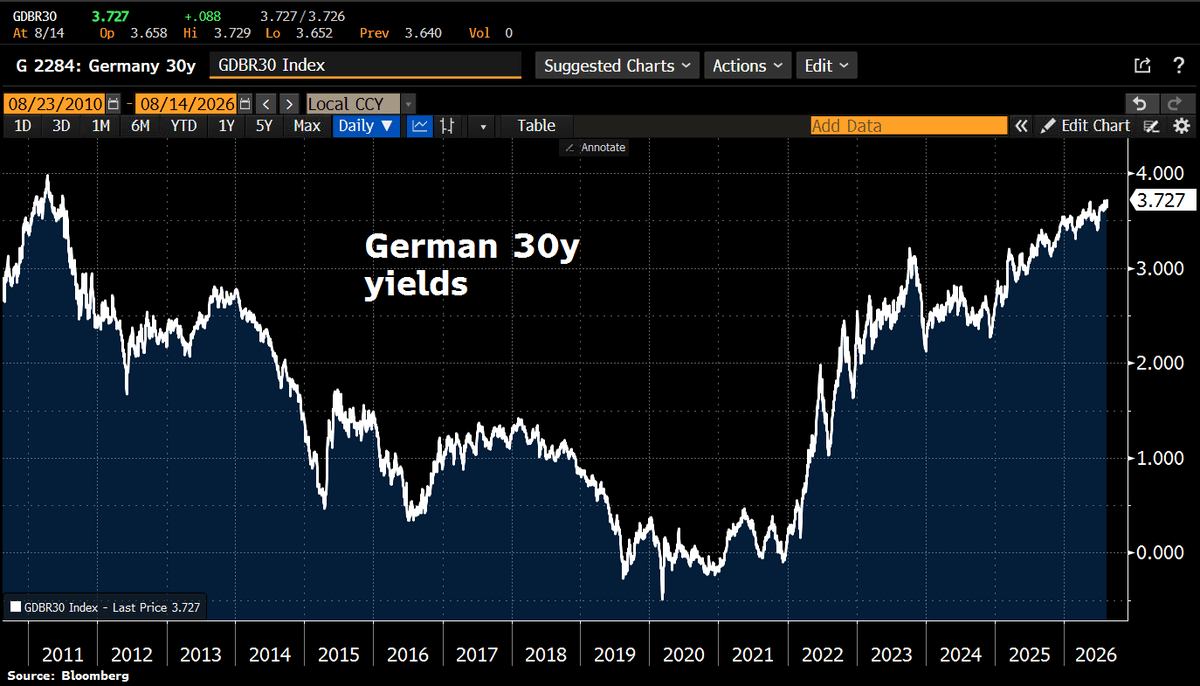
Bund yield chart provided by Holger Zschaepitz in his X post on August 15, 2026.

The yield on long-term French OAT bonds (short for Obligations Assimilables du Trésor) has returned to levels characteristic of the global financial crisis period. The yield on Japan's 5-year government bonds rose above 2.14%, marking a clear break after years of artificially soft monetary policy.

Investors Demand Compensation

Bond yield is the price governments pay investors for their money. When yields rise sharply, bond prices fall, and borrowing quickly becomes more expensive.

For over a decade after the 2008 financial crisis, central banks kept rates low and purchased vast amounts of government debt. This drove down yields, which in Europe and Japan even fell below zero. The pandemic doubled down on this trend: governments borrowed freely, and central banks prevented the market from asking inconvenient questions.

This scheme is collapsing. Investors providing credit for decades ahead now want protection from inflation, rampant bond issuance, and the erosion of the purchasing power of the cash they will get back.

"This week has seen a significant rise in the yields of long-term government bonds in heavily indebted European countries," explained Robin Brooks, a senior fellow in the Economic Studies Program at the Brookings Institution. "The situation is most notable in France, where the yield on 10y10y (orange line) and 10y20y (red line) has reached new historical highs."

Brooks added:

"The market's patience with fiscal dysfunction is running out."

Debt Markets Begin to Dictate Terms

The pressure point is fiscal policy—the growing gap between government spending and tax revenues. The United States, France, Japan, and other developed economies have accumulated massive debt while simultaneously increasing spending on defense, infrastructure, energy, and addressing aging populations.

In the US, according to recent estimates, the federal government's annual interest expense has exceeded $1 trillion. Each refinancing cycle locks in higher rates, turning yesterday's debt into tomorrow's budgetary problem.
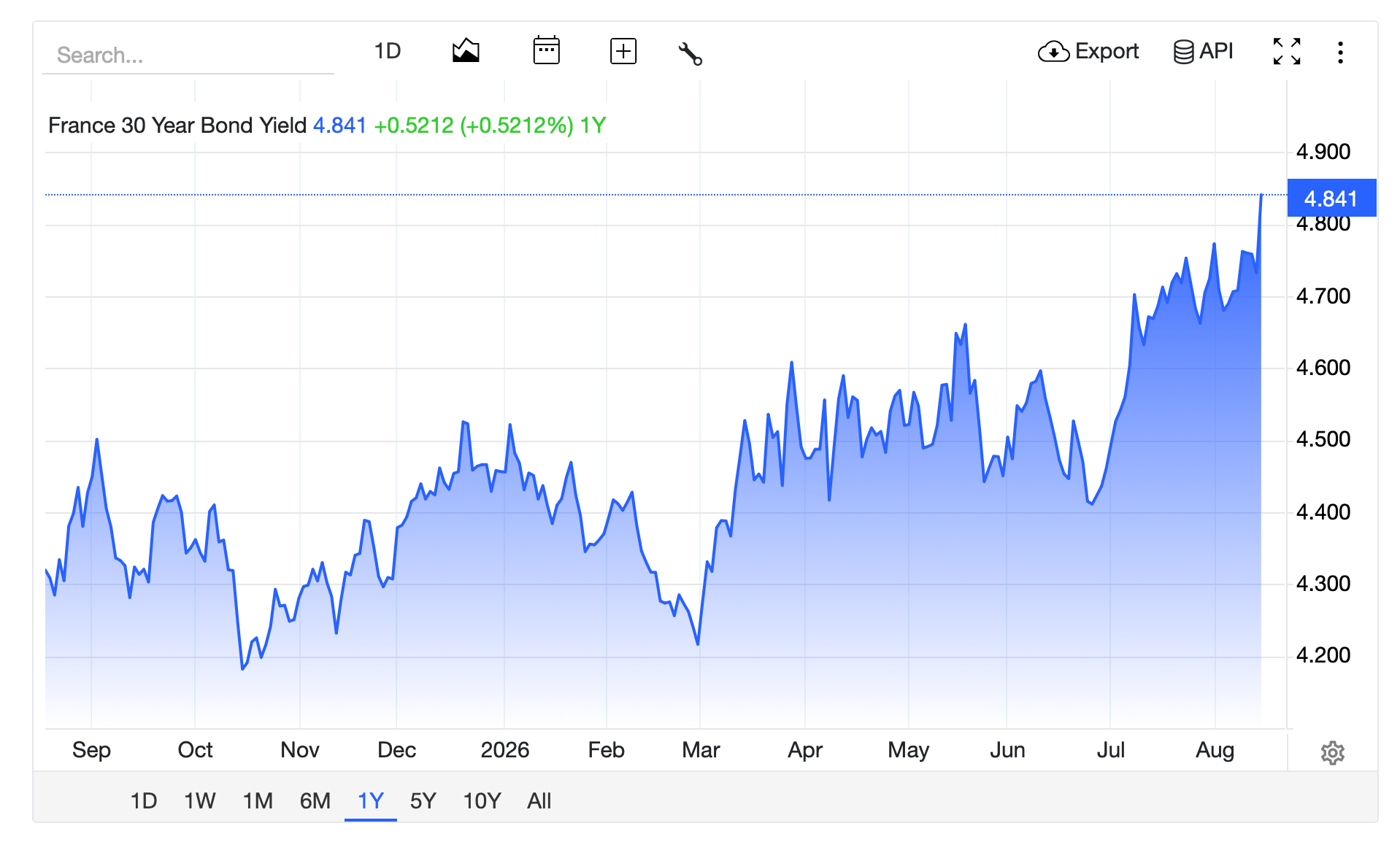
Yield on France's 30-year bonds according to tradingeconomics.com.

France has its own political and budgetary issues. Bond market participants are closely watching spending negotiations and debt forecasts, contributing to the rise in French bond yields compared to German benchmark bonds.

Germany, long considered the eurozone's most reliable borrower, plans to increase spending on infrastructure and defense. This means a larger supply of bonds, i.e., more government debt competing for investors' money.

Central Banks Exit the Market

Japan's actions are hard to ignore, as the Bank of Japan for years suppressed yields through yield curve control—a policy designed to keep borrowing costs low. As it gradually unwinds this regime, markets are re-pricing for higher rates and much less official support.

"Cheap money was a temporary phenomenon," wrote the Wealthmoose account on X. "Debt is forever. Now the bond market is presenting the bill."

The same trend is visible elsewhere. The Federal Reserve and other central banks have shrunk their bond portfolios through quantitative tightening, thereby removing a major buyer from the market.

Governments are flooding the market with bonds while central banks are buying fewer and fewer of them. Private investors can buy these securities, but only at higher yields. This extra compensation is the term premium—the fee for locking money away in long-term bonds.

The Bill Extends Beyond Government Budgets

The rise in long-term yields primarily hits households through mortgage rates. In the US, 30-year mortgage rates often follow Treasury yields, making home buying and refinancing more expensive.

Businesses face higher rates when issuing long-term bonds. Stocks also suffer as higher bond yields attract cash flows and reduce the present value investors assign to distant future profits. Savers, pension funds, and insurance companies can earn more on bonds. However, this resource reallocation comes at a high cost to governments and borrowers accustomed to the cheap money era.

end-content

Perguntas relacionadas

QWhat has caused long-term bond yields in major economies like the US and Germany to surge to multi-year highs?

AA large-scale, synchronized sell-off in the bond market has pushed yields to levels not seen in many years or even decades. This reflects a fundamental shift from the era of ultra-cheap money, as central banks withdraw support and investors demand higher compensation for inflation and fiscal risks.

QAccording to market analysts cited in the article, what message is the bond market sending to governments with high debt?

AThe bond market is sending a clear signal that its patience with fiscal dysfunction is running out. Analysts like Robin Brooks state that investors are now demanding a premium for lending to governments for decades, seeking protection against inflation, rampant bond issuance, and the erosion of purchasing power.

QWhat are the two main factors creating the current pressure on bond markets, according to the article?

AThe two main factors are expansive fiscal policy (governments increasing spending and accumulating huge debt) and the withdrawal of central bank support. Governments are flooding the market with new bonds while central banks are buying fewer of them through quantitative tightening, forcing private investors to step in only at higher yields.

QHow do rising long-term bond yields impact the broader economy beyond government budgets?

ARising long-term yields make mortgages and corporate borrowing more expensive, dampen stock prices by reducing the present value of future earnings, and increase costs for all borrowers. While savers and pension funds may earn more, the overall effect is a costly redistribution of resources away from entities accustomed to cheap money.

QWhat specific example illustrates the breaking of Japan's long-standing artificial monetary policy regime?

AThe yield on Japan's 5-year government bonds rose above 2.14%, which the article describes as a clean break after years of artificially soft monetary policy. This reflects the Bank of Japan's gradual retreat from its Yield Curve Control policy, forcing markets to reprice debt with much less official support.

Leituras Relacionadas

Meme Coins Peak in 17.2 Days on Average: Ephemeral Fervor and the Great Capital Migration

Meme Coins' Average Peak: 17.2 Days - A Fleeting Frenzy and a Capital Exodus A Bloomberg analysis reveals the stark reality behind meme coin mania: extreme short-term speculation. On average, a new meme coin reaches its all-time high (ATH) a mere 17.2 days after its first trade. Alarmingly, 25% of projects peak within just 38.4 hours. The subsequent decline is brutal, with the median time to drop 95% from the peak and enter dormancy being 370 days. Only about 3% ever break their previous ATH again. This drastic compression of the speculative lifecycle is driven by zero-barrier token creation on platforms like Pump.fun and automated trading tools like sniper bots, which enable instant deployment and rapid pump-and-dump schemes. The market is saturated, diluting liquidity and forcing a predatory, player-versus-player environment where early holders quickly exit with minimal gains. As the odds of success in traditional meme coins diminish, speculative capital is migrating. Decentralized prediction markets like Polymarket, offering transparent, event-driven betting, are attracting significant liquidity. Concurrently, AI agent tokens are drawing funds with their combination of high volatility and long-term narrative tied to artificial intelligence. This capital shift marks a move away from simplistic "greater fool" assets toward platforms with clearer mechanisms or dynamic technological themes.

marsbitHá 18m

Meme Coins Peak in 17.2 Days on Average: Ephemeral Fervor and the Great Capital Migration

marsbitHá 18m

CoreWeave Default Probability Exceeds 60%! Huang Renxun 'Puts Out Fire': Financing Costs Declining, No Need for NVIDIA to Provide Backstop

CoreWeave, a major AI cloud service provider and key NVIDIA customer, is facing heightened credit market concerns. Its five-year credit default swap (CDS) spreads soared to a record high of over 1190 basis points, implying a perceived default probability exceeding 60%. Concurrently, its bond prices plummeted, with yields surging above 15-16%, reflecting intense investor worries about its ability to service nearly $50 billion in debt while remaining unprofitable. This stress is spreading within the AI infrastructure sector. CDS spreads for companies like Oracle, SoftBank, NVIDIA, and others also widened significantly, indicating a broader market reassessment of the debt risks behind massive AI capital expenditures. In response, NVIDIA CEO Jensen Huang publicly expressed confidence in CoreWeave, stating its "financial strength is growing daily" and its cost of capital is declining. He explicitly stated NVIDIA sees no need to provide a financial backstop for CoreWeave, in which it holds a roughly 10% stake. His comments helped CoreWeave's stock recover from early losses. The core issue under scrutiny is whether the future cash flows from AI investments can cover the enormous upfront costs and interest burdens, especially as financing becomes more expensive. The situation highlights a critical shift in market focus: from purely evaluating AI compute demand to questioning the sustainability of the debt-fueled expansion models used to build that capacity.

marsbitHá 37m

CoreWeave Default Probability Exceeds 60%! Huang Renxun 'Puts Out Fire': Financing Costs Declining, No Need for NVIDIA to Provide Backstop

marsbitHá 37m

Farcaster Changes Hands Again: The Hottest Potato in the Decentralized World

The decentralized social protocol Farcaster has changed ownership for the third time in nine months, being described as a "hot potato" in the decentralized world. On October 15, 2026, Rish, co-founder of Neynar, announced that Network School, founded by Balaji Srinivasan, would take over Farcaster, including its application, protocol codebase, and related products. This followed Neynar's acquisition of Farcaster from its original creator, Merkle Manufactory, in January 2026. Farcaster, which achieved a $1 billion valuation after a $150 million Series A round in 2024, saw its user activity and revenue decline sharply post-2025. Daily active users (DAU) dropped 40% from its peak of nearly 100,000, and monthly revenue fell to around $10,000. After taking over, Neynar pivoted Farcaster toward developers, but protocol revenue (including from Clanker) plummeted by 99% from Q1 to Q3 2026, leading to the search for a new owner. Network School, Balaji Srinivasan's venture practicing his "network state" theory and recently valued at $2 billion, plans to rebrand Farcaster as the "Network State Protocol." Significant rule changes include requiring users to accept a "social smart contract" to mint an NFT for full access, implementing content moderation based on Singaporean public conduct codes, and introducing AI-assisted review with potential human verification. These changes, particularly the centralized control over content and access via the dominant official app (formerly Warpcast), have sparked community debate. The repeated ownership transfers highlight a core tension in decentralized social networking: while the protocol layer is technically decentralized, control over the primary user application grants centralized power over the entire network's experience and direction. Each new owner brings a different vision, but all face the fundamental challenge of reviving a platform with declining users and revenue.

marsbitHá 38m

Farcaster Changes Hands Again: The Hottest Potato in the Decentralized World

marsbitHá 38m

US Stock Market Trends (October 16): Dow Surges Over 550 Points, TSMC's Net Profit Rises Nearly 70% but Stock Closes Lower

**U.S. Market Trends (October 16): Dow Jumps Over 550 Points, TSMC Falls Despite 69% Net Profit Surge** U.S. stocks reversed early losses on Thursday. The Dow Jones surged over 550 points (1.08%), while the Nasdaq Composite edged up 0.08%. The Philadelphia Semiconductor Index fell for a seventh consecutive session, closing down 0.88%. The S&P 500 rose 0.33%, with healthcare, materials, and financials leading gains. Energy and tech sectors declined. Major tech stocks were mixed. Microsoft and Alphabet gained, while Nvidia and Tesla fell. Server stocks like Dell and Hewlett Packard Enterprise dropped sharply. Despite reporting strong Q3 results—a 69% year-on-year jump in net profit and raising its full-year revenue growth forecast to ~44%—TSMC's U.S.-listed shares fell 1.80%. Investor concerns persist about funding for massive AI/data center expansions and their eventual returns. CoreWeave's stock rebounded to close nearly 6% higher after Nvidia CEO Jensen Huang stated the AI cloud provider was strengthening and did not need rescue, easing equity investor worries. However, its bonds remained under pressure due to high leverage and funding needs. Economic data showed mixed signals. September PPI surged 1.3% month-on-month (the highest since March 2022), driven by energy prices. Retail sales grew 0.8%, largely fueled by gasoline spending. Excluding autos and gas, growth was minimal. Despite hot inflation prints, Treasury yields retreated, with the 10-year near 5.09%. Oil (WTI) rose over 3%, while gold gained 2%. Bitcoin traded around $82,300. Focus turns to upcoming remarks from Fed officials ahead of the quiet period and key data like industrial production, as investors weigh inflation against growth concerns and tech sector volatility.

marsbitHá 54m

US Stock Market Trends (October 16): Dow Surges Over 550 Points, TSMC's Net Profit Rises Nearly 70% but Stock Closes Lower

marsbitHá 54m

Trading

Spot
活动图片