a16z Crypto Partner: Cash Flow is the Moat

marsbitPublicado em 2026-06-12Última atualização em 2026-06-12

Resumo

Cash Flow as the Moat: A Playbook for Crypto Founders Historically, the most enduring businesses have been built by positioning themselves within the "flow of funds"—facilitating the creation and transfer of value in a network and extracting a portion of it. Cryptocurrency is the first modern technology natively built for this purpose. For startups, failing to architect products and businesses to leverage these principles means missing a major opportunity. Blockchains are inherently network businesses. Each transaction settles on a shared ledger, and every new participant strengthens the underlying network for all. Well-designed network tokens amplify this by aligning users, developers, and validators around growing the network, with value flowing back to contributors in a transparent feedback loop. This model is not new; companies from railroads and Standard Oil to Google, Meta, and AWS have thrived by inserting themselves into critical flows of value (goods, attention, compute). Financial markets make it even clearer: firms like Visa and major market makers generate immense revenue not by predicting markets but by being in the path of transactions. The combination of fund flow and network effects creates one of the most durable business structures. The high margins in traditional finance (payments, custody, lending, FX) represent prime targets. Crypto founders have the opportunity to build the next version—programmable, instant, global, and natively in the flow of funds...

Author: Jason Rosenthal, a16z Operating Partner

Translation: Hu Tao, ChainCatcher Selection

Many of history's greatest businesses were built by positioning themselves in the "flow of funds"—facilitating the creation and transfer of value within a network and taking a cut of it. The more value that flows through the network, the larger the business typically becomes.

Cryptocurrency is the first modern technology natively built for this purpose. If your startup hasn't yet architected its product and business to benefit from these principles, you're missing an opportunity. Thanks to stablecoins, capital and value now flow at internet speed—settling globally, 24/7, with end-to-end programmability. Payment channels are unobstructed, unit economics are transparent, and every dollar flowing anywhere in the world is reachable.

The Model

Blockchains are network businesses by design. Every transaction settles on a shared ledger. Each new participant reinforces the same underlying network that the next builder can use. As more people use and build on it, the network becomes more valuable to all users.

Most companies spend years manufacturing network effects on top of traditional infrastructure. Crypto founders inherit them as a starting condition.

Network tokens amplify this. Well-designed tokens can align users, developers, suppliers, validators, and protocols around a single outcome—growing the network—and pay proportionally to each participant's contribution. But the protocol's revenue belongs to the people who use it. No partner rebates, no side deals. Just a feedback loop between value flowing through the system and value accruing to the hands of those building and growing it.

This isn't a new model. Cryptocurrency just makes it accessible and scalable for startups for the first time.

Railroads didn't make money from locomotives. They made money from every ton of grain, coal, and steel that crossed their tracks. Standard Oil, U.S. Steel, and AT&T were all companies in the flow of funds. Google and Meta displaced print and TV not because their ads were better, but because they sat at the chokepoint where attention converts to commerce, enabling them to take a cut of trillions in commercial intent. AWS is in the flow of computation.

The model is consistent: find where value flows, and position yourself in the middle of it.
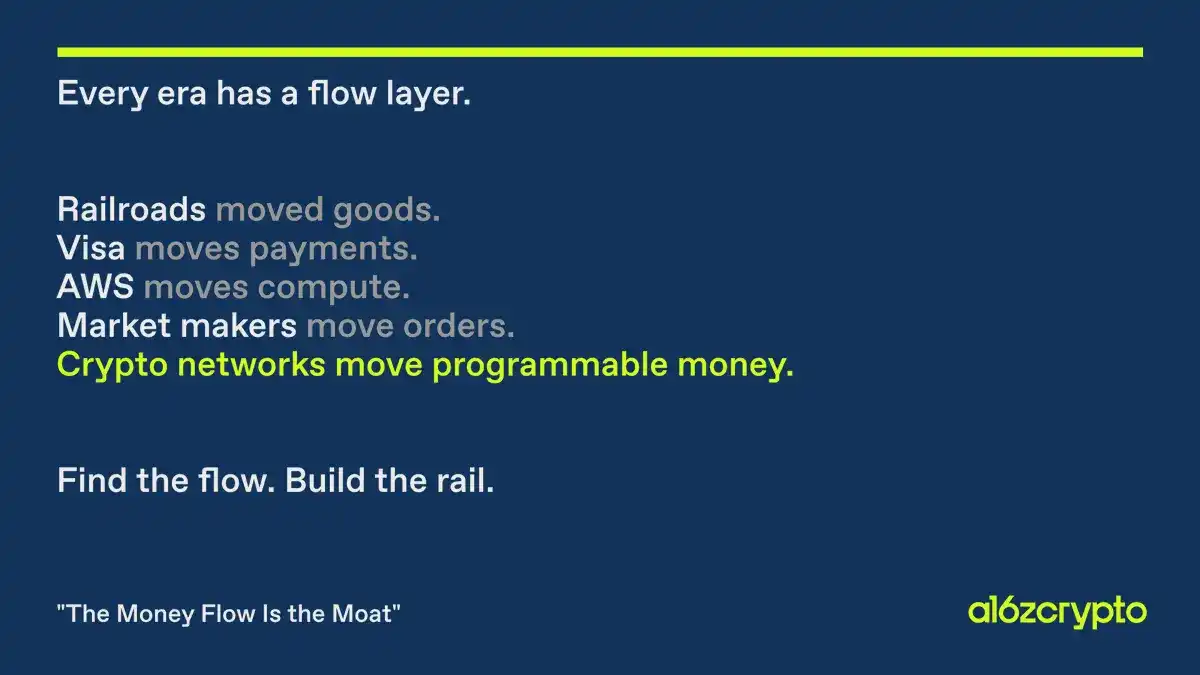
Financial markets make this model even clearer. Visa processed $15.7 trillion in payment volume in FY2024, reporting $35.9 billion in net revenue. Jane Street posted $20.5 billion in net trading revenue last year—more than Citigroup or Bank of America. The top five U.S. market makers handled 87% of order flow payment: they don't predict the market; they sit in the flow of every order and earn more as trading volume grows.

These businesses share another commonality: network effects. Visa is more useful to more merchants because there are more cards; more useful to more cardholders because more merchants accept it. It's the same with order flow—each additional broker narrows spreads, attracting more brokers, which attracts more flow.

The flow of funds plus network effects is one of the most durable business structures ever.

Your Margin is My Opportunity

Bezos called it "your margin is my opportunity." He was talking about retail, but it applies even more to traditional financial services—the world's largest pool of margin extraction. Payments, custody, lending, FX, securitization, settlement, market making—all of it. Visa and Mastercard charge 2-3% transaction fees on networks designed in the 1960s. Remittance corridors charge 6-9%. Prime brokers and custodians take a piece of every securities trade. Even after the U.S. shifted to T+1 settlement in 2024, money still sits idle overnight as a structural tax on every participant.

Each of these margins is a target. Compress cost, increase speed, and potentially expand the entire market. Stripe and Square proved this is possible in payments.

Crypto founders have the opportunity to build the next version—programmable, instant, global, and natively in the flow of funds.

And the frontier extends far beyond financial services. Compute and GPU markets. Memory chips. AI training data. Energy. Robotics. Space. Rare earth metals. Each category is an area where global value can begin to flow at volumes the existing rails were never designed to handle.

Each is an open field for building flow-of-funds businesses from the ground up on programmable infrastructure. These markets have no existing rails, no entrenched intermediaries, and nothing to defend.

As a founder, ask yourself:

1. Are you in the flow of funds today?

2. When the value of activity on your product grows 10x, does your revenue grow with it?

3. If you're building a new product, where in your target market is the margin extraction highest relative to the value being created?
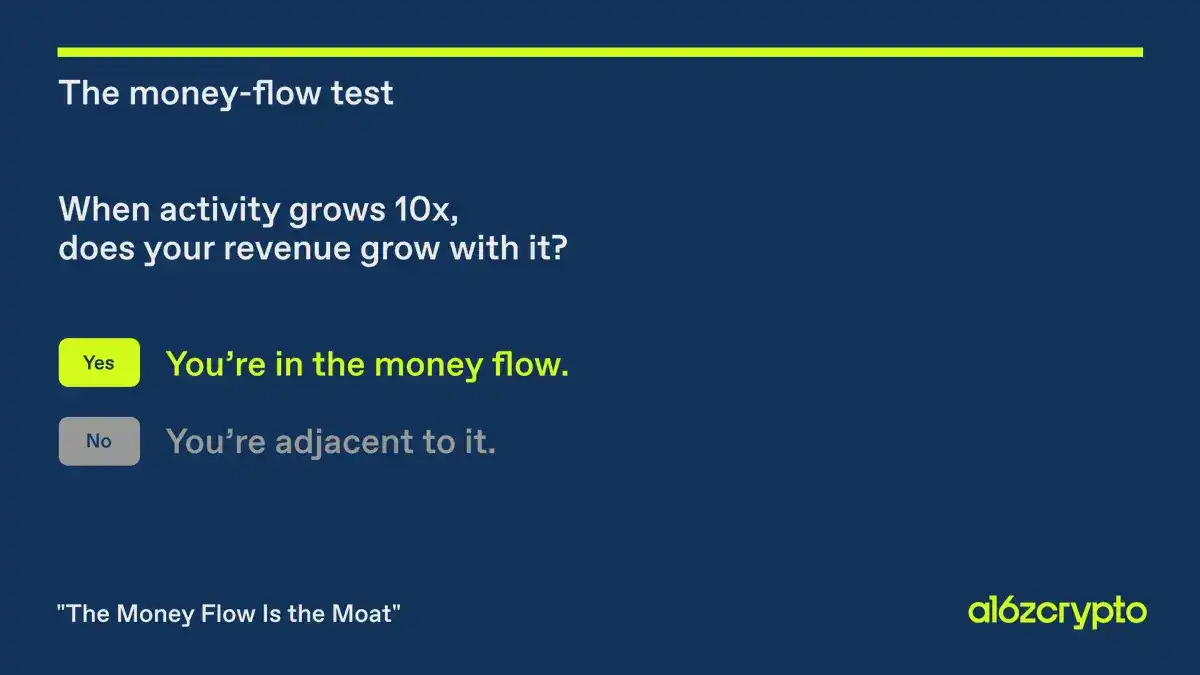
The opportunity is there. Seize it, ride the new flow, and let the network compound from there.

Criptomoedas em alta

Perguntas relacionadas

QAccording to the article, what are the core characteristics of successful business models historically?

AHistorically, many of the best businesses positioned themselves within 'cash flows'—facilitating the creation and transfer of value within a network and taking a cut of that flow. The more value that flows through the network, the larger the business typically becomes.

QHow does the article describe the fundamental advantage that cryptocurrency offers for startups?

ACryptocurrency is the first modern technology natively built for cash flow. It enables value to move at internet speed—24/7, global settlement, with end-to-end programmability—providing startups with accessible and scalable network effects and open unit economics from the start.

QWhat is the relationship between network tokens and business growth as explained in the text?

AWell-designed network tokens align users, developers, suppliers, validators, and the protocol around a single outcome: growing the network. Participants are paid proportionally to their contributions. This creates a feedback loop between the value flowing through the system and the value accumulating to those building it, without private deals or rebates.

QWhat does the phrase 'your margin is my opportunity' refer to in the context of the article?

AIt refers to the opportunity for new, often crypto-native, businesses to compete by targeting high-margin areas in traditional industries (especially financial services). By reducing costs, increasing speed, and building on programmable infrastructure, they can capture market share from established players with inefficient profit structures.

QWhat are the three key questions founders should ask themselves, according to the article's conclusion?

A1. Are you in the cash flow today? 2. When the value of activity on your product grows 10x, does your revenue grow with it? 3. If you're building a new product, where in your target market is the profit-taking highest relative to the value being created?

Leituras Relacionadas

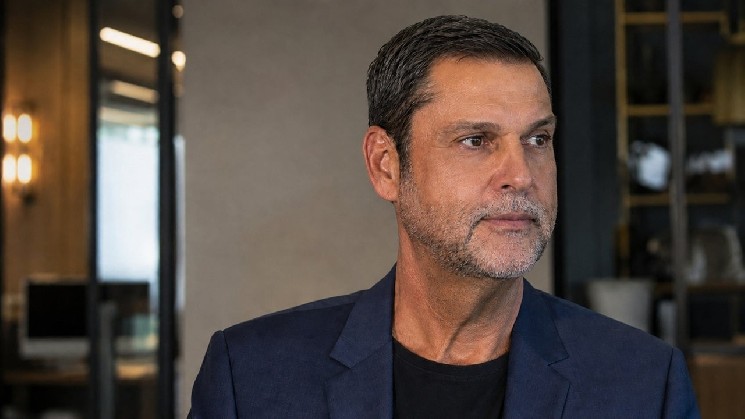
Raoul Pal: Bitcoin's 87% Correlation with Global Liquidity Outweighs Financial Results and News

Raoul Pal, founder of Real Vision and former Goldman Sachs hedge fund manager, asserts that Bitcoin and major indices like the Nasdaq trade primarily based on global liquidity conditions, not fundamentals like earnings or news. He claims an 87% correlation between Bitcoin and global liquidity, with Nasdaq showing a 97% correlation. Global liquidity is measured by central bank balance sheets, the M2 money supply, and bank lending growth. Analysts at crypto market maker Keyrock developed a model supporting Pal's correlation claim, noting an eight-month lag between Treasury bill issuance and Bitcoin's price response. Pal's theory, which he detailed earlier this year, posits that central banks are forced to inject liquidity in a recurring cycle to manage global debt refinancing every four years. This forms the basis for his $450,000 Bitcoin price target, contingent on continued liquidity expansion. The high correlation suggests Bitcoin and tech stocks are trading as similar liquidity indicators rather than distinct asset classes. This view challenges narratives centered on Bitcoin's own supply dynamics, halving cycles, or adoption news. Michael Saylor of MicroStrategy has expressed a similar sentiment, downplaying the halving cycle's dominance in favor of capital flows from ETFs, corporate treasuries, and sovereign reserves. It's noted that Pal's post does not include the original datasets or methodology. Furthermore, the correlation's strength has fluctuated in 2026, and Keyrock's model indicates an eight-month lag, meaning current correlations reflect past, not real-time, liquidity conditions. The future path of central bank balance sheet expansion remains a key test for Pal's thesis.

cryptonews.ruHá 3m

Raoul Pal: Bitcoin's 87% Correlation with Global Liquidity Outweighs Financial Results and News

cryptonews.ruHá 3m

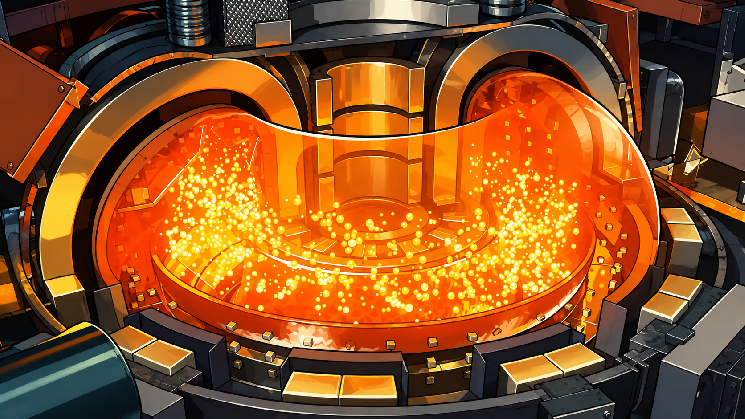
The Heart of the 'Artificial Sun': China Builds Largest Magnet for Fusion Reactor

On June 27, 2026, China's Institute of Plasma Physics announced the successful development and comprehensive testing of two key superconducting magnets for its "artificial sun" fusion reactor project. These magnets are crucial for containing plasma exceeding 100 million degrees Celsius within a vacuum chamber using powerful magnetic fields. The first is a D-shaped toroidal field magnet, claimed to be the world's largest for a fusion reactor. Measuring 21m long and weighing 582 tons, it has 1.3 times the volume and triple the stored energy of its counterpart in the international ITER project. Key parameters include a 98 kA operating current and 120 GJ of stored energy. Sixteen such magnets will eventually form a ring generating a central field of 6.5 Tesla to confine the plasma. Concurrently tested was a high-temperature superconducting central solenoid. It stably carries 60 kA of current and plays a critical role in inducing and sustaining the plasma current, essentially "igniting" the fusion reaction. All key technologies and materials are domestically developed, with 47 patents filed. The magnets are destined for the BEST (Burning Plasma Experimental Superconducting Tokamak) device, with assembly planned by 2027 and a demonstration of power generation targeted for around 2030. Fusion is pursued as a potential source of vast, clean energy without long-lived radioactive waste. While this marks a significant technical achievement, the article's concluding AI perspective notes the ongoing race between China's state-funded, large-scale approach and private ventures in other countries betting on compact, high-field magnets, highlighting funding sustainability as a key long-term factor.

cryptonews.ruHá 58m

The Heart of the 'Artificial Sun': China Builds Largest Magnet for Fusion Reactor

cryptonews.ruHá 58m

Trading

Spot

Artigos em Destaque

Como comprar FLOW

Bem-vindo à HTX.com!Tornámos a compra de Flow (FLOW) simples e conveniente.Segue o nosso guia passo a passo para iniciar a tua jornada no mundo das criptos.Passo 1: cria a tua conta HTXUtiliza o teu e-mail ou número de telefone para te inscreveres numa conta gratuita na HTX.Desfruta de um processo de inscrição sem complicações e desbloqueia todas as funcionalidades.Obter a minha contaPasso 2: vai para Comprar Cripto e escolhe o teu método de pagamentoCartão de crédito/débito: usa o teu visa ou mastercard para comprar Flow (FLOW) instantaneamente.Saldo: usa os fundos da tua conta HTX para transacionar sem problemas.Terceiros: adicionamos métodos de pagamento populares, como Google Pay e Apple Pay, para aumentar a conveniência.P2P: transaciona diretamente com outros utilizadores na HTX.Mercado de balcão (OTC): oferecemos serviços personalizados e taxas de câmbio competitivas para os traders.Passo 3: armazena teu Flow (FLOW)Depois de comprar o teu Flow (FLOW), armazena-o na tua conta HTX.Alternativamente, podes enviá-lo para outro lugar através de transferência blockchain ou usá-lo para transacionar outras criptomoedas.Passo 4: transaciona Flow (FLOW)Transaciona facilmente Flow (FLOW) no mercado à vista da HTX.Acede simplesmente à tua conta, seleciona o teu par de trading, executa as tuas transações e monitoriza em tempo real.Oferecemos uma experiência de fácil utilização tanto para principiantes como para traders experientes.

288 Visualizações TotaisPublicado em {updateTime}Atualizado em 2026.06.02

Como comprar FLOW

Discussões

Bem-vindo à Comunidade HTX. Aqui, pode manter-se informado sobre os mais recentes desenvolvimentos da plataforma e obter acesso a análises profissionais de mercado. As opiniões dos utilizadores sobre o preço de FLOW (FLOW) são apresentadas abaixo.

活动图片