Morgan Stanley Report Analysis: Foldable iPhone Expected to Contribute $14 Billion, Pro Models to See Price Increase Over $200

marsbitPublished on 2026-09-04Last updated on 2026-09-04

Abstract

Morgan Stanley Research Report Summary: Foldable iPhone and Pro Price Hikes Morgan Stanley's pre-iPhone 18 launch report maintains an Overweight rating on Apple with a $360 target. The key takeaway is the introduction of a foldable iPhone, seen as the most significant hardware change since the iPhone X, set to contribute approximately $14 billion in revenue in its first December quarter. The Pro models are expected to see their largest price increases in years, driven by rising memory costs, with the iPhone 18 Pro starting at $1,299—a $200 increase. The foldable iPhone, with a predicted base price of $2,399, is forecast to have strong initial demand. It features design trade-offs like an in-display fingerprint sensor instead of Face ID and a dual-camera system. The hardware launch coincides with new CEO John Ternus's debut as the keynote presenter. For the iPhone 18 Pro series, the core upgrade is the move to a 2nm A20 Pro chip, promising significant performance and efficiency gains to support advanced on-device AI. However, memory supply constraints pose a potential risk to production volumes. Overall, Morgan Stanley believes the combination of a lengthening iPhone upgrade cycle, global AI feature rollout, and the new foldable form factor will accelerate iPhone growth. The report highlights Ternus's presentation, the foldable's user experience, and Apple's pricing strategy as critical factors for the stock's performance post-launch.

Author: Rita

Apple's September 9th event will unveil its first foldable iPhone, while the Pro series sees its largest price hike in years. On September 1st, Morgan Stanley released its iPhone 18 launch preview report, maintaining an Overweight rating with a $360 price target. Morgan Stanley considers this the most significant iPhone hardware transformation since the iPhone X. The foldable model is projected to have initial production of 7 to 8 million units in the second half of 2026, with its first product cycle potentially reaching 20 million units, contributing approximately $14 billion in revenue in the December quarter alone.

This event holds another layer of significance: Tim Cook will no longer host, marking the first stage appearance for new CEO John Ternus. Morgan Stanley believes that Ternus's performance, the user experience of the foldable device, and how Apple balances price increases with market demand will determine the direction of Apple's stock price through the end of the year.

Foldable: The Biggest Hardware Shift Since iPhone X

Apple is entering the foldable phone market seven years later than Samsung. Morgan Stanley views this as the most significant change in hardware form factor since the iPhone X and the greatest test of Apple's pricing power. Market expectations for the foldable's starting price range from $2300 to $2500, with Morgan Stanley's base case forecast at $2399 (for the 512GB model). Every 1% penetration of the foldable model in overall iPhone shipments is expected to lift the Average Selling Price (ASP) by about 1.5 percentage points.

The foldable model makes some hardware trade-offs: it replaces Face ID with a fingerprint sensor, and the rear camera system includes only wide and ultra-wide lenses, omitting a telephoto lens. Its thickness when folded is thinner than the iPhone Air, and advanced hinge and screen technology nearly eliminate the crease.

Morgan Stanley's consumer survey indicates significant interest in foldable devices among iPhone users, particularly in the Chinese market. Market feedback for the Samsung Galaxy Z Fold 8 (starting at $1899) also suggests genuine demand for the book-style foldable form factor. Morgan Stanley expects the foldable iPhone to sell out quickly, with strong demand and constrained initial supply.

2nm Chip is the Real Upgrade for Pro Series

Hardware changes for the iPhone 18 Pro series are relatively conservative. The biggest upgrade comes from the chip: the first application processor, the A20 Pro, manufactured using TSMC's 2nm process. TSMC data indicates that the 2nm process offers a 10% to 15% performance increase at the same power consumption, or a 25% to 30% power reduction at the same performance level.

Apple's recently released M6 chip (also using 2nm) provides a reference point. Compared to the 3nm M5, the M6 adds two "super CPU cores" for the first time, increases GPU cores by two, and boosts Neural Engine peak performance by up to 100%. The A20 Pro is confirmed to use Wafer-Level Chip-on-Wafer (WLC) packaging technology, offering greater design flexibility, improved speed, and better thermal management compared to the Integrated Fan-Out (InFO) packaging used over the past decade.

Morgan Stanley believes the computational power boost from the 2nm chip will support two key Apple narratives: more powerful on-device AI capabilities (Siri AI) and higher product pricing.

Largest Price Hike, Memory Cost is Core Variable
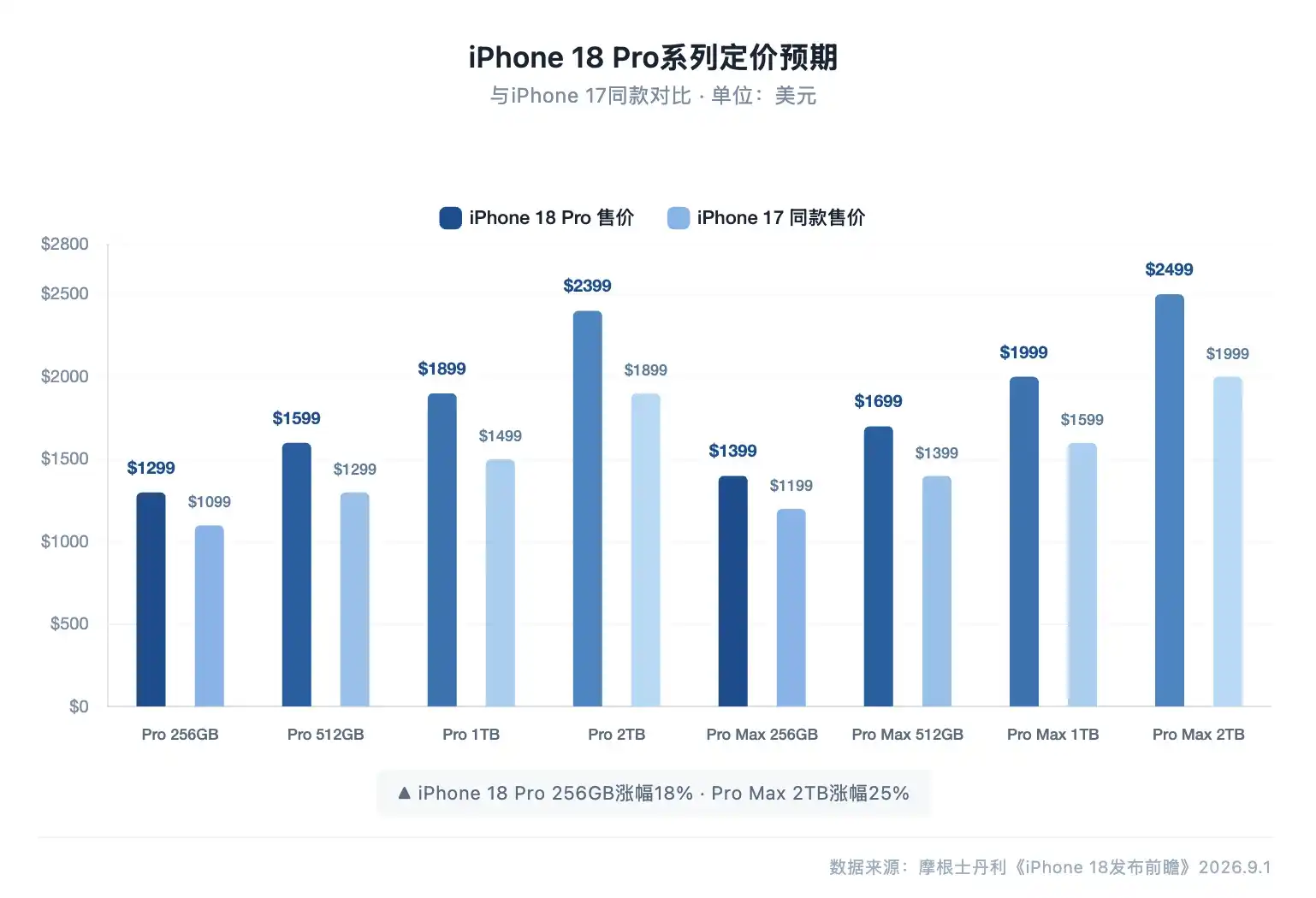
The Pro series is set for its most substantial same-model price increase in years. Morgan Stanley expects the iPhone 18 Pro (256GB) to start at $1299, a $200 (18%) increase from the iPhone 17 Pro's $1099 starting price. The iPhone 18 Pro Max (256GB) is forecast to start at $1399, also a $200 (17%) increase from the previous generation's $1199. Price hikes for the 1TB and 2TB models are even larger, with the Pro Max 2TB seeing a 25% increase.

The primary driver of the price increase is rising memory costs. Apple's DRAM consumption for iPhone production in the first half of 2026 grew nearly 50% year-over-year, while NAND consumption grew over 30%. Morgan Stanley calculates that the $200 price increase is sufficient to cover the memory cost inflation and maintain a gross margin of approximately 40%.

Morgan Stanley acknowledges the price hike is not without risk. Consumer price sensitivity, changes in trade-in values, and the prevalence of installment payment plans will all impact demand elasticity. Apple's supply chain plans suggest the company is currently more concerned about securing enough components than finding enough buyers.

Supply is the Bottleneck, Memory May Constrain Production

Apple's total component orders for 2026 iPhones are projected at 265 to 270 million units, representing 5% to 7% year-over-year growth. Combined production for the iPhone 18 Pro, Pro Max, and foldable models in the second half is estimated at around 81 million units. In the past week, TSMC's 2nm wafer orders saw a slight increase and pull-in, equivalent to adding an extra 2 to 3 million iPhone units to production. It is uncommon to increase supply chain forecasts before a product launch, especially when existing plans already reflect the company's internal "bull case" scenario.

Memory supply remains the biggest uncertainty. If Apple fully executes its current component order plan, DRAM consumption in the second half of 2026 would increase by about 15% year-over-year, and NAND by about 25%. This is an aggressive target given that the consumer memory market is already tight. Morgan Stanley has not yet incorporated the recent wafer order increase into its iPhone shipment forecasts, awaiting post-launch sales data for confirmation.

Recommendations and Risks

Morgan Stanley maintains an Overweight rating on Apple with a $360 price target, based on a price-to-earnings ratio of approximately 35x on its fiscal year 2027 earnings per share estimate of $10.30. The longest iPhone replacement cycle, the global rollout of AI features, and the new hardware form factor are expected to jointly drive accelerated iPhone growth.

Upside risks include the iPhone 18 exceeding expectations, higher-than-expected adoption of Apple Intelligence, new product line launches, and re-acceleration in services growth. Downside risks include consumer spending weakness limiting replacement rates, rising memory costs, slow progress in AI features, geopolitical tensions, and tighter App Store regulation.

The September 9th event carries narrative significance beyond hardware, marking the debut of the Ternus era. Morgan Stanley will closely watch three variables: Ternus's performance under the spotlight, whether the foldable's software and hardware experience can catalyze demand, and how Apple balances price increases, profit margins, and demand for new versus legacy models.

Disclaimer

This article is a compilation and interpretation by ChaoXiang Research of a third-party brokerage research report (Morgan Stanley, September 1, 2026), combined with publicly available market information. The ratings, price targets, earnings forecasts, and related judgments cited herein represent the views of the respective brokerage analysts, reflecting their institutional positions. They do not represent the views of ChaoXiang Research and do not constitute any investment advice.

The market involves risks, and decisions should be made independently. This article should not serve as the basis for buying or selling any securities.


Related Questions

QAccording to the Morgan Stanley report, what are the key factors that will determine Apple's stock price trajectory through the end of the year following the September 9th event?

AAccording to the Morgan Stanley report, the key factors are: 1) The performance of new CEO John Ternus in his first keynote presentation. 2) The user experience of the new foldable iPhone hardware and software. 3) How Apple balances the significant price increases with market demand.

QWhat is Morgan Stanley's rationale for the iPhone 18 Pro series price increase of over $200?

AMorgan Stanley states the primary driver of the price increase is rising memory costs. Apple's DRAM consumption for iPhone production in H1 2026 grew nearly 50% year-over-year, and NAND grew over 30%. The $200 price hike is calculated to cover these increased memory costs while maintaining Apple's gross margin around 40%.

QWhat does Morgan Stanley identify as the single biggest hardware form factor change for the iPhone since the iPhone X?

AMorgan Stanley identifies Apple's entry into the foldable phone market with the new foldable iPhone as the single biggest hardware form factor change since the iPhone X.

QWhat is the potential revenue contribution Morgan Stanley forecasts for the foldable iPhone in its first product cycle, specifically for the December quarter?

AMorgan Stanley forecasts that the foldable iPhone could contribute approximately $14 billion in revenue in just the December quarter of its first product cycle.

QWhat specific technological advancement is highlighted as the core upgrade for the iPhone 18 Pro series, and what are its expected benefits?

AThe core upgrade is the A20 Pro application processor, which will be Apple's first chip built on TSMC's 2nm process. TSMC data suggests the 2nm process offers a 10-15% performance increase at the same power, or a 25-30% power reduction at the same performance. This advancement is seen as foundational for more powerful on-device AI capabilities and justifying higher product pricing.

Related Reads

Nobel Laureate Hassabis Delivers Another Masterpiece: AlphaGenome 2 Deciphers 98% of Human DNA 'Dark Matter'

DeepMind has unveiled AlphaGenome 2, a next-generation DNA foundation model led by Nobel laureate Demis Hassabis. While AlphaFold decoded only the 2% of the human genome that encodes proteins, AlphaGenome 2 targets the remaining 98% of non-coding "dark matter," which harbors gene-regulatory switches and over 90% of disease-causing mutations. Released alongside a 78-page technical report, the model delivers four major breakthroughs. First, it achieves single-cell resolution, trained on over 107 million single cells across 68 human tissues, doubling the rate at which it identifies pathogenic mutations—raising detection from 16% to 30% and directional accuracy from 23% to 43% on the TenK10K immune-cell benchmark. Second, it reproduces years of Nature-published research purely through computation: with zero wet-lab experiments, it correctly identified a distant regulatory mutation that over-activates ETS2 across 290,000 bases to cause inflammatory bowel disease, and precisely located the regulatory site and GATAA core sequence targeted by approved sickle-cell CRISPR therapy. Third, a new cell encoder lets the model interpret previously unseen diseases from just dozens of patient cells without retraining—identifying 41% of pathogenic mutations in unseen Parkinson's brain samples versus 17% for a specialized model, and uncovering a hidden severe-COVID mutation active only in immune-activated T cells. Finally, DeepMind released free databases covering 640 real human cell types and impact scores for nearly 7 million genetic variants across 510 cell states, with APIs and Colab tutorials open for non-commercial research. The model will soon be packaged as Skills and integrated into Google Antigravity for direct use by Gemini 4, promising to dramatically shorten the cycle of disease investigation and drug discovery.

marsbit37m ago

Nobel Laureate Hassabis Delivers Another Masterpiece: AlphaGenome 2 Deciphers 98% of Human DNA 'Dark Matter'

marsbit37m ago

Midterm Elections Settled, What Lies Ahead for the CLARITY Act?

The CLARITY Act (Digital Asset Market Clarity Act), which had already struggled before the election, now faces dim prospects after Democrats swept both chambers in the midterms. On September 15, a Senate cloture motion on the House-passed bill failed 49-50, eleven votes short of the 60-vote threshold. All 49 yes votes came from Republicans; the opposition included all Democrats present, two independents, and four Republicans (Collins, Hawley, Moran, Tillis). Even if absentee Democrat Coons had voted yes and the four Republicans had flipped, the tally would have reached only 54—still short. The bill's core compromise would make the CFTC the primary regulator for digital commodities and trading platforms while preserving clear SEC authority; jurisdictional division and added ethics provisions are the main disputes. Democrats will control both chambers when the new Congress opens January 3, 2027, leaving little incentive to cooperate during the lame-duck session. Only two theoretical paths remain before the 119th Congress ends: renegotiate the text and hold another cloture vote via Tillis's reconsideration motion, or attach crypto market structure provisions to must-pass December legislation such as government funding (expiring December 11) or the NDAA. Both are unlikely, given the tight legislative calendar and Democratic leverage. Stablecoin oversight continues separately under the GENIUS Act and OCC rulemaking. If the bill dies, it must be reintroduced in the 120th Congress, where Democrats—likely led by Elizabeth Warren and Maxine Waters—are expected to draft a very different framework expanding SEC authority and narrowing the CFTC's role. Key things to watch before January 3: any new cloture vote or revised text, any attempt to attach provisions to funding or defense bills, outstanding vote counts in Alaska, Mississippi, and House districts, and the incoming committee chair selections. Absent such developments, the CLARITY Act is effectively finished as a 2026 legislative project.

marsbit37m ago

Midterm Elections Settled, What Lies Ahead for the CLARITY Act?

marsbit37m ago

4.8 Billion Dollars: Tether's Hand Has Reached Into 13 U.S. Public Companies

Tether, the world's largest stablecoin issuer, holds roughly $4.8 billion in public-market exposure across 13 U.S.-listed companies, according to a Protos review of regulatory filings. Its holdings span a controversial video platform, gold royalty companies, a satellite firm, bitcoin miners, and a bitcoin treasury project. Key positions include a 50.3% stake (including warrants) in Rumble (RUM), though voting power is capped below 9.9%; Rumble has also acquired Tether's Northern Data and counts Tether as its most important advertising client, committed to $50 million annually for two years. Tether and Bitfinex are controlling shareholders of Twenty One Capital (XXI), with rights to nominate four of seven directors, including Tether CEO Paolo Ardoino; the company trades at about 60% of its bitcoin value. In gold, Tether holds about 27% of Elemental Royalty (ELE), 12.6% of Gold.com (GOLD), 12.6% of Versamet Royalties (VMET), 14.6% of Metalla (MTA), 14.4% of Gold Royalty (GROY), 12% of Aurelion (AURE), and about 8% of Antalpha (ANTA). It also holds 19.7% of Bitdeer (BTDR) and a stake in Adecoagro (AGRO), plus shares in Satellogic (SATL), 9.9% of SDEV (down about 99%), and a stake in VCI Global (VCIG) via Oobit. Powerlaw Corp (PWRL) claims roughly $20 million in Tether equity. The exposure is concentrated in a few large holdings—Twenty One, Rumble, and Adecoagro—showing Tether's growing role as a multi-sector financial institution that also places executives in key positions.

marsbit1h ago

4.8 Billion Dollars: Tether's Hand Has Reached Into 13 U.S. Public Companies

marsbit1h ago

Trading

Spot
活动图片