Crypto Should Be Judged By Economic Role, Not Tech Design: ASIC Fintech Chief

bitcoinistPublicado em 2026-03-11Última atualização em 2026-03-11

Resumo

According to Rhys Bollen, head of fintech at the Australian Securities and Investments Commission (ASIC), consumer harm in crypto primarily stems from intermediaries—exchanges, custodians, lenders—rather than the tokens themselves. In a paper presented at the Melbourne Money and Finance Conference, Bollen argued that Australia should regulate digital assets based on their economic function, not their technological design. Tokens that act like securities should be treated as such, stablecoins moving money should fall under payments law, and consumer protection rules should cover the rest. This approach contrasts with jurisdictions like the U.S. and EU, which are creating crypto-specific laws. Australia is already implementing this through its Digital Asset Framework bill, which integrates digital assets into existing financial regulations rather than building a separate legal structure.

Most harm done to consumers in the crypto space has come not from the tokens themselves, but from the platforms handling them — the exchanges, custodians, lenders, and yield services.

That finding sits at the center of a new paper delivered this week by Rhys Bollen, the head of fintech at the Australian Securities and Investments Commission, who argues Australia should stop treating digital assets as something categorically new and start applying the financial laws already on the books.

Regulating What It Does, Not What It’s Called

Bollen made the case at the Melbourne Money and Finance Conference, where he argued that crypto tokens should be judged by their economic function. A token that acts like a security should be treated as one. A stablecoin that moves money should fall under payments law.

Consumer protection rules should pick up whatever else remains. His argument strips away the technological wrapping and asks a simpler question: what does this thing actually do?
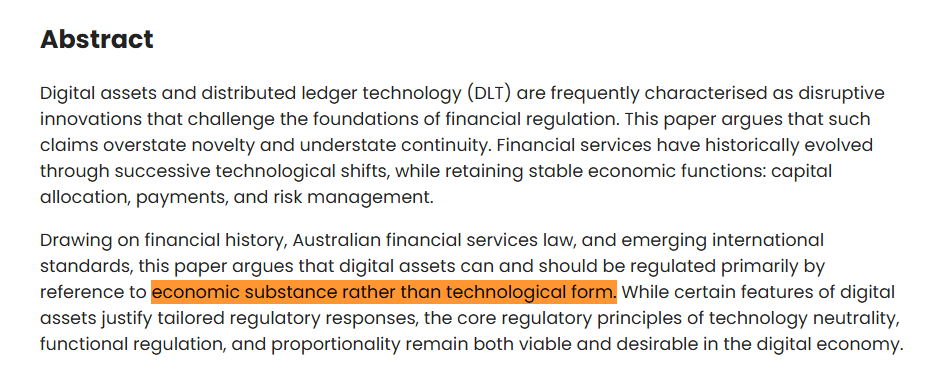
Paper presented at the Melbourne Money & Finance Conference, University of Melbourne by Dr. Rhys Bollen, Senior Executive Leader, FinTech

Crypto-Specific Law

That framing puts Australia at odds with how other countries have gone about it. The US is pushing the CLARITY Act, a purpose-built crypto framework. The European Union has rolled out its Markets in Crypto-Assets rules, known as MiCA. Both create dedicated regulatory structures for digital assets.

Bollen’s position, by contrast, is that building a separate system from scratch misses the point — and leaves gaps that bad actors will find.

“Opportunities for regulatory arbitrage” is how Bollen describes those gaps. Build a crypto-specific law, and someone will structure a product to fall outside it. Attach crypto to existing law based on what the product does, and that exit shrinks.

BTCUSD trading at $69,615 on the 24-hour chart: TradingView

Australia Already Writing It Into Law

Australia isn’t waiting on theory. The country’s Digital Asset Framework bill, currently moving through parliament, doesn’t attempt to replace the Corporations Act.

Reports indicate the bill amends it — slotting digital asset platforms into the existing regulatory structure rather than building a lane beside it.

ASIC’s own guidance document, Information Sheet 225, has already confirmed that existing definitions of financial products and services under the Corporations Act can apply to crypto, depending on how a given asset functions.

Bollen was direct about what that means in practice. Regulators, he said, should be focused on intermediaries — the companies sitting between users and their crypto — rather than on the tokens themselves. That’s where the consumer harm has actually shown up.

Featured image from Cyber Security News, chart from TradingView

Perguntas relacionadas

QAccording to Rhys Bollen, where has most consumer harm in the crypto space originated from?

AMost consumer harm has come not from the tokens themselves, but from the platforms handling them, such as exchanges, custodians, lenders, and yield services.

QWhat is the core argument made by the ASIC FinTech chief regarding how crypto should be regulated?

ACrypto tokens should be judged by their economic function rather than their technological design, meaning a token that acts like a security should be treated as one, and existing financial laws should be applied based on what the product actually does.

QHow does Australia's proposed regulatory approach for digital assets differ from that of the US and EU?

AAustralia is amending its existing Corporations Act to slot digital assets into the current regulatory structure, whereas the US is pushing the purpose-built CLARITY Act and the EU has created a dedicated framework called MiCA.

QWhat does the term 'regulatory arbitrage' refer to in the context of crypto regulation, as mentioned by Bollen?

A'Regulatory arbitrage' refers to the opportunities for bad actors to structure crypto products in a way that falls outside the scope of a purpose-built, crypto-specific regulatory framework, thereby creating gaps in consumer protection.

QWhat is the practical focus for regulators that Bollen suggests to prevent consumer harm in the crypto space?

ARegulators should focus on the intermediaries—the companies that sit between users and their crypto, such as platforms and service providers—rather than on the tokens themselves, as that is where the actual consumer harm has occurred.

Leituras Relacionadas

Web4 Is Here: When the Internet Is No Longer Built Only for Humans

Amid a crypto bear market, a significant debate has emerged around redefining the internet's future, sparked by the concept of "Web4" introduced by crypto researcher Sigil Wen. He argues that advanced AI lacks not intelligence, but "write access to the world"—the ability to act autonomously via wallets, payments, and smart contracts. This idea, termed the "Web4 Manifesto," resonated widely, gaining millions of views and triggering industry reflection. Dragonfly's Haseeb Qureshi added that crypto's complexity—long addresses, irreversible transactions, phishing risks—may stem from it being designed more for AI than humans. These features, cumbersome for people, are structured and verifiable for AI agents. Web4 proposes shifting internet agency from humans to AI, granting it "action rights": reading, writing, transacting, and collaborating autonomously. Projects like OpenClaw demonstrate this shift, enabling AI to manage emails, calendars, and tasks independently. Underlying protocols (e.g., Coinbase’s x402, Anthropic’s MCP, Google’s A2A) are standardizing machine-to-machine interactions, making the internet more agent-friendly. Cryptocurrencies, especially stablecoins, are positioned as ideal "machine money"—programmable, low-friction, and embeddable in automated workflows. Real-World Assets (RWA) could serve as reserves for AI economies. This vision suggests crypto’s future lies not in human adoption but in enabling agent-driven economies, with billions of AI agents potentially using wallets. However, Vitalik Buterin cautions against reduced human oversight, emphasizing the need for accountability and control. The Web4 debate highlights a fundamental shift: the internet is evolving from a human-operated interface to a system where humans delegate actions to AI agents, redefining who the primary users are.

marsbitHá 1h

Web4 Is Here: When the Internet Is No Longer Built Only for Humans

marsbitHá 1h

Trading

Spot
Futuros
活动图片