2026 New Policy Interpretation: The "Mutual Pursuit" of Intelligent Agents and AI Terminals, and the Three Major Value Reconstructions in the AIoT Industry

marsbitPublicado em 2026-05-12Última atualização em 2026-05-12

Resumo

In May 2026, China's national ministries released two pivotal policy documents that jointly establish a strategic "dual-track" framework for the AIoT industry. The "Intelligent Agent Standardized Application and Innovation Development Implementation Opinions" defines the "soul"—positioning intelligent agents as core AI products. The "Artificial Intelligence Terminal Intelligence Grading" national standard defines the "body"—establishing a four-tier capability ladder (L1 to L4) for AI hardware. This synchronized policy approach is globally unique, moving beyond market-led (US) or risk-focused (EU) models. It frames AIoT as a new type of "intelligent infrastructure," comparable to electricity or the internet in historical significance. The core analysis identifies a value evolution from IoT 1.0 (connection) to AIoT 4.0 (collaboration, represented by the forward-looking L4 level). This "L4" signifies a paradigm shift: from users operating tools to delegating tasks to agent-like devices ("Intelligent Action of All Things"). The article outlines three strategic paths for companies: becoming Standard Definers, Scenario Integrators (focusing on 19 specified application areas), or Infrastructure Builders. A critical 18-24 month window is identified for strategic positioning. A "Four Levers" strategy is proposed: leveraging Standards (L-level certification), leveraging Scenarios (deep vertical focus), leveraging Open Source (for cost reduction and ecosystem influence), and leveragi...

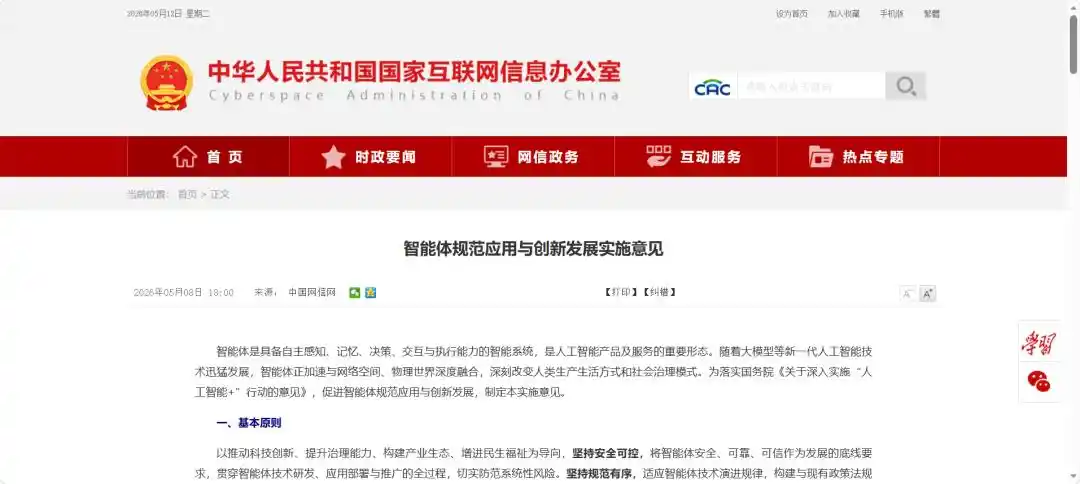
May 8, 2026, is destined to be written into the development history of China's AIoT industry. Multiple national-level ministries dropped two strategic anchors concerning the next decade on the same day.

The first one is the "Implementation Opinions on the Standardized Application and Innovative Development of Intelligent Agents" jointly issued by the Cyberspace Administration of China, the National Development and Reform Commission, and the Ministry of Industry and Information Technology. For the first time, it defines intelligent agents from a national policy perspective as intelligent systems with capabilities of autonomous perception, memory, decision-making, interaction, and execution. It proposes 19 typical application scenarios around scientific research, industrial development, stimulating consumption, people's livelihood and well-being, and social governance.
The second one is the series of national standards "Intelligence Grading for Artificial Intelligence Terminals" (GB/Z 177—2026) jointly released by the Ministry of Industry and Information Technology, the State Administration for Market Regulation, the Ministry of Commerce, and other departments. It establishes a four-level capability ladder from L1 (responsive) to L4 (collaborative), with the first batch covering seven categories: mobile phones, computers, TVs, glasses, automotive cockpits, speakers, and earphones.
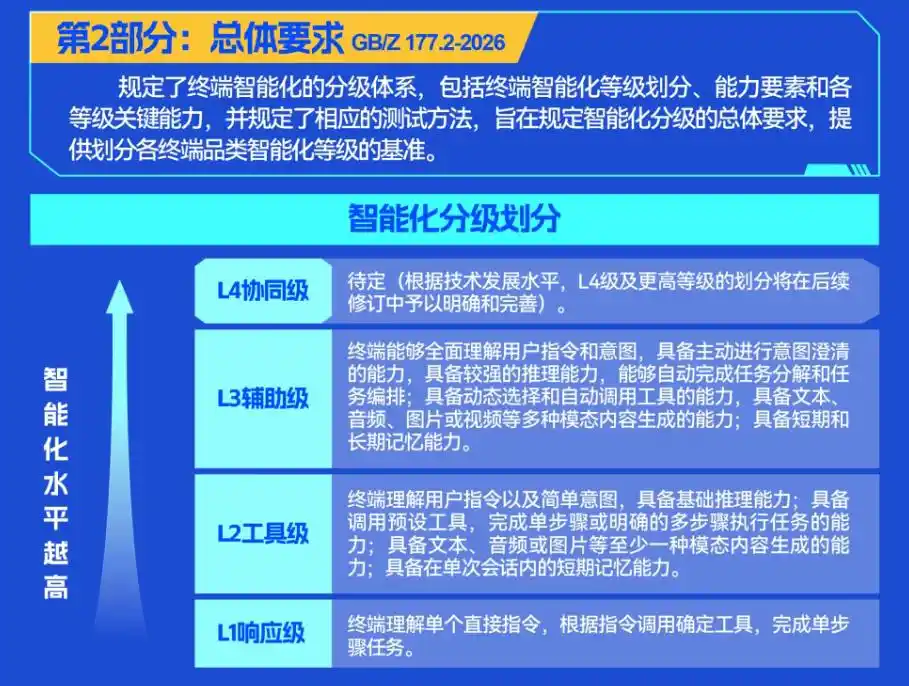
Image source: Ministry of Industry and Information Technology Weibo

The simultaneous release of these two documents is by no means a coincidence. This is a policy-level mutual pursuit: intelligent agents move downward, seeking physical carriers; intelligent terminals move upward, seeking intelligent cores. One defines the intelligent software agent, the other defines the intelligent hardware carrier, together constituting a "dual-track" top-level design of "spirit and body."

This leads to the core judgment of this article: China is defining AIoT as a new type of infrastructure—intelligent infrastructure—whose importance is on the same order of magnitude as historically defining electricity and the internet as infrastructure.

Regarding this already-begun industrial race, this article will share three progressively deepening observations:

What exactly do the two standards reveal (seeing the signal)?

What does L4 truly mean (understanding the paradigm)?

How should AIoT companies proceed next (grasping the window)?

Dual-Track Standard Setting: The World's Unique Top-Level Design for AIoT

What landed on May 8th were not two policies, but a dual-axis coordinate system. The "Implementation Opinions on the Standardized Application and Innovative Development of Intelligent Agents" defines the "spirit," and the "Intelligence Grading for Artificial Intelligence Terminals" defines the "body." Understanding this coordinate system is key to understanding the next decade of China-style AIoT.

This design has three layers of industrial meaning.

The first layer: AI capabilities have been reduced from conceptual vocabulary to engineering indicators for the first time.

Over the past two years, the biggest pain point in the AIoT industry has been conceptual generalization, parameter stacking, and a disconnect between marketing and user experience. The Grading standard uses the L1 to L4 capability ladder to transform intelligence from a vague adjective into a measurable, comparable, and certifiable product attribute. This is essentially issuing the entire industry a unified "physical examination form," bidding farewell to pseudo-intelligence and parameter involution, and providing a basis for judgment.

The second layer: Intelligent agents are positioned as a product form, not an application-layer add-on.

The Implementation Opinions clearly define intelligent agents as an important form of artificial intelligence products and services, and emphasize guiding manufacturers of complete machines, software, etc., to develop products and services based on intelligent agents. The policy implications of these two sentences are extremely important: intelligent agents are no longer functional modules attached to hardware but are primary industrial entities on par with PCs and smartphones. This repositions the power structure of the entire AIoT industry chain.

The third layer: The drafting units themselves present a map of the industry's deployment.

The main drafting units of the Grading standard include industry players like Huawei, Honor, Xiaomi, OPPO, Vivo, Lenovo, Unisoc... all hardware players. In contrast, the implementation path outlined in the Implementation Opinions simultaneously involves large model manufacturers, open-source communities, chip manufacturers, and operating system manufacturers. This means that in the next five years, the key bargaining nodes in the AIoT industry chain will emerge at two intersecting points: how hardware players become carriers for intelligent agents, and how intelligent agent players penetrate hardware operating systems.

Viewed from a global perspective, the uniqueness of this dual-track standard-setting approach becomes even clearer.

The U.S. follows a market competition path, neither defining what an intelligent agent is nor grading AI terminal capabilities, leaving it entirely to leading enterprises like OpenAI, Anthropic, Apple, and Google to compete at the product level. The European Union follows a risk regulation path. The AI Act regulates only by risk level of use case, not touching product form. Japan and South Korea follow corporate ecosystems.

China has chosen a third way, establishing a coordinate system for both the software agent and the hardware carrier using national standards. This practice of simultaneously setting standards for both software and hardware is unique in the global AI policy landscape of the same period.

Historically, the most compelling parallel is China's dual-credit policy for new energy vehicles. Released in 2017 and implemented in 2018, the dual-credit policy seemed like just a technical industry management measure. However, by simultaneously binding the production and sales targets for new energy vehicles with fuel consumption targets for conventional vehicles—one hand setting standards, the other creating pressure—it directly reshaped the competitive dimensions of the entire Chinese automotive industry. A decade later, China's new energy vehicle production and sales have ranked first globally for many consecutive years, transforming from an industry follower to a global leader.

The AIoT dual-standards of May 8th are highly similar in policy design philosophy to the dual-credit policy. Both use a combination of soft and hard measures, capability and direction, to leverage the overall leap forward of a trillion-level industry. The difference is that this time, it's not just about leveraging one industry but a new type of infrastructure.

Intelligent Action of All Things: How L4 is Rewriting the Value Anchor of AIoT

Within the four-level capability ladder provided by "Intelligence Grading for Artificial Intelligence Terminals," the L4 collaborative level is deliberately left blank. The standard explicitly states it will be further clarified and improved in subsequent revisions based on industrial development levels. What seems like a technical blank space is, in reality, a very sober acknowledgment by policymakers: L4 is not yet clear, but it is certainly coming.

This unclear level is precisely the biggest variable for the future of the entire AIoT industry.

Looking back at the value evolution path of AIoT, a clear curve can be drawn.

The core value of IoT 1.0 was connectivity, with device networking enabling data backhaul and remote control.

The core value of AIoT 2.0 was cognition, with devices possessing local AI capabilities for recognition, judgment, and response.

The core value of AIoT 3.0 is assistance, corresponding to L2 to L3, where devices have multimodal understanding and contextual judgment, upgrading from passive tools to proactive assistants. This is where current AI PCs and AI phones are positioned.

The core value of AIoT 4.0 will be collaboration, corresponding to L4, where devices become extensions of users in the physical world, actively perceiving scenarios, coordinating across devices, and autonomously executing tasks.

I summarize the endpoint of this curve in four words: Intelligent Action of All Things.
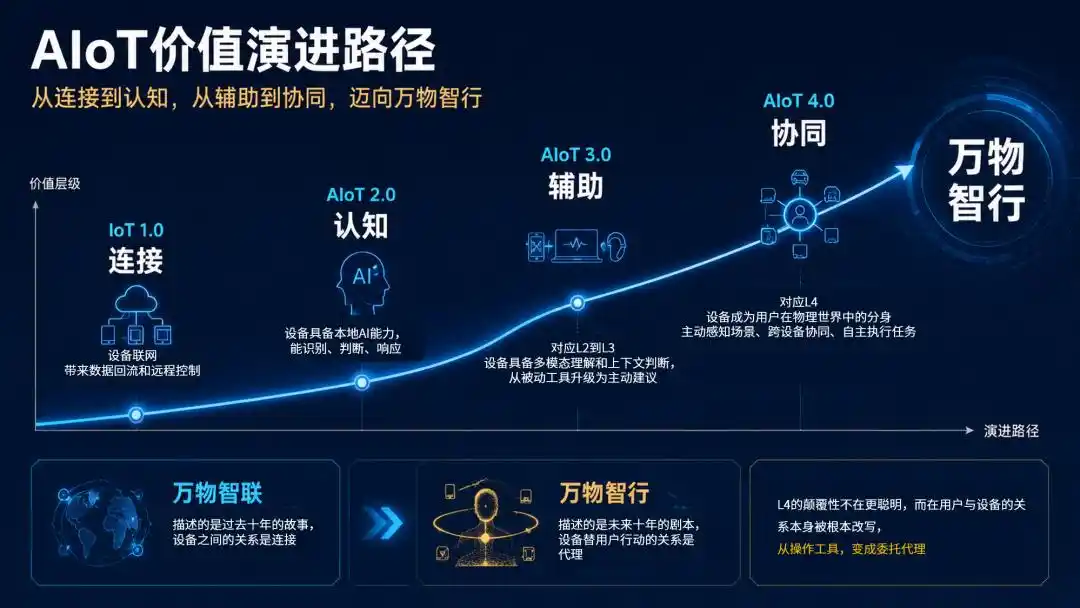
"Intelligent Connectivity of All Things" describes the story of the past decade, where the relationship between devices was connection. "Intelligent Action of All Things" describes the script for the next decade, where the relationship of devices acting on behalf of users is that of agency.

The disruptiveness of L4 lies not in being smarter, but in fundamentally rewriting the relationship between the user and the device itself—from operating a tool to delegating to an agent.

This paradigm shift is happening simultaneously in both the C-end and B-end, but in different forms.

For the C-end, the shift is from operating tools to delegating to agents.

The product logic from L1 to L3 is selling hardware with intelligence added. The product logic for L4 is selling agency capability, with hardware merely being an access point. The Grading standard explicitly mentions in the description of the highest-level capabilities that it should rely on personal large models and knowledge bases to achieve autonomous learning and continuous evolution of terminals. This means whoever masters the user's personal large model masters the user's long-term value.

Lenovo launching the Tianxi AI Personal Intelligent Agent and Huawei continuously upgrading Xiao Yi toward an Agent are essentially preempting positions at the L4 level.

Industrial chain power will shift from terminal brands to intelligent agent service providers. The business model will evolve from one-time hardware sales to a tripartite structure of hardware entry points, capability subscriptions, and data assets.

For the B-end, the shift is from data dashboards to autonomous execution.

Industrial Internet over the past decade primarily solved connectivity and visualization: sensors collected data, sent it to the cloud to generate dashboards, while decision-making and execution still relied on humans. With the introduction of intelligent agents, the logic has fundamentally reversed.

The Implementation Opinions explicitly propose the research and development of production management intelligent agents to dynamically optimize production scheduling, resource allocation, and process coordination. It also promotes the integration of intelligent agents with CNC machine tools, industrial robots, and automated production lines. Combined with the deployment for forward-looking layout in areas like multi-agent collaboration and intelligent internet, the smart factories of the future will no longer be assembly lines but rather an intelligent agent society composed of scheduling Agents, quality inspection Agents, and logistics Agents. They will autonomously negotiate, dynamically allocate resources, and collaboratively complete complex tasks.

The center of value gravity in the B-end is comprehensively shifting from data collection and PaaS platforms to vertical industry "Intelligent Agent as a Service."

The forms of transformation in the C-end and B-end differ, but they share the same singularity logic: manufacturers crossing the L4 threshold will define the rules for intelligent agents and occupy the value center; those failing to cross it will become the execution endpoints of intelligent agent rules, reduced to value channels.

This scene has been previewed once in history, right next door in the automotive industry. Before the emergence of the L0 to L5 autonomous driving classification, intelligent driving was just a concept, with each company claiming to be smarter. After the classification appeared, industry order, product positioning, consumer expectations, and liability division were all rewritten. Capital flow shifted from fragmentation to being highly concentrated around the L-levels.

Today's AIoT is replaying the same script, only this time the stage covers all device forms.

Based on this judgment, two clear industrial predictions can be made: Within the next 12 to 18 months, the first batch of L3-level nationally certified products will be launched intensively. The L-level will gradually replace computing power TOPS and parameter counts to become the new core yardstick for next-generation AIoT products. Within the next 18 to 24 months, L4 reference implementations will appear in flagship products from leading manufacturers, and personal intelligent agents will move from concept to scale.

L4 is not just a technical level; it is the singularity point of the AIoT industry.

Breaking Through with Four Leverages: The 18-Month Window for AIoT Companies to Position Themselves

The dual-track standard-setting plus scenario-driven path chosen by China opens up a globally unique strategic window for domestic AIoT companies. However, the validity period of this window may only be 18 to 24 months.

The key to understanding this path is to see that it is an overlay of three maps.

The Capability Map is the L1 to L4 grading of terminals, the yardstick on the supply side.

The Risk Map is the categorized and graded governance framework clarified in the Implementation Opinions. For sensitive fields and key industries, open scenarios are determined by the cyberspace administration in conjunction with competent industry authorities, implementing management measures such as filing, testing, and recall of problematic products. For low-risk fields like entertainment and daily office work, efficient governance is achieved through compliance self-testing, information reporting, distribution platform management, and industry self-regulation. This is the boundary on the demand side.

The Direction Map consists of 19 typical application scenarios plus the subsidy tilt for consumer goods trade-ins, serving as the guiding force on the industrial side.

The meaning of these three overlapped maps is that the state has already drawn clear boundaries for the game rules, leaving the track open for companies to run on.

The uncertainty of the U.S. path lies in market competition. The uncertainty of the EU path lies in the scope of regulation. The certainty of the Chinese path lies in the clear policy direction; companies only need to decide which position to secure. This is a paradigm shift from finding opportunities within policy uncertainty to seizing positions within policy certainty.

Next, all AIoT companies will be forced to answer a three-choice track question.
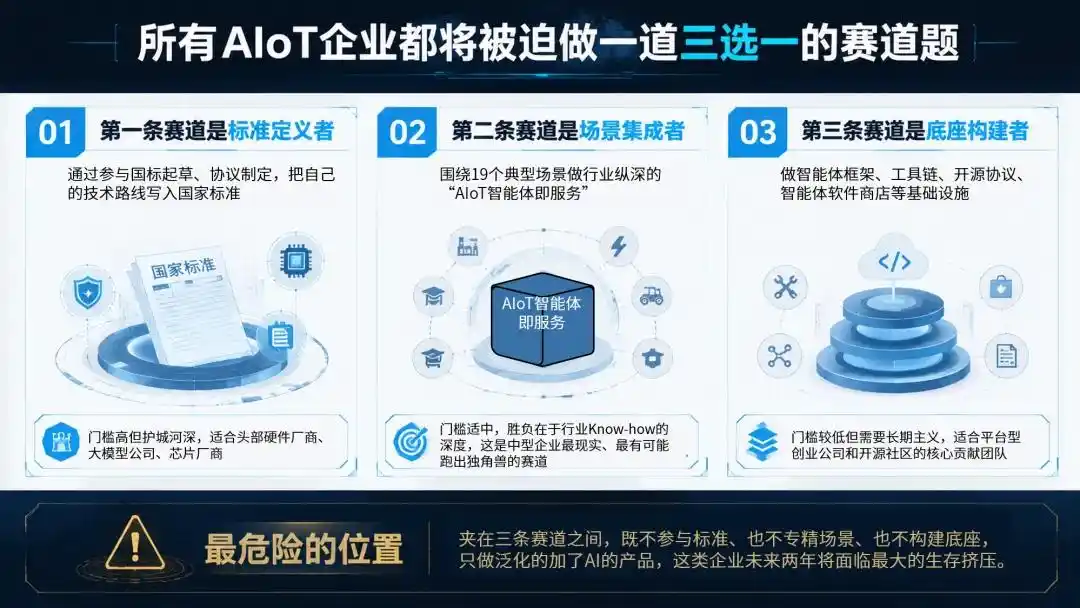
The first track is Standard Definers, writing their technical roadmaps into national standards by participating in the drafting of national standards and protocol formulation. The threshold is high, but the moat is deep, suitable for leading hardware manufacturers, large model companies, and chip manufacturers.

The second track is Scenario Integrators, focusing on providing "AIoT Intelligent Agent as a Service" with industry depth around the 19 typical scenarios. The threshold is moderate, and victory lies in the depth of industry know-how. This is the most realistic track for medium-sized enterprises and the one most likely to produce unicorns.

The third track is Base Builders, working on intelligent agent frameworks, toolchains, open-source protocols, intelligent agent software stores, and other infrastructure. The threshold is lower but requires a long-term approach, suitable for platform-type startups and core contributor teams of open-source communities.

The most dangerous position is being caught between the three tracks—neither participating in standard setting, nor specializing in scenarios, nor building the base, only making generalized products with AI added. Such enterprises will face the greatest survival pressure in the next two years.

After selecting a track, there are four common tactical levers worth immediately incorporating into strategic planning for the next 18 to 24 months. I summarize it as the "Four Leverages" strategy.

The first leverage is Leveraging Standards. The L-level national standards are essentially a super endorsement prepared by policy for enterprises. Companies that first achieve L3 and sprint towards L4 will gain triple benefits: consumer subsidy tilts, priority in government procurement, and consumer premium pricing. For leading manufacturers, the next competition is about the speed of L4 reference implementation. For small and medium-sized manufacturers, the real opportunity lies in achieving an L-level first benchmark in a specific niche category, such as the first L3 for AI glasses or the first L3 for AI home appliances. Instead of competing comprehensively across the seven major categories, it's better to achieve an L-level benchmark in one niche category.

The second leverage is Leveraging Scenarios. The 19 typical scenarios are not policy slogans but a directional blueprint for subsidy tilts, pilot openings, and procurement priorities in the next three years. Among them, the direction of intelligent manufacturing and the integration of intelligent agents with CNC machine tools/industrial robots is the most certain because China's manufacturing data foundation and application foundation are globally leading. The most crucial insight is: rather than ranking in the top ten in ten scenarios, aim to be in the top three in one scenario.

The third leverage is Leveraging Open Source. The Implementation Opinions explicitly call for conducting compatibility and adaptation of intelligent agents with open-source chips, open-source operating systems, and open-source large models. This is essentially issuing a collective cost-reduction coupon to AIoT entrepreneurs. However, a deeper insight gap exists: using open source reduces costs, but contributing to open source secures position. The value of a contributor identity is an order of magnitude higher than that of a user identity. Medium-sized and larger enterprises should reverse-contribute to open source to gain ecosystem leadership.

The fourth leverage is Leveraging Trends. Protocol ecosystems are becoming the new battlefield in global AIoT competition. Anthropic's MCP, Google's A2A, as well as ANP, ACP, etc., have already formed the first tier internationally. Chinese AIoT companies need a two-legged approach: one leg outward, actively participating in international protocol communities to occupy front-row seats; one leg inward, validating protocols through China's advantageous scenarios like industrial internet and smart homes, and then feeding them back into international standards.

Final Thoughts

The dual standards of May 8th are not the end of policy but the starting gun for a decade-level industrial race.

Looking back at the path of China's communications industry, from 1G blank, 2G followership, 3G/4G parallel running to 5G leadership, it took thirty years to complete the reversal of standard discourse power. Today's path of L-level plus protocol ecosystem for the AIoT industry has the opportunity to complete a leap of even greater magnitude in a shorter time. The protagonists of this leap are not nations but enterprises.

The nation has paved the track, drawn the starting line, and fired the gun. The remaining question is only one: As enterprises, which track are we on, and what stance do we use to start the race?

"Intelligent Connectivity of All Things" was the story of the past decade. "Intelligent Action of All Things" is the script for the next decade.

This article is from the WeChat public account "IoT Think Tank" (ID: iot101), author: Peng Zhao

Perguntas relacionadas

QWhat is the core significance of the dual standards (the 'Smart Body' implementation opinions and the 'AI Terminal Intelligence Grading') announced on May 8, 2026?

AThe dual standards represent a top-down national framework that defines both the software 'soul' (intelligent agents as autonomous systems) and the hardware 'body' (standardized intelligence levels for terminals). This coordinated 'spirit-and-flesh' design is unique globally and aims to establish AIoT as a new type of national-scale 'smart infrastructure' comparable to electricity or the internet, steering the entire industry towards a unified developmental trajectory.

QAccording to the article, what fundamental shift in user-device relationship does the L4 (Collaborative Level) in the AI terminal grading standard represent?

AL4 represents a paradigm shift from 'operating a tool' to 'delegating to an agent.' At L4, devices become proactive extensions of the user, capable of perceiving scenarios, coordinating across devices, and autonomously executing tasks. This transforms the core value proposition from selling hardware with added intelligence (L1-L3) to selling agentic capability, with hardware serving merely as an access point.

QWhat are the three strategic 'maps' that define the unique opportunity for Chinese AIoT companies, as described in the article?

AThe three overlapping maps are: 1) The 'Capability Map' defined by the L1-L4 terminal intelligence grading (supply-side scale). 2) The 'Risk Map' outlined by the classified governance framework for intelligent agents, which sets boundaries for different application domains (demand-side boundary). 3) The 'Direction Map' provided by the 19 typical application scenarios and policy incentives like subsidy programs (industry-side guidance). Together, they create a clear policy-defined playing field for companies to compete.

QWhat are the 'Four Borrowings' ('四借') strategy recommended for AIoT enterprises to capitalize on the 18-24 month window?

AThe 'Four Borrowings' strategy comprises: 1) Borrowing Standards ('借标'): Leverage the national L-grading for credibility, subsidies, and market advantage. 2) Borrowing Scenarios ('借场'): Deeply focus on the 19 government-highlighted application scenarios for targeted opportunities. 3) Borrowing Open Source ('借源'): Utilize and contribute to open-source chips, OS, and models to reduce costs and gain ecosystem influence. 4) Borrowing Momentum ('借势'): Engage with both international protocol ecosystems (e.g., MCP, A2A) and domestic advantage scenarios to shape global standards.

QWhat three main strategic tracks ('赛道') are AIoT companies advised to choose from, and which position is considered the most vulnerable?

AThe three strategic tracks are: 1) Standard Definers: Involved in drafting national standards (high barrier, deep moat). 2) Scenario Integrators: Providing vertical 'AIoT Agent-as-a-Service' for specific industries (moderate barrier, relies on domain expertise). 3) Foundation Builders: Developing underlying frameworks, toolchains, and platforms (lower barrier, requires long-term commitment). The most vulnerable position is being stuck between these tracks—companies that only make generic 'AI-added' products without engaging in standards, specializing in scenarios, or building foundational elements will face severe competitive pressure.

Leituras Relacionadas

Wall Street's 'Compliance Hunt': The Great Stablecoin Reserve Migration

In a concentrated move over the past week, several Wall Street giants have advanced their tokenized money market fund initiatives, signaling a strategic shift driven by impending U.S. stablecoin regulations. JPMorgan Chase launched its second such fund, JLTXX, on Ethereum, explicitly targeting future stablecoin issuer reserve needs. Concurrently, Franklin Templeton partnered with Kraken to integrate its BENJI tokenized funds onto the exchange platform for use as collateral and cash management tools. BlackRock further solidified its position by filing for two new tokenized funds with the SEC, aiming to convert its massive traditional stablecoin custody business into a tokenized model. These parallel developments represent a multi-pronged institutional "compliance hunt" to capture future crypto liquidity. BlackRock and JPMorgan are focusing on the backend, preparing to serve as the core reserve and settlement infrastructure for compliant stablecoins as outlined by the GENIUS Act. This act defines strict "qualified reserve asset" requirements for stablecoin backing while prohibiting interest payments to holders. Franklin Templeton and Kraken, however, are exploiting a potential regulatory gap. By offering a tokenized fund (BENJI) that is not a stablecoin, they aim to provide yield-bearing, collateralizable digital cash instruments, circumventing GENIUS Act's ban on stablecoin yield. The impending CLARITY Act, which will delineate digital asset market structure, is seen as a complementary piece to GENIUS. Its treatment of passive income could solidify the niche for instruments like BENJI. With conservative market size estimates for tokenized money market funds reaching hundreds of billions by 2030, Wall Street institutions are positioning themselves early, using on-chain settlement as a key competitive differentiator to offer superior liquidity and composability for the next generation of dollar reserves.

marsbitHá 51m

Wall Street's 'Compliance Hunt': The Great Stablecoin Reserve Migration

marsbitHá 51m

Altman Drops Bombshell While Musk is Away: He Once Wanted His Children to Inherit OpenAI

In a California court, Sam Altman testified for the first time in the ongoing legal battle between Elon Musk and OpenAI. Altman made a striking claim: Musk once suggested that control of OpenAI could one day be passed down to his children. This statement reframes the long-standing conflict not as a simple governance dispute but as a foundational power struggle. Altman sought to counter the narrative that OpenAI betrayed its original non-profit, idealistic mission. He argued that from the beginning, it was Musk who sought increasing control over the organization, including a larger equity stake and ultimate decision-making authority. Altman opposed this, citing OpenAI's core principle that AGI should not be controlled by any single individual. He also addressed the key point of contention about OpenAI's shift to a for-profit structure, claiming Musk was aware of and initially supportive of exploring such a model to secure the massive funding needed for advanced AI research. Altman framed the change as a practical necessity, not a betrayal. Further testimony revealed internal concerns after Musk left OpenAI's board, with worries he might take retaliatory action. Altman critiqued Musk's management style as unsuitable for a research lab, damaging morale and culture. Throughout his testimony, Altman's focus appeared to shift from technological idealism to the realities of organizational governance and resource requirements. Regarding his brief ouster in 2023, Altman stated he seriously considered joining Microsoft but ultimately returned because OpenAI was too important to abandon.

marsbitHá 1h

Altman Drops Bombshell While Musk is Away: He Once Wanted His Children to Inherit OpenAI

marsbitHá 1h

Trading

Spot
Futuros

Artigos em Destaque

O que é GROK AI

Grok AI: Revolucionar a Tecnologia Conversacional na Era Web3 Introdução No panorama em rápida evolução da inteligência artificial, a Grok AI destaca-se como um projeto notável que liga os domínios da tecnologia avançada e da interação com o utilizador. Desenvolvida pela xAI, uma empresa liderada pelo renomado empreendedor Elon Musk, a Grok AI procura redefinir a forma como interagimos com a inteligência artificial. À medida que o movimento Web3 continua a florescer, a Grok AI visa aproveitar o poder da IA conversacional para responder a consultas complexas, proporcionando aos utilizadores uma experiência que é não apenas informativa, mas também divertida. O que é a Grok AI? A Grok AI é um sofisticado chatbot de IA conversacional projetado para interagir com os utilizadores de forma dinâmica. Ao contrário de muitos sistemas de IA tradicionais, a Grok AI abraça uma gama mais ampla de perguntas, incluindo aquelas tipicamente consideradas inadequadas ou fora das respostas padrão. Os principais objetivos do projeto incluem: Raciocínio Fiável: A Grok AI enfatiza o raciocínio de senso comum para fornecer respostas lógicas com base na compreensão contextual. Supervisão Escalável: A integração de assistência de ferramentas garante que as interações dos utilizadores sejam monitorizadas e otimizadas para qualidade. Verificação Formal: A segurança é primordial; a Grok AI incorpora métodos de verificação formal para aumentar a fiabilidade das suas saídas. Compreensão de Longo Contexto: O modelo de IA destaca-se na retenção e recordação de um extenso histórico de conversas, facilitando discussões significativas e contextualizadas. Robustez Adversarial: Ao focar na melhoria das suas defesas contra entradas manipuladas ou maliciosas, a Grok AI visa manter a integridade das interações dos utilizadores. Em essência, a Grok AI não é apenas um dispositivo de recuperação de informações; é um parceiro conversacional imersivo que incentiva um diálogo dinâmico. Criador da Grok AI A mente por trás da Grok AI não é outra senão Elon Musk, um indivíduo sinónimo de inovação em vários campos, incluindo automóvel, viagens espaciais e tecnologia. Sob a égide da xAI, uma empresa focada em avançar a tecnologia de IA de maneiras benéficas, a visão de Musk visa reformular a compreensão das interações com a IA. A liderança e a ética fundacional são profundamente influenciadas pelo compromisso de Musk em ultrapassar os limites tecnológicos. Investidores da Grok AI Embora os detalhes específicos sobre os investidores que apoiam a Grok AI permaneçam limitados, é reconhecido publicamente que a xAI, a incubadora do projeto, é fundada e apoiada principalmente pelo próprio Elon Musk. As anteriores empreitadas e participações de Musk fornecem um forte apoio, reforçando ainda mais a credibilidade e o potencial de crescimento da Grok AI. No entanto, até agora, informações sobre fundações ou organizações de investimento adicionais que apoiam a Grok AI não estão prontamente acessíveis, marcando uma área para exploração futura potencial. Como Funciona a Grok AI? A mecânica operacional da Grok AI é tão inovadora quanto a sua estrutura conceptual. O projeto integra várias tecnologias de ponta que facilitam as suas funcionalidades únicas: Infraestrutura Robusta: A Grok AI é construída utilizando Kubernetes para orquestração de contêineres, Rust para desempenho e segurança, e JAX para computação numérica de alto desempenho. Este trio assegura que o chatbot opere de forma eficiente, escale eficazmente e sirva os utilizadores prontamente. Acesso a Conhecimento em Tempo Real: Uma das características distintivas da Grok AI é a sua capacidade de aceder a dados em tempo real através da plataforma X—anteriormente conhecida como Twitter. Esta capacidade concede à IA acesso às informações mais recentes, permitindo-lhe fornecer respostas e recomendações oportunas que outros modelos de IA poderiam perder. Dois Modos de Interação: A Grok AI oferece aos utilizadores a escolha entre “Modo Divertido” e “Modo Regular”. O Modo Divertido permite um estilo de interação mais lúdico e humorístico, enquanto o Modo Regular foca em fornecer respostas precisas e exatas. Esta versatilidade assegura uma experiência adaptada que atende a várias preferências dos utilizadores. Em essência, a Grok AI combina desempenho com envolvimento, criando uma experiência que é tanto enriquecedora quanto divertida. Cronologia da Grok AI A jornada da Grok AI é marcada por marcos fundamentais que refletem as suas fases de desenvolvimento e implementação: Desenvolvimento Inicial: A fase fundamental da Grok AI ocorreu ao longo de aproximadamente dois meses, durante os quais o treinamento inicial e o ajuste do modelo foram realizados. Lançamento Beta do Grok-2: Numa evolução significativa, o beta do Grok-2 foi anunciado. Este lançamento introduziu duas versões do chatbot—Grok-2 e Grok-2 mini—cada uma equipada com capacidades para conversar, programar e raciocinar. Acesso Público: Após o seu desenvolvimento beta, a Grok AI tornou-se disponível para os utilizadores da plataforma X. Aqueles com contas verificadas por um número de telefone e ativas há pelo menos sete dias podem aceder a uma versão limitada, tornando a tecnologia disponível para um público mais amplo. Esta cronologia encapsula o crescimento sistemático da Grok AI desde a sua concepção até ao envolvimento público, enfatizando o seu compromisso com a melhoria contínua e a interação com o utilizador. Principais Características da Grok AI A Grok AI abrange várias características principais que contribuem para a sua identidade inovadora: Integração de Conhecimento em Tempo Real: O acesso a informações atuais e relevantes diferencia a Grok AI de muitos modelos estáticos, permitindo uma experiência de utilizador envolvente e precisa. Estilos de Interação Versáteis: Ao oferecer modos de interação distintos, a Grok AI atende a várias preferências dos utilizadores, convidando à criatividade e personalização na conversa com a IA. Base Tecnológica Avançada: A utilização de Kubernetes, Rust e JAX fornece ao projeto uma estrutura sólida para garantir fiabilidade e desempenho ótimo. Consideração de Discurso Ético: A inclusão de uma função de geração de imagens demonstra o espírito inovador do projeto. No entanto, também levanta considerações éticas em torno dos direitos autorais e da representação respeitosa de figuras reconhecíveis—uma discussão em curso dentro da comunidade de IA. Conclusão Como uma entidade pioneira no domínio da IA conversacional, a Grok AI encapsula o potencial para experiências transformadoras do utilizador na era digital. Desenvolvida pela xAI e impulsionada pela abordagem visionária de Elon Musk, a Grok AI integra conhecimento em tempo real com capacidades avançadas de interação. Esforça-se por ultrapassar os limites do que a inteligência artificial pode alcançar, mantendo um foco nas considerações éticas e na segurança do utilizador. A Grok AI não apenas incorpora o avanço tecnológico, mas também representa um novo paradigma de conversas no panorama Web3, prometendo envolver os utilizadores com conhecimento hábil e interação lúdica. À medida que o projeto continua a evoluir, ele permanece como um testemunho do que a interseção da tecnologia, criatividade e interação humana pode alcançar.

427 Visualizações TotaisPublicado em {updateTime}Atualizado em 2024.12.26

O que é GROK AI

O que é ERC AI

Euruka Tech: Uma Visão Geral do $erc ai e as suas Ambições no Web3 Introdução No panorama em rápida evolução da tecnologia blockchain e das aplicações descentralizadas, novos projetos surgem frequentemente, cada um com objetivos e metodologias únicas. Um desses projetos é a Euruka Tech, que opera no vasto domínio das criptomoedas e do Web3. O foco principal da Euruka Tech, particularmente do seu token $erc ai, é apresentar soluções inovadoras concebidas para aproveitar as capacidades crescentes da tecnologia descentralizada. Este artigo tem como objetivo fornecer uma visão abrangente da Euruka Tech, uma exploração das suas metas, funcionalidade, a identidade do seu criador, potenciais investidores e a sua importância no contexto mais amplo do Web3. O que é a Euruka Tech, $erc ai? A Euruka Tech é caracterizada como um projeto que aproveita as ferramentas e funcionalidades oferecidas pelo ambiente Web3, focando na integração da inteligência artificial nas suas operações. Embora os detalhes específicos sobre a estrutura do projeto sejam um tanto elusivos, ele é concebido para melhorar o envolvimento dos utilizadores e automatizar processos no espaço cripto. O projeto visa criar um ecossistema descentralizado que não só facilita transações, mas também incorpora funcionalidades preditivas através da inteligência artificial, daí a designação do seu token, $erc ai. O objetivo é fornecer uma plataforma intuitiva que facilite interações mais inteligentes e um processamento eficiente de transações dentro da crescente esfera do Web3. Quem é o Criador da Euruka Tech, $erc ai? Neste momento, a informação sobre o criador ou a equipa fundadora da Euruka Tech permanece não especificada e algo opaca. Esta ausência de dados levanta preocupações, uma vez que o conhecimento sobre o histórico da equipa é frequentemente essencial para estabelecer credibilidade no setor blockchain. Portanto, categorizamos esta informação como desconhecida até que detalhes concretos sejam disponibilizados no domínio público. Quem são os Investidores da Euruka Tech, $erc ai? De forma semelhante, a identificação de investidores ou organizações de apoio para o projeto Euruka Tech não é prontamente fornecida através da pesquisa disponível. Um aspeto que é crucial para potenciais partes interessadas ou utilizadores que consideram envolver-se com a Euruka Tech é a garantia que vem de parcerias financeiras estabelecidas ou apoio de empresas de investimento respeitáveis. Sem divulgações sobre afiliações de investimento, é difícil tirar conclusões abrangentes sobre a segurança financeira ou a longevidade do projeto. Em linha com a informação encontrada, esta seção também se encontra no estado de desconhecido. Como funciona a Euruka Tech, $erc ai? Apesar da falta de especificações técnicas detalhadas para a Euruka Tech, é essencial considerar as suas ambições inovadoras. O projeto procura aproveitar o poder computacional da inteligência artificial para automatizar e melhorar a experiência do utilizador no ambiente das criptomoedas. Ao integrar IA com tecnologia blockchain, a Euruka Tech visa fornecer funcionalidades como negociações automatizadas, avaliações de risco e interfaces de utilizador personalizadas. A essência inovadora da Euruka Tech reside no seu objetivo de criar uma conexão fluida entre os utilizadores e as vastas possibilidades apresentadas pelas redes descentralizadas. Através da utilização de algoritmos de aprendizagem automática e IA, visa minimizar os desafios enfrentados por utilizadores de primeira viagem e agilizar as experiências transacionais dentro do quadro do Web3. Esta simbiose entre IA e blockchain sublinha a importância do token $erc ai, que se apresenta como uma ponte entre interfaces de utilizador tradicionais e as capacidades avançadas das tecnologias descentralizadas. Cronologia da Euruka Tech, $erc ai Infelizmente, devido à informação limitada disponível sobre a Euruka Tech, não conseguimos apresentar uma cronologia detalhada dos principais desenvolvimentos ou marcos na jornada do projeto. Esta cronologia, tipicamente inestimável para traçar a evolução de um projeto e compreender a sua trajetória de crescimento, não está atualmente disponível. À medida que informações sobre eventos notáveis, parcerias ou adições funcionais se tornem evidentes, atualizações certamente aumentarão a visibilidade da Euruka Tech na esfera cripto. Esclarecimento sobre Outros Projetos “Eureka” É importante abordar que múltiplos projetos e empresas partilham uma nomenclatura semelhante com “Eureka.” A pesquisa identificou iniciativas como um agente de IA da NVIDIA Research, que se concentra em ensinar robôs a realizar tarefas complexas utilizando métodos generativos, bem como a Eureka Labs e a Eureka AI, que melhoram a experiência do utilizador na educação e na análise de serviços ao cliente, respetivamente. No entanto, estes projetos são distintos da Euruka Tech e não devem ser confundidos com os seus objetivos ou funcionalidades. Conclusão A Euruka Tech, juntamente com o seu token $erc ai, representa um jogador promissor, mas atualmente obscuro, dentro do panorama do Web3. Embora os detalhes sobre o seu criador e investidores permaneçam não divulgados, a ambição central de combinar inteligência artificial com tecnologia blockchain destaca-se como um ponto focal de interesse. As abordagens únicas do projeto em promover o envolvimento do utilizador através da automação avançada podem diferenciá-lo à medida que o ecossistema Web3 avança. À medida que o mercado cripto continua a evoluir, as partes interessadas devem manter um olhar atento sobre os avanços em torno da Euruka Tech, uma vez que o desenvolvimento de inovações documentadas, parcerias ou um roteiro definido pode apresentar oportunidades significativas no futuro próximo. Neste momento, aguardamos por insights mais substanciais que possam desvendar o potencial da Euruka Tech e a sua posição no competitivo panorama cripto.

466 Visualizações TotaisPublicado em {updateTime}Atualizado em 2025.01.02

O que é ERC AI

O que é DUOLINGO AI

DUOLINGO AI: Integrar a Aprendizagem de Línguas com Inovação Web3 e IA Numa era em que a tecnologia transforma a educação, a integração da inteligência artificial (IA) e das redes blockchain anuncia uma nova fronteira para a aprendizagem de línguas. Apresentamos DUOLINGO AI e a sua criptomoeda associada, $DUOLINGO AI. Este projeto aspira a unir o poder educativo das principais plataformas de aprendizagem de línguas com os benefícios da tecnologia descentralizada Web3. Este artigo explora os principais aspectos do DUOLINGO AI, analisando os seus objetivos, estrutura tecnológica, desenvolvimento histórico e potencial futuro, mantendo a clareza entre o recurso educativo original e esta iniciativa independente de criptomoeda. Visão Geral do DUOLINGO AI No seu cerne, DUOLINGO AI procura estabelecer um ambiente descentralizado onde os alunos podem ganhar recompensas criptográficas por alcançar marcos educativos em proficiência linguística. Ao aplicar contratos inteligentes, o projeto visa automatizar processos de verificação de habilidades e alocação de tokens, aderindo aos princípios do Web3 que enfatizam a transparência e a propriedade do utilizador. O modelo diverge das abordagens tradicionais de aquisição de línguas ao apoiar-se fortemente numa estrutura de governança orientada pela comunidade, permitindo que os detentores de tokens sugiram melhorias ao conteúdo dos cursos e à distribuição de recompensas. Alguns dos objetivos notáveis do DUOLINGO AI incluem: Aprendizagem Gamificada: O projeto integra conquistas em blockchain e tokens não fungíveis (NFTs) para representar níveis de proficiência linguística, promovendo a motivação através de recompensas digitais envolventes. Criação de Conteúdo Descentralizada: Abre caminhos para educadores e entusiastas de línguas contribuírem com os seus cursos, facilitando um modelo de partilha de receitas que beneficia todos os colaboradores. Personalização Através de IA: Ao empregar modelos avançados de aprendizagem de máquina, o DUOLINGO AI personaliza as lições para se adaptar ao progresso de aprendizagem individual, semelhante às características adaptativas encontradas em plataformas estabelecidas. Criadores do Projeto e Governança A partir de abril de 2025, a equipa por trás do $DUOLINGO AI permanece pseudónima, uma prática frequente no panorama descentralizado das criptomoedas. Esta anonimidade visa promover o crescimento coletivo e o envolvimento das partes interessadas, em vez de se concentrar em desenvolvedores individuais. O contrato inteligente implementado na blockchain Solana indica o endereço da carteira do desenvolvedor, o que significa o compromisso com a transparência em relação às transações, apesar da identidade dos criadores ser desconhecida. De acordo com o seu roteiro, o DUOLINGO AI pretende evoluir para uma Organização Autónoma Descentralizada (DAO). Esta estrutura de governança permite que os detentores de tokens votem em questões críticas, como implementações de funcionalidades e alocação de tesouraria. Este modelo alinha-se com a ética de empoderamento comunitário encontrada em várias aplicações descentralizadas, enfatizando a importância da tomada de decisão coletiva. Investidores e Parcerias Estratégicas Atualmente, não existem investidores institucionais ou capitalistas de risco publicamente identificáveis ligados ao $DUOLINGO AI. Em vez disso, a liquidez do projeto origina-se principalmente de trocas descentralizadas (DEXs), marcando um contraste acentuado com as estratégias de financiamento das empresas tradicionais de tecnologia educacional. Este modelo de base indica uma abordagem orientada pela comunidade, refletindo o compromisso do projeto com a descentralização. No seu whitepaper, o DUOLINGO AI menciona a formação de colaborações com “plataformas de educação blockchain” não especificadas, com o objetivo de enriquecer a sua oferta de cursos. Embora parcerias específicas ainda não tenham sido divulgadas, estes esforços colaborativos sugerem uma estratégia para misturar inovação em blockchain com iniciativas educativas, expandindo o acesso e o envolvimento dos utilizadores em diversas vias de aprendizagem. Arquitetura Tecnológica Integração de IA O DUOLINGO AI incorpora dois componentes principais impulsionados por IA para melhorar as suas ofertas educativas: Motor de Aprendizagem Adaptativa: Este motor sofisticado aprende a partir das interações dos utilizadores, semelhante a modelos proprietários de grandes plataformas educativas. Ele ajusta dinamicamente a dificuldade das lições para abordar desafios específicos dos alunos, reforçando áreas fracas através de exercícios direcionados. Agentes Conversacionais: Ao empregar chatbots alimentados por GPT-4, o DUOLINGO AI oferece uma plataforma para os utilizadores se envolverem em conversas simuladas, promovendo uma experiência de aprendizagem de línguas mais interativa e prática. Infraestrutura Blockchain Construído na blockchain Solana, o $DUOLINGO AI utiliza uma estrutura tecnológica abrangente que inclui: Contratos Inteligentes de Verificação de Habilidades: Esta funcionalidade atribui automaticamente tokens aos utilizadores que passam com sucesso em testes de proficiência, reforçando a estrutura de incentivos para resultados de aprendizagem genuínos. Emblemas NFT: Estes tokens digitais significam vários marcos que os alunos alcançam, como completar uma seção do seu curso ou dominar habilidades específicas, permitindo-lhes negociar ou exibir as suas conquistas digitalmente. Governança DAO: Membros da comunidade com tokens podem participar na governança votando em propostas-chave, facilitando uma cultura participativa que incentiva a inovação nas ofertas de cursos e funcionalidades da plataforma. Cronologia Histórica 2022–2023: Conceituação O trabalho preliminar para o DUOLINGO AI começa com a criação de um whitepaper, destacando a sinergia entre os avanços em IA na aprendizagem de línguas e o potencial descentralizado da tecnologia blockchain. 2024: Lançamento Beta Um lançamento beta limitado introduz ofertas em línguas populares, recompensando os primeiros utilizadores com incentivos em tokens como parte da estratégia de envolvimento comunitário do projeto. 2025: Transição para DAO Em abril, ocorre um lançamento completo da mainnet com a circulação de tokens, promovendo discussões comunitárias sobre possíveis expansões para línguas asiáticas e outros desenvolvimentos de cursos. Desafios e Direções Futuras Obstáculos Técnicos Apesar dos seus objetivos ambiciosos, o DUOLINGO AI enfrenta desafios significativos. A escalabilidade continua a ser uma preocupação constante, particularmente no equilíbrio dos custos associados ao processamento de IA e à manutenção de uma rede descentralizada responsiva. Além disso, garantir a criação e moderação de conteúdo de qualidade num ambiente descentralizado apresenta complexidades na manutenção dos padrões educativos. Oportunidades Estratégicas Olhando para o futuro, o DUOLINGO AI tem o potencial de aproveitar parcerias de micro-certificação com instituições académicas, proporcionando validações verificadas em blockchain das habilidades linguísticas. Além disso, a expansão cross-chain poderia permitir que o projeto acedesse a bases de utilizadores mais amplas e a ecossistemas de blockchain adicionais, melhorando a sua interoperabilidade e alcance. Conclusão DUOLINGO AI representa uma fusão inovadora de inteligência artificial e tecnologia blockchain, apresentando uma alternativa focada na comunidade aos sistemas tradicionais de aprendizagem de línguas. Embora o seu desenvolvimento pseudónimo e o modelo económico emergente tragam certos riscos, o compromisso do projeto com a aprendizagem gamificada, educação personalizada e governança descentralizada ilumina um caminho a seguir para a tecnologia educativa no domínio do Web3. À medida que a IA continua a avançar e o ecossistema blockchain evolui, iniciativas como o DUOLINGO AI poderão redefinir a forma como os utilizadores interagem com a educação linguística, empoderando comunidades e recompensando o envolvimento através de mecanismos de aprendizagem inovadores.

402 Visualizações TotaisPublicado em {updateTime}Atualizado em 2025.04.11

O que é DUOLINGO AI

Discussões

Bem-vindo à Comunidade HTX. Aqui, pode manter-se informado sobre os mais recentes desenvolvimentos da plataforma e obter acesso a análises profissionais de mercado. As opiniões dos utilizadores sobre o preço de AI (AI) são apresentadas abaixo.

活动图片