OCC Highlights Major Concerns Over Crypto Debanking Practices Among Major Banks

bitcoinistPublicado em 2025-12-11Última atualização em 2025-12-11

Resumo

The Office of the Comptroller of the Currency (OCC) has raised concerns over "harmful debanking policies" among nine major US banks, including JPMorgan Chase, Bank of America, and Wells Fargo. A review found that between 2020 and 2023, these institutions restricted services or imposed heightened scrutiny on customers in legal industries—including crypto, oil and gas, firearms, and adult entertainment—based on the banks' own values rather than legality. OCC Comptroller Jonathan V. Gould criticized the use of "government-granted charter and market power" for such practices. The agency is evaluating thousands of debanking complaints and recently allowed national banks to facilitate crypto transactions, aiming to provide a more regulated environment than external exchanges.

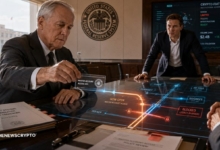
On Wednesday, the Office of the Comptroller of the Currency (OCC) released findings that have raised alarm bells regarding crypto debanking, reigniting fears of what some are dubbing “Operation Chokepoint 2.0” within the financial sector.

This supervisory review focused on nine of the largest national banks under OCC supervision, including JPMorgan Chase, Bank of America, Citibank, Wells Fargo, US Bank, Capital One, PNC Bank, TD Bank, and BMO Bank.

‘Harmful Debanking Policies’

The preliminary findings from the OCC reveal troubling trends: between 2020 and 2023, these banks appeared to make unwarranted distinctions among customers based on their legal business activities.

Specifically, many of these institutions maintained policies that either restricted access to financial services or required heightened scrutiny and approvals for certain clients.

The OCC identified examples where at least one bank imposed limitations on various sectors, including crypto, due to their engagement in activities considered “contrary to [the bank’s] values,” even though those activities were not illegal.

Sectors affected by these policies included oil and gas exploration, coal mining, firearms, private prisons, tobacco and e-cigarettes, adult entertainment, and notably, digital assets.

The findings indicated that many banks placed strict limitations on crypto-related activities as well, which often stemmed from concerns about financial crime.

These practices, the OCC confirmed, were prevalent at each of the banks examined in the review. Comptroller Jonathan V. Gould expressed frustration regarding the situation, stating:

It is unfortunate that the nation’s largest banks thought these harmful debanking policies were an appropriate use of their government-granted charter and market power.

Gould noted that while many of these policies were publicly announced, some banks have maintained that they did not participate in debanking.

In his comments, Comptroller Gould emphasized the OCC’s commitment to eliminating practices that would “weaponize finance,” whether instigated by regulators or the banks themselves.

National Banks To Facilitate Crypto Transactions

The agency disclosed that it is still evaluating “thousands of complaints” related to allegations of political and religious debanking, with plans to report on these findings “in due course.” The OCC aims to hold banks accountable for these actions and ensure that unlawful debanking practices do not persist.

This follows Tuesday’s letter from the banking regulator that allows national banks to participate in “riskless principal transactions” involving cryptocurrencies. This permits national banks to buy and sell cryptocurrencies for their customers’ accounts.

This new structure allows users to transact in crypto-assets through established national banks, resulting in a more regulated environment than exchanges that operate outside of strict oversight regulation.

The daily chart shows the total crypto market cap valuation at $3.16 trillion. Source: TOTAL on TradingView.com

Featured image from DALL-E, chart from TradingView.com

Leituras Relacionadas

AI Saved a Group of New Energy Investors

The article "AI Saves a Group of New Energy Investors" details a remarkable turnaround in the green energy investment sector, driven by its convergence with artificial intelligence infrastructure. After a prolonged downturn marked by valuation slumps and funding cold spells since 2022, the sector has experienced a dramatic resurgence in 2026. This shift is attributed to new policies, particularly the "AI-Energy Synergy" national strategy, which mandates green power and energy storage systems for new large-scale computing centers. This redefines green electricity and storage from traditional manufacturing into core, indispensable assets for AI's operational backbone, creating a new narrative where "computing power equals electricity, and green power equals assets." This paradigm change is reflected in surging market performance. Power stocks like Datang Power have seen massive gains, and green energy ETFs have recorded significant capital inflows. The IPO market is also active, with companies like Sige New Energy listing successfully. Investment and financing have accelerated sharply, with major expansion projects and large-scale IPOs like China Resources New Energy's record-breaking offering. Notably, some top projects have seen valuations rebound by approximately 60%. The article highlights that the previous industry trough became a prime investment window. With AI-driven demand predicted to create massive power shortfalls (e.g., a projected 55GW gap for data centers), sectors like energy storage, grid upgrades, and green power are seeing explosive growth. Investors are now prioritizing areas like power management, large-scale storage, virtual power plants, and supporting technologies like liquid cooling—the "pick-and-shovel" plays of the AI infrastructure boom. Examples like KKR's highly successful investment in cooling company CoolIT Systems underscore the lucrative opportunities. In conclusion, the integration with AI has sparked a fundamental revaluation of new energy assets. For investors who endured the sector's低谷, a harvest season has arrived, with the broader investment upswing seemingly just beginning.

marsbitHá 26m

AI Saved a Group of New Energy Investors

marsbitHá 26m

Learn Codex with the "Morning Briefing": Six Replicable Levels of Use

This article introduces a "Morning Briefing" as a simple, progressive framework for learning to effectively use Codex (an AI assistant), moving from basic information gathering to a more sophisticated, autonomous work partner. It outlines six actionable levels: **Level 1: Basic Information Query.** Start by simply asking Codex to check your Slack, Gmail, and Calendar to summarize what needs your attention today. **Level 2: Personalization with an Agents File.** Create a persistent file containing your default preferences for the briefing's format and content, so it's consistently useful. **Level 3: Automation.** Set the briefing to run automatically every weekday morning, creating a reliable starting point for your day. **Level 4: Project-Specific Briefings.** Instead of one overwhelming summary, create separate, dedicated threads for different projects (e.g., a launch, recruitment), each with its own focused briefing. **Level 5: Drafting Follow-Up Actions.** Elevate the briefing from a summary to an action starter by having it draft replies, prepare meeting notes, or highlight stalled decisions—ready for your review. **Level 6: Building a Memory System (Vault).** Integrate a knowledge vault (a structured file system) where important recurring information (project statuses, key people, decisions) is stored and updated. The briefing consults this vault to provide richer context and learns over time. The approach's strength is its incremental nature. Each level teaches a core Codex capability (connectors, personalization, automation, project context, assisted work, persistent memory) within a familiar, practical workflow, avoiding overwhelming theoretical concepts. It transforms a simple daily check-in into a personalized, evolving work operating system.

marsbitHá 1h

Learn Codex with the "Morning Briefing": Six Replicable Levels of Use

marsbitHá 1h

Trading

Spot
Futuros
活动图片