Grok 4.5, finally delivered!
Just now, Musk's SpaceXAI impressively released its own strongest flagship model to date, Grok 4.5.

This time, SpaceXAI and Cursor have joined forces powerfully.
On tens of thousands of GB300 beasts, they have fiercely "forged" this performance monster, born for coding and agents.
The report card is quite dazzling—
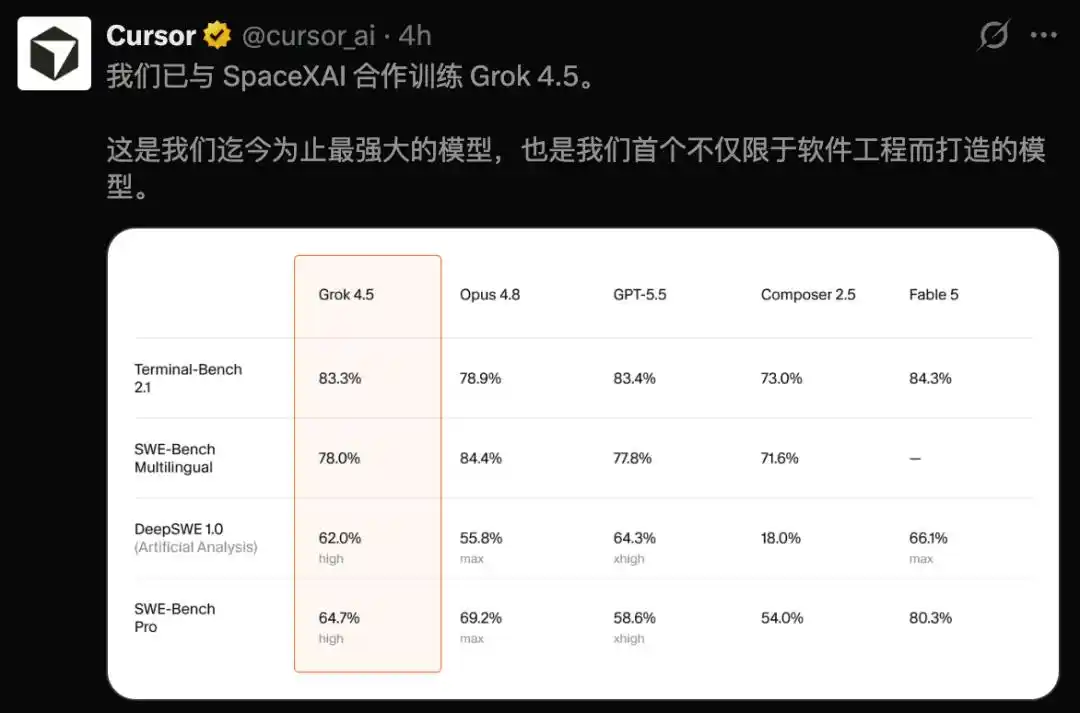
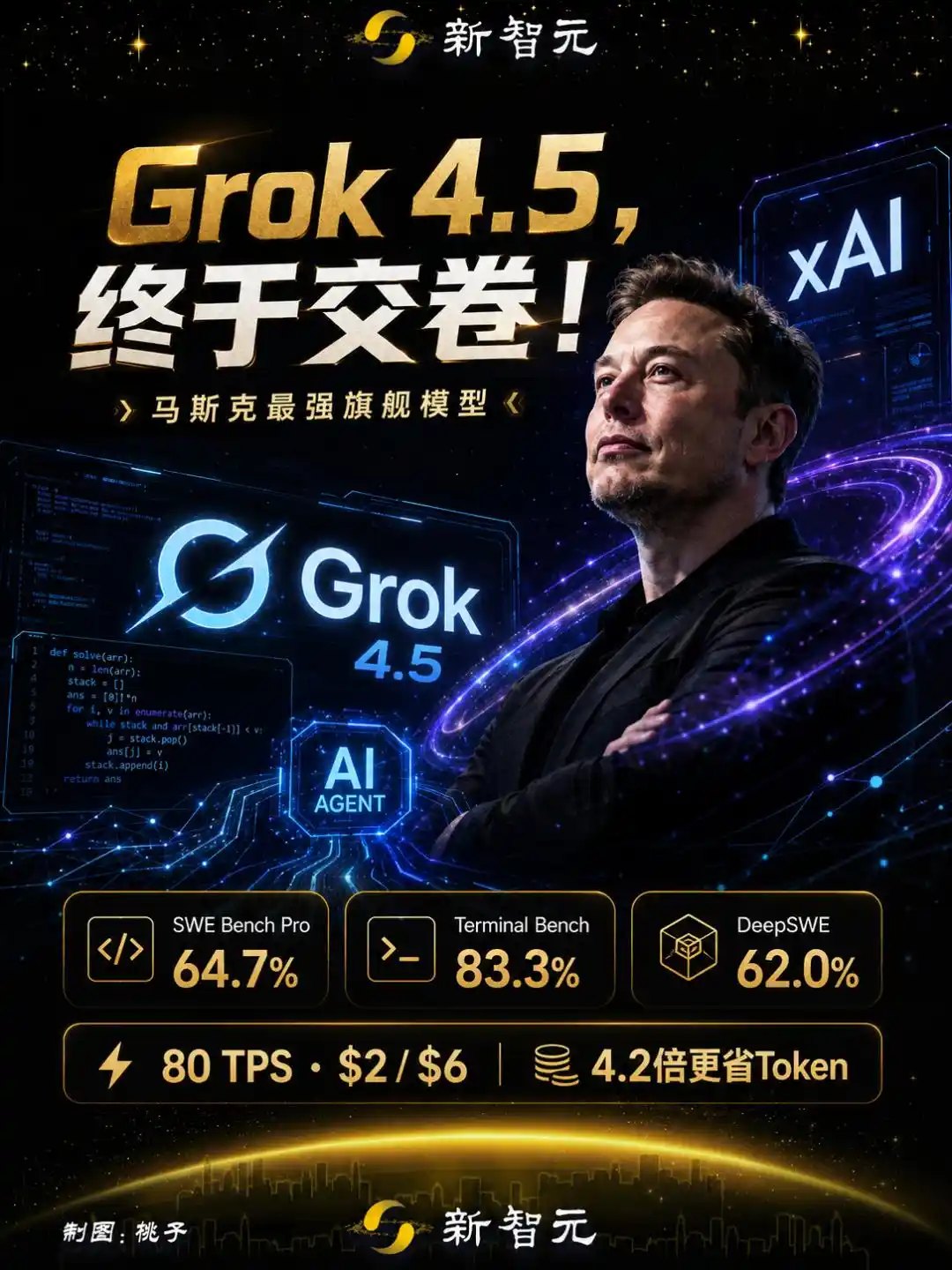
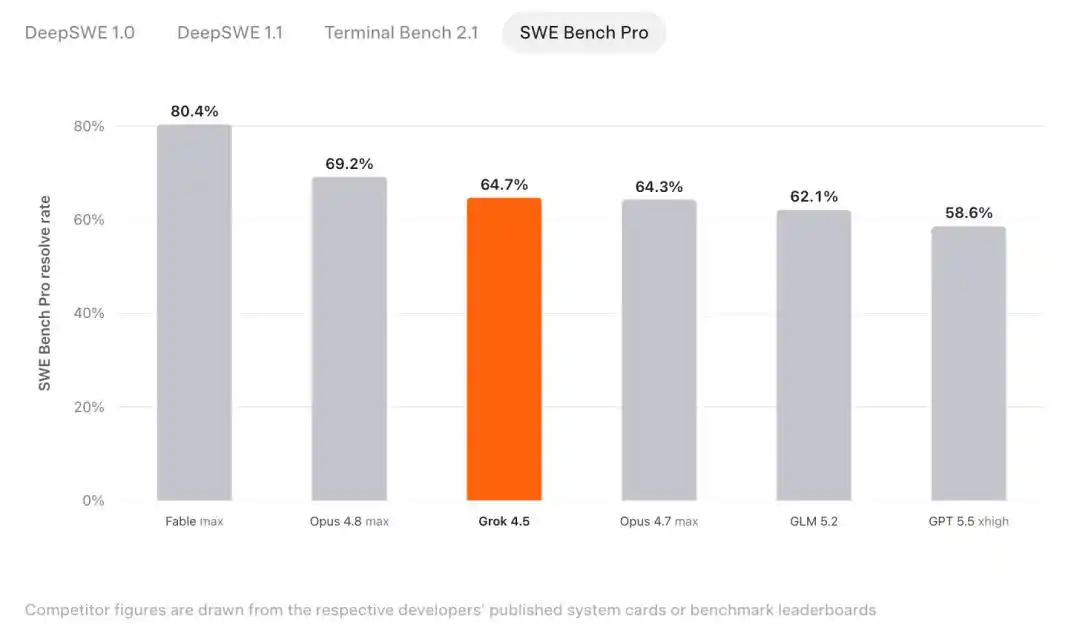
- SWE Bench Pro: Sweeps a whopping 64.7%, directly challenging and surpassing Opus 4.7's 64.3%;
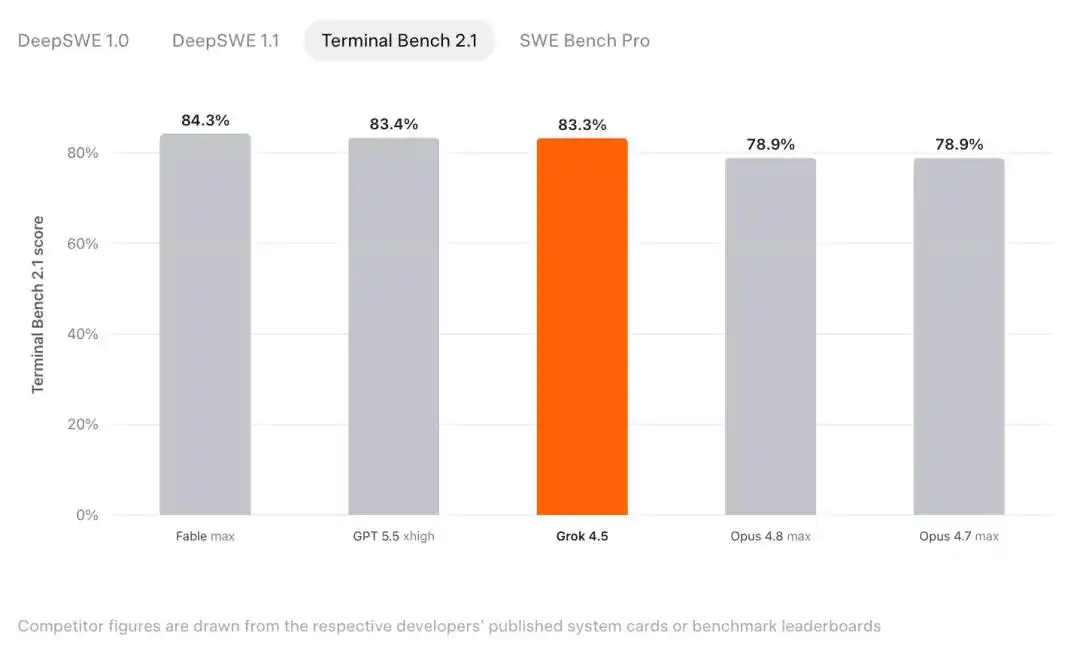
- Terminal Bench 2.1: Races all the way up to 83.3%;
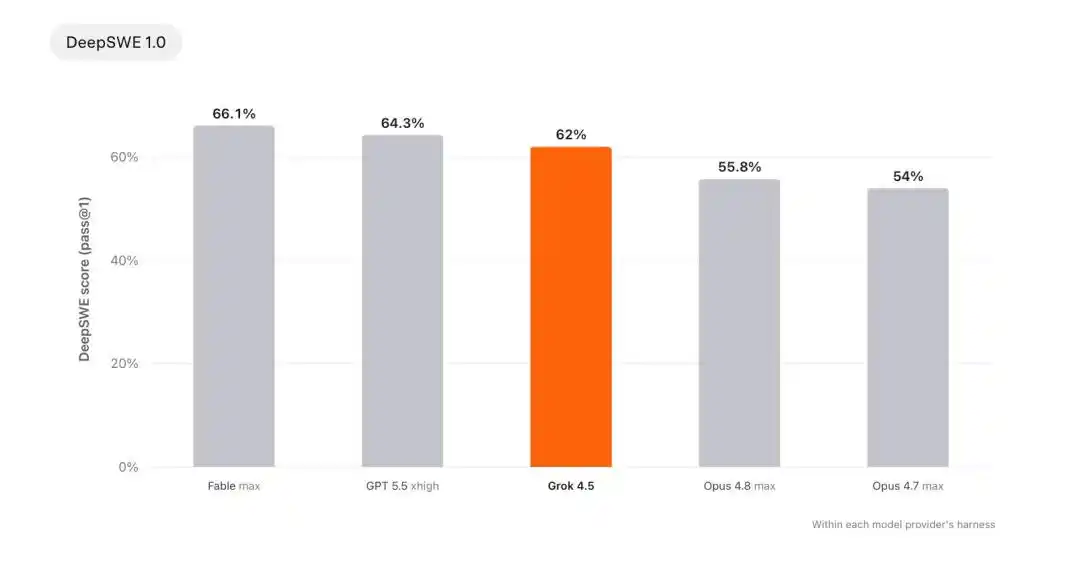
- DeepSWE 1.0: Firmly stands at 62.0%, decisively crushing Opus 4.8.
Musk stated plainly, "Grok 4.5 is roughly equivalent to Opus 4.7, but much faster."
It's the combination of capability, speed, and cost that forms its competitiveness. In other words, the Tokens it uses for work are only a fraction of others'.

Grok 4.5 is priced at $2 per million tokens for input, $6 per million tokens for output.
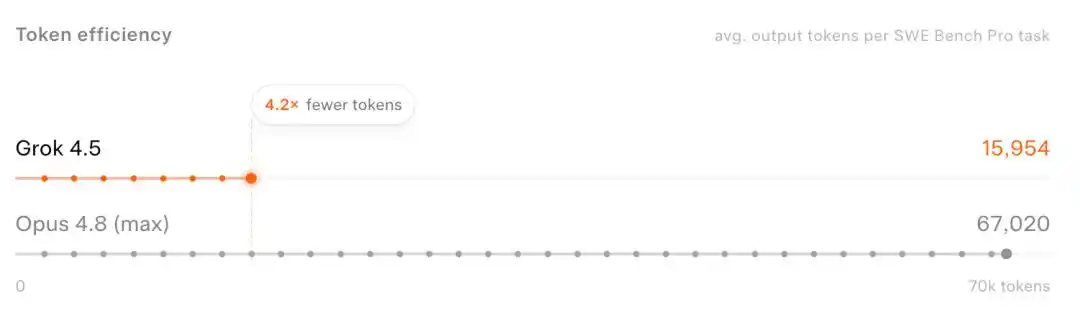
Compared to Opus 4.8, Token consumption is dramatically reduced by 4.2 times.

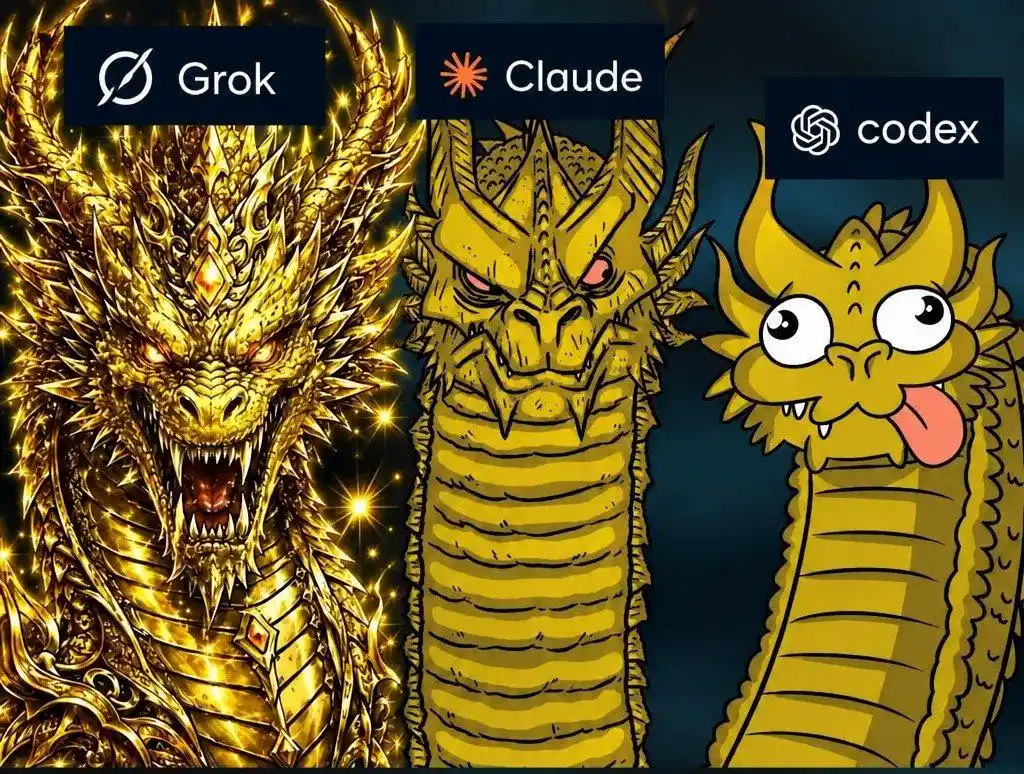
Tens of thousands of GB300s forged an "Opus-level" model
Grok 4.5 is the first ace card after SpaceXAI went public and the first report card from their collaboration with Cursor.
So, how was it trained?
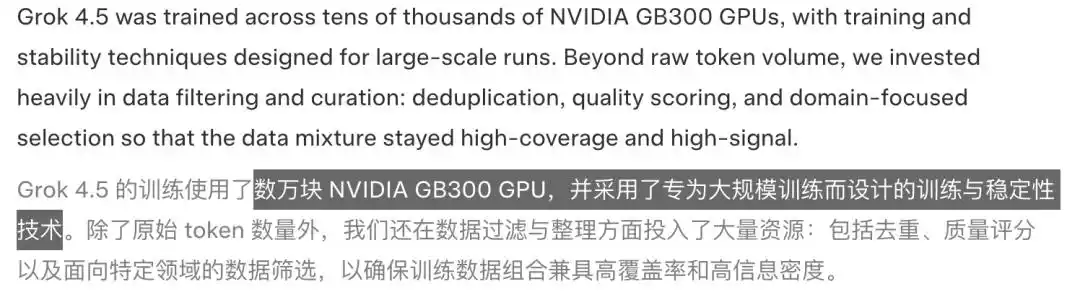
The answer: tens of thousands of NVIDIA GB300 GPUs, in one super large-scale training session. But stacking compute power was just the entry ticket.

Musk previews: Grok 4.5 context will be upgraded to 1 million next week
Where SpaceXAI truly put in exhaustive effort is in the data.
They subjected massive corpora to devilish filtering, deduplication, and quality scoring, ensuring every bit fed into the model was professional content with high information density.
Then, they focused RL efforts on an indicator rarely mentioned—"per-token intelligence".
Cursor's involvement is the most crucial link in this flywheel.
Grok 4.5's base is V9 (1.5T), and officially, it was trained on trillions of Cursor data points.
This data records how real developers interact with codebases, tools, and agents.
This means the model learns not just "what code looks like," but "how humans and AI code together."
And its training stack is designed for high asynchronicity—
Agents can run for hours continuously, the model keeps learning while working, and training on tens of thousands of GPUs never stops.
The result is that it not only solves problems but can also withstand complex, multi-step engineering tasks over hours.
Matches GPT-5.5, approaches Opus 4.8
The hardcore performance of Grok 4.5, trained with this approach, can absolutely withstand scrutiny.
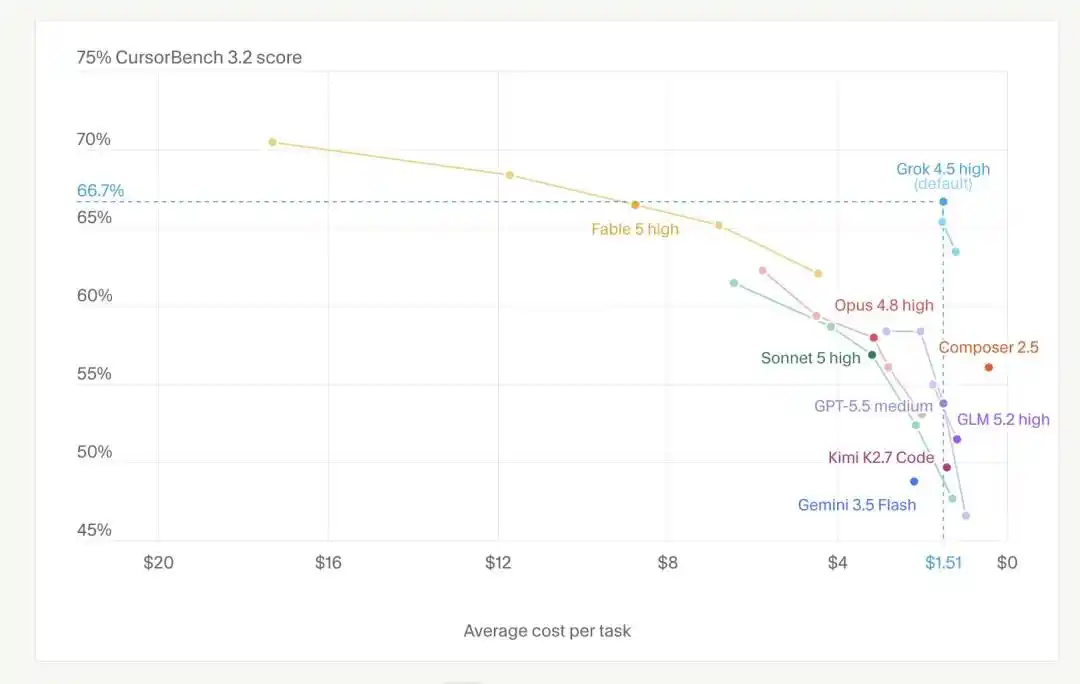
Its performance on several core engineering benchmarks can be described as "steady"—not the strongest, but solidly within the top tier.
On DeepSWE 1.0, it scores 62.0%, surpassing Opus 4.8 (55.75%) and closely trailing GPT-5.5 (64.31%);
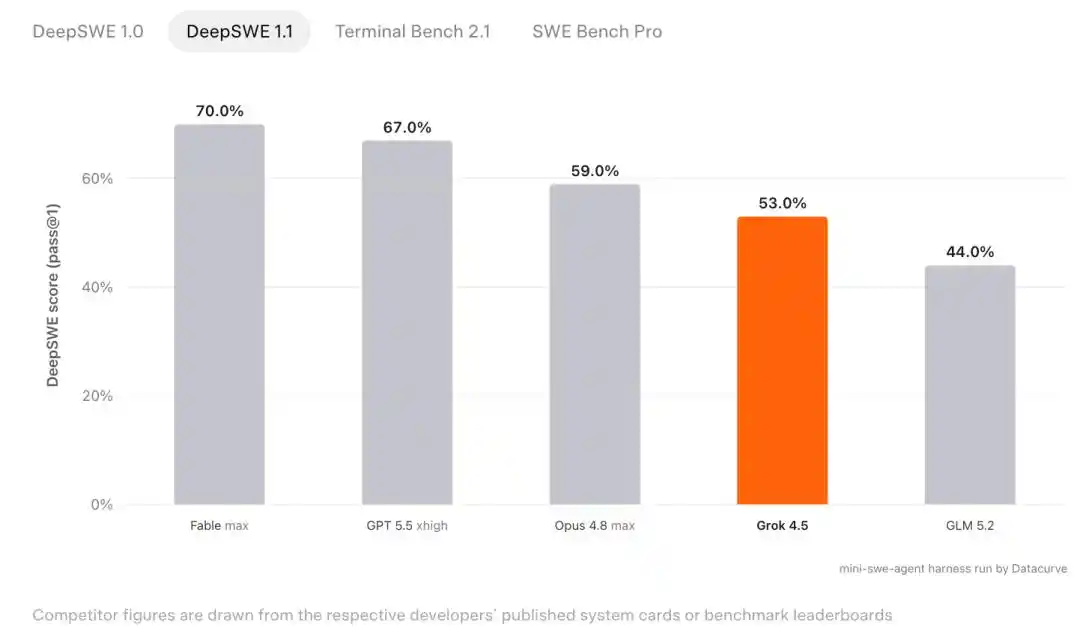
On Terminal Bench 2.1, it surges to 83.3%, only 0.1 behind GPT-5.5 (83.4%)!;
On the more hardcore SWE Bench Pro, it overtakes GPT-5.5 (58.6%) with a 64.7% solve rate, approaching Opus 4.8 (69.2%).
In the official AAAI test, Grok 4.5 ranks fourth, behind only Fable 5, GPT-5.5, and Opus 4.8.
In the Harvey legal agent benchmark test, it ranks first.
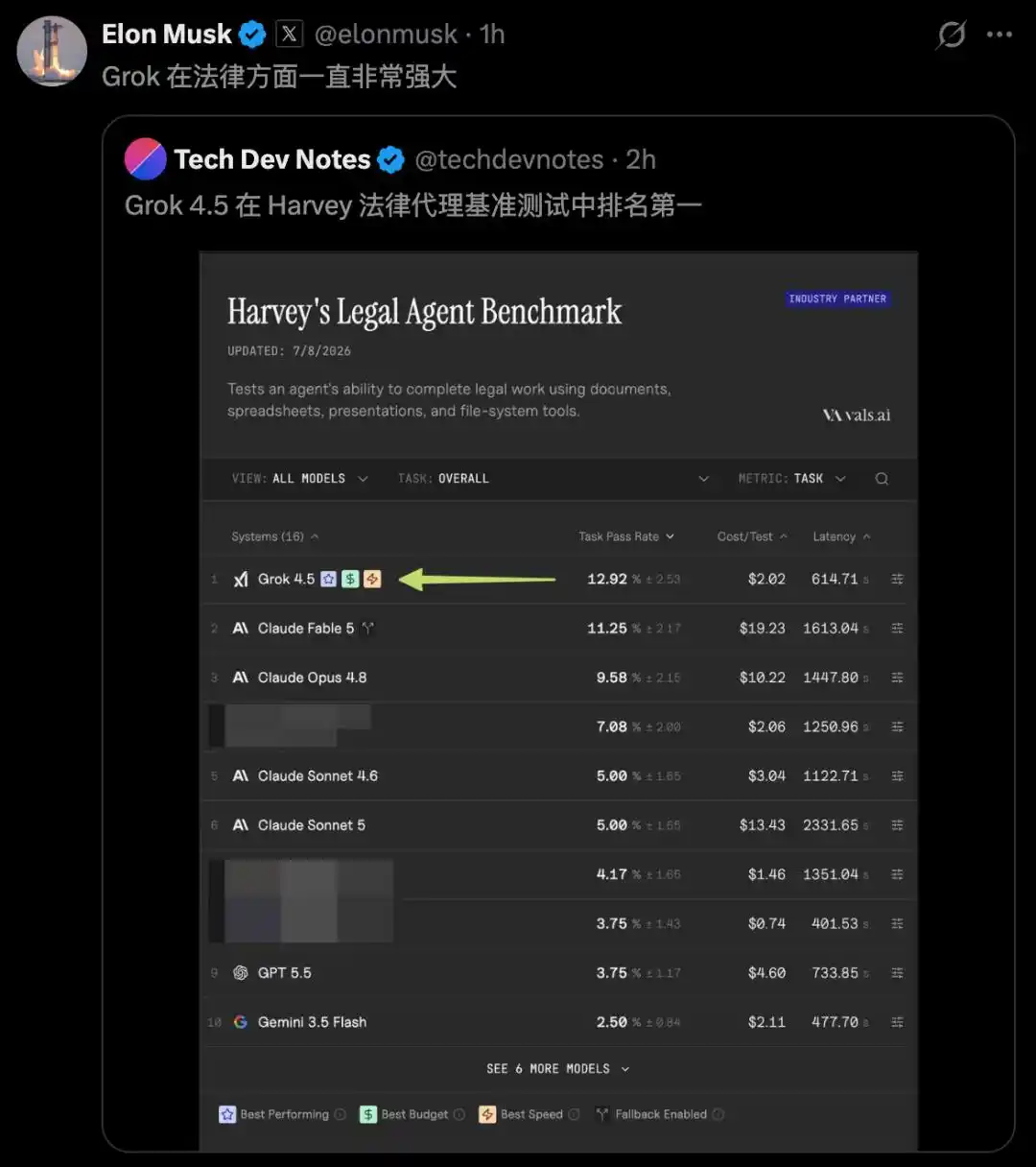
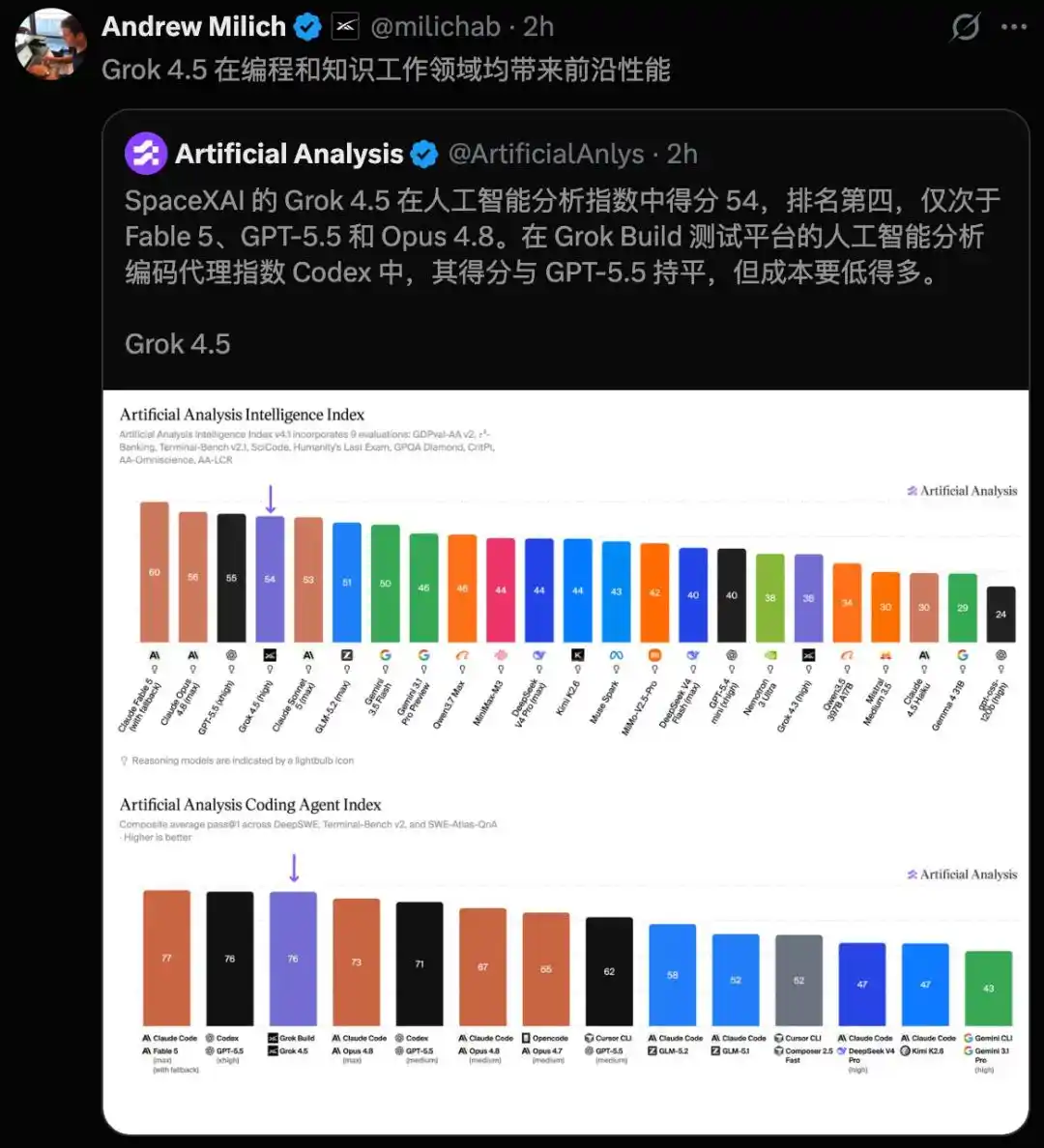
It must be said, this report card is quite impressive.
But it must be acknowledged that the current undisputed king is still Claude Fable.
In summary, Grok 4.5 is roughly on par with GPT-5.5, closely follows Opus 4.8, but there is still a distance to the true ceiling.
Musk himself said quite realistically: "Our internal evaluation is that Grok 4.5 is roughly equivalent to Opus 4.7, but much faster."
The real killer feature: Fast and cheap
Grok 4.5's real knockout punch lies in three words: speed, efficiency, and price.
Its inference speed reaches up to 80 TPS (Tokens per second). The official statement is "faster than flash-type models."
With just one sentence, it wrote a 3D solar system simulator using Three.js:
Supports time acceleration, realistic orbital motion of the eight planets, even the HUD panel is quite well-crafted.

Regarding efficiency, on SWE Bench Pro tasks, Grok 4.5 on average outputs only 15,954 Tokens to solve the problem.
Opus 4.8, doing the same job, spits out an average of 67,020 Tokens.
4.2 times—Grok 4.5 solves the same engineering problem using less than a quarter of its competitor's Tokens.
On price, it's $2 per million tokens for input, $6 per million tokens for output.
There's also an even faster premium version priced at $4 input / $18 output.
Compared to a host of top-tier models starting at over ten dollars, this price almost beats the cost down to the bone.

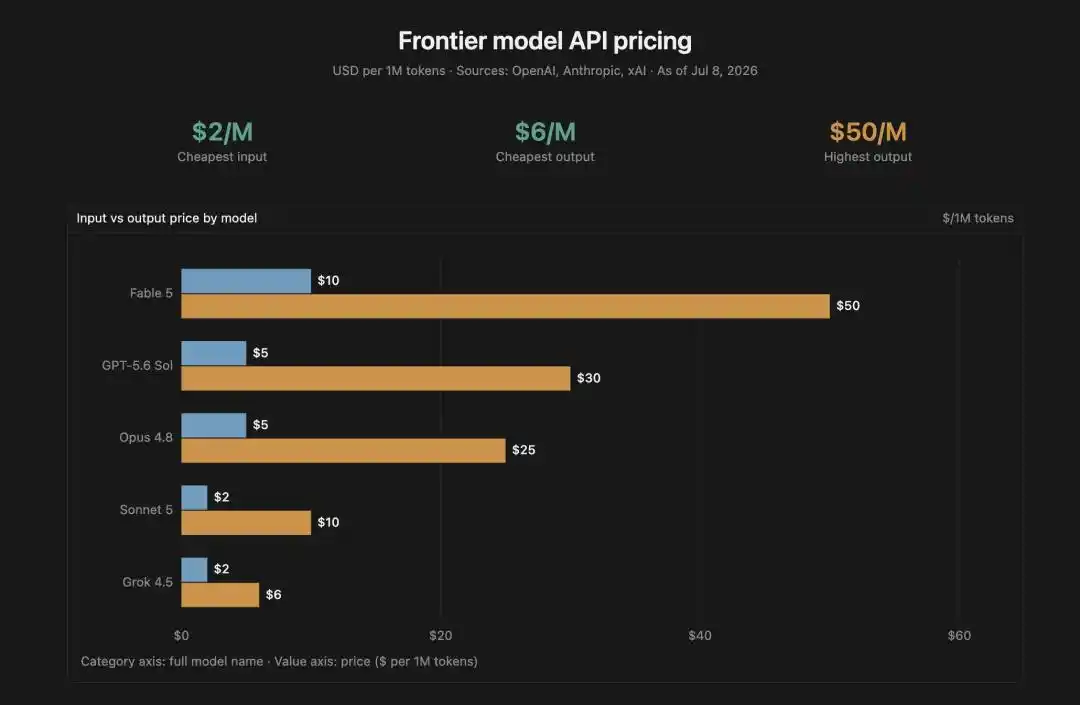
Put these three numbers together, and the conclusion is one sentence:
When it comes to "how much intelligence you can buy per unit of time and cost," Grok 4.5 is currently the "king of cost-effectiveness."
Global hands-on tests: Grok 4.5's real performance
Furthermore, from the hands-on feedback of netizens, we can glimpse a corner of Grok 4.5's true capabilities.
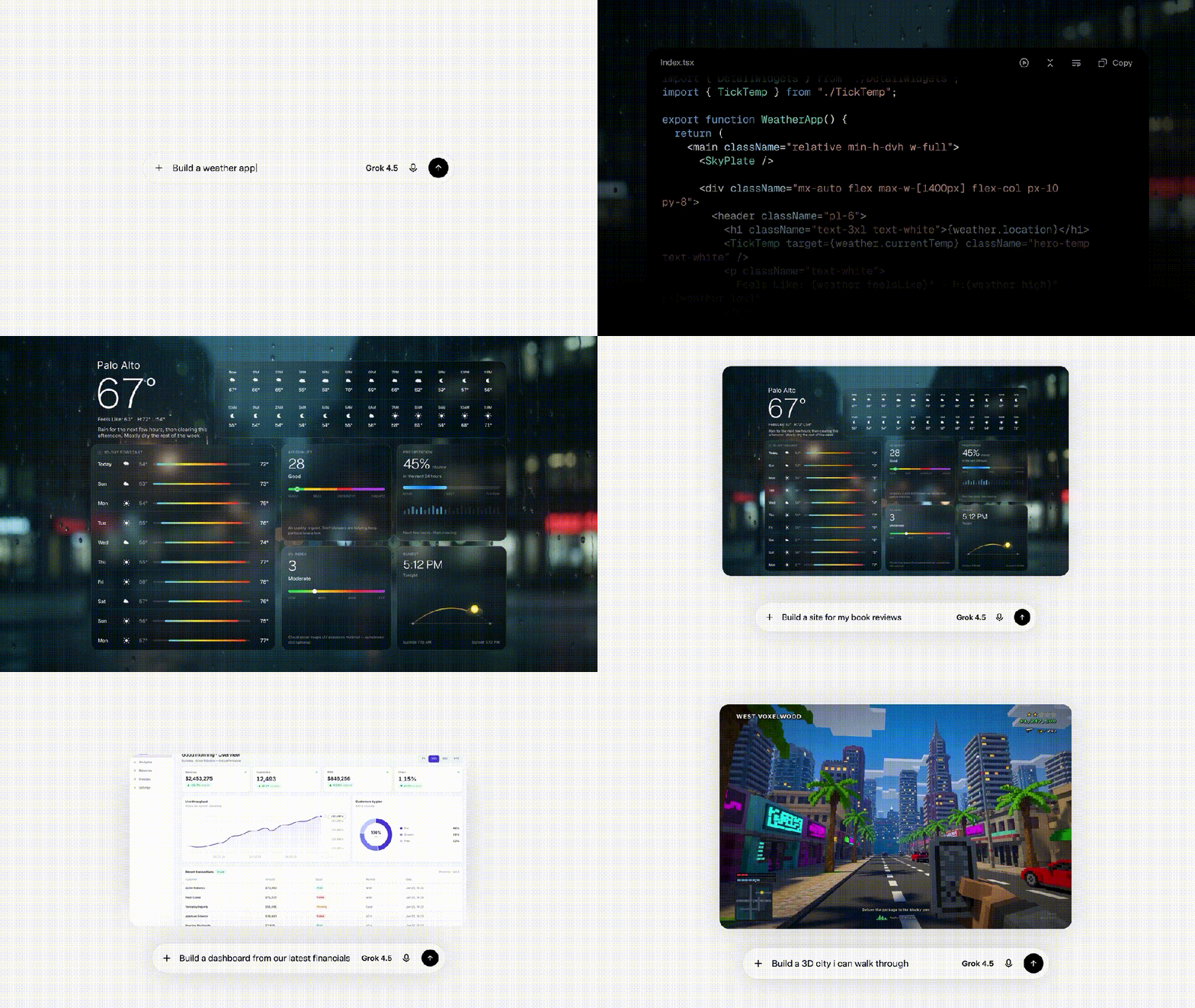
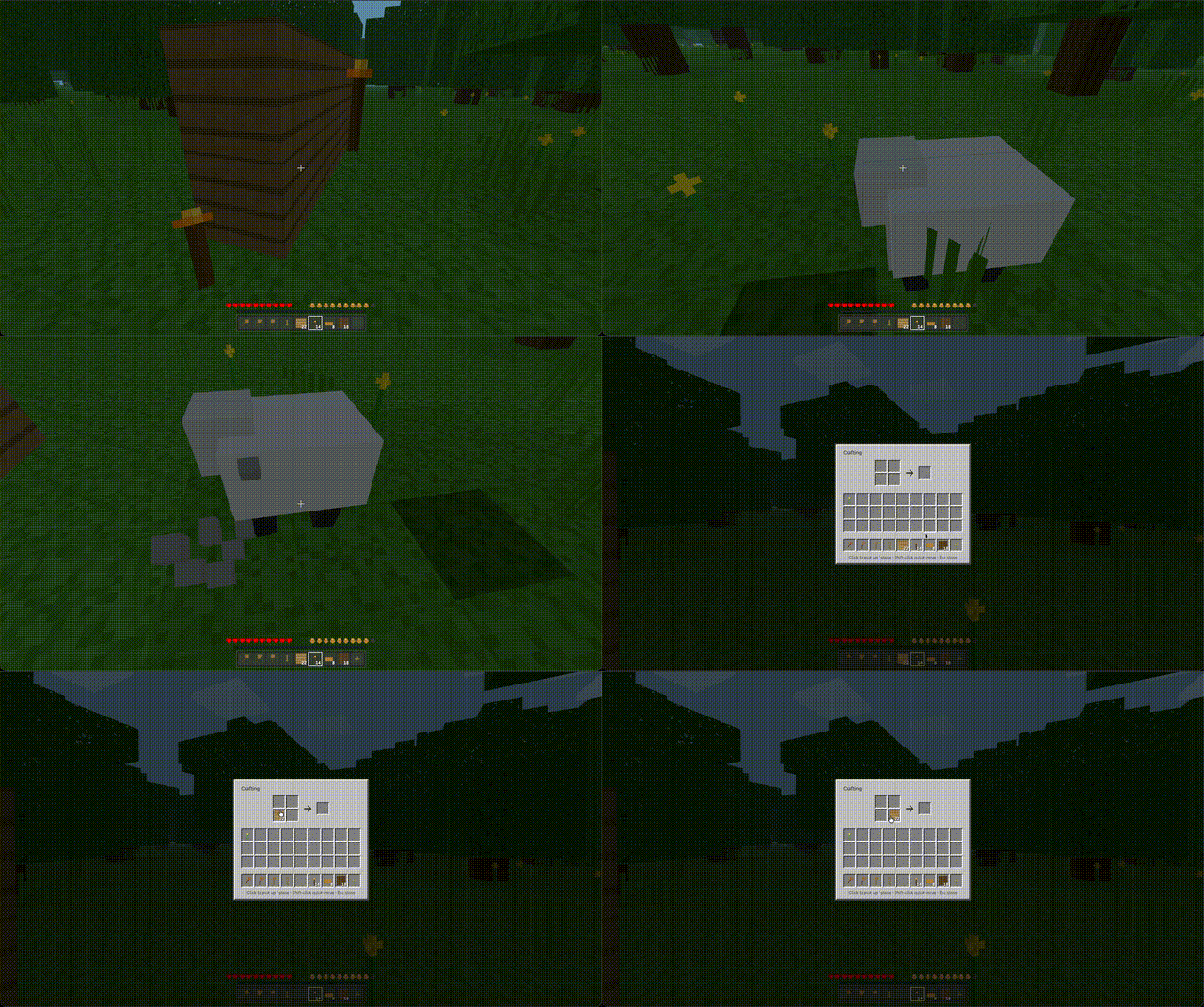
One sentence, directly outputs "Minecraft."
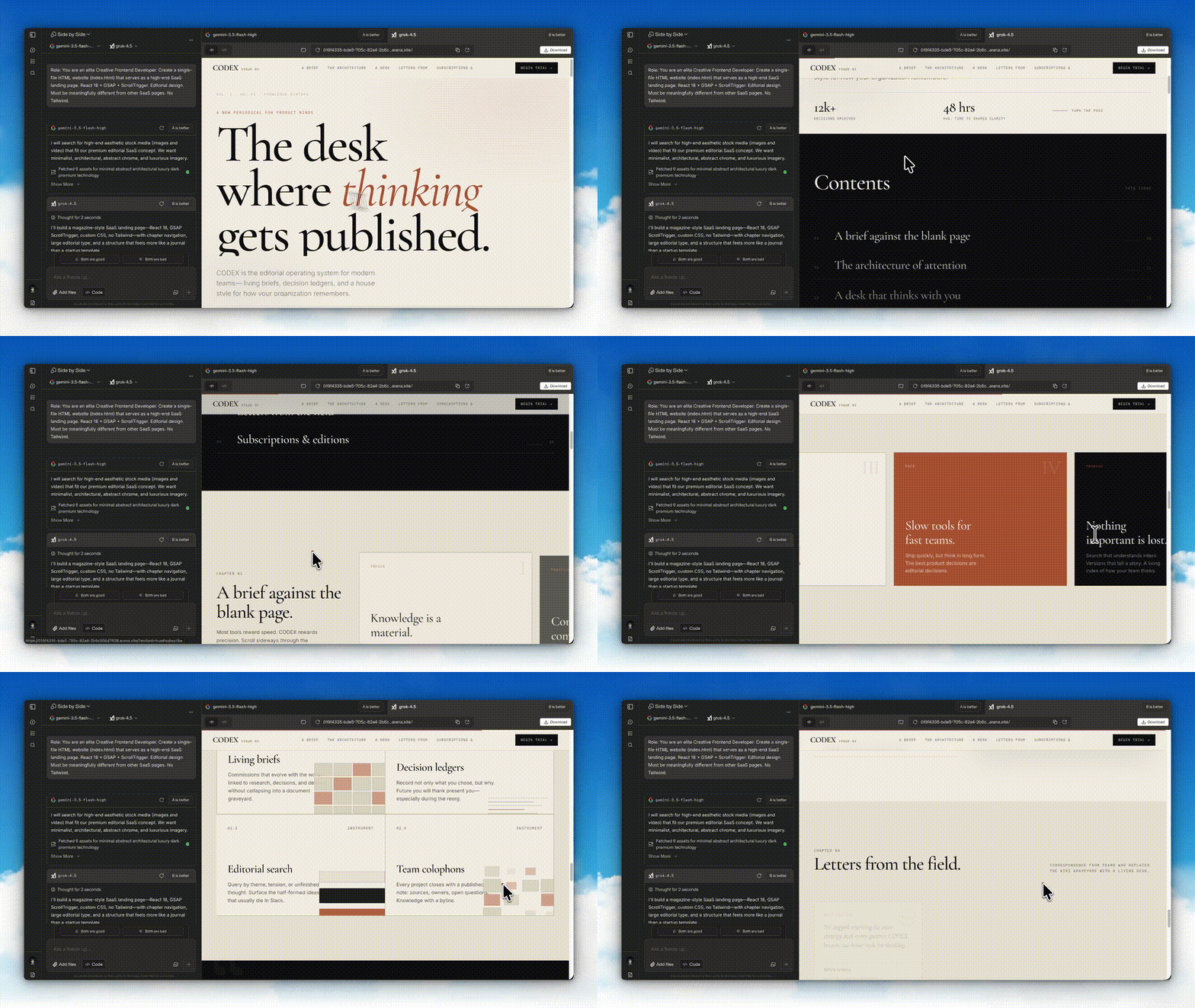
In a single HTML file, Grok 4.5 can easily handle a complete high-end SaaS page.
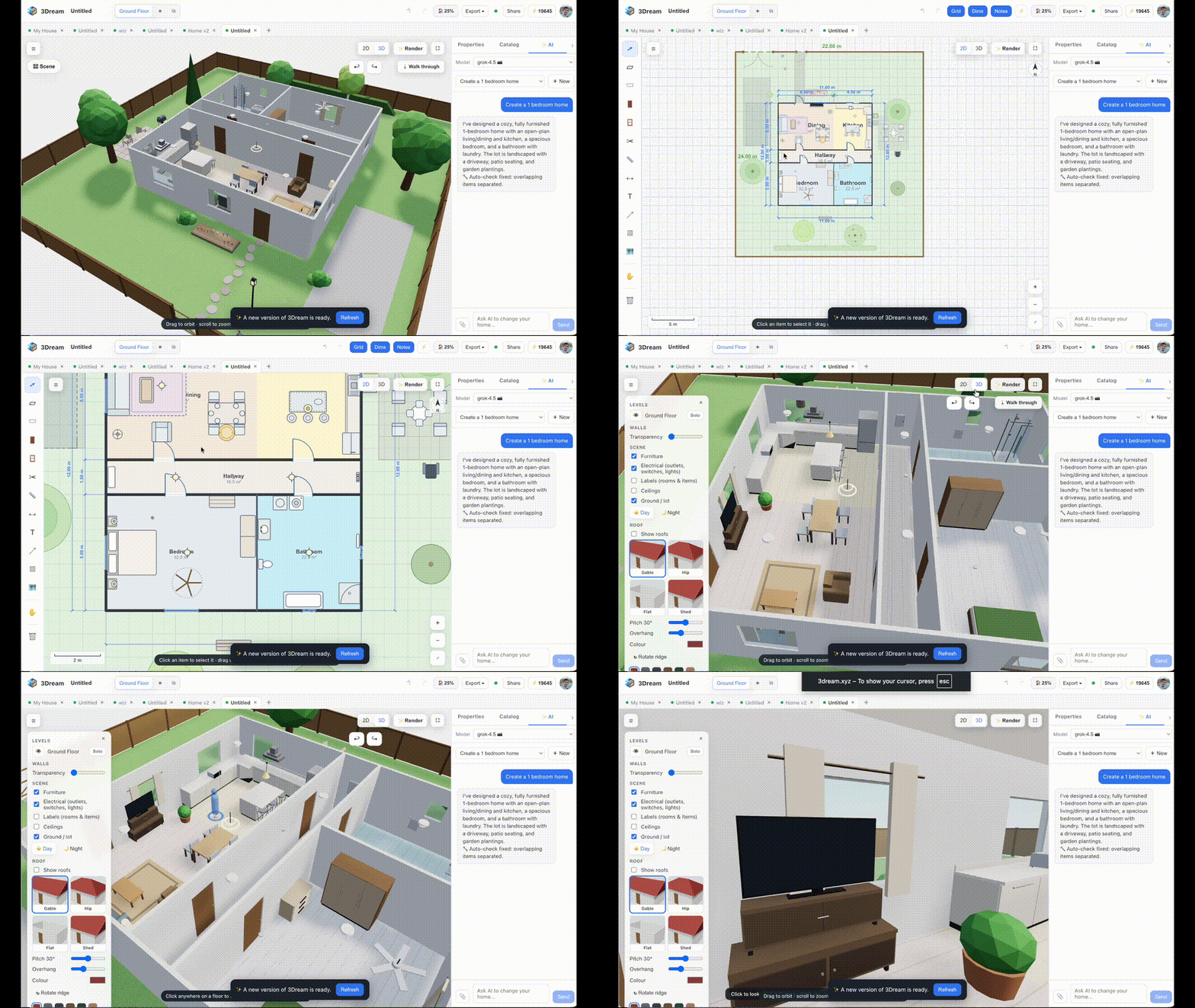
Grok 4.5 showcases its skills, completing a full set of 2D+3D design schemes within the app in less than a minute.
AI game master Danny Limanseta used Grok 4.5 to generate a game with various complete functions.

However, some developers stated that Grok 4.5 is completely not on the same level as Opus 4.7, and the generated lava lamp test performed poorly.

Not the strongest, saving energy to overturn the table next month
Today, Musk planted another bombshell:
Grok understands engineering deeply.
Next month's version will be another step-change improvement, because we are closing the loop on solving real engineering problems inside Tesla, SpaceX, Neuralink, and Boring Company.

Next month, another leap. And reportedly, a larger 2 trillion parameter version is already on the way.
Benchmarks are fireworks for outsiders; efficiency and cost are the real weapons to drag opponents into a war of attrition.
When model intelligence starts being billed like electricity per kilowatt-hour, the winning move is who can make intelligence fast, cheap, and omnipresent.
This time, Musk didn't play the strongest card, but he flipped the table.
References:
https://x.ai/news/grok-4-5
https://cursor.com/blog/grok-4-5
This article is from WeChat official account "New Zhiyuan," author: ASI Apocalypse, editor: Taozi