The National Sheriffs' Association sent a letter to Senate Majority Leader John Thune and Democratic Leader Chuck Schumer, warning that the CLARITY Act in its current form would create broad exemptions from registration, know-your-customer (KYC), anti-money laundering (AML), and sanctions requirements for certain participants in decentralized finance (DeFi) systems, potentially allowing bad actors to exploit platforms and services designed to obscure digital asset transactions.
This is not the association's first warning on this matter: the NSA first raised the same objections in a May 13 letter to the Senate Banking Committee, then joined a coalition letter from four organizations in late June that repeated the warning almost verbatim, meaning the August letter is less a new alarm and more a third reiteration of the same core complaint as the Senate session winds down.
The sheriffs' group is not acting alone: it has joined forces with the National District Attorneys Association, the National Association of Assistant United States Attorneys, and the International Association of Chiefs of Police, warning that the bill's approach to DeFi could create loopholes for human traffickers, sanctions evaders, and money launderers to exploit; a coalition whose joint letter dates to late June and whose core argument is echoed in each subsequent NSA letter.
The specific target of the coalition's objections is Section 604 of the bill—a provision often called the "Blockchain Regulatory Certainty Act"—which provides a safe harbor for developers who create non-custodial software, wallets, and protocols without taking control of user funds.
Law enforcement argues that the wording of this exemption is broad enough to allow operators who are essentially custodians or facilitating money laundering to claim the same protection, weakening KYC and AML standards compared to those that traditional financial institutions must follow.
Industry Response
The Blockchain Association did not leave this argument unchallenged, expressing clear disagreement.
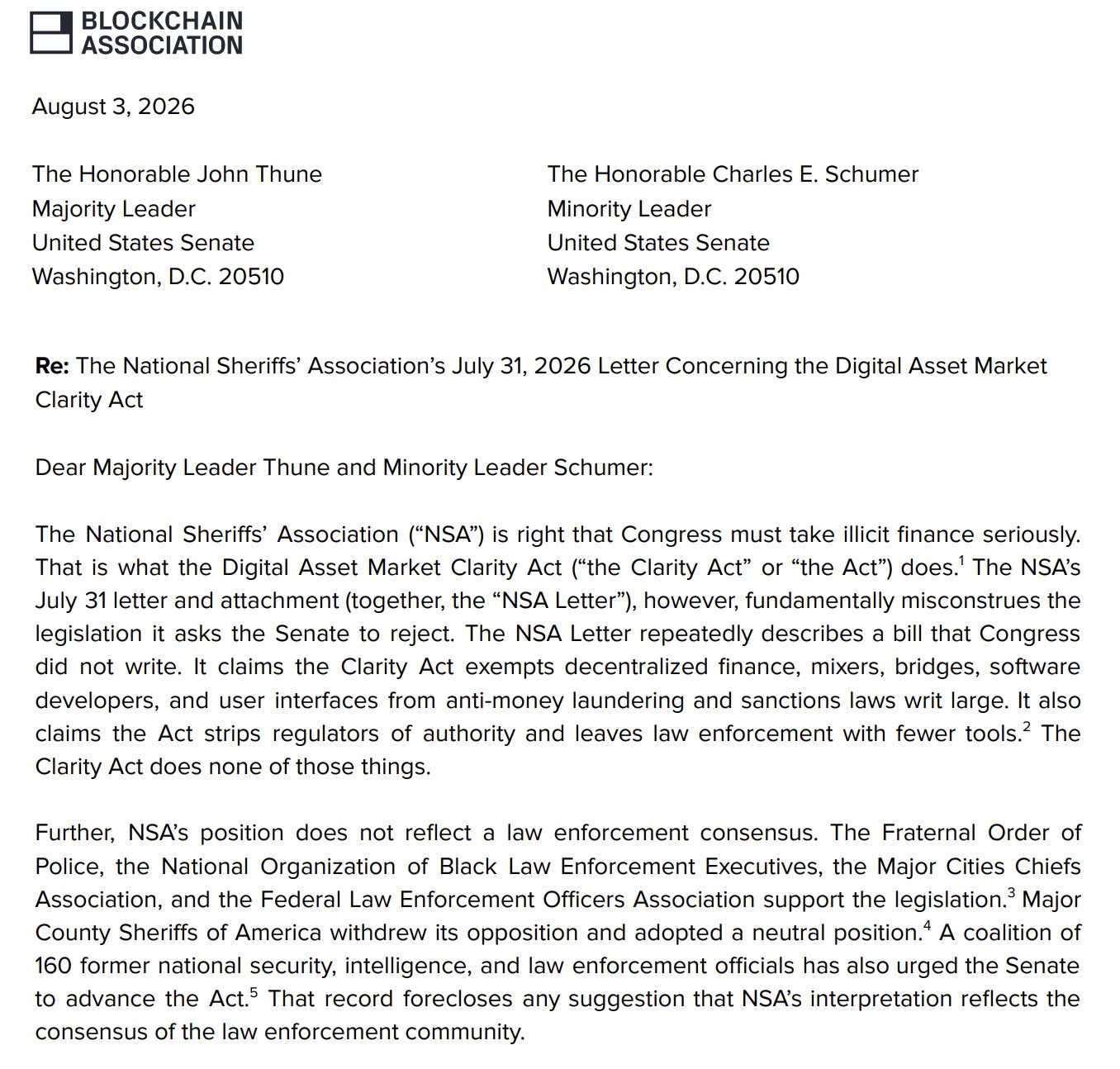
Section 604 addresses one specific issue: it prevents the mistaken classification of developers of non-custodial software as money transmitters if they are not holding assets or controlling transactions.
She went further, rejecting the idea that the provision creates a loophole for bad actors, stating plainly that it "does not provide immunity to criminals," "does not limit sanctions enforcement," and "does not prevent prosecution for money laundering, fraud, or terrorist financing."
A Disagreement That Could Decide the Vote
This stalemate illustrates why the enforcement question within the CLARITY Act has become its own subplot in the broader Senate fight. Unlike the ethics dispute over Trump's crypto business ties or stablecoin oversight issues, which have individually slowed negotiations, the fight over Section 604 pits active law enforcement in direct opposition to the industry group most actively lobbying for the bill's passage, with both sides claiming to champion public safety.
Law enforcement itself is far from united on this provision. On July 1, the National Organization of Black Law Enforcement Executives formally endorsed the bill, becoming the first major law enforcement group to support it fully, arguing that it preserves long-standing crime-fighting authority while adding meaningful new capabilities.
Two days later, on July 3, the Major County Sheriffs of America—a separate organization from the National Sheriffs' Association, representing sheriffs' offices serving 130 million people—shifted its position specifically on Section 604 from active opposition to neutral, informing the Senate Banking Committee that ongoing negotiations have clarified how the provision would actually be implemented.
With Thune saying the Senate still aims for a full floor vote before the August recess, and roughly four legislative days left in the session, this fight over developer liability has become one of its most detailed and significant.