Crypto, AI Investments Surface In Fed Chair Nominee’s Financial Disclosure

bitcoinistPublicado em 2026-04-15Última atualização em 2026-04-15

Resumo

Amidst key regulatory vacancies at the SEC and CFTC, Federal Reserve Chair nominee Kevin Warsh disclosed over $100 million in assets, including investments in crypto firms (Compound, Dapper Labs, Kinetic) and AI companies (Delphi, Conversion, among others). His largest holding is the $50+ million Juggernaut Fund. The disclosure did not value his crypto/AI holdings, raising questions about potential conflicts of interest as the Fed’s rate decisions directly impact these sectors. With Jerome Powell’s term ending May 15, Warsh’s Senate confirmation process is advancing rapidly.

Two of the most closely watched regulatory bodies in American finance are operating with skeleton crews. The Securities and Exchange Commission has three of its five commissioner seats filled — all by Republicans.

The Commodity Futures Trading Commission has just one sitting commissioner. Both vacancies come at a moment when the agencies are expected to take center stage in shaping the rules around digital assets, should a crypto market structure bill that has been stalled in the Senate since July 2025 finally pass.

A Nominee With Stakes In The Industry

Against that backdrop, Kevin Warsh — US President Donald Trump’s pick to replace Federal Reserve Chair Jerome Powell — filed a financial disclosure last week that revealed personal investments in crypto and artificial intelligence companies.

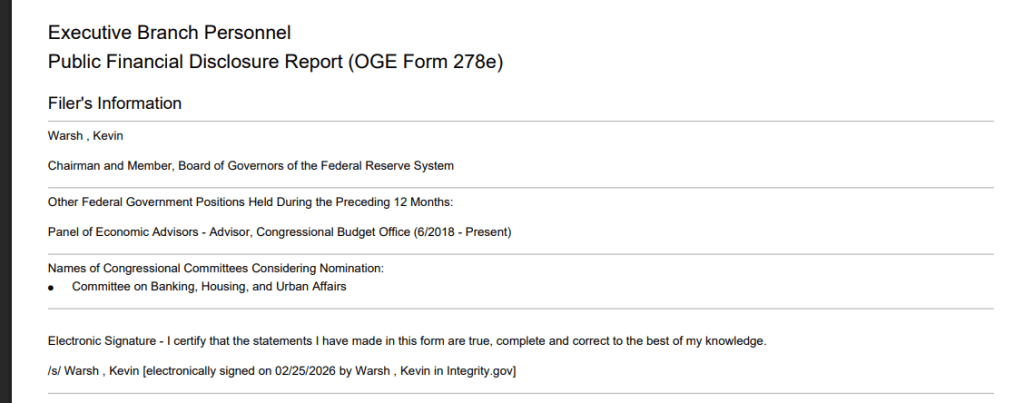
Based on reports, Warsh’s filing with the US Office of Government Ethics lists holdings in Compound, Dapper Labs, and Kinetic on the crypto side, alongside AI firms including Delphi, Conversion, Factory, and Glue, among others.

Source: US Office of Government Ethics
His total disclosed assets top $100 million. The largest single entry is more than $50 million in something called the Juggernaut Fund. Another major line item: more than $10 million in consulting fees from the Duquesne Family Office, the investment firm run by billionaire Stanley Druckenmiller.

None of his crypto and AI investments included a value range in the disclosure. It is unclear why. The ethics office’s rules do not require reporting assets valued under $1,000, which may explain the omission — though the gap leaves open questions about the full scope of his exposure to sectors the Fed’s interest rate decisions directly affect.

BTCUSD trading at $73,929 on the 24-hour chart: TradingView

Powell’s Clock Is Running Out

Time is short. Powell’s second four-year term ends May 15. Trump first floated Warsh’s name in January, then formally sent his nomination to the Senate in March, following months of public pressure on Powell to cut interest rates. As of Tuesday, the Senate Banking Committee had not announced a hearing date, but reports indicated a vote could come as early as next week.

Whoever takes the Fed chair position wields enormous influence over US financial policy — most visibly through decisions on federal interest rates, which ripple through every corner of the economy, including the crypto and AI sectors where Warsh holds investments.

Featured image from Real Estate News, chart from TradingView

Perguntas relacionadas

QWho is Kevin Warsh and what role has he been nominated for?

AKevin Warsh is US President Donald Trump's nominee to replace Jerome Powell as the Chair of the Federal Reserve.

QWhich crypto and AI companies were listed in Kevin Warsh's financial disclosure?

AHis disclosure listed holdings in crypto companies Compound, Dapper Labs, and Kinetic, and AI firms including Delphi, Conversion, Factory, and Glue.

QWhat is the significance of the SEC and CFTC operating with vacancies according to the article?

AThe vacancies are significant because these agencies are expected to be central in shaping the rules around digital assets if a stalled crypto market structure bill passes.

QWhat was the largest single asset disclosed in Kevin Warsh's filing?

AThe largest single disclosed asset was over $50 million in something called the Juggernaut Fund.

QWhen does Jerome Powell's term as Federal Reserve Chair end, creating the vacancy?

AJerome Powell's second four-year term as Federal Reserve Chair ends on May 15.

Leituras Relacionadas

The End of the Crypto Premium? Market Logic Shift Seen Through Gemini's Post-IPO Struggles

The article "The End of the Crypto Premium? Market Logic Shifts as Gemini Struggles Post-IPO" examines the dramatic downturn of cryptocurrency exchange Gemini following its public listing in September 2025. Initially part of a wave of crypto IPOs, including Bullish, which saw soaring valuations and massive investor interest, Gemini's stock price has since collapsed by over 80%, falling from $28 to around $5. The company has cut 30% of its workforce, exited international markets, and faces significant financial strain, including $330 million in Bitcoin-denominated debt. The core argument is that Gemini's struggles reflect a broader market shift where the "excess premium" once associated with crypto assets is disappearing. Two key factors are identified: the erosion of regulatory arbitrage, as compliance costs rise for all players (up 22.5% for small firms in 2026), and the decline of liquidity scarcity premiums, as institutional investors now access crypto via low-friction ETFs and stocks rather than volatile altcoins. The approval of Bitcoin and other crypto ETPs, which now manage $1.8 trillion globally, has diverted institutional capital away from altcoins, causing their liquidity to dry up and volatility to increase. For Gemini, its strategy of being "the most compliant exchange" became a liability in a bear market, as fixed compliance costs remained high while trading revenue fell. The article concludes that the era of narrative-driven crypto valuations is ending, giving way to a market logic focused on fundamentals like actual usage, liquidity depth, and sustainable institutional adoption.

marsbitHá 3h

The End of the Crypto Premium? Market Logic Shift Seen Through Gemini's Post-IPO Struggles

marsbitHá 3h

Utexo Partners with x402 to Provide Near-Instant USDT Settlement for the Agent Economy

Utexo, a Bitcoin-native stablecoin payment execution and settlement layer, has partnered with x402 to integrate USDT compatibility into the x402 payment protocol. This collaboration enables near-instant settlement for agent-to-agent transactions, with speeds as fast as 50 milliseconds. x402 is an open protocol that uses the HTTP 402 "Payment Required" status code to embed payment functionality directly into HTTP requests. This allows applications, APIs, and autonomous systems to pay for services in real-time without requiring pre-funded accounts. The integration expands x402’s initial USDC support to include USDT, one of the most widely used stablecoins globally. Utexo’s infrastructure is designed for high-frequency, low-latency transactions, making it well-suited for machine-driven payments. According to Utexo CEO Viktor Ihnatiuk, supporting USDT within the x402 framework significantly broadens access and provides developers the performance needed for real-time agent-based systems. Kevin Leffew of x402 at Coinbase added that expanding stablecoin access improves performance and accelerates developer adoption. This partnership supports growing use cases where software systems autonomously conduct transactions—such as paying for API calls, accessing data on-demand, and coordinating services across platforms without human intervention. By combining x402’s protocol with Utexo’s settlement infrastructure, the collaboration enables a payment model where transactions are as fast and efficient as the requests that trigger them.

marsbitHá 6h

Utexo Partners with x402 to Provide Near-Instant USDT Settlement for the Agent Economy

marsbitHá 6h

Trading

Spot
Futuros
活动图片