Moore Threads, Having Just Raised 8 Billion, Is Already Planning a Hong Kong IPO

marsbitPublicado em 2026-08-10Última atualização em 2026-08-10

Resumo

On August 9th, Moore Threads announced plans for a Hong Kong IPO alongside a strong first-half 2026 earnings report. Listed on the Shanghai STAR Market in December 2025 as the "first domestic GPU stock," the company raised 8 billion yuan. Its stock price initially surged but has since fallen 40% from its peak. This decline followed market concerns over its use of substantial idle raised funds for low-risk financial products instead of promised projects. The company's H1 2026 revenue reached 1.74 billion yuan, a 147.4% year-over-year increase, already surpassing its full-year 2025 revenue. This growth is attributed to strong demand for AI and full-feature GPUs, particularly its Kuae AI computing clusters. Despite the revenue surge, Moore Threads remains unprofitable on a non-GAAP basis, with a net loss of 115 million yuan after adjustments. R&D and sales expenses grew significantly. The proposed Hong Kong listing aims to support its global strategy, attract international talent, and improve corporate governance, following the path of other Chinese tech firms pursuing dual listings. However, its港股 IPO valuation may face challenges as international investors could benchmark it against peers like Biren Technology, potentially demanding a discount. In summary, while Moore Threads is expanding rapidly and strategically seeking a港股 listing for global growth, it continues to face profitability challenges amid high costs and market skepticism about its capital allocation and valuat...

On August 9th, Moore Threads announced two major pieces of news: a plan for a Hong Kong listing and a stellar semi-annual report.

The announcements immediately sparked heated discussions in comment sections. Some investors pointed out: "The listed company is now sitting on a huge sum of raised capital, investing it in wealth management products, and is about to seek secondary financing in Hong Kong."

8 Months After Listing, A-Share Market Cap Has Shrunk by 40%

In December 2025, Moore Threads debuted on the STAR Market as the "first domestic GPU stock," raising 8 billion yuan.

On its first trading day, its stock price soared 468%, and on December 11th, it even touched a high of 941.08 yuan, pushing its market capitalization to a historical peak of 442.3 billion yuan.

However, on December 12th, it announced that to improve the efficiency of its raised funds, it would use idle capital for wealth management, purchasing principal-guaranteed products—a move that sparked market controversy.

Some shareholders expressed dissatisfaction: "In principle, after a company goes public and takes investors' money, it should be used for promised projects. Is it appropriate to use it to buy principal-guaranteed wealth management products?"

Subsequently, Moore Threads' stock price experienced significant fluctuations. As of August 10th, the stock price fell to 573.97 yuan per share, with a market cap of 269.8 billion yuan, a 40% drop from its peak.
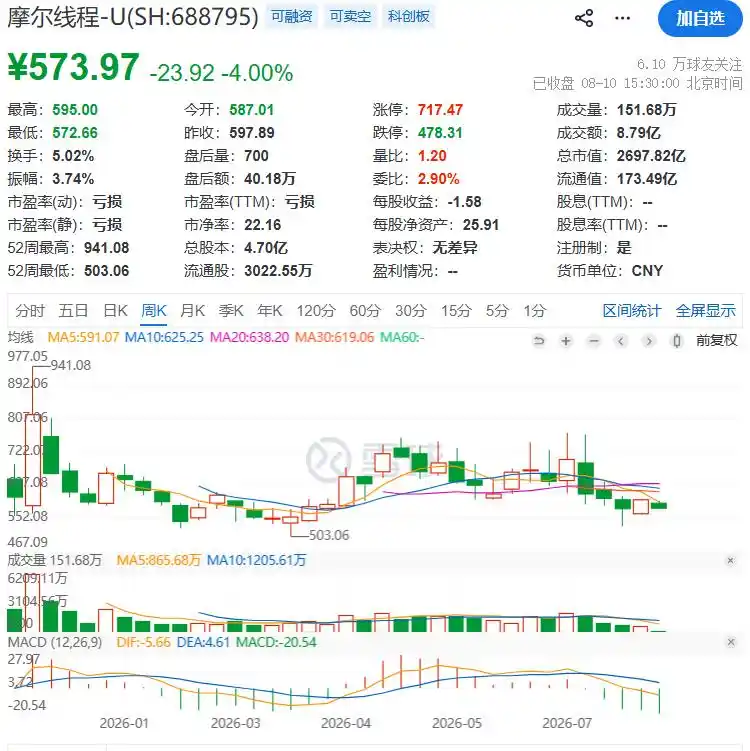
Behind this, Moore Threads' valuation was excessively hyped during its initial listing, with its price-to-sales ratio severely deviating from fundamentals. Its dynamic P/S ratio once exceeded 1,000x, significantly higher than the industry's static P/E ratio of around 60x. Meanwhile, its wealth management actions created a huge gap with investor expectations, impacting investor confidence.

Around July, the AI computing power sector experienced a collective pullback, with many stocks halving in value, and Moore Threads was no exception.

Planning Hong Kong IPO, Valuation Faces Test

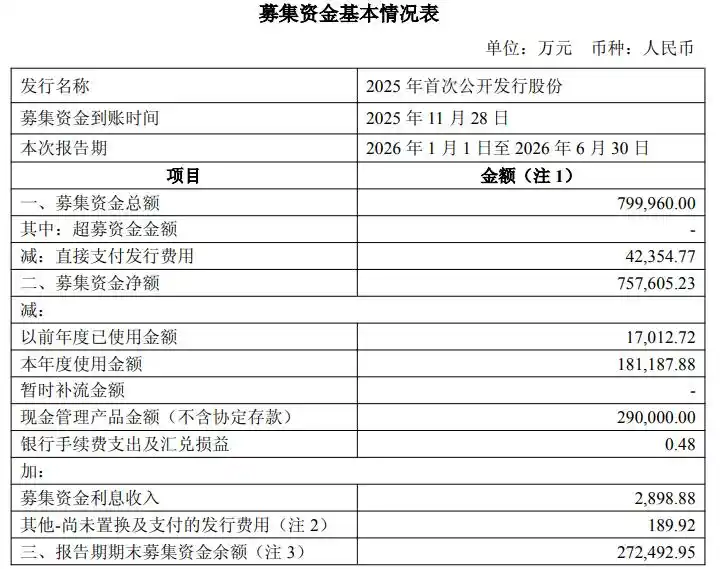
According to Moore Threads' fund usage announcement, it still has money on its books. It received 7.57 billion yuan from its A-share issuance, spent nearly 2 billion yuan, invested 2.9 billion yuan in wealth management products, and has 2.7 billion yuan deposited in banks.
The purpose of its Hong Kong listing is to "deepen its international strategic layout, continuously attract and gather outstanding global R&D and management talent, and enhance corporate governance and core competitiveness."

For the GPU industry it operates in, characterized by rapid technological iteration and intense capital competition, listing in Hong Kong helps open international capital channels and attract top overseas talent.

Industry insiders indicate that the perception of the "A+H" platform among enterprises has fundamentally shifted from a financing tool to a core strategic pillar for globalization.

Now is a golden window for "A+H" listings. In 2024, the China Securities Regulatory Commission proposed supporting leading domestic industry enterprises to list in Hong Kong; the Hong Kong Stock Exchange simultaneously reformed IPO rules, lowering listing thresholds.

Since 2024, over 270 mainland enterprises have listed in Hong Kong, raising over 650 billion Hong Kong dollars. Leading hard-tech companies like CATL, InnoLight, and Montage Technology have already completed or are pursuing the A+H path.

Among the "Four Little Dragons" of domestic GPUs, Biren Technology has already listed in Hong Kong. MetaX, which went public on the A-share market at the end of last year, swiftly announced plans for a Hong Kong listing in June.

However, for Moore Threads, it will be challenging for its Hong Kong IPO pricing to break through Biren Technology's valuation ceiling. International investors may use Biren's Hong Kong valuation as a benchmark and demand a discount for Moore Threads.

Revenue Surged in First Half, Still in the Red

In terms of performance, Moore Threads' revenue grew significantly in the first half, but it still hasn't turned a profit.

In the first half, Moore Threads achieved revenue of 1.74 billion yuan, a year-on-year increase of 147.4%, exceeding its full-year revenue from last year.

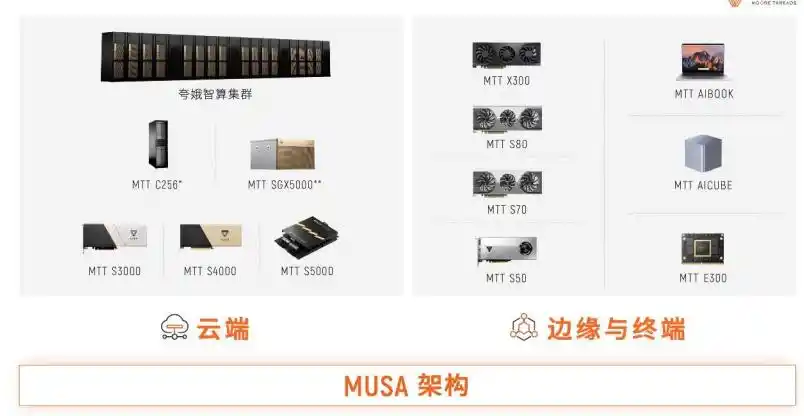
The semi-annual report explains that the significant revenue growth was driven by the development of the AI industry and strong market demand for full-feature GPUs, coupled with the accelerated commercialization of the company's Kua'e Intelligent Computing Cluster, whose performance has been highly recognized by customers.

The Kua'e Intelligent Computing Cluster is a "super factory" built by Moore Threads specifically for large language models, providing the computing power needed for training and inference of trillion-parameter-scale models.

Currently, almost all of Moore Threads' revenue comes from its cloud product line, including cloud intelligent computing cards, all-in-one intelligent computing machines, and intelligent computing clusters, generating about 1.7 billion yuan in the first half.

The edge and terminal product lines are still relatively small in scale and have not yet formed significant volume.
Moore Threads' net loss narrowed sharply from 271 million yuan in the same period last year to 11.563 million yuan. The company is very close to profitability, but its non-GAAP net profit attributable to the parent company still showed a loss of 150 million yuan in the first half, with non-recurring gains coming from government subsidies and investment income.

According to its previous disclosures, the earliest it expects to turn profitable is 2027.

In the first half, Moore Threads' total operating costs also surged, exceeding 1.8 billion yuan.

Among these, R&D investment reached 770 million yuan, a year-on-year increase of 38%; operating costs and sales expenses grew by 245% and 121% respectively, squeezed by both rising raw material prices and sales team expansion.

Conclusion

Moore Threads' initiation of a Hong Kong listing aims to broaden financing channels, facilitate attracting international talent, and enhance corporate governance, representing a strategic layout for the future.

Its revenue grew rapidly in the first half, but it is still not profitable on a non-GAAP basis, with R&D and sales investments continuing to increase. On the GPU track, whether Moore Threads can continue to narrow the gap with global industry leaders remains to be seen. Faced with market skepticism, it ultimately needs to respond with performance and technological breakthroughs.

This article is from the WeChat public account "Yijian Caijing," author: Feng Jianhong

Perguntas relacionadas

QWhat major announcements did Moore Threads make on August 9th?

AOn August 9th, Moore Threads announced two major pieces of news: its plan to list on the Hong Kong stock exchange (IPO) and the release of its strong first-half financial report.

QHow did Moore Threads' share price and market value change after its A-share IPO?

AAfter its A-share IPO, Moore Threads' stock price surged 468% on the first day and reached a historical high market value of 442.3 billion yuan. However, its market value subsequently declined. As of August 10th, its share price was 573.97 yuan/share, with a market value of 269.8 billion yuan, representing a 40% decrease from its peak.

QAccording to the article, what is the main purpose of Moore Threads seeking a Hong Kong IPO?

AAccording to the article, the main purpose of Moore Threads' Hong Kong IPO is to deepen its international strategic layout, continuously attract and gather top global R&D and management talent, and enhance its corporate governance level and core competitiveness.

QWhat were Moore Threads' financial results for the first half of the year, particularly regarding revenue and profitability?

AIn the first half of the year, Moore Threads achieved revenue of 1.74 billion yuan, a year-on-year increase of 147.4%, exceeding its full-year revenue from the previous year. However, it still reported a net loss of 11.563 million yuan on a non-GAAP basis, with non-recurring gains coming from government subsidies and investment income.

QWhat concerns did some investors express regarding Moore Threads' use of its IPO proceeds?

ASome investors expressed dissatisfaction, questioning the appropriateness of Moore Threads using a large portion (29 billion yuan) of its IPO proceeds to purchase low-risk financial products instead of investing in the promised projects for which the funds were raised, as this action created a gap with investor expectations and impacted market confidence.

Leituras Relacionadas

Founders Fund Leads $5 Million Token Purchase of ANVL: What Exactly is This "Non-Lending" DeFi Protocol Doing?

On October 6th, Founders Fund, led by Peter Thiel, invested $5 million to purchase ANVL tokens from the DeFi protocol Anvil's treasury. The round included participation from Pantera Capital and others, alongside angel investors like Compound founder Robert Leshner. Anvil is not a lending protocol. Instead, users lock assets like ETH or USDC into its vault to generate a verifiable on-chain "Letter of Credit" (LOC). This LOC acts as an economic guarantee, proving the user has sufficient locked collateral to back financial commitments, without borrowing funds. The protocol applies this mechanism to use cases like payment guarantees for merchants (via integration with Flexa) and enabling instant deposits for traders on exchanges like Bullish. Anvil's economic model is unique: it charges zero protocol fees. Its native token, ANVL, derives value solely from governance rights over parameters like supported collateral types. The total supply is 100 billion tokens. Despite an 83% price surge on the investment news, ANVL remains down approximately 89% from its all-time high. The protocol's Total Value Locked (TVL) has also fallen about 87% from its peak of ~$109 million in July 2025 to around $14 million currently. The investment represents a strategic bet that on-chain credit guarantees could become a significant category. Key factors to watch include the rate of real enterprise adoption through Anvil's SDK, the long-term sustainability of its zero-fee model, and the broader migration of traditional trade finance needs to blockchain infrastructure.

marsbitHá 43m

Founders Fund Leads $5 Million Token Purchase of ANVL: What Exactly is This "Non-Lending" DeFi Protocol Doing?

marsbitHá 43m

Mathematical Explosion: OpenAI Overnight Solves 722 Math Problems, Quasi-Riemann Hypothesis Proven

OpenAI has stunned the global mathematics and AI communities by releasing a GitHub repository containing 722 manuscripts addressing 372 previously unresolved major mathematical problem families, all reportedly generated by an unreleased internal AI model. The announcement, made without prior peer review, has provoked both excitement and alarm among mathematicians. The most notable breakthrough claims to be a proof of a "quasi-Riemann Hypothesis," establishing a zero-free region for Dirichlet L-functions with real part greater than 7/8 and eliminating the Landau-Siegel zeros—a significant leap in analytic number theory. The work has reportedly undergone formal verification using Lean. Other highlighted results include: unconditionally proving the NP-hardness of the basic semidefinite programming (SDP) threshold for approximation algorithms, based solely on P ≠ NP and circumventing the Unique Games Conjecture; proving the rational Hodge conjecture for abelian varieties with complex multiplication (CM); and resolving both the symmetric and asymmetric Mahler conjectures in convex geometry. According to OpenAI, most proofs were generated automatically by the model, with an average "thinking" time of just three hours per problem. This unprecedented scale and speed have sparked intense debate about the future of human mathematicians. While some express fear about the concentration of intellectual power, others see it as the dawn of a new era of discovery driven by AI. The mathematical world is now tasked with scrutinizing these claims, which, if verified, would represent historic milestones.

marsbitHá 1h

Mathematical Explosion: OpenAI Overnight Solves 722 Math Problems, Quasi-Riemann Hypothesis Proven

marsbitHá 1h

As Midterm Elections Approach, the Real Trade in U.S. Stocks Isn't About Who Wins

With the US midterm elections approaching in early November, political uncertainty has re-emenrged as a market variable. While market participants are weighing potential shifts in congressional control and policy direction, historical data suggests midterm elections themselves are not a definitive negative catalyst for US equities. Since 1937, the S&P 500 has averaged a positive gain of 9.2% in midterm election years, though this lags behind the 13.3% average for non-election years. A more consistent historical pattern is increased market volatility and a tendency for stronger performance concentrated in the fourth quarter, as political uncertainty is resolved. The article, citing analysis from J.P. Morgan and Capital Group, argues that the market's primary concern is policy path uncertainty rather than which party wins. This uncertainty tends to depress markets in the run-up to the vote, with a potential rebound afterward as the political risk premium dissipates. However, the article cautions against attributing market performance solely to the election. Recent midterm years like 2018 and 2022 saw significant market declines primarily driven by factors like Federal Reserve tightening and inflation, not the election outcome itself. The core argument is that the midterm election's impact on markets is often secondary to more fundamental drivers. Regardless of whether the result is a unified or divided government, the market's longer-term trajectory has historically been determined by underlying economic conditions. For the current environment, the key variables to watch post-election are not political labels but the path of interest rates, corporate earnings trends, and whether any actual policy changes materially alter cash flow expectations for businesses. The election may influence sentiment and policy expectations, but the sustainability of any year-end rally will ultimately depend on these core fundamentals of profitability, rates, and economic data.

marsbitHá 1h

As Midterm Elections Approach, the Real Trade in U.S. Stocks Isn't About Who Wins

marsbitHá 1h

AI Can't Change 'DNA': How Long Can SanDisk Stay Strong?

**AI Cannot Alter the "DNA": How Much Longer Can Western Digital's Run Last?** This analysis examines the sustainability of the current "super cycle" for NAND flash memory, driven by AI, with a focus on Western Digital (WD). The core argument is that while AI demand has fundamentally shifted NAND's role from a data warehouse to an essential component on the compute path, especially for AI inference, this does not eliminate the industry's cyclical nature. The piece first assesses the supply-demand dynamics. On the supply side, major producers are showing capital expenditure restraint for NAND, prioritizing DRAM/HBM. Capacity growth through 2028 relies heavily on technological upgrades (increasing 3D layers to 300+) and expansion primarily from China's YMTC, rather than new fabs. Global new fab capacity from players like Samsung and WD/Kioxia is concentrated post-2029. This results in estimated bit supply growth (CAGR ~24% for 2026-2028) largely driven by higher per-wafer output. Demand is undergoing a structural shift. AI-related NAND demand (for data lakes, KV cache, and staging) is forecast to grow at a 75% CAGR from 2025-2028, becoming the dominant driver. Data center demand will surpass 50% of total NAND demand in 2026. Consumer demand (PC, smartphone) is being squeezed and is expected to decline or stagnate. A key 2027 demand catalyst is NVIDIA's Rubin platform with its dedicated contextual memory storage (ICMS). The analysis concludes that a supply-demand deficit will persist into 2027. However, 2028 is identified as a potential inflection point where supply (led by YMTC's new fab) could outpace demand, ending the price rally. For Western Digital, the analysis models a more conservative path than management's guidance. It forecasts Average Selling Price (ASP) peaking in FY28 (ending June 2028) before declining in FY29-30 as the market loosens, though supported by long-term agreements (LTAs) and a higher mix of data center products. Consequently, margins and profits are expected to peak in FY28 and then contract. The valuation suggests WD's current price largely reflects a neutral scenario, with limited short-term upside unless the market becomes convinced that prices will remain stable post-2028. The fundamental takeaway is that despite AI's transformative impact, NAND's cyclical "DNA" remains intact.

marsbitHá 1h

AI Can't Change 'DNA': How Long Can SanDisk Stay Strong?

marsbitHá 1h

Trading

Spot
活动图片