Crypto Trading Volumes Approach Three-Year Low

cryptonews.ruPublicado em 2026-07-29Última atualização em 2026-07-29

Resumo

Cryptocurrency trading volumes have plunged, approaching a three-year low in July 2026, according to analysts from K33 Research. The report indicates that average daily spot trading volumes over the past 30 days fell to $2.2 billion, potentially reaching the lowest point since November 2023. Activity in derivatives is also weak, with open interest near multi-year lows. Experts attribute the slump to typical seasonal summer slowdowns, a cautious market mood due to low volatility and lack of clear trends, and a challenging macroeconomic backdrop. The crypto Fear & Greed Index remains at a "fear" level of 29. High oil prices driven by the US-Iran conflict are stoking inflation fears, leading investors to anticipate prolonged high interest rates. This environment reduces liquidity for risk assets like cryptocurrencies. Spot Bitcoin ETFs have seen minimal net inflows recently, indicating institutional passivity. Market participants are now focused on upcoming Federal Reserve decisions for potential catalysts. Following the Fed's June decision to maintain rates at 3.5-3.75%, traders are divided on whether a hike will follow. Analysts note that macro factors, particularly Fed policy, have become more significant for Bitcoin's price than its traditional four-year halving cycle.

In July 2026, spot trading activity on the cryptocurrency market could fall to its lowest level since November 2023. This is stated in a report by analysts at K33.

According to their data, the average daily spot trading volume over the last 30 days was $2.2 billion. Specialists also pointed to weak activity in derivatives: the open interest (OI) on CME remains near multi-year lows, and the OI for perpetual futures is holding around 300,000 $BTC.

"This picture accurately reflects the typical July slowdown, which historically has been the weakest period of the year for the crypto market in terms of $BTC trading volumes," states the message from K33 Research.

Analysts linked the weak volumes to pressure on crypto exchange revenues. As an example, they cited BitMEX, which announced its closure and will completely cease operations on September 23. Starting August 26, the company will apply risk limits, allowing users only to reduce positions. All remaining open positions will be force-closed by the time trading stops.

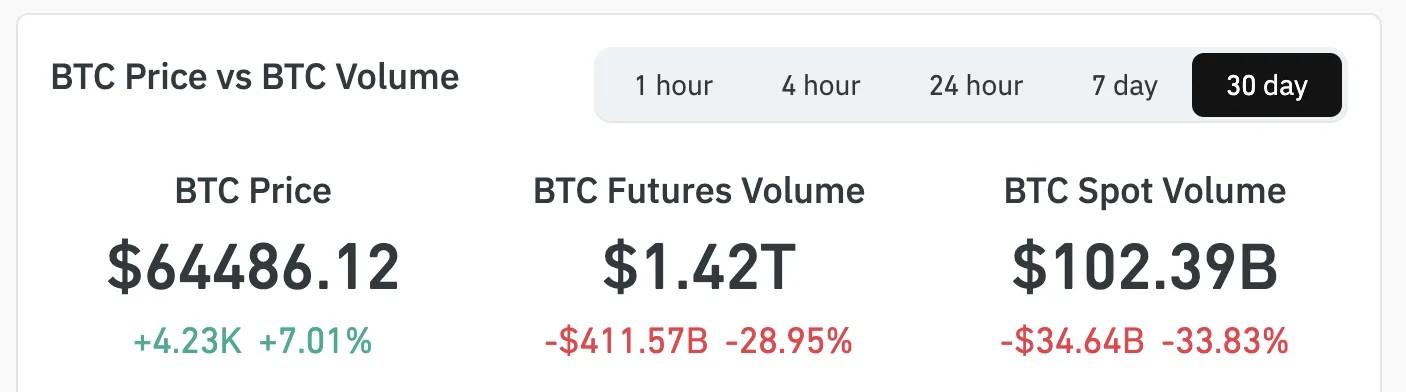
According to Coinglass, the 30-day spot trading volume for bitcoin was $102.39 billion, which is 33.83% lower than a month earlier. The futures trading volume for the same period fell by 28.95%, to $1.42 trillion.
Source: Coinglass.

Alexander Peresichan, CEO of Technobit, linked the decline in activity not only to seasonality but also to market participants' sentiment.

"Traders have become more cautious amid low volatility and the absence of a clear upward or downward trend," he noted.

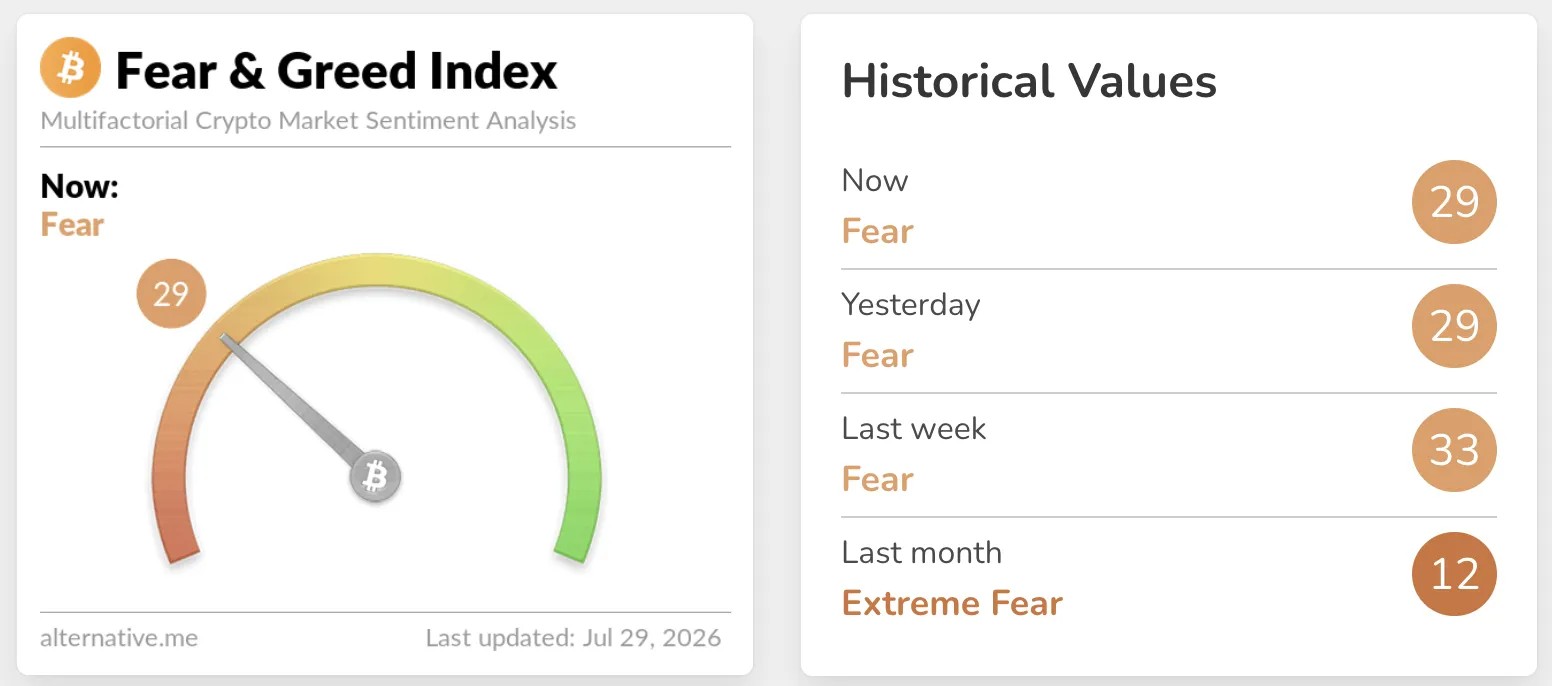
At the time of writing, the cryptocurrency Fear and Greed Index is at 29 points. In early July, the indicator dropped to 20 points.
Source: Alternative.me.

Millpay's Chief Operating Officer Igor Plotnikov pointed to the influence of the macroeconomic background.

"The escalating US-Iran conflict supports high oil prices and fuels inflationary risks. This forces investors to consider the possibility of a scenario where high interest rates will remain with us for a long time. In such an environment, cryptocurrencies, like other risk assets, receive less liquidity," he explained.

According to Plotnikov, statistics on capital inflows into spot bitcoin ETFs confirm investors' cautious stance. According to Farside, over the past two weeks, outflows have practically balanced inflows into the funds.

"Institutions are behaving passively: ETF flows are weak, and large players are waiting for clearer signals," he noted.

In the near term, the main catalysts for changing the market situation will be macroeconomic events, both experts believe. According to Plotnikov, investors are currently awaiting signals from the Fed regarding the key rate.

Prediction market traders increased the odds of a Fed rate hike

Peresichan emphasized that the Fed's decision largely depends on the situation in the energy market, the continuation of uncertainty around the US-Iran conflict, and high oil prices, which will inevitably lead to accelerating inflation, and consequently, to a slower rate cut than expected at the beginning of 2026.

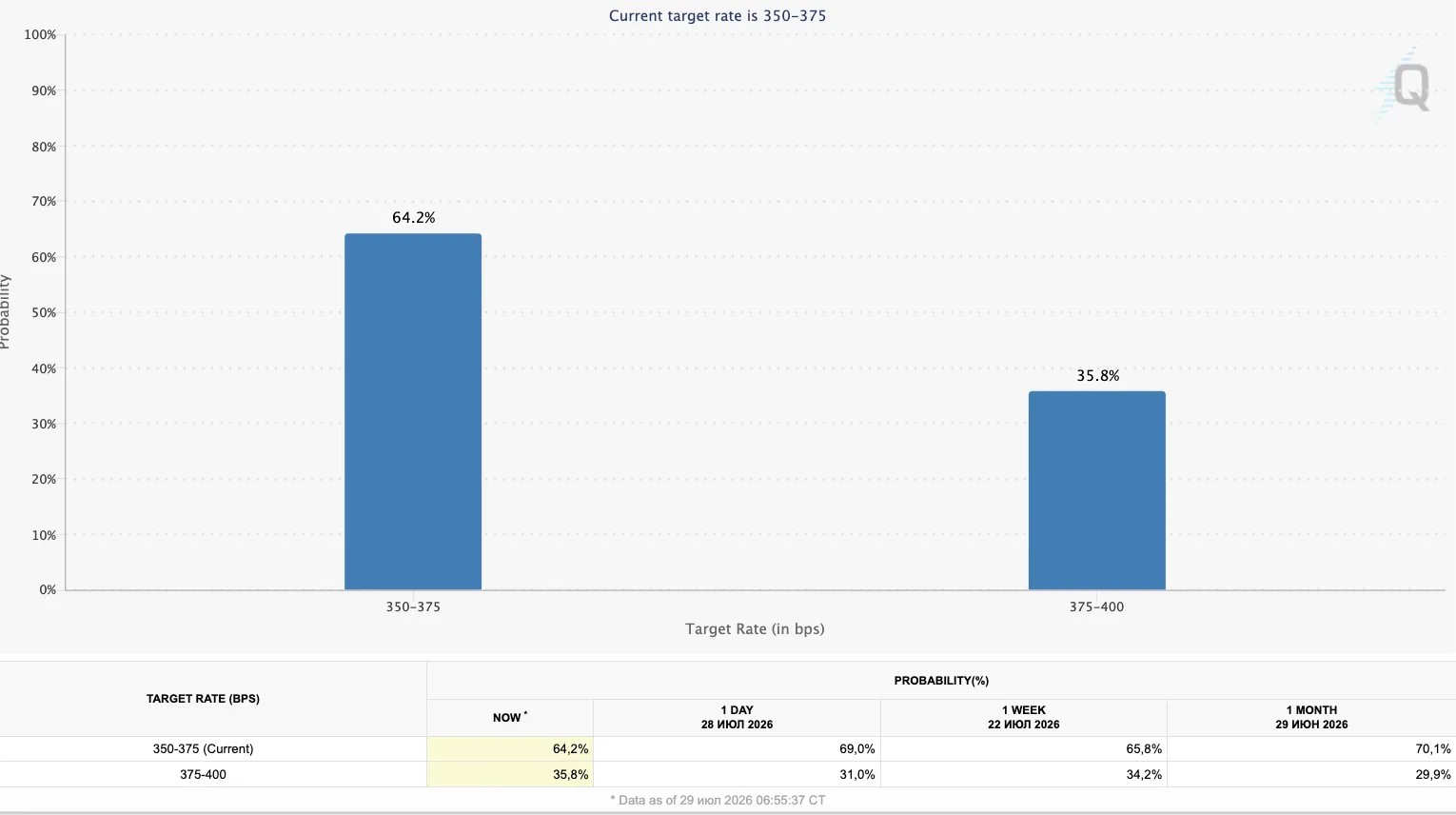
At the June meeting, the Federal Reserve kept the target range at 3.5–3.75%. At the time of writing, 64.2% of traders do not expect changes. However, 35.8% of market participants anticipate an increase to 3.75-4%.
Source: CME FedWatch.

Recall that in July, analysts at Grayscale linked a possible bitcoin bottom to future Fed policy. In their opinion, macroeconomic factors have become more important than the classic four-year halving cycle.

How does the Fed rate affect cryptocurrency prices?
end-content

Perguntas relacionadas

QAccording to the article, to what low point could crypto market spot trading activity fall in July 2026?

ACrypto market spot trading activity in July 2026 could fall to its lowest level since November 2023.

QWhat are two main reasons cited by experts for the decline in crypto market activity?

AExperts cited seasonality (typical July slowdown) and overall market sentiment, where traders are showing more caution due to low volatility and the absence of a clear price trend.

QWhat is a key macroeconomic factor that is influencing investor caution and limiting liquidity for cryptocurrencies, according to the operational director of Millpay?

AThe escalating U.S.-Iran conflict is supporting high oil prices and fueling inflation risks. This makes investors consider the possibility of high interest rates persisting, which reduces liquidity for risky assets like cryptocurrencies.

QWhat do investors and traders seem to be waiting for, according to the experts, as a potential catalyst to change the market situation?

AInvestors and traders are primarily waiting for signals from the U.S. Federal Reserve regarding its key interest rate policy.

QWhat recent news about a major crypto exchange is given as an example of the pressure on industry revenues?

AThe article cites BitMEX, which announced its closure and will cease all operations on September 23rd, as an example of the pressure on crypto exchange revenues.

Leituras Relacionadas

CryptoQuant Analyst Claims 'Frightening Scenario and Simultaneously Promising Signal for Bitcoin' Reveals Ultimate Bottom Point! Here Are the Details

Bitcoin, the leading cryptocurrency, entered a bear market after hitting a historic high of $126,000 in October 2025 and has since fallen over 50%. As BTC recently dropped to around $57,000, opinions diverge on whether the bottom has been reached, with some expecting a drop closer to $50,000. According to a pseudonymous CryptoQuant analyst, the Bitcoin bear market may be nearing its end. The analyst notes that as selling pressure following the all-time high weakens, price corrections are becoming shorter and recovery periods more substantial. The July decline was only slightly below lows seen in early February, and BTC has remained relatively stable around $60,000 since, indicating diminished seller influence. Positive technical signals are also cited, with MACD and RSI showing bullish signals, positive divergences, and oversold conditions, collectively suggesting a potential bottom formation for BTC. However, the analyst does not rule out a final sell-off in the short term. They suggest the ultimate market bottom could be around $51,336, corresponding to the 61.8% Fibonacci retracement level. The $50,000 area is highlighted as a crucial historical support zone, aligning with the average investor cost basis and the 200-week moving average—conditions similar to bottoms in previous bear markets. *This is not investment advice.

cryptonews.ruHá 23m

CryptoQuant Analyst Claims 'Frightening Scenario and Simultaneously Promising Signal for Bitcoin' Reveals Ultimate Bottom Point! Here Are the Details

cryptonews.ruHá 23m

Trading

Spot
活动图片