Telegram’s Pavel Durov responds to Russia’s terrorism designation

cointelegraphPublicado em 2026-07-30Última atualização em 2026-07-30

Resumo

Telegram founder Pavel Durov has publicly responded after Russian authorities designated him a "terrorist," claiming the move came after he refused government demands for mass surveillance and censorship. The Russian Federal Security Service accused him of facilitating terrorist activity by failing to remove channels used by terrorist groups and Ukrainian intelligence, building on a criminal case launched in February. Durov's legal challenges extend beyond Russia. He faced arrest in France in 2024 over allegations Telegram failed to adequately moderate illegal content, though he was later allowed to return to Dubai. The platform is also facing new court proceedings in Australia for allegedly not removing terrorism-related content. Positioning himself as a defender of free speech and digital privacy, Durov has criticized proposed EU surveillance measures and threatened to leave France if forced to grant access to users' private messages.

Telegram founder Pavel Durov said Russian authorities designated him a “terrorist” after he refused government demands for mass surveillance and censorship on the messaging platform, responding publicly a day after Russia announced charges against him.

In a Telegram post on Thursday, Durov also said Russia had barred him from “publishing information on the Internet,” adding that authorities had “got confused about who can ban whom from the Internet.”
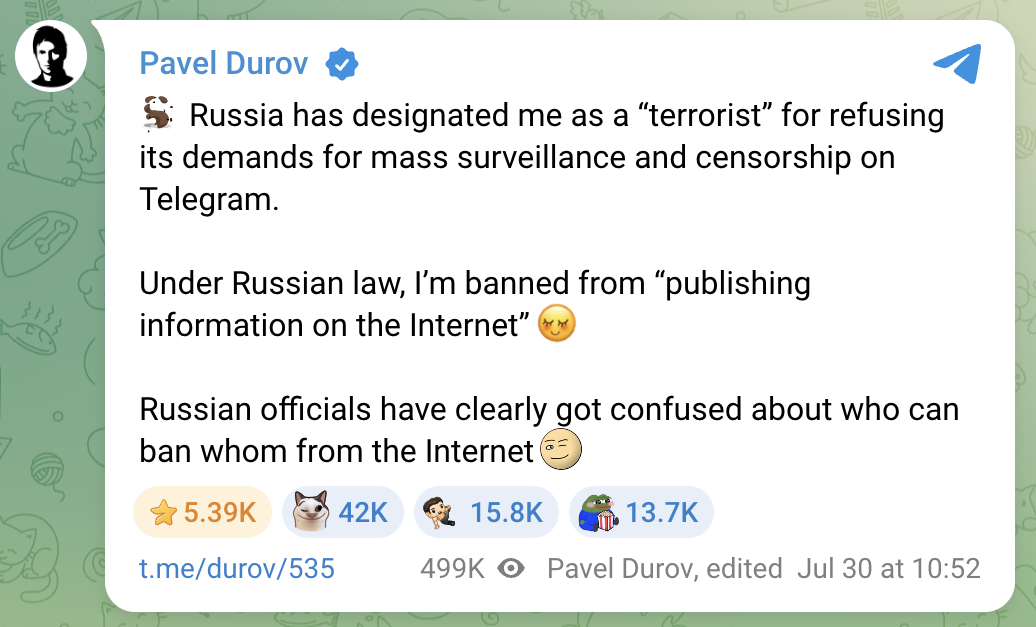
Source: Telegram, Pavel Durov

The comments came a day after Russia’s Federal Security Service accused Durov of facilitating terrorist activity, alleging Telegram failed to remove channels used by terrorist groups and Ukrainian intelligence services.

The case builds on a criminal investigation Russia launched in February, when regulators accused Telegram of leaving nearly 155,000 channels, chats and bots online despite claims they violated Russian laws covering extremist content, terrorism, drug trafficking and other illicit activity.

Related: Pavel Durov says Telegram to roll out native Gram crypto wallet

Durov’s legal battles extend beyond Russia

The Russian case adds to Durov’s legal challenges abroad. Durov was arrested in France in August 2024 and remains under judicial investigation over allegations that Telegram facilitated criminal activity by failing to adequately moderate illegal content and respond to law enforcement requests.

Durov has denied wrongdoing, arguing that French authorities failed to follow due process in seeking information from Telegram. His arrest also prompted a TON Community-backed campaign that collected more than 9 million signatures on an open letter urging French authorities to release him.

French authorities initially allowed Durov to temporarily return to Dubai in March 2025 before lifting his travel restrictions entirely later that year.

Telegram is also facing fresh legal pressure in Australia, where regulators this week launched court proceedings alleging the platform failed to remove terrorism-related content.

Durov has cast himself as a defender of free speech and digital privacy. In April, he warned the European Union’s proposed age-verification app could pave the way for broader online surveillance. The same month, he blamed alleged tax data leaks for a wave of crypto-related kidnappings in France and said Telegram would leave the country rather than grant authorities access to users’ private messages.

Magazine: A quantum roadmap would push Bitcoin much higher: Charles Edwards


Perguntas relacionadas

QAccording to the article, what were the two main reasons Pavel Durov said Russian authorities designated him a terrorist?

AHe said it was because he refused government demands for mass surveillance and censorship on the Telegram platform.

QWhat specific allegation did Russia's Federal Security Service make against Telegram in relation to terrorist activity?

AThey alleged that Telegram failed to remove channels used by terrorist groups and Ukrainian intelligence services.

QWhere was Pavel Durov arrested in August 2024, and what was the primary legal accusation against him there?

AHe was arrested in France over allegations that Telegram facilitated criminal activity by failing to adequately moderate illegal content and respond to law enforcement requests.

QWhat action did Durov threaten to take in France rather than grant authorities access to users' private messages?

AHe said Telegram would leave the country rather than grant authorities access to users' private messages.

QBesides Russia and France, which other country is mentioned as having launched new legal proceedings against Telegram this week?

AAustralia, where regulators launched court proceedings alleging the platform failed to remove terrorism-related content.

Leituras Relacionadas

Global Market Share Survey: Japanese Firms Lead in Semiconductor Materials

Global Market Share Survey: Japanese Firms Lead in Semiconductor Materials According to the 2025 "Major Goods and Services Market Share Survey" by Nikkei, Japanese companies maintain strong positions in semiconductor-related materials. In silicon wafers, Shin-Etsu Chemical ranks first with a 26.3% share, followed by SUMCO at 17.8%. Together, they hold 44.1% of the market, widening their lead over competitors from Taiwan, Germany, and South Korea. In photoresists, Tokyo Ohka Kogyo, JSR, and Shin-Etsu Chemical occupy the top three spots, with a combined share of 60.5%. Despite their strength in materials, Japanese firms have a weaker presence in core semiconductor segments like DRAM and NAND flash memory, where South Korean and U.S. companies dominate. For instance, SK Hynix and Samsung lead in DRAM, while China’s CXMT doubled its share to 6% in 2025. The semiconductor market is projected to grow rapidly, with WSTS forecasting a 90% increase to $1.5112 trillion by 2026. Major players like Samsung, SK Hynix, and Micron are making massive investments to expand capacity. To maintain their edge in materials, Japanese companies must similarly commit to large-scale, risk-taking investments. In contrast, Japan’s automotive sector shows stagnation. Toyota remains the global leader but with only a slight share increase to 12.3%, while Japanese brands are absent from the top five in the EV market. In shipbuilding, Imabari Shipbuilding rose to third place globally with a 7.2% share, benefiting from large container ship deliveries. However, Chinese and South Korean firms dominate the sector, holding the top two positions. Japan aims to revitalize its shipbuilding industry through government and corporate efforts, targeting a near doubling of output by 2035. Addressing labor shortages and adopting advanced technologies like physical AI will be critical for competitiveness.

marsbitHá 24m

Global Market Share Survey: Japanese Firms Lead in Semiconductor Materials

marsbitHá 24m

STRC Major De-pegging's First Financial Report, How Will Strategy Repair Its Capital Flywheel?

Bitcoin treasury company Strategy released its Q2 2026 earnings report on July 31. Despite a 6.9% year-over-year revenue increase to $122 million, the company recorded a net loss of $8.22 billion, largely due to $8.32 billion in unrealized losses from Bitcoin price fluctuations. As of quarter-end, Strategy holds 843,775 BTC with an average cost of $75,000 per coin, and Bitcoin per share increased. The report highlights a critical shift in Strategy's capital model following the de-pegging of its key financing tool, STRC (Strategic Coin), which fell below its $100 target. Management's top priority is restoring STRC to its target value, aiming for a recovery by September 8. They rule out discounted STRC issuances and plan to maintain its dividend yield at 12%, instead focusing on bolstering its $3.75 billion cash reserve. Strategy has moved from a one-way "buy-and-hold" Bitcoin strategy to active capital management. This new approach, part of its "Digital Credit Capital Framework," involves flexibly managing its balance sheet across four elements: BTC, USD cash, common stock (MSTR), and digital credit securities like STRC. This allows for BTC monetization (having sold $218.4 million in BTC so far), strategic repurchases of discounted securities, and debt optimization, as seen with a $1.5 billion convertible bond buyback. The company's future hinges on two key tests: successfully re-pegging STRC to restore market confidence in its digital credit system, and a long-term recovery in Bitcoin's price to ultimately support its growth thesis.

marsbitHá 1h

STRC Major De-pegging's First Financial Report, How Will Strategy Repair Its Capital Flywheel?

marsbitHá 1h

STRC's First Financial Report Post-Depegging, How is Strategy Restoring the Capital Flywheel?

On July 31, 2026, Bitcoin treasury company Strategy released its Q2 financial report. Despite a 6.9% year-over-year increase in revenue to $122 million, the company recorded a substantial net loss of $8.22 billion, primarily due to $8.32 billion in unrealized losses from Bitcoin holdings. While Strategy's core Bitcoin strategy remains intact—its holdings grew 11% to 843,775 BTC—the company is undergoing a fundamental shift in its capital model. Following the de-pegging of its key financing tool, the STRCoin (STRC), from its $100 target in May, Strategy has pivoted from a one-directional "raise funds, buy Bitcoin" cycle to a more dynamic, multi-asset capital management approach. A key part of this new framework is the "Monetization Program," through which Strategy has sold approximately $218.4 million worth of BTC to bolster liquidity. The company's top priority is repairing STRC's peg, committing not to issue discounted shares until it returns to its target range. It has initiated a $1 billion buyback program for discounted digital credit securities, having repurchased $28.9 million face value of STRC so far. Management aims to restore the peg around September 8, 2026. Strategy now actively manages a matrix of assets: Bitcoin (for accumulation or strategic sales), USD cash reserves (now at $3.75 billion), common stock (MSTR), and digital credit securities like STRC. This allows for tactical moves like repurchasing discounted debt or equity to capture value. The future success of Strategy's "capital flywheel" hinges on two factors: the short-term ability to successfully re-peg STRC to restore market confidence in its digital credit system, and the long-term price trajectory of Bitcoin, upon which its entire investment thesis ultimately depends.

Odaily星球日报Há 1h

STRC's First Financial Report Post-Depegging, How is Strategy Restoring the Capital Flywheel?

Odaily星球日报Há 1h

Trading

Spot
活动图片