JPMorgan Hit With Lawsuit Tied To $328 Million Crypto Ponzi Scheme

bitcoinistPublicado em 2026-03-13Última atualização em 2026-03-13

Resumo

In a proposed class action lawsuit, JPMorgan Chase is accused of enabling a $328 million crypto Ponzi scheme operated by Florida-based Goliath Ventures. The suit alleges the bank ignored red flags and allowed the firm to use its banking infrastructure to process around $250 million, despite Know Your Customer obligations. One plaintiff claims he lost $650,000, including retirement savings. Goliath’s CEO, Christopher Delgado, has been arrested on fraud and money laundering charges. A separate federal case also names Bank of America for its role. The lawsuit argues JPMorgan should have detected and stopped the fraudulent activity.

One of the first named plaintiffs in a new lawsuit against JPMorgan Chase says he lost $650,000 — including retirement savings — to an alleged $328 million crypto Ponzi scheme the bank helped keep running.

Robby Alan Steele is among more than 2,000 investors who say they were defrauded by Goliath Ventures, a Florida-based crypto investment firm that prosecutors say collected hundreds of millions of dollars under false pretenses.

JPMorgan Named As Sole Financial Institution For Goliath

A proposed class action filed Tuesday in the US District Court for the Northern District of California accuses JPMorgan of letting Goliath use its banking infrastructure to pull in investor funds while ignoring warning signs that something was wrong.
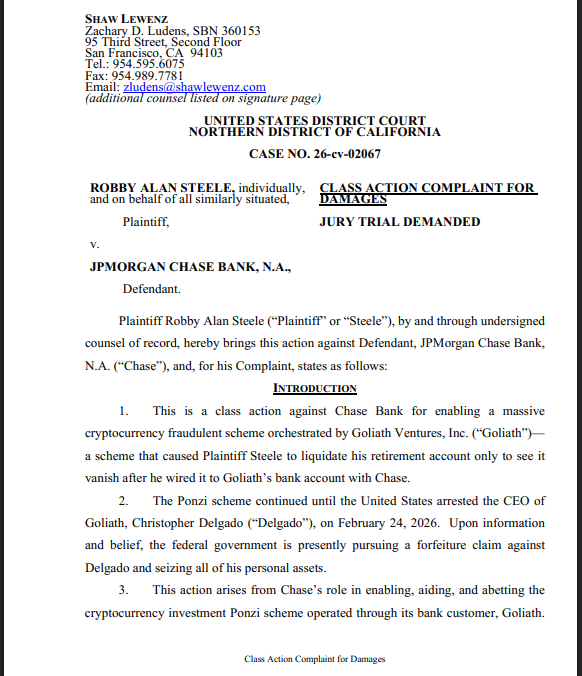
Source: Law.com

According to the complaint, JPMorgan was the only bank holding Goliath’s accounts from January 2023 through mid-2025 — the bulk of the scheme’s run.

During that stretch, roughly $250 million passed through a single JPMorgan account linked to Goliath. About $123 million of that was sent to Goliath’s wallets held at Coinbase.

Attorneys say the sheer volume moving through one account should have triggered scrutiny under federal banking rules that require institutions to know who their customers are and what those customers do with their money.

“Chase, by virtue of its Know Your Customer obligations, actually knew that Goliath was acting as a private equity cryptocurrency pool operator investing money for investors, without being licensed at all to sell these investments,” the complaint states.

BTCUSD now trading at $70,261. Chart: TradingView

Goliath, originally called Gen-Z Venture Firm, operated from January 2023 until January 2026, based on court documents. CEO Christopher Delgado was arrested on Feb. 24 by the US Attorney’s Office for the Middle District of Florida.

He faces wire fraud and money laundering charges. If convicted on all counts, he could spend up to 30 years in federal prison.

Bank Of America Also Appears In Federal Case

A separate federal criminal complaint names Bank of America as well. Prosecutors say Delgado was a co-signatory on a BOA business account used by Goliath, with at least one investor directed to that account by company representatives.

Investor funds, based on the government’s account, were routed through the JPMorgan account, the BOA account, or sent straight to Goliath’s Coinbase wallets — all controlled by Delgado.

The civil lawsuit was filed by attorneys from Shaw Lewenz, Sonn Law Group, and Schwartzbaum. Lead attorney Jordan Shaw said more complaints are coming as the team continues to identify people believed to be involved in the scheme.

Featured image from Unsplash, chart from TradingView

Perguntas relacionadas

QWhat is the main allegation against JPMorgan Chase in the lawsuit?

AThe lawsuit alleges that JPMorgan Chase allowed Goliath Ventures to use its banking infrastructure to collect investor funds while ignoring red flags that it was a Ponzi scheme, violating its Know Your Customer obligations.

QHow much money did the lead plaintiff, Robby Alan Steele, allegedly lose in the scheme?

ARobby Alan Steele allegedly lost $650,000, which included his retirement savings.

QWhat was the total amount of the alleged Ponzi scheme and how much passed through a single JPMorgan account?

AThe alleged Ponzi scheme totaled $328 million. Approximately $250 million passed through a single JPMorgan account linked to Goliath.

QWhat charges does Goliath Ventures CEO Christopher Delgado face?

AChristopher Delgado faces charges of wire fraud and money laundering. If convicted on all counts, he could face up to 30 years in federal prison.

QBesides JPMorgan, which other major bank is named in the federal case related to this scheme?

ABank of America is also named in a separate federal criminal complaint, as Delgado was a co-signatory on a BOA business account used by Goliath.

Leituras Relacionadas

The 4 Truths and Fee Traps Behind Polymarket's LP Market Making Incentives

Polymarket, a prediction market platform, has recently shifted its focus to incentivizing liquidity providers (LPs) to address its core issue of low liquidity. While most markets remain free, it now charges a taker fee on specific markets like crypto price movements and select sports events. This fee, highest near 50% probability, funds new LP reward programs. There are two primary reward systems: one pays LPs when their limit orders are executed (maker rewards), and another rewards simply for placing orders within a set spread to provide liquidity, even if they don't get filled. A third mechanism allows anyone to sponsor additional incentives for specific markets. A positive view argues this structure values genuine liquidity over mere trading volume, making fees earned and rewards received a potential key, anti-sybil metric for a future POLY token airdrop. It rewards users who improve market depth and stability. A contrasting, negative view claims the LP program is a "trap." Critics argue that professional market makers avoid it due to insider trading risks and that most LPs are actually losing money due to hidden "LP wear and tear" (impermanent loss), only participating based on speculation of a valuable airdrop. They warn that if Polymarket expands fees to fund these unsustainable rewards, it could lose its competitive edge of zero fees and better odds compared to traditional sportsbooks. Proposed solutions include a fixed fee only on profits, using a native POLY pool for liquidity, or charging for premium products like parlays instead of core markets.

marsbitHá 2h

The 4 Truths and Fee Traps Behind Polymarket's LP Market Making Incentives

marsbitHá 2h

The 4 Truths Behind Polymarket's LP Market-Making Incentives and the Fee Trap

Polymarket, a prediction market platform, has recently shifted its incentive structure towards rewarding Liquidity Providers (LPs) to solve its core problem of low market depth. While most markets remain free, it now charges a taker fee on specific markets (all Crypto markets, NCAAB basketball, and Serie A football) to fund new LP reward programs. The fee is calculated on a symmetric curve, highest near 50% probability. The platform has introduced two main incentive systems: one rewards LPs whose limit orders are executed (Maker Incentives), and another rewards LPs simply for providing resting liquidity, even if orders aren't filled (Liquidity Incentives). A third system allows anyone to sponsor additional rewards for specific markets. A key argument is that the fees paid and rewards earned could be a strong anti-sybil metric for a potential POLY token airdrop, valuing genuine liquidity provision over mere trading volume. However, a counter viewpoint argues the LP program is a potential trap. Critics claim that the displayed ROI for LPs is misleading as it doesn't account for "LP wear and tear"—losses from filled orders that can't be easily exited. They state professional market makers avoid it due to insider trading risks and that the model of subsidizing liquidity with massive daily rewards is unsustainable. The concern is that widespread fee implementation could erase Polymarket's competitive edge over traditional betting platforms. Proposed solutions include a fixed fee on profits only, using a POLY token for native liquidity, and charging for premium products like parlays instead of core markets.

Odaily星球日报Há 2h

The 4 Truths Behind Polymarket's LP Market-Making Incentives and the Fee Trap

Odaily星球日报Há 2h

Understanding x402 and MPP: Two Approaches to Agent Payments

Stripe's MPP and x402 represent two competing approaches to enabling machine-to-machine payments, both leveraging the long-dormant HTTP 402 status code ("Payment Required"). x402, led by Coinbase, is a minimalist protocol that embeds payment directly into HTTP requests. It requires no accounts, API keys, or intermediaries. A server returns a 402 response with payment details; the client pays on-chain and resubmits the request with a proof. It's open-source, chain-agnostic (currently supporting Base, Polygon, Solana), and designed for open, permissionless systems. However, current usage is low, with small microtransactions. MPP, developed by Stripe and Tempo, is a full-stack solution built for high-frequency agent transactions. Its core innovation is sessions, allowing an agent to pre-authorize a spending limit and make numerous micro-payments within it without repeated on-chain transactions. It runs on the Tempo blockchain, optimized for high throughput and sub-second confirmations. Crucially, it integrates with Stripe's existing compliance, risk, and fiat infrastructure, including support for credit cards via Shared Payment Tokens (SPTs). While x402 offers simplicity and decentralization, MPP provides scalability and enterprise-grade features. Stripe supports both, aiming to capture agent payment flows regardless of the underlying protocol. The ecosystem is still experimental, but major players like Google, Visa, and Anthropic are involved. The choice depends on the use case: x402 for open, long-tail applications, and MPP for commercial, high-volume scenarios.

marsbitHá 2h

Understanding x402 and MPP: Two Approaches to Agent Payments

marsbitHá 2h

Trading

Spot
Futuros

Artigos em Destaque

Como comprar ONE

Bem-vindo à HTX.com!Tornámos a compra de Harmony (ONE) simples e conveniente.Segue o nosso guia passo a passo para iniciar a tua jornada no mundo das criptos.Passo 1: cria a tua conta HTXUtiliza o teu e-mail ou número de telefone para te inscreveres numa conta gratuita na HTX.Desfruta de um processo de inscrição sem complicações e desbloqueia todas as funcionalidades.Obter a minha contaPasso 2: vai para Comprar Cripto e escolhe o teu método de pagamentoCartão de crédito/débito: usa o teu visa ou mastercard para comprar Harmony (ONE) instantaneamente.Saldo: usa os fundos da tua conta HTX para transacionar sem problemas.Terceiros: adicionamos métodos de pagamento populares, como Google Pay e Apple Pay, para aumentar a conveniência.P2P: transaciona diretamente com outros utilizadores na HTX.Mercado de balcão (OTC): oferecemos serviços personalizados e taxas de câmbio competitivas para os traders.Passo 3: armazena teu Harmony (ONE)Depois de comprar o teu Harmony (ONE), armazena-o na tua conta HTX.Alternativamente, podes enviá-lo para outro lugar através de transferência blockchain ou usá-lo para transacionar outras criptomoedas.Passo 4: transaciona Harmony (ONE)Transaciona facilmente Harmony (ONE) no mercado à vista da HTX.Acede simplesmente à tua conta, seleciona o teu par de trading, executa as tuas transações e monitoriza em tempo real.Oferecemos uma experiência de fácil utilização tanto para principiantes como para traders experientes.

218 Visualizações TotaisPublicado em {updateTime}Atualizado em 2025.03.21

Como comprar ONE

Discussões

Bem-vindo à Comunidade HTX. Aqui, pode manter-se informado sobre os mais recentes desenvolvimentos da plataforma e obter acesso a análises profissionais de mercado. As opiniões dos utilizadores sobre o preço de ONE (ONE) são apresentadas abaixo.

活动图片