World Gold Council Proposes “Gold as a Service” Framework Impacting Tokenized Gold Market

TheNewsCryptoPublicado em 2026-03-20Última atualização em 2026-03-20

Resumo

The World Gold Council has introduced a "Gold as a Service" framework aimed at modernizing the global tokenized gold infrastructure. This system connects physical gold custody with digital issuance, enabling more efficient creation of gold-backed products. It is structured around three core components: physical custody, digital issuance, and synchronization systems that link assets to blockchain records. The framework is expected to impact major market players like Tether Gold (XAUT) and Paxos Gold (PAXG), which currently dominate the tokenized gold sector but operate on fragmented systems. By introducing standardized processes for custody, compliance, and redemption, the initiative seeks to unify the market, improve regulatory alignment, and reduce operational costs. This development is seen as a significant step in merging traditional gold markets with blockchain technology, potentially driving greater adoption among institutional investors and fintech companies. The Council emphasized that the framework is designed to foster future growth rather than target existing issuers.

The World Gold Council created a “Gold as a Service” framework to help modernize tokenized gold infrastructure worldwide. It does this by connecting physical gold custody and digital issuance systems, allowing companies to issue gold-backed products more efficiently. It is built on three levels of physical custody, digital issuance, and synchronization systems that connect assets and blockchain records.
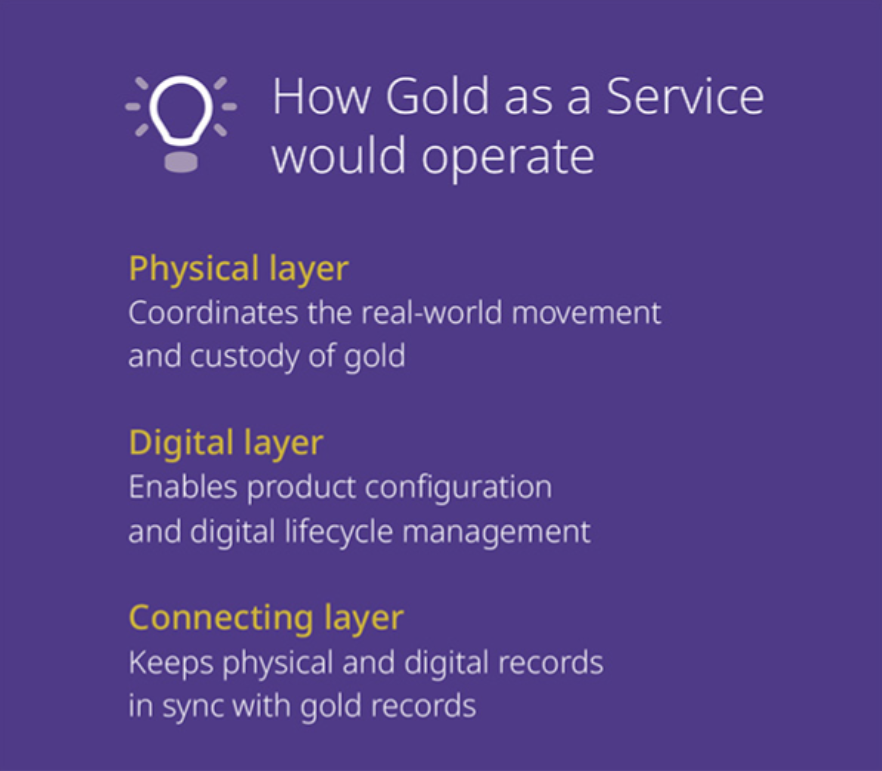
Source: World Gold Council

The World Gold Council CEO, David Tait, said, “Financial services are undergoing a rapid and pervasive digital transformation.” He further added that shared infrastructure would help in improving accessibility, tradability, and integration of gold in modern financial systems worldwide.

Impact on Tether Gold and Paxos Gold Market Leaders

Currently, Tether Gold (XAUT) and Paxos Gold (PAXG) currently dominate the overall tokenized gold market. Also, they collectively command a large market share in the overall market worldwide. Both of these operate on different systems for custody, audit, and redemption, and this is causing fragmentation in the overall digital gold market worldwide.

The new framework also outlines a set of standardized processes that include custody coordination, compliance checks, and redemption systems that are to be followed on all platforms globally. Such a framework would ensure that all platforms are aligned in terms of regulatory compliance. It has been noted that such a platform can enable hundreds of new issuances to happen in a more efficient manner.

The Potential and Development Mark

The platform can potentially lead to lower operational costs as well as better integration between tokenized gold assets on various blockchain platforms globally. This can further increase adoption rates among institutional investors as well as fintech companies that are entering the tokenized commodity space. Officials emphasized that the platform focuses on enabling growth. Rather than targeting existing issuers in the space.

The development marks a significant convergence between traditional gold markets and blockchain technology as the adoption of digital assets continues to gain momentum globally. Analysts noted that tokenized gold can act as a major growth driver in traditional gold markets globally.

Highlighted Crypto News:

Ondo Finance Expands Tokenized Securities Offering With BlackRock IBIT and Galaxy Digital

TagsBlockchainCryptocurrencyDigital assetsGoldservice

Perguntas relacionadas

QWhat is the main purpose of the 'Gold as a Service' framework proposed by the World Gold Council?

AThe main purpose is to modernize tokenized gold infrastructure worldwide by connecting physical gold custody and digital issuance systems, allowing companies to issue gold-backed products more efficiently.

QWhich two products currently dominate the tokenized gold market according to the article?

ATether Gold (XAUT) and Paxos Gold (PAXG) currently dominate the tokenized gold market.

QWhat are the three levels that the 'Gold as a Service' framework is built upon?

AIt is built on three levels: physical custody, digital issuance, and synchronization systems that connect assets and blockchain records.

QWhat benefits does the World Gold Council CEO believe shared infrastructure will bring to gold?

ADavid Tait believes shared infrastructure will help improve accessibility, tradability, and integration of gold in modern financial systems worldwide.

QHow can the new framework potentially impact operational costs and adoption rates?

AThe framework can lead to lower operational costs and better integration, which can further increase adoption rates among institutional investors and fintech companies entering the tokenized commodity space.

Leituras Relacionadas

From Cash to Crypto: Towards a Consistent Regulatory Approach to Illicit Payments

"From Cash to Crypto: Towards a Consistent Regulatory Approach to Illicit Payments" by Andrea Minto et al. (BIS) examines the challenges for Anti-Money Laundering and Countering the Financing of Terrorism (AML/CFT) regulation posed by the diversification of payment instruments, from cash and bank deposits to cryptoassets and CBDCs. The paper introduces a conceptual framework centered on the degree of intermediary involvement in a payment tool. It identifies a "waterbed effect": as regulators tighten AML/CFT rules on one type of instrument (e.g., bank transfers), illicit activity may shift to less-regulated alternatives with lower detection probabilities (e.g., self-hosted crypto wallets). This regulatory arbitrage undermines overall effectiveness. The framework categorizes payment tools as either intermediary-dependent (e.g., bank deposits, e-money, custodial wallets) where regulated entities perform checks, or non-intermediated (e.g., cash, self-hosted wallets, offline CBDCs) which offer higher anonymity and pose greater detection challenges. Malicious actors are assumed to choose tools that minimize their risk of detection. A case study of the EU's evolving AML/CFT regime illustrates this dynamic, showing how regulation has expanded over time to cover new entities like Crypto-Asset Service Providers (CASPs). However, inconsistencies remain, such as transaction limits for cash but not yet for self-hosted wallets or offline digital euro transactions. The paper concludes by proposing a dual regulatory approach: a *lex generalis* establishing a unified baseline of core obligations for all intermediated tools, and a *lex specialis* with tailored rules for non-intermediated instruments (e.g., transaction limits for cash and offline CBDCs, enhanced "touch point" monitoring for self-hosted wallets). This aims to create a more effective, consistent, and forward-looking framework that balances financial integrity with considerations for user privacy and innovation.

marsbitHá 4h

From Cash to Crypto: Towards a Consistent Regulatory Approach to Illicit Payments

marsbitHá 4h

Trading

Spot
Futuros
活动图片