The latest quarterly report card released by SanDisk features a top-line revenue of $8.965 billion for the single quarter. According to the company's announcement, this represents a 51% increase compared to the previous quarter.
This is not the "Q2" of the company's fiscal year. In SanDisk's books, it is called FY2026 Q4, with the reporting period ending on July 3rd, covering most of the second quarter of the calendar year and serving as the most recent snapshot of Q2 operations. The fiscal year naming adds a layer of complexity. What is easier to overlook when reading the financial report is the source of the growth.
The company notes in its 8-K filing attachment submitted to the U.S. Securities and Exchange Commission that the results are still preliminary before the fiscal year closing and audit process, and final 10-K figures may be adjusted. This article is based on this earnings announcement and does not treat management's next-quarter guidance as already realized revenue.
How Did Revenue Jump This Quarter?
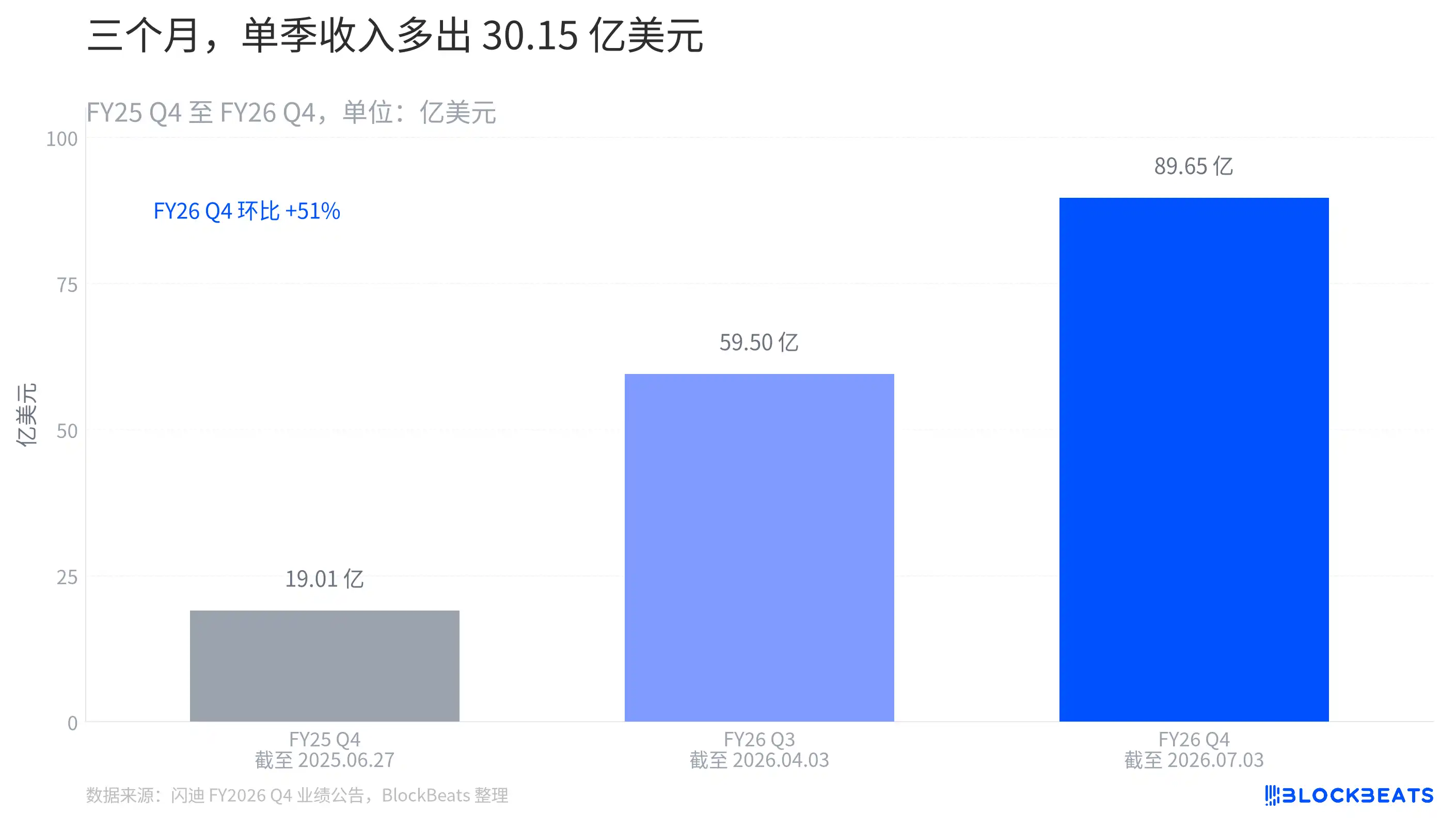
According to SanDisk's earnings announcement, revenue for FY2025 Q4 was still at $1.901 billion, while the latest quarter reached $8.965 billion. The step in the chart is steep, yet it more closely reflects the company's operational reality than "year-over-year growth."
The final column is particularly interesting. The additional revenue generated in the latest quarter compared to the previous quarter has already exceeded the total quarterly revenue of FY2025 Q4. It translates the 51% quarter-over-quarter increase into a more intuitive picture. SanDisk did not add a small segment to its original scale; rather, it essentially grew another version of its past self within three months.
The company's midpoint revenue guidance for the next quarter has already surpassed $10 billion. That is a dotted line, representing management's current assessment, not a fact confirmed in advance by this article.
Why Did Almost All the New Revenue Stay as Gross Profit?
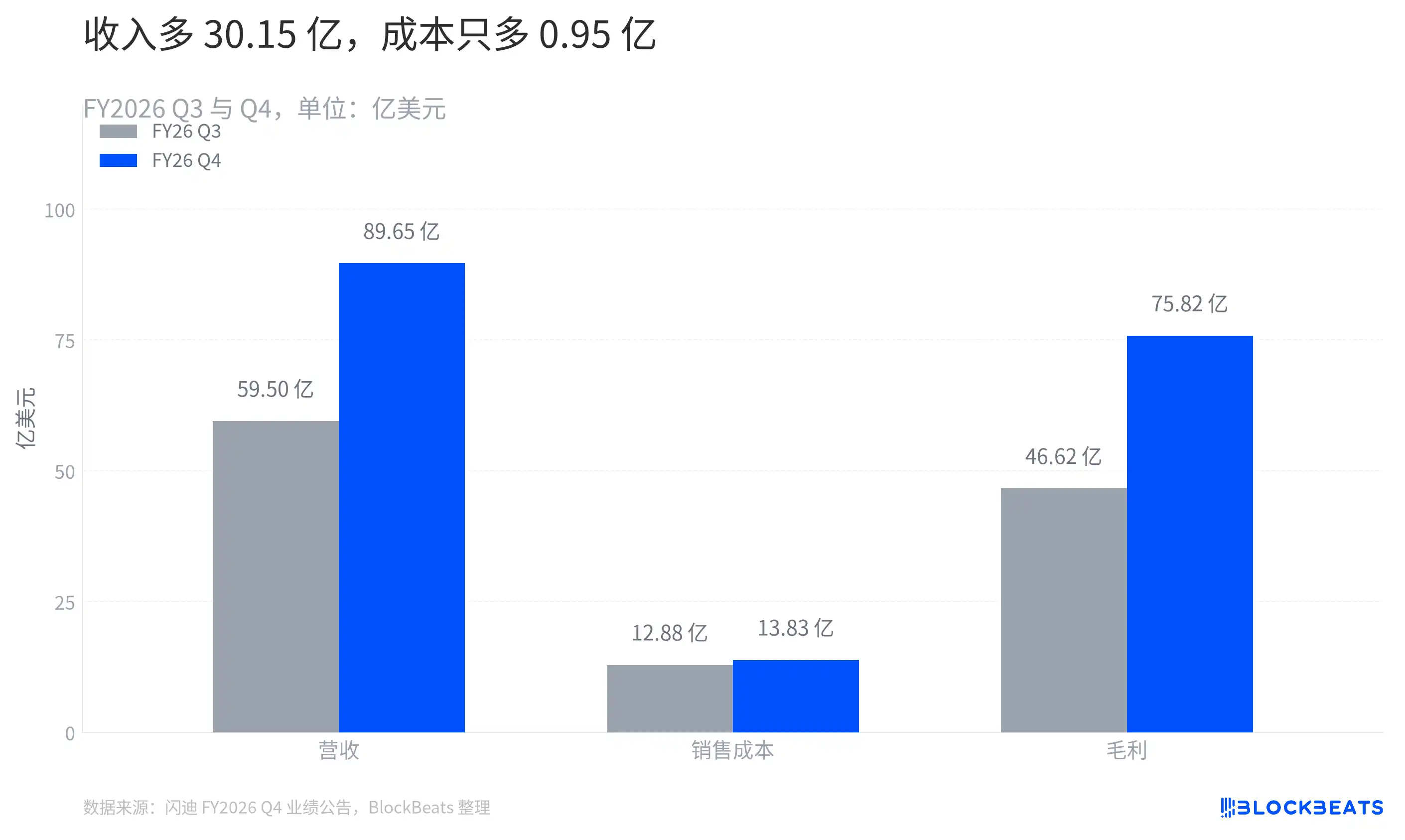
According to the company announcement, SanDisk sold $3.015 billion more in FY2026 Q4 compared to the previous quarter, while the cost of sales increased by only about $95 million. The chart shows a clear misalignment. The blue revenue bar stretches far, while the cost bar remains almost stationary.
This is a change that a NAND manufacturer must take seriously. The new revenue did not bring a proportionate increase in manufacturing expenses. Gross margin continued to rise above 80%. Translating this accounting change into plain language, the vast majority of every additional dollar of revenue stayed within the gross profit.
Significant profits still need to be examined closely. According to the company's reconciliation table, there is a difference of approximately $741 million between GAAP net income and Non-GAAP net income. The most noticeable item is $804 million in gains on equity securities, which the company excluded from its Non-GAAP metrics. Gains from valuation or disposal of such securities represent a different type of profit from selling more flash memory in the quarter, meaning not all the brightness in the GAAP income statement can be attributed to the core business.
Is Data Center the Only Protagonist?
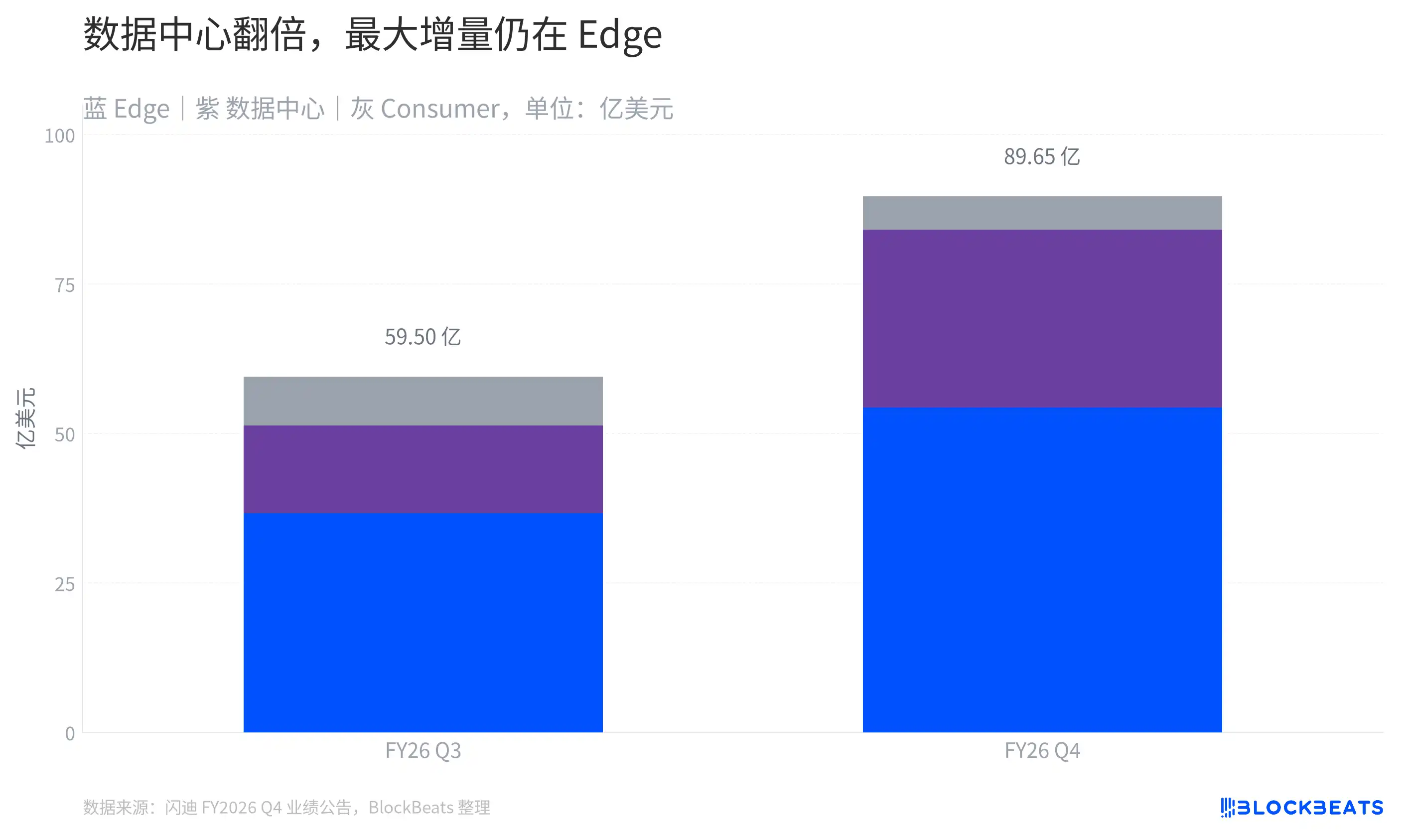
According to the company announcement, data center revenue doubled this quarter, naturally making it the star in the AI narrative. However, looking at the three markets stacked together, the blue Edge segment remains the largest foundation, and its incremental revenue for the quarter was slightly higher than that of the data center.
This distinction is crucial. The data center provided the fastest speed, while Edge provided the larger revenue increment. The top Consumer segment actually shrank, indicating this surge is not an across-the-board simultaneous uptick in all demand, but a reordering of different end markets with varying intensities.
Summarizing it as "AI driving flash memory" is not entirely wrong but misses the revenue structure. The data center makes the growth more noticeable, Edge continues to expand the scale, and the decline in Consumer reminds readers that SanDisk has not turned every product line into the same growth curve.
What Did Price Do?
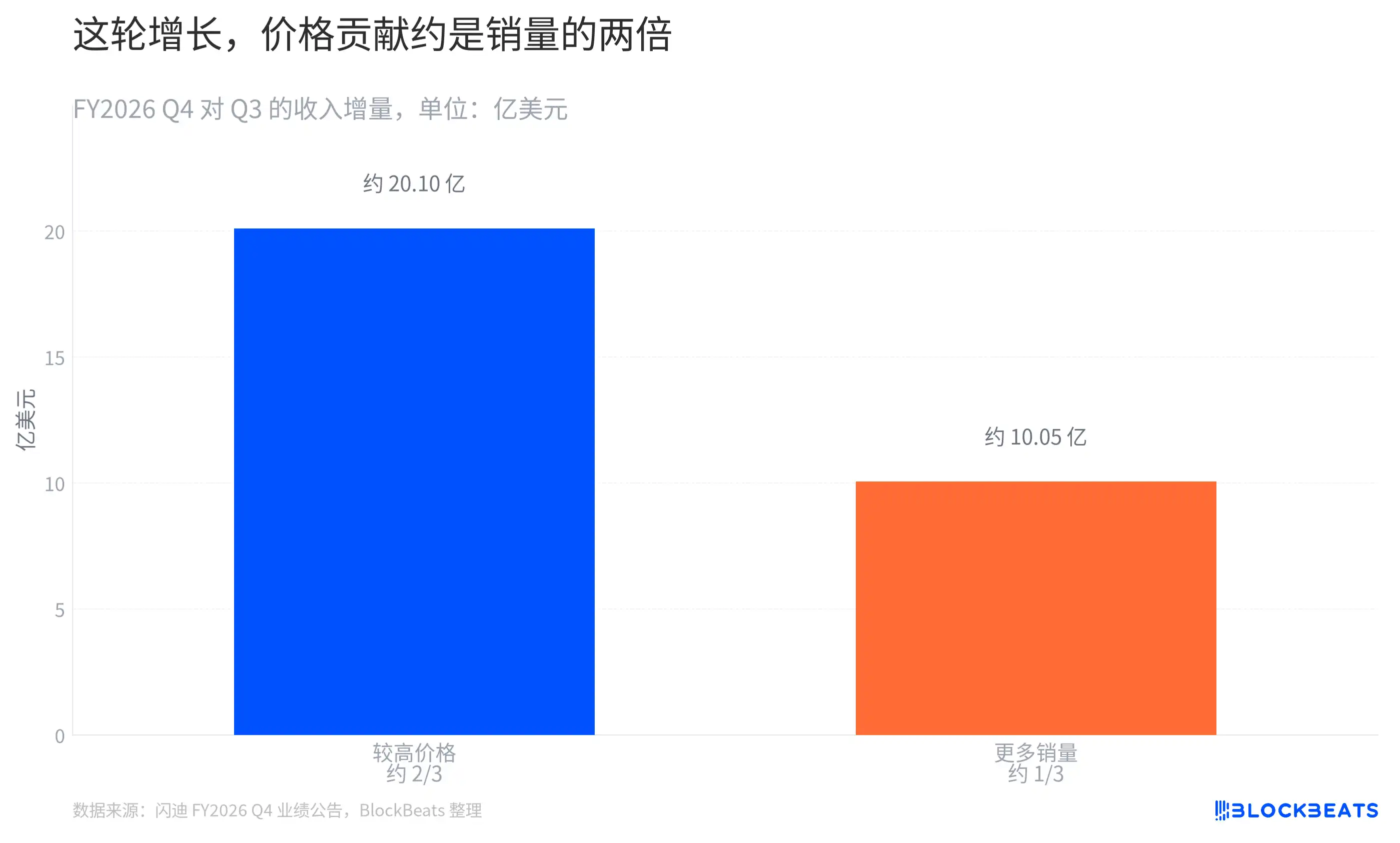
SanDisk provided a rare breakdown in its earnings announcement. Of the quarter-over-quarter revenue growth, approximately one-third came from higher volume, and approximately two-thirds came from higher prices. Based on the proportion provided by the company, the contribution from price was about twice that from volume.
The two bars in the chart are not separately disclosed, audited segments but rather a visual representation of "approximately two-thirds" and "approximately one-third" on the same scale. It at least shows that customers did not just buy more NAND; SanDisk also completed sales at higher average revenue per unit. Once both price and product mix move upward together, without manufacturing costs increasing proportionally, the income statement exhibits the kind of folding effect seen earlier.
SanDisk's latest Q2 financial report is not a single-threaded story reliant solely on AI. The data center amplified the narrative, Edge secured the largest increment, and price pushed the new revenue into thicker profits.