State Street, Galaxy and Ondo join tokenized cash race with 24/7 sweep fund

cointelegraphPublicado em 2025-12-11Última atualização em 2025-12-11

Resumo

State Street Investment Management, Galaxy Asset Management, and Ondo Finance are launching a tokenized liquidity fund called the State Street Galaxy Onchain Liquidity Sweep Fund (SWEEP). The fund will use PayPal’s PYUSD stablecoin to allow accredited investors to move cash "sweep" balances onto public blockchains, enabling 24/7 onchain liquidity. Ondo will seed the fund with $200 million. State Street will serve as custodian, while Galaxy provides digital asset infrastructure. The fund is set to launch on Solana in early 2026, with plans to expand to Stellar and Ethereum using Chainlink’s CCIP. This move places SWEEP in a growing race among institutions like BlackRock and Franklin Templeton to define onchain cash and tokenized real-world assets (RWA). The partnership highlights the convergence of traditional finance and crypto, with each firm contributing regulatory oversight, infrastructure, and distribution networks. Solana was chosen for its low fees and fast settlement, appealing to large institutions adopting blockchain for digital assets.

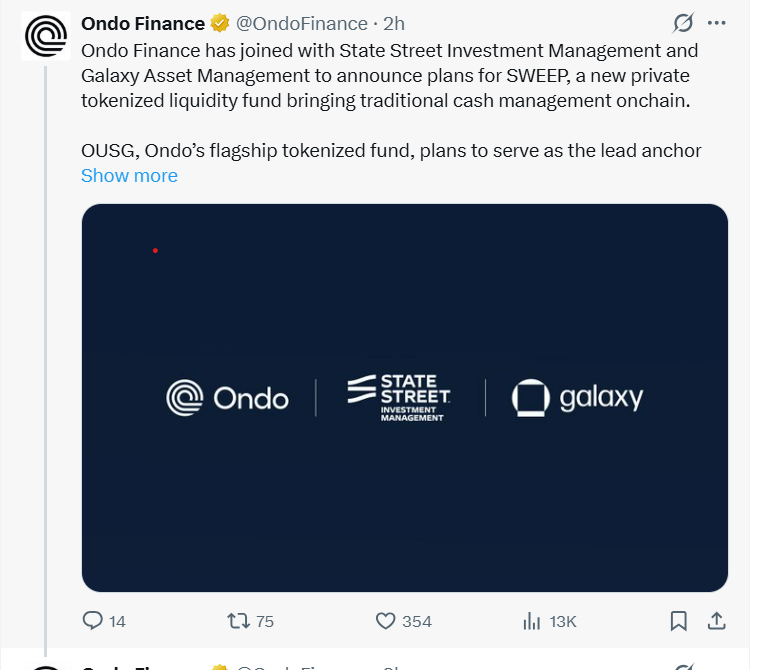
State Street Investment Management and Galaxy Asset Management are joining forces with Ondo Finance on a tokenized liquidity fund that pushes cash “sweep” balances directly onto public blockchains, opening up a source of potential 24/7 onchain liquidity.

The planned State Street Galaxy Onchain Liquidity Sweep Fund, or SWEEP, is designed to take in and pay out PayPal’s (PYUSD) stablecoin for accredited investors, the companies said Tuesday.

Ondo is expected to seed the fund with $200 million, tying a major tokenized real-world asset (RWA) issuer directly into State Street’s tokenization stack. The fund will be powered by Galaxy Digital infrastructure, and State Street Bank and Trust Company, an affiliate of State Street Investment Management, will act as custodian.

SWEEP is set to launch on Solana in early 2026, with rollouts on other networks, including Stellar and Ethereum, to follow, using Chainlink’s Cross-Chain Interoperability Protocol (CCIP).

Related: Solana and Coinbase’s Base connect together using Chainlink

Race to define onchain cash

The move drops another heavyweight into an increasingly crowded race to define what “onchain cash” looks like for institutions. BlackRock and Franklin Templeton already run tokenized cash‐management vehicles, including money‐market and other short‐term fixed‐income funds, on public blockchains. For its part, Ondo has built a business around wrapping Treasurys and other credit exposures into onchain vehicles that can plug into crypto markets.

“By partnering with Galaxy, we will push the envelope together and drive the evolution of the TradFi landscape onchain,” said Kim Hochfeld, global head of cash and digital assets for State Street Investment Management.

“Tokenization is rapidly becoming the connective tissue between traditional finance and the onchain economy,” said Ian De Bode, president of Ondo Finance. “Our planned investment would not only anchor this innovative fund – but also supports the continued growth of Ondo’s fund that offers institutional investors exposure to short-term US Treasuries with 24/7 instant mints and redemptions.”
Source: Ondo Finance

Related: Blockchain trial on Canton Network tests collateral reuse with tokenized US Treasurys

Building an onchain capital markets stack

The launch comes as tokenized funds and tokenized equities are starting to resemble components of an emerging onchain capital markets stack more than isolated pilots.

Superstate opened up onchain capital raising for US Securities and Exchange Commission‐registered public companies via its Direct Issuance Programs on Ethereum and Solana Wednesday, targeting the equity side of that stack by letting issuers sell new stock directly for stablecoins and settle immediately to investor wallets.

State Street’s partnership with Galaxy and Ondo also highlights how the roles are shaping up as traditional finance and crypto firms share the same products. State Street brings Big Four regulatory cover and custody, Galaxy contributes digital‐asset infrastructure and tokenization expertise, and Ondo provides both capital and an existing RWA distribution network.

Related: Galaxy expands into UAE as part of Middle East push

Solana’s role in the tokenization race

Solana’s role as the initial venue highlights a second competitive race unfolding beneath the product arms race. The chain has become a favored home for tokenized assets and high‐throughput trading, from tokenized public shares to experiments in onchain liquidity funds, as issuers look for lower fees and fast settlement.
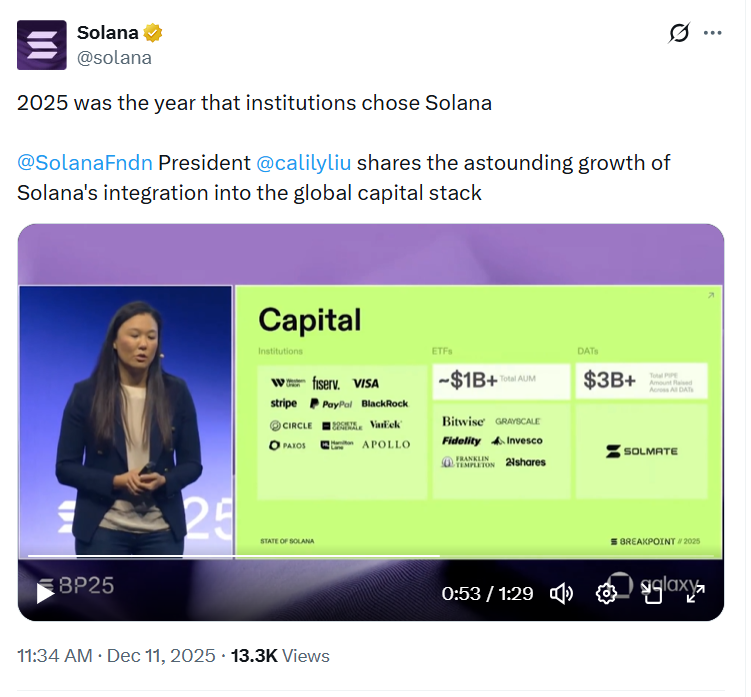
Source: Solana

Some of the largest institutions in the world have chosen the Solana blockchain for their digital assets play, including Western Union, which processes over $100 billion in remittance volume every year, and Pfizer, which processes $2 trillion of merchant payment volume annually. Physical staked exchange-traded funds (ETFs) on Solana have also almost reached $1 billion in assets under management.

Launching on Solana first, with plans to expand to Stellar and Ethereum, allows SWEEP to tap into multiple ecosystems where stablecoins and RWA tokens are already part of the infrastructure.


Leituras Relacionadas

From Airdrop Myth to King of Derivatives: A Look Back at Hyperliquid's 2025 Conquest

Reviewing crypto's growth in 2025, Hyperliquid stands out. It began the year with an epic airdrop and strong price performance, capturing attention. By year's end, it transformed into a top-four revenue-generating platform in crypto, earning over $650M and at one point capturing 70% of all perp trading volume. Its success was no accident. In Q1, it solidified its reputation by being first to list new assets like the TRUMP perp and launched HyperEVM, a smart contract layer. Q2 saw explosive growth: HYPE token surged 4x from April lows, and HyperEVM's TVL grew from $350M to $1.8B. The platform gained mainstream media coverage. In Q3, major wallets like Phantom and MetaMask integrated via Hyperliquid's builder codes, routing $158B in volume and earning partners nearly $50M. A high-profile stablecoin bid war was won by Native Markets, aligning with Hyperliquid's bootstrapped ethos. However, new competitors like Aster and Lighter emerged with aggressive airdrops. Q4 brought permissionless listings via HIP-3, enabling new markets like stock perps and yield-bearing collateral. Yet, HYPE fell nearly 50% from its September peak due to market conditions, a rare ADL event during a crash, and the start of team token unlocks. As perps go mainstream in 2026, Hyperliquid's true test begins. Its success came from building a superior product and ecosystem without shortcuts. Maintaining leadership will require doing it all over again in a crowded field.

marsbitHá 21m

From Airdrop Myth to King of Derivatives: A Look Back at Hyperliquid's 2025 Conquest

marsbitHá 21m

ETC Olympia Development Part 1: Implementing ECIP-1111 and ECIP-1112

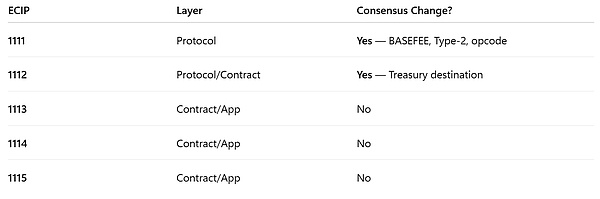
ETC Olympia Development Series Part 1: Implementing ECIP-1111 and ECIP-1112 This article introduces the first part of the Ethereum Classic Olympia development series, focusing on the implementation of ECIP-1111 and ECIP-1112. These two proposals are the only components within the broader Olympia framework that modify consensus behavior. ECIP-1111 modernizes the fee market by introducing an EIP-1559-style mechanism with a base fee and optional priority tip (miner tip). A key difference from Ethereum is that the base fee is not burned but is instead redirected to a treasury address defined by ECIP-1112. It also adds support for Type-2 transactions and the BASEFEE opcode (0x48), ensuring compatibility with modern EVM tooling and wallets. Crucially, it does not change miner rewards, monetary policy, or existing transaction types. ECIP-1112 defines an immutable, deterministic treasury smart contract that will receive the redirected base fees. This vault is designed to be receive-only upon activation, meaning it can accumulate value but cannot distribute funds until a separate, subsequent governance layer (defined in other ECIPs) is deployed and activated on the contract layer. The article emphasizes the modular architecture of Olympia. While the suite includes five ECIPs (1111-1115), only these two affect consensus. This separation ensures that the core protocol remains minimal and auditable, while future governance and funding mechanisms can evolve independently at the contract level without requiring further hard forks. The implementation is currently in the draft stage per the ECIP-1000 process. Any decision to move forward with mainnet activation will require extensive testing on the Mordor testnet and full community review.

金色财经Há 25m

ETC Olympia Development Part 1: Implementing ECIP-1111 and ECIP-1112

金色财经Há 25m

Trading

Spot
Futuros
活动图片