NEAR to Airdrop 330,000 Tokens, Betting on TVL Reaching $70 Million

Foresight NewsPublicado em 2026-06-12Última atualização em 2026-06-12

Resumo

On June 11th, NEAR Protocol launched the Near@3.33 Milestone Incentive Program, targeting users of its Confidential Intents privacy cross-chain execution feature. The program will distribute 333,333 milestone tokens when the Confidential Intents Total Value Locked (TVL) reaches $70 million. Users must have conducted Confidential transactions on near.com and maintain a Confidential balance above $100 in any asset to qualify, with a single wallet capped at 2% of the current airdrop pool. The milestone tokens will be locked upon receipt and cannot be sold or transferred. They can only be converted 1:1 to NEAR tokens once NEAR's Volume Weighted Average Price (VWAP) maintains $3.33 or higher for three consecutive trading days. As of the report, Confidential Intents TVL exceeds $20.69 million, needing roughly a 3x increase to trigger the airdrop. Confidential Intents, launched in February 2026, is NEAR's privacy execution layer designed to prevent MEV, front-running, and strategy leaks by building confidentiality directly into the execution environment. Its TVL has grown from zero to approximately $15 million in about three months. NEAR token price, which surged from around $1 in April to a peak of $3.08, currently trades near $2. The program aims to boost user activity for Confidential Intents, with future incentive rounds planned as community engagement increases.


By: Ma He, Foresight News


On June 11th, NEAR Protocol officially launched the Near@3.33 Milestone Incentive Program. This program is designed for users of the Confidential Intents private cross-chain execution function. When the total TVL of Confidential Intents reaches $70 million, a snapshot will be triggered, and the first round of 333,333 milestone tokens will be distributed to eligible accounts.



With airdrops generally being shelved by project teams and token prices remaining low in the bear market, is NEAR making another big move in the privacy space?


Airdrop Details


According to the official announcement, the first round will distribute 333,333 milestone tokens. When the aggregated TVL of Confidential Intents reaches $70 million, the system will automatically take a snapshot and allocate tokens to eligible accounts. Users' past activities will continue to be counted towards the allocation weight until the snapshot occurs; newly joined users can still gain a higher share by increasing their activity on the platform.


The specific eligibility threshold requires users to have conducted Confidential transactions on near.com. The Confidential balance must remain above $100 (in any asset), and holdings and transaction activities exceeding the threshold will affect the final allocation ratio. A single wallet can receive a maximum of 2% of the current airdrop pool.


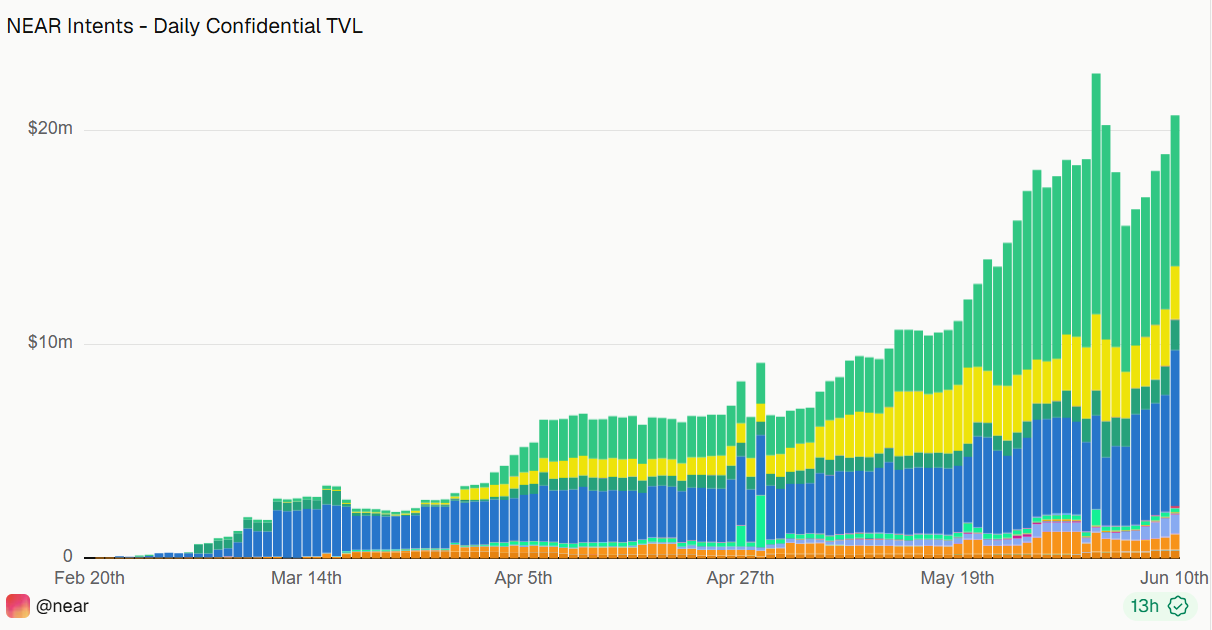
Currently, according to the latest data from Dune's dashboard, NEAR's Confidential Intents total TVL has exceeded $20.69 million, meaning it needs to grow another 3 times to reach the airdrop threshold.


The NEAR milestone tokens will be locked upon receipt and cannot be sold or transferred. They can only be converted into NEAR tokens at a 1:1 ratio when the volume-weighted average price (VWAP) of NEAR tokens remains at or above $3.33 for three consecutive trading days.


The official statement also indicates that subsequent rounds of incentive programs will be launched gradually. The trigger conditions for each round will increase correspondingly with the growth of community activity, continuously encouraging higher levels of participation.


Confidential Intents


Confidential Intents is the privacy execution layer of the NEAR Intents protocol, officially launched in late February 2026. It is not a simple coin mixer or post-hoc anonymization tool but builds confidentiality directly into the execution environment, allowing users to achieve limited visibility when conducting cross-chain transactions.


Confidential Intents is initially operated by decentralized permissioned validators and connects to the NEAR mainnet via a bridge based on Trusted Execution Environments (TEE).


Issues like MEV, front-running, strategy leaks, and forced liquidations have long plagued DeFi players on public chains. Confidential Intents avoids these risks from the source through sharded execution: retail users no longer lose value to sandwich attacks, large holders can execute substantial operations without exposing their intent, institutions can protect their positions and negotiation information while retaining selective disclosure capabilities to meet compliance and audit needs. Enterprise application scenarios include confidential handling of sensitive operations such as salary payments, treasury management, and supply chain payments.


Since its launch, according to official NEAR and community data, the TVL of Confidential Intents has grown from zero to approximately $15 million in about three months.


The product addresses real needs, and the incentives will also boost user participation and activity. For Confidential Intents to reach the $70 million target, perhaps under the ongoing wave of AI and privacy narratives, it might have a chance to achieve it in the second half of this year.
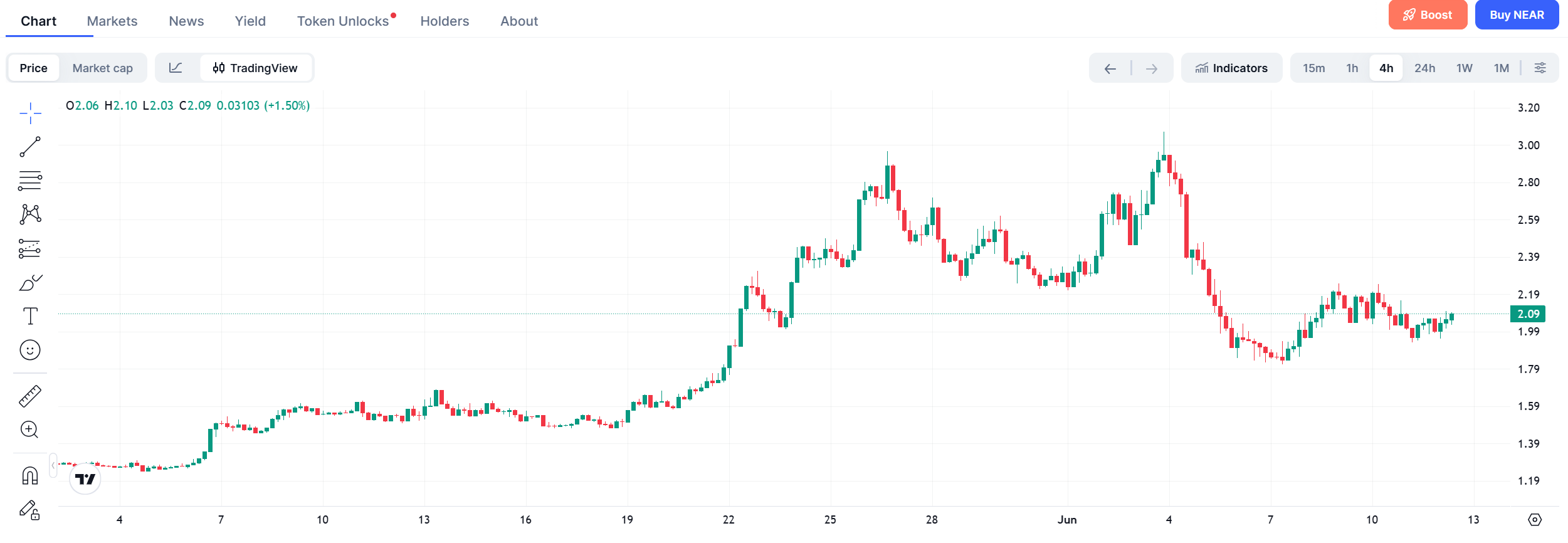


Previously, the NEAR token price surged under the AI narrative from around $1 in April this year to a high of $3.08, currently fluctuating around $2. When the crypto market conditions improve and liquidity becomes more abundant, the locked milestone tokens will convert into fully liquid NEAR tokens.


Perguntas relacionadas

QWhat is the trigger condition for NEAR Protocol's milestone token airdrop to begin distribution?

AThe first round of 333,333 milestone tokens will be distributed once the total TVL of Confidential Intents reaches $70 million.

QWhat are the eligibility criteria for users to participate in the NEAR@3.33 milestone incentive airdrop?

AUsers must have performed a Confidential transaction on near.com and maintain a Confidential balance above $100 (in any asset). Holdings and transaction activity beyond the threshold influence the final allocation share.

QWhat is Confidential Intents on the NEAR Protocol, and what problem does it aim to solve?

AConfidential Intents is the privacy execution layer for NEAR's Intents protocol. It builds confidentiality directly into the execution environment to provide users with limited visibility during cross-chain transactions, aiming to solve issues like MEV, front-running, strategy leakage, and forced liquidations.

QWhen do the milestone tokens received from the airdrop become convertible to NEAR tokens?

AThe milestone tokens are locked upon receipt and can only be converted to NEAR tokens at a 1:1 ratio when the volume-weighted average price (VWAP) of NEAR tokens remains at or above $3.33 for three consecutive trading days.

QAccording to the article, what is the current approximate TVL of NEAR's Confidential Intents and how close is it to the airdrop trigger target?

AAccording to the article, the current TVL of Confidential Intents is over $20.69 million. It needs to grow approximately 3.4 times from this level to reach the $70 million airdrop trigger target.

Leituras Relacionadas

Vitalik Updates Ethereum Roadmap: From Merge to 'Lean Refactoring', with STARK, AI, and Privacy Reshaping the Technical Foundation

Vitalik Buterin has updated Ethereum's long-term roadmap, outlining a major shift from the post-Merge evolution toward a "Lean Ethereum" vision. The update builds on the 2023 framework but reorders priorities and introduces new concepts. Key continuations include improving consensus (single-slot finality), scaling data availability (larger blobs), simplifying light client verification with SNARKs/STARKs, and protocol simplification. Major adjustments involve significantly prioritizing quantum resistance due to heightened perceived threats, while deprioritizing items like VDFs and some EVM improvements. Technical replacements are planned, such as moving from Verkle trees to a unified Binary Tree and eventually PBTs, and rethinking state management with "New State Types." Notable new additions are: 1. Making **privacy a top-tier priority**, aiming to build it natively into the protocol. 2. **Radical scaling under post-quantum conditions**, using techniques like leanSPHINCS signatures and zkzk frames. 3. **Protocol "Lean-ification" and formal verification**, leveraging modern AI tools to make full formal verification feasible. 4. Exploring **Blob and Gas futures** for future capacity. 5. Developing **Native Rollups**, deeply integrating rollup capabilities into the protocol. 6. **Reimagining the EVM's future**, potentially exposing a simpler, modern instruction set (e.g., leanISA or RISC-V), with EVM becoming a compatibility layer. The core philosophy shifts toward specializing mechanisms for high-load activities (transfers, swaps, privacy) to gain scalability, rather than attempting to infinitely scale all activities. It also elevates **recursive STARKs and AI-assisted formal verification** as foundational infrastructure. In summary, Ethereum is embarking on a systemic "third-generation" redesign—Lean Ethereum—involving replacements or rewrites of major components. The goal is to achieve a quantum-safe, privacy-first, secure, decentralized, and highly scalable network while maintaining a lean and verifiable protocol.

marsbitHá 18m

Vitalik Updates Ethereum Roadmap: From Merge to 'Lean Refactoring', with STARK, AI, and Privacy Reshaping the Technical Foundation

marsbitHá 18m

China Monopolizes the Humanoid Market: The U.S. Is Forced to Defend Itself

China's Humanoid Robot Market Domination and US Response According to a report by Smart Analytics Global (SAG), Chinese manufacturers supplied over 97% of the global humanoid robot shipments (approximately 19,100 units) in the first half of 2026, a 272% year-on-year increase. Shanghai-based AGIBOT led with a 44% market share, followed by Unitree Robotics with 31%. Together, these two firms accounted for about 75% of global shipments. China itself represented over 85% of global demand for these devices, with industrial and commercial applications now comprising more than 70% of shipments. Key factors driving China's leadership include strong state support, abundant funding, expanding production capacity, IPO waves for developers, and a vast manufacturing ecosystem for rapid testing and deployment. Furthermore, over 90% of key components for humanoid robots are now sourced domestically. In response, the US Federal Communications Commission (FCC) banned federal agencies and subsidy recipients from purchasing or using foreign "advanced robotic devices," including humanoid and quadruped robots, citing national security concerns in July 2026. SAG forecasts global shipments to approach 60,000 units for full-year 2026, with industry revenue around $1.6 billion, projecting 500,000 units by 2030. The analysis notes potential challenges for Chinese expansion, such as reputational risks from alleged ties to China's defense sector and the precedent of trade disputes seen in solar panels and batteries, potentially triggered by the current low average robot price.

cryptonews.ruHá 36m

China Monopolizes the Humanoid Market: The U.S. Is Forced to Defend Itself

cryptonews.ruHá 36m

What's New in Ethereum's Roadmap: Privacy, Quantum Security, Native Rollup?

On August 10, 2024, Ethereum co-founder Vitalik Buterin revealed an updated technical roadmap, highlighting significant changes in priorities and new focus areas. Key new additions include: - **Strong Privacy Protection**: Elevated to a top-tier protocol concern. Proposals like EIP-8250 (keyed nonces for concurrency), EIP-8272 (recent roots for verification), and EIP-8182 (shared protocol-level privacy pools) aim to enable private transfers of ETH and ERC-20s, moving toward default private accounts. - **Quantum Resilience**: Priority increased. The plan addresses risks to ECDSA/BLS signatures, KZG commitments, and ZK systems, exploring solutions like leanSPHINCS signatures, STARK proofs (considered quantum-resistant), and streamlined verification processes. A full L1 upgrade is tentatively targeted for ~2029. - **Native Rollups**: A novel concept where rollups could reuse Ethereum's core validation infrastructure via a new EXECUTE precompile (EIP-8079 draft). This aims to reduce custom code and enhance security for certain L2s, while specialized chains will continue to exist. - **Protocol Simplification & Formal Verification**: Leveraging AI tools to make full-protocol formal verification feasible, aiming for more rigorous and machine-verifiable specifications. Other notable shifts: - State storage is evolving from Verkle trees to a Partitioned Binary Tree (PBT, EIP-8347 draft). - Some 2023 items like VDFs and certain EVM improvements were deprioritized. - Long-term discussions include blob/gas futures and non-EVM instruction sets (e.g., RISC-V). The "Strawmap" outlines potential upgrades through ~2029 but is a directional guide, not a firm timeline. Key milestones to watch include the Glamsterdam (Q4 2026) and Hegotá (2027) forks. Many proposals remain in draft or research phases.

marsbitHá 57m

What's New in Ethereum's Roadmap: Privacy, Quantum Security, Native Rollup?

marsbitHá 57m

Hyperliquid Trading Volume Soars, So Why Are Profits Falling?

Hyperliquid, a leading decentralized perpetuals trading platform, has seen its open interest surge to a record high above $11 billion, capturing roughly 9% of the global market share. Trading volume remains robust, nearing $178 billion over 30 days, driven largely by the explosive growth of third-party markets offering tokenized real-world assets (RWAs) like stocks and commodities. Despite this growth, the platform's protocol revenue has declined for four consecutive quarters, falling 43% from its Q3 2025 peak of $357 million to approximately $202 million in Q2 2026. This divergence is primarily attributed to the HIP-3 governance proposal, which allows external developers to launch their own markets and keep up to half of the generated fees. These third-party markets now account for nearly 50% of total volume. Consequently, the share of revenue redistributed to developers, market makers, and the treasury has tripled from 6% to 18% in a year. This directly reduces the funds allocated to the platform's buyback-and-burn mechanism for its native HYPE token, weakening a key price support. HYPE's price has fallen 28% from its all-time high. The platform's growth is also heavily concentrated, with a single entity, Trade.xyz, responsible for over 90% of HIP-3 open interest, introducing systemic risk. Additionally, the ecosystem lacks diversity beyond HYPE, faces ongoing token unlocks adding sell pressure, and is encountering increased regulatory scrutiny and new competition from platforms like Robinhood Chain. While still a major revenue generator in crypto, Hyperliquid's model of sharing fees to fuel expansion is currently compressing its own earnings and token economics.

marsbitHá 57m

Hyperliquid Trading Volume Soars, So Why Are Profits Falling?

marsbitHá 57m

Trading

Spot
活动图片