Arthur Hayes Puts $100K On Hyperliquid (HYPE) Outrunning Every $1B+ Altcoin

bitcoinistPublicado em 2026-02-09Última atualização em 2026-02-09

Resumo

Arthur Hayes, co-founder of BitMEX, has placed a $100,000 bet that the Hyperliquid (HYPE) token will outperform every altcoin with a market cap over $1 billion during a specific period in 2026. This wager, made against Multicoin Capital's Kyle Samani, who criticized Hyperliquid for being "everything wrong with crypto," reframes the debate into a performance-based challenge. The bet comes amid analysis of Hyperliquid's new HIP-3 product, which offers non-crypto derivatives like equity and commodity perpetuals. Early data suggests these traditional finance instruments are gaining traction, accounting for 31% of the platform's volume. However, a stress test during a silver selloff revealed liquidity gaps compared to established venues like COMEX. Hayes's bet ultimately tests whether Hyperliquid's growth narrative and 24/7 access to non-crypto markets will translate into superior token performance.

Arthur Hayes is turning a long-running debate about Hyperliquid into a price-denominated wager, staking $100,000 that HYPE will beat every altcoin with a $1 billion-plus market cap over a defined window.

“Since HYPE is bad Kyle Samani let’s make a bet,” Hayes wrote on X. “I bet that from 00:00 UTC 10 Feb 2026 to 00:00 UTC 31 July 2026 $HYPE will out perform any shitcoin >$1bn mcap on coingecko in USD terms. You choose your champion. Loser donates $100k to a charity of the winner’s choice.”

Hayes’ post landed in the wake of a pointed takedown from Multicoin Capital co-founder Kyle Samani, who called Hyperliquid “in most respects everything wrong with crypto,” while listing objections “Founder literally fled his home country to build, openly facilitates crime and terror, closed source, permissioned.”

Why Hyperliquid Could Be Superior

The sparring unfolded alongside a separate thread of bullish commentary on Hyperliquid’s push into non-crypto derivatives via HIP-3, a product line that has begun listing equity and commodity perpetuals. Blockworks analyst Shaunda Devens, whose research was shared by Jon Charbonneau, argued that HIP-3 is already pulling meaningful activity outside pure crypto flow.

In devens’ analysis of HIP-3 silver perpetuals versus CME/COMEX Micro Silver futures, Hyperliquid is framed less as a meme-driven venue and more as an attempt to build an always-on, order-driven derivatives market for traditional underlyings. The report notes that “TradFi instruments now [account for] 31% of venue volume” with “daily notional above $5B,” positioning the silver contract as a stress test of whether those markets can hold up when the underlying is moving fast.

“Pre-crash, Hyperliquid was competitive at top-of-book for the sizes that dominate perp flow,” the report said, citing a 2.4 bps median spread versus 3 bps on COMEX, and “median slippage was 0.5 bps from the benchmark.” But it also emphasized the capacity gap: roughly “~$230k within ±5 bps on Hyperliquid vs. ~$13M on COMEX,” a difference that matters as clip sizes rise.

That trade-off sharpened during a violent silver selloff, when the report says both venues degraded but Hyperliquid developed a heavier execution tail. It cites a brief dislocation of more than 400 bps versus the benchmark before mean reversion via funding, and notes that “1% of Hyperliquid trades printed >50 bps from mid, vs. none on COMEX.”

Hayes’ wager effectively reframes the dispute: not whether Hyperliquid is philosophically “good” or “bad,” but whether its growth narrative, especially around 24/7 access to non-crypto risk, translates into token outperformance relative to large-cap peers.

If the next six months validate the thesis embedded in HIP-3: tight execution for retail-weighted flow, continuous trading when legacy venues are closed, and a path to less cycle-sensitive revenue, HYPE’s relative performance becomes a simple scoreboard. If not, the bet offers a high-visibility way for critics to test whether the market is pricing substance or momentum.

At press time, HYPE traded at $32.275.
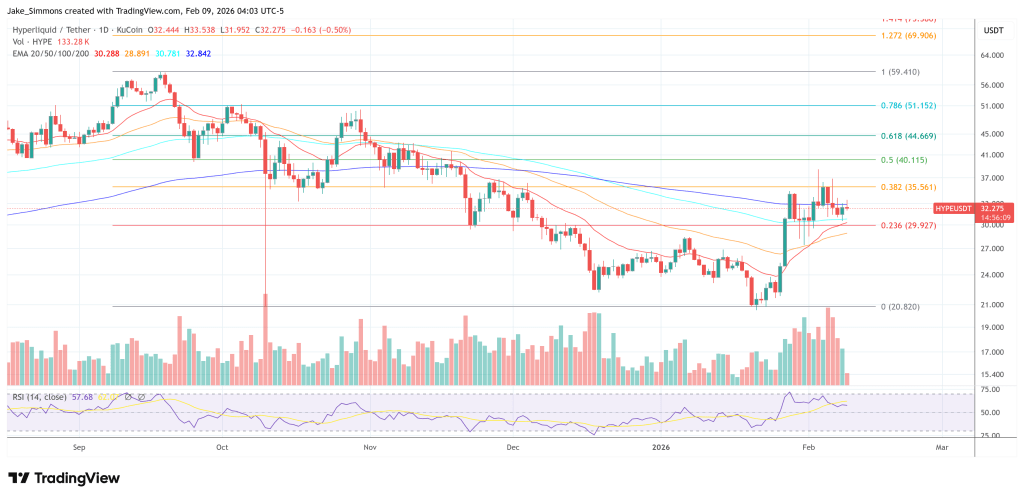
HYPE must break the 0.382 Fib, 1-week chart | Source: HYPEUSDT on TradingView.com

Perguntas relacionadas

QWhat is the specific bet that Arthur Hayes made regarding Hyperliquid (HYPE)?

AArthur Hayes bet $100,000 that from February 10, 2026, to July 31, 2026, the price of HYPE will outperform any other cryptocurrency with a market cap over $1 billion in USD terms. The loser will donate the money to a charity of the winner's choice.

QWho is the target of Arthur Hayes's bet and what was their criticism of Hyperliquid?

AThe bet is directed at Kyle Samani, co-founder of Multicoin Capital. Samani criticized Hyperliquid, calling it 'in most respects everything wrong with crypto,' citing that its founder fled his home country, it openly facilitates crime and terror, and that it is closed source and permissioned.

QWhat is HIP-3 and why is it significant for Hyperliquid's growth narrative?

AHIP-3 is Hyperliquid's product line for non-crypto derivatives, specifically listing equity and commodity perpetuals. It is significant because it represents the platform's push into traditional finance (TradFi) instruments, aiming to provide 24/7, order-driven derivatives markets and attract activity outside of pure cryptocurrency flow.

QAccording to the analysis cited, how did Hyperliquid's silver perpetuals compare to CME/COMEX futures in terms of market performance?

AThe analysis found that pre-crash, Hyperliquid was competitive with a median spread of 2.4 basis points (bps) versus 3 bps on COMEX, and had median slippage of 0.5 bps. However, it had a significant capacity gap, with ~$230k within ±5 bps on Hyperliquid versus ~$13M on COMEX, which became more apparent during a violent selloff.

QWhat is the ultimate question that Arthur Hayes's bet reframes the debate into?

AThe bet reframes the debate from whether Hyperliquid is philosophically 'good' or 'bad' to whether its growth narrative—particularly its 24/7 access to non-crypto derivatives—will translate into its token (HYPE) outperforming other large-cap altcoins.

Leituras Relacionadas

【Mystical Finance】2026 Bing Wu Fire Horse Year Investment Fortune Revealed: Which Zodiac Signs Can Win Effortlessly? Huobi HTX Justin Sun: Only 'Fire' Prevails!

**Title: 2026 Bing Wu Fire Horse Year Investment Forecast: Which Zodiac Signs Can Win Big? Huobi HTX's Justin Sun: Only 'Fire' Prevails!** The year 2026 is the Bing Wu year, characterized by the powerful "Emperor's Prosperity" fire element in Chinese metaphysics. This signifies a global financial market, especially in Web3, that will be volatile yet full of opportunities—described as "intense flames and great openings and closings." **Zodiac Investment Rankings:** * **Top Tier - Offensive Group (Goat, Tiger, Dog):** These signs are in harmony with the year's energy. Goats will have sharp intuition for finding alpha in early Web3 projects. Tigers and Dogs will benefit from strong贵人运 (nobleman luck), gaining access to insider information or good copy-trading opportunities. Their strategy should be aggressive, focusing on high-heat sectors like AI, DePIN, or Meme coins. * **Key Defense Group (Rat, Horse, Ox):** These signs face conflicts with the year's energy. Rats may experience drastic asset volatility and liquidations. Horses (born in the same zodiac year) might make emotional, FOMO-driven decisions. Oxen should be wary of information traps and scam projects. Their strategy must be defensive: avoid high leverage, hold BTC or stablecoins, and prioritize capital preservation. **The 'Fire' Year Survival Guide: Seek Strong Liquidity** The Fire Horse year is defined by speed—trends emerge and vanish quickly. To capture opportunities or find shelter from volatility, a platform with deep liquidity is crucial. The article positions Huobi HTX as a focal point for this, capable of handling the year's fiery nature. **Justin Sun's 'Fire' Philosophy: Go With the Flow** Huobi HTX's global advisor, Justin Sun, summarized the platform's strategy as going after what's "hot" (火 - fire). If a trend or asset has heat, it gets listed quickly, allowing users to capitalize on momentum swiftly. The platform aims to balance this pursuit of "fire" with deep liquidity ("water"), creating a stable environment for users. **New Year Promotion: Huobi HTX's "Instant Coin" Event** To kick off the fiery year, Huobi HTX launched a "Instant Coin" Spring Festival event, giving away a total of 3,000,000 USDT. The event includes daily login rewards, exclusive红包 (red packets) from seven partner projects, and a lucky draw with a top prize of 18,888 USDT. **Conclusion: Ride the Fire Horse with Huobi HTX** 2026 is predicted to be an extraordinary year where the market can forge true gold or burn out weak players. Whether an investor's fortune is strong or requires caution, choosing a platform that understands and manages the year's "fire" is presented as key to navigating the market and potentially achieving success.

marsbitHá 14m

【Mystical Finance】2026 Bing Wu Fire Horse Year Investment Fortune Revealed: Which Zodiac Signs Can Win Effortlessly? Huobi HTX Justin Sun: Only 'Fire' Prevails!

marsbitHá 14m

LayerZero Gathers Wall Street Old Money in a Day, as the Cross-Chain Leader Begins to Tell the Story of a 'Wall Street Public Chain'

LayerZero, known for its cross-chain protocol, has announced a new Layer 1 blockchain called "Zero," positioning itself as a decentralized multi-core world computer designed for institutional financial markets. The project has garnered significant backing from major Wall Street players, including Citadel Securities, which made an unusual strategic investment in the ZRO token. Other supporters include ARK Invest, Tether, DTCC, ICE, and Google Cloud, all exploring applications in clearing, exchange operations, and cloud infrastructure. Zero features a unique architecture with multiple independent zones optimized for different use cases: a general-purpose EVM-compatible environment, a private payment system, and a dedicated trading zone. This structure aims to address Wall Street's need for high throughput, privacy, and scalability, with claims of supporting up to 2 million TPS. The move signals a strategic pivot from cross-chain bridging to capturing institutional demand for tokenized assets and high-frequency trading. While Ethereum remains a key player in tokenization, Zero is positioned as a potential alternative for production-level financial activity. For the ZRO token, the narrative shifts from cross-chain governance to potentially capturing value from institutional-scale asset flows. However, 80% of ZRO tokens remain locked, with unlocks extending to 2027, and a fee mechanism proposal failed in December, with another vote scheduled for June. The partnerships, while significant, are often framed as exploratory, indicating cautious interest rather than full commitment from traditional finance institutions.

marsbitHá 31m

LayerZero Gathers Wall Street Old Money in a Day, as the Cross-Chain Leader Begins to Tell the Story of a 'Wall Street Public Chain'

marsbitHá 31m

Trading

Spot
Futuros
活动图片