The Changing Landscape: What Are Crypto VCs Experiencing?

Foresight NewsPublicado em 2026-07-22Última atualização em 2026-07-22

Resumo

Title: The Shifting Landscape of Crypto Venture Capital The era of dedicated crypto venture capital funds is undergoing a significant transformation. Once essential for navigating the sector's complexity and high risk, these specialized funds are now facing an identity crisis as the market matures. This shift mirrors historical patterns in other specialized investment classes like cleantech and SPACs, where initial information advantages dissipate as technologies become mainstream and integrated into existing industry frameworks. The article argues that crypto is reaching a critical inflection point, transitioning from a "building phase" to an "integration phase." Major players like Stripe, BlackRock, and Visa now engage with crypto not for its novel mechanics but as a foundational financial infrastructure. Their needs—regulatory compliance, banking partnerships, distribution channels—align with traditional fintech, a domain easily understood by large, generalist funds like Sequoia and Founders Fund. This evolution creates a "barbell effect" within the VC landscape. On one end are massive, diversified platforms that can incorporate crypto as one vertical among many. On the other are small, nimble funds focused on niche, experimental projects. The middle ground—medium-sized dedicated crypto funds—is being squeezed out. Their typical fund size makes it impossible to generate sufficient returns solely from early-stage crypto bets, yet they cannot compete with giants for later...


Author: Vaidik Mandloi

Translation: Luffy, Foresight News


Paradigm, one of the world's top pure-play crypto-focused funds, recently completed a $1.2 billion new fundraise, with capital to be invested in startups in AI, robotics, aerospace, and other fields. The firm has even removed all mentions of "cryptocurrency" from its official website entirely, reflecting a core investment thesis: crypto was merely the first frontier they tackled, and other current technological waves are equally unmissable.


Framework Ventures also raised a $400 million fund in June, initiating a cross-sector investment strategy, and they are far from the only firm making such adjustments. Over the past year, almost all leading crypto-specialist VCs have been broadening their investment horizons and adjusting their theses. In Q1 2026, only eight new pure-play crypto VC funds were established globally, the lowest number since 2020.


In this article, I will delve into whether crypto-focused venture capital funds are truly facing their demise. If the answer is yes, how will this industry shakeout affect the lifecycle of various funds? For crypto startups, what does it mean for their future, where they will compete for resources with other sectors within the portfolios of generalist funds?


The Development Cycle of Crypto-Specialist Funds


The emergence of crypto-specialist funds was fundamentally driven by their willingness to invest significant time in building informational moats within the industry, making them the only investors willing to bear the sector's high risk back then. In 2017, partners at generalist growth funds like Tiger Global couldn't even grasp the underlying logic of Solidity smart contracts, let alone establish deep working relationships with anonymous developers in Discord communities.


To gauge whether the crypto VC sector is heading towards a decline, one can reference the rise and fall patterns of other specialized investment categories in history. Similar industry iterations have played out repeatedly.


From 2006 to 2011, the cleantech sector became a major investment trend, with numerous firms launching dedicated clean energy funds. The underlying rationale mirrored that of early crypto VCs: investors believed they had caught an epoch-defining technological shift early and sought to build an exclusive investment footprint around it.


Cumulative capital invested in cleantech startups exceeded $25 billion, with over half of those investments ending in losses. Intriguingly, the underlying technology itself was viable; today's clean energy market is vast, and solar power costs fell by 85% during that period. However, VC firms made a fundamental miscalculation: they applied software company investment models, writing $5 million seed checks for startups that actually needed $200 million in project financing and 15 years to reach profitability.


A post-mortem analysis by MIT's Energy Initiative concluded that the traditional VC model was inherently ill-suited to the cleantech industry. Early specialist funds assumed technology development risk, funded foundational R&D, built sector credibility, and attracted large-scale industrial capital. But once the technology matured and infrastructure loans and project finance arrived, the informational moats unique to specialist funds vanished completely.
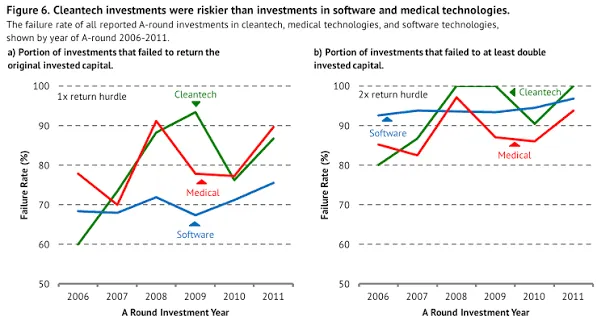

Source: Massachusetts Institute of Technology


Special Purpose Acquisition Companies (SPACs) followed a similar boom-and-bust trajectory. A SPAC is a blank-check company that raises funds via an IPO with no operational business, later merging with a private company to take it public faster than a traditional IPO. In 2020–2021, many investors viewed it as a replicable capital tool, with some even establishing funds entirely centered on SPACs.


Chamath Palihapitiya once raised a $1.6 billion fund dedicated to SPACs. But by 2022, two-thirds of SPACs that went public in 2021 failed to complete a merger, and Chamath ultimately had to return capital to investors. This market reversal within just two years illustrates how quickly an industry's structure can change once the informational advantages of a specialized niche disappear.


The same storyline recurring across different industries points to an underlying pattern. Analyzing 250 years of technological revolutions, Carlota Perez proposed the Techno-Economic Paradigm theory: each major technological revolution goes through an early niche phase where only insiders understand the technology, and deep-diving investors hold exclusive information, becoming the most valuable capital providers. As the technology matures, it gradually integrates into the traditional, existing industrial fabric.
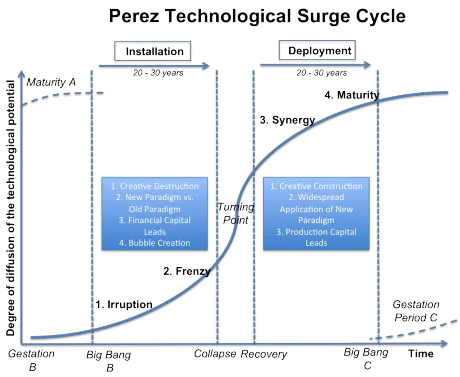


When it reaches this stage, the informational moats that sustained specialist funds cease to exist — generalist giants can now comprehend the asset class. Fred Wilson predicted this crypto inflection point early, writing in 2015 that the industry would reach a critical financial watershed, transitioning from Perez's "Installation Period" to the "Deployment Period."


This watershed has now arrived, with characteristics of the deployment phase visible everywhere: payments giant Stripe acquiring Bridge and launching its own stablecoin chain; asset managers like BlackRock and Fidelity issuing tokenized money market funds; traditional payment leaders like Visa and Mastercard building settlement networks on stablecoin rails.


These traditional giants don't need crypto-specialist funds to explain MEV extraction or validator economics; such exclusive industry knowledge holds little relevance for their business expansion. What they truly need is regulatory approval, distribution channels, and banking partnerships — resources identical to those required for scaling any fintech company. Today, investors at generalist funds like Sequoia and Founders Fund evaluate crypto projects using the same logic they apply to fintech ventures like Stripe or Plaid.


Polarization and Fund Sector Expansion


Given that the informational moats of crypto-specialist funds have eroded, what happens to funds built upon this advantage? Their ultimate fate is entirely determined by the capital logic dictated by their fund size.


The venture capital industry has long settled into a "barbell-shaped" polarization: On one end are giant, integrated investment platforms like a16z, Sequoia, and Founders Fund, which can absorb entire sectors as verticals within their portfolios. On the other end are small, boutique funds that bet on niche, cutting-edge projects based on deep investor insight, where a single breakout winner can return the entire fund. Medium-sized funds caught in the middle find their survival space entirely squeezed, and most crypto-specialist funds currently reside in this "death zone."
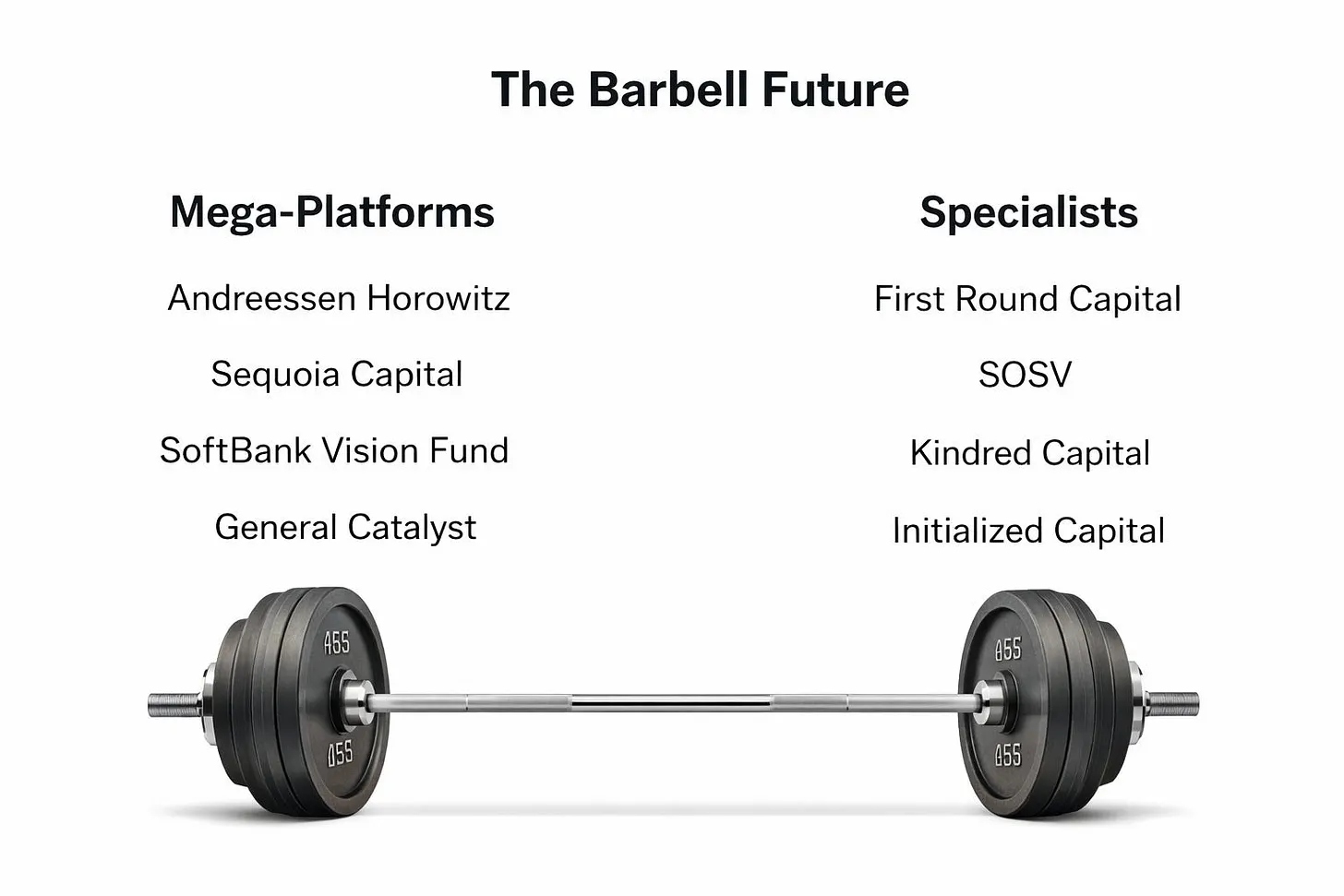


A $500 million fund needs a total exit value of $1.5 billion to deliver a 3x net return to its Limited Partners (LPs). This target is unattainable through seed-stage investments alone; a portfolio of only seed investments rarely yields enough large winners. Simultaneously, they cannot compete with $50 billion giants for growth-stage deals — the latter can casually write nine-figure checks. For perspective, in H1 2025, the fundraising total of Founders Fund alone equaled 1.7 times the combined total of all emerging small funds during the same period. Capital continues to concentrate at both ends of the industry.


While both Framework Ventures and Paradigm are broadening their investment scope, their underlying strategies differ fundamentally due to scale. Framework manages $400 million — too small to rely on a few seed bets for fund returns, yet insufficient to compete with mega-funds for growth-stage projects. The exit proceeds generated solely from the crypto sector cannot meet the fund's return requirements, forcing it to expand its boundaries. Paradigm, with $1.2 billion under management, has a scale substantial enough to transform into a cross-sector, generalist investment platform. Their strategic choices are inherently different. In short, fund size determines which end of the barbell a firm occupies and dictates its viable development path.


Even those VCs claiming to remain crypto-focused have thoroughly redefined what "crypto investing" means. Dragonfly raised $650 million in February, three times its initial target. However, the firm explicitly stated that the crypto application space detached from financial use cases has largely failed, and the fund will only bet on stablecoins and prediction markets. a16z raised a $2.2 billion crypto fund in May 2026, just half the size of its $4.5 billion fund in 2022. Moreover, partner Chris Dixon has shifted his core narrative: no longer framing crypto as a new computing paradigm, he now posits finance as the industry's foundational bedrock.



Today, what these firms call "pure crypto investing" is essentially investing in the financial infrastructure built upon blockchain rails — a category also heavily targeted by well-capitalized generalist funds.


Another core driver of this industry shift comes from the changing behavior of fund LPs. The VC industry broadly faces a DPI (Distributions to Paid-In Capital) crisis, with funds launched in 2021 averaging a mere 0.08x DPI. The 2022 crypto bear market caused significant losses for many LPs, while the AI sector now serves as a new outlet, absorbing ~70% of global private market capital. Faced with years of locked-up capital and witnessing AI projects deliver the promised high returns once associated with crypto, fund managers are compelled to venture into AI to meet LP demands.
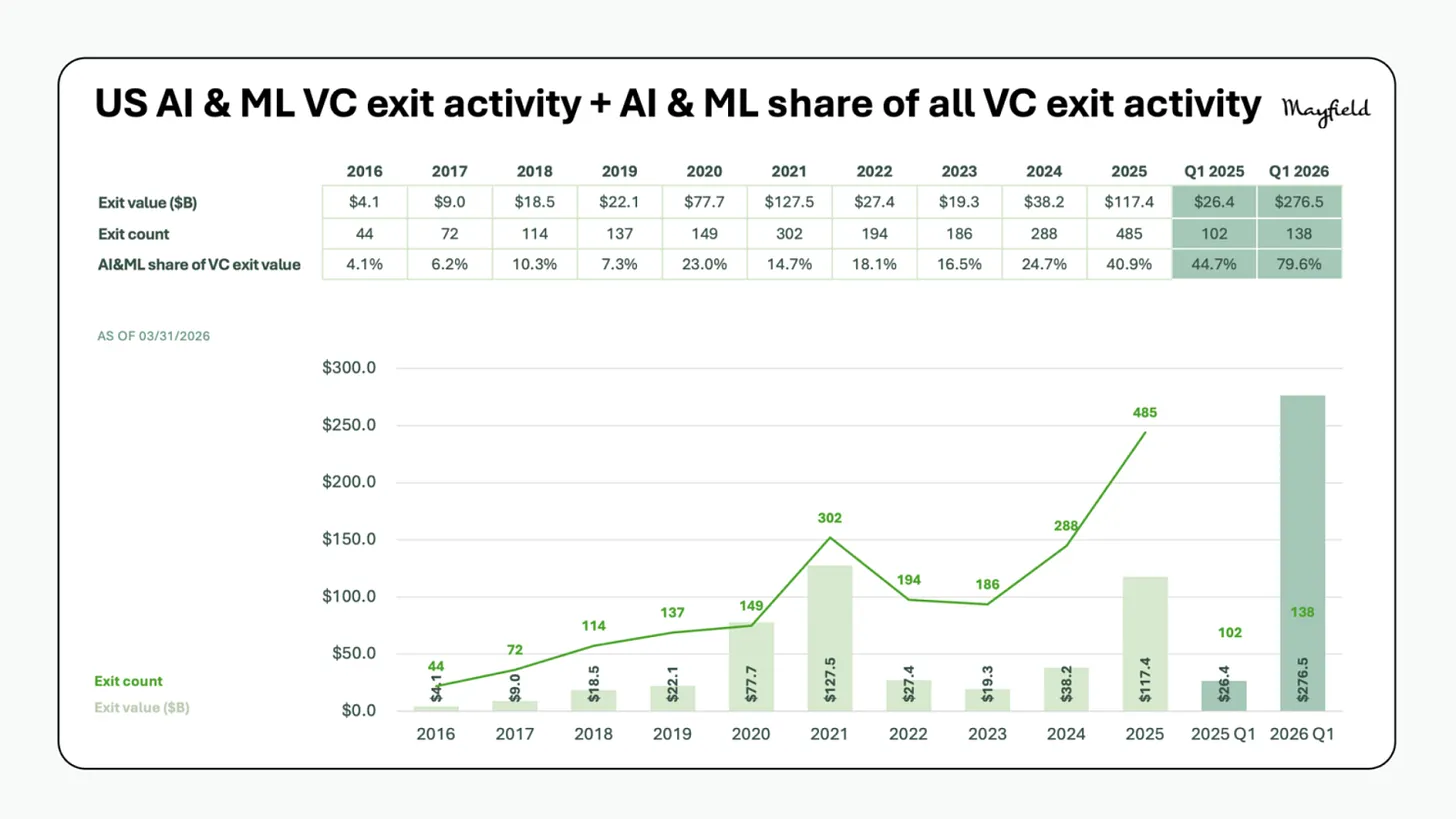


This trend is unfavorable for crypto entrepreneurs still dedicated to the space: the number of investors who truly understand crypto and are willing to double down is shrinking. Many would argue that entrepreneurs can simply raise from generalist funds, which seems plausible in theory — firms like Sequoia and Founders Fund can write larger checks and provide go-to-market resources that native crypto funds struggle to match.


However, two major hurdles exist in reality. First, the AI sector currently siphons off most attention and deal flow within generalist funds. Crypto projects internally compete for the investment team's focus against a flood of AI opportunities; only the most exceptional crypto projects make it to investment committee discussions, a vastly different competitive dynamic from pitching to a dedicated crypto fund. Second, the crypto ecosystem's development relies on the long-term, foundational investments made by specialist funds. Paradigm funding MEV-related academic research, Dragonfly supporting cross-chain developer tools — these investments may not generate commercial returns on a standalone project basis but build shared public infrastructure for the entire industry. Generalist funds will not touch such projects; they judge opportunities solely by standalone commercial returns.


I believe in a few years, the term "crypto investor" will sound as dated as "internet investor" does today. Crypto has become foundational infrastructure — a pipeline supporting various financial products. No one builds an entire investment thesis solely around the pipeline itself; investment value is created in the applications built on top. If Perez's technological cycle theory holds, the industry is precisely at this transition point: crypto is no longer a standalone investment sector but a foundational layer for various investable assets.


This doesn't mean crypto-specialist funds will vanish entirely. As new sub-categories like tokenization and on-chain securities continue to emerge, numerous niche, cutting-edge areas will arise that generalist funds are unwilling to touch. Each cycle will see small specialist funds form around these micro-verticals. What is truly facing decline are the current cohort of medium-to-large-sized pure-play crypto funds — the crypto niche alone cannot generate sufficient returns to meet their fund targets. The sector will continue to reconfigure along the barbell structure: large growth-stage investments handled by generalists, while frontier, experimental niche projects are left to small specialist funds.


Early specialist funds formed in 2017–2018 incubated core infrastructure like Uniswap, the Ethereum ecosystem, and stablecoin tooling. But times have changed. Leading crypto projects emerging in recent years, such as Hyperliquid and MegaETH, raised funds entirely through community efforts, completely bypassing VCs. Those early specialist funds gave crypto a coherent investment narrative, attracting generalist capital. Today, more entrepreneurs are realizing they can bootstrap projects successfully without relying on venture capital at all.


Criptomoedas em alta

Perguntas relacionadas

QAccording to the article, why are dedicated crypto venture capital funds expanding their investment scope into areas like AI, as seen with Paradigm and Framework Ventures?

AThe article explains that this expansion is driven by several factors. The information advantage that dedicated crypto funds once held is diminishing as the technology matures and traditional financial giants (like BlackRock, Fidelity) now understand it. Crypto is being integrated into the existing financial system, becoming more of an infrastructure. Furthermore, limited partners (LPs) who fund these VCs are demanding better returns. With AI currently offering high returns and attracting most venture capital, fund managers must invest in AI to meet LP expectations and sustain their funds.

QWhat historical examples does the author cite to demonstrate the typical lifecycle of a dedicated investment sector, and what is the common pattern?

AThe author cites two historical examples: clean energy funds (circa 2006-2011) and Special Purpose Acquisition Companies (SPAC) funds (circa 2020-2022). The common pattern is that a new, complex technology emerges, creating an information barrier. Dedicated funds form to invest in it, taking on high risk. As the technology matures and integrates into mainstream industries, that information barrier erodes. Large, generalist funds can then easily enter the space, and the dedicated funds lose their unique competitive advantage, often leading to their decline or transformation.

QHow does the article describe the current 'barbell effect' in the venture capital industry, and what fate awaits mid-sized dedicated crypto funds?

AThe article describes a 'barbell effect' where capital is concentrated at two extremes. One end consists of giant, multi-sector platforms (like a16z, Sequoia) that can invest in crypto as one vertical among many. The other end consists of small, agile, specialized funds that can thrive on a few big hits. Mid-sized funds are squeezed in the 'death zone' between them. They are too large to rely solely on small, niche crypto seed investments for returns, yet too small to compete with giant funds for major later-stage deals. The article concludes that these mid-sized dedicated crypto funds are the ones facing decline.

QWhat are the two major drawbacks for crypto startups trying to raise funds from generalist venture capital firms instead of dedicated crypto funds?

AThe two major drawbacks are: 1. **Intense Internal Competition:** Within a generalist firm, crypto projects must compete for the investment team's attention and capital against a flood of highly attractive AI and other sector projects. Only the most exceptional crypto projects will make it to an investment committee. 2. **Lack of Public Goods Investment:** Generalist funds judge projects strictly on standalone commercial returns. They are unlikely to fund critical but non-commercial infrastructure, academic research, or developer tools (e.g., MEV research, cross-chain tools) that dedicated crypto funds have historically supported. This public goods investment is vital for the ecosystem's long-term health.

QWhat is the article's final prediction about the future role of 'crypto' as an investment category and the types of funds that will invest in it?

AThe article predicts that 'crypto' will cease to be a standalone investment category, much like 'internet' did. It will become a foundational infrastructure layer upon which applications (especially financial ones) are built. The investment thesis will focus on the applications, not the underlying pipeline. Consequently, dedicated crypto funds as we know them will transform or decline, particularly the mid-sized ones. The sector will reorganize around the barbell structure: large, multi-sector funds will handle major growth-stage deals, while new, small, specialized funds will emerge to fund experimental, niche, and frontier projects within evolving crypto subsectors like tokenization.

Leituras Relacionadas

Bitcoin Mining Farms Are Becoming AI Factories

Bitcoin mines are transforming into AI factories. This shift is driven by the convergence of three key assets from the previous crypto cycle: infrastructure, talent, and capital. Crypto mining companies like Crusoe, CoreWeave, and Bitdeer are repurposing their core competency—securing power, land, and grid connections in remote locations—to build data centers for AI clients. These firms are signing multi-billion dollar, long-term contracts with companies like Anthropic, AWS, and Microsoft, as AI's demand for reliable, high-capacity compute surpasses the profitability of Bitcoin mining. Simultaneously, crypto entrepreneurs and engineers are applying their skills to new AI ventures. Examples include OpenSea's co-founder launching OpenRouter (an AI model aggregator), and former Coinbase engineers building Fal.ai (a generative media infrastructure platform). Their experience in building scalable, global software networks translates effectively to the AI space. Furthermore, capital accumulated during the crypto boom is now fueling AI. Figures like Jed McCaleb (co-founder of Ripple) funded Voltage Park, a large-scale GPU cloud provider. Notably, some crypto investments, like FTX's early bets on Anthropic and Cursor, have generated astronomical paper returns, demonstrating how high-risk crypto capital flowed into AI before it became mainstream. The transition is not just about repurposing hardware, but about redirecting critical resources—power infrastructure, distributed systems expertise, and venture funding—to the next technological frontier: artificial intelligence.

链捕手Há 9m

Bitcoin Mining Farms Are Becoming AI Factories

链捕手Há 9m

Morpho Launches Fixed-Rate Product Midnight: Lenders and Borrowers Set Their Own Rates, Ending the Era of Interest Rate Models

Morpho Launches Fixed-Rate Product Midnight: Lenders and Borrowers Set Their Own Rates, Ending the Era of Algorithmic Interest Models On-chain lending has grown to $60 billion but remains minuscule compared to traditional finance's $200 trillion annual credit volume. Morpho identifies the lack of fixed rates and maturity dates as key bottlenecks. Institutions need predictability, not the passive floating rates set by algorithmic models. Midnight allows lenders and borrowers to directly quote rates, set terms, and become price makers, not takers. Fixed-rate lending is now viable due to cheaper, faster blockchains and the entry of institutions demanding control and certainty over returns, costs, and duration. Morpho Blue previously gave users control over risk; Midnight adds control over interest rates. Past attempts at on-chain fixed-rate lending failed primarily because they were built on top of floating-rate pools (creating unpredictability) or lacked sufficient active participants. Midnight avoids these pitfalls as a standalone primitive with fixed rates at its core, built upon Morpho Blue's existing large and active user base. Midnight offers distinct value: institutions gain predictable term structures and full control; fintech companies can offer tailored fixed-rate products; lenders/borrowers achieve predictability and efficiency; and curators can now differentiate by configuring both risk and interest rates. Morpho Midnight is not a replacement for Morpho Blue. The Morpho network will now feature two complementary market structures: floating-rate/open-term (Blue) for flexibility and fixed-rate/fixed-term (Midnight) for predictability. Liquidity can flow between them. The launch will be gradual, prioritizing security. Initially, it will support direct lending on Base network with one trading pair (cbBTC/USDC) and limited maturity dates. Advanced features like auto-rollovers will be introduced later.

marsbitHá 10m

Morpho Launches Fixed-Rate Product Midnight: Lenders and Borrowers Set Their Own Rates, Ending the Era of Interest Rate Models

marsbitHá 10m

human.tech Launches Clean SDK for Privacy-First Web3 Apps

human.tech has launched the Clean SDK, a toolkit enabling developers to build privacy-first Web3 applications with transparent accountability. Released alongside Aztec's version 5, the SDK provides components for integrating zero-knowledge identity verification, sanctions screening, and private transactions, without developers handling sensitive user data or building compliance infrastructure from scratch. It uses zero-knowledge proofs and programmable verification to allow apps to confirm user legitimacy and sanctions compliance while keeping identities confidential. The first application built on the SDK, Shield, a privacy bridge to Aztec, also launched. It allows users to transfer assets privately while proving a unique human is behind each transfer and that funds have passed sanctions checks, as verified by a May 2026 audit. The SDK offers three core verification techniques: Proof of Innocence (sanctions screening against 23 sources), Proof of Personhood (simpler verification via Human Passport), and Proof of Clean Hands (higher-assurance zero-knowledge government ID checks). This allows apps to authenticate users and transactions without exposing personal data. Designed for Aztec builders, the SDK lets developers add programmable privacy to decentralized apps, eliminating the need to create their own verification and ZK infrastructure. Shield demonstrates its practical use for private bridges, but the SDK aims to enable a wider ecosystem of private, accountable financial apps and services. The launch addresses growing demand for infrastructure that balances privacy and accountability. The SDK avoids traditional identity databases, storing encrypted data off-chain, screening at both entry and exit points, and including a gated disclosure mechanism for legal requests. human.tech's products, including the Clean SDK, focus on using zero-knowledge technology to enable verifiable personhood and privacy in digital systems.

TheNewsCryptoHá 46m

human.tech Launches Clean SDK for Privacy-First Web3 Apps

TheNewsCryptoHá 46m

Unlocking $100 Million in Liquidity? Pump.fun's New Policy Tests the 5-Minute Pump Technique

Pump.fun, a popular meme coin launchpad, has introduced a new standard mechanism called BOOST. It aims to address a significant capital efficiency issue: when a newly launched token graduates from its initial bonding curve to a liquidity pool (LP), roughly 20% of its liquidity becomes permanently locked as "dead liquidity," estimated to waste over $100 million annually. Instead of locking these funds permanently, BOOST repurposes them. Upon a token's migration, approximately 20% of the settlement funds (e.g., 17.6 SOL or ~$2516 USDC) are used to buy back the token on the open market over a 5-minute period via a Time-Weighted Average Price (TWAP) mechanism. All purchased tokens are immediately burned. This creates a brief, systematic buy pressure immediately after migration, potentially generating a short-term price surge ("pump") while permanently reducing the token's circulating supply. The goal is to enhance the immediate post-launch trading experience, potentially increasing trader retention and sustainable protocol revenue, which funds ongoing token buybacks. However, concerns exist that this artificial 5-minute boost could lower the barrier for launching low-quality tokens and lead to steeper price crashes once the buy pressure stops, if followed by large sell-offs. The feature automatically applies to tokens migrating after July 21, 2024, but not to previously migrated tokens or those launched via the Mayhem AI Agent lab.

marsbitHá 53m

Unlocking $100 Million in Liquidity? Pump.fun's New Policy Tests the 5-Minute Pump Technique

marsbitHá 53m

Trading

Spot

Artigos em Destaque

Como comprar ONE

Bem-vindo à HTX.com!Tornámos a compra de Harmony (ONE) simples e conveniente.Segue o nosso guia passo a passo para iniciar a tua jornada no mundo das criptos.Passo 1: cria a tua conta HTXUtiliza o teu e-mail ou número de telefone para te inscreveres numa conta gratuita na HTX.Desfruta de um processo de inscrição sem complicações e desbloqueia todas as funcionalidades.Obter a minha contaPasso 2: vai para Comprar Cripto e escolhe o teu método de pagamentoCartão de crédito/débito: usa o teu visa ou mastercard para comprar Harmony (ONE) instantaneamente.Saldo: usa os fundos da tua conta HTX para transacionar sem problemas.Terceiros: adicionamos métodos de pagamento populares, como Google Pay e Apple Pay, para aumentar a conveniência.P2P: transaciona diretamente com outros utilizadores na HTX.Mercado de balcão (OTC): oferecemos serviços personalizados e taxas de câmbio competitivas para os traders.Passo 3: armazena teu Harmony (ONE)Depois de comprar o teu Harmony (ONE), armazena-o na tua conta HTX.Alternativamente, podes enviá-lo para outro lugar através de transferência blockchain ou usá-lo para transacionar outras criptomoedas.Passo 4: transaciona Harmony (ONE)Transaciona facilmente Harmony (ONE) no mercado à vista da HTX.Acede simplesmente à tua conta, seleciona o teu par de trading, executa as tuas transações e monitoriza em tempo real.Oferecemos uma experiência de fácil utilização tanto para principiantes como para traders experientes.

348 Visualizações TotaisPublicado em {updateTime}Atualizado em 2026.06.02

Como comprar ONE

Discussões

Bem-vindo à Comunidade HTX. Aqui, pode manter-se informado sobre os mais recentes desenvolvimentos da plataforma e obter acesso a análises profissionais de mercado. As opiniões dos utilizadores sobre o preço de ONE (ONE) são apresentadas abaixo.

活动图片