Secures Over $60 Million in Funding from Dragonfly, Sequoia, and Others. An In-Depth Look at the On-Chain Derivatives Protocol Variational | CryptoSeed

链捕手Publicado em 2026-05-22Última atualização em 2026-05-22

Resumo

Variational, a decentralized derivatives trading platform, has raised over $61.8 million in total funding, including a recent $50 million Series A led by Dragonfly Capital. Investors include Sequoia Capital, Coinbase Ventures, Bain Capital Crypto, and Hack VC. The platform, with over $810 million in Open Interest (ranking 4th among on-chain derivatives protocols), is founded by Lucas Schuermann and Edward Yu. Both are Columbia University graduates and former partners at quant fund Qu Capital. They later held senior roles at Genesis Trading, handling billions in trading volume. The broader team includes talent from Google, Meta, and top trading firms like Jane Street. Operating on Arbitrum, Variational distinguishes itself by aggregating external liquidity from CEXs, DEXs, and traditional market makers using an RFQ (Request-for-Quote) model, positioning itself more as a broker than an exchange like Hyperliquid. Its dual product line features Omni for retail users (offering up to 50x leverage on ~450+ crypto and TradFi pairs) and Pro for institutional OTC trading. Currently in a pre-TGE phase, Variational has launched an "Omni Points" system, with 50% of its upcoming $VAR token supply allocated for community incentives through trading-based rewards and referrals until Q3 2026.

Author: momo, ChainCatcher

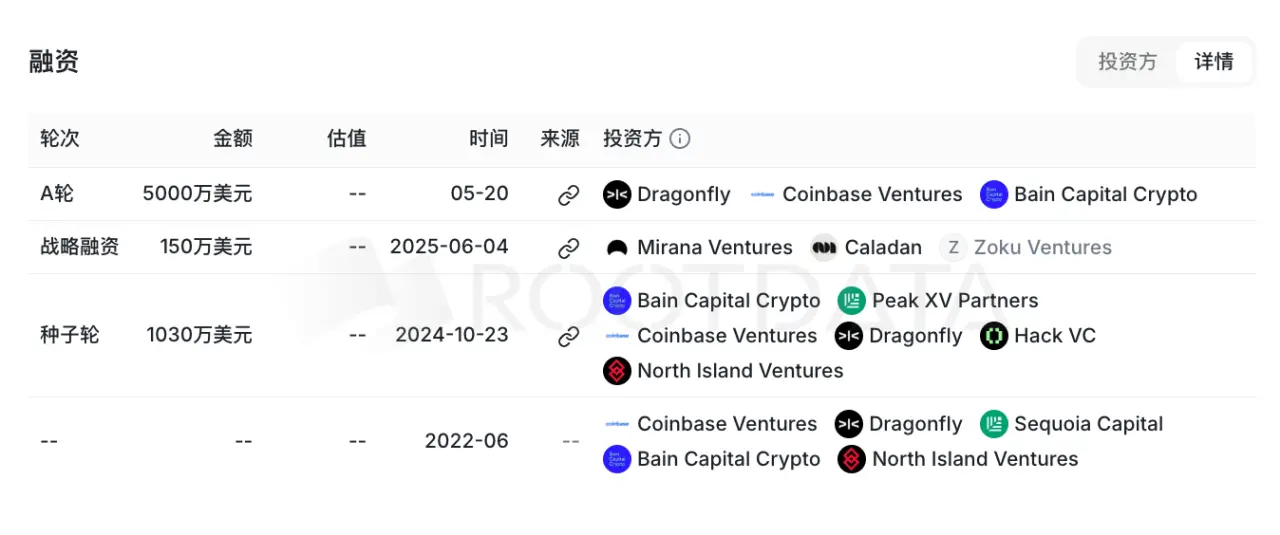
Recently, the decentralized derivatives trading platform Variational announced the completion of a $50 million Series A financing round led by Dragonfly. Combined with three previous funding rounds, Variational has raised a cumulative total of $61.8 million. Its investor lineup is quite impressive, including not only Dragonfly but also renowned institutions such as Sequoia Capital, Coinbase Ventures, Bain Capital Crypto, Hack VC, and others.
According to DeFiLlama data, the open interest (OI) on Variational has exceeded $810 million. While there remains a significant gap compared to Hyperliquid's $9.4 billion, its OI currently ranks fourth among on-chain derivatives protocols.
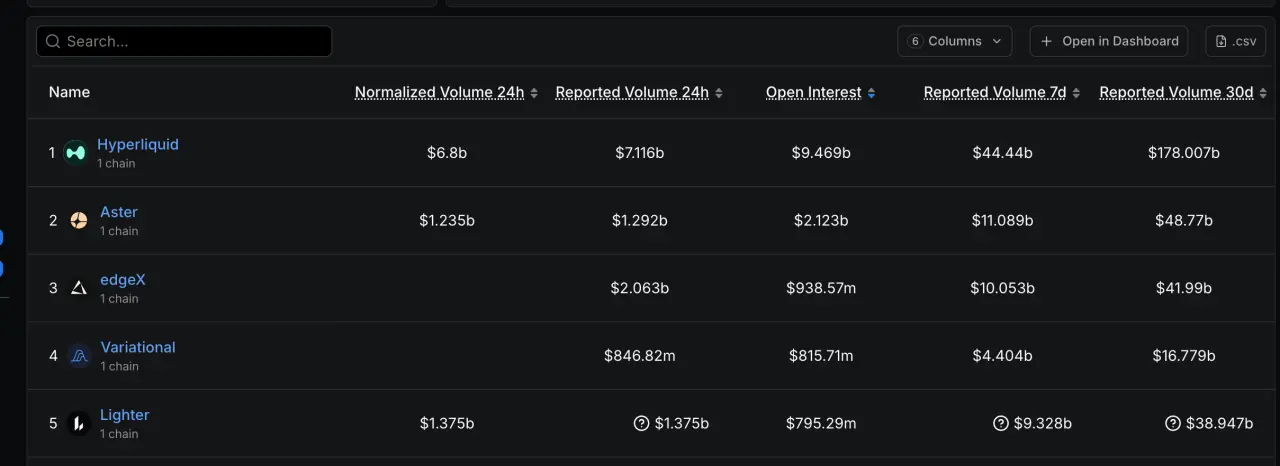
In the fiercely competitive decentralized derivatives sector, why has Variational continued to secure backing from top-tier institutions? What is the team's background? What are its differentiated approaches? This article provides a brief overview.

What is the team's background?

In terms of team background and entrepreneurial experience, Variational and Hyperliquid share several similarities: both teams graduated from prestigious universities, come from quantitative trading backgrounds, founded quantitative funds, and subsequently transitioned to building on-chain derivatives platforms.

However, unlike Hyperliquid's early mystique and anonymous team approach, Variational discloses its founding team's background and entrepreneurial journey in its whitepaper.
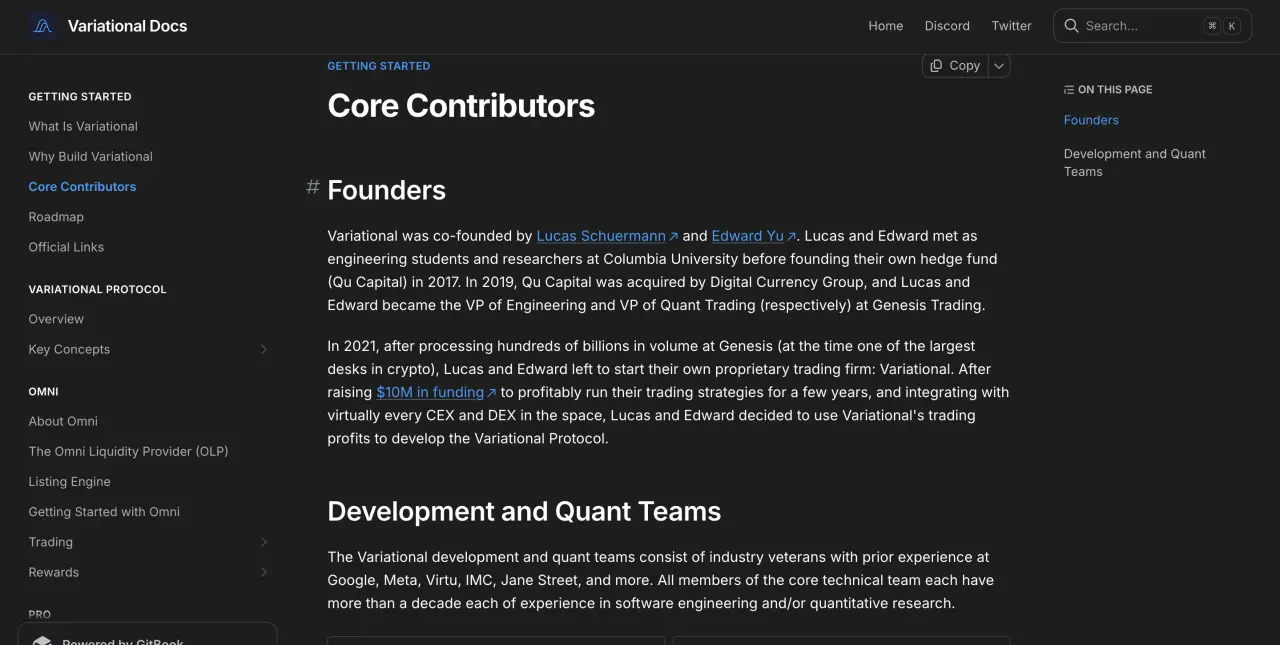
Variational was co-founded by Lucas Schuermann and Edward Yu. CEO Lucas graduated from Columbia University and was previously responsible for trading systems engineering architecture; Edward Yu has a Chinese background and was originally a quantitative analyst. The two met while studying and conducting research in the engineering department at Columbia University and co-founded the quantitative hedge fund Qu Capital in 2017.

In 2019, Qu Capital was acquired by Digital Currency Group. Subsequently, both joined Genesis Trading: Lucas served as Vice President of Engineering, and Edward Yu served as Vice President of Quantitative Trading.

According to the whitepaper, before leaving Genesis in 2021, their team had processed trading volumes in the hundreds of billions of dollars. After leaving, they founded their proprietary trading firm, Variational, and secured $10 million in funding.

In the following years, the team operated proprietary trading strategies while integrating with mainstream CEX and DEX trading interfaces. Later, based on their own trading business and system experience, they began developing and operating the Variational Protocol.

Additionally, Variational's development and quantitative team members also hail from technology and quantitative institutions such as Google, Meta, Virtu Financial, IMC Trading, and Jane Street. The whitepaper states that core technical team members generally possess over a decade of experience in software engineering or quantitative research.

What are its product features? How does it differ from Hyperliquid?

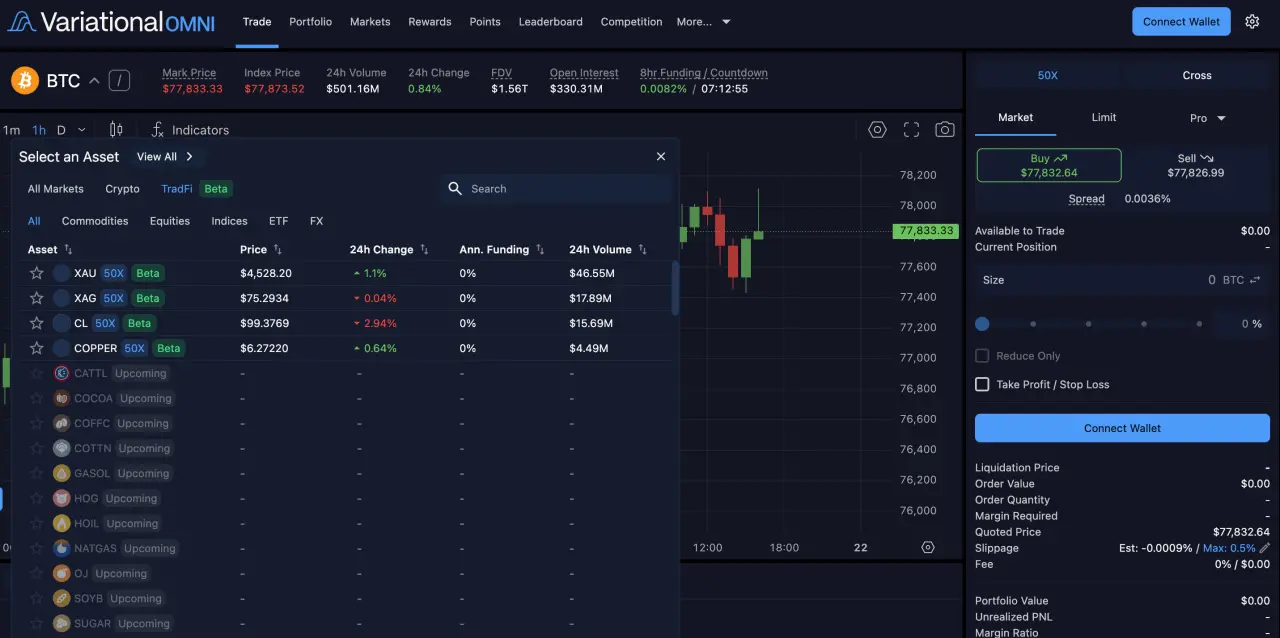
Judging from the trading interface, there isn't a significant difference between Variational and Hyperliquid. The platform currently lists approximately 450 trading pairs, mainly covering cryptocurrency and TradFi assets, offering users leverage up to 50x. The TradFi section is currently in Beta testing. According to official disclosures, the TradFi market will list over 100 trading pairs.
However, in its press release, Variational emphasizes a distinctly different positioning from Hyperliquid.

Variational describes its model as more akin to a brokerage rather than another exchange in the style of Hyperliquid. Its target users are not limited to crypto-native traders; it aims to make the on-chain derivatives trading experience closer to traditional markets through zero-fee trading and liquidity aggregation.

Currently operating on Arbitrum, Variational employs a dual-product-line model. The Omni version primarily targets retail users, positioned as a perpetual contracts trading product aggregating liquidity from multiple sources, while the Pro version caters to institutional over-the-counter derivatives trading.

The most significant difference from Hyperliquid lies in order matching and liquidity mechanisms. Hyperliquid relies on its self-built L1 chain and a public central limit order book (CLOB), with market makers or the HLP treasury within the protocol competing to provide quotes, and traders paying maker/taker fees. In contrast, Variational uses an RFQ (Request for Quote) model, with a single liquidity provider as the counterparty. It does not rely on on-chain internal market making but instead aggregates external liquidity in real-time from sources like CEXs, DEXs, OTC channels, and traditional financial market makers, managing risk through hedging.

The rationale for choosing this differentiated path, according to Variational CEO Lucas, is that on-chain liquidity still lags far behind traditional trading venues like the CME, and order book models face a "cold start" problem. Aggregating liquidity from external sources avoids the need to rebuild liquidity from scratch on-chain.

What is the current stage? What participation opportunities are available?

Variational is currently still in the Pre-TGE stage; the $VAR token has not been issued. The project initially planned a TGE in Q1 2025, which has since been postponed. No new definitive TGE date has been officially announced.

In December 2025, Variational launched the Omni Points points system. The official statement indicates that 50% of the $VAR supply will be allocated for community incentives, distributed gradually through mechanisms like Points rather than a one-time airdrop.

Regarding points, 3 million points have been retroactively distributed to early users. Subsequently, points are distributed every Friday based on the previous week's trading snapshot. The points program is scheduled to conclude by Q3 2026 at the latest.

The main current participation opportunity is to engage in perpetual contracts trading on the Omni platform. Trading volume is the core factor for earning points, with additional point bonuses available for holding positions over time and referring others.


Perguntas relacionadas

QWhat is the total funding amount raised by the decentralized derivatives platform Variational, and who led its Series A round?

AVariational has raised a total of $61.8 million. Its Series A round of $50 million was led by Dragonfly.

QWhat are the key differences between Variational and its competitor Hyperliquid in terms of their operational models?

AThe key difference lies in their order matching and liquidity mechanisms. Hyperliquid relies on its own L1 blockchain with a public Central Limit Order Book (CLOB). Variational uses an RFQ (Request for Quote) model, acting as a single liquidity provider counterparty that aggregates external liquidity from CEXs, DEXs, OTC channels, and TradFi market makers, then manages risk through hedging.

QWhat is the professional background of Variational's founding team prior to starting the protocol?

ACo-founders Lucas Schuermann and Edward Yu met at Columbia University. They co-founded the quantitative hedge fund Qu Capital in 2017, which was later acquired by Digital Currency Group. They then joined Genesis Trading, where Lucas served as VP of Engineering and Edward Yu as VP of Quantitative Trading, before leaving in 2021 to found Variational.

QWhat is the current stage of Variational's token ($VAR) launch, and how is the project engaging its community?

AVariational is currently in the Pre-TGE stage, and the $VAR token has not been launched yet. The previously planned TGE for Q1 2025 has been postponed with no new official date announced. The project is engaging its community through an 'Omni Points' loyalty program launched in December 2025, with 50% of the $VAR supply designated for community incentives distributed via points and other mechanisms over time.

QOn which blockchain does Variational primarily operate, and what are its two main product lines?

AVariational primarily operates on the Arbitrum blockchain. It follows a dual-product line model: the 'Omni' version targets retail users as a perpetual contracts trading product aggregating liquidity from multiple sources, while the 'Pro' version is designed for institutional over-the-counter (OTC) derivatives trading.

Leituras Relacionadas

Anthropic Major Release: "The Founder's Playbook" - All 4 Stages of Entrepreneurship, Completely Reimagined with AI

**Anthropic Releases "The Founder's Playbook," Reimagining the Four Stages of Startups with AI** The logic of entrepreneurship is being fundamentally reshaped by AI. Anthropic's new handbook, "The Founder's Playbook: Building an AI-Native Startup," defines the AI-native startup as a new species: not a traditional company with AI tools, but a venture driven by AI from day one. The founder's role is transforming from a hands-on builder to a conductor or architect, orchestrating AI agents for execution while focusing on high-level judgment and strategy. Anthropic outlines a product matrix of Claude tools for different tasks: Claude Chat for interactive research, Claude Code for generating production-ready code, and Claude Cowork for automating knowledge-intensive workflows. The handbook structures the startup lifecycle into four stages, detailing core goals, pitfalls, and AI applications for each: 1. **Idea Stage**: Focuses on validating a real problem. The core challenge is avoiding confirmation bias. AI practices include using Claude as a "structured devil's advocate" to challenge assumptions and for automated market/competitor research. 2. **MVP Stage**: Aims to gather early signals of Product-Market Fit (PMF). Key risks are technical debt and scope creep due to rapid AI-assisted development. Recommended AI uses include maintaining project memory documents (e.g., CLAUDE.md), using Claude Code for structured coding, and automating user feedback analysis. 3. **Launch Stage**: Centers on establishing scalable growth, operations, and compliance. Challenges include accelerating technical debt and founders becoming bottlenecks. AI should be used to build an "operating system" for launch—automating routine tasks (scheduling, reporting, content) and code audits—freeing founders for critical decisions. 4. **Scale Stage**: Focuses on achieving sustainable business operations. The main challenge is delegating operational control. AI should be leveraged for differentiated marketing, operational optimization, and building competitive moats through data network effects. The handbook concludes that in the AI era, "Can we build it?" is no longer the primary constraint. The advantage shifts back to foundational strengths: **insight, judgment, and a deep understanding of a specific problem and audience.**

marsbitHá 5h

Anthropic Major Release: "The Founder's Playbook" - All 4 Stages of Entrepreneurship, Completely Reimagined with AI

marsbitHá 5h

Eight Departments Launch Severe Crackdown on Cross-Border Securities Firms, How to Interpret This?

China's top financial regulators, including the CSRC and seven other ministries, have launched a sweeping crackdown on unlicensed cross-border securities operations. The core action involves a joint enforcement plan and the issuance of administrative penalties against major offshore internet brokers like Futu and Tiger Brokers for conducting unauthorized securities business in mainland China without a domestic license. The primary legal basis is China's requirement for securities businesses to operate with proper, locally issued licenses. The crackdown aims to eliminate a major regulatory gray area, plugging channels that allowed massive, unmonitored capital outflows which posed risks to financial stability, currency controls, and foreign exchange reserves. It also seeks to protect mainland investors who previously lacked legal recourse when dealing with offshore platforms and to secure sensitive financial data. The immediate impact is severe for the targeted brokers, including a complete ban on new mainland business, forced liquidation of existing mainland client positions over two years, and the confiscation of illegal profits estimated in the billions. Their U.S.-listed shares plummeted in response. Market analysts warn that the forced sell-off of an estimated 250-280 billion RMB in assets, concentrated in U.S. tech stocks, Chinese ADRs, and Hong Kong equities, could create sustained selling pressure on these markets over the next two years, potentially lowering valuations. For mainland investors, legal cross-border investment channels will become extremely constrained. The high asset threshold for the Stock Connect program and the severe shortage of QDII fund quotas—leading to chronic high premiums on popular U.S.-focused ETFs—mean retail access to overseas markets like the U.S. will be sharply limited. Conversely, some of the returning capital may flow into domestic A-share sectors like AI, semiconductors, and advanced manufacturing. However, this could further inflate valuations in these already elevated sectors. In conclusion, regulators frame this move not as closing off cross-border investment, but as a necessary step to enforce compliance, manage systemic risk, and steer investors toward regulated, protected channels like QDII and Stock Connect for the long-term health of the financial system.

链捕手Há 5h

Eight Departments Launch Severe Crackdown on Cross-Border Securities Firms, How to Interpret This?

链捕手Há 5h

Trading

Spot
Futuros
活动图片