The Calculation Behind Plasma's U Card with Free Claude Membership

Foresight NewsPublicado em 2026-06-16Última atualização em 2026-06-16

Resumo

Plasma has launched a three-tiered "U Card" (Visa stablecoin debit card) system, introducing a new demand mechanism for its XPL token through membership lock-ups. The cards offer increasing benefits: * **Lite:** Free, 2% cashback, no lock-up. * **Core:** Costs $120/year or requires locking 10,000 XPL for 12 months. Offers 3% cashback, 5% AI spending cashback (on up to $500/month), and a ChatGPT Go subscription. * **Platinum:** Requires locking 100,000 XPL for 12 months. Offers 4% cashback, 10% AI cashback, Claude Pro & ChatGPT Plus subscriptions, and extensive travel/insurance benefits. The analysis suggests Lite is for trialing, Core's value depends on substantial AI spending, and Platinum is mainly for existing large XPL holders due to the significant lock-up value and price volatility risk. The primary impact is creating a non-speculative use case for XPL. Locking XPL for card tiers can reduce circulating supply, helping counter future token unlocks and inflation. However, the system's success depends on real user adoption for daily spending, not just acquiring cards for rewards. The program expands Plasma's reach from a pure stablecoin transfer chain into consumer finance, tying XPL's utility to real-world payment frequency.


By: KarenZ, Foresight News


As the U Card trend extends to AI subscriptions, Plasma has found a new avenue for asset staking.


On June 12th, Plasma launched three tiers of U Cards, which will become available to all users this week.


On the surface, this is a stablecoin debit card membership system. What users see are base cashback, AI benefits, airport rebates, and Visa spending scenarios. What the project is focused on is longer-term spending frequency, token holdings, and staking.


How are the three tiers differentiated: Lite for onboarding, Core targets AI users, Platinum locks in large holders


Before dissecting the benefits, it's necessary to clarify the product scope of Plasma One. According to the official website, the Plasma One global account service is provided by Bridge, while the Plasma One card is issued by Rain, a principal member of Visa, under Visa's authorization, and is usable in countries and with merchants that accept Visa. In other words, Bridge focuses more on the account service layer, Rain on card issuance and the Visa payment channel layer, and the end-user experience is a stablecoin spending card connected to the Visa network.


Lite is the lowest barrier to entry. The website states the Lite card cost is $0, with a base cashback of 2% and 1 free virtual card. It's suitable for users who just want to try a stablecoin card and are not ready to buy or stake XPL yet.


Core targets regular AI users. It offers 3% base cashback, 5% AI spending cashback, a ChatGPT Go subscription, and up to 2 free virtual cards. Core is accessible through an annual fee of $120 or by staking 10,000 XPL for 12 months. It's important to note: The Core page specifies the 5% AI cashback applies to up to $500 in AI spending per month. This $500 is the spending cap for the cashback calculation, not the cashback amount cap.


Platinum is more akin to a premium spending card. The official page states it's designed for major XPL holders, accessible by staking 100,000 XPL for 12 months, with no additional fee. Benefits include 4% base cashback, 10% AI spending cashback, Claude Pro and ChatGPT Plus subscriptions, up to $600/year in flight ticket rebates, lounge access, Visa concierge service, car rental insurance, travel insurance, baggage delay & loss coverage, and global eSIM, among others.


The Platinum product page also promotes annual cashback and benefit values exceeding $10,000, including $7,500 in base cashback, $1,400 in AI credit, $600 in airline credit, etc. However, these are closer to marketing assumptions and do not equate to guaranteed, unconditional maximums for users.


Is it worth it: Lite is for trying, Core depends on AI spending, Platinum depends on tolerance for asset volatility


First, Lite. Its advantage is simplicity: $0 card fee, 2% base cashback, no staking. Its disadvantage is also clear: no additional category bonuses, no AI subscriptions, and no travel benefits. For most regular users, Lite is the most suitable tier for testing the waters, as it doesn't immediately expose you to XPL price volatility.


The key question for Core is: Can the $120 annual fee or the staking of 10,000 XPL be covered by actual spending? Calculating based on XPL at $0.088 (as of writing on June 15th), 10,000 XPL is roughly $880.


If not staking XPL, one needs $120 to register for the Core card. Comparing only ordinary spending between Lite and Core, Core offers 3% base cashback vs. Lite's 2%, a difference of 1 percentage point. To cover the $120 annual fee with this 1% difference, requires approximately $12,000 in annual eligible spending.


If focusing primarily on AI spending, Core's benefits should be calculated separately: The website states Core offers 5% AI cashback, applicable to up to $500 in AI spending per month; Lite explicitly has no AI cashback. Therefore, based on this specific AI cashback, covering the $120 annual fee requires $2,400 in annual eligible AI spending, roughly $200 per month. If maxing out the monthly $500 AI spending cap, Core can yield about $25 monthly in AI cashback, or $300 annually. Combined with the ChatGPT Go subscription benefit, Core is more suitable for users who already have ongoing AI tool expenses.


However, if a user chooses to stake 10,000 XPL instead of paying the annual fee, the calculation changes. The real cost of the staking-based Core version comes from XPL price volatility and the 12-month liquidity lockup; it shouldn't be simply viewed as getting the card for free.


Platinum's threshold is higher. 100,000 XPL is approximately $8,800 and requires a 12-month lockup. It suits three types of people: users already heavily invested in XPL, those with high AI and travel spending, and large holders who can accept a one-year lockup and price volatility.


Platinum's AI benefits are also weightier: Beyond 10% AI spending cashback, it includes Claude Pro and ChatGPT Plus subscriptions. For users already long-term subscribers of Claude Pro and ChatGPT Plus, these subscriptions can be considered as actual cost offsets. But for those staking temporarily just to get the card, they are more like add-on benefits that don't offset the price volatility risk associated with locking up 100,000 XPL for a year.


To achieve the advertised $7,500 value from the 4% base cashback alone requires about $187,500 in eligible spending; the maximum $600 flight ticket rebate, calculated at 10%, also corresponds to roughly $6,000 in eligible flight ticket spending. For an ordinary user buying 100,000 XPL temporarily just for the benefits, the risk-reward ratio isn't attractive.


Another layer of risk comes from the terms. Plasma One cashback is first denominated in USD, then converted to XPL at the XPL/USD price at the time of distribution. Rewards may undergo a pending period, and transactions involving refunds, chargebacks, abnormal spending, or arbitrage-like card usage may trigger forfeiture or clawbacks. The terms also state that Plasma may adjust reward rates, monthly caps, eligibility, excluded transactions, distribution cycles, and referral reward structures. Before valuing benefits at their full-cash hypotheticals, it's wise to discount these variables.


What is the impact on XPL?


The most direct impact of Plasma U Cards on XPL is adding a membership qualification attribute to the token. Previously, XPL's narrative primarily stemmed from the Plasma chain itself and zero-fee USDT transfers. Now, Core and Platinum tie XPL to spending benefits, motivating users to hold XPL for AI subscriptions, cashback, travel perks, and card tier status.


Plasma documentation shows an initial XPL supply of 10 billion, with 10% public sale, 40% ecosystem & growth, 25% team, and 25% investors. Within the ecosystem & growth portion, 800 million tokens unlock at the Mainnet Beta on September 25, 2025, with the remaining 3.2 billion released linearly over 3 years.


Let's examine staking effects with a few scenarios:
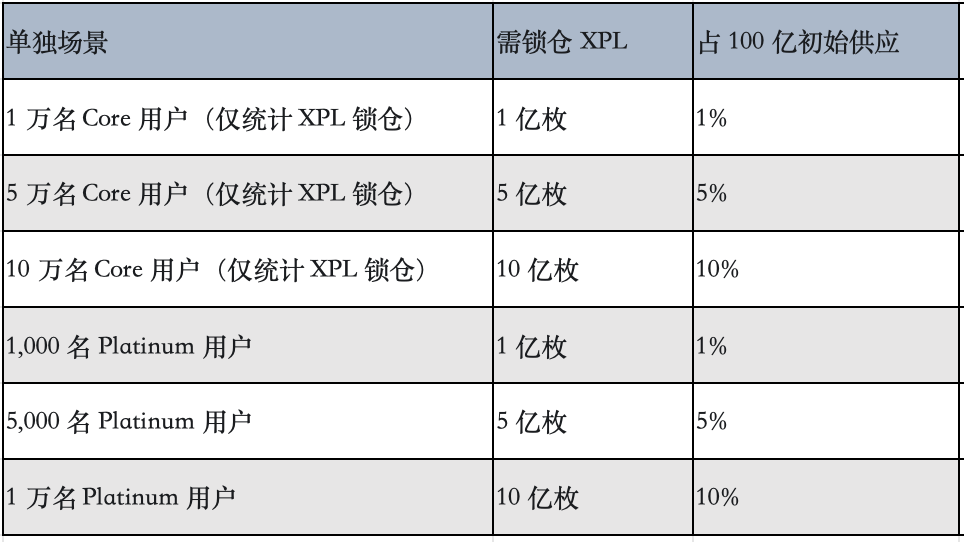


The implication of this table is straightforward: Core needs scale, Platinum needs large holders. With just 1,000 Platinum users, 100 million XPL can be locked; with 10,000 Platinum users, 1 billion XPL can be locked, accounting for 10% of the total initial supply.


More crucially, compare this to the unlock schedule. From the ecosystem & growth allocation, the remaining 3.2 billion tokens will be released over 3 years (fully unlocked by September 25, 2028), averaging about 88.89 million per month. To absorb one month's ecosystem release, approximately 8,889 Core users staking XPL, or 889 Platinum users, would be needed.


The team and investor allocations total 5 billion tokens, with a one-year cliff unlocking one-third (~1.667 billion) on September 25, 2026. To fully offset this amount with card staking would require about 166,667 Core users staking XPL, or 16,667 Platinum users. This number is already substantial, indicating that Plasma One card tiers can improve the circulating structure but are unlikely to single-handedly absorb future large-scale unlocks.


Another variable is inflation. Plasma plans to initiate validator rewards after external validators and delegated staking go live, starting with 5% annual inflation, decreasing by 0.5 percentage points each year until reaching a long-term baseline of 3%; simultaneously, a base fee burn mechanism similar to EIP-1559 aims to counteract new issuance.


Roughly calculating based on the 10 billion initial supply, 5% annual inflation corresponds to 500 million XPL. Covering this annually would require staking from 50,000 Core users or 5,000 Platinum users.


Data from a Dune dashboard built by Sumcap shows Plasma One currently has 24,000 cardholders, with 8,884 cards activated.
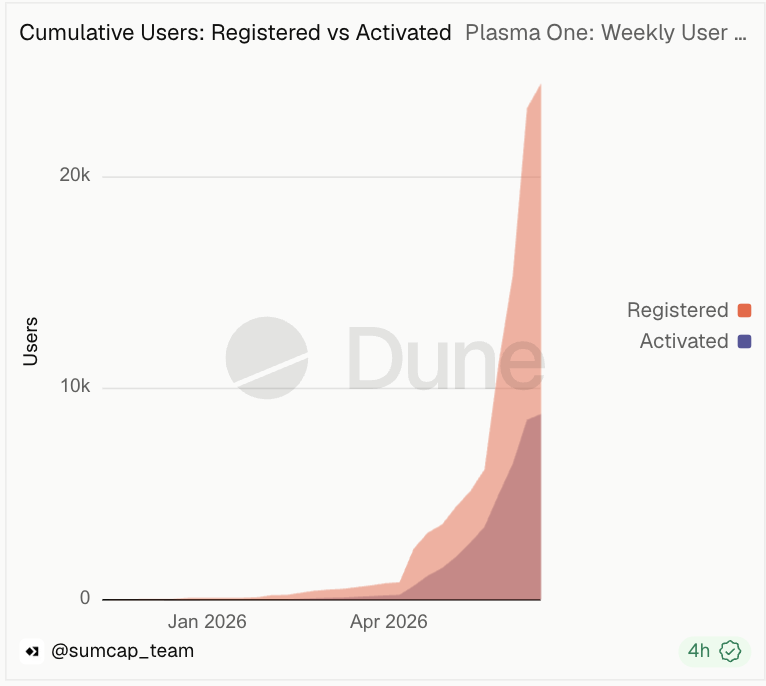


The positive effect of Plasma's latest move on the token lies in: Adding non-speculative reasons to hold XPL, reducing part of the circulating supply, and expanding XPL's reach.


The negative effects are also clear: Cashback is distributed in XPL, and if users treat it as cash-equivalent, they might sell immediately upon receipt. Of course, this is digested gradually.


Another point is that the official sources have not yet disclosed the specific origin of the reward XPL, which determines whether it ultimately constitutes a net buy pressure, a net distribution, or a mix of both.


Plasma's Real Experiment


The counter-intuitive aspect of Plasma is here: The smoother the zero-fee USDT transfers, the less ordinary users need to actively hold XPL to pay for Gas. The membership staking adds another demand curve for XPL. It brings users from exchanges, airdrops, and staking pages into more everyday scenarios: swiping a Visa card, receiving cashback, subscribing to AI tools, etc.


This is good for the project itself. Stablecoin Layer 1s are easily evaluated by the market based on TVL and subsidies. Plasma One provides it with a consumer finance entry point and also links XPL to real-world payment frequency. However, this path is also more challenging. Users won't swipe their cards daily because of a Layer 1 narrative; they will stay for fees, currency exchange, risk controls, customer service, regional coverage, and benefit fulfillment.


For XPL, Plasma One Tiers is a useful experiment for staking and distribution, but it cannot replace real transaction volume, stablecoin liquidity, and subsequent unlock management.


It's more like a door, handing on-chain assets to everyday spending. The door is open; the next step is to see how many people actually walk through it every day.


Perguntas relacionadas

QWhat are the three tiers of Plasma U Card and their primary target audiences?

AThe Plasma U Card has three tiers: 1) Lite Card, designed for users who want to try stablecoin cards without buying or staking XPL. 2) Core Card, targeting daily AI users, requiring an annual fee of $120 or staking 10,000 XPL for 12 months. 3) Platinum Card, aimed at high-consumption users and XPL whales, requiring the staking of 100,000 XPL for 12 months.

QAccording to the article, is the Platinum Card's advertised annual value of over $10,000 guaranteed for users?

ANo, the advertised annual value of over $10,000 for the Platinum Card is not guaranteed. The article states this figure is closer to a marketing assumption and does not equal an unconditional payout. It's based on hypothetical maximum spending levels for cashback and benefits, which most users are unlikely to fully achieve.

QWhat is the main financial consideration for a user choosing the Core Card via XPL staking instead of paying the annual fee?

AThe main financial consideration is not just the cashback benefits but the real cost associated with locking 10,000 XPL for 12 months. This cost stems from the potential price volatility of XPL and the loss of liquidity for one year, meaning it cannot be simply viewed as getting the card for free.

QWhat potential impact does the Plasma U Card program have on the XPL token's circulating supply?

AThe Plasma U Card program adds a membership utility to XPL, creating a new demand curve by incentivizing users to hold and stake XPL for card benefits. This can potentially lock up a portion of the circulating supply. For example, 1,000 Platinum users would lock 100 million XPL. However, the article suggests the program alone is unlikely to fully absorb future large token unlocks from the team and investors.

QWhat does the article identify as the broader strategic significance of the Plasma U Card for the Plasma project?

AThe article identifies that the Plasma U Card provides a consumer finance gateway for the project, moving beyond typical blockchain metrics like TVL. It connects the XPL token to real-world payment frequency and daily spending scenarios (like using a Visa card, getting cashback, subscribing to AI tools), which is a more sustainable but challenging path that depends on user experience with fees, exchange rates, and customer service.

Leituras Relacionadas

The Foundation of SpaceX's Trillion-Dollar Valuation: Who is Dividing Up Musk's Annual Tens of Billions in Capital Expenditure?

SpaceX's trillion-dollar valuation is built on its three core businesses: Starlink (profitable, 60% of revenue), rockets (driving down launch costs), and AI (a major investment area). This creates a financial cycle: Starlink funds rocket development, which enables low-cost launches for AI hardware, generating future revenue. This cycle fuels annual capital expenditures of tens of billions, flowing to a vast supply chain. Suppliers are categorized by their replaceability. The first group includes irreplaceable players like NVIDIA (GPU/CUDA ecosystem), Eutelsat (critical radio spectrum), Filtronic (specialized amplifiers), Materion (strategic beryllium), and STMicroelectronics (antenna chips). The second group consists of hard-to-replace suppliers due to high switching costs, such as Honeywell (flight control), Carpenter Technology (specialty alloys), Hexcel (carbon fiber), Broadcom (data exchange), and Linde (industrial gases). The third group comprises high-volume, cost-critical suppliers for mass-produced items like Starlink terminals. Key names include Wistron NeWeb (primary manufacturer) and several A-share companies like Shenzhen Sunway (connectors), Pies New Materials (forgings), Western Superconducting (alloys), and Yingliu (castings). Other niche players include Trimble (timing), Astronics (power distribution), and CTS (thermal management). The article argues that investing in these suppliers, rather than SpaceX stock directly, offers an alternative opportunity. The rationale is threefold: procurement is just beginning to scale, SpaceX's IPO brings new transparency to its supply chain, and the situation mirrors early stages of past "super terminal" ecosystems like Apple or Tesla. While risks exist (commodity cycles, geopolitical factors, technology shifts), the core thesis is that SpaceX's massive, ongoing procurement will translate into reliable revenue for its key suppliers, regardless of its own stock price volatility.

marsbitHá 48m

The Foundation of SpaceX's Trillion-Dollar Valuation: Who is Dividing Up Musk's Annual Tens of Billions in Capital Expenditure?

marsbitHá 48m

SpaceX's Trillion-Dollar Valuation Base: Who's Sharing in Musk's Annual Tens of Billions in Capital Expenditure?

**Title: The Foundation of SpaceX's Trillion-Dollar Valuation: Who Benefits from Musk's Annual $100 Billion Capital Expenditure?** This article argues that investors seeking to benefit from SpaceX's growth might find greater opportunities in its supply chain rather than directly investing in the company itself, drawing parallels to historical successes with Apple, Tesla, and NVIDIA suppliers. **SpaceX's Business Model & Cash Flow:** SpaceX generates revenue from three main areas: 1. **Starlink:** Its profitable core, earning $11.3B in 2023 (60% of revenue), funding other ventures. 2. **Rockets (Falcon/Starship):** Requires $3B+ in annual R&D but achieves the world's lowest launch costs. 3. **AI:** Currently unprofitable (-$6B+ in 2023), investing heavily in ground-based supercomputers (220,000 GPUs) and future orbital data centers. The cycle is: Starlink profits → fund cheaper rockets → low-cost launches deploy AI hardware → AI compute rentals generate future revenue. This cycle drives annual procurement spending of tens of billions of dollars. **The Supply Chain Beneficiaries:** Suppliers are categorized by their replaceability: **1. Nearly Irreplaceable (High Barriers to Entry):** * **NVIDIA:** Powers the Colossus supercomputer; its CUDA ecosystem creates immense switching costs. * **Eutelsat (SATS):** Controls critical radio spectrum for satellite communications; holds a ~3% stake in SpaceX. * **Filtronic (FTC):** Supplies millimeter-wave signal amplifiers for Starlink satellites; SpaceX constitutes 83% of its revenue. * **Materion (MTRN):** Global leader in beryllium production, a strategic material used in Starship structures. * **STMicroelectronics (STM):** Supplies phased-array antenna chips for Starlink satellites. **2. Replaceable, but Switching Cost is Prohibitively High:** * **Honeywell (HON):** Provides flight control and inertial navigation systems with decades of certification. * **Carpenter Technology (CRS):** Manufactures ultra-pure specialty steel alloys for Raptor engines. * **Hexcel (HXL):** Supplies custom carbon fiber composites developed over a decade with SpaceX. * **Broadcom (AVGO):** Manages high-speed data switching. * **Linde Group:** Supplies industrial gases (liquid oxygen/nitrogen) from facilities built near SpaceX launch sites. **3. High-Volume, Cost-Critical Manufacturing:** Focuses on mass-producing components like Starlink user terminals (target: 30 million units). * **Key Players:** Wistron NeWeb (6285, primary terminal manufacturer), several Chinese A-share companies (e.g., Sunway Communication, PAX New Materials, Western Metal Materials, Yingliu Co.), and smaller US firms like Trimble (TRMB, timing systems). **Why Now?** Three factors make the supply chain opportunity timely: 1. **Volume Ramp-Up:** SpaceX plans 100 launches in 2026, aims for 30 million Starlink terminals, and will deploy AI data centers, meaning procurement will accelerate. 2. **Increased Transparency:** The IPO provides public financial data, allowing investors to track supplier order growth. 3. **Historical Precedent:** The current phase is likened to Tesla's early mass-production stage (circa 2018), suggesting a long growth runway for suppliers. **Conclusion:** The article posits that while investing in SpaceX stock is betting on Elon Musk's ambitious vision at a high valuation, investing in its established suppliers is a bet on the tangible, recurring revenue from its massive procurement budget, which is largely decoupled from day-to-day stock price volatility.

链捕手Há 52m

SpaceX's Trillion-Dollar Valuation Base: Who's Sharing in Musk's Annual Tens of Billions in Capital Expenditure?

链捕手Há 52m

The U.S. Government Blocked the Anthropic Model. It Wasn't About 'Jailbreaking' at All.

Last Friday, the U.S. Commerce Department issued an enforcement letter that forced Anthropic to take its two most advanced AI models, Fable 5 and Mythos 5, offline. The stated reason was unspecified national security concerns, initially linked to potential "jailbreaks" of the models' safeguards. However, new details suggest the action stemmed more from a deteriorating relationship between the Trump administration and Anthropic, rather than a genuine technical threat. According to reports, the government cited a little-known export control regulation, compelling Anthropic to block access for all non-U.S. persons, including its own international employees. The company complied, shutting down the models without a court order or specific technical details from the government. Cybersecurity expert Katie Moussouris revealed she was privately shown a research paper detailing a potential safeguard bypass in Fable 5. She argued the described method was minor and did not warrant an export ban, stating that attempts to "fix" it would only weaken the model's defensive capabilities. Moussouris and other experts have since called for the order to be revoked, warning it dangerously removes advanced cybersecurity tools from U.S. defenders. Analysts like Justin Hendrix suggest the move appears retaliatory and sets a dangerous precedent, signaling that the U.S. government can unilaterally shut down a tech company's products. The incident has raised concerns about the reliability of American AI and the potential for political interference in the tech industry, serving as a warning to the broader sector.

marsbitHá 55m

The U.S. Government Blocked the Anthropic Model. It Wasn't About 'Jailbreaking' at All.

marsbitHá 55m

Ray Dalio: AI Bull Market Continues to Soar, Should Investors Go All In or Cash Out and Leave the Field?

In his latest notes, Ray Dalio addresses a critical question for investors amid the AI-driven stock market surge: how should one allocate assets during a transformative technological revolution? Dalio emphasizes that technological advancement does not automatically make related stocks attractive. Historical tech cycles—marked by excitement, crowding, volatility, and eventual shakeouts—show that even long-term winners like Microsoft and Apple experienced severe drawdowns. Today's AI sector faces similar uncertainties: overinvestment, intensifying competition, geopolitical tensions (e.g., Taiwan's chip supply), tax policy shifts, anti-AI sentiment, and potential disruption from future technologies like quantum computing. Dalio's core argument focuses on the highly concentrated market structure, where a few tech giants dominate major indices. He warns investors against unknowingly holding concentrated, correlated exposures. Instead of chasing a handful of AI leaders, he advocates for a robust, diversified portfolio of 15 or more high-quality, uncorrelated investments, risk-balanced to match an investor's volatility tolerance. Mathematically, such diversification significantly improves the risk-return ratio—for example, holding 15 uncorrelated assets can boost the ratio by over four times compared to a single concentrated bet. Dalio cautions that future equity returns appear low, with his bubble indicator suggesting real returns could be negative over the next 5-10 years. He stresses that knowing what you don't know is as important as knowing what you do. In an environment of high uncertainty and concentration, avoiding large, concentrated bets on AI stocks is prudent. The optimal strategy is disciplined diversification—the "holy grail" of investing—to navigate this technologically driven cycle with lower risk and comparable or better returns.

marsbitHá 59m

Ray Dalio: AI Bull Market Continues to Soar, Should Investors Go All In or Cash Out and Leave the Field?

marsbitHá 59m

Trading

Spot
Futuros

Artigos em Destaque

O que é $S$

Compreender o SPERO: Uma Visão Abrangente Introdução ao SPERO À medida que o panorama da inovação continua a evoluir, o surgimento de tecnologias web3 e projetos de criptomoeda desempenha um papel fundamental na formação do futuro digital. Um projeto que tem atraído atenção neste campo dinâmico é o SPERO, denotado como SPERO,$$s$. Este artigo tem como objetivo reunir e apresentar informações detalhadas sobre o SPERO, para ajudar entusiastas e investidores a compreender as suas bases, objetivos e inovações nos domínios web3 e cripto. O que é o SPERO,$$s$? O SPERO,$$s$ é um projeto único dentro do espaço cripto que procura aproveitar os princípios da descentralização e da tecnologia blockchain para criar um ecossistema que promove o envolvimento, a utilidade e a inclusão financeira. O projeto é concebido para facilitar interações peer-to-peer de novas maneiras, proporcionando aos utilizadores soluções e serviços financeiros inovadores. No seu núcleo, o SPERO,$$s$ visa capacitar indivíduos ao fornecer ferramentas e plataformas que melhoram a experiência do utilizador no espaço das criptomoedas. Isso inclui a possibilidade de métodos de transação mais flexíveis, a promoção de iniciativas impulsionadas pela comunidade e a criação de caminhos para oportunidades financeiras através de aplicações descentralizadas (dApps). A visão subjacente do SPERO,$$s$ gira em torno da inclusão, visando fechar lacunas dentro das finanças tradicionais enquanto aproveita os benefícios da tecnologia blockchain. Quem é o Criador do SPERO,$$s$? A identidade do criador do SPERO,$$s$ permanece algo obscura, uma vez que existem recursos publicamente disponíveis limitados que fornecem informações detalhadas sobre o(s) seu(s) fundador(es). Esta falta de transparência pode resultar do compromisso do projeto com a descentralização—uma ética que muitos projetos web3 partilham, priorizando contribuições coletivas em vez de reconhecimento individual. Ao centrar as discussões em torno da comunidade e dos seus objetivos coletivos, o SPERO,$$s$ incorpora a essência do empoderamento sem destacar indivíduos específicos. Assim, compreender a ética e a missão do SPERO é mais importante do que identificar um criador singular. Quem são os Investidores do SPERO,$$s$? O SPERO,$$s$ é apoiado por uma diversidade de investidores que vão desde capitalistas de risco a investidores-anjo dedicados a promover a inovação no setor cripto. O foco desses investidores geralmente alinha-se com a missão do SPERO—priorizando projetos que prometem avanço tecnológico social, inclusão financeira e governança descentralizada. Essas fundações de investidores estão tipicamente interessadas em projetos que não apenas oferecem produtos inovadores, mas que também contribuem positivamente para a comunidade blockchain e os seus ecossistemas. O apoio desses investidores reforça o SPERO,$$s$ como um concorrente notável no domínio em rápida evolução dos projetos cripto. Como Funciona o SPERO,$$s$? O SPERO,$$s$ emprega uma estrutura multifacetada que o distingue de projetos de criptomoeda convencionais. Aqui estão algumas das características-chave que sublinham a sua singularidade e inovação: Governança Descentralizada: O SPERO,$$s$ integra modelos de governança descentralizada, capacitando os utilizadores a participar ativamente nos processos de tomada de decisão sobre o futuro do projeto. Esta abordagem promove um sentido de propriedade e responsabilidade entre os membros da comunidade. Utilidade do Token: O SPERO,$$s$ utiliza o seu próprio token de criptomoeda, concebido para servir várias funções dentro do ecossistema. Esses tokens permitem transações, recompensas e a facilitação de serviços oferecidos na plataforma, melhorando o envolvimento e a utilidade gerais. Arquitetura em Camadas: A arquitetura técnica do SPERO,$$s$ suporta modularidade e escalabilidade, permitindo a integração contínua de funcionalidades e aplicações adicionais à medida que o projeto evolui. Esta adaptabilidade é fundamental para manter a relevância no panorama cripto em constante mudança. Envolvimento da Comunidade: O projeto enfatiza iniciativas impulsionadas pela comunidade, empregando mecanismos que incentivam a colaboração e o feedback. Ao nutrir uma comunidade forte, o SPERO,$$s$ pode melhor atender às necessidades dos utilizadores e adaptar-se às tendências do mercado. Foco na Inclusão: Ao oferecer taxas de transação baixas e interfaces amigáveis, o SPERO,$$s$ visa atrair uma base de utilizadores diversificada, incluindo indivíduos que anteriormente podem não ter participado no espaço cripto. Este compromisso com a inclusão alinha-se com a sua missão abrangente de empoderamento através da acessibilidade. Cronologia do SPERO,$$s$ Compreender a história de um projeto fornece insights cruciais sobre a sua trajetória de desenvolvimento e marcos. Abaixo está uma cronologia sugerida que mapeia eventos significativos na evolução do SPERO,$$s$: Fase de Conceituação e Ideação: As ideias iniciais que formam a base do SPERO,$$s$ foram concebidas, alinhando-se de perto com os princípios de descentralização e foco na comunidade dentro da indústria blockchain. Lançamento do Whitepaper do Projeto: Após a fase conceitual, um whitepaper abrangente detalhando a visão, os objetivos e a infraestrutura tecnológica do SPERO,$$s$ foi lançado para atrair o interesse e o feedback da comunidade. Construção da Comunidade e Primeiros Envolvimentos: Esforços ativos de divulgação foram feitos para construir uma comunidade de primeiros adotantes e investidores potenciais, facilitando discussões em torno dos objetivos do projeto e angariando apoio. Evento de Geração de Tokens: O SPERO,$$s$ realizou um evento de geração de tokens (TGE) para distribuir os seus tokens nativos a apoiantes iniciais e estabelecer liquidez inicial dentro do ecossistema. Lançamento da dApp Inicial: A primeira aplicação descentralizada (dApp) associada ao SPERO,$$s$ foi lançada, permitindo que os utilizadores interagissem com as funcionalidades principais da plataforma. Desenvolvimento Contínuo e Parcerias: Atualizações e melhorias contínuas nas ofertas do projeto, incluindo parcerias estratégicas com outros players no espaço blockchain, moldaram o SPERO,$$s$ em um jogador competitivo e em evolução no mercado cripto. Conclusão O SPERO,$$s$ é um testemunho do potencial do web3 e das criptomoedas para revolucionar os sistemas financeiros e capacitar indivíduos. Com um compromisso com a governança descentralizada, o envolvimento da comunidade e funcionalidades inovadoras, abre caminho para um panorama financeiro mais inclusivo. Como em qualquer investimento no espaço cripto em rápida evolução, potenciais investidores e utilizadores são incentivados a pesquisar minuciosamente e a envolver-se de forma ponderada com os desenvolvimentos em curso dentro do SPERO,$$s$. O projeto demonstra o espírito inovador da indústria cripto, convidando a uma exploração mais aprofundada das suas inúmeras possibilidades. Embora a jornada do SPERO,$$s$ ainda esteja a desenrolar-se, os seus princípios fundamentais podem, de facto, influenciar o futuro de como interagimos com a tecnologia, as finanças e uns com os outros em ecossistemas digitais interconectados.

69 Visualizações TotaisPublicado em {updateTime}Atualizado em 2024.12.17

O que é $S$

O que é AGENT S

Agent S: O Futuro da Interação Autónoma no Web3 Introdução No panorama em constante evolução do Web3 e das criptomoedas, as inovações estão constantemente a redefinir a forma como os indivíduos interagem com plataformas digitais. Um projeto pioneiro, o Agent S, promete revolucionar a interação humano-computador através do seu framework aberto e agente. Ao abrir caminho para interações autónomas, o Agent S visa simplificar tarefas complexas, oferecendo aplicações transformadoras em inteligência artificial (IA). Esta exploração detalhada irá aprofundar-se nas complexidades do projeto, nas suas características únicas e nas implicações para o domínio das criptomoedas. O que é o Agent S? O Agent S é um framework aberto e agente, especificamente concebido para abordar três desafios fundamentais na automação de tarefas computacionais: Aquisição de Conhecimento Específico de Domínio: O framework aprende inteligentemente a partir de várias fontes de conhecimento externas e experiências internas. Esta abordagem dupla capacita-o a construir um rico repositório de conhecimento específico de domínio, melhorando o seu desempenho na execução de tarefas. Planeamento ao Longo de Longos Horizontes de Tarefas: O Agent S emprega planeamento hierárquico aumentado por experiência, uma abordagem estratégica que facilita a decomposição e execução eficientes de tarefas intrincadas. Esta característica melhora significativamente a sua capacidade de gerir múltiplas subtarefas de forma eficiente e eficaz. Gestão de Interfaces Dinâmicas e Não Uniformes: O projeto introduz a Interface Agente-Computador (ACI), uma solução inovadora que melhora a interação entre agentes e utilizadores. Utilizando Modelos de Linguagem Multimodais de Grande Escala (MLLMs), o Agent S pode navegar e manipular diversas interfaces gráficas de utilizador de forma fluida. Através destas características pioneiras, o Agent S fornece um framework robusto que aborda as complexidades envolvidas na automação da interação humana com máquinas, preparando o terreno para uma infinidade de aplicações em IA e além. Quem é o Criador do Agent S? Embora o conceito de Agent S seja fundamentalmente inovador, informações específicas sobre o seu criador permanecem elusivas. O criador é atualmente desconhecido, o que destaca ou o estágio nascente do projeto ou a escolha estratégica de manter os membros fundadores em anonimato. Independentemente da anonimidade, o foco permanece nas capacidades e no potencial do framework. Quem são os Investidores do Agent S? Como o Agent S é relativamente novo no ecossistema criptográfico, informações detalhadas sobre os seus investidores e financiadores não estão explicitamente documentadas. A falta de informações disponíveis publicamente sobre as fundações de investimento ou organizações que apoiam o projeto levanta questões sobre a sua estrutura de financiamento e roteiro de desenvolvimento. Compreender o apoio é crucial para avaliar a sustentabilidade do projeto e o seu impacto potencial no mercado. Como Funciona o Agent S? No núcleo do Agent S reside uma tecnologia de ponta que lhe permite funcionar eficazmente em diversos ambientes. O seu modelo operacional é construído em torno de várias características-chave: Interação Humano-Computador Semelhante: O framework oferece planeamento avançado em IA, esforçando-se para tornar as interações com computadores mais intuitivas. Ao imitar o comportamento humano na execução de tarefas, promete elevar as experiências dos utilizadores. Memória Narrativa: Utilizada para aproveitar experiências de alto nível, o Agent S utiliza memória narrativa para acompanhar os históricos de tarefas, melhorando assim os seus processos de tomada de decisão. Memória Episódica: Esta característica fornece aos utilizadores orientações passo a passo, permitindo que o framework ofereça suporte contextual à medida que as tarefas se desenrolam. Suporte para OpenACI: Com a capacidade de funcionar localmente, o Agent S permite que os utilizadores mantenham o controlo sobre as suas interações e fluxos de trabalho, alinhando-se com a ética descentralizada do Web3. Fácil Integração com APIs Externas: A sua versatilidade e compatibilidade com várias plataformas de IA garantem que o Agent S possa integrar-se perfeitamente em ecossistemas tecnológicos existentes, tornando-o uma escolha apelativa para desenvolvedores e organizações. Estas funcionalidades contribuem coletivamente para a posição única do Agent S no espaço cripto, à medida que automatiza tarefas complexas e em múltiplos passos com mínima intervenção humana. À medida que o projeto evolui, as suas potenciais aplicações no Web3 podem redefinir a forma como as interações digitais se desenrolam. Cronologia do Agent S O desenvolvimento e os marcos do Agent S podem ser encapsulados numa cronologia que destaca os seus eventos significativos: 27 de Setembro de 2024: O conceito de Agent S foi lançado num artigo de pesquisa abrangente intitulado “Um Framework Agente Aberto que Usa Computadores como um Humano”, mostrando a base para o projeto. 10 de Outubro de 2024: O artigo de pesquisa foi disponibilizado publicamente no arXiv, oferecendo uma exploração aprofundada do framework e da sua avaliação de desempenho com base no benchmark OSWorld. 12 de Outubro de 2024: Uma apresentação em vídeo foi lançada, proporcionando uma visão visual das capacidades e características do Agent S, envolvendo ainda mais potenciais utilizadores e investidores. Estes marcos na cronologia não apenas ilustram o progresso do Agent S, mas também indicam o seu compromisso com a transparência e o envolvimento da comunidade. Pontos-Chave Sobre o Agent S À medida que o framework Agent S continua a evoluir, várias características-chave destacam-se, sublinhando a sua natureza inovadora e potencial: Framework Inovador: Concebido para proporcionar um uso intuitivo de computadores semelhante à interação humana, o Agent S traz uma abordagem nova à automação de tarefas. Interação Autónoma: A capacidade de interagir autonomamente com computadores através de GUI significa um avanço em direção a soluções computacionais mais inteligentes e eficientes. Automação de Tarefas Complexas: Com a sua metodologia robusta, pode automatizar tarefas complexas e em múltiplos passos, tornando os processos mais rápidos e menos propensos a erros. Melhoria Contínua: Os mecanismos de aprendizagem permitem que o Agent S melhore a partir de experiências passadas, aprimorando continuamente o seu desempenho e eficácia. Versatilidade: A sua adaptabilidade em diferentes ambientes operacionais, como OSWorld e WindowsAgentArena, garante que pode servir uma ampla gama de aplicações. À medida que o Agent S se posiciona no panorama do Web3 e das criptomoedas, o seu potencial para melhorar as capacidades de interação e automatizar processos significa um avanço significativo nas tecnologias de IA. Através do seu framework inovador, o Agent S exemplifica o futuro das interações digitais, prometendo uma experiência mais fluida e eficiente para os utilizadores em diversas indústrias. Conclusão O Agent S representa um ousado avanço na união da IA e do Web3, com a capacidade de redefinir a forma como interagimos com a tecnologia. Embora ainda esteja nas suas fases iniciais, as possibilidades para a sua aplicação são vastas e cativantes. Através do seu framework abrangente que aborda desafios críticos, o Agent S visa trazer interações autónomas para o primeiro plano da experiência digital. À medida que avançamos mais profundamente nos domínios das criptomoedas e da descentralização, projetos como o Agent S desempenharão, sem dúvida, um papel crucial na formação do futuro da tecnologia e da colaboração humano-computador.

678 Visualizações TotaisPublicado em {updateTime}Atualizado em 2025.01.14

O que é AGENT S

Como comprar S

Bem-vindo à HTX.com!Tornámos a compra de Sonic (S) simples e conveniente.Segue o nosso guia passo a passo para iniciar a tua jornada no mundo das criptos.Passo 1: cria a tua conta HTXUtiliza o teu e-mail ou número de telefone para te inscreveres numa conta gratuita na HTX.Desfruta de um processo de inscrição sem complicações e desbloqueia todas as funcionalidades.Obter a minha contaPasso 2: vai para Comprar Cripto e escolhe o teu método de pagamentoCartão de crédito/débito: usa o teu visa ou mastercard para comprar Sonic (S) instantaneamente.Saldo: usa os fundos da tua conta HTX para transacionar sem problemas.Terceiros: adicionamos métodos de pagamento populares, como Google Pay e Apple Pay, para aumentar a conveniência.P2P: transaciona diretamente com outros utilizadores na HTX.Mercado de balcão (OTC): oferecemos serviços personalizados e taxas de câmbio competitivas para os traders.Passo 3: armazena teu Sonic (S)Depois de comprar o teu Sonic (S), armazena-o na tua conta HTX.Alternativamente, podes enviá-lo para outro lugar através de transferência blockchain ou usá-lo para transacionar outras criptomoedas.Passo 4: transaciona Sonic (S)Transaciona facilmente Sonic (S) no mercado à vista da HTX.Acede simplesmente à tua conta, seleciona o teu par de trading, executa as tuas transações e monitoriza em tempo real.Oferecemos uma experiência de fácil utilização tanto para principiantes como para traders experientes.

1.3k Visualizações TotaisPublicado em {updateTime}Atualizado em 2026.06.02

Como comprar S

Discussões

Bem-vindo à Comunidade HTX. Aqui, pode manter-se informado sobre os mais recentes desenvolvimentos da plataforma e obter acesso a análises profissionais de mercado. As opiniões dos utilizadores sobre o preço de S (S) são apresentadas abaixo.

活动图片