Kaito Reboots 'Talk-to-Earn Economy', but Many Are Hesitant to Install the New Plugin

Odaily星球日报Publicado em 2026-08-21Última atualização em 2026-08-21

Resumo

Kaito AI has launched a new browser extension called Kaito Pulse, aiming to revitalize what the community terms the "talk-to-earn" or "social-fi" economy on X (formerly Twitter). The plugin displays users' on-chain trading activity, such as positions from platforms like Polymarket, directly within the X timeline. This aims to create a new "attention + behavior verification" system, shifting focus from who generates the most discussion to whose discussions are backed by credible, verifiable actions. However, the launch quickly sparked significant privacy concerns within the crypto community. Critics, led by an analysis from user "Ultra," allege the extension's code enables deep data collection. This includes potential device fingerprinting (using GPU, hardware, and audio data), tracking of X user behavior (browsing paths, clicks, engagement), and verification processes that could access sensitive data from third-party accounts like ChatGPT, Claude, and trading platforms. The debate centers on whether such extensive verification is necessary to combat fake engagement and AI-generated content, or if it constitutes an unacceptable privacy sacrifice. In response, Kaito founder Yu Hu stated the design follows data minimization principles. He claimed Kaito Pulse does not collect or store users' raw data but instead uses verification techniques, including zkTLS, to generate proofs of identity or behavior without exposing the underlying information. Yu Hu acknowledged that some perm...

Original | Odaily Planet Daily (@OdailyChina)

Author | Asher (@Asher_ 0210)

Your X feed might once again be flooded with 'Talk-to-Earn' projects.

On August 18, Kaito AI announced the launch of its browser plugin Kaito Pulse, further binding users' discussion behavior on X, on-chain activities, and social influence. Simultaneously, Kaito revealed its first post-relaunch partnership with Axis Robotics, reigniting the incentive model centered around content creators and community contributors.

Unlike the simple content incentives previously centered around Yaps, Kaito's aim this time is not merely 'rewarding posts' but establishing a new scoring system based on 'attention + behavior verification.'

What is Kaito Pulse?

Kaito Pulse is a browser plugin launched by Kaito, designed to overlay more 'on-chain identity' information onto the X timeline. This allows users to not only see the opinions expressed by an X account but also understand the real market actions behind it.
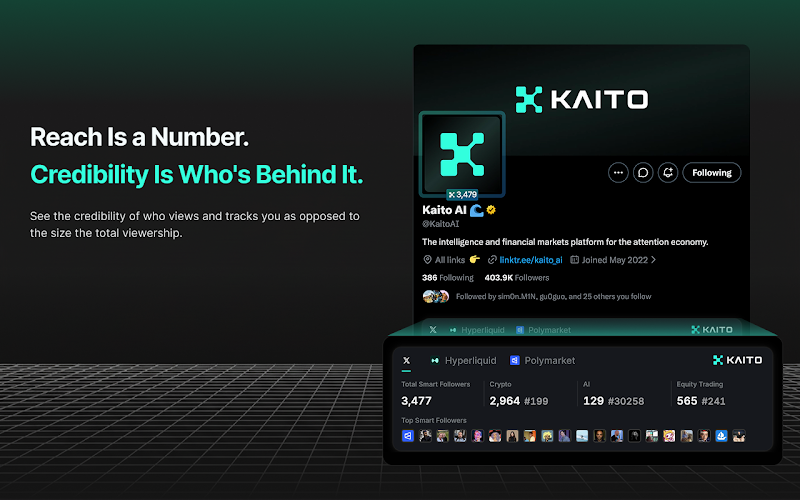
After installing the plugin, users can directly view other users' on-chain activity information within the X timeline, including public trading positions from platforms like Polymarket and Hyperliquid, to better assess whether an account's views align with its actual actions.

By combining social influence with on-chain behavior, Kaito hopes to transform X from a simple information dissemination platform into a social layer that integrates 'opinions, identity, and trading behavior.'

This also represents an upgrade from Yaps to Pulse for Kaito.

Previously, Kaito primarily tracked discussion heat around crypto on X, building content influence leaderboards and incentivizing user participation with KAITO tokens. However, as numerous accounts began mass-producing content, the limitations of measuring influence solely based on discussion volume became increasingly apparent. Therefore, Pulse further incorporates dimensions like content influence, community interaction, and on-chain behavior verification, while introducing a new scoring system called Aura to measure user influence and verified on-chain actions.

Previously, Kaito focused on who generated the most discussion; now, Kaito is more concerned with whose discussion is worth trusting.

Plugin's Excessive Permissions Spark 'Data Collection' Controversy Upon Launch

The launch of Kaito Pulse sparked heated community discussions, with many believing that as market conditions warm up, a new wave of 'Talk-to-Earn economy' is imminent. However, Kaito Pulse also quickly ignited debates within the community regarding privacy and permission overreach.
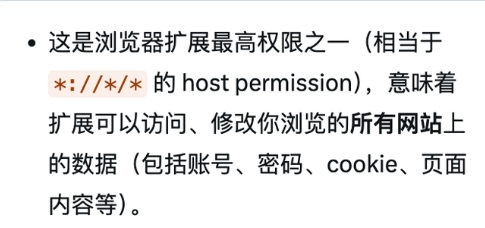
Kaito Pulse Plugin Accused of Multiple Deep Data Collection Behaviors

Ultra posted on X, stating that an analysis of the Pulse plugin code revealed potential involvement in multiple data collection activities, including device fingerprinting, X platform behavior tracking, and third-party account verification.

Among these, device identification is the most concerning issue. Ultra claimed that Kaito Pulse might generate a device fingerprint using information like GPU rendering results, hardware model, and hardware test audio, and link this information to X accounts, affecting anonymity in scenarios involving multi-account users and community matrix accounts.

Besides device information, Ultra also questioned the scope of Kaito Pulse's collection of user X behavior data. The plugin might record certain user behaviors on the X platform, including browsing paths, content dwell time, click behavior, and follow status, and use periodic requests to determine user activity status.

Additionally, third-party account verification is another point of contention. Ultra pointed out that Pulse involves verification processes for ChatGPT, Claude, and multiple trading platform accounts, suggesting these processes might access sensitive user data like subscription status, usage quotas, and trading account information.

Community Divide: Verifying Authenticity or Sacrificing Privacy?

During the Yaps era, Kaito primarily measured influence based on discussion heat on X. However, as mass content production by numerous accounts became more common, the community gradually raised a question: Does high heat equal real influence?

By adding more dimensions like on-chain behavior and external account verification, Kaito Pulse aims to reduce the room for users to gain rankings solely through posting and interaction, making the influence score closer to users' real contributions.

But more verification mechanisms also mean users need to grant more data permissions. Consequently, the community has formed two different views on Kaito Pulse:

  • Supporters argue that a major issue in InfoFi is artificial inflation and false influence, and only by adding identity and behavior verification can a more credible incentive system be built;
  • Skeptics believe platforms should not infinitely expand data collection scope just to improve scoring accuracy, and a new balance must be found between user privacy and incentive rewards.

Official Response to Privacy Controversy: Kaito Pulse Does Not Collect User Raw Data

In response to community skepticism, Kaito founder Yu Hu subsequently addressed the concerns.

Yu Hu stated that Kaito Pulse is designed with the principle of data minimization. The product's goal is not to collect user data but to prove certain identities or behaviors through verification mechanisms under active user authorization.

Regarding concerns about account information, Kaito Pulse does not obtain complete account contents from users nor does it save user raw data. The related processes are mainly used to generate verification results; the platform receives proof information, not the underlying user data.

Addressing the controversy over external account verification, Kaito Pulse uses verification technologies including zkTLS, aiming to allow users to prove they possess certain off-chain identities or behavioral records without exposing raw data.

Simultaneously, Yu Hu acknowledged that the presentation scope of certain permissions might be prone to misunderstanding, and future versions will further optimize permission descriptions and user prompts.

The Next Step for 'Talk-to-Earn Economy': Verifying Influence or Surrendering Privacy?

The debate sparked by Kaito Pulse essentially touches on the unavoidable data dilemma within the InfoFi sector.

In the past, platforms judged an account's value mainly based on follower count, interaction data, and content popularity. However, with the increasing prevalence of AI-generated content, batch accounts, and matrix operations, simple 'discussion volume' has become an increasingly unreliable proxy for genuine influence.

Therefore, Kaito attempts to introduce more verification dimensions, and controversy has followed suit—as platforms seek to further prove 'who you are' and 'whether your views are credible,' the information users need to provide also increases.

For users, installing the plugin to participate in the next wave of the 'Talk-to-Earn economy' also means they need to reconsider: for rankings, points, and potential rewards, how much data are they truly willing to open? Platforms need more data to distinguish real influence from artificial hype; but users also need assurance that this data is genuinely used only for verification and does not become a new digital profile.

Kaito Pulse aims to verify user influence, but as it gains access to more device, behavioral, and account data, Kaito itself has become the subject of scrutiny.


Criptomoedas em alta

Perguntas relacionadas

QWhat is Kaito Pulse, and what is its main purpose?

AKaito Pulse is a browser plugin launched by Kaito AI. Its main purpose is to integrate on-chain identity information into the X (formerly Twitter) timeline. It allows users to view others' on-chain activities, such as public trading positions from platforms like Polymarket and Hyperliquid, to assess if a user's opinions align with their actual market behavior. It aims to evolve X from a simple information platform into a social layer combining 'opinions, identity, and trading behavior'.

QWhat are the main privacy concerns raised by the community regarding the Kaito Pulse plugin?

AThe main privacy concerns raised by the community include: 1. Device fingerprinting: The plugin may collect information like GPU rendering results and hardware models to create a device fingerprint, potentially compromising anonymity for users with multiple accounts. 2. X platform behavior tracking: It may record user actions on X, such as browsing paths, content dwell time, and click behavior. 3. Third-party account verification: The verification process for accounts like ChatGPT, Claude, and trading platforms might access sensitive data such as subscription status and transaction information.

QHow did Kaito's founder, Yu Hu, respond to the privacy controversy surrounding Kaito Pulse?

AYu Hu responded by stating that Kaito Pulse is designed with a principle of data minimization. He clarified that the product's goal is not to collect user data but to generate verification proofs based on user authorization. He emphasized that the plugin does not access or store users' raw data; instead, it only obtains proof of certain identities or actions. He also acknowledged that some permission descriptions might be misleading and promised to optimize user prompts in future versions.

QAccording to the article, how has Kaito's approach to measuring user influence evolved from Yaps to Pulse?

AKaito's approach has evolved from primarily tracking discussion volume and popularity on X (during the Yaps era) to incorporating multiple verification dimensions with Pulse. Previously, Kaito focused on 'who generated the most discussion.' Now, with Pulse and its new Aura scoring system, it aims to assess 'whose discussion is worth believing' by adding factors like content influence, community interaction, and verified on-chain behavior to create a more trustworthy measure of real influence.

QWhat fundamental dilemma does the Kaito Pulse plugin highlight for the InfoFi (Information Finance) sector?

AThe Kaito Pulse plugin highlights the fundamental data dilemma in the InfoFi sector: platforms need more user data (like on-chain activity and verified identities) to distinguish genuine influence from artificial hype or bot-generated content. However, to provide this data, users must surrender more privacy. The core challenge is finding a balance where platforms can verify credibility without excessively expanding data collection, ensuring user data is used solely for verification and not for creating detailed digital profiles without consent.

Leituras Relacionadas

White House Crypto Summit Full Breakdown: Trump Pushes for On-Chain Exchanges to Enter the U.S., September 15 Crypto Regulation Vote is the Real Deadline

White House Crypto Summit: Trump Backs On-Chain Exchange Entry, September 15th Vote is the Deadline On August 19th, former President Trump convened crypto and Wall Street executives at the White House, declaring an end to the "crypto war." He urged Congress to pass a "fair version" of the CLARITY Act by the September 15th deadline, hinted at potential further U.S. Bitcoin purchases, and announced CFTC efforts to bring the decentralized exchange Hyperliquid into the U.S. compliantly. The summit was preceded by an SEC proposal creating new exemptions for crypto asset fundraising and followed the next day by CFTC Chair Selig's stark warning. Selig stated that if Congress fails to pass the CLARITY Act by September 15th, the CFTC will independently write rules to allow registered and some unregistered platforms to offer leveraged trading under its oversight. Trump's endorsement of Hyperliquid triggered a significant market reaction, boosting its token and related stock prices. However, its path to U.S. compliance remains uncertain, potentially involving a hybrid structure with licensed brokers handling front-end operations. The primary hurdle for the CLARITY Act is not its crypto provisions but attached ethics clauses aimed at restricting federal officials, including the President, from profiting from crypto businesses. Industry leaders like Coinbase's Brian Armstrong view the September 15th vote as critical for establishing durable regulatory certainty, while Selig framed congressional action as the only sure defense against future regulatory overreach.

marsbitHá 5m

White House Crypto Summit Full Breakdown: Trump Pushes for On-Chain Exchanges to Enter the U.S., September 15 Crypto Regulation Vote is the Real Deadline

marsbitHá 5m

Is Poland Still a Low-Cost Gateway to the EU CASP Market?

Is Poland still a low-cost gateway to the EU’s Crypto-Asset Service Provider (CASP) regime? As of mid-2026, the answer has fundamentally changed. Poland’s previous light-touch VASP registration system, once an attractive EU entry point, is no longer valid for providing MiCA-regulated services after its transition period ended on July 1, 2026. Furthermore, Poland's domestic legislation implementing MiCA is still undergoing final adjustments, creating uncertainty for direct CASP authorization. This shift means the old logic—choosing Poland primarily for low registration and operational costs—is no longer viable. Under MiCA, a CASP license is no longer a "light" registration, and Poland's current regulatory limbo adds unpredictable delays and risks. For projects seeking EU market access, a more practical strategy is emerging: obtain a MiCA CASP authorization in another EU member state with a stable regulatory framework (e.g., Lithuania, Malta), then use MiCA's passporting rights to serve the Polish market. This approach prioritizes regulatory certainty and EU-wide access over marginal cost savings. Poland remains a significant EU market. It is a viable CASP home country only for projects with a genuine, long-term operational presence there. For others, especially those with teams and clients across Europe, starting the CASP process elsewhere in the EU is now the more efficient and reliable path. The era of using a Polish entity as a cheap, quick EU regulatory foothold is over.

marsbitHá 5m

Is Poland Still a Low-Cost Gateway to the EU CASP Market?

marsbitHá 5m

Trading

Spot

Artigos em Destaque

Como comprar KAITO

Bem-vindo à HTX.com!Tornámos a compra de Kaito (KAITO) simples e conveniente.Segue o nosso guia passo a passo para iniciar a tua jornada no mundo das criptos.Passo 1: cria a tua conta HTXUtiliza o teu e-mail ou número de telefone para te inscreveres numa conta gratuita na HTX.Desfruta de um processo de inscrição sem complicações e desbloqueia todas as funcionalidades.Obter a minha contaPasso 2: vai para Comprar Cripto e escolhe o teu método de pagamentoCartão de crédito/débito: usa o teu visa ou mastercard para comprar Kaito (KAITO) instantaneamente.Saldo: usa os fundos da tua conta HTX para transacionar sem problemas.Terceiros: adicionamos métodos de pagamento populares, como Google Pay e Apple Pay, para aumentar a conveniência.P2P: transaciona diretamente com outros utilizadores na HTX.Mercado de balcão (OTC): oferecemos serviços personalizados e taxas de câmbio competitivas para os traders.Passo 3: armazena teu Kaito (KAITO)Depois de comprar o teu Kaito (KAITO), armazena-o na tua conta HTX.Alternativamente, podes enviá-lo para outro lugar através de transferência blockchain ou usá-lo para transacionar outras criptomoedas.Passo 4: transaciona Kaito (KAITO)Transaciona facilmente Kaito (KAITO) no mercado à vista da HTX.Acede simplesmente à tua conta, seleciona o teu par de trading, executa as tuas transações e monitoriza em tempo real.Oferecemos uma experiência de fácil utilização tanto para principiantes como para traders experientes.

350 Visualizações TotaisPublicado em {updateTime}Atualizado em 2026.06.02

Como comprar KAITO

Discussões

Bem-vindo à Comunidade HTX. Aqui, pode manter-se informado sobre os mais recentes desenvolvimentos da plataforma e obter acesso a análises profissionais de mercado. As opiniões dos utilizadores sobre o preço de KAITO (KAITO) são apresentadas abaixo.

活动图片