CryptoQuant Founder: The Cost to Double BTC Has Increased by 20,000 Times, Where Will the $100 Billion Buying Power Come From?

marsbitPublicado em 2026-07-07Última atualização em 2026-07-07

Resumo

CryptoQuant founder Ki Young Ju analyzes Bitcoin's current capital challenge. He notes that the cryptocurrency market has grown too large for retail-driven momentum alone to generate massive price increases as in past cycles. His calculations show that in 2011, approximately $2.7 million in capital inflow could push BTC's price up by 550x, whereas the current cycle requires an estimated $101 billion in new capital just for a 100% price increase. This shift underscores that sustaining a bull run now depends on attracting large-scale, long-term institutional capital rather than short-term speculative trading. Recent outflows from US spot Bitcoin ETFs, totaling nearly $10 billion since May, highlight the fragility of current demand and challenge the narrative of deep institutional support. While surveys indicate continued institutional interest, these entities prioritize regulated products, risk management, and portfolio integration over speculative gains. For the next significant bull market, Bitcoin must transition to being a core macro asset. The key drivers are no longer just more buyers, but capital allocation from larger, slower-moving entities like wealth advisors, corporate treasuries, banks, and sovereign wealth funds. This new phase pits Bitcoin against other major asset classes like AI for a share of institutional capital, making its growth trajectory dependent on sustained, high-quality inflows from diversified financial balance sheets.

Author: CryptoSlate

Compiled by: Deep Tide TechFlow

Deep Tide Introduction: ETF outflows, institutional wait-and-see, AI capturing investor attention... Bitcoin has grown too large to be moved by retail investors alone. CryptoQuant founder Ki Young Ju did the math: In 2011, $2.7 million could push BTC up 550 times; now, it takes $101 billion to double it. Whether the next bull market arrives depends on whether wealth advisors, corporate treasuries, banks, and sovereign funds are willing to treat BTC as a long-term allocation rather than a short-term trade.

Bitcoin's next major rally may no longer depend on whether investors believe in the asset, but on how much major capital is willing to participate with real money.

The latest analysis from CryptoQuant CEO Ki Young Ju shows that the world's largest cryptocurrency has matured into a market too large to be easily propelled as it was in early cycles. According to him, each bull cycle requires more capital to produce smaller percentage gains, a shift that raises the threshold for another parabolic rally.

This is particularly relevant now as BTC is in a prolonged bear market, having fallen to around $63,000, down 50% from the peak above $126,000 recorded last October.

This pullback tests the institutional adoption that helped push the asset into mainstream portfolios. The core question now is whether Bitcoin can attract enough persistent capital to offset its declining price sensitivity.

A Larger Market Changes the Cycle Math

Bitcoin's early rallies were built on a much smaller base, allowing small amounts of new money to produce massive price changes. This relationship has diminished as the asset has matured.

Ju's analysis compares the growth in Bitcoin's realized capitalization across several bull cycles with the subsequent price gains. Realized capitalization calculates coins at their last on-chain move price, making it a common proxy for the amount of capital absorbed by the network.

Ju said that in the 2011 cycle, roughly $27 million in net capital inflow was associated with a roughly 55,000% price gain.

The current cycle has absorbed about $697 billion, producing about a 689% gain, highlighting how much more capital is needed to generate smaller gains as the asset scales.
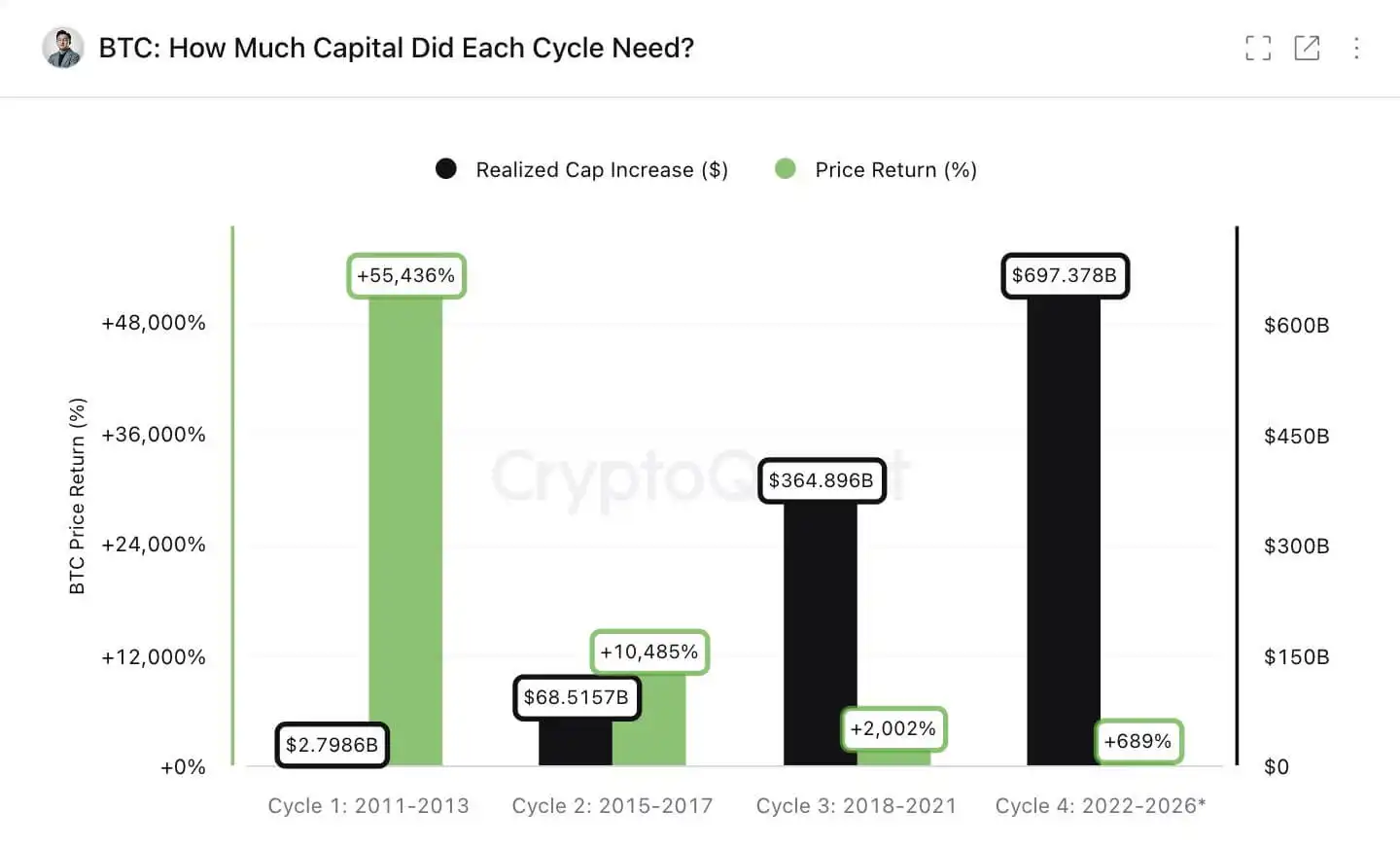
Figure: Bitcoin Price Returns vs Realized Cap Gains

Source: CryptoQuant

The same pattern appears in smaller increments. Ju said that around $5 million in new money was enough to double the Bitcoin price in 2011. In the current cycle, that figure is around $101 billion.

While this doesn't end the bullish thesis around BTC, it changes the type of demand needed to sustain it.

Ju argues another major rally is still possible if Bitcoin becomes a deeper macro allocation. "Bitcoin needs to become a core macro asset," he wrote, adding that the market can no longer rely solely on retail-dominated ETF trading.

This perspective frames Bitcoin's next cycle as a test of financial market integration. Supply shocks from halvings still reduce new issuance, but the growth trajectory increasingly depends on whether capital allocators treat Bitcoin as a recurring portfolio position rather than a tactical trade.

ETF Outflows Weaken the Near-Term Setup

This test arrives as the market's most visible institutional vehicle hits a rough patch.

U.S. spot Bitcoin ETFs helped broaden access following their 2024 launch, offering advisors, hedge funds, and traditional investors a regulated path to the asset. But recent flows have turned negative, undercutting the argument that institutional demand is already deep enough to support another major rally.

Data from Santiment shows nearly $10 billion in outflows from Bitcoin ETFs since early May, with the 12 products currently on an eight-week streak of outflows.

Addressing these numbers, the BTC-focused analytics platform Ecoinometrics said:

"The pattern since May has been very one-sided. Every attempt to rebuild buying momentum almost immediately stalls. Bitcoin ETFs have failed to achieve more than a single day of inflows, while outflow streaks repeatedly last for days, culminating in the longest outflow streak since the ETFs launched."
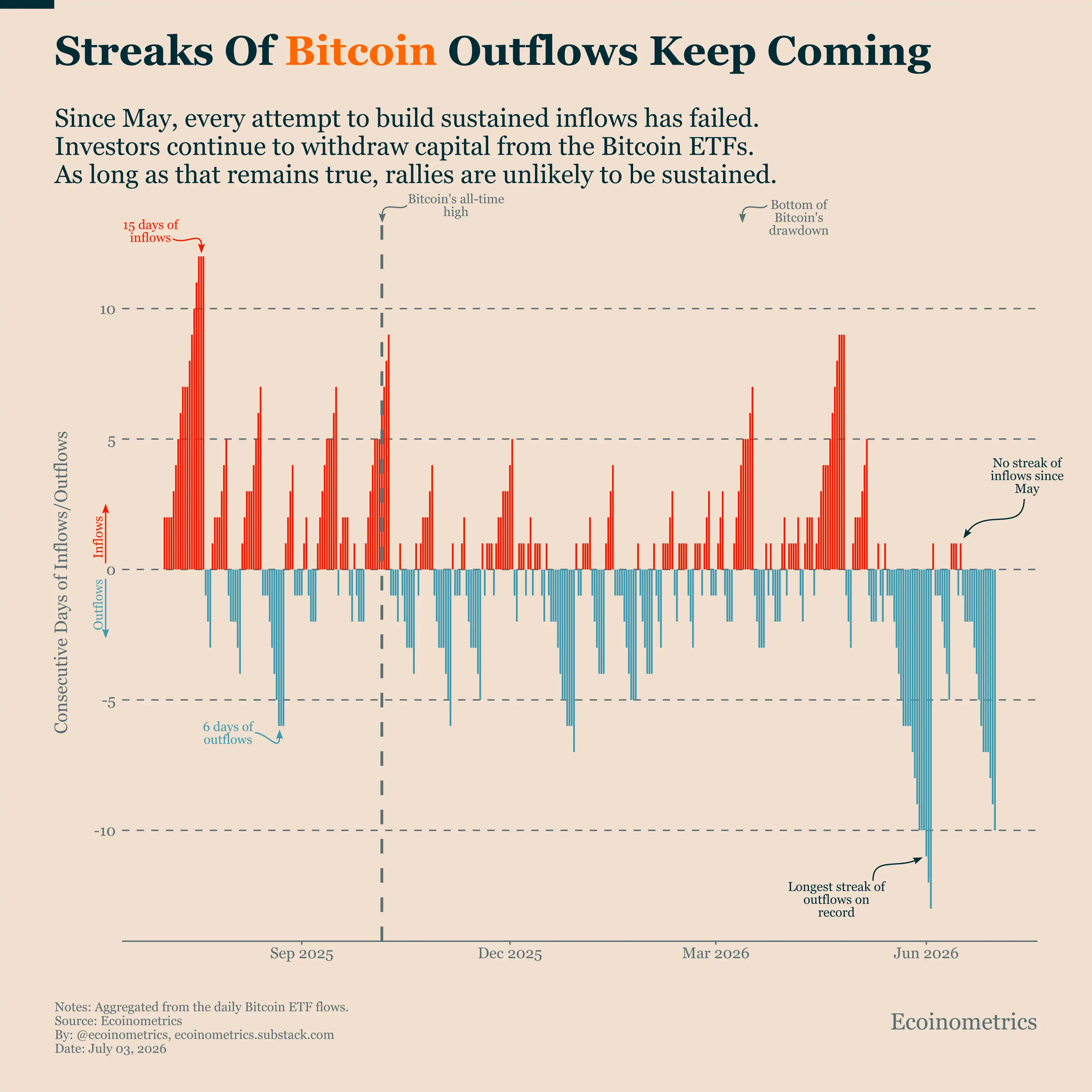
Figure: Bitcoin ETF Outflows

Source: Ecoinometrics

These outflows complicate a rapid return to highs. Bitcoin's October record came during a period when investors were still rewarding ETF access and treating the asset as a beneficiary of friendlier policies, institutional participation, and broader links to global markets.

Now, the ETF weakness suggests access alone is insufficient. The next phase of adoption requires steadier allocations across wealth platforms, model portfolios, corporate balance sheets, and other capital pools that move more slowly than retail traders but can deploy at larger scale.

For Bitcoin, this creates a demand landscape that is higher quality but harder to win. Institutions may bring bigger checks, but they also require liquidity, risk controls, custody standards, portfolio mandates, and compliance approval before allocations become durable.

Institutions Are Still Engaging, But With Stricter Standards

Despite these substantial outflows, survey data from Coinbase suggests institutional interest hasn't vanished.

A January 2026 survey of 351 institutional decision-makers by Coinbase and EY-Parthenon found nearly three-quarters plan to increase crypto allocations, while 74% expect crypto prices to rise in the next 12 months.

The same survey found 49% are placing more emphasis on risk management, liquidity, and position sizing.

This combination matters for Bitcoin's capital problem. Institutions don't approach crypto with the same behaviors that defined early retail-led cycles.

They are more likely to demand regulated products, clear governance, operational resilience, and defined exposure limits.

The survey found 66% of respondents already have exposure through spot crypto ETFs or exchange-traded products, while 81% prefer spot exposure through registered vehicles.

These findings support the view that regulated wrapper products remain central to the next adoption phase.

However, they also show why the recent ETF outflows are a pressure point. If ETFs are the primary institutional on-ramp, sustained weakness in these products could slow the broader allocation process.

Thus, Bitcoin's capital-efficiency problem cuts both ways. Its larger scale may make the asset more acceptable to traditional finance.

But that scale also means marginal buyers must be larger, more consistent, and less speculative than those driving early cycles.

Bitcoin's Next Buyers Must Compete With the Rest of Wall Street

This makes Bitcoin's next cycle dependent on a broader set of investors than the retail traders and crypto-native funds that powered early rallies.

Michael Saylor, executive chairman of MicroStrategy, argues Bitcoin's next decade will be less driven by miner issuance and more by capital flows across financial markets. MicroStrategy is the largest corporate holder of Bitcoin, making Saylor one of the most visible advocates for treating the asset as a balance-sheet tool rather than a speculative trade.

According to him:

"Over the next decade, Bitcoin's trajectory will be less driven by miner issuance and more by capital flows. ETF flows. Corporate treasury flows. Sovereign reserve flows. Banking credit flows. Derivative flows. Insurance flows. Collateral flows. Structured credit flows. Global savings flows. Halvings tighten supply. Capital flows set the growth trajectory. This is the next phase of Bitcoin adoption: not just more buyers, but more balance sheets."

The emphasis is that Bitcoin's supply story is no longer novel. Its issuance schedule is known, halving cycles are understood, and the asset already trades at a scale that requires larger pools of capital to move it meaningfully.

Therefore, any new repricing must come from demand channels capable of absorbing a market valued over $1 trillion.

This means ETF demand is only part of the shift. A stronger cycle may require advisors adding Bitcoin to model portfolios, companies using it more aggressively on balance sheets, banks building credit products around it, insurers and asset managers viewing it as a macro allocation, and sovereign entities considering exposure over time.

This shift may be slower than retail momentum cycles. It will also expose Bitcoin more to rate expectations, regulatory delays, liquidity shocks, and competition with other markets chasing the same institutional capital.

Notably, artificial intelligence has emerged as one of those competitors. AI-related assets and infrastructure have absorbed a significant portion of investor attention this year, with spending and investment forecasts reaching trillions.

In earlier crypto cycles, looser speculative capital might have flowed more easily into Bitcoin. In today's market, Bitcoin must compete for the same pool of institutional capital against AI stocks, private infrastructure deals, credit products, commodities, and other macro trades.

That competition is now at the center of the Bitcoin cycle debate. The asset is large enough to enter mainstream allocation conversations, but that also means it gets compared against every other major capital use.

The views expressed in this article are those of the author alone and do not represent the views of CryptoSlate. Nothing you read on CryptoSlate should be taken as investment advice, nor does CryptoSlate endorse any projects mentioned or linked in this article. Buying and trading cryptocurrencies should be considered a high-risk activity. Please conduct your own due diligence before taking any action related to the content of this article. Finally, CryptoSlate assumes no liability for any losses incurred while trading cryptocurrencies. Please refer to our company disclaimer for more information.


Criptomoedas em alta

Perguntas relacionadas

QAccording to the CryptoQuant founder, how has the capital required to double Bitcoin's price changed from 2011 to the current cycle?

AIn 2011, approximately $5 million in new capital was enough to double Bitcoin's price. In the current cycle, that number has risen to about $101 billion, representing a roughly 20,000-fold increase in the capital efficiency cost for generating the same percentage gain.

QWhat does the article suggest is the new key factor for Bitcoin's next major bull run, as opposed to earlier cycles?

AThe article suggests that Bitcoin's next major bull run depends less on investor belief and more on whether large, institutional capital (like wealth advisors, corporate treasuries, banks, and sovereign funds) is willing to make Bitcoin a long-term portfolio allocation, rather than engaging in short-term trading.

QWhat recent trend in U.S. Bitcoin ETFs complicates the argument for immediate institutional-driven price appreciation?

ASince early May, U.S. spot Bitcoin ETFs have experienced nearly $10 billion in net outflows, marking their longest streak of consecutive weekly outflows since launch. This sustained weakness suggests that mere access to regulated products is insufficient and that deeper, more stable institutional allocations are needed.

QAccording to Michael Saylor, what will drive Bitcoin's trajectory in the next decade, replacing the previous dominant factor?

AMichael Saylor states that Bitcoin's trajectory in the next decade will be less driven by miner issuance and more driven by capital flows from various sources, including ETF flows, corporate treasury flows, sovereign reserve flows, bank credit flows, and global savings flows.

QWhat new competitive challenge does Bitcoin face in attracting institutional capital, as mentioned in the article?

ABitcoin now faces significant competition for institutional capital from other major sectors, particularly Artificial Intelligence (AI). AI-related assets and infrastructure are absorbing a large portion of investor attention and capital, forcing Bitcoin to compete for the same pool of institutional funds.

Leituras Relacionadas

Why 2026 could redefine Ethereum, Solana, Base and Avalanche

Blockchain infrastructure is undergoing a major coordinated transformation, driven by institutional demand for reliability, compliance, and predictable settlement. Over $30 billion in Real-World Assets (RWA) on-chain has exposed network weaknesses. Major blockchains are responding with foundational upgrades, moving beyond incremental speed improvements. Ethereum's "Glamsterdam" upgrade, planned for H1 2026, will significantly increase gas limits and introduce features like PBS (pre-blocked state) for enhanced settlement and parallel execution. Solana's "Alpenglow," targeting a mainnet launch in H2 2026, focuses on reducing finality time dramatically and freeing network resources to improve reliability. Beyond speed, compliance is critical. Base's "Beryl" upgrade in Q3 2026 will introduce a standardized, regulatory-compliant token framework (B20). Avalanche's "Octane" upgrade aims to boost transaction processing and reduce costs for enterprise applications. Even Bitcoin is evolving with the potential activation of OP_CAT by late 2026/early 2027. The competition is shifting. While technical upgrades are widespread, institutions will ultimately allocate capital based on proven execution, operational resilience, and regulatory compatibility during market stress. Ethereum currently leads in tokenized assets, while networks like Base and Solana are strengthening their institutional offerings. The blockchain that best delivers reliable, compliant, and uninterrupted service is poised to attract the greatest share of future institutional capital.

ambcryptoHá 12m

Why 2026 could redefine Ethereum, Solana, Base and Avalanche

ambcryptoHá 12m

Tiger Research: Take RWA Tokenization Overseas First

This article discusses the strategic choices facing financial institutions in jurisdictions lacking mature regulatory frameworks for Real-World Asset (RWA) tokenization. With the market growing rapidly, institutions must choose between waiting for local legislation, using regulatory sandboxes, or—the recommended priority—expanding into overseas markets to gain early experience. Successfully launching cross-border RWA tokenization requires meticulous preparation across six key areas: establishing an overseas base (e.g., Hong Kong, Singapore, the U.S.), securing necessary licenses, defining the tokenized asset (with bonds being simpler than non-standard assets), defining the target investor scope, deciding on settlement currencies/payment flows, and designing operational requirements like custody and on-chain governance. The article outlines two primary strategic paths: a direct "onshore" path and a "native on-chain" path. The direct path involves setting up a legal entity and obtaining licenses in a mature jurisdiction like Hong Kong, Singapore, or the U.S., leveraging existing platforms (e.g., DigiFT, Securitize) for efficiency. The alternative native on-chain path involves partnering with compliant, decentralized platforms (e.g., Ondo, Plume Nest) that use structures like offshore SPVs to facilitate tokenization and access DeFi liquidity, offering speed and broader reach but with greater structural complexity. The core argument is that institutions should not wait for perfect domestic regulation. A detailed hypothetical case study illustrates the multi-step, 6-12 month process of launching an overseas tokenized bond. The key takeaway is that the essence of a tokenization business lies not in the technology but in successfully executing the entire sales and operational process. The market is moving forward, and the time to act is now.

marsbitHá 23m

Tiger Research: Take RWA Tokenization Overseas First

marsbitHá 23m

Trading

Spot

Artigos em Destaque

O que é BITCOIN

Compreender o HarryPotterObamaSonic10Inu (ERC-20) e a Sua Posição no Espaço Cripto Nos últimos anos, o mercado de criptomoedas assistiu a um aumento na popularidade das moedas meme, cativando não apenas os traders, mas também aqueles que procuram envolvimento comunitário e valor de entretenimento. Entre estes tokens únicos está o HarryPotterObamaSonic10Inu (ERC-20), um projeto intrigante que mistura referências culturais no tecido das criptomoedas. Este artigo explora os principais aspetos do HarryPotterObamaSonic10Inu, examinando os seus mecanismos, a sua ética orientada pela comunidade e o seu envolvimento com o vasto panorama cripto. O que é o HarryPotterObamaSonic10Inu (ERC-20)? Como o nome sugere, o HarryPotterObamaSonic10Inu é uma moeda meme construída na blockchain Ethereum, classificada sob o padrão ERC-20. Ao contrário das criptomoedas tradicionais, que podem enfatizar a utilidade prática ou o potencial de investimento, este token prospera no valor de entretenimento e na força da sua comunidade. O projeto visa promover um ambiente onde utilizadores envolvidos possam reunir-se, partilhar ideias e participar em atividades inspiradas por diversos fenómenos culturais. Uma característica notável do HarryPotterObamaSonic10Inu é a zero taxa sobre transações. Este elemento atraente visa encorajar a negociação e o envolvimento da comunidade, isento de encargos adicionais que podem desencorajar os traders de pequena escala. A oferta total da moeda está fixada em mil milhões de tokens, uma cifra que marca a sua intenção de manter uma circulação substancial dentro da comunidade. Criador do HarryPotterObamaSonic10Inu (ERC-20) As origens do HarryPotterObamaSonic10Inu estão um pouco envoltas em mistério; os detalhes sobre o criador permanecem desconhecidos. O desenvolvimento deste token carece de uma equipa identificável ou de um plano explícito, o que não é raro no setor das moedas meme. Em vez disso, o projeto surgiu de forma orgânica, com o seu progresso a depender fortemente do entusiasmo e da participação da sua comunidade. Investidores do HarryPotterObamaSonic10Inu (ERC-20) No que diz respeito a investimentos externos e apoios, o HarryPotterObamaSonic10Inu também permanece ambíguo. O token não lista quaisquer fundações de investimento conhecidas ou apoio organizacional significativo. Em vez disso, o “sangue vital” do projeto é a sua comunidade de base, que informa o seu crescimento e sustentabilidade através da ação coletiva e do envolvimento no espaço cripto. Como Funciona o HarryPotterObamaSonic10Inu (ERC-20)? Como uma moeda meme, o HarryPotterObamaSonic10Inu opera principalmente fora dos quadros tradicionais que muitas vezes governam o valor dos ativos. Existem vários aspetos distintivos que definem como o projeto funciona: Transações Sem Taxas: Sem taxas sobre transações, os utilizadores podem comprar e vender o token livremente, sem a preocupação de custos ocultos. Envolvimento da Comunidade: O projeto prospera na interação da comunidade, aproveitando plataformas de redes sociais para criar entusiasmo e facilitar a participação. Discussões, partilha de conteúdo e envolvimento são elementos cruciais que ajudam a expandir o seu alcance e a fomentar a lealdade entre os apoiantes. Sem Utilidade Prática: Deve ser notado que o HarryPotterObamaSonic10Inu não oferece utilidade concreta dentro do ecossistema financeiro. Em vez disso, é classificado como um token principalmente para entretenimento e atividades comunitárias. Referência Cultural: O token incorpora de forma inteligente elementos da cultura popular para atrair interesse, conectando-se tanto com entusiastas de memes como com seguidores de criptomoedas. HarryPotterObamaSonic10Inu exemplifica como as moedas meme operam de forma diferente de projetos de criptomoedas mais tradicionais, entrando no mercado como construções sociais inovadoras em vez de ativos utilitários. Linha do Tempo do HarryPotterObamaSonic10Inu (ERC-20) A história do HarryPotterObamaSonic10Inu é marcada por vários marcos notáveis: Criação: O token surgiu de um meme viral, capturando a imaginação de muitos entusiastas de criptomoedas. Datas específicas de criação não estão disponíveis, sublinhando a sua ascensão orgânica. Listagem em Exchanges: O HarryPotterObamaSonic10Inu conseguiu entrar em várias exchanges, permitindo um acesso e negociação mais fáceis pela comunidade. Iniciativas de Envolvimento da Comunidade: Atividades contínuas direcionadas a melhorar a interação comunitária, incluindo concursos, campanhas em redes sociais e geração de conteúdo por fãs e defensores. Planos de Expansão Futura: O roteiro do projeto inclui o lançamento de uma coleção de NFTs, mercadorias e um site de eCommerce relacionado aos seus temas culturais, envolvendo ainda mais a comunidade e tentando adicionar mais dimensões ao seu ecossistema. Pontos-Chave sobre o HarryPotterObamaSonic10Inu (ERC-20) Natureza Orientada pela Comunidade: O projeto prioriza a contribuição coletiva e a criatividade, assegurando que o envolvimento dos utilizadores está na vanguarda do seu desenvolvimento. Classificação como Moeda Meme: Representa o epítome da criptomoeda baseada em entretenimento, destacando-se dos veículos de investimento tradicionais. Sem Afiliação Direta com o Bitcoin: Apesar da semelhança no nome do ticker, o HarryPotterObamaSonic10Inu é distinto e não tem qualquer relação com o Bitcoin ou outras criptomoedas estabelecidas. Foco na Colaboração: O HarryPotterObamaSonic10Inu é projetado para criar um espaço de colaboração e partilha de histórias entre os seus detentores, proporcionando uma via para a criatividade e o fortalecimento da comunidade. Perspectivas Futuras: A ambição de expandir além da sua premissa inicial para NFTs e mercadorias delineia um caminho para o projeto potencialmente entrar em avenidas mais mainstream dentro da cultura digital. À medida que as moedas meme continuam a capturar a imaginação da comunidade cripto, HarryPotterObamaSonic10Inu (ERC-20) destaca-se devido aos seus laços culturais e abordagem centrada na comunidade. Embora possa não se encaixar no molde típico de um token orientado para utilidade, a sua essência reside na alegria e camaradagem fomentadas entre os seus apoiantes, destacando a natureza em evolução das criptomoedas em uma era cada vez mais digital. À medida que o projeto continua a desenvolver-se, será importante observar como as dinâmicas comunitárias influenciam a sua trajetória no panorama em constante mudança da tecnologia blockchain.

1.7k Visualizações TotaisPublicado em {updateTime}Atualizado em 2024.12.03

O que é BITCOIN

Como comprar BTC

Bem-vindo à HTX.com!Tornámos a compra de Bitcoin (BTC) simples e conveniente.Segue o nosso guia passo a passo para iniciar a tua jornada no mundo das criptos.Passo 1: cria a tua conta HTXUtiliza o teu e-mail ou número de telefone para te inscreveres numa conta gratuita na HTX.Desfruta de um processo de inscrição sem complicações e desbloqueia todas as funcionalidades.Obter a minha contaPasso 2: vai para Comprar Cripto e escolhe o teu método de pagamentoCartão de crédito/débito: usa o teu visa ou mastercard para comprar Bitcoin (BTC) instantaneamente.Saldo: usa os fundos da tua conta HTX para transacionar sem problemas.Terceiros: adicionamos métodos de pagamento populares, como Google Pay e Apple Pay, para aumentar a conveniência.P2P: transaciona diretamente com outros utilizadores na HTX.Mercado de balcão (OTC): oferecemos serviços personalizados e taxas de câmbio competitivas para os traders.Passo 3: armazena teu Bitcoin (BTC)Depois de comprar o teu Bitcoin (BTC), armazena-o na tua conta HTX.Alternativamente, podes enviá-lo para outro lugar através de transferência blockchain ou usá-lo para transacionar outras criptomoedas.Passo 4: transaciona Bitcoin (BTC)Transaciona facilmente Bitcoin (BTC) no mercado à vista da HTX.Acede simplesmente à tua conta, seleciona o teu par de trading, executa as tuas transações e monitoriza em tempo real.Oferecemos uma experiência de fácil utilização tanto para principiantes como para traders experientes.

4.2k Visualizações TotaisPublicado em {updateTime}Atualizado em 2026.06.02

Como comprar BTC

O que é $BITCOIN

OURO DIGITAL ($BITCOIN): Uma Análise Abrangente Introdução ao OURO DIGITAL ($BITCOIN) OURO DIGITAL ($BITCOIN) é um projeto baseado em blockchain que opera na rede Solana, com o objetivo de combinar as características dos metais preciosos tradicionais com a inovação das tecnologias descentralizadas. Embora partilhe um nome com o Bitcoin, frequentemente referido como “ouro digital” devido à sua percepção como uma reserva de valor, o OURO DIGITAL é um token separado projetado para criar um ecossistema único dentro da paisagem Web3. O seu objetivo é posicionar-se como um ativo digital alternativo viável, embora os detalhes sobre as suas aplicações e funcionalidades ainda estejam em desenvolvimento. O que é o OURO DIGITAL ($BITCOIN)? OURO DIGITAL ($BITCOIN) é um token de criptomoeda explicitamente projetado para uso na blockchain Solana. Em contraste com o Bitcoin, que fornece um papel amplamente reconhecido como armazenamento de valor, este token parece focar em aplicações e características mais amplas. Aspectos notáveis incluem: Infraestrutura Blockchain: O token é construído na blockchain Solana, conhecida pela sua capacidade de lidar com transações de alta velocidade e baixo custo. Dinâmicas de Oferta: O OURO DIGITAL tem um fornecimento máximo limitado a 100 quatrilhões de tokens (100P $BITCOIN), embora os detalhes sobre o seu fornecimento circulante ainda não tenham sido divulgados. Utilidade: Embora as funcionalidades precisas não estejam explicitamente delineadas, existem indicações de que o token poderia ser utilizado para várias aplicações, potencialmente envolvendo aplicações descentralizadas (dApps) ou estratégias de tokenização de ativos. Quem é o Criador do OURO DIGITAL ($BITCOIN)? Neste momento, a identidade dos criadores e da equipa de desenvolvimento por trás do OURO DIGITAL ($BITCOIN) permanece desconhecida. Esta situação é típica entre muitos projetos inovadores no espaço da blockchain, particularmente aqueles alinhados com finanças descentralizadas e fenómenos de moedas meme. Embora tal anonimato possa fomentar uma cultura orientada pela comunidade, intensifica as preocupações sobre governança e responsabilidade. Quem são os Investidores do OURO DIGITAL ($BITCOIN)? As informações disponíveis indicam que o OURO DIGITAL ($BITCOIN) não tem apoiantes institucionais conhecidos ou investimentos proeminentes de capital de risco. O projeto parece operar num modelo peer-to-peer focado no apoio e adoção da comunidade, em vez de rotas de financiamento tradicionais. A sua atividade e liquidez estão principalmente situadas em exchanges descentralizadas (DEXs), como a PumpSwap, em vez de plataformas de negociação centralizadas estabelecidas, destacando ainda mais a sua abordagem de base. Como Funciona o OURO DIGITAL ($BITCOIN) A mecânica operacional do OURO DIGITAL ($BITCOIN) pode ser elaborada com base no seu design de blockchain e nas características da rede: Mecanismo de Consenso: Ao aproveitar o exclusivo proof-of-history (PoH) da Solana combinado com um modelo de proof-of-stake (PoS), o projeto assegura uma validação eficiente das transações, contribuindo para o alto desempenho da rede. Tokenomics: Embora mecanismos deflacionários específicos não tenham sido extensivamente detalhados, o vasto fornecimento máximo de tokens implica que pode atender a microtransações ou casos de uso de nicho que ainda estão por definir. Interoperabilidade: Existe o potencial para integração com o ecossistema mais amplo da Solana, incluindo várias plataformas de finanças descentralizadas (DeFi). No entanto, os detalhes sobre integrações específicas permanecem não especificados. Cronologia de Eventos Chave Aqui está uma cronologia que destaca marcos significativos relacionados ao OURO DIGITAL ($BITCOIN): 2023: O lançamento inicial do token ocorre na blockchain Solana, marcado pelo seu endereço de contrato. 2024: O OURO DIGITAL ganha visibilidade ao tornar-se disponível para negociação em exchanges descentralizadas como a PumpSwap, permitindo que os utilizadores o negociem contra SOL. 2025: O projeto testemunha atividade de negociação esporádica e potencial interesse em envolvimentos liderados pela comunidade, embora não tenham sido documentadas parcerias ou avanços técnicos notáveis até ao momento. Análise Crítica Forças Escalabilidade: A infraestrutura subjacente da Solana suporta altos volumes de transações, o que pode aumentar a utilidade do $BITCOIN em vários cenários de transação. Acessibilidade: O potencial preço de negociação baixo por token pode atrair investidores de retalho, facilitando uma participação mais ampla devido a oportunidades de propriedade fracionada. Riscos Falta de Transparência: A ausência de apoiantes, desenvolvedores ou um processo de auditoria publicamente conhecidos pode gerar ceticismo em relação à sustentabilidade e confiabilidade do projeto. Volatilidade do Mercado: A atividade de negociação depende fortemente do comportamento especulativo, o que pode resultar em volatilidade significativa dos preços e incerteza para os investidores. Conclusão O OURO DIGITAL ($BITCOIN) surge como um projeto intrigante, mas ambíguo, dentro do ecossistema em rápida evolução da Solana. Embora tente aproveitar a narrativa do “ouro digital”, a sua divergência do papel estabelecido do Bitcoin como reserva de valor sublinha a necessidade de uma diferenciação mais clara da sua utilidade pretendida e estrutura de governança. A aceitação e adoção futuras dependerão provavelmente da abordagem da atual opacidade e da definição mais explícita das suas estratégias operacionais e económicas. Nota: Este relatório abrange informações sintetizadas disponíveis até outubro de 2023, e desenvolvimentos podem ter ocorrido além do período de pesquisa.

121 Visualizações TotaisPublicado em {updateTime}Atualizado em 2025.05.13

O que é $BITCOIN

Discussões

Bem-vindo à Comunidade HTX. Aqui, pode manter-se informado sobre os mais recentes desenvolvimentos da plataforma e obter acesso a análises profissionais de mercado. As opiniões dos utilizadores sobre o preço de BTC (BTC) são apresentadas abaixo.

活动图片