Top Trader Explains the Logic Behind Bitcoin's Surge: What Is the Market Actually Trading?

marsbitPublicado em 2026-08-25Última atualização em 2026-08-25

Resumo

Summary: On August 19th, the U.S. Treasury announced an increase in its long-term bond repurchase program from $2 billion to at least $4 billion. While the direct scale is small relative to the overall market, the move triggered a decline in long-term Treasury yields and a weaker dollar, with Bitcoin subsequently breaking above $70,000. In an interview, Arthur Hayes argues this Bitcoin rally is not primarily driven by internal crypto regulatory news (like the CLARITY Act), but by a shift in macro expectations regarding U.S. liquidity policy. Hayes interprets the Treasury's timing—acting as long-term yields hit multi-decade highs—as a signal that policymakers are sensitive to rising financing costs. He posits that Bitcoin acts as a "pressure release valve" for global liquidity shifts. The market is not trading the $4 billion repurchase itself, but the *expectation* of further, more aggressive interventions (like yield curve control or Fed balance sheet expansion) should long-term interest rates continue to rise threateningly. His logic follows a chain: unsustainable U.S. debt requires stable Treasury market function; if yields rise too high, policymakers will intervene to provide liquidity; increased dollar liquidity ultimately benefits scarce assets like Bitcoin. Hayes speculates on more extreme scenarios, such as foreign central banks selling Treasuries back to the Fed via facilities like FIMA Repo, further expanding liquidity. The key takeaway is that Bitcoin's price ac...

Editor's Note: On August 19, the U.S. Treasury Department announced that, starting September 9, it would increase the single liquidity support repurchase ceiling for 10- to 30-year long-term Treasury bonds from $2 billion to at least $4 billion. While the scale of this policy is not large relative to the more than $30 trillion U.S. Treasury market, following the announcement, long-term U.S. bond yields quickly fell back, the dollar weakened, and Bitcoin broke through $70,000 again.

This rebound has thus spawned two interpretations. One attributes it to Trump's push for crypto market structure legislation, while the other argues that what truly changed market pricing was the U.S. Treasury's demonstrated policy sensitivity to rising long-term interest rates. In other words, investors might not be trading the $4 billion repurchase itself, but rather speculating on what actions the Treasury and the Fed might take if Treasury yields continue to rise.

Arthur Hayes, in an interview with Altcoin Daily, chose the latter explanation. In his view, Bitcoin acts as a 'pressure release valve' for changes in global liquidity: when the market begins to worry that the U.S. will take measures such as larger-scale repurchases, expansion of the Federal Reserve's balance sheet, or even yield curve control to lower long-term financing costs, scarce assets will once again attract buying.

Related Reading: Arthur Hayes' Latest Interview: ETH to $30,000; FLOP Will Surpass ETH

This remains a macro narrative with a distinct personal stance. The Treasury emphasizes that the goal of the repurchases is to improve the market liquidity of long-term Treasuries, not to directly release currency; the Fed has also not announced yield curve control. Whether Hayes's judgment holds ultimately depends on whether repurchases continue to expand in scale, whether long-term interest rates approach the policy pressure interval again, and whether the Fed actually expands its balance sheet.

Below is a compiled and translated summary of key information from the original text:

On August 19, the U.S. Treasury Department announced it would increase the single liquidity support repurchase size for 10- to 20-year and 20- to 30-year nominal coupon-bearing Treasury securities from a maximum of $2 billion to at least $4 billion. The new arrangement will take effect on September 9 and last until November 4.

Before the announcement, the yield on the U.S. 30-year Treasury bond once rose to about 5.34%, hitting a new high since 2007; after the announcement, long-term U.S. bond yields retreated by about 10 basis points, and the dollar weakened simultaneously. Bitcoin subsequently broke through $70,000, the first time since June, and related crypto stocks also rose broadly.

In the Altcoin Daily interview, Arthur Hayes argued that the core clue to Bitcoin's rise lies not within the crypto industry itself, but in the U.S. Treasury bond market.

$4 Billion Is Not Huge; The Market Is Trading The Policy Signal

The U.S. Treasury's increase in single long-term bond repurchase size from $2 billion to at least $4 billion is itself insufficient to significantly alter the supply-demand structure of the Treasury market. Hayes also acknowledges this is not a number large enough to directly create massive liquidity.

He is more concerned with the timing of the repurchase expansion announcement.

After long-term Treasuries faced selling pressure and the 30-year yield climbed to a nearly two-decade high, the Treasury quickly increased its repurchase efforts. In Hayes's view, this demonstrates to the market the policy establishment's 'pain point' regarding long-term interest rates: when yield increases begin to threaten government financing costs and financial market stability, the Treasury may adopt more proactive interventions.

'The size is not staggering, but it is a signal,' Hayes said.

The Treasury's official definition of this operation is 'liquidity support repurchase,' primarily used to repurchase older, less liquid securities to improve Treasury market trading conditions. It is not equivalent to Federal Reserve quantitative easing and does not necessarily increase the net amount of dollars in the market.

Therefore, more accurately, the repurchase announcement does not directly prove that the U.S. has restarted 'money printing,' but it strengthens a market expectation: if long-term interest rates continue to spiral out of control, policy tools may escalate further.

Hayes's Bitcoin Logic: From Treasury Pressure to Liquidity Expansion

Hayes views Bitcoin as the most direct 'pressure release valve' when central banks expand the money supply.

His logic can be broken down into three steps: U.S. debt and interest payments are continuously increasing, and the Treasury needs to maintain the financing capacity of the Treasury market; if long-term Treasuries lack buyers and yields continue to rise, policymakers may use expanded repurchases or other tools to stabilize the market; once these operations ultimately lead to an increase in dollar liquidity, Bitcoin, with its fixed supply, will become a potential beneficiary.

Under this framework, Bitcoin's rise does not stem from the $4 billion repurchase directly flowing into the crypto market, but from investors front-running the possibility of a more accommodative liquidity environment in the future.

Hayes believes the real focus should be on yield curve control. This refers to policymakers maintaining Treasury yields near target levels by purchasing bonds of specific maturities, among other methods. The U.S. is not currently implementing this policy, but Hayes judges that if long-term yields continue to rise, the market will increase expectations for implicit or explicit yield control.

He further stated that once the market confirms the Fed will massively expand its balance sheet, Bitcoin could quickly enter the 'hundreds of thousands of dollars' range. He predicts Bitcoin could rise to around $126,000 by year-end; if policy clearly turns towards yield curve control, it might surge towards $500,000 even faster.

A More Aggressive Scenario: Foreign Holders Selling, The Fed Buying

Compared to Treasury repurchases, Hayes pays more attention to the FIMA Repo Facility, or the 'Foreign and International Monetary Authorities Repo Facility.'

This facility allows eligible foreign central banks and international institutions to obtain dollar liquidity from the Federal Reserve, using their held U.S. Treasuries as collateral. Hayes speculates that countries like Japan and in Europe may need to sell some U.S. assets in the future, repatriating funds to their own countries for fiscal, defense, and social spending. If major foreign holders of U.S. Treasuries shift from buyers to sellers, long-term Treasury yields may face further pressure.

In his envisioned scenario, the U.S. might expand the FIMA Repo Facility, allowing foreign official institutions to exchange Treasuries for dollars, then sell dollars and buy back their own currencies in the foreign exchange market. This could both alleviate direct selling pressure in the Treasury market and potentially absorb some liquidity demand through the Fed's balance sheet expansion.

However, this part is mainly Hayes's speculation on future policy paths. Existing public information does not confirm that the Fed will remove transaction limits for the FIMA tool, much less announce using it to unlimitedly absorb U.S. Treasuries sold by foreign investors.

Therefore, the 'unlimited money printing' Hayes mentions has not yet occurred. It represents the extreme scenario he believes policy may ultimately head towards.

Why Is Bitcoin More Important Than Regulatory Tailwinds?

In the interview, Altcoin Daily also asked about the impact of U.S. crypto market structure legislation on the market. Hayes was cautious in his evaluation, even suggesting that the CLARITY Act is not important for Bitcoin's price.

The CLARITY Act seeks to clarify whether digital assets are securities or commodities and delineate the regulatory authority between the U.S. Securities and Exchange Commission and the Commodity Futures Trading Commission. For companies needing to raise funds, issue tokens, and operate trading businesses in the U.S., clear regulatory boundaries indeed hold practical significance.

But Hayes argues that Bitcoin, having operated since 2009, does not rely on the U.S. establishing a specialized regulatory framework for it. Compared to Congress passing a crypto bill, how the U.S. Treasury and Fed handle debt, interest rates, and dollar liquidity has a more direct impact on Bitcoin's valuation.

This judgment also explains his attribution of this rally. Trump's push for the CLARITY Act and the Treasury's repurchase expansion happened almost simultaneously; both could have improved market sentiment. But Hayes believes the variable that truly caused Bitcoin's rapid rebound is investors starting to reassess the U.S. policy establishment's tolerance for long-term interest rates.

Reuters cited analyst views stating that the Treasury's operation is relatively limited in scale, and its relief for the bond market is also relatively short-lived; however, against a backdrop of narrow recent trading ranges and accumulated short positions, this signal triggered short-covering in the crypto market, amplifying price gains.

This means Bitcoin's recent rise can be explained by multiple factors: the decline in U.S. bond yields reduced the opportunity cost for risk assets, dollar weakness improved the liquidity environment, regulatory news boosted industry expectations, and short covering amplified short-term volatility. Attributing all gains solely to the Treasury repurchase similarly risks overestimating the impact of a single event.

What to Watch Next: Long-Term Bond Yields Around 5%

The core observation indicator Hayes provides is not Bitcoin's technical chart, but U.S. long-term Treasury bond yields.

He believes recent policy reactions indicate the U.S. Treasury has become more sensitive to the rapid rise in long-term yields. If the 10-year yield approaches 5% and the 30-year yield challenges highs again, the market will observe whether the Treasury continues to expand repurchases and whether the Fed introduces new liquidity tools.

If repurchase sizes continue to increase, the Fed's balance sheet expands again, and the dollar continues to weaken, Hayes's liquidity trading framework will be strengthened. Bitcoin may then continue to be viewed as a scarce asset hedging against monetary expansion and sovereign debt risk.

Conversely, if long-term yields fall back on their own, repurchases remain at the level of liquidity management, and the Fed does not expand its balance sheet, then interpreting the $4 billion repurchase as a prelude to yield curve control may be an over-interpretation.

Therefore, the core question this interview truly discusses is not whether Bitcoin will reach $126,000 or $500,000 by year-end. The core question Hayes raises is: when the Treasury market once again approaches the policy pressure interval, will the U.S. allow long-term interest rates to rise freely, or will it use more liquidity to stabilize the market?

Bitcoin is already front-running the second possibility.

[Video Link]

Perguntas relacionadas

QAccording to the article, what are the two main explanations given for Bitcoin's recent price rebound above $70,000?

AThe article presents two explanations: one attributes the rebound to Trump pushing for crypto market structure legislation, while the other attributes it to the market's reaction to the U.S. Treasury's policy sensitivity toward rising long-term interest rates, signaled by its increase of long-term bond buybacks.

QWhat is the core logic Arthur Hayes uses to connect U.S. Treasury actions to Bitcoin's price movement?

AArthur Hayes' core logic is that Bitcoin acts as a 'pressure release valve' for global liquidity changes. He argues that if rising long-term Treasury yields threaten U.S. government financing and financial stability, policymakers may intervene with tools like expanded buybacks or yield curve control, which could increase dollar liquidity. This expectation of future monetary expansion benefits scarce assets like Bitcoin.

QWhat specific U.S. Treasury policy announcement from August 19th is discussed as a potential catalyst for the market move?

AThe article discusses the U.S. Treasury's announcement on August 19th to increase the maximum size of single-operation buybacks for 10-to-30-year Treasury securities from $2 billion to at least $4 billion, effective from September 9th.

QWhy does Arthur Hayes believe the CLARITY Act (crypto market structure legislation) is less important for Bitcoin's price than Treasury/Fed actions?

AHayes believes Bitcoin has operated since 2009 without a specific U.S. regulatory framework. He argues that how the U.S. Treasury and Federal Reserve handle debt, interest rates, and dollar liquidity has a more direct impact on Bitcoin's valuation than Congress passing a crypto-specific bill, as it affects the fundamental monetary environment.

QWhat does Hayes identify as the key indicator to watch for validating his macro thesis on Bitcoin's future price direction?

AHayes identifies U.S. long-term Treasury yields, specifically around the 5% level for the 10-year yield and highs for the 30-year yield, as the key indicator. He states that if yields approach these levels again, the market will watch for whether the Treasury expands buybacks further or if the Fed introduces new liquidity tools, which would support his thesis of coming monetary expansion benefiting Bitcoin.

Leituras Relacionadas

Zcash's ETF Gilding: How a Privacy Coin Was Packaged by Wall Street into a Compliant Asset

The article traces the decade-long path of Zcash (ZEC), a privacy-focused cryptocurrency, to its potential launch as the first privacy coin spot ETF, with Grayscale's ZCSH filing in August 2026. It argues ZEC's suitability stemmed not from regulatory acceptance of its privacy technology, but from its centralized, institutional structure from inception—a commercial company (ECC) with venture capital backing and a Founder's Reward—making it easier to package than decentralized alternatives. Three key institutions, intertwined in a network, drove the process: Grayscale (owned by DCG, an early ZEC investor), which had held ZEC in a trust since 2017; Coinbase, providing custody, prime brokerage, derivatives, and venture investment; and ZODL, a new for-profit entity formed in 2026 when ECC's core development team split from the non-profit foundation. The major regulatory hurdle was SEC scrutiny (2023-2026) over ZEC's historical structure, which resembled an unregistered investment contract due to automatic block rewards to ECC and the Foundation. This was resolved through governance changes (NU6 upgrade in 2024) that ended direct funding and shifted control to community voting, coinciding with a broader shift in SEC enforcement policy. Notably, the law firm Davis Polk represented both the Zcash Foundation in its SEC defense and Grayscale in the ETF filing. The push is also driven by DCG's dire financial needs amid Genesis bankruptcy lawsuits, seeking high-fee products (the ZEC ETF charges 2.5%). Concurrently, major mining operations by entities like Cypherpunk Technologies (backed by Winklevoss Capital) and DCG's Fortitude Mining expanded, motivated by profitability and aiming to influence the network. The article concludes with irony: to become a compliant ETF asset, ZEC must shed its core privacy feature for the fund's holdings, which will be held in transparent, auditable addresses. Wall Street is not adopting privacy technology but packaging the *concept* of privacy into a tradable, fee-generating financial product. The transformation was not a single master plan but the result of a network of aligned interests capitalizing on regulatory, governance, and market shifts over ten years.

marsbitHá 8m

Zcash's ETF Gilding: How a Privacy Coin Was Packaged by Wall Street into a Compliant Asset

marsbitHá 8m

Bitcoin Core Developer Warns That Bitcoin Payments Are Disappearing at 'Bitcoin Beach'

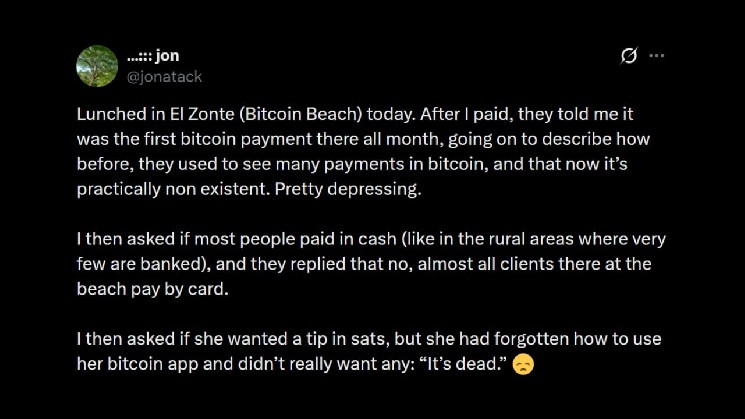
A Bitcoin Core developer, John Atack, who has lived in El Salvador since 2022, shared a concerning anecdote about Bitcoin adoption in the country. While dining at El Zonte, a region known as "Bitcoin Beach," he paid with Bitcoin and was told it was the first such payment the establishment had received in a month. Staff explained Bitcoin payments, once common, have now virtually disappeared, with nearly all customers using cards. An employee even declined a Bitcoin tip, stating she had forgotten how to use her wallet and declaring "It's already dead." Atack emphasized this was a single observation but noted the employee had witnessed the payment evolution over three years. His comments sparked mixed reactions. Some disputed his experience, with one user confirming successful Bitcoin payments in the same area. However, Bitcoin reporter Juan Galt acknowledged an underlying "economic problem," arguing that expecting price appreciation makes using Bitcoin for everyday transactions counterintuitive to economic incentives needed for a circular crypto economy. Despite the concerning report, Atack also reflected that El Salvador remains a global leader in cryptocurrency adoption and progressive legislation, sometimes causing locals to take these advancements for granted. The story highlights the ongoing challenges of mainstream Bitcoin adoption for daily commerce, even in pioneering nations.

cryptonews.ruHá 10m

Bitcoin Core Developer Warns That Bitcoin Payments Are Disappearing at 'Bitcoin Beach'

cryptonews.ruHá 10m

A Huge 'Sleeping' Wave of New Bitcoin Buyers Has Not Even Bought Bitcoin Yet

A recent study by the Federal Reserve Bank of Cleveland, titled "Do You Even Crypto, Bro? Cryptocurrencies in Household Finance," reveals that Bitcoin and other crypto assets are less understood than other financial assets in US households. The primary reasons for not owning crypto are a lack of knowledge and the perception that it is a poor investment. Even among owners, the main motivations are profit-seeking and portfolio diversification rather than an understanding of the underlying technology's benefits, such as independence from banks. The research found that showing respondents Bitcoin's past 12-month performance increased their desired portfolio allocation by about 47%, indicating investment decisions are driven more by recent returns than fundamental comprehension. Crypto gains are often treated like lottery winnings, leading to one-off luxury purchases rather than sustained increases in spending. While non-owners largely view crypto as high-risk, owners are somewhat less likely to do so, though they exhibit greater uncertainty about future returns compared to traditional assets like stocks or gold. This ambiguity about Bitcoin's nature and valuation contributes directly to its price volatility. The study concludes that this volatility will persist, but education efforts combined with price appreciation could convert today's uninformed non-owners into future Bitcoin holders.

cryptonews.ruHá 13m

A Huge 'Sleeping' Wave of New Bitcoin Buyers Has Not Even Bought Bitcoin Yet

cryptonews.ruHá 13m

Grain Prices Haven't Taken Off Yet, So Why Have Fertilizer Prices Risen First?

Fertilizer prices are rising ahead of a potential global food price surge, driven primarily by supply-side constraints rather than current agricultural demand. While a strong El Niño is forecast for late 2026, its impact is expected to be initially limited to specific crops like palm oil and rubber, not leading to immediate, broad-based grain shortages. The fertilizer market is currently propelled by its own dynamics: **Urea** faces domestic oversupply in China, with its price reliant on the potential to export to higher-priced international markets. **Phosphate fertilizers** are experiencing a rare "supply-led" cycle due to global sulfur shortages, shipping disruptions, and production cuts overseas, placing Chinese producers with integrated resources and export channels in a key position. **Potash** supply is tightening due to planned maintenance and production cuts at major global producers, underpinning its long-term resource scarcity narrative. Looking ahead to 2027, a prolonged El Niño could shift the market into a second phase of "demand-supply resonance." If extreme weather significantly impacts crop yields and global grain inventories, rising food prices and farmer income would boost fertilizer application demand. This potential demand surge, layered onto the existing supply constraints, could amplify the price cycle. The overarching theme is that **food security is redefining the strategic value of fertilizers**, particularly for resource-constrained phosphate and potash. Policy priorities balancing domestic supply guarantees with export opportunities, coupled with resource ownership and global supply chain access, are becoming critical determinants of profitability beyond short-term weather cycles.

marsbitHá 16m

Grain Prices Haven't Taken Off Yet, So Why Have Fertilizer Prices Risen First?

marsbitHá 16m

Trading

Spot
活动图片