Single-Day Plunge of 30%, Arthur Hayes Suddenly Liquidates: Why Did ZEC Get Exploded by Security Issues?

foresightnews_apiPublicado em 2026-06-05Última atualização em 2026-06-05

Resumo

On June 5th, Zcash founder Zooko Wilcox disclosed a critical soundness vulnerability in the project's latest Orchard privacy pool. This flaw, found in the elliptic curve multiplication constraints, could allow an attacker to create unlimited counterfeit ZEC within the shielded pool, with transactions appearing valid. The vulnerability was discovered in late May by security researcher Taylor Hornby, who utilized Anthropic's new Opus 4.8 AI model for a targeted audit. The Zcash ecosystem had already performed an emergency network upgrade to patch the issue. However, the detailed disclosure triggered severe market panic, causing ZEC's price to plummet over 30% in a single day. Notably, prominent investor Arthur Hayes announced he had sold his entire ZEC position following the news. The incident starkly challenges the "technological trust" narrative central to privacy coins. Despite years of top-tier cryptographic audits, the bug persisted until uncovered with advanced AI-assisted research. This highlights the growing gap between theoretical perfection and practical implementation in privacy technology. The event serves as a industry-wide warning: in an AI-driven security landscape, the assumption that "undiscovered equals safe" is obsolete. It underscores the urgent need for continuous, proactive security practices combining AI audits, formal verification, and rapid response mechanisms.


Author: Ma He, Foresight News


On June 5th, Zcash founder Zooko Wilcox, along with Jason McGee and Taylor Hornby, published a detailed article disclosing a critical soundness vulnerability in the project's latest privacy layer, the Orchard pool, which could be exploited to create an unlimited amount of counterfeit ZEC in a covert environment.
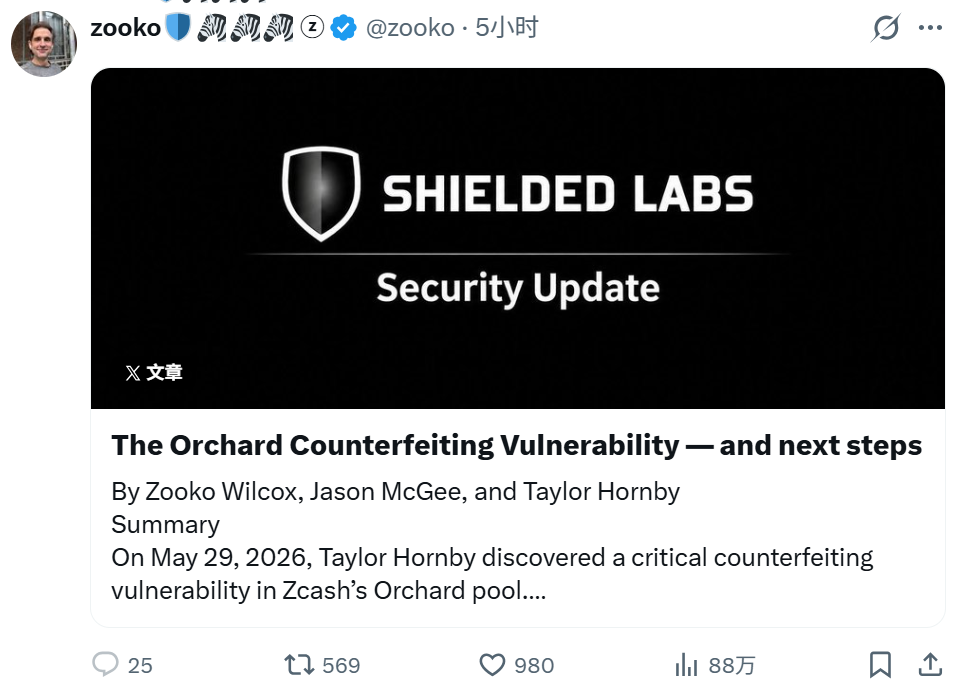


Although the Zcash ecosystem had already urgently completed a network upgrade to fix the issue, after the detailed impact was disclosed, ZEC's price experienced severe volatility, with a single-day drop exceeding 30% at one point, touching lows around $411.
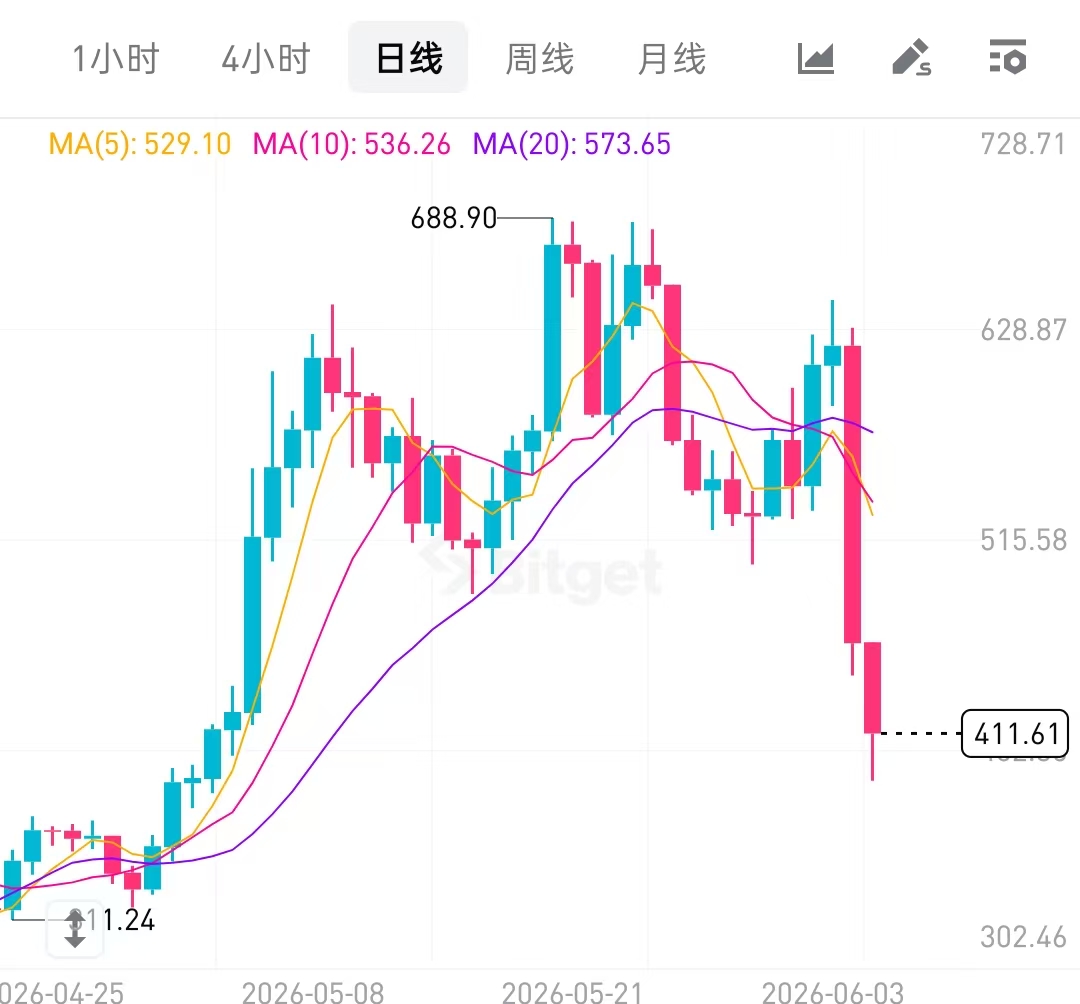


Zcash has been the absolute star in the privacy coin track over the past six months, surging from around $200 in March this year to a peak of $688. Figures including AllianceDAO co-founder Wang Qiao, Bankless founder David Hoffman, and the "shilling king" Arthur Hayes have all expressed high optimism about its performance.


However, after the vulnerability was discovered, Arthur Hayes tweeted that he had sold his entire ZEC holdings. He stated that after reading the vulnerability details and observing ZEC's 30% pullback, he decided to completely close his position for profit. He mentioned he would continuously re-evaluate and, if subsequent evidence proved his assumptions wrong, would consider buying back at lower prices.


So, what exactly happened with Zcash?


In simple terms, Orchard is a privacy vault within Zcash that is "completely opaque" to the outside; after people deposit funds, neither the outside world nor the blockchain itself knows how much money is inside or who owns it. The vulnerability this time lies in the vault's "verification lock"—this lock was supposed to be extremely rigorous, allowing only legitimate transactions to pass verification. However, due to a loosely written mathematical constraint (akin to a loose gear in the lock), an attacker could forge a key that appears completely legitimate, trick the system, and create new ZEC out of thin air within the vault.


This incident directly challenges the narrative of the privacy coin track that "technological trust is core value."


As the earliest public chain to scale the application of zk-SNARKs for private transactions, Zcash's Orchard pool, activated with the NU5 upgrade in May 2022, has been regarded as a more efficient evolution of the Sapling pool, hosting a large amount of private funds. Now, vulnerabilities discovered by security researchers using the latest AI models are forcing the entire industry to re-examine the gap between privacy technology theory and practice.


Vulnerability Discovery Originated from AI-Assisted Audit


The discovery process of the vulnerability was dramatic.


In April 2026, Shielded Labs hired senior security engineer Taylor Hornby to conduct ongoing security research targeting the Zcash protocol, aiming to discover issues before malicious actors.


On May 28th, Anthropic released the Opus 4.8 model. The next day, Taylor used this model combined with traditional methods to conduct a highly targeted review of the Orchard circuit, discovering the issue: an insufficient constraint in elliptic curve multiplication within the halo2_gadgets crate, allowing attackers to input arbitrary false values into the multiplication operation while verification would still pass. This meant it was possible to construct seemingly fully valid Orchard actions—that is, generate counterfeit ZEC within the Orchard pool, and due to privacy features, on-chain differentiation between real and fake was impossible.


Taylor immediately disclosed the issue to ZODL core engineers, who confirmed the severity of the vulnerability within hours and initiated an emergency response.


The foundation's initial security announcement tried to downplay the severity, describing it as a "double-spend risk," and assured that the "rotation mechanism protected the total supply from inflation," attempting to use "total supply security" to stabilize market sentiment and conceal the harsh reality that the Orchard pool might have already been flooded with counterfeit coins, diluting honest users' assets.


By June 4th, founder Zooko's statement supplemented the fatal details. He candidly admitted that "cryptographically, it is impossible to prove whether the vulnerability had been exploited before the fix," and publicly disclosed the "possibility of infinite ZEC forgery." It was this frank admission by the founder that directly punctured the "safety illusion" maintained by the foundation earlier, triggering the market's panic sell-off.


Zooko


Because if an attacker had, over the past few years, already used the vulnerability to mint 1 million fake ZEC inside the Orchard pool and cashed out by withdrawing to the transparent pool via the rotation mechanism before the fix, the total supply indeed didn't inflate, but the real assets of users within the Orchard pool had already been evaporated and harvested in a targeted manner. Once the rotation limits are announced next week, the Orchard pool will face the largest "bank run" in the history of privacy blockchains, with the assets of users who retreat later being permanently locked.


In the AI Era, "Unfound Vulnerability Equals Security" No Longer Holds True


Orchard, since its activation in 2022, underwent years of security audits by top cryptographers yet still contained bugs, only discovered through targeted research combined with the latest AI tools. This serves as a warning for many privacy solutions (including other ZK privacy projects): theoretically "perfect" mathematical constructs may still have omissions in engineering implementation.


Taylor Hornby's use of Anthropic Opus 4.8 to pinpoint the Orchard flaw in an extremely short time proves that AI can be a powerful aid for white-hat researchers, but also implies that attackers can similarly use similar tools to mine high-value targets faster.


If project teams fail to establish continuous, proactive security review mechanisms, the window from vulnerability discovery to malicious exploitation will shrink dramatically. While Zcash gained the upper hand this time by proactively investing in security research,


for the entire crypto industry, this is more like a collective warning: in the AI-driven security offense and defense race, any reliance on the侥幸心理 of "safe because undiscovered for years" is no longer valid. Only by internalizing AI auditing, formal verification, and rapid response capabilities as standard practices can privacy protocols truly withstand the pressure tests of the new era.

Criptomoedas em alta

Leituras Relacionadas

The Verdict in Choi Tae-won's Divorce Case: Revealing the Inheritance Undercurrent Behind SK Hynix's Trillion-Won Empire

SK Group Chairman Chey Tae-won's high-profile divorce case, involving a record 1.38 trillion won settlement, has drawn attention to the succession plans for Korea's second-largest conglomerate, especially its crown jewel, SK hynix. Unlike traditional chaebol scripts centered on the eldest son, Chey's three children from his marriage to former President Roh Tae-woo's daughter, Roh Soh-yeong, are carving distinct, non-traditional paths. Eldest daughter Chey Yun-jung (b. 1989) is seen as the most evident successor. With a scientific and consulting background, she holds executive roles at SK bioscience and SK Inc.'s growth support department, focusing on future strategy and biopharma. Her marriage is to an AI infrastructure entrepreneur, not a traditional business alliance. Second daughter Chey Min-jung (b. 1991) took a unique route, voluntarily serving as a South Korean naval officer, including an anti-piracy deployment. She later worked on policy and strategy for SK hynix in Washington D.C. before co-founding an AI-driven healthcare startup. She married a former U.S. Marine Corps officer, connecting her to U.S. defense and policy circles—networks crucial for a global semiconductor giant. The only son, Chey In-geun (b. 1995), who studied physics like his father, worked briefly at SK E&S before joining McKinsey. Despite fitting the traditional "heir" profile as the eldest son, he remains silent and holds no public position or shares in SK, suggesting the old succession playbook is obsolete. As SK hynix's valuation soars, becoming a geopolitical asset in the AI era, the heirs' legitimacy is no longer automatic. They must prove themselves in fields like AI biotech, global policy, and strategic consulting. Their marriages also reflect new elite networks in tech and defense, not old political alliances. Their inheritance is the complex challenge of navigating a globalized, tech-driven world, not just a corporate throne.

marsbit2 dias atrás 09:06

The Verdict in Choi Tae-won's Divorce Case: Revealing the Inheritance Undercurrent Behind SK Hynix's Trillion-Won Empire

marsbit2 dias atrás 09:06

From OpenSea to OpenRouter: Is Alex Atallah Repeating His 'Exit at the Peak' Playbook?

From OpenSea to OpenRouter: Is Alex Atallah Repeating His "Exit at the Peak" Playbook? According to the Wall Street Journal, payments giant Stripe is in talks to acquire the AI model aggregation platform OpenRouter in a potential deal valuing the company near $100 billion. This would mark founder Alex Atallah's second creation of a company reaching a $100 billion valuation, following his co-founding of NFT marketplace OpenSea. OpenRouter, founded just over three years ago, has grown rapidly by acting as a unified gateway for developers to access over 400 AI models. It currently has about 10 million users and processes over 200 trillion tokens monthly. While the platform's annualized revenue is around $50 million, its valuation has skyrocketed from $1.3 billion in March 2026. The potential acquisition by Stripe, a company OpenRouter's founder once likened it to, represents a major expansion into AI infrastructure for the payments leader. This move echoes Atallah's previous timing with OpenSea, where he departed before the NFT market's significant downturn. For OpenRouter, selling now may be strategic. Despite its scale, its business model—charging a 5-5.5% fee on AI inference calls—faces pressure from competition, open-source models, and potential price wars among model providers, limiting its profitability narrative for an IPO. A key asset for potential acquirers like Stripe is OpenRouter's vast repository of real-world AI usage data, which offers unique insights into model performance and developer preferences that are difficult to replicate. Whether this potential deal signifies a new valuation benchmark for AI infrastructure or another market peak signal remains to be seen.

链捕手2 dias atrás 08:42

From OpenSea to OpenRouter: Is Alex Atallah Repeating His 'Exit at the Peak' Playbook?

链捕手2 dias atrás 08:42

Trading

Spot

Artigos em Destaque

Como comprar ZEC

Bem-vindo à HTX.com!Tornámos a compra de Zcash (ZEC) simples e conveniente.Segue o nosso guia passo a passo para iniciar a tua jornada no mundo das criptos.Passo 1: cria a tua conta HTXUtiliza o teu e-mail ou número de telefone para te inscreveres numa conta gratuita na HTX.Desfruta de um processo de inscrição sem complicações e desbloqueia todas as funcionalidades.Obter a minha contaPasso 2: vai para Comprar Cripto e escolhe o teu método de pagamentoCartão de crédito/débito: usa o teu visa ou mastercard para comprar Zcash (ZEC) instantaneamente.Saldo: usa os fundos da tua conta HTX para transacionar sem problemas.Terceiros: adicionamos métodos de pagamento populares, como Google Pay e Apple Pay, para aumentar a conveniência.P2P: transaciona diretamente com outros utilizadores na HTX.Mercado de balcão (OTC): oferecemos serviços personalizados e taxas de câmbio competitivas para os traders.Passo 3: armazena teu Zcash (ZEC)Depois de comprar o teu Zcash (ZEC), armazena-o na tua conta HTX.Alternativamente, podes enviá-lo para outro lugar através de transferência blockchain ou usá-lo para transacionar outras criptomoedas.Passo 4: transaciona Zcash (ZEC)Transaciona facilmente Zcash (ZEC) no mercado à vista da HTX.Acede simplesmente à tua conta, seleciona o teu par de trading, executa as tuas transações e monitoriza em tempo real.Oferecemos uma experiência de fácil utilização tanto para principiantes como para traders experientes.

363 Visualizações TotaisPublicado em {updateTime}Atualizado em 2026.06.02

Como comprar ZEC

Discussões

Bem-vindo à Comunidade HTX. Aqui, pode manter-se informado sobre os mais recentes desenvolvimentos da plataforma e obter acesso a análises profissionais de mercado. As opiniões dos utilizadores sobre o preço de ZEC (ZEC) são apresentadas abaixo.

活动图片