BTC Market Pulse: Week 50

insights.glassnodePublicado em 2025-12-08Última atualização em 2025-12-08

Resumo

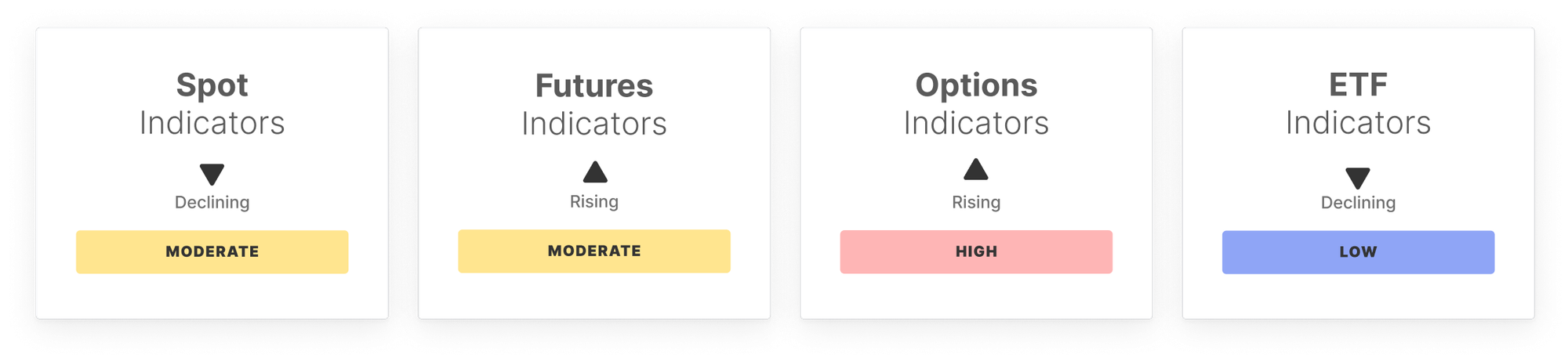
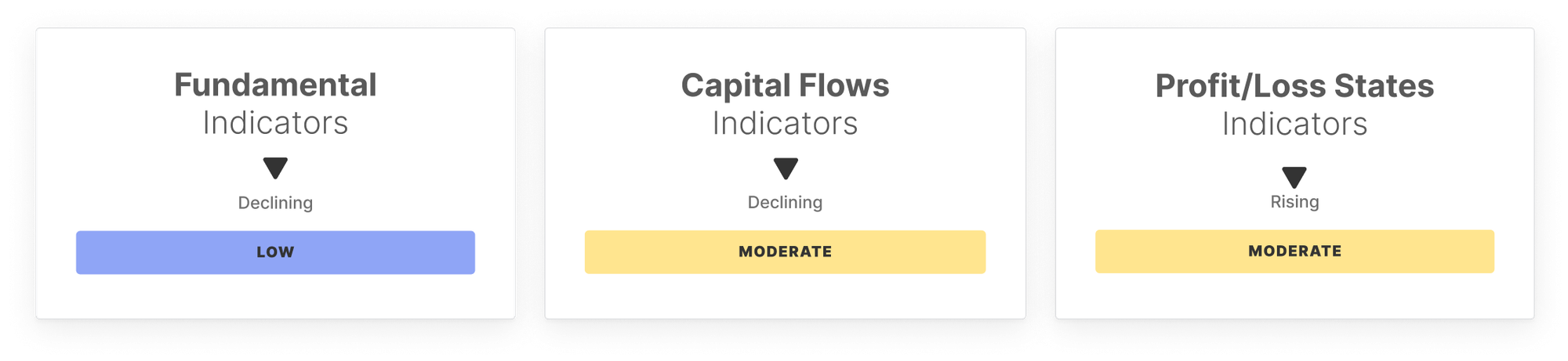
BTC's market pulse showed mixed signals in Week 50. Momentum strengthened as the 14-day RSI rose to 58.2 and spot volume increased 13.2% to $11.1B. However, Spot CVD weakened significantly, indicating stronger underlying sell pressure. Derivatives remained cautious with lower futures open interest and mixed options sentiment, including a high demand for downside protection. ETF flows turned negative, shifting from a $134.2M inflow to a $707.3M outflow, suggesting profit-taking or reduced institutional interest. Despite this, ETF trade volume rose 21.33% and ETF MVRV increased, pointing to higher holder profitability and potential distribution.

Momentum firmed as the 14-day RSI climbed from 38.6 to 58.2, while spot volume rose 13.2 percent to $11.1B. However, Spot CVD weakened from -$40.8M to -$111.7M, pointing to stronger underlying sell pressure.

Derivatives remained cautious. Futures open interest fell to $30.6B, perpetual CVD improved slightly, and funding turned more supportive with long-side payments up to $522.7K. Options showed mixed sentiment: steady OI at $46.3B, a sharply negative volatility spread at -14.6 percent, and a high 25-delta skew at 12.88 percent, indicating demand for downside protection.

ETF flows added a clear headwind. Netflows flipped from a $134.2M inflow to a $707.3M outflow, signalling profit-taking or softer institutional interest. Yet ETF trade volume rose 21.33 percent to $22.6B, and ETF MVRV increased to 1.67, pointing to higher holder profitability and some potential for distribution..

Off-Chain Indicators
On-Chain Indicators
🔗 Access the full report in PDF

Don't miss it!

Smart market intelligence, straight to your inbox.

Subscribe now
  • Follow us and reach out on X
  • Join our Telegram channel
  • For on-chain metrics, dashboards, and alerts, visit Glassnode Studio

Disclaimer: This report does not provide any investment advice. All data is provided for information and educational purposes only. No investment decision shall be based on the information provided here and you are solely responsible for your own investment decisions.

Exchange balances presented are derived from Glassnode’s comprehensive database of address labels, which are amassed through both officially published exchange information and proprietary clustering algorithms. While we strive to ensure the utmost accuracy in representing exchange balances, it is important to note that these figures might not always encapsulate the entirety of an exchange’s reserves, particularly when exchanges refrain from disclosing their official addresses. We urge users to exercise caution and discretion when utilizing these metrics. Glassnode shall not be held responsible for any discrepancies or potential inaccuracies.

Please read our Transparency Notice when using exchange data.
Leituras Relacionadas

Why Can HashKey Become Hong Kong's 'First Crypto Stock'?

HashKey, a licensed Virtual Asset Trading Platform (VATP) in Hong Kong, has passed the listing hearing of the Hong Kong Stock Exchange (HKEX) and is poised to become the city’s first listed crypto-native company. Its Post-Hearing Information Pack (PHIP) reveals key aspects of its business, compliance, and governance. A major strength lies in its global multi-jurisdictional regulatory compliance, with licenses in financial hubs including Hong Kong, Singapore, Japan, Bermuda, the UAE, and Ireland. This allows it to operate across borders while adhering to local regulations. The platform emphasizes strong technical and internal controls: 96.9% of user assets are stored in cold wallets, customer funds are segregated, and multi-signature approval processes are implemented. It has also developed HashKey Chain, a compliant Ethereum Layer-2 network designed for institutional use, particularly in tokenized securities, which embeds regulatory requirements at the protocol level. HashKey Holdings is incorporated in Cayman Islands and has established a corporate governance structure aligned with HKEX standards, including a board with independent directors and a fully independent audit committee. Its potential listing is seen as a significant milestone, demonstrating that Web3 businesses can operate within regulatory frameworks. It also reflects Hong Kong’s supportive stance toward virtual asset innovation. However, ongoing compliance across multiple regions entails high and continuous operational and legal costs.

marsbitHá 1h

Why Can HashKey Become Hong Kong's 'First Crypto Stock'?

marsbitHá 1h

The Crisis Behind Silver's Surge: When the Paper System Begins to Fail

Silver has emerged as the star performer in the precious metals market, with its price surging nearly 110% year-to-date, far outpacing gold's 60% gain. This dramatic rise, driven by seemingly rational factors like Fed rate cut expectations and strong industrial demand from solar, EVs, and AI, masks a deeper and more dangerous reality. The core of the crisis lies in the market's structure. Unlike gold, which is backed by central bank purchases, silver is an "island asset" with almost no official reserves and a much smaller, less liquid market. Its daily trading volume is a fraction of gold's. The rally is increasingly fueled by a futures market squeeze, where paper contracts (derivatives, ETFs) vastly outweigh physical metal. This has created a dangerous inversion where futures prices trade at a persistent premium to spot—a sign of potential market manipulation or a short squeeze. A major red flag is the surge in physical silver withdrawals from key exchanges like COMEX, LBMA, and Shanghai. Investors are increasingly demanding physical delivery, distrusting the "paper silver" system. This has led to plunging exchange inventories, exposing the system's fragility: a small physical base supports a massive pyramid of paper claims. Suspicions of market manipulation are heightened by the dominant role of JPMorgan, which holds nearly half of COMEX silver inventory and is the custodian for a major silver ETF. While no wrongdoing is proven, its immense influence over both physical supply and paper markets places it at the center of the volatility. Ultimately, the silver surge signals a broader crisis of confidence in financialized paper assets. A global shift is underway from financial instruments to physical possession, a movement driven by de-dollarization and a quest for certainty. The rules of the game are changing: when the music stops, only those holding real metal will have a seat.

marsbitHá 2h

The Crisis Behind Silver's Surge: When the Paper System Begins to Fail

marsbitHá 2h

Trading

Spot
Futuros
活动图片