Crude Oil Surges 10% in Intraday Trading! US Military Restores Blockade on Iran, Trump Warns of 'Heavy Blows' Tonight and Tomorrow, Imposes 20% Fee on Strait Shipping

marsbitPublicado em 2026-07-14Última atualização em 2026-07-14

Resumo

Crude oil prices surged up to 10% intraday as tensions between the US and Iran escalated sharply. President Trump announced the reinstatement of a maritime blockade against Iran, targeting its ships and their customers, while stating the Strait of Hormuz would remain open to all other nations. He further declared that the US, as the "guardian" of the strait, would impose a 20% fee on all cargo transiting the strategic waterway to compensate for security costs. The US Central Command confirmed the naval blockade would commence on July 14 (GMT). Following Trump's statements, reports emerged of explosions near Iran's Larak Island and the port of Bandar Abbas, though Iranian authorities did not confirm their nature. Iran's Foreign Minister criticized the proposed 20% fee as excessive, asserting Iran's role as the guardian of the strait. An Iranian military spokesperson warned of a strong response to any unauthorized US interference in the waterway. The United Nations' International Maritime Organization (IMO) expressed opposition to charging tolls for passage through international straits, stating such measures lack legal foundation. Market reactions were pronounced, with Brent crude briefly surpassing $83 and WTI above $78. The situation intensified as Trump notified Congress of renewed hostilities with Iran, following US airstrikes on Iranian targets.

Authors: Li Dan, Li Jia

The situation between the US and Iran has escalated abruptly, with transit risks through the Strait of Hormuz sharply rising, leading to a robust rebound in international crude oil futures.

According to Xinhua News Agency, US President Trump stated on Monday the 13th that he is restoring a maritime blockade on Iran. According to CCTV News, Trump posted on his social media platform on Monday, saying the Strait of Hormuz is currently open and will remain open regardless of Iran's involvement. The US will reinstate "blockade measures against Iran," targeting only Iranian vessels or their clients, restricting their access to the strait, while all other countries can use the strait fairly and openly. He also stated that the US will impose a 20% fee on all goods transported through here, with the relevant procedures and deployment to commence immediately.

In his social media post, Trump framed this fee as "compensation" for the US acting as the guardian of the strait. He wrote: "From now on, the United States will be regarded as the 'Guardian of the Strait of Hormuz'; as the guardian, and in the spirit of 'fairness,' the US will impose a 20% fee on all transported goods to compensate for the necessary expenditures required to maintain the security and safety of this turbulent region of the world."

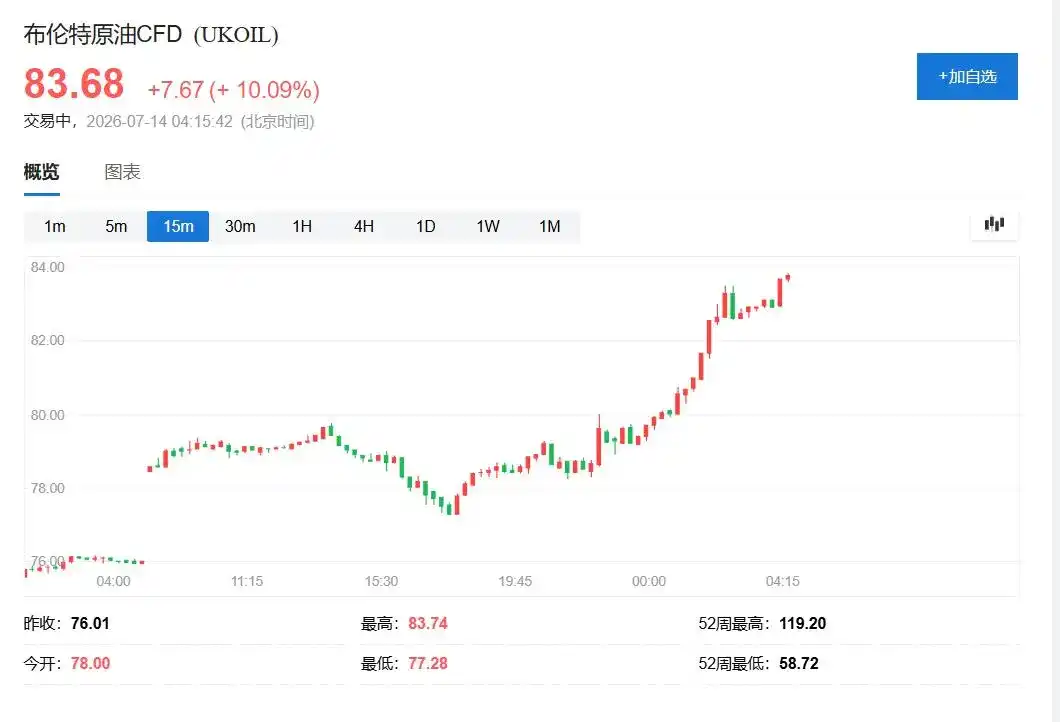
After Trump's post during early US stock market hours on Monday, international crude oil prices rose further, with WTI crude breaking above $75, expanding its intraday gain to 5%, and Brent crude approaching the $80 mark, also up nearly 5%; the US Dollar Index and Treasury yields rose in tandem, the S&P 500 extended its decline to 0.5%, while spot gold plummeted nearly 3%.

During the US stock market's lunch hour, the US Central Command confirmed that US forces would begin the maritime blockade on Iran at 4:00 PM EST on Tuesday, July 14, which is 4:00 AM Beijing time on Wednesday. International crude oil gains expanded to nearly 10%. Iranian Foreign Minister Araghchi stated that Trump's proposed 20% fee for the Strait of Hormuz was "too much" and added that Iran has always been the guardian of the Strait of Hormuz.

During the US stock market's late trading hours, according to Iranian media Tasnim, explosions were heard on Iran's Larak Island, located in the Strait of Hormuz, and explosions were also reported in the southern Iranian ports of Bandar Abbas and Konarak. Subsequently, CCTV reported that on the evening of the 13th local time, four explosions were heard east of Bandar Abbas port. After the US market closed, CCTV reported at around 2:00 AM local time on the 14th that three more explosions were heard in Bandar Abbas port. Iranian authorities have not confirmed the nature of the explosions.

During late US trading, after the news about explosions in the mentioned Iranian areas was released, international crude oil maintained gains of around 9%. After the US market closed on Monday, Trump stated that the US would deliver "heavy blows" to Iran tonight and tomorrow. Crude oil remained high, with Brent crude up over 10% compared to Friday's close.

Later, Trump claimed that he believed an Iran deal might be reached. He said, "I want 'compensation' for the Strait of Hormuz. The US is providing protection for shipping in the Strait of Hormuz and will receive compensation from countries that have benefited from US assistance."
After the US market closed on Monday, according to Xinhua citing Iran's Fars News Agency on Monday the 13th, a US MQ-1 drone was shot down by Iran's Islamic Revolutionary Guard Corps (IRGC) air defense system late that night over the Strait of Hormuz. Earlier on Monday, the US Central Command revealed on social media that US forces had struck a submarine and ship repair facility at Iran's Bandar Abbas naval base on Sunday, marking the first combat use of armed unmanned surface vessels by the US military.

Citing a post from the US Central Command, CCTV reported that under Trump's directive, US forces began a third consecutive night of airstrikes on Iran starting at 4:45 PM EST on Monday. The post also stated that the operations would continue to inflict heavy costs on Iran's armed forces and degrade their ability to attack innocent civilians and commercial shipping in the Strait of Hormuz.

US Military to Begin Maritime Blockade on Iran Starting Tuesday, US/Europe Time

The United Nations' International Maritime Organization (IMO) stated after Trump's post that it opposes charging fees for ships passing through international sea lanes but would wait for more details. During the US stock market's lunch hour, according to CCTV, the Joint Maritime Information Center, overseen by the US Navy, indicated that US forces will begin enforcing a maritime blockade on all Iranian ports and coastal areas starting at 20:00 GMT on July 14 (4:00 AM Beijing time on the 15th).

The blockade applies to all vessels, regardless of their flag. The blockade area covers the entire coastline of Iran, including but not limited to Iranian ports and oil terminals. The blockade operation will not hinder the transit passage of neutral vessels through the Strait of Hormuz to or from non-Iranian destinations. Humanitarian shipments will be permitted passage but subject to inspection.

After the news of the US maritime blockade during the US lunch hour, oil price gains continued to expand. WTI and Brent crude rose above $78 and $83 respectively, with intraday gains reaching 9.86% and 9.9%, approaching 10%.
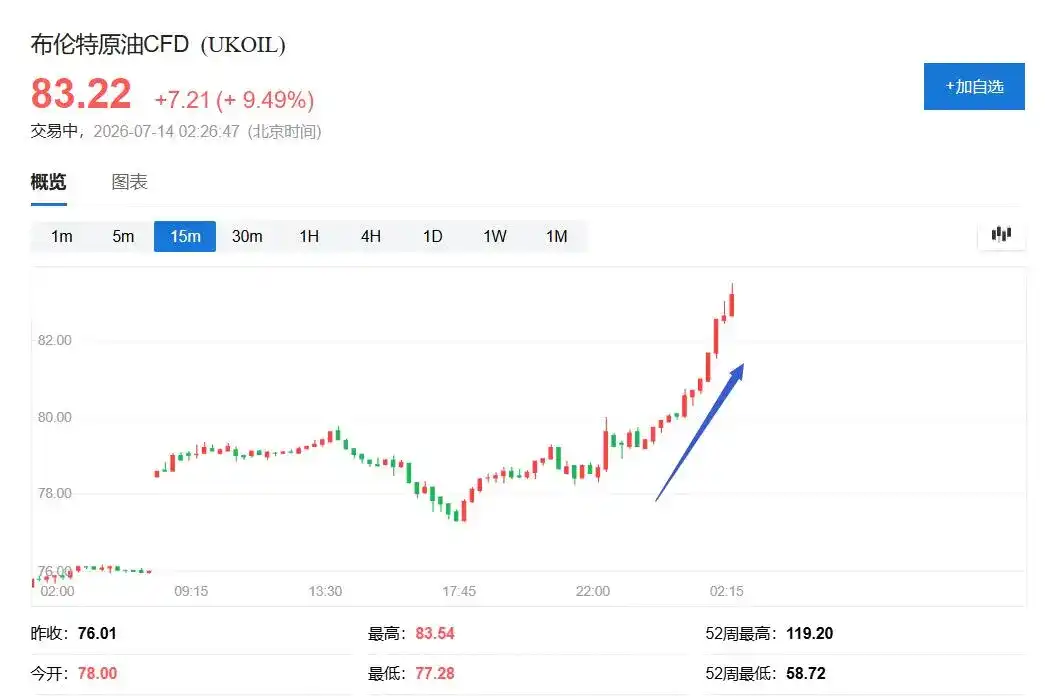
Although Trump said the fee plan would begin formulation and implementation immediately, the White House did not immediately provide more details about the proposal, including how it would be enforced or whether communication had occurred with US allies. Comments suggest that Trump's remarks have intensified the dispute between the US and Iran over whether this crucial shipping corridor remains open to traffic.

Previously, according to Xinhua citing Iranian media reports on the 13th, a spokesperson for Iran's Armed Forces General Staff's Khatam al-Anbiya Central Headquarters stated on that day that they would never allow the US to interfere in the management of the Strait of Hormuz.

The spokesperson said that the Iranian armed forces would respond forcefully to any unauthorized entry by US forces into designated sea lanes or interference with the passage of merchant ships and oil tankers. "The recent actions of Iran's Islamic Revolutionary Guard Corps and the Iranian Islamic Republic Army are clear proof."

Earlier on Monday, Trump said in a phone interview with Fox News Channel that the US plans to control the Strait of Hormuz and should be compensated for "guarding" this vital waterway. He said, "We've been guarding that strait for 50 years and have never gotten a penny. We want to be compensated because we're putting our people in harm's way."

Iran Calls Southern Route in Strait of Hormuz 'Unsafe'

Additionally, according to Xinhua, the Iranian embassy in the UK stated on social media on the 13th that the southern route in the Strait of Hormuz is "unsafe, unreliable, and prone to accidents."

The Iranian embassy in the UK said that in compliance with the Islamabad Memorandum of Understanding, Iran established a temporary maritime security corridor. This corridor has no technical or military obstacles and has been notified to the IMO. However, "the US is directing vessels towards a dangerous southern parallel route. This route is not only legally questionable but also unsafe, unreliable, and prone to accidents."

The Iranian embassy said that US "acts of military aggression," such as attacking Iranian ports, have made the Strait of Hormuz a highly tense and high-risk area.

After the US-Iran understanding was reached, two traffic routes formed in the strait: the northern route controlled by Iran and the southern route closer to Oman's side, where US forces provide navigation assistance.

The Iranian IRGC Navy announced early Sunday morning local time on the 12th that, due to the unsafe situation caused by illegal foreign interference, the Strait of Hormuz is closed as of now until further notice and until the US ceases interference in the region. The US Central Command posted on social media on Sunday morning Eastern Time, stating that "transit continues" in the Strait of Hormuz. Iran does not control the strait.

International Maritime Organization: Opposes Toll Charges for Transit Through Straits Used for International Navigation

After Trump's post, a spokesperson for the International Maritime Organization (IMO) said: "We have noted the remarks and are awaiting further details."

The spokesperson stated: "Our position on fees is clear and consistent—the IMO firmly opposes the imposition of charges for transit through straits used for international navigation. Mandatory transit fees levied solely for passing through a strait are legally untenable."

Media noted that shipping industry officials expressed concern about Trump's latest move regarding fees, saying their assessment is that such measures would violate international law.

One industry official questioned Trump's remarks: "How exactly will this make navigation safer? And what kind of guarantee will it provide?"

Trump Has Notified Congress of Resumption of Hostilities with Iran

According to CCTV citing US reports on Monday the 13th, Trump has formally notified Congress that hostilities with Iran have resumed. Trump wrote in a letter to congressional leaders dated the 10th that US forces conducted a "defensive strike" on targets within Iran on the 7th.

It is reported that this letter has reignited the dispute between Congress and the White House. Although both houses of Congress previously voted to require the President to end the war or seek approval to continue actions, the White House insists that Trump is acting within his constitutional powers as Commander-in-Chief.


Criptomoedas em alta

Perguntas relacionadas

QWhat major action did President Trump announce regarding the Strait of Hormuz and what was the stated reason?

APresident Trump announced the U.S. would begin charging a 20% fee on all cargo transported through the Strait of Hormuz. He stated this was 'compensation' for the U.S. acting as the 'guardian of the Strait of Hormuz,' covering the necessary costs for maintaining security and safety in the turbulent region.

QHow did the announcement of U.S. actions against Iran impact international oil prices?

AThe announcements of U.S. actions, including the planned blockade and fee, caused international oil prices to surge sharply. U.S. crude oil prices rose by up to nearly 10%, briefly surpassing $78 per barrel, while Brent crude neared $83 per barrel, also with a near 10% increase.

QWhen was the U.S. naval blockade of Iran scheduled to begin, and what are its key conditions?

AThe U.S. naval blockade of all Iranian ports and coastal areas was scheduled to begin at 20:00 GMT on July 14th (04:00 Beijing Time on July 15th). The blockade applies to all vessels regardless of flag but allows neutral ships transit through the Strait of Hormuz to non-Iranian destinations. Humanitarian shipments are permitted but subject to inspection.

QWhat was the response of the International Maritime Organization (IMO) to the proposed fee for the Strait of Hormuz?

AThe International Maritime Organization (IMO) stated its firm opposition to imposing fees on passage through straits used for international navigation. An IMO spokesperson said such a compulsory toll for merely passing through a strait is 'legally untenable.'

QWhat significant military incident involving a U.S. drone was reported following the announcements?

AAccording to Iran's Fars News Agency, an American MQ-1 drone was shot down over the Strait of Hormuz by Iran's Islamic Revolutionary Guard Corps air defense system late on Monday night (July 13th).

Leituras Relacionadas

Jito Revives with New Exchange JTX Buyback: Self-Salvation or Lifeline?

Jito, a Solana-based MEV and liquid staking infrastructure protocol, has announced new governance proposal JIP-38 and the launch of a new self-custody trading platform, JTX. The proposal establishes a rigid value-capture mechanism, mandating that 100% of the DAO's share of revenue from JTX—80% of its platform fees—will be used for programmatic, on-chain verifiable open market buybacks and permanent burns of the JTO token. This commitment is set to last at least from JTX's launch until Q4 2027. The move comes as Jito faces significant challenges in its core liquid staking market, with protocol-staked SOL declining from 18 million to under 10 million. Intense competition from protocols like Sanctum and Jupiter, coupled with continuous monthly token unlocks (1.15% of max supply), has pressured JTO's price, which fell over 96% from its all-time high to a low of $0.21 earlier this year, before recovering to around $0.63. JIP-38 formalizes Jito Network as a "token-centric" network, where all major revenue streams flow to the DAO for governance by JTO holders. While the JTX buyback is a firm commitment using new revenue, decisions on other income streams and the post-2027 strategy will be determined by future governance votes. The proposal is seen as a strategic pivot to create a new revenue source and directly align token value with ecosystem growth, though its success depends heavily on JTX's ability to compete effectively in the crowded Solana trading landscape.

Foresight NewsHá 38m

Jito Revives with New Exchange JTX Buyback: Self-Salvation or Lifeline?

Foresight NewsHá 38m

The More Proficient AI Becomes at Answering, Why Do Humans Need Deep Thinking More? Fudan Releases the 2026 Blue Book on Intelligent Development in Humanities and Social Sciences

As AI capabilities rapidly expand, particularly in generating sophisticated text, analyzing data, and automating complex tasks, the need for human deep thinking becomes more critical, not less. The "2026 Blue Paper on Intelligent Development for Humanities and Social Sciences" from Fudan University argues that the relationship between AI and these fields is shifting from "one-way empowerment" to "bidirectional fusion." While AI transforms research methodologies, the humanities must guide its purpose, application, and governance. The core challenge is no longer processing vast information, but defining worthwhile problems, establishing genuine causal mechanisms, and constructing verifiable evidence chains. AI excels at producing coherent, fluent outputs but risks oversimplifying complex social realities into standardized formats it can easily process. For instance, in areas like climate-society systems, the difficulty lies not in handling more variables, but in understanding the fundamental mismatches between natural and social systems. Similarly, in automated research, AI can efficiently search for statistically significant results or generate papers quickly, potentially masking flawed assumptions or "packaging" statistical noise as discovery. The speed of paper production does not equate to the speed of genuine knowledge advancement. This underscores the non-transferable human responsibility for judgment. Deep thinking must be embedded into research workflows, governance systems, and organizational structures. Key principles include: * **Maintaining the Evidence Chain:** While AI can handle tasks like data processing, researchers must retain oversight over problem definition, conceptual translation into metrics, causal interpretation, and defining the scope of conclusions. Frameworks like STRIDES aim to document decisions and enable audit trails. * **Ensuring Meaningful Human Oversight:** In public governance, AI systems should operate in an "assistive" rather than an "agentic" mode. Human operators must retain genuine intervention, correction, and explanation rights to prevent "responsibility theater," where humans merely rubber-stamp algorithmic decisions. * **Translating Principles into Practice:** AI governance needs enforceable mechanisms across a system's lifecycle—pre-deployment risk assessment, runtime monitoring and human-in-the-loop controls, and post-hoc review and accountability—tailored to the level of risk involved. * **Defining Direction, Not Just Answers:** Humanities and social sciences provide the essential framework for navigating value conflicts (e.g., efficiency vs. fairness) and analyzing the social consequences of technology, questions AI alone cannot resolve. Building lasting capacity requires more than isolated projects. It demands integrated infrastructure—shared data standards, tools, interdisciplinary training, and collaborative mechanisms—as measured by initiatives like the "Chinese Universities AI4SSH Index." The ultimate imperative is clear: as AI becomes better at answering questions, humans must become more deliberate and responsible in deciding which questions are worth asking, critically evaluating the answers, and steering the technology's impact on society.

marsbitHá 57m

The More Proficient AI Becomes at Answering, Why Do Humans Need Deep Thinking More? Fudan Releases the 2026 Blue Book on Intelligent Development in Humanities and Social Sciences

marsbitHá 57m

Trading

Spot

Artigos em Destaque

Como comprar AB

Bem-vindo à HTX.com!Tornámos a compra de AB (AB) simples e conveniente.Segue o nosso guia passo a passo para iniciar a tua jornada no mundo das criptos.Passo 1: cria a tua conta HTXUtiliza o teu e-mail ou número de telefone para te inscreveres numa conta gratuita na HTX.Desfruta de um processo de inscrição sem complicações e desbloqueia todas as funcionalidades.Obter a minha contaPasso 2: vai para Comprar Cripto e escolhe o teu método de pagamentoCartão de crédito/débito: usa o teu visa ou mastercard para comprar AB (AB) instantaneamente.Saldo: usa os fundos da tua conta HTX para transacionar sem problemas.Terceiros: adicionamos métodos de pagamento populares, como Google Pay e Apple Pay, para aumentar a conveniência.P2P: transaciona diretamente com outros utilizadores na HTX.Mercado de balcão (OTC): oferecemos serviços personalizados e taxas de câmbio competitivas para os traders.Passo 3: armazena teu AB (AB)Depois de comprar o teu AB (AB), armazena-o na tua conta HTX.Alternativamente, podes enviá-lo para outro lugar através de transferência blockchain ou usá-lo para transacionar outras criptomoedas.Passo 4: transaciona AB (AB)Transaciona facilmente AB (AB) no mercado à vista da HTX.Acede simplesmente à tua conta, seleciona o teu par de trading, executa as tuas transações e monitoriza em tempo real.Oferecemos uma experiência de fácil utilização tanto para principiantes como para traders experientes.

535 Visualizações TotaisPublicado em {updateTime}Atualizado em 2026.06.02

Como comprar AB

Discussões

Bem-vindo à Comunidade HTX. Aqui, pode manter-se informado sobre os mais recentes desenvolvimentos da plataforma e obter acesso a análises profissionais de mercado. As opiniões dos utilizadores sobre o preço de AB (AB) são apresentadas abaixo.

活动图片