Bitcoin fund flows show investors trading Fed rate path, not exiting market: CoinShares

cointelegraphPublished on 2026-09-08Last updated on 2026-09-08

Abstract

Bitcoin fund flows are increasingly tied to U.S. interest rate expectations, with CoinShares research head James Butterfill stating the Federal Reserve's policy is capping Bitcoin's price near $80,000 despite strong investor demand. Market reactions to Fed officials' speeches demonstrate this sensitivity, causing outflows and inflows as rate hike probabilities shift. Currently, markets price in a roughly 60% chance of a September rate hike. The analysis highlights Bitcoin's continued sensitivity to liquidity and monetary policy, similar to gold. Recent U.S. Treasury plans to increase bond buybacks have added liquidity, contributing to Bitcoin's rally from the low $60,000s to above $80,000 last month and leading to forecasts of a potential rise to $100,000 by year-end. Analysts suggest the rally may be driven more by a desire to de-risk exposure to the U.S. than by crypto-specific factors.

Crypto fund flows are becoming increasingly sensitive to changes in the US interest-rate outlook, with CoinShares arguing that Federal Reserve policy remains a key barrier to Bitcoin (BTC) breaking above $80,000 despite continued investor demand for crypto.

In his latest market update, CoinShares head of research James Butterfil argued that “Bitcoin is trading like gold again, but the Fed still sets the ceiling” at around $80,000.

That sensitivity was evident after Fed Chair Kevin Warsh’s speech at Jackson Hole. Warsh said progress on inflation had been modest and that price pressures were not easing quickly enough to give the central bank’s policy makers the confidence inflation was returning to its 2% target. Roughly $100 million exited digital asset investment products immediately after the speech, as markets sharply increased the probability of a September rate hike.

Flows reversed over the following week, reaching $1 billion by Sept. 4. The turnaround coincided with comments from Fed Governor Christopher Waller, who pointed to recent signs of “disinflation” and said he was inclined to keep rates steady in September if upcoming inflation data showed further progress.

“Investors are not exiting the asset class,” Butterfill wrote. “They are trading the rate path.”

As of Monday, Fed Funds futures prices implied a roughly 60% chance of a rate hike following next week’s Federal Open Market Committee (FOMC) meeting, according to CME Group.
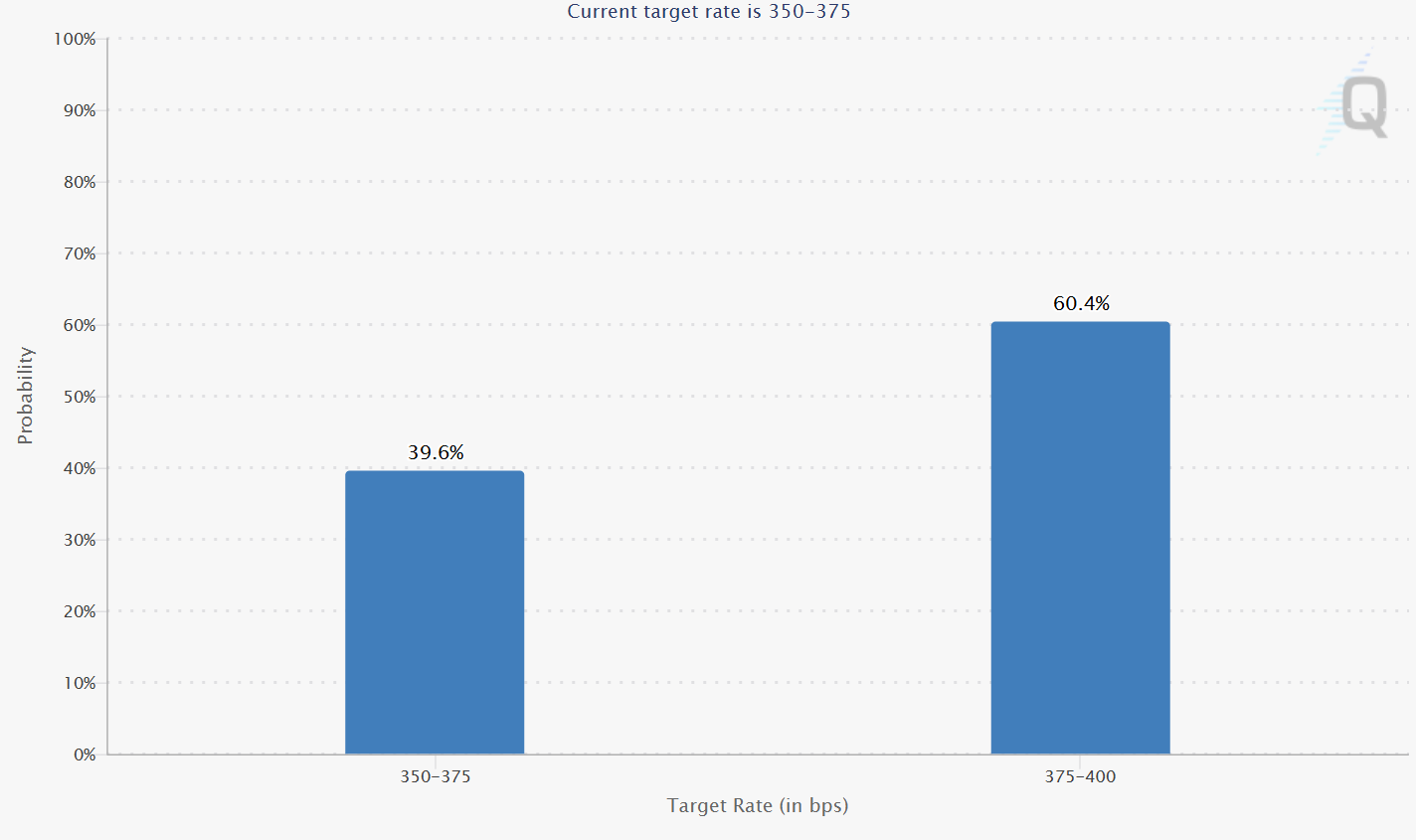
Markets are now pricing in a 25 basis-point rate hike on Sept. 16. Source: CME Group

The movements suggest that Bitcoin and broader digital asset markets remain highly sensitive to shifts in liquidity and monetary policy. Easier financial conditions have historically supported crypto and other risk assets.

Related: Crypto Biz: AI took a back seat when Bitcoin started climbing

Treasury buybacks add to liquidity backdrop

CoinShares’ assessment comes against the backdrop of a strong rebound in Bitcoin and the broader digital asset market last month, when the US Treasury announced plans to double certain long-dated bond buybacks from $2 billion to $4 billion per operation. Bitcoin climbed from the low $60,000s to above $80,000 during the month.

The expanded buyback program is expected to run from Sept. 9 through Nov. 4.

“Around the Treasury announcement we also saw equity sell-offs and shifts across the yield curve, layered on top of the ongoing noise from the Iran war — oil and equities swinging depending on whether or not people are feeling optimistic about diplomacy on any given day,” wrote 21shares co-founder Ophelia Snyder in her Substack newsletter last week.

“Taken together, these factors suggest to me that the current Bitcoin rally may have less to do with crypto-specific catalysts and more to do with growing interest in de-risking exposure to the US specifically,” she added.

The move reinforced the market’s focus on liquidity conditions and prompted Standard Chartered to forecast that Bitcoin could reach $100,000 before the end of the year.

Related: Strategy’s $66B Bitcoin machine hinges on capital markets, not BTC price: Report

Related Questions

QAccording to CoinShares, what is the main factor currently preventing Bitcoin from breaking above $80,000?

AAccording to CoinShares head of research James Butterfill, Federal Reserve policy remains a key barrier to Bitcoin breaking above $80,000.

QHow did crypto fund flows react immediately after Fed Chair Kevin Warsh's Jackson Hole speech, and why?

AImmediately after Fed Chair Kevin Warsh's Jackson Hole speech, roughly $100 million exited digital asset investment products. This occurred because markets sharply increased the probability of a September interest rate hike after Warsh stated that progress on inflation had been modest and was not easing quickly enough.

QWhat evidence does James Butterfill provide to support the claim that 'investors are not exiting the asset class' but are 'trading the rate path'?

AButterfill points to the reversal of fund flows the week after Warsh's speech. Outflows of $100 million were followed by inflows reaching $1 billion by September 4, coinciding with more dovish comments from Fed Governor Christopher Waller about potential disinflation and keeping rates steady.

QWhat US Treasury action is mentioned as contributing to Bitcoin's price rally last month, and what was its scale?

AThe US Treasury announced plans to double certain long-dated bond buybacks from $2 billion to $4 billion per operation. This expansion of liquidity is cited as a factor in Bitcoin's climb from the low $60,000s to above $80,000 during that period.

QWhat price target for Bitcoin did Standard Chartered forecast following the Treasury's buyback announcement, and by when?

AFollowing the US Treasury's buyback announcement, Standard Chartered forecast that Bitcoin could reach $100,000 before the end of the year.

Related Reads

Xsolla ZK Introduces a Gas Token Designed to Let Digital Items Move Between Games and Players

Xsolla ZK, Inc. has introduced Xsolla Gas (XLA), the native token of Xsolla ZK, an Ethereum Layer 2 ZK rollup network for games. XLA is designed to pay network fees when players transfer or share eligible digital items on the network. Players who prefer not to set up a separate wallet can buy XLA-NT, a non-transferable gas credit usable only for network fees on Xsolla ZK, through Xsolla Gas Station using familiar payment methods. XLA is also available on crypto exchanges including Kraken, LBank, and Biconomy in supported markets. The initiative addresses a key limitation: most digital items today live on a single game's backend and cannot be transferred to friends or used in other games, and they become inaccessible if a game shuts down. Blockchain-backed items stay with players, but transferring them typically requires a separate wallet and the right token. Xsolla ZK aims to lower these barriers. Players use Xsolla Backpack, an inventory for owned digital items; items issued in transferable form are designed to remain available even if the issuing game shuts down, and players can give them to others. Players sign in with their usual account, without needing a seed phrase or separate wallet setup. Chris Hewish, President of Xsolla (USA), said players should be able to share and gift digital items they own anytime, anywhere, with anyone they know, and that developers gain a new way to monetize games while players gain items that are theirs to keep. Developers and partners can also use XLA to pay network fees for their item activity. More than 1,500 game teams use Xsolla's tools, and Xsolla Backpack and Xsolla Gas Station are available without additional development for teams using compatible Xsolla products, integrating with existing player and payment flows. XLA is an ERC-20 token on Ethereum mainnet with a total supply of 1 billion and becomes the base token of Xsolla ZK through the canonical bridge.

TheNewsCrypto38m ago

Xsolla ZK Introduces a Gas Token Designed to Let Digital Items Move Between Games and Players

TheNewsCrypto38m ago

Hyperliquid API Wallet Permissions Keep Expanding: Once an AI Agent Is Attacked, It Could Drain the Main Account

As personal AI agents take over everyday financial decisions, Hyperliquid is seen as an ideal decentralized trading foundation thanks to its deep liquidity and composability. However, the API wallets that underpin automated trading have quietly seen their security boundaries erode across network upgrades over the past year. Lacking fine-grained permission policies, a compromised API wallet can even trigger staking slashing, spot locking, and priority fee burning, exposing the main account to total loss. The article traces how API wallets—originally scoped to prevent direct withdrawals or external transfers—have accumulated expanded permissions through successive upgrades, with no cap on margin exposure. A maliciously altered API wallet controlling an account with over ~$40M could buy 500,000 HYPE, stake it, link it to a malicious HIP-3 market, invite slashing, and lock the main account's funds for 183 days. Because API wallets are now the default trading method across the Hyperliquid frontend and third-party apps, and agents must interact with untrusted internet environments, prompt injection or key leakage can let attackers drain funds without ever stealing a private key. Existing fine-grained control via HyperEVM smart contracts introduces too much latency for high-frequency trading, while custodial solutions outsource trust to centralized middleware. The proposed fix is a lightweight bitmap permission field set at API wallet creation, recording which operation types the wallet may trigger—mirroring the mechanism already used in HIP-3 deployer sub-lists. Validating the signer against the main account's bitmap adds negligible overhead, and critically, old API wallets would never auto-inherit new permissions from future L1 upgrades. This would safely unlock staking and transfer interfaces, remove reliance on centralized custody, and pave the way for large-scale personal AI agent adoption on HyperCore.

marsbit1h ago

Hyperliquid API Wallet Permissions Keep Expanding: Once an AI Agent Is Attacked, It Could Drain the Main Account

marsbit1h ago

Upbit and Bithumb Customer Deposits Plunge 31.86%, Falling $1.87 Billion in 2026

Customer deposits in South Korean won at Upbit and Bithumb, South Korea's two largest crypto exchanges, fell 31.86% in the first nine months of 2026, according to regulatory disclosures published November 17. The platforms held about ₩5.36 trillion ($4 billion) in customer cash at end-September, down from ₩7.87 trillion at end-2025—a reduction of roughly ₩2.51 trillion ($1.87 billion). Upbit operator Dunamu saw deposits drop 31.9% from ₩5.83 trillion to ₩3.97 trillion, while Bithumb fell 31.8% from ₩2.04 trillion to ₩1.39 trillion. The figures were disclosed via South Korea's Financial Supervisory Service electronic filing system. Customer crypto holdings also lost value: Upbit's book value fell 10.9% from ₩62.23 trillion to ₩55.46 trillion, and Bithumb declined 13.1% from ₩17.90 trillion to ₩15.56 trillion. However, quantities of several major cryptocurrencies held for customers increased despite lower valuations—Upbit added 13,259 Bitcoin, 337,609 Ether and 1.22 million Solana versus year-end levels, and Bithumb reported higher holdings of Bitcoin, Ether, XRP and Solana. The data indicate the deposit decline does not necessarily mean investors withdrew entirely from the crypto market; disclosures do not explain whether funds went to bank accounts, crypto purchases or elsewhere. The drop comes amid weaker trading activity in South Korea's digital asset market, adding pressure on major exchanges.

TheNewsCrypto1h ago

Upbit and Bithumb Customer Deposits Plunge 31.86%, Falling $1.87 Billion in 2026

TheNewsCrypto1h ago

Trading

Spot
活动图片