Bitroot Public Chain Invited to Attend Tencent Cloud Singapore AI Conference, Discussing the Future Alongside Solana

marsbitPublicado em 2026-05-27Última atualização em 2026-05-27

Resumo

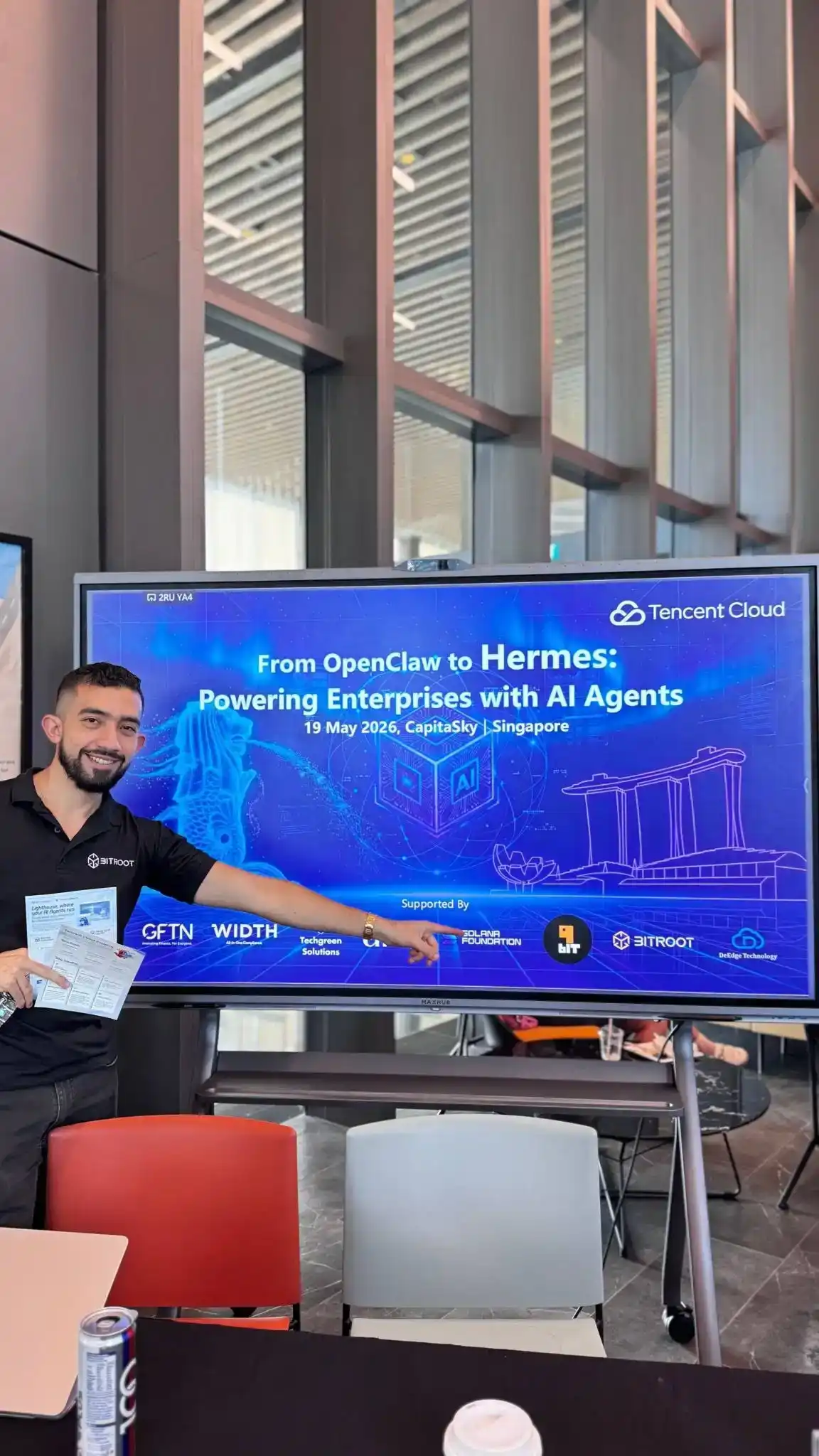
On May 19, Bitroot, an emerging Layer 1 blockchain, participated in the Tencent Cloud AI Summit in Singapore alongside key industry players like Solana Foundation. The event explored the intersection of AI infrastructure, enterprise applications, AI Agents, and Web3. Bitroot's invitation, despite being pre-mainnet, highlights industry interest in its focus on high-performance, AI-native architecture tailored for future AI Agent execution and verifiable on-chain automation. Bitroot CEO Juan Jose emphasized that AI competition is shifting from model performance to data, real-world application scenarios, and trust infrastructure. He argued that for AI Agents to evolve from assistants to autonomous executors managing transactions and assets, they require low-latency, low-cost, and high-throughput blockchain environments. Bitroot aims to address this through its EVM-compatible design, optimistic parallel execution, and a consensus mechanism targeting high scalability. Currently in its Testnet 5.0 phase, Bitroot reports metrics like over 50,000 peak TPS and sub-0.3 second average block time. Its narrative positions it within a growing landscape where next-generation Layer 1s like Monad and Aptos also compete on performance, while Bitroot differentiates by integrating AI computational capabilities natively across its stack. The summit underscored that the fusion of AI and Web3 is moving from concept to infrastructure competition, where networks balancing performance, security, and...

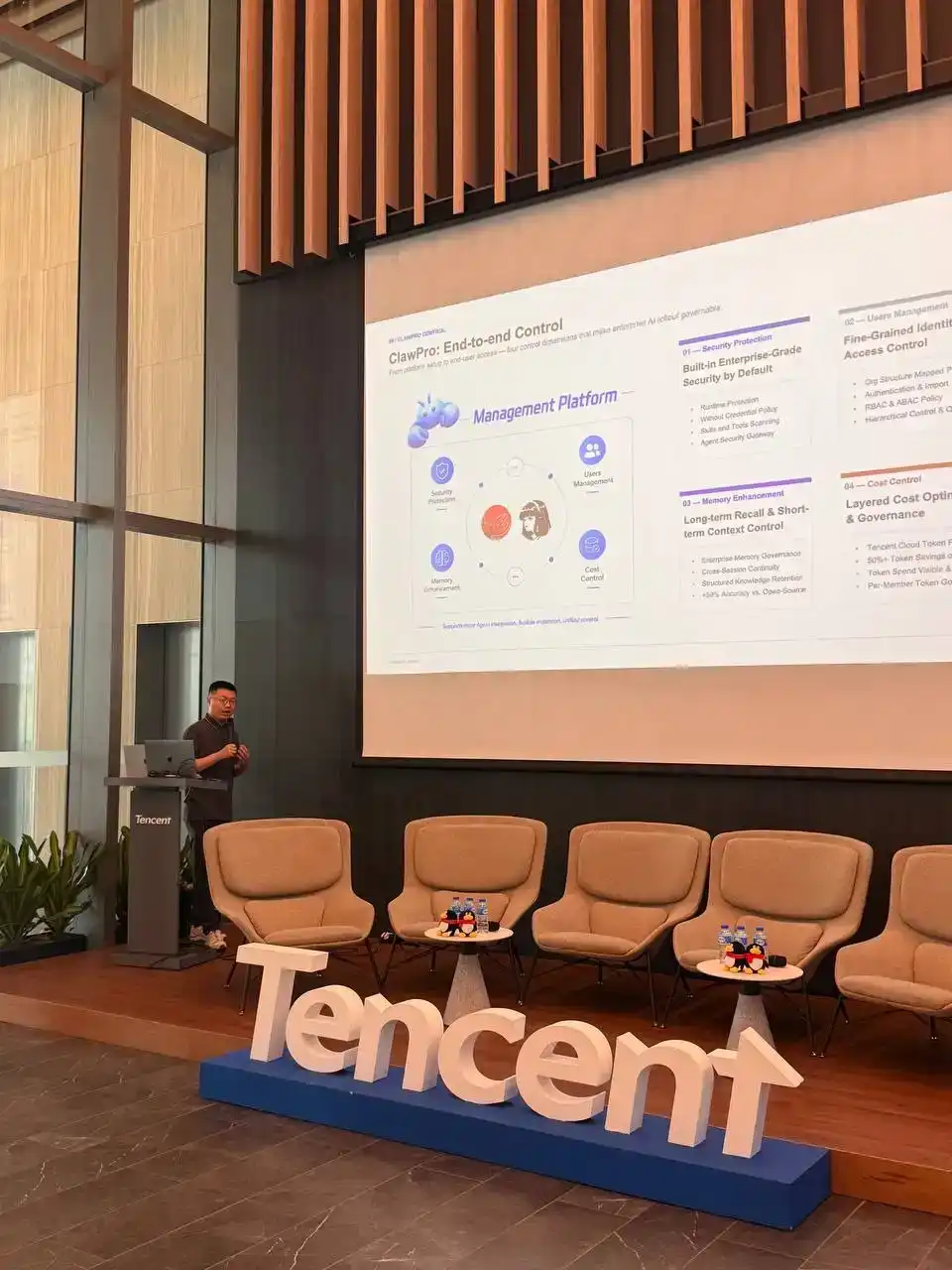
On May 19th, an AI-themed event hosted by Tencent Cloud was held in Singapore. The event focused on topics such as AI infrastructure, enterprise-level AI implementation, AI Agents, Web3 verifiable computing, and fintech, bringing together industry representatives from cloud services, public chain ecosystems, payment networks, financial technology, and investment institutions.

As a significant financial and technological hub in Asia, Singapore has increasingly become a crucial node for AI, Web3, and digital finance companies looking to expand into the Southeast Asian market. Tencent Cloud's choice to host its AI event in Singapore also reflects how major cloud service providers are paying more attention to the integration of AI application implementation, computing power services, enterprise-level solutions, and new digital infrastructure.
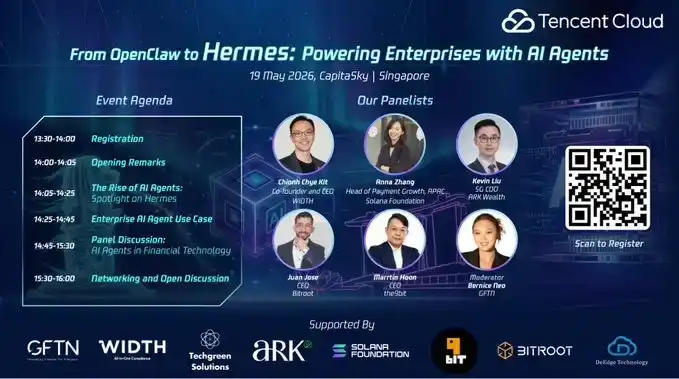

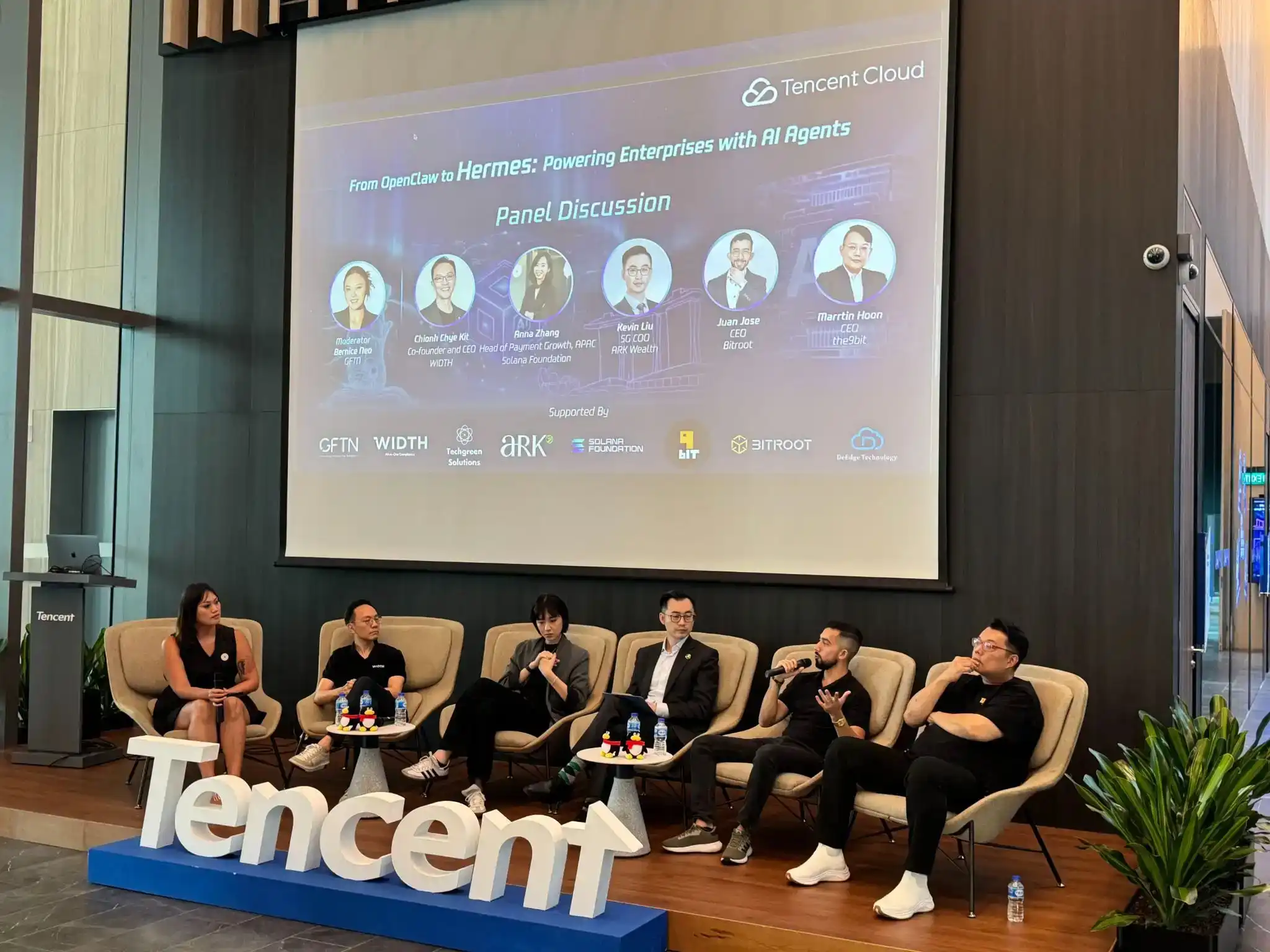
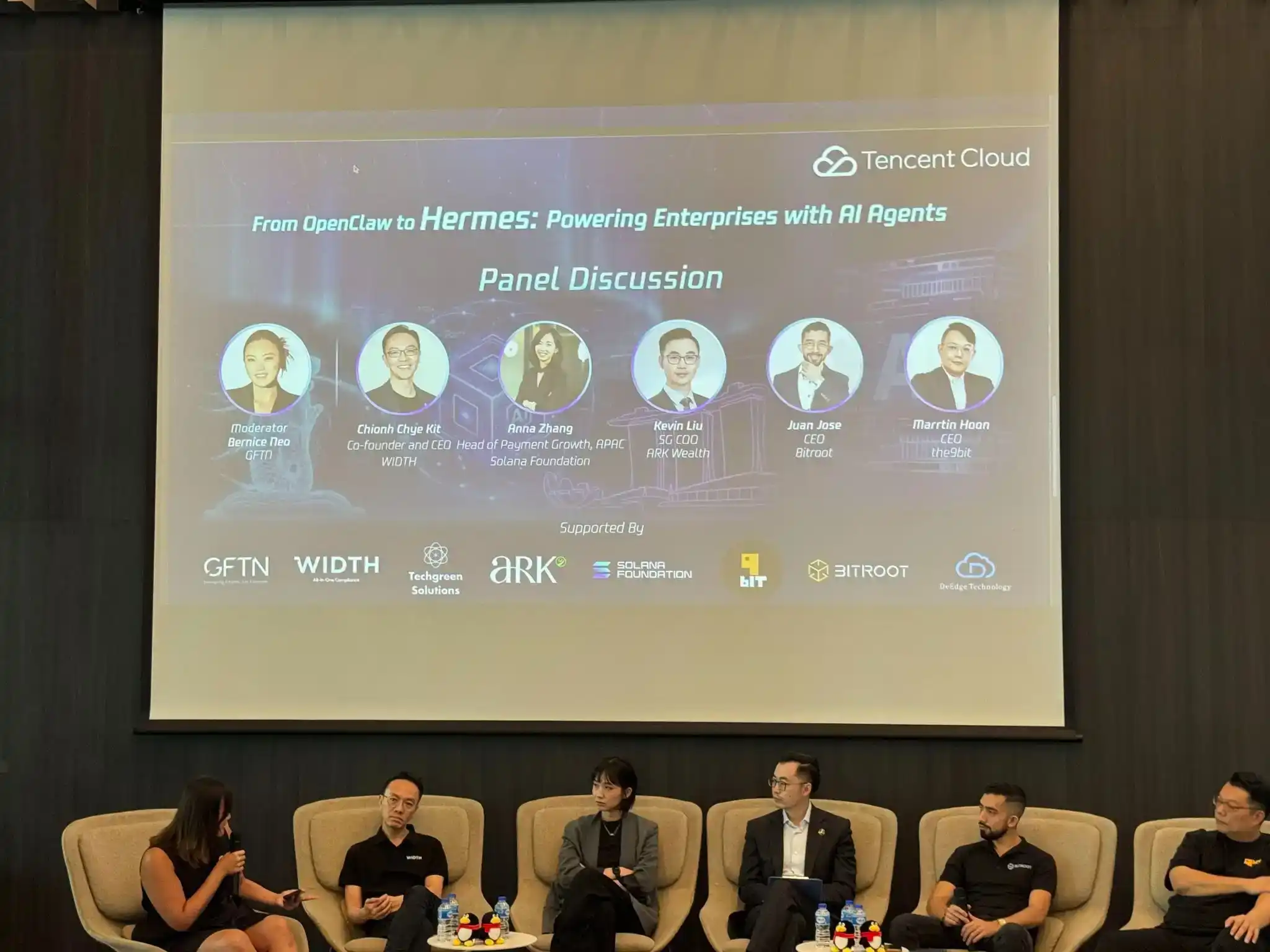
According to event information, attendees included Kevin Zhou, Director of Tencent Cloud Computing; Anna Zhang, Head of Payments Growth, APAC at Solana Foundation; Juan Jose, CEO of Bitroot; Chionh Chye Kit, Co-founder and CEO of WIDTH; Martin Hoon, CEO of the9bit; and Kevin Liu, COO of ARK Wealth Singapore, among others.

Judging by the lineup, this event was not merely a single AI product showcase but a cross-domain discussion centered on "how AI integrates with cloud services, payment networks, on-chain infrastructure, and financial technology." Tencent Cloud represents Web2 cloud computing and enterprise-level service capabilities, Solana represents a mature public chain ecosystem and on-chain payment exploration, while fintech and wealth management institutions represent the application demands of AI in real business scenarios. Against this backdrop, Bitroot, as an emerging public chain project focusing on high-performance Layer 1 and AI-native architecture, was invited to participate, making it one of the noteworthy Web3 infrastructure representatives at this event.

Behind the High-Profile AI Event, Web3 Infrastructure Re-enters the Discussion

Over the past year, the focus in the AI industry has gradually shifted from model capability competition to enterprise implementation, data governance, Agent workflows, and automated decision-making. For cloud service providers and fintech institutions, the commercialization of AI depends not only on the model itself but also on a complete set of infrastructure capabilities including computing power, data, permissions, security, and auditing mechanisms.

This explains why Web3 infrastructure is beginning to be included in AI discussions. As AI Agents evolve from "conversational tools" to "execution entities," they may need to call APIs, initiate payments, manage assets, complete settlements, and even participate in multi-party collaborative workflows in the future. In these scenarios, traditional centralized systems and on-chain verifiable infrastructure may complement each other.

The programmable assets, automated settlement, state verifiability, and on-chain auditing capabilities provided by blockchain precisely address the trust issues faced by AI Agents in financial, payment, and enterprise collaboration scenarios. Therefore, Tencent Cloud's Singapore AI event, by placing public chain ecosystems, cloud services, payment growth, and fintech representatives in the same discussion space, itself sends a signal: the next phase of AI competition is shifting from single-point technological capabilities to composite infrastructure competition.
Why Was Bitroot, Yet to Launch, Invited?

For Bitroot, being invited to this event holds certain representativeness. Unlike public chains like Solana, which already have a mature mainnet and a large ecosystem, Bitroot is currently still in the testnet and ecosystem expansion phase before its mainnet launch. The fact that an emerging Web3 project, yet to launch its mainnet, could make it onto the participant list of Tencent Cloud's Singapore AI event indicates that its technical direction and narrative approach have at least attracted the attention of some industry players.

From an industry logic perspective, the reason for Bitroot's invitation may not lie in its current ecosystem scale, but rather in the alignment of the infrastructure direction it is betting on with the demands of the AI era.

First, AI Agents and on-chain automated execution require higher-performance underlying networks. Traditional public chains still have certain limitations in throughput, latency, and cost, while AI Agents may bring about more frequent, continuous, and automated interaction demands in the future. This means the underlying chain needs to have stronger concurrent processing capabilities and lower execution costs.

Second, developer compatibility remains key to whether a new public chain can establish an ecosystem. Bitroot's choice of an EVM-compatible route means it does not attempt to completely migrate developers to an unfamiliar environment. Instead, it aims to provide a higher-performance execution environment while retaining the Ethereum developer toolchain. For a new public chain still in its early stages, this approach helps reduce the difficulty of ecosystem cold-start.

Third, AI-native architecture is becoming an important differentiating direction for next-generation infrastructure projects. Compared to simply emphasizing TPS or transaction fees, Bitroot emphasizes AI Agent, on-chain automated application, and verifiable execution scenarios. This positioning makes it easier to enter discussions about the convergence of AI and Web3, rather than being seen as just another high-performance public chain.

Therefore, from an industry observation perspective, it at least indicates that some participants in cloud services, fintech, and the Web3 ecosystem are paying attention to new infrastructure projects yet to launch their mainnets, especially those Layer 1 networks designed around AI-native features, high-performance execution, and developer compatibility.
Sharing the Stage with Solana, Enhancing the Observational Value of Emerging Layer 1s

At this event, the participation of Anna Zhang, Head of Payments Growth, APAC at Solana Foundation, added perspectives from a mature public chain ecosystem and on-chain payments. Solana has been continuously advancing in the direction of high-performance public chains, payments, and consumer-grade applications in recent years, establishing itself as a key example in the Web3 infrastructure domain.

The fact that Bitroot shared the stage with representatives of mature ecosystems like Solana for discussions is itself noteworthy. It reflects that in the broader context of AI-Web3 convergence, the industry is not only focused on public chains that have already achieved scale but is also paying attention to new variables that may emerge in the next generation of infrastructure.

For an emerging Layer 1 like Bitroot, the fact that its mainnet is not yet launched means its technical roadmap is still malleable. If its parallel execution, EVM compatibility, and AI-native design can be validated in subsequent testnets and the mainnet, then it has the opportunity to carve out a differentiated position in scenarios like AI Agents, on-chain automated execution, and high-frequency applications.

Especially as AI gradually becomes a central industry theme, market requirements for public chains may change. Past public chain competition largely revolved around DeFi, NFTs, GameFi, and asset issuance. Future competition may increasingly focus on Agent execution, on-chain settlement, automated finance, data invocation, and verifiable computing. Bitroot entering industry discussions at this juncture is precisely why it deserves attention.

Juan Jose: AI Competition Will Shift from Models to Data, Scenarios, and Trust

During the panel discussion, Juan Jose, CEO of Bitroot, stated that the future gap between AI companies may no longer be just about model performance or parameter scale, but rather a comprehensive competition of data, scenarios, and trust mechanisms.
He believes that as both open-source and closed-source models continue to iterate, model capabilities themselves are accelerating in commoditization. The truly long-term, effective moat for enterprises comes from whether they possess high-quality industry data, whether they can deeply integrate into specific business processes, and whether they can establish long-term trust at both user and institutional levels.

This assessment aligns with current AI industry trends. More and more companies are realizing that the value of AI lies not only in generating content or completing simple Q&A, but in whether it can enter real business processes and consistently produce results in a controllable, auditable, and evaluable environment.

Juan Jose further pointed out that enterprise-level AI implementation still faces challenges in reliability, data infrastructure, and organizational change. Especially in high-risk scenarios like finance, payments, and auditing, AI systems must not only pursue capability ceilings but also meet stability, permission control, and auditing requirements.

AI Agents Require High-Performance and Verifiable Execution Environments

AI Agents were another important direction discussed at this event. Juan Jose stated that the industry is still in the "assistive Agent" stage, and there is still time before truly enterprise-level autonomy is achieved. The reason is that once Agents enter enterprise systems, they will face issues like multi-step task error accumulation, security permissions, legal liability, and explainability.

However, in the long term, the direction for AI Agents is relatively clear. Future Agents will not just provide suggestions; they may call services, manage accounts, initiate transactions, execute strategies, and complete settlements. This means the underlying infrastructure must support higher-frequency interactions and more trustworthy execution.

In this regard, Bitroot's technical narrative strongly correlates with industry needs. According to project information, Bitroot adopts an EVM-compatible route and enhances on-chain execution efficiency through designs like optimistic parallel EVM and the Pipeline BFT consensus mechanism, aiming to provide a high-performance, low-cost on-chain execution environment for AI Agents, DeFi, and Web3 applications.

For AI + Web3 scenarios, performance is not merely a technical metric but a prerequisite for whether applications can be viable. If an Agent requires high fees and long confirmation times for every operation, many automation scenarios will struggle to scale. Conversely, an on-chain environment with low latency, low cost, and high throughput could become an important foundation for AI Agents moving towards real-world applications.
The Testnet Phase Will Be a Crucial Validation Window for Bitroot

Bitroot is also advancing its testnet and ecosystem infrastructure development. According to project information, its testnet has entered version 5.0, with related upgrades covering network performance, cross-chain components, ecosystem application deployment, and node optimization.

Judging from testnet data, Bitroot has demonstrated technical implementation capability: the test network address count exceeds 1 million+, daily on-chain transaction volume exceeds 50,000+, peak TPS reaches 50,000+, and average block time is approximately <0.3 seconds.

For an emerging public chain yet to launch its mainnet, the testnet phase holds dual significance. On one hand, it is a validation window for the technical roadmap, where developers can observe network performance, contract compatibility, toolchain maturity, and node stability. On the other hand, it is also an important phase for ecosystem cold-start, allowing community users and developers to participate in network building through early interaction.

Industry Observation: The Competitive Landscape of High-Performance AI-Native Public Chains

From the discussions at this summit, it is evident that the convergence of AI and Web3 is shifting from conceptual narratives to specific infrastructure-level issues. In this track, different projects have chosen different technical paths:

Solana is known for its high-speed execution and mature ecosystem, having established a large developer community and DeFi ecosystem; Monad focuses on performance optimization of parallel EVM; Aptos achieves optimistic parallel execution through Block-STM. The differentiation of Bitroot lies in that it not only pursues extreme breakthroughs in public chain performance but also natively integrates AI computing capabilities into the underlying architecture of the chain—from the useful Proof-of-Work at the consensus layer, to the parallelized EVM at the execution layer, and to the distributed training and inference network at the application layer, constructing a complete decentralized AI Stack.

For next-generation infrastructure projects, how to support more complex AI application invocations while maintaining security and decentralization characteristics will become a core competitive proposition in the future.

Conclusion

Judging from the signals released at the Singapore AI-themed summit, AI is becoming the main theme for the next phase of the technology industry's evolution. The new demands arising around AI Agents, automated finance, on-chain data, and verifiable execution are placing higher requirements on the underlying infrastructure.

High-performance infrastructure is not merely a narrative choice for a single project but an inevitable direction in the process of scaling AI and Web3 applications. Bitroot's entry into this track with its full-stack architecture of "parallelized EVM + AI-native computing network," sharing the stage with mature ecosystems like Solana at the Tencent Cloud summit, demonstrates the technical depth and industry ambition of a new generation of AI public chains.

In the future, underlying networks that can simultaneously balance performance, compatibility, security, and verifiability will have a greater opportunity to host next-generation application scenarios and occupy key positions in the long-term trend of AI and blockchain convergence. Bitroot's performance is worth continued attention.

About Bitroot

Bitroot is a Layer 1 public chain project focused on parallel execution and AI-native architecture. Bitroot adopts an EVM-compatible technical route and explores providing a high-performance, low-cost on-chain execution environment for AI Agents, DeFi, and Web3 applications through parallel execution mechanisms, consensus optimization, and AI-related interface design.


Perguntas relacionadas

QWhat was the main theme of the Tencent Cloud AI event in Singapore that Bitroot was invited to?

AThe event focused on AI infrastructure, enterprise AI implementation, AI Agents, Web3 verifiable computing, and fintech. It explored the integration of AI with cloud services, payment networks, on-chain infrastructure, and financial technology.

QAccording to the article, why was Bitroot, an unreleased Layer 1 blockchain, invited to such a high-profile event?

ABitroot was invited primarily due to its focus on an AI-native infrastructure and high-performance execution architecture, which aligns with the future needs of AI Agent operations and verifiable on-chain execution, rather than its current ecosystem size.

QWhat is Bitroot's core technical approach as a new Layer 1 project?

ABitroot's core technical approach is an EVM-compatible, high-performance Layer 1 architecture featuring optimistic parallel EVM execution, a Pipeline BFT consensus mechanism, and an AI-native stack designed to provide a low-cost, high-throughput environment for AI Agents and Web3 applications.

QWhat key point did Bitroot CEO Juan Jose make about the future of AI competition during the panel discussion?

AJuan Jose stated that the future gap between AI companies will shift from competing on model performance or parameter scale to a comprehensive competition based on data quality, integration into specific business scenarios, and establishing trust mechanisms.

QWhat is a key potential advantage of integrating high-performance blockchains like Bitroot with AI, as discussed in the article?

AHigh-performance, low-cost, and low-latency blockchain environments can provide the verifiable execution, automated settlement, and trust mechanisms necessary for AI Agents to scale into real-world applications, especially in areas like automated finance, payments, and multi-party workflows.

Leituras Relacionadas

Agentized OS: It's Not About AI, It's About the Foundation

The Agentic OS: Beyond AI, It's About the Foundational Stack In 2026, major operating systems like Android, iOS, HarmonyOS, and Windows are entering the "Agentic" era, integrating proactive AI assistants deeply into the system layer. However, the real competition lies not in the flashy AI features showcased at events, but in the three-layer foundational stack that enables them: the system-level AI Runtime, proprietary/controllable chips, and the on-device/cloud model matrix. The AI Runtime acts as the central scheduler, managing model inference, resource allocation, and exposing capabilities to apps. Controllable chips (e.g., Apple Silicon, Google Tensor, Huawei Kirin) are crucial for deep hardware-software co-optimization, determining the efficiency and experience limits of on-device Agents. The on-device/cloud model matrix provides the "intelligence," with proprietary, chip-optimized small models (like Gemini Nano, Apple's ~3B model) handling daily tasks locally for low latency, privacy, and reliability, while cloud models tackle complex requests. Deep synergy between these three layers enables key Agent differentiators: ultra-low latency and power efficiency, genuine "on-device first" privacy, access to system-level personal context across apps, and reliable performance as a system service even offline. OS vendors with strong integration across this stack (like Apple, Google, and Huawei) build a deeper moat. Beyond this core stack, long-term competitiveness depends on variables like structured App integration (e.g., App Intents/AppFunctions) for reliable multi-step workflows, and robust privacy frameworks that build user trust. This shift towards Agentic OS extends beyond phones and PCs to IoT, cars, and XR glasses via existing multi-device ecosystems. The race is won not in a keynote, but through generations of meticulously co-developed chips, models, and system software.

marsbitHá 1h

Agentized OS: It's Not About AI, It's About the Foundation

marsbitHá 1h

Why Sam Altman's 'Water and Electricity Theory' Sparks Copyright Controversy

OpenAI CEO Sam Altman's recent statement that "intelligence will become a utility like electricity or water" has sparked significant controversy, primarily around copyright issues and the nature of AI development. While positioning AI as a utility serves as a compelling narrative for infrastructure investors, critics argue the analogy is flawed in three key areas. First, there's a fundamental "property gap." Traditional utilities like water and power create new, physical infrastructure from scratch. In contrast, major AI models are trained by reorganizing vast amounts of existing human-created content—books, articles, code, etc.—often scraped from the web without explicit permission or compensation to creators. This "free acquisition, paid resale" model is seen by many as ethically problematic. Second, there's a "pricing gap." True public utilities are typically regulated to ensure universal service with non-discriminatory, cost-plus pricing. AI's token-based pricing, however, involves significant price discrimination (e.g., output tokens costing much more than input tokens) and is designed for revenue maximization, not equitable access. Third, a "governance gap" exists. Utilities operate under public oversight, while AI pricing and development are currently controlled by a few private companies. Furthermore, the industry's own shift toward buying licensed training data (e.g., deals with Reddit or news publishers) undermines its previous legal reliance on "fair use" for freely scraped data. In conclusion, while AI is indeed becoming a foundational technology, calling it a public utility remains contentious. The title requires not just scale and a pay-per-use model, but also credible solutions for data provenance, equitable pricing, and public governance.

marsbitHá 1h

Why Sam Altman's 'Water and Electricity Theory' Sparks Copyright Controversy

marsbitHá 1h

Trading

Spot
Futuros

Artigos em Destaque

O que é SOLANA

HarryPotterWifHatMyroWynn10Inu,$solana: Uma Mergulho no Projeto de Meme Coin Trendy Introdução No panorama em constante evolução das criptomoedas, projetos inovadores surgem continuamente, capturando a imaginação de investidores e entusiastas. Um desses projetos é o HarryPotterWifHatMyroWynn10Inu,$solana, uma moeda meme que começou a esculpir seu nicho dentro da comunidade cripto. Este artigo tem como objetivo fornecer uma visão abrangente do projeto, elucidando seu propósito, arquitetura, criador, investidores e marcos notáveis ao longo da jornada. O que é HarryPotterWifHatMyroWynn10Inu,$solana? Visão Geral HarryPotterWifHatMyroWynn10Inu,$solana é um projeto de moeda meme estruturado na blockchain Solana – uma plataforma conhecida pela sua escalabilidade e rapidez. Com o objetivo de trazer alegria e criatividade para o espaço cripto, este projeto não serve apenas como um token de negociação, mas também como um catalisador para a geração e partilha de conteúdo meme. Esta comunidade, no seu núcleo, é incentivada a participar ativamente, proporcionando um ecossistema dinâmico onde a criatividade e a colaboração prosperam. Objetivos e Metas Na sua essência, o projeto visa fomentar um ambiente onde os entusiastas de meme possam congregar, partilhar e criar conteúdo meme novo. Esta abordagem orientada pela narrativa infunde entusiasmo dentro da comunidade, impulsionando o envolvimento e ao mesmo tempo lançando luz sobre as robustas funcionalidades inerentes à blockchain Solana. Ao construir um projeto focado na comunidade, HarryPotterWifHatMyroWynn10Inu,$solana também deseja explorar o impacto social das moedas digitais como meio de expressão. Quem é o Criador de HarryPotterWifHatMyroWynn10Inu,$solana? A identidade do criador por trás de HarryPotterWifHatMyroWynn10Inu,$solana permanece envolta em mistério. O projeto foi estruturado de tal forma que a propriedade foi renunciada; portanto, ele prospera como uma iniciativa liderada pela comunidade. Esta descentralização promove transparência e participação democrática entre todos os intervenientes envolvidos. Tal abordagem está a tornar-se cada vez mais popular no mundo das moedas meme, onde o envolvimento da comunidade reina supremo. Quem são os Investidores de HarryPotterWifHatMyroWynn10Inu,$solana? Até agora, não há informações disponíveis publicamente sobre os investidores ou fundações específicas que apoiam HarryPotterWifHatMyroWynn10Inu,$solana. A ausência de investidores conhecidos enfatiza ainda mais a ética orientada para a comunidade do projeto, uma vez que este se mantém independente de estruturas financeiras tradicionais. Esta independência permite que o projeto desenvolva a sua identidade livre de pressões externas, confiando em vez disso no interesse coletivo da sua base de utilizadores. Como Funciona HarryPotterWifHatMyroWynn10Inu,$solana? Modelo Econômico O projeto emprega um modelo econômico único que sustenta sua funcionalidade e envolvimento dos utilizadores. As transações dentro de HarryPotterWifHatMyroWynn10Inu,$solana são projetadas para serem benéficas para todas as partes envolvidas. Cada negociação acarreta uma taxa, que é posteriormente redistribuída entre os detentores atuais, enquanto simultaneamente aumenta o fundo de liquidez. Os principais componentes deste modelo incluem: Mecanismo de Reflexão: Uma parte das taxas de transação é devolvida aos detentores, promovendo o investimento a longo prazo no token. Aquisição de Pool de Liquidez: Fundos são alocados para aumentar a liquidez, garantindo que as operações de compra e venda possam ser executadas sem problemas. Mecanismos de Queima: Uma parte dos tokens pode ser queimada para criar escassez, potencialmente aumentando o valor à medida que a demanda aumenta. Este design incentiva um ecossistema auto-sustentável que prospera com as interações e investimentos da comunidade. Envolvimento da Comunidade No coração de HarryPotterWifHatMyroWynn10Inu,$solana está o valor atribuído ao envolvimento da comunidade. Ao permitir que os utilizadores participem no desenvolvimento do projeto através de várias atividades, como criação e promoção de memes, o projeto promove um ecossistema vibrante onde a criatividade pode florescer. Linha do Tempo de HarryPotterWifHatMyroWynn10Inu,$solana A trajetória de HarryPotterWifHatMyroWynn10Inu,$solana apresenta vários eventos notáveis que moldaram sua posição atual na comunidade cripto: Criação: A data específica de criação permanece não divulgada, mas a origem do projeto está enraizada na cultura meme que permeia a era digital. Assunção da Comunidade: Após a renúncia da propriedade por seu criador, o projeto transitou para um modelo liderado pela comunidade, permitindo que todos os participantes tenham uma participação em seu sucesso. Audit e Coleção de NFT: Em uma tentativa de fortalecer a credibilidade, o projeto completou uma auditoria minuciosa, lançando simultaneamente uma coleção de NFT que serve para incorporação de sua ética centrada em memes. Parcerias e Desenvolvimento: O projeto está atualmente em processo de busca de parcerias potenciais com outros tokens e organizando o desenvolvimento de um website único e opções de merchandising baseadas em seus memes lendários. Pontos Chave Em resumo, HarryPotterWifHatMyroWynn10Inu,$solana assume um papel notável dentro do setor de moedas meme da criptomoeda. Aqui estão algumas das principais conclusões: Iniciativa Liderada pela Comunidade: O projeto prospera como um esforço colaborativo, incentivando contribuições ativas dos membros da sua comunidade enquanto se desliga das reivindicações de propriedade. Modelo Econômico Inovador: Utilizando mecanismos de reflexão, aquisição de liquidez e queima, cria um ambiente financeiro robusto e envolvente para os utilizadores. Envolvimento com NFT e Mercadorias: Com o lançamento de uma coleção de NFT, o projeto busca aprofundar o envolvimento em sua comunidade, reforçando o vínculo entre a cultura meme e moeda digital. Exploração de Parcerias: A iniciativa não está estagnada – o desenvolvimento contínuo e potenciais parcerias indicam uma abordagem visionária voltada para um crescimento sustentável. Conclusão À medida que HarryPotterWifHatMyroWynn10Inu,$solana continua a ganhar tração no panorama das criptomoedas, sua mistura única de envolvimento comunitário, estruturas econômicas inovadoras e integração da cultura meme delineiam seu potencial caminho à frente. Mesmo com o mistério que envolve suas origens e afiliações de investidores, o projeto captura uma história intrigante que fala à essência da inovação descentralizada. Em um mundo onde as criptomoedas são frequentemente vistas através de uma lente puramente financeira, HarryPotterWifHatMyroWynn10Inu,$solana demonstra que o movimento cripto incorpora criatividade, comunidade e colaboração. Seja você um investidor experiente ou um novato, a jornada em desenvolvimento deste projeto de moeda meme certamente serve como um estudo de caso envolvente digno de atenção.

469 Visualizações TotaisPublicado em {updateTime}Atualizado em 2024.12.03

O que é SOLANA

O que é SOLANA 2.0

BarbieCrashBandicootRFK777Inu, $SOLANA 2.0: Um Novo Jogador no Cenário Cripto Introdução ao BarbieCrashBandicootRFK777Inu, $SOLANA 2.0 No sempre evolutivo cenário das criptomoedas, novos participantes estão continuamente a capturar a atenção de investidores e entusiastas. Entre estes projetos emergentes está BarbieCrashBandicootRFK777Inu, representado pelo símbolo de criptomoeda $SOLANA 2.0. Esta iniciativa única combina elementos de glamour, aventura e cultura meme, propondo-se a desafiar as expectativas numa arena altamente competitiva. Com aspirações de crescimento e inovação, este projeto captura o espírito de um azarão a lutar contra gigantes estabelecidos. O que é BarbieCrashBandicootRFK777Inu, $SOLANA 2.0? No seu núcleo, BarbieCrashBandicootRFK777Inu é um projeto de criptomoeda que se inspira em várias referências culturais icónicas. Incluindo a elegância e charme associados à Barbie, a energia dinâmica de Crash Bandicoot e a determinação incansável representada por RFK, o projeto pretende oferecer uma experiência multifacetada no mundo das criptomoedas. O objetivo principal do projeto BarbieCrashBandicootRFK777Inu é fundir estes elementos díspares num ecossistema coeso que atraia um amplo público. Ao abraçar a whimsicalidade da cultura meme enquanto se mantém enraizado nos princípios da descentralização e do empoderamento financeiro, o projeto posicionou-se como uma opção atraente tanto para investidores experientes quanto para novatos no mundo cripto. Quem é o Criador do BarbieCrashBandicootRFK777Inu, $SOLANA 2.0? Apesar do crescente interesse em BarbieCrashBandicootRFK777Inu, as informações sobre o seu criador continuam a ser amplamente desconhecidas. O anonimato do seu fundador ou equipa de desenvolvimento levanta questões sobre a estrutura e governança do projeto. No mundo das criptomoedas, não é incomum que os projetos operem sem criadores públicos. Esta falta de informação pode desmotivar alguns potenciais investidores, enquanto outros podem vê-la como uma oportunidade de abraçar o espírito de descentralização que fundamenta muitas iniciativas de criptomoeda. Quem são os Investidores do BarbieCrashBandicootRFK777Inu, $SOLANA 2.0? Atualmente, há escassas informações disponíveis sobre as fundações ou organizações de investimento que apoiam BarbieCrashBandicootRFK777Inu. A falta de suporte de investimento detalhado do projeto destaca a natureza independente de várias criptomoedas. Neste caso, ainda permanece a incógnita se o financiamento do projeto virá do apoio da comunidade ou do suporte de entidades financeiras maiores. Como Funciona o BarbieCrashBandicootRFK777Inu, $SOLANA 2.0? BarbieCrashBandicootRFK777Inu é concebido com várias características que contribuem para a sua singularidade no espaço cripto saturado. Embora detalhes técnicos específicos permaneçam em segredo, espera-se que o projeto incorpore funcionalidades destinadas a melhorar o envolvimento dos utilizadores e fomentar o crescimento da comunidade. A combinação de influências variadas — desde a moda e aventura até o gaming — incentiva uma atmosfera inclusiva que atende a interesses diversos. Adicionalmente, os laços do projeto com o ecossistema $SOLANA 2.0 sugerem potenciais vantagens tecnológicas. Isto pode incluir velocidades de transação inovadoras, escalabilidade e custo-efetividade, alinhando-se com as capacidades técnicas da blockchain Solana. Os fundadores do projeto parecem estar a aproveitar esta base tecnológica para criar uma experiência comunitária duradoura e uma oferta de produtos substancial. Linha do Tempo do BarbieCrashBandicootRFK777Inu, $SOLANA 2.0 A jornada do BarbieCrashBandicootRFK777Inu contém vários marcos-chave, fornecendo uma visão sobre o desenvolvimento do projeto até agora: Conceitualização do Projeto: Ideias iniciais surgiram em torno da fusão de glamour, aventura e cultura meme, fornecendo a estrutura para o conceito único do projeto. Criação do Token: O token simbólico $SOLANA 2.0 foi estabelecido, concebido para incorporar as aspirações do projeto e atrair o interesse de investidores potenciais. Desenvolvimento do Projeto: Atualmente, o projeto está a passar por novos desenvolvimentos, com ênfase em desafiar os jogadores estabelecidos no espaço cripto e entregar ofertas inovadoras. Estes marcos refletem a trajetória de crescimento do projeto, enquanto destacam o seu compromisso em desenvolver uma experiência pioneira em criptomoedas. Pontos-Chave Sobre BarbieCrashBandicootRFK777Inu, $SOLANA 2.0 Conceito Único: BarbieCrashBandicootRFK777Inu destaca-se ao fundir elementos de glamour, aventura e cultura meme num único projeto de criptomoeda. Espírito de Azarão: O projeto abraça uma persona de azarão, visando desafiar projetos de criptomoeda estabelecidos e criar um nicho na indústria. Fase de Desenvolvimento: Esforços de desenvolvimento ativos estão em andamento, com a intenção de fornecer ofertas novas e inovadoras em alinhamento com as expectativas da comunidade e investidores. Conclusão BarbieCrashBandicootRFK777Inu, representado pelo símbolo $SOLANA 2.0, é uma nova entrada intrigante no mercado de criptomoedas. A sua mistura única de referências culturais e visão ambiciosa pode ressoar com aqueles que buscam valores alternativos em projetos no panorama cripto. Embora o estado desconhecido do seu criador e investidores possa levantar sobrancelhas, a ênfase do projeto em charme e aventura apresenta uma narrativa cativante que expande os limites do que as criptomoedas podem representar. À medida que o projeto continua a desenvolver-se, será interessante observar a sua evolução dentro do amplo cenário cripto e como se posiciona entre os seus concorrentes. Para aqueles envolvidos, BarbieCrashBandicootRFK777Inu pode muito bem desbloquear experiências surpreendentes que redefinem o envolvimento com ativos digitais. Por agora, à medida que o projeto avança, a sua jornada serve como um lembrete de que a inovação no espaço cripto não conhece limites, oferecendo tudo, desde excitação e entretenimento até a potencialidade de empoderamento financeiro.

89 Visualizações TotaisPublicado em {updateTime}Atualizado em 2024.12.03

O que é SOLANA 2.0

Como comprar SOL

Bem-vindo à HTX.com!Tornámos a compra de Solana (SOL) simples e conveniente.Segue o nosso guia passo a passo para iniciar a tua jornada no mundo das criptos.Passo 1: cria a tua conta HTXUtiliza o teu e-mail ou número de telefone para te inscreveres numa conta gratuita na HTX.Desfruta de um processo de inscrição sem complicações e desbloqueia todas as funcionalidades.Obter a minha contaPasso 2: vai para Comprar Cripto e escolhe o teu método de pagamentoCartão de crédito/débito: usa o teu visa ou mastercard para comprar Solana (SOL) instantaneamente.Saldo: usa os fundos da tua conta HTX para transacionar sem problemas.Terceiros: adicionamos métodos de pagamento populares, como Google Pay e Apple Pay, para aumentar a conveniência.P2P: transaciona diretamente com outros utilizadores na HTX.Mercado de balcão (OTC): oferecemos serviços personalizados e taxas de câmbio competitivas para os traders.Passo 3: armazena teu Solana (SOL)Depois de comprar o teu Solana (SOL), armazena-o na tua conta HTX.Alternativamente, podes enviá-lo para outro lugar através de transferência blockchain ou usá-lo para transacionar outras criptomoedas.Passo 4: transaciona Solana (SOL)Transaciona facilmente Solana (SOL) no mercado à vista da HTX.Acede simplesmente à tua conta, seleciona o teu par de trading, executa as tuas transações e monitoriza em tempo real.Oferecemos uma experiência de fácil utilização tanto para principiantes como para traders experientes.

1.5k Visualizações TotaisPublicado em {updateTime}Atualizado em 2025.03.21

Como comprar SOL

Discussões

Bem-vindo à Comunidade HTX. Aqui, pode manter-se informado sobre os mais recentes desenvolvimentos da plataforma e obter acesso a análises profissionais de mercado. As opiniões dos utilizadores sobre o preço de SOL (SOL) são apresentadas abaixo.

活动图片