Unitree is Not Worth Its Current Valuation

Odaily星球日报Publicado em 2026-08-14Última atualização em 2026-08-14

Resumo

Unitree's recent IPO pricing at 150.80 yuan per share, valuing the company at 60.99 billion yuan, has sparked intense market speculation. The valuation metrics appear stretched, with a P/E ratio of 219.23x—nearly six times the industry average—earning it the nickname "dream valuation." Off-exchange platforms like Hyperliquid have seen even more extreme pre-market prices, implying valuations up to four times the IPO level. The core concern is the mismatch between this valuation and the company's current business reality. Unitree's revenue breakdown reveals that over 73% of its humanoid robot sales in the first nine months of 2025 came from research and education, with another 17% from commercial exhibitions. Only 9% was classified as industrial application, and within that small slice, approximately 70% was for enterprise tours and guest reception—essentially advanced display items. Consequently, revenue from actual industrial tasks like manufacturing, inspection, and logistics accounted for less than 3% of total humanoid robot sales. Financially, growth is showing signs of strain. While Q1 2026 revenue grew 68.49% year-over-year, this represents a sharp slowdown from the 332.64% growth seen in Q1 2025. More notably, net profit (non-GAAP) halved, dropping 52.55%, attributed to surging R&D and marketing expenses. The company has also updated its risk disclosures, highlighting the threat of competition from Tesla's Optimus, which plans mass production. Analysts and institutio...

Original | Odaily Planet Daily(@OdailyChina)

Author|jk

On the evening of August 6, Unitree Technology announced its STAR Market issue price at 150.80 yuan per share, corresponding to an issuance market capitalization of 60.993 billion yuan. On the day of online subscription, August 10, 9.78 million retail investors rushed in, with the preliminary effective subscription multiple reaching 8288.82 times, setting a new historical low for the lottery winning rate on the STAR Market. On the Hyperliquid perpetual contract platform, Unitree's pre-market quote once surged to 90 dollars, which translates to a market cap of over 240 billion yuan, four times its 60.993 billion yuan issuance market cap. These numbers together paint a picture of a near-nationwide frenzy for the new share subscription. But behind the frenzy, more and more voices are starting to question whether this price has already priced in too much imagination.

Odaily Planet Daily today takes you through the five reasons to short behind the euphoria.

1. P/E Ratio Far Exceeds Industry Levels

Unitree Technology announced its issue price on August 6 at 150.80 yuan per share, corresponding to an issuance market cap of approximately 60.99 billion yuan. What truly made the market gasp was its underlying P/E ratio: 219.23 times. For comparison, the average static P/E ratio for the general equipment manufacturing industry released by the China Securities Index over the recent month is only around 38.56 times. Unitree's pricing is about 5.7 times the industry average.
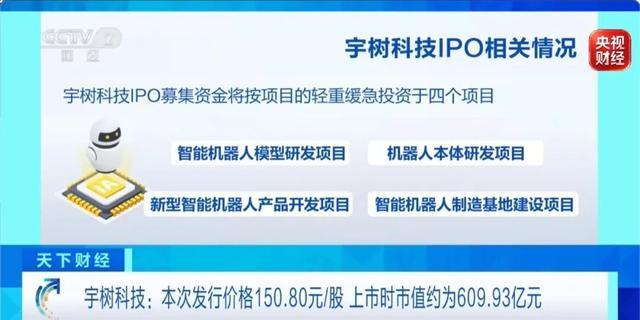
CCTV's report on Unitree. Source: CCTV

Some investors have already jokingly called this P/E ratio the "dream P/E ratio," meaning that at this price, you're not buying current profitability, but a distant dream.

2. Off-Market Quotes Are Even More Absurd Than the Issue Price

On overseas secondary market platforms like Hiive, Unitree's quote reached as high as 61.63 dollars per share during August 10-11. Based on this conversion, the overall valuation was close to 22.4 billion dollars, more than double the valuation corresponding to the issue price.

On Hyperliquid, the situation was even more extreme. Data as of the time of writing shows that the pre-market perpetual contract UNITREE-USDC for Unitree Technology once quoted around 90 dollars. Based on a total of 404 million shares, this corresponds to a market cap of approximately 35.47 billion dollars, or about 239 billion yuan, nearly four times the 60.993 billion yuan issuance market cap.
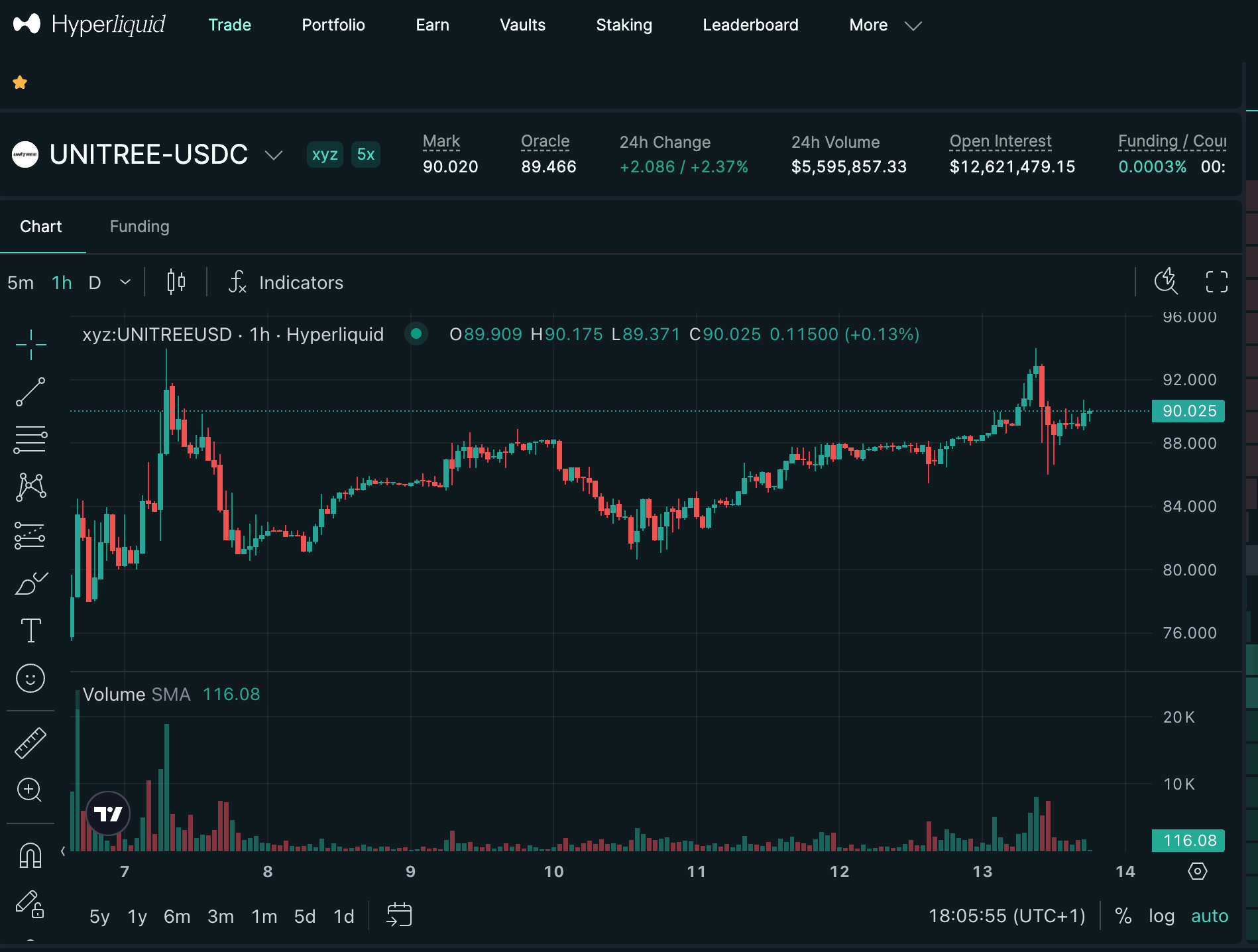
Unitree's pre-market quote on Hyperliquid. Source: Hyperliquid

But the sentiment it reflects is real: the market has priced an extreme amount of imagination into Unitree.

3. Only 3% of Robot Sales Are Actually for Industrialization

The narrative supporting this valuation is the story of humanoid robots entering factories on a large scale and replacing human labor. But opening Unitree's own prospectus reveals that this story is still just a story for now.

In the first nine months of 2025, 73.6% of Unitree's humanoid robot revenue came from scientific research and education scenarios, 17.4% from commercial exhibitions and performances. The revenue share from actual industrial application was only 9.01%. And within this 9%, revenue from actual work scenarios like manufacturing, inspection, and logistics was less than 3%, only 15.70 million yuan in the first nine months, with the majority of the remainder still being for corporate visit reception.

36Kr raised a pointed question in the article "Humanoid Robots: Not Yet 'Creating Prosperity,' But Already 'Creating Wealth'": "Does Unitree making money necessarily mean humanoid robots will definitely make money?" and provided specific data to support this doubt.

In the first nine months of 2025, scientific research and education accounted for 73.60% of humanoid robot business revenue, commercial consumption 17.39%, and industry application only 9.01%. And within this 9.01%, corporate tours accounted for 70%. Revenue actually used in defined industrial scenarios like intelligent manufacturing, intelligent inspection only amounted to 15.702 million yuan, accounting for 29.29% of industry application revenue.

The source of this data is actually Unitree's own written reply to the Shanghai Stock Exchange's second round of inquiry letter:
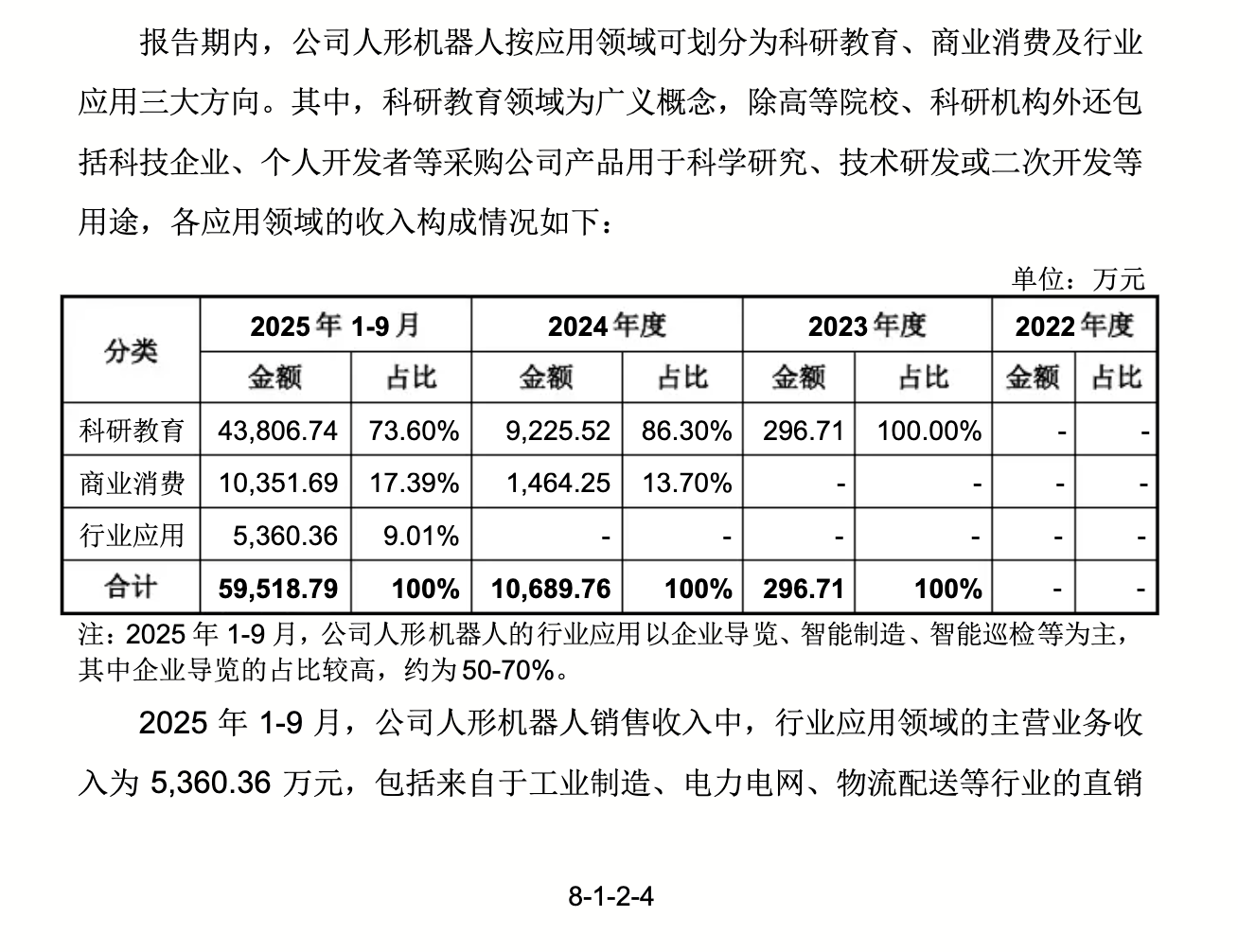
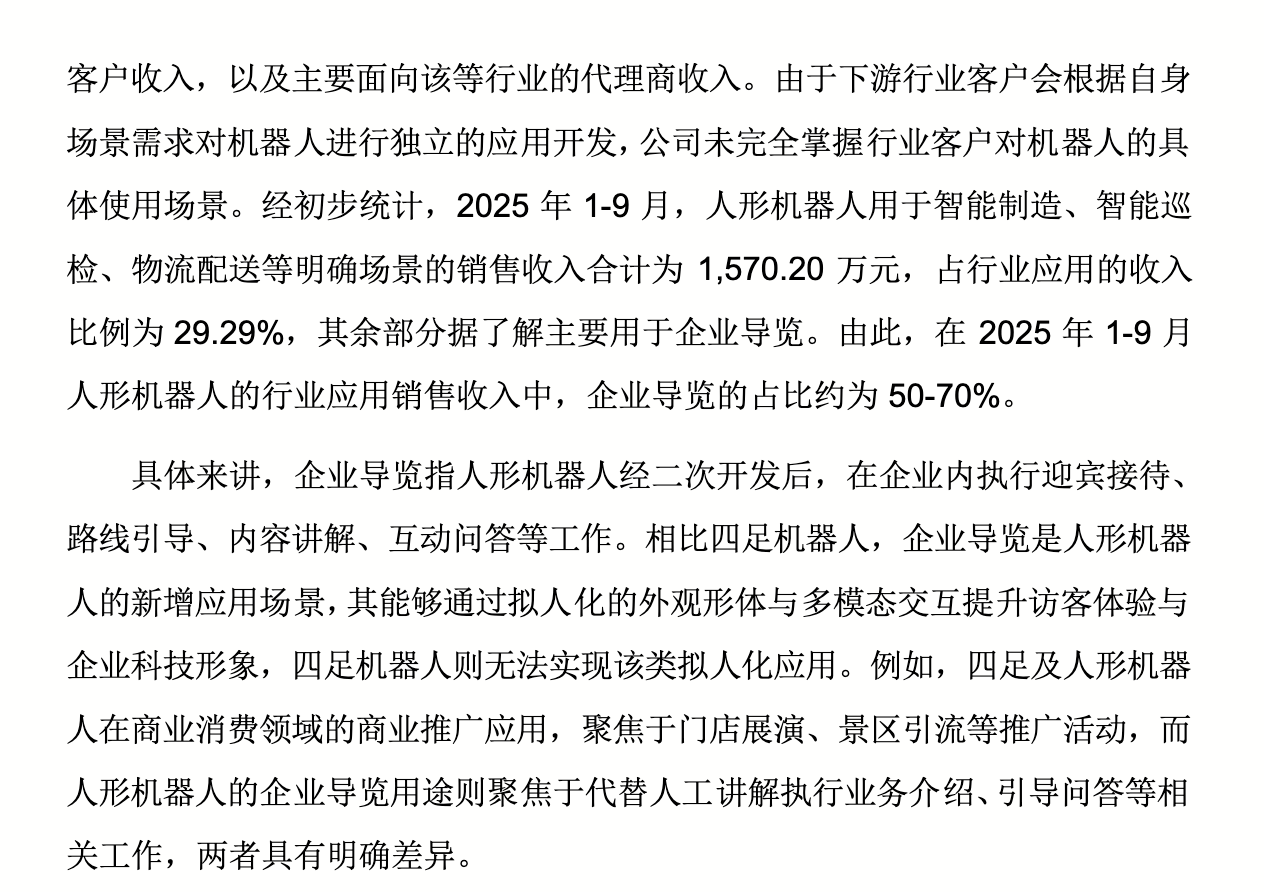
Unitree Technology's Reply Letter. Source: Shanghai Stock Exchange

In simple terms, the biggest buyers of humanoid robots currently are universities, research institutions, and tech companies, who buy robots for algorithm research, model training, teaching experiments. The demand in the research and education market is limited and could very quickly hit a ceiling.

And within this 9.01% industry application revenue, the portion corresponding to defined industrial scenarios like intelligent manufacturing, intelligent inspection, and logistics distribution is 15.702 million yuan, accounting for 29.29%. The remaining approximately 70%, according to the company's own statement, is "understood to be mainly used for corporate tours." So-called corporate tours refer to humanoid robots, after secondary development, performing tasks like reception, route guidance, content explanation, and interactive Q&A within companies, essentially being talking, walking exhibition pieces.

If you multiply the 9.01% industry application share by the roughly 70% corporate tours share, then a significant portion of revenue counted under the "industry application" statistic—which sounds like industrial deployment—is actually front desk reception and exhibition hall explanations, quite different from the imagined scenario of robots screwing screws or moving goods in factories.

Revenue that truly corresponds to intelligent manufacturing, intelligent inspection, and logistics distribution accounts for less than 3% of the company's total humanoid robot revenue.

The article also mentions that while competitor Ubtech's humanoid robots have frequently won large orders, its cumulative losses from 2020 to the first half of 2025 exceeded 5 billion yuan, and it has not yet turned a profit. For comparison, even with impressive orders, it doesn't mean the business is all set. Another analysis article on IPO subscriptions directly pointed out that scientific research and education is a good business, but it cannot support the premium in the 60.1 billion market cap related to "general-purpose robots entering every household." That part of the premium requires industrial scenarios and consumer markets to take over, and both are currently still in the pilot stage.

4. Slowing Profit Growth, Deteriorating Profit Quality

In the first quarter of this year, Unitree's revenue was 423 million yuan, a year-on-year increase of 68.49%, seemingly still strong. But compared to the 332.64% growth in Q1 2025, this is a cliff-like drop. Q1 non-GAAP net profit fell from 84.8365 million yuan in the same period last year to 40.2536 million yuan, a year-on-year decline of 52.55%, directly halved. The company's explanation is that R&D expenses increased year-on-year by a net 38.328 million yuan, mainly directed towards embodied AI large models, motion control algorithms, and body structure R&D, while intensive brand promotion on platforms like the CCTV Spring Festival Gala pushed up sales expenses.
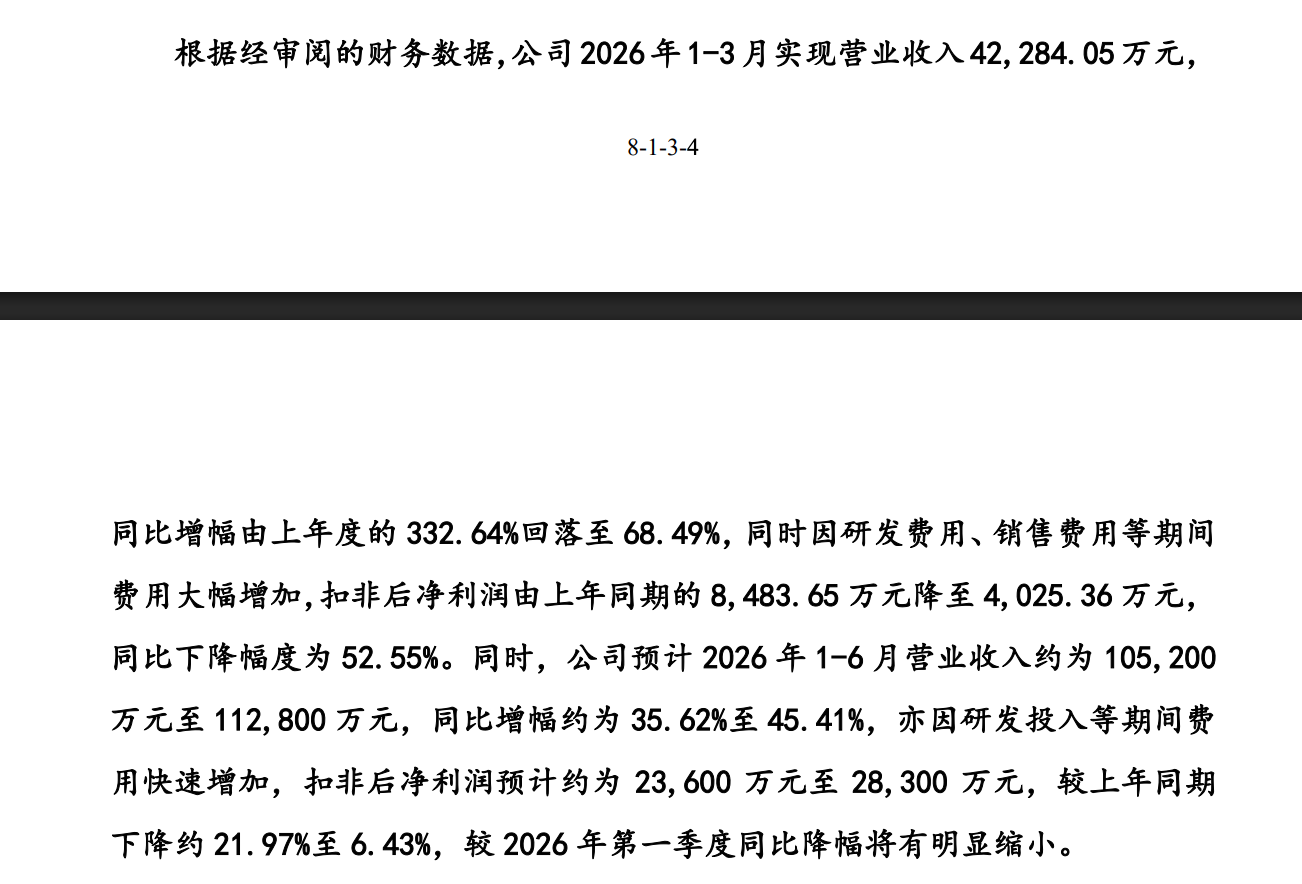
Unitree Technology Financial Reply Letter, Source: Shanghai Stock Exchange

Comparing the prospectus disclosed in March this year and the meeting draft disclosed in May, Unitree Technology made five modifications to its Special Risk Disclosure. The most critical one was adding a "Net Profit Year-on-Year Decrease Warning" and replacing the originally relatively broad "Risk of Technology Breakthrough and Product Innovation Falling Short of Expectations" with "Risk of Slowing Growth and Business Performance Fluctuations," placing it at the top of the seven special risk warnings. The prospectus also for the first time named Tesla as a threat, acknowledging that Tesla, leveraging mass production and supply chain integration capabilities, has started small-batch trial production of its humanoid robot Optimus Gen-3, with planned annual capacity reaching 1 million units. Once mass production is achieved, it will directly compete with Unitree.

Wang Feili, China Industrial Analyst at UBS Securities, mentioned that even if many manufacturers aim for shipments of ten thousand units this year, humanoid robots may not have truly reached a commercialization inflection point, because current industry orders are still mainly verification purchases, not expansion purchases based on productivity demand.

5. Institutions and Analysts' Bearish Views

Zhuo Wang, a partner at a Shanghai investment institution, told Reuters in an interview, "This IPO pricing is on the expensive side, the investment risk is already quite high," and pointed out that most of Unitree's sales revenue comes from research and exhibition scenarios, and true large-scale commercial application is still far away.

Even the relatively bullish Shenwan Hongyuan Research used cautious wording when commenting on this pricing, stating that the relatively high issuance valuation might draw market attention to the commercial value of the entire robot industry, thereby driving re-pricing of related stocks. Looking at this statement conversely, it can also be understood that Unitree's current commercial value itself still needs verification, and valuation has outpaced its business.

Research firm SemiAnalysis gave in its report that they estimate Unitree had only about 250 robots actually used in industrial scenarios in 2025, while annual shipments had already exceeded 5500 units, a relatively large discrepancy.

Conclusion: Valuation Ultimately Returns to Fundamentals

In the end, this round of pricing is largely the result of the combined push from the global humanoid robot frenzy and A-share retail investor sentiment. Since the beginning of this year, almost all companies tagged with "embodied intelligence," from Tesla Optimus to Zhiyuan, Dobot, and Yunsenchu, have been assigned far more imagination in the capital markets than their existing performance warrants.

For this bet to succeed, three assumptions need to materialize simultaneously: humanoid robot industry demand sees explosive growth in the short term, Unitree can defend its market share amid strong competitors like Zhiyuan Robot and Tesla Optimus, and it won't sacrifice its current high gross margin of around 60% due to price wars. All three conditions are indispensable, and each carries considerable uncertainty.

In the short term, constrained by structural factors like a small free float and index fund support, Unitree's stock price may not weaken immediately, and may even continue to rise in the initial post-listing period. But in the medium term, once these structural supporting forces fade over time, especially as the one-year post-listing lock-up period for institutional shares approaches, valuation will ultimately have to return to fundamentals for examination. If by then the revenue share from industrial scenarios has not significantly improved and profit growth continues to decline, this currently dream-based high valuation will likely experience a significant correction.

How similar this is to the trajectory of most crypto assets...

Perguntas relacionadas

QWhat is the key concern raised about Unitree's valuation based on its P/E ratio?

AThe key concern is that Unitree's P/E ratio of 219.23 times is significantly higher than the industry average of 38.56 times for the general equipment manufacturing sector, which is about 5.7 times the industry norm. This suggests its valuation is heavily based on future expectations rather than current profitability.

QWhat evidence does the article provide to challenge the narrative of large-scale industrial adoption of Unitree's humanoid robots?

AThe article cites Unitree's own prospectus data showing that in the first nine months of 2025, only 9.01% of humanoid robot revenue came from industry applications. Within that segment, roughly 70% was from enterprise tours and reception (e.g., guides, exhibits), with revenue from actual industrial scenarios like manufacturing, inspection, and logistics amounting to only 15.7 million RMB, accounting for less than 3% of total humanoid robot revenue.

QHow does Unitree's pre-market price on Hyperliquid compare to its official IPO valuation, and what does this indicate?

AOn the Hyperliquid perpetual contract platform, Unitree's pre-market price reached around $90, translating to a market cap of approximately 239 billion RMB. This is nearly four times its official IPO market cap of 60.993 billion RMB. This extreme premium indicates highly speculative and optimistic market sentiment that has vastly outpaced the official valuation.

QWhat negative trend in Unitree's financial performance is highlighted in the article?

AThe article highlights a sharp decline in profit growth. In Q1, while revenue grew 68.49% year-over-year, the growth rate slowed dramatically from 332.64% in Q1 2025. More critically, non-GAAP net profit fell by 52.55% to 40.2536 million RMB, attributed to increased R&D and marketing expenses.

QAccording to the article's conclusion, what three conditions must be met for Unitree's high valuation to be justified?

AThe article concludes that justifying the high valuation requires three simultaneous conditions: 1) The humanoid robot industry must experience explosive demand growth in the short term. 2) Unitree must maintain its market share against strong competitors like Tesla's Optimus and Zhiyuan Robot. 3) Unitree must avoid sacrificing its current high gross margin of around 60% in potential price wars. The article notes significant uncertainty for each condition.

Leituras Relacionadas

The U.S. Payment System Collectively Shut Down Over Weekends, This Settlement Network Keeps the Dollar Running 24/7

The U.S. dollar's traditional settlement systems, like Fedwire, T2, and CHAPS, shut down for 44 to 60 hours every weekend, creating a void in round-the-clock markets. This vacuum is being filled by crypto-based dollar stablecoins. A key example is the Tempo settlement network, which saw $447 million of the newly launched Open USD stablecoin flow onto its platform just one day after its debut. Open USD is a consortium-backed stablecoin initiated by companies like Coinbase, Stripe, and Visa. Tempo addresses three major friction points in traditional finance: weekend closures, cross-border delays, and siloed bank ledgers. It enables near-instant, low-cost settlements 24/7, contrasting with the slow evolution of legacy systems (e.g., Fedwire plans to add Sunday hours only by 2028/2029). For cross-border payments, which often fail to meet speed targets, Tempo eliminates the need for pre-funded nostro accounts, freeing up working capital. The network differentiates itself through "liquidity mobility"—allowing the same cash pool to settle various transactions (e.g., repo trades,跨境 payments, margin calls) without re-issuance. It separates private execution in "Zones" from shared settlement. Tempo's business model involves minimal transaction fees, with revenue from API access and consulting, and notably, it has no native token. While current stablecoin payment volume is a tiny fraction of global financial flows, the rapid adoption by major financial players and infrastructure like Tempo signals an early collision between traditional finance and crypto-based settlement rails.

marsbitHá 13m

The U.S. Payment System Collectively Shut Down Over Weekends, This Settlement Network Keeps the Dollar Running 24/7

marsbitHá 13m

Pearl: Can You Simultaneously Conduct AI Inference and Mine Cryptocurrency? | Project Introduction

Pearl: Can AI Inference and Mining Really Be Done Simultaneously? A Project Introduction Pearl is a new proof-of-work (PoW) blockchain that aims to merge cryptocurrency mining with useful AI computation. Its core idea is to replace the traditional, arbitrary cryptographic hashing in PoW (like Bitcoin's) with matrix multiplications—the fundamental operation in neural network inference. In theory, a GPU performing these multiplications for an AI task (like generating text) could simultaneously be participating in block validation and earning the native PRL token. This proposes a "2-for-1" scenario where one unit of energy produces both AI output and cryptocurrency. The concept tackles the perceived "waste" in traditional PoW by making the computation useful. However, the critical challenge lies in ensuring this useful work is performed in a trustless, permissionless manner like Bitcoin. Pearl's protocol uses cryptographic techniques (adding verifiable "noise" to matrices and requiring proofs for small slices of the calculation) to prevent miners from cheating by using easily computable random numbers instead of genuine AI model weights and data. Despite the technical design, current network data suggests a significant gap between theory and practice. Analysis indicates the vast majority of the network's substantial computing power (tens of Exahashes) is still spent on multiplying randomly generated matrices, not on processing real AI inference requests. The "useful" output of the network is currently near zero. This happens because the protocol verifies the computational work (the multiplication) but cannot inherently verify the semantic usefulness or origin of the input data. Miners economically optimize for the block reward, not for producing usable AI results. Pearl's development includes releasing certified variants of open-source AI models (like Llama, Qwen) optimized for its system and partnerships (e.g., with Together AI) to offer discounted inference services subsidized by the future value of PRL tokens. The project bets that a future surge in scalable, low-latency AI inference demand will make it more profitable for miners to run real models than random data, aligning the network's security with productive output. Until then, it operates primarily as a GPU mining chain with a different, AI-compatible algorithm.

marsbitHá 53m

Pearl: Can You Simultaneously Conduct AI Inference and Mine Cryptocurrency? | Project Introduction

marsbitHá 53m

September US Bond Sell-off: Not Inflation Expectations, But Soaring Real Interest Rates

In September, the U.S. Treasury market experienced a significant sell-off. The yield on the 10-year Treasury surged from 4.75% to 5.29%, a 54 basis point increase. However, analysis reveals that over 90% of this rise, about 49 bps, came from a jump in real yields (as measured by TIPS), while market-implied inflation compensation rose only slightly by about 5 bps. This indicates the sell-off was driven primarily by a spike in real interest rates, not renewed inflation fears. This raises a key question: why is the market demanding higher real returns? Explanations could include stronger growth expectations, monetary policy adjustments, or higher risk premiums for holding long-term bonds. Notably, this bond market stress coincided with strong performance in AI-related tech stocks, particularly semiconductors, while other rate-sensitive sectors declined. This divergence suggests investors are pricing in vastly different futures for different assets. QuantStreet Capital's Harry Mamaysky proposes one explanation: the market may be repricing for both stronger future economic growth and the massive capital demands from Big Tech's AI infrastructure expansion. In this view, higher real rates and strong AI stocks aren't contradictory if investors believe future AI-driven profit growth can offset higher financing and discount rates. Yet, this remains a theory. Rising real yields could also reflect an increase in the term premium—the extra compensation investors require for holding long-term bonds—due to fiscal concerns or market volatility, rather than pure growth optimism. This distinction is crucial: if driven by growth, higher rates can coexist with rising equity valuations; if driven by a higher term premium, it could pressure corporate profits and asset prices more broadly. The critical unresolved issue is whether the market's demand for higher real returns stems from confidence in future economic profits (especially from AI diffusion) or from a reassessment of the risks of holding long-term assets. The answer will define the path for bonds, stocks, and the ongoing AI investment cycle.

marsbitHá 1h

September US Bond Sell-off: Not Inflation Expectations, But Soaring Real Interest Rates

marsbitHá 1h

Goldman Sachs Research Report Interpretation: Dell Delivers 4 to 6 Weeks Faster Than Peers, Memory Is the 2027 Bottleneck

Goldman Sachs Research Report Summary: Dell's Competitive Edge and Future Outlook (Based on October 8, 2026 Report) Dell maintains a competitive advantage in AI server delivery, with a lead time approximately 4-6 weeks faster than its competitors. This speed-to-market allows customers to generate revenue from their infrastructure sooner, supporting Dell's premium pricing relative to other OEMs and ODMs. Goldman Sachs reiterates a Buy rating with a $570 price target. Key points from the report, based on a management meeting at Dell's headquarters, include: * **Extended Competitive Moat:** Dell's leadership extends beyond component procurement to differentiated capabilities in system design, supply chain, manufacturing, and deployment. The company's scale and pre-integration testing enable faster deployment of large clusters. * **2027 Memory Bottleneck:** Supply remains a primary constraint for AI infrastructure growth. Dell expects memory supply tightness to persist into 2027, with demand growth outpacing supply improvements. Its scale and direct sales model provide early visibility into demand shifts, aiding in prioritizing allocations for AI/server opportunities over weaker segments like PCs. * **Profitability Drivers:** Future margin expansion is expected to be driven primarily by storage solutions (leveraging Dell's own IP like PowerScale) and operational leverage. AI server margins are maintained in the mid-single-digit range, seen as a balance between profitability and competitive positioning. Component cost fluctuations, especially for memory, are passed through to customers. * **Enterprise AI Adoption:** Enterprise AI adoption is still in early stages. Dell believes successful deployment requires data preparation and business process redesign, not just compute infrastructure. A hybrid architecture model is anticipated, combining cloud-based cutting-edge models with on-premise open-source models for cost control and security. The report concludes that the sustainability of Dell's premium pricing hinges on maintaining its delivery speed, order quality, and storage attach rates, with 2027 memory supply being a critical near-term factor to watch. *Disclaimer: This summary is based on a third-party Goldman Sachs research report dated October 8, 2026, and is for informational purposes only.*

marsbitHá 1h

Goldman Sachs Research Report Interpretation: Dell Delivers 4 to 6 Weeks Faster Than Peers, Memory Is the 2027 Bottleneck

marsbitHá 1h

U.S. Treasury Yields Soar, Why Can AI Stocks Continue to Rise?

In September, U.S. financial markets experienced a notable divergence: while long-term Treasury yields surged dramatically—the 10-year yield rising over 50 basis points—and fixed-income assets declined, AI-related and semiconductor stocks continued to rally, with the Nasdaq holding relatively firm. In contrast, small and mid-cap stocks, the equal-weight S&P 500, and rate-sensitive sectors lagged. This dynamic raises a key question: if higher interest rates typically pressure equity valuations by raising discount rates, why have tech stocks remained strong? The article, referencing analysis from QuantStreet Capital, suggests one interpretation: markets may be pricing in sufficiently high future earnings growth from AI, potentially enough to offset the valuation drag from elevated rates. However, a deeper puzzle emerges. The market optimism appears concentrated in AI infrastructure suppliers like semiconductor firms, which directly benefit from soaring capital expenditure (Capex) on data centers and chips. There is little evidence yet of this enthusiasm spreading to the broader corporate sector (the "Rest of the Corporate Sector"), whose future profits are supposed to ultimately justify these massive AI investments. This highlights the critical uncertainty in the AI investment thesis: who ultimately captures the economic value? While chipmakers see near-term revenue, the long-term sustainability depends on whether AI adoption boosts productivity and profitability for the wider economy, enabling end-user companies to bear the high costs. Preliminary productivity data shows some improvement, but direct evidence of AI-driven profit gains outside the tech sector remains sparse. Moving forward, key signals to watch include: the sustainability of AI infrastructure spending, evidence of AI translating into improved profitability for non-tech companies, and whether the rise in long-term yields reflects strong growth expectations or other risks like fiscal concerns. The current market behavior suggests confidence in the AI builders, but the broader payoff from AI—essential for justifying current valuations—is still pending confirmation.

marsbitHá 1h

U.S. Treasury Yields Soar, Why Can AI Stocks Continue to Rise?

marsbitHá 1h

Trading

Spot
活动图片