With Less Than 1% Support, Will BIP-110 Still Force a Bitcoin Soft Fork?

Odaily星球日报Publicado em 2026-07-17Última atualização em 2026-07-17

Resumo

**English Summary:** Despite garnering minimal support (less than 1% from miners and around 14.6% of nodes), the controversial BIP-110 proposal is poised to enter its "forced activation" window in early August. Proposed in December 2025 by Dathon Ohm and backed by Bitcoin Core developer Luke Dashjr, BIP-110 aims to temporarily restrict non-monetary data (like Ordinals and Bitcoin NFTs) in transactions for one year to reduce network "spam" and refocus Bitcoin on its monetary function. The proposal's contentious mechanism means that supporting nodes will enforce the new rules starting at block height 965,664 (late August/early September), even without reaching the 55% activation threshold. This will likely cause a chain split between nodes enforcing BIP-110 and the main chain. **Supporters**, led by Luke Dashjr and his Ocean mining pool, view BIP-110 as a necessary correction to stop what they consider an "attack" on Bitcoin—the use of block space for data storage, which they argue drives up transaction fees and burdens nodes. They believe the stricter BIP-110 chain could eventually become the longest chain. **Opponents**, including figures like Adam Back, Jameson Lopp, and Michael Saylor, argue that BIP-110 fails to solve core issues while creating new risks. Their concerns include stifling future innovation (e.g., hindering BitVM), compromising Bitcoin's censorship-resistant and decentralized ethos, introducing potential chain-split uncertainties like double-spend risks, ...

Original | Odaily Planet Daily (@OdailyChina)

Author | Golem (@web3_golem)
As the mandatory activation window in August approaches, discussions around the BIP-110 proposal have recently heated up again.

BIP-110 was proposed by Dathon Ohm in December 2025 and is supported by Bitcoin Core developer Luke Dashjr. This proposal aims to limit arbitrary/non-monetary data in Bitcoin transactions over the next year, primarily targeting large data storage like Ordinals and Bitcoin NFTs, in hopes of reducing "spam transactions" in the network and keeping Bitcoin focused on its monetary function.

This proposal has been controversial since its introduction, but data shows that BIP-110 currently lacks mainstream support from miners and nodes. The activation threshold for BIP-110 is 55%. According to statistics, current miner support is less than 1%. Out of a total of 102,674 nodes in the network, only 15,035 nodes are willing to enforce BIP-110, a ratio of 14.64%.
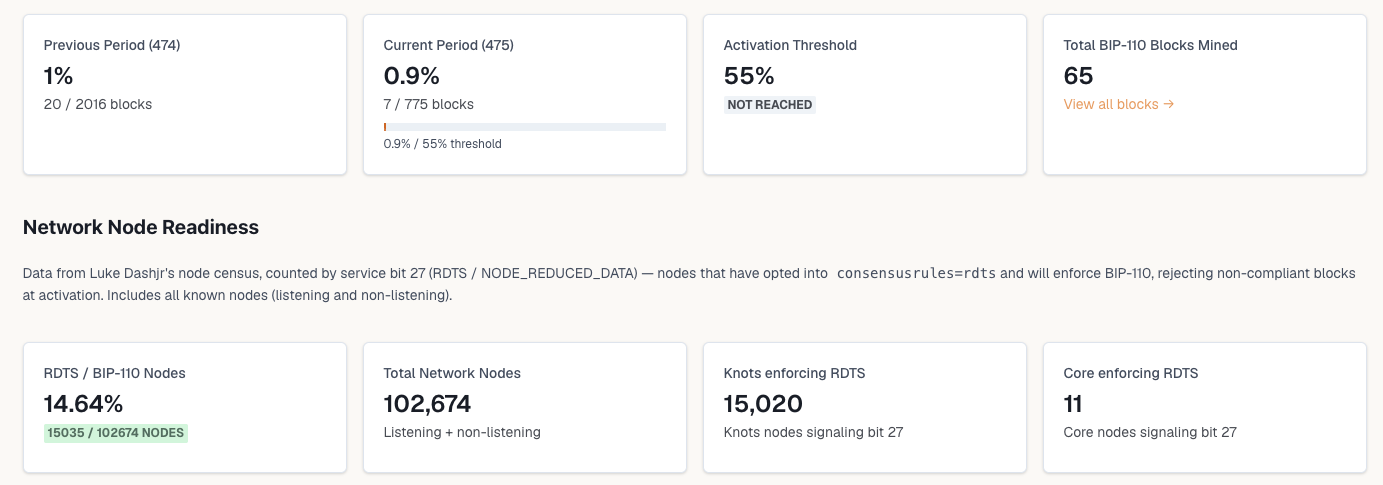
BIP-110 Miner and Node Support Rate

Typically, a proposal with such low support cannot pass on the Bitcoin network. However, the audacious aspect of BIP-110 is that even without achieving consensus, nodes supporting BIP-110 will enforce it. If BIP-110 does not reach the 55% activation threshold before block height 961,632, it will enter a mandatory activation window (block heights 961,632-963,647). During this period, nodes running BIP-110 will reject non-compliant blocks, forcibly pushing the acceptance rate to 100%, enabling BIP-110 to be ultimately activated and enforced at block height 965,664.

At the current Bitcoin network block production rate, BIP-110 will enter its mandatory activation window in early August. This means that although BIP-110 is a soft fork proposal, the Bitcoin network will still experience a chain split (a minority chain supporting BIP-110 and the main chain not supporting it) at that time.

BIP-110 Continuous Controversy

According to Bitcoin's "longest chain rule," a soft fork only succeeds—meaning the entire network unifies under the new rules—when miners supporting BIP-110 (or, more accurately, the proposed changes) actually possess a majority (>50%) of the hash rate, allowing their chain to become the longest chain. Therefore, although the forced activation of BIP-110 seems inevitable, its ultimate persistence still depends on consensus. Otherwise, BIP-110 will likely meet the same fate as the vast majority of Bitcoin soft forks in history: dying out naturally.

Supporters: BIP-110 is not a change, but a negation of a change

The main representatives of the BIP-110 supporters are Luke Dashjr and his mining pool, Ocean. Luke Dashjr has long been a vocal opponent of BRC-20 and inscriptions within the Bitcoin developer community and provided initial suggestions for the BIP-110 proposal.

Luke Dashjr is considered a representative figure of Bitcoin maximalism or fundamentalism. They are unwilling to see Bitcoin block space used for any purpose other than Bitcoin transfers. In the BIP-110 proposal, inscriptions that emerged in 2022 are viewed as a type of "Bitcoin attack." The rationale is that allowing arbitrary data to be embedded in Bitcoin transactions creates a massive and unnecessary burden for nodes. Furthermore, this "junk data" occupies a significant amount of block space, forcing monetary transactions to raise their fee bids to be included in a block, thereby crowding out Bitcoin's monetary use.

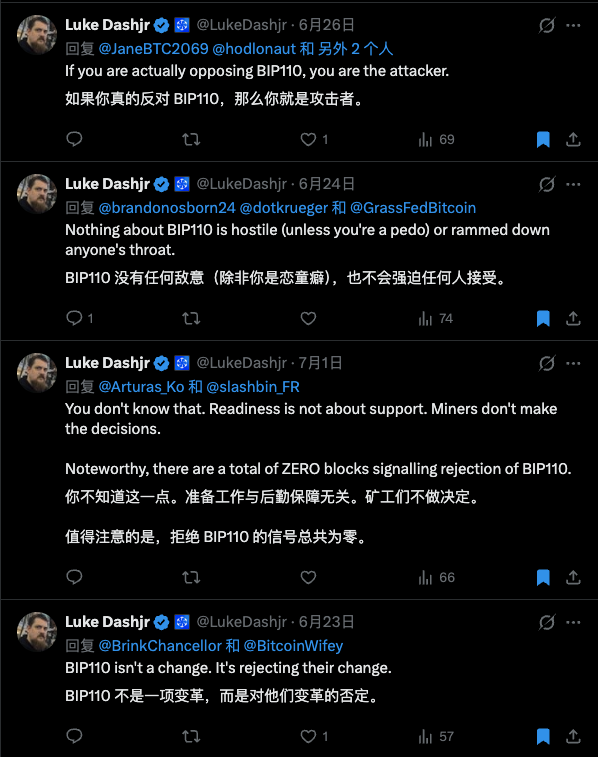
Therefore, Luke Dashjr posted on platform X, stating that BIP-110 is not a change, but a negation of a change. When facing opposition to BIP-110, he also employs sophistry, claiming on one hand that BIP-110 has no hostility and does not force anyone to accept it, and on the other hand, asserting that those who oppose BIP-110 are the true attackers of Bitcoin.

Moreover, although the current voting rate of miners approving BIP-110 is very low (<1%), Luke Dashjr remains optimistic, pointing out that the direct opposition voting rate among miners is also nearly 0%. The implication is that miners are not making a decision; once BIP-110 activates, they will naturally follow.
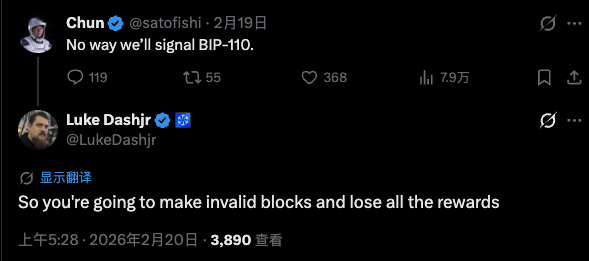
Looking at reality, as of now, the only mining pool publicly supporting BIP-110 is Luke Dashjr's own Ocean. F2Pool co-founder Wang Chun publicly stated back in February that they would absolutely not support BIP-110. Luke Dashjr confidently replied under that post, "Then you will mine invalid blocks and lose all your rewards."
According to miningradar data, F2Pool is the third-largest Bitcoin mining pool globally, with a hash rate share of 13.6%. Meanwhile, Ocean's current hash rate is only 24.6 EH/s, accounting for 2.6% of the network's total hash rate.
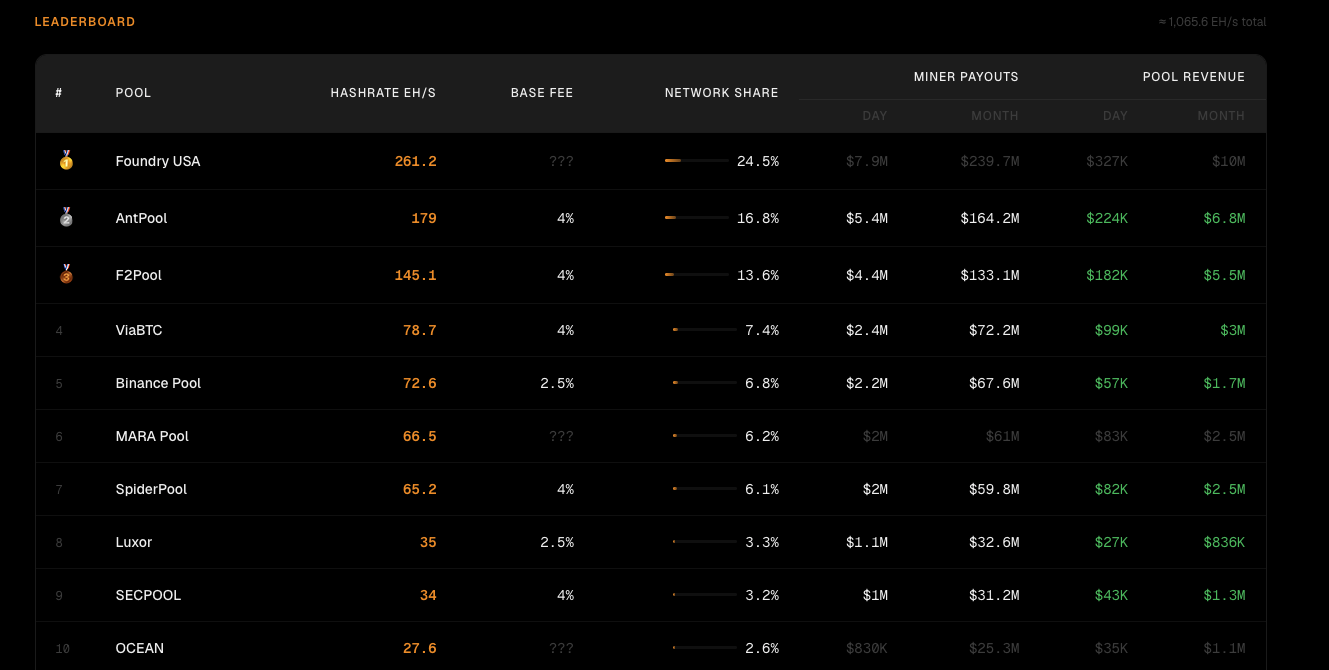
Bitcoin Mining Pool Rankings

If Ocean ultimately becomes the only pool supporting the fork, they would only produce 3-5 blocks per day. Such efficiency and block production speed would be insufficient to become the "longest chain" on the Bitcoin network.

Opponents: BIP-110 Doesn't Solve the Problem and Creates More New Issues

Opponents of the BIP-110 proposal not only focus on whether BIP-110 will be successful after activation but also criticize it for failing to solve the "spam transaction" problem on the Bitcoin network while simultaneously creating many potential new issues. In short, BIP-110 opponents are strongly opposing it out of concern for various unintended consequences, not out of any attachment to Ordinals or inscriptions. Key figures among the opponents include cypherpunk pioneer Adam Back, Bitcoin Core developer Jameson Lopp, and MicroStrategy founder Michael Saylor.

Firstly, opponents argue that BIP-110 cannot completely solve the "spam transaction" issue facing the Bitcoin network; the author of the BIP-110 proposal also admits it can only provide temporary relief. Jameson Lopp believes that Bitcoin's block size limit and the fee market for block space have already mitigated the spam transaction problem to some extent. However, Bitcoin remains a target for various spam transaction attacks primarily because very few people actually use the Bitcoin network regularly, keeping transaction fees consistently low. This prevents the formation of sufficient fee pressure to deter most spam transactions.

Furthermore, BIP-110 could stifle future innovation on Bitcoin. The BIP-110 proposal itself acknowledges that restrictions on Taproot would hinder the implementation of advanced functionalities or complex contracts like BitVM on the Bitcoin network. Although BIP-110 is described as a one-year temporary restriction, Jameson Lopp believes this is merely a delaying tactic by Luke Dashjr. If these restrictions severely constrain future Bitcoin upgrades, it could ultimately lead to a Bitcoin hard fork rather than a soft fork.

Adam Back focuses more on Bitcoin's censorship resistance and decentralized spirit. He argues that BIP-110 would subjectively censor transactions within blocks, fundamentally aiming to regulate others. This goes against the neutrality and censorship-resistant spirit Bitcoin has upheld since its inception, representing a dangerous step towards centralization and control. Adam Back uses Bitcoin's original principles to negate the changes proposed by Bitcoin extremists, essentially "using magic to defeat magic."

Michael Saylor summarizes BIP-110 as a "Bitcoin Iatrogenic Proposal," implying that the "treatment" (BIP-110) itself would harm Bitcoin rather than solve existing problems.
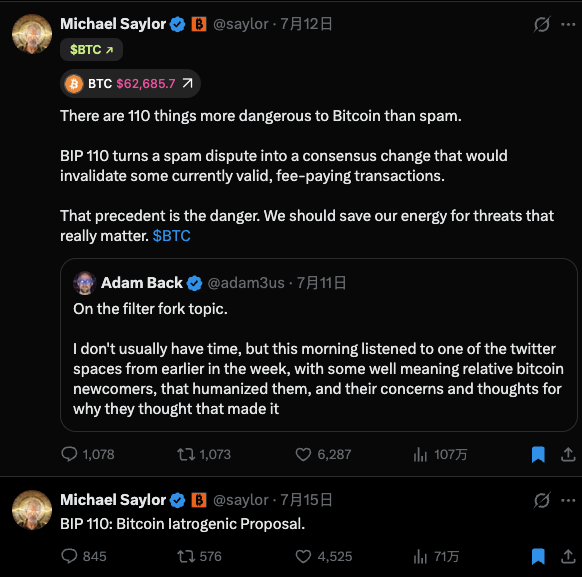
Michael Saylor also believes that if BIP-110 were to become consensus, some valid paid transactions would become invalid, and setting this precedent for censorship is the true danger.

Opponents have another major concern: the serious consequence that activating BIP-110 could split the Bitcoin chain ecosystem. Two competing chains would emerge, vying for the status of the "real Bitcoin." In such a scenario, uncertainty about the fork's outcome could create a risk of Bitcoin double-spending. Even without causing double-spending, if BIP-110 ultimately evolves into a new chain, it would split Bitcoin's developer resources, hash rate resources, and monetary consensus.

Opponents believe BIP-110 is attempting to use a technical solution to address a cultural problem, potentially generating more unpredictable issues in the process.

Despite these concerns, opponents are confident about BIP-110's failure. Jameson Lopp made a bet against BIP-110 back in February, with a minimum wager of 1 BTC. So far, no BIP-110 supporter has publicly accepted the bet.
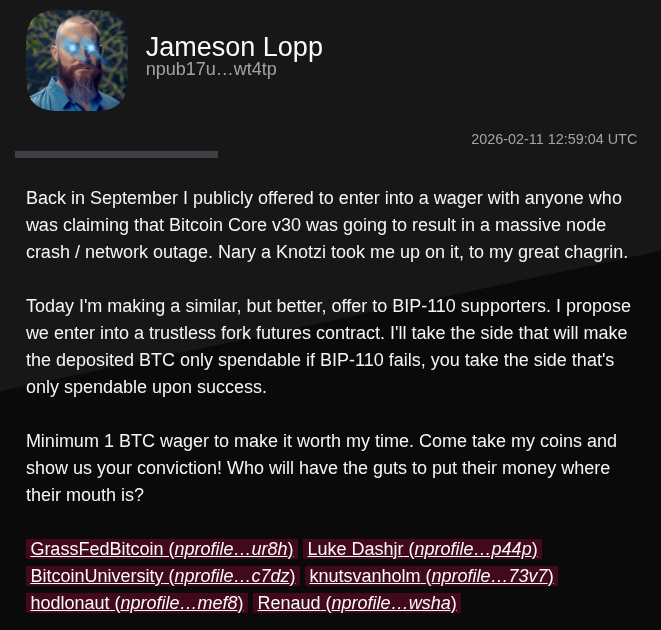
Jameson Lopp's Wager Invitation to BIP-110 Supporters

On the prediction market Predyx, the probability for "BIP-110 will activate and be enforced on Bitcoin between September 1-7, 2026" is 10%. The settlement condition for "Yes" is that the BIP-110 chain must become the "Bitcoin longest chain" and be accepted by most nodes.
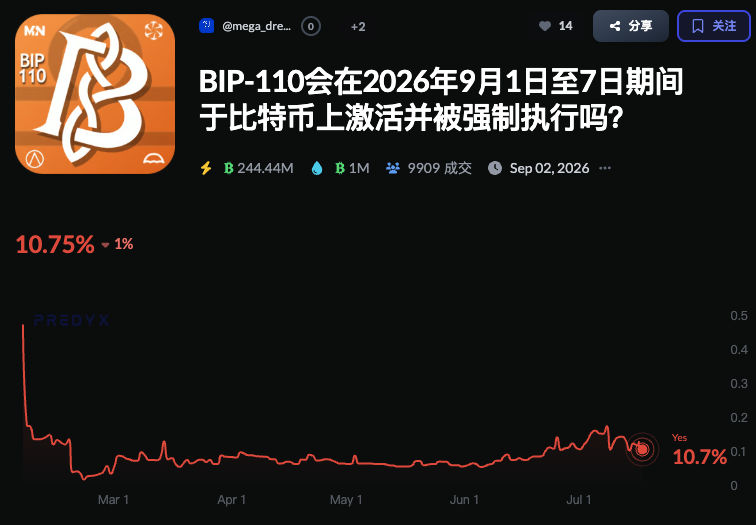
What Happens After BIP-110 Activates?

We can now consider several hypothetical scenarios for what might happen when BIP-110 is ultimately forcibly activated at block height 965,664 (late August to early September).

The first scenario is as described above. After reaching the activation height, BIP-110 nodes reject main chain blocks, but there aren't enough miners producing new blocks that comply with BIP-110 rules. The BIP-110 chain's block production speed would be extremely slow, eventually stopping altogether and ceasing to "grow."

The second scenario assumes a certain proportion of miners support BIP-110. BIP-110 supporters believe they possess an "asymmetric advantage" because BIP-110 rules are stricter. Therefore, while BIP-110 nodes will reject blocks containing违规数据 (inscriptions, etc.), non-BIP-110 nodes (mainstream Core nodes) will consider blocks produced by BIP-110 nodes as valid.

Moreover, currently, inscription transactions only account for about 5% of Bitcoin block space usage, with over 95% being traditional Bitcoin transfer transactions. BIP-110 nodes would still receive a large number of mainstream blocks. This is why Luke Dashjr believes BIP-110 will ultimately become the "longest chain" and unify the network.
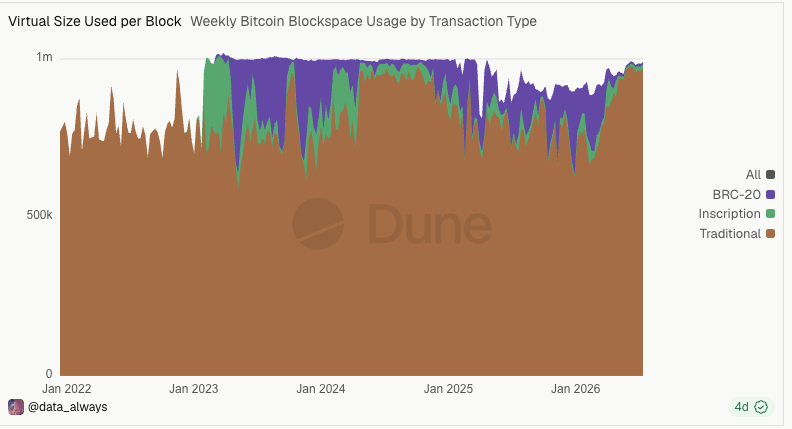
Bitcoin Block Space Usage by Transaction Type

The third scenario involves a certain proportion of miners supporting BIP-110, but their hash rate never surpasses that of the existing majority chain. Typically, miners are highly rational because their machines incur electricity costs as soon as they are turned on. In a competition between two chains, miners weigh the pros and cons. Miners on the BIP-110 chain might find it easier to abandon sunk costs (mining rewards on the minority chain) and join the majority chain, as the minority chain not only lags in length but also accumulates fewer Bitcoin rewards than the majority chain. This would ultimately lead to the first scenario.

Now, assuming Luke Dashjr has immense influence and miners act irrationally, persisting in mining on the BIP-110 chain, what would happen? This chain would continue to operate independently, but block times could be very slow. Miners would essentially be mining for the sake of ideology, consuming energy meaninglessly. The most plausible outcome in this situation is that the BIP-110 chain, driven by its supporters, permanently forks into an independent chain, "manually" adjusts its difficulty, and launches a new network token.

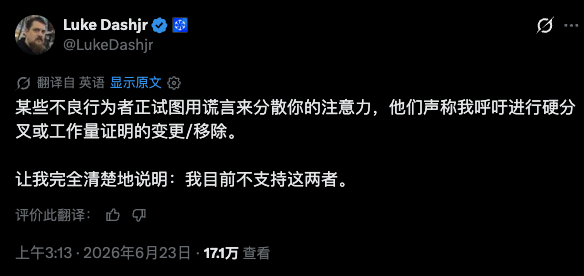
However, Luke Dashjr has repeatedly emphasized his refusal to hard fork for BIP-110, believing it's not yet time to use that method. Public sentiment can be a double-edged sword. At that point, even Luke Dashjr might be carried away by the will of the crowd, finding the arrow already on the bowstring and having to release it.
Therefore, the minority chain run by BIP-110 supporters can technically continue to operate, but it will likely struggle to thrive, as that depends on economic and ecosystem factors, including support from wallets, exchanges, users, etc. There are many such examples on the Bitcoin network; most ultimately fail. Even those that succeed rarely reach heights beyond independent coins like BCH or BSV.

Criptomoedas em alta

Perguntas relacionadas

QWhat is BIP-110 and what is its main objective?

ABIP-110 is a proposal introduced by Dathon Ohm in December 2025, supported by Bitcoin Core developer Luke Dashjr. Its main objective is to limit arbitrary/non-monetary data in Bitcoin transactions, particularly targeting large data storage like Ordinals and Bitcoin NFTs, over the next year. The aim is to reduce 'spam transactions' on the network and refocus Bitcoin on its monetary function.

QAccording to the article, what are the current support levels for BIP-110 among miners and nodes?

AThe current support levels for BIP-110 are very low. The activation threshold is 55%, but miner support is reportedly under 1%. Out of 102,674 total nodes, only 15,035 nodes (approximately 14.64%) are willing to enforce BIP-110.

QWhat is the 'forced activation period' for BIP-110, and what is the primary concern about this period?

AThe 'forced activation period' for BIP-110 is between block heights 961,632 and 963,647, which is expected around early August. The primary concern is that during this period, nodes running BIP-110 will reject non-compliant blocks, attempting to force the adoption rate to 100% and activate BIP-110 by block height 965,664. This could lead to a chain split between the minority chain supporting BIP-110 and the main chain that does not.

QWho are some prominent opponents of BIP-110, and what are their main arguments against it?

AProminent opponents include cypherpunk pioneer Adam Back, Bitcoin Core developer Jameson Lopp, and MicroStrategy founder Michael Saylor. Their main arguments are: 1) BIP-110 doesn't fully solve the spam transaction problem and could create new issues. 2) It could stifle future innovation on Bitcoin (e.g., hindering BitVM). 3) It introduces subjective transaction censorship, contradicting Bitcoin's neutral and censorship-resistant principles. 4) It risks splitting the Bitcoin ecosystem and consensus, potentially creating two competing chains.

QWhat are the possible scenarios described in the article for what could happen after BIP-110 is forcibly activated?

AThe article outlines three possible scenarios: 1) BIP-110 nodes reject main chain blocks, but without enough miner support to produce compliant blocks, the BIP-110 chain stops growing and 'dies naturally.' 2) A significant portion of miners supports BIP-110. Due to its stricter rules, its blocks are valid on the main chain, potentially allowing it to become the longest chain. 3) Some miners support BIP-110, but their hash power never surpasses the majority chain. Rational miners would eventually switch to the more profitable main chain, leading again to scenario 1. A fourth implied scenario is a permanent hard fork creating a separate chain, though Luke Dashjr has stated opposition to this.

Leituras Relacionadas

From Somersaults to Working 24/7: We Saw the ‘Working-Class’ Aura in Robots at WAIC

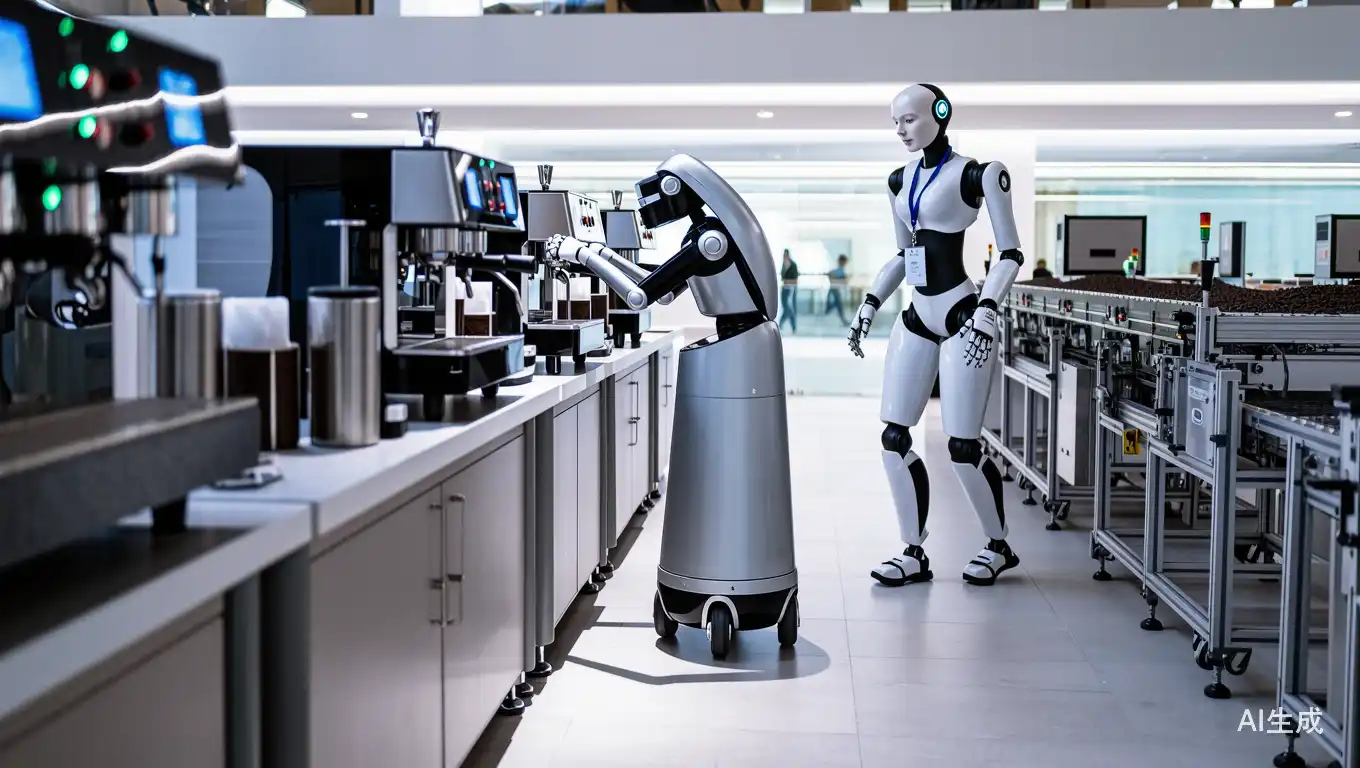
From performing acrobatics to working 24/7: Robots at WAIC are getting down to business. This year's World Artificial Intelligence Conference (WAIC) in Shanghai showcased a significant shift in the robotics industry. While "show-off" robots that dance, play music, or compete in sports are still present, the dominant trend is now practical, task-oriented machines. Hundreds of wheeled and humanoid robots were deployed as guides, baristas, factory workers, and even traffic controllers, moving beyond mere demonstrations to highlight real-world "work capabilities." The focus has pivoted from showcasing technical parameters to pursuing mass production and industrial落地 (landing/implementation). This transition presents major challenges. First, deploying powerful AI models onto robots requires overcoming hardware limitations in computing power and latency. Second, robots demand complex, integrated systems for real-time perception and control. Third, achieving reliable mass production necessitates unprecedented industry-wide collaboration on standards and supply chains. A key bottleneck identified by industry leaders is the robot's "brain"—its AI and cognitive capabilities. While hardware and basic movement ("little brain") have advanced rapidly, the higher-level intelligence for understanding complex instructions and adapting to unstructured environments is progressing more slowly. Companies are investing heavily in developing more advanced "brain" systems, but fully autonomous operation in dynamic settings remains a work in progress. Cost is another critical hurdle. While some consumer-oriented humanoid robots are now priced under $15,000, capable industrial models often cost $50,000 or more. The industry consensus is that bringing robots into unstructured home environments for tasks like comprehensive cleaning is still at least five years away due to technical, safety, and cost barriers. Therefore, 2026 is being called the "first year of mass production," but primarily for industrial and specific commercial applications. WAIC 2026 served less as a stage for spectacular tricks and more as a serious examination of robots' commercial viability, marking their transition from laboratory prototypes to real-world products that must prove their value through stable, repetitive work.

marsbitHá 2h

From Somersaults to Working 24/7: We Saw the ‘Working-Class’ Aura in Robots at WAIC

marsbitHá 2h

Live-Action Short Series Forced onto the Big Screen by AI

Live-action short dramas, originally a popular online format, are now attempting to enter the cinema. Several top IPs like "What a Good Girl" and "One Family, Same Class" have received approval for film adaptations. This shift is driven by several pressures within the short drama industry. After rapid growth fueled by low costs and platform support, the sector now faces a slowdown with fewer hits and reduced investment. A major disruptor is the explosive rise of AI-generated short dramas, which dominate new releases and challenge the traditional model with their speed and low cost. Platform policy changes, such as adjustments to revenue guarantees, have further squeezed producers. In this context, film adaptation is seen as a potential new growth path. It offers a chance to extend a short-lived online hit into a longer-lasting IP asset, moving beyond the "fast production, fast consumption" cycle. Established short dramas bring pre-validated stories and emotional appeal to the table, potentially lowering the risk for film investors. However, significant challenges remain. Translating a fast-paced, fragmented viewing experience designed for phones into a compelling cinematic narrative is difficult. Past attempts by popular TV shows and variety programs to make films have often failed due to weak content. A short drama's massive online viewership does not guarantee box office success, as cinema requires a higher commitment of time and money from audiences. Ultimately, the success of these adaptations will depend not on their original popularity, but on their ability to tell complete, emotionally resonant stories that meet the standards of the theatrical market.

marsbitHá 3h

Live-Action Short Series Forced onto the Big Screen by AI

marsbitHá 3h

Trading

Spot

Artigos em Destaque

O que é BITCOIN

Compreender o HarryPotterObamaSonic10Inu (ERC-20) e a Sua Posição no Espaço Cripto Nos últimos anos, o mercado de criptomoedas assistiu a um aumento na popularidade das moedas meme, cativando não apenas os traders, mas também aqueles que procuram envolvimento comunitário e valor de entretenimento. Entre estes tokens únicos está o HarryPotterObamaSonic10Inu (ERC-20), um projeto intrigante que mistura referências culturais no tecido das criptomoedas. Este artigo explora os principais aspetos do HarryPotterObamaSonic10Inu, examinando os seus mecanismos, a sua ética orientada pela comunidade e o seu envolvimento com o vasto panorama cripto. O que é o HarryPotterObamaSonic10Inu (ERC-20)? Como o nome sugere, o HarryPotterObamaSonic10Inu é uma moeda meme construída na blockchain Ethereum, classificada sob o padrão ERC-20. Ao contrário das criptomoedas tradicionais, que podem enfatizar a utilidade prática ou o potencial de investimento, este token prospera no valor de entretenimento e na força da sua comunidade. O projeto visa promover um ambiente onde utilizadores envolvidos possam reunir-se, partilhar ideias e participar em atividades inspiradas por diversos fenómenos culturais. Uma característica notável do HarryPotterObamaSonic10Inu é a zero taxa sobre transações. Este elemento atraente visa encorajar a negociação e o envolvimento da comunidade, isento de encargos adicionais que podem desencorajar os traders de pequena escala. A oferta total da moeda está fixada em mil milhões de tokens, uma cifra que marca a sua intenção de manter uma circulação substancial dentro da comunidade. Criador do HarryPotterObamaSonic10Inu (ERC-20) As origens do HarryPotterObamaSonic10Inu estão um pouco envoltas em mistério; os detalhes sobre o criador permanecem desconhecidos. O desenvolvimento deste token carece de uma equipa identificável ou de um plano explícito, o que não é raro no setor das moedas meme. Em vez disso, o projeto surgiu de forma orgânica, com o seu progresso a depender fortemente do entusiasmo e da participação da sua comunidade. Investidores do HarryPotterObamaSonic10Inu (ERC-20) No que diz respeito a investimentos externos e apoios, o HarryPotterObamaSonic10Inu também permanece ambíguo. O token não lista quaisquer fundações de investimento conhecidas ou apoio organizacional significativo. Em vez disso, o “sangue vital” do projeto é a sua comunidade de base, que informa o seu crescimento e sustentabilidade através da ação coletiva e do envolvimento no espaço cripto. Como Funciona o HarryPotterObamaSonic10Inu (ERC-20)? Como uma moeda meme, o HarryPotterObamaSonic10Inu opera principalmente fora dos quadros tradicionais que muitas vezes governam o valor dos ativos. Existem vários aspetos distintivos que definem como o projeto funciona: Transações Sem Taxas: Sem taxas sobre transações, os utilizadores podem comprar e vender o token livremente, sem a preocupação de custos ocultos. Envolvimento da Comunidade: O projeto prospera na interação da comunidade, aproveitando plataformas de redes sociais para criar entusiasmo e facilitar a participação. Discussões, partilha de conteúdo e envolvimento são elementos cruciais que ajudam a expandir o seu alcance e a fomentar a lealdade entre os apoiantes. Sem Utilidade Prática: Deve ser notado que o HarryPotterObamaSonic10Inu não oferece utilidade concreta dentro do ecossistema financeiro. Em vez disso, é classificado como um token principalmente para entretenimento e atividades comunitárias. Referência Cultural: O token incorpora de forma inteligente elementos da cultura popular para atrair interesse, conectando-se tanto com entusiastas de memes como com seguidores de criptomoedas. HarryPotterObamaSonic10Inu exemplifica como as moedas meme operam de forma diferente de projetos de criptomoedas mais tradicionais, entrando no mercado como construções sociais inovadoras em vez de ativos utilitários. Linha do Tempo do HarryPotterObamaSonic10Inu (ERC-20) A história do HarryPotterObamaSonic10Inu é marcada por vários marcos notáveis: Criação: O token surgiu de um meme viral, capturando a imaginação de muitos entusiastas de criptomoedas. Datas específicas de criação não estão disponíveis, sublinhando a sua ascensão orgânica. Listagem em Exchanges: O HarryPotterObamaSonic10Inu conseguiu entrar em várias exchanges, permitindo um acesso e negociação mais fáceis pela comunidade. Iniciativas de Envolvimento da Comunidade: Atividades contínuas direcionadas a melhorar a interação comunitária, incluindo concursos, campanhas em redes sociais e geração de conteúdo por fãs e defensores. Planos de Expansão Futura: O roteiro do projeto inclui o lançamento de uma coleção de NFTs, mercadorias e um site de eCommerce relacionado aos seus temas culturais, envolvendo ainda mais a comunidade e tentando adicionar mais dimensões ao seu ecossistema. Pontos-Chave sobre o HarryPotterObamaSonic10Inu (ERC-20) Natureza Orientada pela Comunidade: O projeto prioriza a contribuição coletiva e a criatividade, assegurando que o envolvimento dos utilizadores está na vanguarda do seu desenvolvimento. Classificação como Moeda Meme: Representa o epítome da criptomoeda baseada em entretenimento, destacando-se dos veículos de investimento tradicionais. Sem Afiliação Direta com o Bitcoin: Apesar da semelhança no nome do ticker, o HarryPotterObamaSonic10Inu é distinto e não tem qualquer relação com o Bitcoin ou outras criptomoedas estabelecidas. Foco na Colaboração: O HarryPotterObamaSonic10Inu é projetado para criar um espaço de colaboração e partilha de histórias entre os seus detentores, proporcionando uma via para a criatividade e o fortalecimento da comunidade. Perspectivas Futuras: A ambição de expandir além da sua premissa inicial para NFTs e mercadorias delineia um caminho para o projeto potencialmente entrar em avenidas mais mainstream dentro da cultura digital. À medida que as moedas meme continuam a capturar a imaginação da comunidade cripto, HarryPotterObamaSonic10Inu (ERC-20) destaca-se devido aos seus laços culturais e abordagem centrada na comunidade. Embora possa não se encaixar no molde típico de um token orientado para utilidade, a sua essência reside na alegria e camaradagem fomentadas entre os seus apoiantes, destacando a natureza em evolução das criptomoedas em uma era cada vez mais digital. À medida que o projeto continua a desenvolver-se, será importante observar como as dinâmicas comunitárias influenciam a sua trajetória no panorama em constante mudança da tecnologia blockchain.

1.7k Visualizações TotaisPublicado em {updateTime}Atualizado em 2024.12.03

O que é BITCOIN

Como comprar BTC

Bem-vindo à HTX.com!Tornámos a compra de Bitcoin (BTC) simples e conveniente.Segue o nosso guia passo a passo para iniciar a tua jornada no mundo das criptos.Passo 1: cria a tua conta HTXUtiliza o teu e-mail ou número de telefone para te inscreveres numa conta gratuita na HTX.Desfruta de um processo de inscrição sem complicações e desbloqueia todas as funcionalidades.Obter a minha contaPasso 2: vai para Comprar Cripto e escolhe o teu método de pagamentoCartão de crédito/débito: usa o teu visa ou mastercard para comprar Bitcoin (BTC) instantaneamente.Saldo: usa os fundos da tua conta HTX para transacionar sem problemas.Terceiros: adicionamos métodos de pagamento populares, como Google Pay e Apple Pay, para aumentar a conveniência.P2P: transaciona diretamente com outros utilizadores na HTX.Mercado de balcão (OTC): oferecemos serviços personalizados e taxas de câmbio competitivas para os traders.Passo 3: armazena teu Bitcoin (BTC)Depois de comprar o teu Bitcoin (BTC), armazena-o na tua conta HTX.Alternativamente, podes enviá-lo para outro lugar através de transferência blockchain ou usá-lo para transacionar outras criptomoedas.Passo 4: transaciona Bitcoin (BTC)Transaciona facilmente Bitcoin (BTC) no mercado à vista da HTX.Acede simplesmente à tua conta, seleciona o teu par de trading, executa as tuas transações e monitoriza em tempo real.Oferecemos uma experiência de fácil utilização tanto para principiantes como para traders experientes.

4.3k Visualizações TotaisPublicado em {updateTime}Atualizado em 2026.06.02

Como comprar BTC

O que é $BITCOIN

OURO DIGITAL ($BITCOIN): Uma Análise Abrangente Introdução ao OURO DIGITAL ($BITCOIN) OURO DIGITAL ($BITCOIN) é um projeto baseado em blockchain que opera na rede Solana, com o objetivo de combinar as características dos metais preciosos tradicionais com a inovação das tecnologias descentralizadas. Embora partilhe um nome com o Bitcoin, frequentemente referido como “ouro digital” devido à sua percepção como uma reserva de valor, o OURO DIGITAL é um token separado projetado para criar um ecossistema único dentro da paisagem Web3. O seu objetivo é posicionar-se como um ativo digital alternativo viável, embora os detalhes sobre as suas aplicações e funcionalidades ainda estejam em desenvolvimento. O que é o OURO DIGITAL ($BITCOIN)? OURO DIGITAL ($BITCOIN) é um token de criptomoeda explicitamente projetado para uso na blockchain Solana. Em contraste com o Bitcoin, que fornece um papel amplamente reconhecido como armazenamento de valor, este token parece focar em aplicações e características mais amplas. Aspectos notáveis incluem: Infraestrutura Blockchain: O token é construído na blockchain Solana, conhecida pela sua capacidade de lidar com transações de alta velocidade e baixo custo. Dinâmicas de Oferta: O OURO DIGITAL tem um fornecimento máximo limitado a 100 quatrilhões de tokens (100P $BITCOIN), embora os detalhes sobre o seu fornecimento circulante ainda não tenham sido divulgados. Utilidade: Embora as funcionalidades precisas não estejam explicitamente delineadas, existem indicações de que o token poderia ser utilizado para várias aplicações, potencialmente envolvendo aplicações descentralizadas (dApps) ou estratégias de tokenização de ativos. Quem é o Criador do OURO DIGITAL ($BITCOIN)? Neste momento, a identidade dos criadores e da equipa de desenvolvimento por trás do OURO DIGITAL ($BITCOIN) permanece desconhecida. Esta situação é típica entre muitos projetos inovadores no espaço da blockchain, particularmente aqueles alinhados com finanças descentralizadas e fenómenos de moedas meme. Embora tal anonimato possa fomentar uma cultura orientada pela comunidade, intensifica as preocupações sobre governança e responsabilidade. Quem são os Investidores do OURO DIGITAL ($BITCOIN)? As informações disponíveis indicam que o OURO DIGITAL ($BITCOIN) não tem apoiantes institucionais conhecidos ou investimentos proeminentes de capital de risco. O projeto parece operar num modelo peer-to-peer focado no apoio e adoção da comunidade, em vez de rotas de financiamento tradicionais. A sua atividade e liquidez estão principalmente situadas em exchanges descentralizadas (DEXs), como a PumpSwap, em vez de plataformas de negociação centralizadas estabelecidas, destacando ainda mais a sua abordagem de base. Como Funciona o OURO DIGITAL ($BITCOIN) A mecânica operacional do OURO DIGITAL ($BITCOIN) pode ser elaborada com base no seu design de blockchain e nas características da rede: Mecanismo de Consenso: Ao aproveitar o exclusivo proof-of-history (PoH) da Solana combinado com um modelo de proof-of-stake (PoS), o projeto assegura uma validação eficiente das transações, contribuindo para o alto desempenho da rede. Tokenomics: Embora mecanismos deflacionários específicos não tenham sido extensivamente detalhados, o vasto fornecimento máximo de tokens implica que pode atender a microtransações ou casos de uso de nicho que ainda estão por definir. Interoperabilidade: Existe o potencial para integração com o ecossistema mais amplo da Solana, incluindo várias plataformas de finanças descentralizadas (DeFi). No entanto, os detalhes sobre integrações específicas permanecem não especificados. Cronologia de Eventos Chave Aqui está uma cronologia que destaca marcos significativos relacionados ao OURO DIGITAL ($BITCOIN): 2023: O lançamento inicial do token ocorre na blockchain Solana, marcado pelo seu endereço de contrato. 2024: O OURO DIGITAL ganha visibilidade ao tornar-se disponível para negociação em exchanges descentralizadas como a PumpSwap, permitindo que os utilizadores o negociem contra SOL. 2025: O projeto testemunha atividade de negociação esporádica e potencial interesse em envolvimentos liderados pela comunidade, embora não tenham sido documentadas parcerias ou avanços técnicos notáveis até ao momento. Análise Crítica Forças Escalabilidade: A infraestrutura subjacente da Solana suporta altos volumes de transações, o que pode aumentar a utilidade do $BITCOIN em vários cenários de transação. Acessibilidade: O potencial preço de negociação baixo por token pode atrair investidores de retalho, facilitando uma participação mais ampla devido a oportunidades de propriedade fracionada. Riscos Falta de Transparência: A ausência de apoiantes, desenvolvedores ou um processo de auditoria publicamente conhecidos pode gerar ceticismo em relação à sustentabilidade e confiabilidade do projeto. Volatilidade do Mercado: A atividade de negociação depende fortemente do comportamento especulativo, o que pode resultar em volatilidade significativa dos preços e incerteza para os investidores. Conclusão O OURO DIGITAL ($BITCOIN) surge como um projeto intrigante, mas ambíguo, dentro do ecossistema em rápida evolução da Solana. Embora tente aproveitar a narrativa do “ouro digital”, a sua divergência do papel estabelecido do Bitcoin como reserva de valor sublinha a necessidade de uma diferenciação mais clara da sua utilidade pretendida e estrutura de governança. A aceitação e adoção futuras dependerão provavelmente da abordagem da atual opacidade e da definição mais explícita das suas estratégias operacionais e económicas. Nota: Este relatório abrange informações sintetizadas disponíveis até outubro de 2023, e desenvolvimentos podem ter ocorrido além do período de pesquisa.

138 Visualizações TotaisPublicado em {updateTime}Atualizado em 2025.05.13

O que é $BITCOIN

Discussões

Bem-vindo à Comunidade HTX. Aqui, pode manter-se informado sobre os mais recentes desenvolvimentos da plataforma e obter acesso a análises profissionais de mercado. As opiniões dos utilizadores sobre o preço de BTC (BTC) são apresentadas abaixo.

活动图片