Is Shiba Inu About to Repeat Its Bearish Playbook Again This Month?

TheNewsCryptoPublicado em 2025-12-26Última atualização em 2025-12-26

Resumo

Shiba Inu is on track to repeat its typical bearish December performance, declining 14.15% so far in December 2025 with only five days remaining. Historical trends show SHIB often struggles in the final month of the year, with significant losses in December 2021 (29.5%), 2022 (13.5%), and 2024 (21%). The only exception was a 24.6% gain in December 2023. To finish this month positively, SHIB would need to rally approximately 16.64% from current levels, reaching at least $0.0000084.

Shiba Inu is on track to repeat its bearish December performance as the month draws to a close. With only five days remaining in December 2025, the meme coin has declined 14.15% and shows limited signs of recovery. The pattern reinforces historical trends that have seen SHIB struggle during the year’s final month.

The fourth quarter of 2025 has proven difficult for Shiba Inu holders amid broader cryptocurrency market weakness. This downward pressure extended into December, with the token losing value consistently throughout the month. Historical data reveals December has frequently been an unfavorable period for SHIB price action.

Historical December performance shows consistent losses

December 2021 saw Shiba Inu close down 29.5% as investors took profits following the 2021 bull run. The token had achieved massive gains earlier in the year, prompting holders to exit positions during the final month.

December 2022 brought another 13.5% decline. The FTX exchange collapse in November triggered widespread panic across crypto markets, with billions wiped from total market capitalization. SHIB continued declining through December as investors reduced risk exposure.
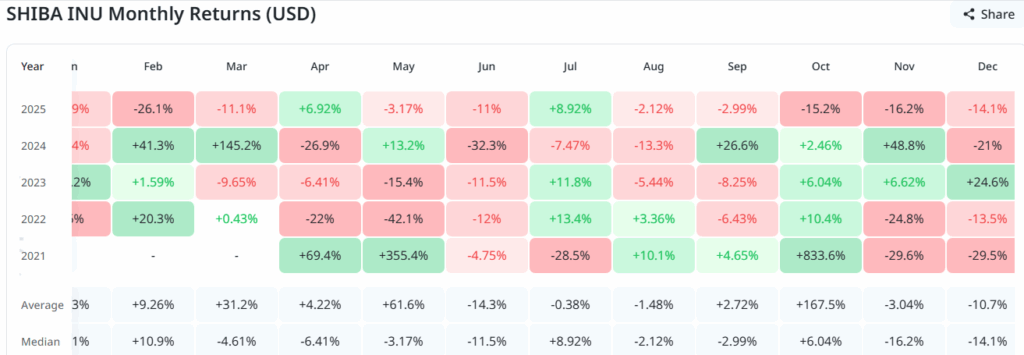
December 2023 provided the only exception to this bearish pattern. Shiba Inu closed that month with a 24.6% gain, delivering double-digit returns that defied the historical trend. Many investors anticipated this positive performance would continue into the following year.

Instead, December 2024 reversed course with a 21% decline. Investors locked in gains after SHIB rallied to $0.000033 during the post-election surge earlier that month. Profit-taking pressure overwhelmed buying demand as the year concluded.

Current month mirrors bearish December trend

December 2025 is following the established pattern of negative performance. Shiba Inu opened the month trading at $0.000008385 and has already fallen close to 14%.

For SHIB to finish December in positive territory, the price must climb to at least $0.0000084 within the remaining five days. This would require a rally of approximately 16.64% from current levels.


TagsShiba Inu

Perguntas relacionadas

QWhat is the current performance trend of Shiba Inu in December 2025?

AShiba Inu is declining, having fallen 14.15% so far in December 2025, and is on track to repeat its historical bearish performance for the month.

QWhich previous December was the only exception to Shiba Inu's typical bearish trend?

ADecember 2023 was the only exception, as Shiba Inu closed that month with a 24.6% gain.

QWhat major event in November 2022 contributed to Shiba Inu's decline that continued into December?

AThe collapse of the FTX exchange in November 2022 triggered widespread panic across crypto markets, leading to a 13.5% decline for SHIB in December as investors reduced risk exposure.

QHow much does Shiba Inu need to rally in the remaining days to finish December 2025 in positive territory?

AShiba Inu needs to rally approximately 16.64% from its current level to reach at least $0.0000084 and finish December in positive territory.

QWhat was cited as the reason for Shiba Inu's 21% decline in December 2024?

AThe decline was due to investors locking in gains after SHIB rallied to $0.000033 during the post-election surge earlier that month, with profit-taking pressure overwhelming buying demand.

Leituras Relacionadas

Node Count Drops 70%, This Time Solana Is in a Hurry

Solana's validator count has dropped by 70% from its peak of 2,560 in March 2023 to around 756, accompanied by a 35% decrease in its Nakamoto coefficient, indicating increased centralization. This decline is largely due to the phasing out of the Solana Foundation Delegation Program (SFDP), which previously subsidized smaller validators. Many of these validators were economically unviable without support, controlling only 19% of the total stake, while larger nodes held over 80%. In response, Solana is implementing a new validator policy effective May 1, focusing on infrastructure decentralization. The policy imposes limits: no single Autonomous System Number (ASN) can host more than 25% of staked SOL, and no single data center can exceed 15%. It also enforces stricter performance rules, including faster transaction processing and anti-censorship measures, to improve network reliability and security. Critics, like node operator Chainflow, argue that the rules may unfairly penalize competent smaller validators based on their hosting location rather than performance, potentially forcing them into less reliable infrastructure and accelerating their decline. Amid ambitions to become a "Nasdaq on-chain" for global capital markets, Solana trails Ethereum and BNB Chain in real-world asset (RWA) value but leads in user activity. The network's upgrades aim to enhance stability and reduce finality times, competing with Ethereum's efforts to scale and decentralize further. The success of Solana's new policies is crucial for gaining institutional trust and competing effectively in the evolving blockchain landscape.

marsbitHá 45m

Node Count Drops 70%, This Time Solana Is in a Hurry

marsbitHá 45m

Crypto Bear Market Startup Guide Part 2: The Token Relay Station - Exchanging Crypto Tokens for AI Tokens

"Token Relay Station: A Guide to Starting a Crypto Bear Market Business (Part 2) - Exchanging Crypto Tokens for AI Tokens" This article explores the business opportunity of creating an AI token relay station, a service that acts as an API aggregation layer. It allows users to pay with cryptocurrency (Crypto Tokens) to access credits for various AI models (AI Tokens), bypassing traditional payment barriers. The piece highlights a significant, underserved market: using crypto to directly purchase AI API credits and the potential "reverse export" of cheaper, high-performing Chinese models (like Qwen, Kimi, GLM) to overseas users. It uses OpenRouter, co-founded by OpenSea's ex-CTO Alex Atallah, as a key case study of a successful pivot from crypto to AI infrastructure, noting its support for crypto payments. The analysis reveals market challenges, including widespread fraud where users pay for premium models but receive inferior ones, and unstable supply chains reliant on bulk accounts prone to bans. It outlines three business models: global/developer-focused (OpenRouter), multi-modal/China-focused (APIMart.ai), and hyper-localized operations. Substantial risks are also detailed: high capital requirements for API procurement and infrastructure, the necessity of stable supply channels, complex legal and compliance issues around data resale and cross-border regulations, and the critical importance of user trust. Ultimately, the article posits this as a viable, revenue-generating business model for the crypto bear market, built on real API usage-based income rather than speculative token narratives.

Odaily星球日报Há 1h

Crypto Bear Market Startup Guide Part 2: The Token Relay Station - Exchanging Crypto Tokens for AI Tokens

Odaily星球日报Há 1h

Trading

Spot
Futuros
活动图片