Behind Circle's Strong Stock Rebound: AI, Prediction Markets, and Institutional Adoption

Odaily星球日报Publicado em 2026-02-27Última atualização em 2026-02-27

Resumo

Circle's stock (CRCL) experienced a strong rebound, rising over 45% in two days after its Q4 2025 earnings report, reaching a high of $90. Key drivers include USDC's growing transaction volume, which hit $18.3 trillion in 2025, surpassing USDT. The growth is attributed to AI agent payments via the x402 protocol, prediction markets like Polymarket, and institutional adoption fueled by regulatory support such as the GENIUS Act. Analysts from Bernstein maintain an "Outperform" rating with a $190 target, while Ark Invest and Vanguard have significantly increased their holdings. However, some analysts caution that the surge may be driven by short squeezes rather than fundamentals. Challenges remain, including competition from Coinbase and potential resistance from traditional banks.

Original|Odaily Planet Daily(@OdailyChina)

Author|Wenser(@wenser 2010)

Recently, after the release of its Q4 2025 financial report, the stock price of "the first stablecoin stock" Circle (CRCL) experienced a long-awaited strong rebound, surging over 45% in two days and once hitting $90 today, reaching a new high since last November. In the continuously declining market of crypto concept stocks, Circle (CRCL) momentarily stole the spotlight, with major institutions and analysts beginning to cheer it on, and many traders even boldly claiming that "Circle's stock still has tenfold growth potential."

Behind the fervent sentiment, what the market is more concerned about might be the underlying drivers of this price rebound, as this directly determines whether Circle's (CRCL) stock price can continue to rise. Odaily Planet Daily will provide a brief analysis of this issue from the perspectives of Circle's business performance, institutional views, the AI "ticket," and prediction markets, attempting to clarify the key question of where Circle's next wave of growth will come from.

Transformation of Circle's Business Fundamentals: From Stablecoins to Internet Financial Infrastructure

When it comes to Circle, many might still perceive it through the stereotypical image of "the perpetual runner-up in the stablecoin race." However, in terms of performance and data growth in 2025, Circle's stablecoin USDC is rapidly catching up with Tether's stablecoin USDT.

Circle's Recent Report Card: USDC Transaction Volume Reached $18.3 Trillion in 2025, Ranking First in the Industry

According to data from the Artemis website, global stablecoin transaction volume surged 72% year-over-year in 2025, reaching a record $33 trillion; among them, the transaction volume of USDC, issued by Circle, reached $18.3 trillion, ranking first; in contrast, Tether's USDT transaction volume was only $13.3 trillion.

As we entered 2026, the scale of USDC transaction counts remained exceptionally rapid: in early February, Circle CEO Jeremy Allaire stated in a post that, according to Artemis data, the on-chain transaction count for USDC in January exceeded 8.4 trillion, while the total on-chain transaction count for the stablecoin market was 10 trillion. In terms of on-chain transaction count, USDC accounted for 84% of the total market share. In other words, unnoticed by many, USDC's trading activity has been quietly climbing. Moreover, the growth rate of USDC's circulation is also accelerating rapidly. As of February 12 local time, the issuance of USDC increased by approximately 2.6 billion tokens within a week.
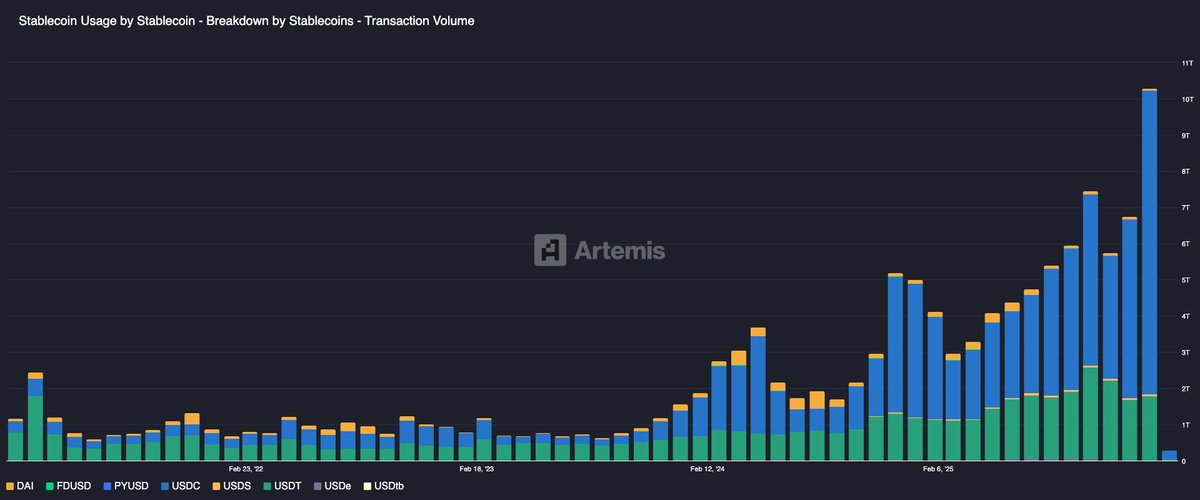
In comparison, the market capitalization of the "stablecoin leader" USDT fell 0.8% in February to $1.8361 trillion, continuing the decline of about 1% in January, marking the first consecutive monthly contraction since the Terra incident in 2022.

Finally, looking closely at its 2025 fiscal year financial report, Circle's USDC circulation at the end of 2025 was $753 billion, a 72% year-over-year increase; USDC on-chain transaction volume in Q4 2025 was $11.9 trillion, a 247% year-over-year increase; Q4 total revenue reached approximately $770 million, a sharp 77% increase compared to the same period last year; total revenue and reserve income for the 2025 fiscal year were $2.7 billion, a 64% year-over-year increase. Although its net loss from continuing operations reached $70 million, this was mainly affected by high IPO-related equity incentive expenses of $424 million. However, Circle expects USDC circulation to maintain an annual growth rate of about 40% in the future and forecasts that other business revenue (excluding reserve income) will reach approximately $170 million in 2026, higher than the approximately $110 million in 2025.

Personally, I speculate that the growth in USDC's circulation and transaction count might be driven by a combination of factors, including AI Agent crypto payment demand, the rising transaction volume in prediction markets, and institutional business demand following the passage of the GENIUS Act regulatory bill. We will elaborate on this point later.

Institutional Views Overview: Some Are Buying the Dip, Others Still Believe Circle Will "Outperform the Market"

Currently, market opinions on Circle's future stock performance are clearly divided: some investment institutions continue to buy the dip and accumulate shares; others are optimistic about its business model upgrade, transitioning from a stablecoin issuer to a fintech infrastructure provider; yet other research institutions believe this stock rebound is primarily driven by a short squeeze and lacks sustainability.

Bernstein: Circle Stock Aims for $190, Maintains "Outperform" Rating

Bernstein pointed out that Circle is no longer viewed merely as a "proxy investment target" for crypto assets but has transformed into a fintech infrastructure service provider, indicating a profound shift in its business positioning. The firm's analyst team believes that Circle will play a key role in this "fundamental transformation of the global economic system" and reaffirmed its "Outperform" rating and $190 target price in its latest research report, suggesting significant upside potential for the stock.

Furthermore, Bernstein analysts Gautam Chhugani and others noted in the report that Circle's Q4 performance clearly diverged from the overall crypto market trend, emphasizing that the company is moving towards becoming a core internet infrastructure provider, rather than just being in the stablecoin or crypto token business.

Ark Invest: Putting Money Where Their Mouth Is, Circle (CRCL) Stock Holdings Total Nearly $350 Million

Unlike research institutions, the investment firm Ark Invest, led by renowned Silicon Valley investor "Cathie Wood," has consistently been a "major buyer" of Circle.

In early February, trading documents showed that Ark Invest purchased approximately $9.4 million worth of Circle stock through two of its ETFs;

On February 12, Ark Invest increased its holdings again by 75,559 shares of Circle (CRCL), worth about $4.4 million.

Based on public information compiled, as of the time of writing, Ark Invest holds a total of approximately 4,015,642 shares of Circle (CRCL) through its three funds: ARKK (ARK Innovation ETF), ARKF (ARK Fintech Innovation ETF), and ARKW (ARK Next Generation Internet ETF), with a total market value of about $349 million (calculated at $87 per share).

Vanguard Group: Holds Over 5.65 Million Circle (CRCL) Shares, Once Faced Floating Losses Exceeding $400 Million

On February 14, according to the latest 13F filing submitted to the U.S. SEC by the world's second-largest fund management company, Vanguard Group, it currently holds a cumulative total of 5,653,110 shares of Circle stock CRCL (current value $339.4 million), with an entry cost of $739.6 million, resulting in floating losses of over $400 million at the time.

With Circle (CRCL)'s stock price rebounding to around $87 (at the time of writing), this nearly $740 million investment now shows a floating profit of over $152 million.

10x Research: Circle Surges Due to Short Squeeze

Yesterday, crypto research firm 10x Research stated in a post that the core driver of the recent rise in Circle's stock price was not the financial report data itself, but the market's positioning structure, which was more likely to trigger a high-probability short covering rally rather than a pure fundamental revaluation. It is reported that a hedge fund established a large short position before the earnings release. However, as Circle's stock price soared in a single day, it triggered a violent short squeeze, causing the hedge fund to lose approximately $500 million in a single day. 10x Research added that this round of sharp volatility not only affected Circle (CRCL) but also spilled over to Coinbase (COIN) and Bitcoin. Although Circle is a clear bullish target, the overall magnitude of the move was primarily driven by an imbalance in the overall crypto market positioning structure. New market catalysts might soon emerge, potentially reshaping the market narrative, after which trading logic may return to fundamentals. In other words, 10x Research is not optimistic about Circle (CRCL)'s future performance.

In summary, Circle is in a critical period of transitioning from its past concept as the "first stablecoin stock" to a narrative of "fintech infrastructure." The business performance of its stablecoin USDC is promising, and its other new revenue streams (non-interest income) have also proven their profitability to the market with a high gross profit of $37 million in Q4.

Whether Circle (CRCL) can continue its current strong upward trend may be closely related to three key keywords—"AI payments," "prediction markets," and "institutional adoption."

USDC's "Growth Boosters": AI Payments, Prediction Market Trading, Large-Scale Institutional Adoption

From Circle's financial reports and the external statements of CEO Jeremy Allaire, we can clearly see that Circle's revenue channels are rapidly expanding, unlike in the past when it heavily relied on the USDC stablecoin issuance business.

Previously, Circle announced that the Circle Payments Network (CPN) has 55 financial institutions registered, with another 74 financial institutions undergoing qualification review; the L1 blockchain network Arc testnet has gone live, attracting over 100 participants; USDC's inherent adoption rate and integration advantages also赋予 Circle with "automated payment" capabilities for AI Agents. This may become its ticket to the next era of interconnected finance.

Circle's "AI Ticket": x402 Protocol, AI Agent Economy, and A2A Transactions

Circle's first ticket comes from AI payments. The x402 standard, led by Coinbase, became a market focus upon its launch in 2025. This protocol allows AI Agents to directly pay for services, such as API data access, computational resources, or content subscriptions, using USDC through the HTTP 402 status code, effectively "bridging the last mile of payment" for AI Agents. USDC can thus be seamlessly integrated into the AI Agent economy. As for the A2A (Agent to Agent) and M2M (Machine to Machine) transactions proposed by many AI model companies, they will also circulate using USDC.

Previously, analysts predicted that the scale of the AI Agent economy ecosystem could exceed $30 trillion by 2030, with Agentic AI dominating 15% of daily financial decisions. In this regard, USDC possesses a super-early mover advantage.

Circle's "Prediction Market Ticket": Prediction Market Trading Volume Continues to Hit New Highs, Weekly Transaction Count Exceeds 38 Million

Another major driver for the growth of USDC and Circle's business data might be attributed to the prediction market sector, where business data is continuously rising.

According to Dune data, on February 23, the weekly transaction count (Feb 16-22) in prediction markets reached a new historical high of 38.01 million, with Polymarket's transaction count at 22.58 million, ranking first; Kalshi's transaction count was 14.86 million, ranking second.

At the same time, Circle is also making continuous efforts in platform-level cooperation with prediction market giants—in early February, Circle announced a partnership with Polymarket to promote the optimization of stablecoin infrastructure for prediction markets. Circle will introduce transparent, fully-reserved stablecoin infrastructure to prediction markets, improving settlement reliability and reducing friction to support the next phase of development in on-chain financial markets.

Based on the background of a "big year for predictions" featuring events like the Winter Olympics and the World Cup, USDC transaction volume and custody income are expected to see further growth.

Circle's "Institutional Adoption Ticket": Legislation, Trust Bank, and Partnership Ecosystem

For institutional users, Circle and USDC might currently be the only "relatively optimal solution." The main reasons are:

First, the GENIUS Act framework will drive a massive inflow of digital dollar reserves into the U.S. Treasury market, further boosting USDC issuance and circulation;

Second, Circle was approved to establish a national trust bank (First National Digital Currency Bank) in December 2025, accelerating its integration into the traditional financial system;

Third, Circle's partners cover various fields, including traditional payment institutions (e.g., Visa), financial software companies (e.g., Intuit), leading prediction market platforms (e.g., Polymarket), blockchain payment settlement networks (e.g., Morph Network), and cryptocurrency exchanges (e.g., Kraken, OKX, Bybit, Hyperliquid), gradually building its own "ecosystem moat."

Conclusion: Concerns for Circle's Stock Lie in Coinbase Profit Sharing and U.S. Banking Sector Strangulation

In summary, Circle (CRCL)'s stock market performance may usher in a wave of strong rebound. However, limited by the overall crypto market conditions and unresolved factors such as the CLARITY Act, its future performance still holds some uncertainty.

Specifically, first, there is Coinbase, which shares nearly $1 billion in annual stablecoin "promotion profits." According to assessments by BI analysts Paul Gulberg and Samuel Radowitz, if payment adoption accelerates under the GENIUS Act framework signed by President Trump in July 2025, Coinbase's stablecoin revenue could grow two to seven times. For a cryptocurrency exchange whose stock price is also under pressure, this is undoubtedly an indispensable big cake.

Second, as the "first compliant stablecoin stock," Circle is destined to face collective suppression from the U.S. banking sector. Although its trust bank application was approved, as Standard Chartered analysts stated in a report, stablecoins pose a real risk to global and U.S. bank deposits. U.S. bank deposits will decrease as the market value of stablecoins grows, with the reduction accounting for a weight roughly equivalent to the stablecoin market value. U.S. regional banks are the most affected, while investment banks are the least affected. The report shows that only 14.5% of Circle's reserve assets are bank deposits, with a very low redeposit ratio. Similarly, traditional banks, driven by profit, are unlikely to sit idly by.

As for whether Circle (CRCL)'s stock price can achieve the "10x miracle" mentioned at the beginning of the article again, beyond the timing of last year's "stablecoin boom," it might require more "regional convenience policies" provided by the U.S. government and regulatory authorities to give it a helping hand.

Perguntas relacionadas

QWhat were the key factors driving the recent surge in Circle's (CRCL) stock price according to the article?

AThe article attributes the surge to a combination of factors: strong Q4 2025 financial results showing significant growth in USDC transaction volume and revenue, a major short squeeze that caused significant losses for hedge funds, and a broader narrative shift where Circle is being viewed as a financial technology infrastructure provider rather than just a stablecoin company. This shift is fueled by its potential in AI agent payments, the prediction market, and increased institutional adoption.

QHow did USDC's performance compare to USDT in terms of transaction volume in 2025?

AAccording to Artemis data cited in the article, USDC's transaction volume reached $18.3 trillion in 2025, ranking first in the industry. In contrast, Tether's USDT transaction volume was $13.3 trillion for the same period.

QWhich major investment firms are highlighted as significant holders or supporters of Circle stock, and what were their positions?

AThe article mentions Ark Invest, which held approximately 4 million shares across three ETFs with a total value of around $349 million, and Vanguard Group, which held over 5.65 million shares. Bernstein maintained an 'Outperform' rating with a $190 price target, while 10x Research presented a bearish view, attributing the price rise to a short squeeze rather than fundamentals.

QWhat are the three key areas or 'tickets' identified as major growth drivers for USDC and Circle's future?

AThe three key growth areas, referred to as 'tickets,' are: 1) AI Payments, through the x402 protocol enabling AI Agent economies; 2) The Prediction Market, with platforms like Polymarket driving massive transaction volumes using USDC; and 3) Institutional Adoption, fueled by regulatory acts like GENIUS Act and Circle's new national trust bank charter.

QWhat are the main potential risks or concerns for Circle's stock price mentioned in the article's conclusion?

AThe conclusion points to two main concerns: 1) The profit-sharing relationship with Coinbase, which takes a significant portion of stablecoin promotion profits and could see its own revenue grow substantially under the GENIUS Act, potentially limiting Circle's upside. 2) Opposition from the traditional U.S. banking sector, which views stablecoins as a threat to their deposits and may politically resist their growth.

Leituras Relacionadas

Behind the Circle Freeze Controversy: Where Are the Power Boundaries of Dollar Stablecoins?

The recent controversy surrounding Circle's freezing of 16 unrelated business wallets, as publicly criticized by on-chain investigator ZachXBT, has ignited a critical debate about the power and boundaries of centralized dollar stablecoin issuers. This incident, occurring alongside Tether's simultaneous unfreezing of previously blacklisted addresses, highlights a fundamental question: who controls the stablecoins users believe they own? The core issue extends beyond a single error. A mistaken freeze can disrupt entire payment flows, preventing users from moving funds and triggering compliance alarms at exchanges. With USDT and USDC dominating over 82% of the stablecoin market, the reality is that most "on-chain dollars" are centralized, subject to freezing, and can be intervened with by their issuers. This event shifts the industry discussion from technical concerns to questions of power and accountability: Who has the authority to freeze funds? What are the public justifications? How is transparency ensured? And what recourse exists for those wrongly affected? Ultimately, the incident underscores that dollar stablecoins are not unregulated digital cash but financial instruments operating within a gray area of centralized control. As stablecoins become critical infrastructure for global value transfer, the power to freeze assets must itself be constrained and held accountable.

marsbitHá 17m

Behind the Circle Freeze Controversy: Where Are the Power Boundaries of Dollar Stablecoins?

marsbitHá 17m

Claude Deliberately Dumbs Down? Are Models Starting to 'Discriminate Based on the User'?

"Claude Deliberately Downgraded? Models Begin to 'Discriminate Based on Users'?" Recent analysis by AMD AI Group Senior Director Stella Laurenzo reveals significant behavioral degradation in Anthropic's Claude since mid-February. Data from 6,852 session files shows Claude's median "thinking" output plummeted 67-73% from 2,200 to 600 characters, with one-third of code edits now performed without reading files first. Users began reporting slower, lazier responses in March, with some describing Claude as "lobotomized." Anthropic's introduction of "adaptive thinking" in early February, officially described as adjusting reasoning depth based on task complexity, effectively became a global throttling mechanism. By March, default effort was quietly reduced to "medium" while thinking summaries were hidden. Anthropic's Claude Code lead Boris Cherny confirmed this was intentional optimization, not a bug, suggesting users manually switch to "high effort" mode. The company never announced these significant changes, leaving paying subscribers with reduced capabilities at unchanged prices. This reflects a broader industry trend where AI companies are silently reducing capabilities to control GPU costs. Analysis shows extreme users generate $42,121 in actual inference costs while paying only $400 monthly, creating unsustainable subsidy model. Anthropic is now testing "high effort" mode by default for Teams and Enterprise users, signaling that superior reasoning is becoming a分层资源. Enterprise API users report significantly better performance at $4k-12k monthly costs, while consumer subscribers receive a "good enough" downgraded version. The incident marks the end of AI's subsidy era, with the industry shifting from universal普惠to elite stratification, quietly compromising consumer experience to manage real costs while offering premium capabilities to deep-pocketed enterprise clients.

marsbitHá 20m

Claude Deliberately Dumbs Down? Are Models Starting to 'Discriminate Based on the User'?

marsbitHá 20m

DeAgentAI Announces Establishment of AIA Ecosystem Fund, Focusing on 'AI Agent + Physical AI' Track

DeAgentAI, a leading decentralized AI infrastructure project on SUI and BNB Chain, has announced the establishment of the AIA Ecosystem Fund. The fund will focus on the integrated track of "AI Agent + Physical AI," aiming to incubate and accelerate the next generation of AI applications with autonomous decision-making capabilities and extend AI technology from on-chain intelligence to the real world. The fund will provide comprehensive support in technology, user traffic, and ecosystem resources. Its core investment directions include AI Agent applications with autonomous on-chain execution and multi-agent collaboration capabilities, and Physical AI projects that extend AI inference into the physical world through hardware and computing efficiency. The fund has already made seed-round investments in two projects: - AliceAI: An AI-driven prediction market decision system that compresses fragmented information into verifiable, tamper-proof decision signals, offering a full-cycle solution from signal generation to automated execution via Telegram Bot. - An ASIC AI chip project: A custom hardware solution designed specifically for Transformer-based inference, aiming to reduce token processing costs to less than one-tenth of current GPU solutions while significantly improving energy efficiency and lowering latency. According to DeAgentAI’s founder, the goal is to bridge the gap between on-chain intelligence and the physical world, supporting key protocols that connect users to the future of Physical AI.

marsbitHá 31m

DeAgentAI Announces Establishment of AIA Ecosystem Fund, Focusing on 'AI Agent + Physical AI' Track

marsbitHá 31m

Trading

Spot
Futuros

Artigos em Destaque

O que é $S$

Compreender o SPERO: Uma Visão Abrangente Introdução ao SPERO À medida que o panorama da inovação continua a evoluir, o surgimento de tecnologias web3 e projetos de criptomoeda desempenha um papel fundamental na formação do futuro digital. Um projeto que tem atraído atenção neste campo dinâmico é o SPERO, denotado como SPERO,$$s$. Este artigo tem como objetivo reunir e apresentar informações detalhadas sobre o SPERO, para ajudar entusiastas e investidores a compreender as suas bases, objetivos e inovações nos domínios web3 e cripto. O que é o SPERO,$$s$? O SPERO,$$s$ é um projeto único dentro do espaço cripto que procura aproveitar os princípios da descentralização e da tecnologia blockchain para criar um ecossistema que promove o envolvimento, a utilidade e a inclusão financeira. O projeto é concebido para facilitar interações peer-to-peer de novas maneiras, proporcionando aos utilizadores soluções e serviços financeiros inovadores. No seu núcleo, o SPERO,$$s$ visa capacitar indivíduos ao fornecer ferramentas e plataformas que melhoram a experiência do utilizador no espaço das criptomoedas. Isso inclui a possibilidade de métodos de transação mais flexíveis, a promoção de iniciativas impulsionadas pela comunidade e a criação de caminhos para oportunidades financeiras através de aplicações descentralizadas (dApps). A visão subjacente do SPERO,$$s$ gira em torno da inclusão, visando fechar lacunas dentro das finanças tradicionais enquanto aproveita os benefícios da tecnologia blockchain. Quem é o Criador do SPERO,$$s$? A identidade do criador do SPERO,$$s$ permanece algo obscura, uma vez que existem recursos publicamente disponíveis limitados que fornecem informações detalhadas sobre o(s) seu(s) fundador(es). Esta falta de transparência pode resultar do compromisso do projeto com a descentralização—uma ética que muitos projetos web3 partilham, priorizando contribuições coletivas em vez de reconhecimento individual. Ao centrar as discussões em torno da comunidade e dos seus objetivos coletivos, o SPERO,$$s$ incorpora a essência do empoderamento sem destacar indivíduos específicos. Assim, compreender a ética e a missão do SPERO é mais importante do que identificar um criador singular. Quem são os Investidores do SPERO,$$s$? O SPERO,$$s$ é apoiado por uma diversidade de investidores que vão desde capitalistas de risco a investidores-anjo dedicados a promover a inovação no setor cripto. O foco desses investidores geralmente alinha-se com a missão do SPERO—priorizando projetos que prometem avanço tecnológico social, inclusão financeira e governança descentralizada. Essas fundações de investidores estão tipicamente interessadas em projetos que não apenas oferecem produtos inovadores, mas que também contribuem positivamente para a comunidade blockchain e os seus ecossistemas. O apoio desses investidores reforça o SPERO,$$s$ como um concorrente notável no domínio em rápida evolução dos projetos cripto. Como Funciona o SPERO,$$s$? O SPERO,$$s$ emprega uma estrutura multifacetada que o distingue de projetos de criptomoeda convencionais. Aqui estão algumas das características-chave que sublinham a sua singularidade e inovação: Governança Descentralizada: O SPERO,$$s$ integra modelos de governança descentralizada, capacitando os utilizadores a participar ativamente nos processos de tomada de decisão sobre o futuro do projeto. Esta abordagem promove um sentido de propriedade e responsabilidade entre os membros da comunidade. Utilidade do Token: O SPERO,$$s$ utiliza o seu próprio token de criptomoeda, concebido para servir várias funções dentro do ecossistema. Esses tokens permitem transações, recompensas e a facilitação de serviços oferecidos na plataforma, melhorando o envolvimento e a utilidade gerais. Arquitetura em Camadas: A arquitetura técnica do SPERO,$$s$ suporta modularidade e escalabilidade, permitindo a integração contínua de funcionalidades e aplicações adicionais à medida que o projeto evolui. Esta adaptabilidade é fundamental para manter a relevância no panorama cripto em constante mudança. Envolvimento da Comunidade: O projeto enfatiza iniciativas impulsionadas pela comunidade, empregando mecanismos que incentivam a colaboração e o feedback. Ao nutrir uma comunidade forte, o SPERO,$$s$ pode melhor atender às necessidades dos utilizadores e adaptar-se às tendências do mercado. Foco na Inclusão: Ao oferecer taxas de transação baixas e interfaces amigáveis, o SPERO,$$s$ visa atrair uma base de utilizadores diversificada, incluindo indivíduos que anteriormente podem não ter participado no espaço cripto. Este compromisso com a inclusão alinha-se com a sua missão abrangente de empoderamento através da acessibilidade. Cronologia do SPERO,$$s$ Compreender a história de um projeto fornece insights cruciais sobre a sua trajetória de desenvolvimento e marcos. Abaixo está uma cronologia sugerida que mapeia eventos significativos na evolução do SPERO,$$s$: Fase de Conceituação e Ideação: As ideias iniciais que formam a base do SPERO,$$s$ foram concebidas, alinhando-se de perto com os princípios de descentralização e foco na comunidade dentro da indústria blockchain. Lançamento do Whitepaper do Projeto: Após a fase conceitual, um whitepaper abrangente detalhando a visão, os objetivos e a infraestrutura tecnológica do SPERO,$$s$ foi lançado para atrair o interesse e o feedback da comunidade. Construção da Comunidade e Primeiros Envolvimentos: Esforços ativos de divulgação foram feitos para construir uma comunidade de primeiros adotantes e investidores potenciais, facilitando discussões em torno dos objetivos do projeto e angariando apoio. Evento de Geração de Tokens: O SPERO,$$s$ realizou um evento de geração de tokens (TGE) para distribuir os seus tokens nativos a apoiantes iniciais e estabelecer liquidez inicial dentro do ecossistema. Lançamento da dApp Inicial: A primeira aplicação descentralizada (dApp) associada ao SPERO,$$s$ foi lançada, permitindo que os utilizadores interagissem com as funcionalidades principais da plataforma. Desenvolvimento Contínuo e Parcerias: Atualizações e melhorias contínuas nas ofertas do projeto, incluindo parcerias estratégicas com outros players no espaço blockchain, moldaram o SPERO,$$s$ em um jogador competitivo e em evolução no mercado cripto. Conclusão O SPERO,$$s$ é um testemunho do potencial do web3 e das criptomoedas para revolucionar os sistemas financeiros e capacitar indivíduos. Com um compromisso com a governança descentralizada, o envolvimento da comunidade e funcionalidades inovadoras, abre caminho para um panorama financeiro mais inclusivo. Como em qualquer investimento no espaço cripto em rápida evolução, potenciais investidores e utilizadores são incentivados a pesquisar minuciosamente e a envolver-se de forma ponderada com os desenvolvimentos em curso dentro do SPERO,$$s$. O projeto demonstra o espírito inovador da indústria cripto, convidando a uma exploração mais aprofundada das suas inúmeras possibilidades. Embora a jornada do SPERO,$$s$ ainda esteja a desenrolar-se, os seus princípios fundamentais podem, de facto, influenciar o futuro de como interagimos com a tecnologia, as finanças e uns com os outros em ecossistemas digitais interconectados.

69 Visualizações TotaisPublicado em {updateTime}Atualizado em 2024.12.17

O que é $S$

O que é AGENT S

Agent S: O Futuro da Interação Autónoma no Web3 Introdução No panorama em constante evolução do Web3 e das criptomoedas, as inovações estão constantemente a redefinir a forma como os indivíduos interagem com plataformas digitais. Um projeto pioneiro, o Agent S, promete revolucionar a interação humano-computador através do seu framework aberto e agente. Ao abrir caminho para interações autónomas, o Agent S visa simplificar tarefas complexas, oferecendo aplicações transformadoras em inteligência artificial (IA). Esta exploração detalhada irá aprofundar-se nas complexidades do projeto, nas suas características únicas e nas implicações para o domínio das criptomoedas. O que é o Agent S? O Agent S é um framework aberto e agente, especificamente concebido para abordar três desafios fundamentais na automação de tarefas computacionais: Aquisição de Conhecimento Específico de Domínio: O framework aprende inteligentemente a partir de várias fontes de conhecimento externas e experiências internas. Esta abordagem dupla capacita-o a construir um rico repositório de conhecimento específico de domínio, melhorando o seu desempenho na execução de tarefas. Planeamento ao Longo de Longos Horizontes de Tarefas: O Agent S emprega planeamento hierárquico aumentado por experiência, uma abordagem estratégica que facilita a decomposição e execução eficientes de tarefas intrincadas. Esta característica melhora significativamente a sua capacidade de gerir múltiplas subtarefas de forma eficiente e eficaz. Gestão de Interfaces Dinâmicas e Não Uniformes: O projeto introduz a Interface Agente-Computador (ACI), uma solução inovadora que melhora a interação entre agentes e utilizadores. Utilizando Modelos de Linguagem Multimodais de Grande Escala (MLLMs), o Agent S pode navegar e manipular diversas interfaces gráficas de utilizador de forma fluida. Através destas características pioneiras, o Agent S fornece um framework robusto que aborda as complexidades envolvidas na automação da interação humana com máquinas, preparando o terreno para uma infinidade de aplicações em IA e além. Quem é o Criador do Agent S? Embora o conceito de Agent S seja fundamentalmente inovador, informações específicas sobre o seu criador permanecem elusivas. O criador é atualmente desconhecido, o que destaca ou o estágio nascente do projeto ou a escolha estratégica de manter os membros fundadores em anonimato. Independentemente da anonimidade, o foco permanece nas capacidades e no potencial do framework. Quem são os Investidores do Agent S? Como o Agent S é relativamente novo no ecossistema criptográfico, informações detalhadas sobre os seus investidores e financiadores não estão explicitamente documentadas. A falta de informações disponíveis publicamente sobre as fundações de investimento ou organizações que apoiam o projeto levanta questões sobre a sua estrutura de financiamento e roteiro de desenvolvimento. Compreender o apoio é crucial para avaliar a sustentabilidade do projeto e o seu impacto potencial no mercado. Como Funciona o Agent S? No núcleo do Agent S reside uma tecnologia de ponta que lhe permite funcionar eficazmente em diversos ambientes. O seu modelo operacional é construído em torno de várias características-chave: Interação Humano-Computador Semelhante: O framework oferece planeamento avançado em IA, esforçando-se para tornar as interações com computadores mais intuitivas. Ao imitar o comportamento humano na execução de tarefas, promete elevar as experiências dos utilizadores. Memória Narrativa: Utilizada para aproveitar experiências de alto nível, o Agent S utiliza memória narrativa para acompanhar os históricos de tarefas, melhorando assim os seus processos de tomada de decisão. Memória Episódica: Esta característica fornece aos utilizadores orientações passo a passo, permitindo que o framework ofereça suporte contextual à medida que as tarefas se desenrolam. Suporte para OpenACI: Com a capacidade de funcionar localmente, o Agent S permite que os utilizadores mantenham o controlo sobre as suas interações e fluxos de trabalho, alinhando-se com a ética descentralizada do Web3. Fácil Integração com APIs Externas: A sua versatilidade e compatibilidade com várias plataformas de IA garantem que o Agent S possa integrar-se perfeitamente em ecossistemas tecnológicos existentes, tornando-o uma escolha apelativa para desenvolvedores e organizações. Estas funcionalidades contribuem coletivamente para a posição única do Agent S no espaço cripto, à medida que automatiza tarefas complexas e em múltiplos passos com mínima intervenção humana. À medida que o projeto evolui, as suas potenciais aplicações no Web3 podem redefinir a forma como as interações digitais se desenrolam. Cronologia do Agent S O desenvolvimento e os marcos do Agent S podem ser encapsulados numa cronologia que destaca os seus eventos significativos: 27 de Setembro de 2024: O conceito de Agent S foi lançado num artigo de pesquisa abrangente intitulado “Um Framework Agente Aberto que Usa Computadores como um Humano”, mostrando a base para o projeto. 10 de Outubro de 2024: O artigo de pesquisa foi disponibilizado publicamente no arXiv, oferecendo uma exploração aprofundada do framework e da sua avaliação de desempenho com base no benchmark OSWorld. 12 de Outubro de 2024: Uma apresentação em vídeo foi lançada, proporcionando uma visão visual das capacidades e características do Agent S, envolvendo ainda mais potenciais utilizadores e investidores. Estes marcos na cronologia não apenas ilustram o progresso do Agent S, mas também indicam o seu compromisso com a transparência e o envolvimento da comunidade. Pontos-Chave Sobre o Agent S À medida que o framework Agent S continua a evoluir, várias características-chave destacam-se, sublinhando a sua natureza inovadora e potencial: Framework Inovador: Concebido para proporcionar um uso intuitivo de computadores semelhante à interação humana, o Agent S traz uma abordagem nova à automação de tarefas. Interação Autónoma: A capacidade de interagir autonomamente com computadores através de GUI significa um avanço em direção a soluções computacionais mais inteligentes e eficientes. Automação de Tarefas Complexas: Com a sua metodologia robusta, pode automatizar tarefas complexas e em múltiplos passos, tornando os processos mais rápidos e menos propensos a erros. Melhoria Contínua: Os mecanismos de aprendizagem permitem que o Agent S melhore a partir de experiências passadas, aprimorando continuamente o seu desempenho e eficácia. Versatilidade: A sua adaptabilidade em diferentes ambientes operacionais, como OSWorld e WindowsAgentArena, garante que pode servir uma ampla gama de aplicações. À medida que o Agent S se posiciona no panorama do Web3 e das criptomoedas, o seu potencial para melhorar as capacidades de interação e automatizar processos significa um avanço significativo nas tecnologias de IA. Através do seu framework inovador, o Agent S exemplifica o futuro das interações digitais, prometendo uma experiência mais fluida e eficiente para os utilizadores em diversas indústrias. Conclusão O Agent S representa um ousado avanço na união da IA e do Web3, com a capacidade de redefinir a forma como interagimos com a tecnologia. Embora ainda esteja nas suas fases iniciais, as possibilidades para a sua aplicação são vastas e cativantes. Através do seu framework abrangente que aborda desafios críticos, o Agent S visa trazer interações autónomas para o primeiro plano da experiência digital. À medida que avançamos mais profundamente nos domínios das criptomoedas e da descentralização, projetos como o Agent S desempenharão, sem dúvida, um papel crucial na formação do futuro da tecnologia e da colaboração humano-computador.

467 Visualizações TotaisPublicado em {updateTime}Atualizado em 2025.01.14

O que é AGENT S

Como comprar S

Bem-vindo à HTX.com!Tornámos a compra de Sonic (S) simples e conveniente.Segue o nosso guia passo a passo para iniciar a tua jornada no mundo das criptos.Passo 1: cria a tua conta HTXUtiliza o teu e-mail ou número de telefone para te inscreveres numa conta gratuita na HTX.Desfruta de um processo de inscrição sem complicações e desbloqueia todas as funcionalidades.Obter a minha contaPasso 2: vai para Comprar Cripto e escolhe o teu método de pagamentoCartão de crédito/débito: usa o teu visa ou mastercard para comprar Sonic (S) instantaneamente.Saldo: usa os fundos da tua conta HTX para transacionar sem problemas.Terceiros: adicionamos métodos de pagamento populares, como Google Pay e Apple Pay, para aumentar a conveniência.P2P: transaciona diretamente com outros utilizadores na HTX.Mercado de balcão (OTC): oferecemos serviços personalizados e taxas de câmbio competitivas para os traders.Passo 3: armazena teu Sonic (S)Depois de comprar o teu Sonic (S), armazena-o na tua conta HTX.Alternativamente, podes enviá-lo para outro lugar através de transferência blockchain ou usá-lo para transacionar outras criptomoedas.Passo 4: transaciona Sonic (S)Transaciona facilmente Sonic (S) no mercado à vista da HTX.Acede simplesmente à tua conta, seleciona o teu par de trading, executa as tuas transações e monitoriza em tempo real.Oferecemos uma experiência de fácil utilização tanto para principiantes como para traders experientes.

832 Visualizações TotaisPublicado em {updateTime}Atualizado em 2025.03.21

Como comprar S

Discussões

Bem-vindo à Comunidade HTX. Aqui, pode manter-se informado sobre os mais recentes desenvolvimentos da plataforma e obter acesso a análises profissionais de mercado. As opiniões dos utilizadores sobre o preço de S (S) são apresentadas abaixo.

活动图片