New York Warns of Crypto and AI Scams: Fraud Losses Reach $8 Billion

cryptonews.ruPublicado em 2026-08-29Última atualização em 2026-08-29

Resumo

New York authorities are warning about cryptocurrency and AI-driven scams. Investment fraud became the costliest category tracked by the Federal Trade Commission in 2025. Over 144,000 consumers reported losses exceeding $8 billion, a 38% increase from 2024, with a median loss of $10,560. Scams often originate on social media, dating apps, texts, or emails, using fake coaching offers. AI enables sophisticated tactics like deepfakes of celebrities, voice cloning, and fake videos to promote fraudulent crypto investments, pump-and-dump schemes, and non-existent trading platforms. Authorities warn that scammers use professionally designed apps showing fake balances and returns, sometimes allowing small withdrawals to build trust before demanding larger sums. Cases from Australia illustrate similar patterns, where fake news articles and AI-generated celebrity ads supported scams. New York's advice includes verifying promoters, checking company legitimacy, and understanding where funds go before investing. Red flags include unsolicited offers, promises of high returns, aggressive sales tactics, and unclear documentation. Suspected fraud should be reported to the FTC, FBI's IC3, SEC, or New York's Attorney General.

According to New York state authorities, investment scams became the costliest fraud category tracked by the Federal Trade Commission in 2025. On August 26, the state's Consumer Protection Bureau issued a warning about AI-enabled investment scams after 144,041 consumers reported losing over $8 billion, a 38% increase from 2024. The median reported loss reached $10,560.

Fraudulent schemes can originate through social media, dating apps, text messages, email, online ads, or even friendly conversations. In its own consumer warning issued in April, the FTC noted total losses for the same 2025 period were over $7.9 billion, with the median individual loss exceeding $10,000. This agency included cryptocurrency alongside stocks and forex in its list of investments that scammers promote through fake coaching offers.

State Secretary Walter T. Mosley warned:

"New Yorkers need to be on the alert for scammers who may use artificial intelligence technologies or other means to create increasingly sophisticated and realistic messaging in order to steal your hard-earned money. If something seems too good to be true, it usually is."
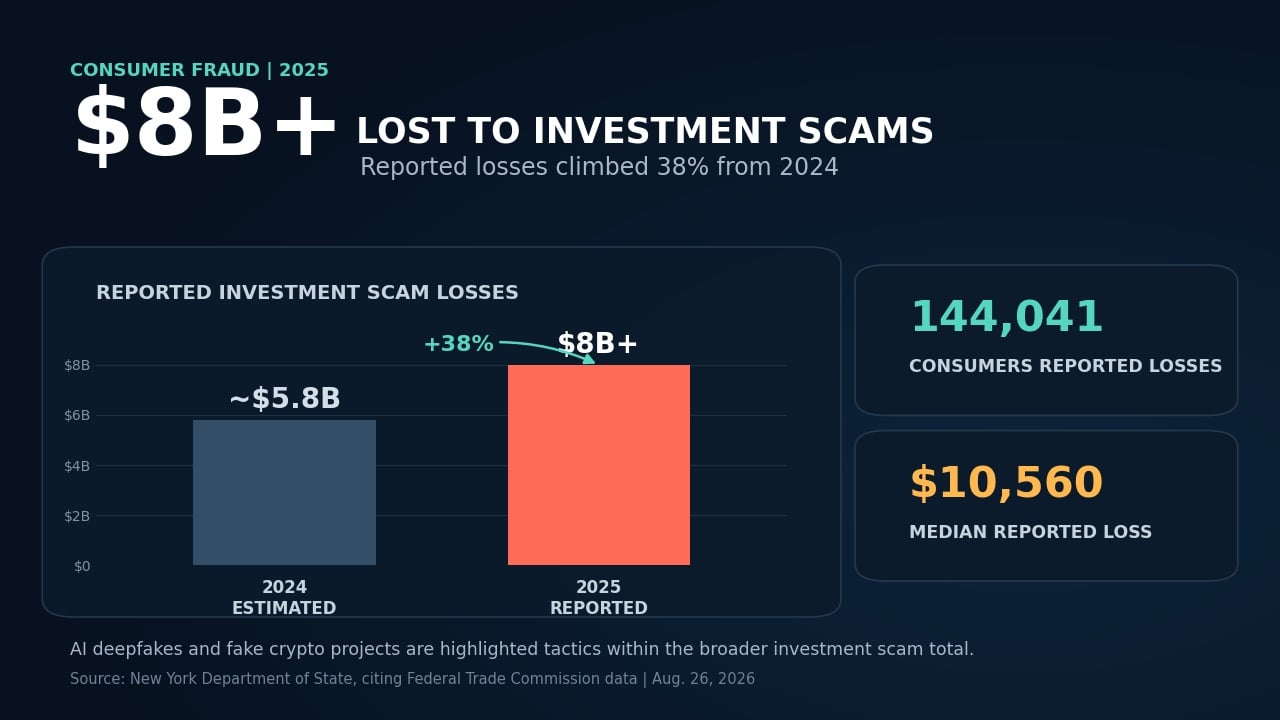
Reported losses from investment fraud in 2025 exceeded $8 billion, a 38% increase from 2024, with the median reported loss reaching $10,560. Chart compiled by Bitcoin.com News based on data from the New York State Department of State referencing Federal Trade Commission information.

AI 'Deepfakes' Promote Fake Crypto Investments

Artificial intelligence allows scammers to clone voices, fake videos, impersonate financial figures, and create professionally designed social media ads. An April warning from New York Attorney General Letitia James described schemes involving celebrity deepfakes, fraudulent cryptocurrencies, pump-and-dump operations, and fake trading platforms promoted on Facebook, Instagram, and WhatsApp.

Victims may encounter professionally designed apps displaying fabricated account balances, returns, and trading activity. Some operators allow small initial withdrawals to build trust before pushing victims to make larger deposits. Similar tactics have appeared internationally: Australian regulators recently took down 3,106 fraudulent cryptocurrency investment platforms during the 2026 financial year, as AI-generated celebrity endorsements became increasingly difficult to distinguish from genuine advertisements.

Fake Platforms Build Trust Before Demanding Fees

A separate case in Australia demonstrated how organized groups create an entire fake ecosystem around a non-existent crypto investment. Investigators detailed the fake trading platforms, fabricated news articles, and chatbots posing as support staff that were involved before one woman lost nearly $74,690. Operators may then demand additional fees before returning funds, which the New York warning advises consumers should never pay.

New York authorities advised consumers to verify the identity of any promoter, research the company and investment, and find out where their money is going before transferring funds. Typical signs of a crypto scam include promises of high returns, unsolicited investment offers, aggressive sales tactics, and projects lacking clear documentation. Anyone suspecting fraud should immediately stop sending money and report it to the Federal Trade Commission (FTC), FBI's Internet Crime Complaint Center (IC3), Securities and Exchange Commission (SEC), or the New York State Attorney General.


Criptomoedas em alta

Perguntas relacionadas

QAccording to the New York authorities' warning, what were the total reported losses from investment scams in 2025 and how does this compare to the previous year?

AAccording to the New York State authorities, the total reported losses from investment scams in 2025 were over 8 billion dollars, which represents a 38% increase compared to 2024.

QWhat specific technologies are scammers increasingly using to promote fake cryptocurrency investments, as highlighted by the New York Attorney General?

AScammers are increasingly using artificial intelligence (AI) technologies, such as deepfakes (cloned voices, fake videos of celebrities), to promote fake cryptocurrency investments, fraudulent tokens, and fake trading platforms.

QWhat common tactic do scammers employ to gain the trust of their victims before stealing larger sums of money?

AA common tactic scammers use is to allow victims to make small, initial withdrawals of funds successfully. This builds trust before they pressure the victims into depositing larger amounts of money.

QWhat actions have Australian regulators taken against cryptocurrency scams, and what challenge do they face according to the article?

AAustralian regulators shut down 3,106 fraudulent cryptocurrency investment platforms during the 2026 financial year. The challenge they face is that AI-generated celebrity endorsement advertisements are becoming increasingly difficult to distinguish from genuine ones.

QWhat advice do New York authorities give to consumers to protect themselves from investment scams?

ANew York authorities advise consumers to: verify the identity of any promoter; research the company and investment project; understand where their money is going before transferring funds; and be wary of promises of high returns, unsolicited offers, aggressive sales tactics, and projects lacking clear documentation.

Leituras Relacionadas

How Can Bitcoin Resist Quantum Computers? A Comparative Analysis of Three Lattice-Based Signature Schemes

This report from Blockstream Research analyzes three lattice-based signature schemes as quantum-resistant candidates for Bitcoin, focusing on Dilithium, Falcon, and the now-withdrawn Hawk. Core evaluation criteria include on-chain costs (combined size of public key and signature), implementation complexity, deployment risks, and potential for integration with Bitcoin's existing infrastructure like BIP-32 hierarchical deterministic wallets. Key Findings: * **Dilithium** is praised for its design simplicity, using only integer operations, making secure implementation easier. However, it has the largest size (5,261 bytes for security level 3). * **Falcon** offers the most compact signatures and the fastest verification. Its main drawback—platform-dependent floating-point operations in signing—can be mitigated with a slower, deterministic integer-based implementation. The report recommends **Falcon-1024** (security level 5) for its safety margin. * **Hawk**, which aimed for a better balance, was withdrawn after a cryptographic attack revealed a structural flaw that halved its estimated security. The report concludes that Falcon-1024 is the most suitable lattice-based choice for Bitcoin, pending the finalization of its NIST FN-DSA standard. In the short term, it still recommends hash-based signatures (like SPHINCS+) as a lower-risk transitional solution, with future hybrid deployments as a possibility.

marsbitHá 1h

How Can Bitcoin Resist Quantum Computers? A Comparative Analysis of Three Lattice-Based Signature Schemes

marsbitHá 1h

Ripple (XRP) Company Announces Plans for Major Future Update

Ripple (XRP) has announced a four-phase plan to prepare the XRP Ledger (XRPL) for future security threats posed by quantum computers. The company's senior director of engineering stated the goal is to build necessary infrastructure before quantum computers become a direct threat, aiming to minimize impact on existing systems, user assets, and network operations. The plan begins with identifying potential quantum vulnerabilities within XRPL, followed by testing quantum-resistant cryptographic methods. The next phase involves parallel testing of existing security mechanisms and new quantum-resistant solutions to ensure reliability and prevent disruption for users and applications. The final phase would involve transitioning the XRPL to more comprehensive, quantum-resistant security standards if the technology matures. Ripple is also developing contingency plans for a faster-than-expected advancement of quantum computing, which could accelerate the transition timeline. A current XRPL feature allowing users to change the keys controlling their accounts without altering the accounts themselves is seen as a potential advantage in any future migration. However, Ripple cannot unilaterally change transaction validation rules or network-wide cryptographic standards; such updates require coordination and approval from independent validators via XRPL's governance process. While quantum computers are not yet capable of breaking the cryptography used by major blockchains like Bitcoin or XRPL, developers across the industry are already evaluating transition scenarios to quantum-resistant algorithms due to the long-term risks they pose to public-key cryptography.

cryptonews.ruHá 2h

Ripple (XRP) Company Announces Plans for Major Future Update

cryptonews.ruHá 2h

Trading

Spot

Artigos em Destaque

Como comprar F

Bem-vindo à HTX.com!Tornámos a compra de Synfutures (F) simples e conveniente.Segue o nosso guia passo a passo para iniciar a tua jornada no mundo das criptos.Passo 1: cria a tua conta HTXUtiliza o teu e-mail ou número de telefone para te inscreveres numa conta gratuita na HTX.Desfruta de um processo de inscrição sem complicações e desbloqueia todas as funcionalidades.Obter a minha contaPasso 2: vai para Comprar Cripto e escolhe o teu método de pagamentoCartão de crédito/débito: usa o teu visa ou mastercard para comprar Synfutures (F) instantaneamente.Saldo: usa os fundos da tua conta HTX para transacionar sem problemas.Terceiros: adicionamos métodos de pagamento populares, como Google Pay e Apple Pay, para aumentar a conveniência.P2P: transaciona diretamente com outros utilizadores na HTX.Mercado de balcão (OTC): oferecemos serviços personalizados e taxas de câmbio competitivas para os traders.Passo 3: armazena teu Synfutures (F)Depois de comprar o teu Synfutures (F), armazena-o na tua conta HTX.Alternativamente, podes enviá-lo para outro lugar através de transferência blockchain ou usá-lo para transacionar outras criptomoedas.Passo 4: transaciona Synfutures (F)Transaciona facilmente Synfutures (F) no mercado à vista da HTX.Acede simplesmente à tua conta, seleciona o teu par de trading, executa as tuas transações e monitoriza em tempo real.Oferecemos uma experiência de fácil utilização tanto para principiantes como para traders experientes.

500 Visualizações TotaisPublicado em {updateTime}Atualizado em 2026.08.21

Como comprar F

Discussões

Bem-vindo à Comunidade HTX. Aqui, pode manter-se informado sobre os mais recentes desenvolvimentos da plataforma e obter acesso a análises profissionais de mercado. As opiniões dos utilizadores sobre o preço de F (F) são apresentadas abaixo.

活动图片