UBS: The Crowdedness of A-Share Tech Stocks Is Far From Reaching Historical Peaks

marsbitPublicado em 2026-06-05Última atualização em 2026-06-05

Resumo

UBS: A-share tech stocks still far from peak crowding levels A-shares' technology sector has seen a strong rebound, with trading activity hitting record highs, raising concerns about market crowding. However, UBS Securities argues that a key indicator of institutional positioning suggests the current crowding level remains well below historical peaks. While the large-cap tech sector's share of total A-share trading volume and market capitalization have reached historical highs, the overweight ratio of domestic mutual funds in this sector stood at 9.9% in Q1 2026. This is down from 11.6% in Q3 2025 and significantly lower than the historical peak of 14.1% in Q4 2015. It also pales in comparison to the historical peak overweight of 18.7% for the consumer sector. UBS notes that typical cycles from a low to a peak in fund overweighting last about three years, and the current outperformance of the tech/growth style has lasted less than two years since the policy pivot in September 2024. UBS expects A-share earnings recovery to accelerate, providing fundamental support. It forecasts 2026 A-share profit growth to rise to 11% from 3.9% in 2025. Non-financial A-share profits grew 11.8% YoY in Q1 2026, with gross and net profit margins at their highest since 2023. Persistent fund inflows, the expansion of thematic ETFs, and a recovery in private fund issuance are supporting market liquidity. In tactical allocation, UBS favors growth and cyclical styles under its "slow bull" base ca...

Author: Xu Chao

Source: Wall Street News

A-share tech stocks have staged a strong rebound, with trading activity repeatedly hitting new highs, raising market concerns about crowding. However, the latest research report from UBS Securities offers a more reassuring judgment: although the trading volume and market cap proportion of the large tech sector have both surpassed historical highs, key indicators measuring the concentration of institutional holdings show that the current crowdedness is still significantly below historical peaks, and the duration of this tech growth style has not yet reached two years.

According to the latest UBS Securities report, as of the first quarter of 2026, the overweight ratio of public funds in the large tech sector (including electronics, communications, computers, and defense) was 9.9%, lower than the 11.6% in the third quarter of 2025 and significantly lower than the historical peak of 14.1% in the fourth quarter of 2015; it also lags far behind the historical maximum overweight ratio of 18.7% for the consumer sector.
UBS points out that it typically takes about three years for the public fund overweight ratio to cycle from a trough to a peak. Since the policy pivot in September 2024, the outperformance of this tech growth style has lasted less than two years so far.

Meanwhile, the A-share earnings recovery is accelerating, providing more solid fundamental support for the market rally.

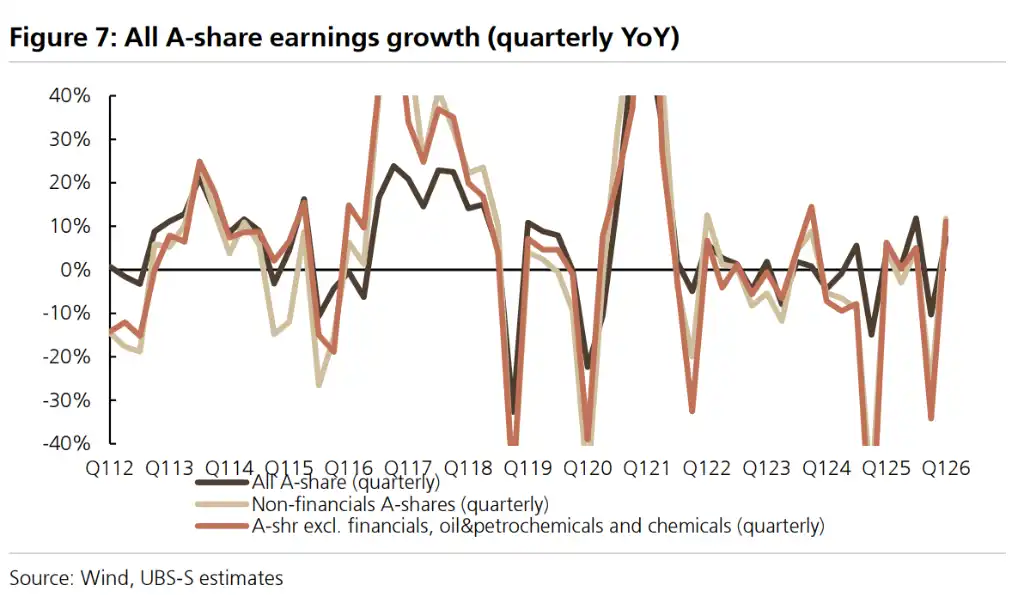
UBS expects the profit growth rate for all A-shares to rise from 3.9% in 2025 to 11% in 2026. In the first quarter of 2026, non-financial sector profits increased by 11.8% year-on-year, with both gross margin and net profit margin hitting their highest levels since 2023. Continued inflows from multiple funding channels, sustained expansion of industry-theme ETF sizes, and the recovery of private fund issuance collectively form important support for the current market micro-liquidity.

In tactical allocation, UBS leans towards growth and cyclical styles under its baseline "slow bull" scenario. At the sector level, it strongly favors electronics, communications, electrical equipment, machinery, non-ferrous metals, and chemicals, and maintains buy ratings on multiple related stocks.

Tech Overweight Ratio Still Has Room, Current Style Duration Still Short

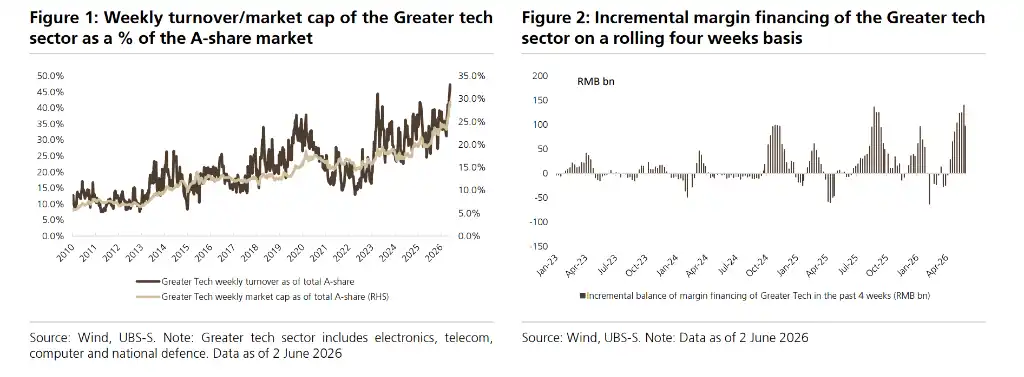
The trading heat and capital concentration in the tech sector have warmed up significantly recently.

According to UBS data, as of June 2, 2026, the weekly trading volume of the large tech sector accounted for 45.5% of total A-share trading volume, and its market cap accounted for 28.6% of the total market. Both metrics are at historical highs. Since the Iran-US ceasefire on April 8, which repaired risk appetite, the STAR 50 and ChiNext indices have surged 35.5% and 30.4% cumulatively, significantly outperforming the 11.0% gain of the Wind All-A Index and the 9.8% gain of the CSI 300 Index over the same period.

However, UBS believes that using trading heat and short-term gains to judge crowdedness has limitations, and the public fund overweight ratio is a more core indicator for measuring institutional positioning concentration. From this perspective, the current overweight ratio of the large tech sector is not only lower than its own historical peak but also far behind levels seen at historical peaks for the consumer sector, such as 22.8% in the third quarter of 2010 and 21.0% in the third quarter of 2012.

UBS reviewed the historical patterns of five major style rotations in A-shares since 2014:

  • From 2014 to 2015, leveraged funds drove sharp market fluctuations.
  • From 2017 to 2019, foreign inflows fueled the "blue-chip stock" rally.
  • From 2019 to 2021, public funds chased profit-compounding companies, forming a positive feedback loop.
  • From 2022 to before the policy pivot in 2024, insurance capital and the "national team" drove defensive sectors to outperform.
  • After the policy pivot in 2024, margin financing, ETFs, and private funds have propelled the outperformance of small-cap and growth styles.

The study found that each style typically lasts about three years from formation to rotation — the high fundamental growth of a single sector rarely lasts more than three years, and there is a natural ceiling to fund concentration. Pressure from redemptions after narrowing outperformance transmits to stock prices and triggers a trend reversal.

However, signals from some sub-sectors are already worth noting. The overweight ratio for the electronics sector has reached 6.6%, exceeding the previous high of 5.4% in the third quarter of 2020. The overweight ratio for the communications sector has refreshed its record high since 2010 for three consecutive quarters, reaching 4.0%. UBS stated it will continue to monitor changes in related indicators.

Earnings Recovery Accelerates, Solidifying Market Rally Foundation

UBS expects the profit growth rate for all A-shares to rise to 11% in 2026 and points out that multiple top-down and bottom-up indicators confirm the acceleration of the earnings improvement trend.

Based on Q1 2026 earnings data, the year-on-year profit growth rate for non-financial A-shares surged from 0.8% in 2025 to 11.8%; excluding oil, petrochemicals, and basic chemicals, the growth rate reached 12.3%. The profit growth rate for the STAR Market in Q1 was as high as 204.7%, and the ChiNext Market reached 22.7%, both significantly outperforming the main board's 5.5%. Gross margin and net profit margin increased by 0.6 and 0.3 percentage points year-on-year, respectively, both hitting their highest levels since 2023, indicating that margin pressure for downstream companies remains manageable despite high oil prices.
On the macro level, April PPI rose 2.8% year-on-year, and CPI rose 1.2%. UBS expects inflation to rise further in the coming months. Since non-financial A-share revenue growth is highly correlated with nominal GDP and PPI trends, rising inflation will directly drive faster expansion on the revenue side.

Bottom-up data also confirms the upward profit trend.

In the first four months of this year, profits for industrial enterprises above designated size grew 18.2% year-on-year, with profits in computer, communication, and electronic equipment manufacturing soaring 107.7% year-on-year; profits in non-ferrous metal mining, mining, and coal washing sectors grew 94.9%, 26.0%, and 21.0% year-on-year, respectively. Regarding profit expectations, earnings growth expectations for the IT, raw materials, real estate, and energy sectors over the past six months have all been revised upward by more than 20 percentage points. The trajectory of these upward revisions is highly similar to past earnings upcycle years like 2017, 2019, and 2021.

From a medium-term perspective, an increasing share of overseas business is another important support for margin expansion. The proportion of overseas revenue for non-financial A-shares has steadily increased from 9.5% in 2010 to 18.7% in 2025. Furthermore, the gross margin of overseas business has consistently been higher than that of domestic business, with the gap widening further in 2025. UBS believes that the continued advancement of "anti-involution" policies and the implementation of supportive policies will also drive further sector margin recovery over the medium term.

Tactical Allocation: Emphasis on Growth and Cyclicals, Six Sectors Overweighted

At the style allocation level, under its baseline "slow bull" scenario, UBS favors growth styles. The backdrop of rising PPI and industrial profits supports cyclical styles. Sustained ample liquidity and high market turnover favor small-cap styles.

However, the continued expansion of industry-theme ETF sizes is providing additional capital support to leading companies. UBS expects the relative performance of large-cap versus small-cap styles to be more balanced in the second half of the year compared to 2025.

At the sector level, UBS is overweight six areas: Electronics (benefiting from semiconductor inventory cycle recovery and AI innovation), Communications (driven by AI computing demand and widespread adoption of industrial internet, fueling profit growth for sub-sector leaders), Machinery (automation equipment and industrial robotics benefiting from domestic capital expenditure recovery and import substitution), Non-ferrous Metals (rising copper and aluminum prices, lithium sector demand recovery), Chemicals (advancement of anti-involution and accelerated exit of overseas capacity accelerating bottom formation), and Electrical Equipment (policy support and AI data center power demand driving energy storage development).


Perguntas relacionadas

QAccording to UBS, is the crowding in A-share technology stocks at a historically high level currently?

ANo. While trading volume and market cap share of the large tech sector are at historical highs, the core indicator measuring institutional position concentration, the public fund overweight ratio, is still far below historical peaks. The current overweight ratio for the large tech sector is 9.9%, significantly lower than its historical peak of 14.1% in Q4 2015 and much lower than the consumer sector's historical peak overweight of 18.7%.

QWhat is the expected profit growth rate for all A-shares in 2026 according to UBS's report?

AUBS expects the profit growth rate for all A-shares to increase to 11% in 2026, up from 3.9% in 2025.

QWhat are the two tech sub-sectors where the overweight ratios have already reached concerning levels as per UBS's analysis?

AThe two sub-sectors are Electronics and Communications. The Electronics sector's overweight ratio has reached 6.6%, surpassing its previous high of 5.4% in Q3 2020. The Communications sector's overweight ratio has hit 4.0%, a new high for three consecutive quarters since 2010.

QWhat are the six sectors that UBS recommends overweighting in its tactical asset allocation under the 'slow bull' baseline scenario?

AThe six sectors are: Electronics, Communications, Electrical Equipment, Machinery, Non-ferrous Metals, and Chemicals.

QBased on historical patterns studied by UBS, how long does a typical market style cycle from formation to rotation usually last in the A-share market?

AUBS's research on style shifts since 2014 indicates that a typical market style cycle, from formation to rotation, usually lasts about three years.

Leituras Relacionadas

Single-Day Plunge of 30%, Arthur Hayes Suddenly Liquidates: Why Did ZEC Get Exploded by Security Issues?

On June 5th, Zcash founder Zooko Wilcox disclosed a critical soundness vulnerability in the project's latest Orchard privacy pool. This flaw, found in the elliptic curve multiplication constraints, could allow an attacker to create unlimited counterfeit ZEC within the shielded pool, with transactions appearing valid. The vulnerability was discovered in late May by security researcher Taylor Hornby, who utilized Anthropic's new Opus 4.8 AI model for a targeted audit. The Zcash ecosystem had already performed an emergency network upgrade to patch the issue. However, the detailed disclosure triggered severe market panic, causing ZEC's price to plummet over 30% in a single day. Notably, prominent investor Arthur Hayes announced he had sold his entire ZEC position following the news. The incident starkly challenges the "technological trust" narrative central to privacy coins. Despite years of top-tier cryptographic audits, the bug persisted until uncovered with advanced AI-assisted research. This highlights the growing gap between theoretical perfection and practical implementation in privacy technology. The event serves as a industry-wide warning: in an AI-driven security landscape, the assumption that "undiscovered equals safe" is obsolete. It underscores the urgent need for continuous, proactive security practices combining AI audits, formal verification, and rapid response mechanisms.

foresightnews_apiHá 1h

Single-Day Plunge of 30%, Arthur Hayes Suddenly Liquidates: Why Did ZEC Get Exploded by Security Issues?

foresightnews_apiHá 1h

Breaking the Curse of DeFi Cascading Liquidations, Vitalik Proposes a New Solution

**Vitalik Buterin Proposes New DeFi Design to Eliminate Forced Liquidations** Ethereum co-founder Vitalik Buterin has published a proposal for a new decentralized finance (DeFi) architecture aimed at removing the automatic liquidation mechanisms prevalent in current lending protocols. The core idea involves creating synthetic assets using options as building blocks, fundamentally avoiding the抵押借贷结构 that triggers forced sell-offs. The proposal responds to a recurring flaw in DeFi: during sharp market downturns, mass自动清算 of under-collateralized positions can exacerbate price declines, creating systemic selling pressure and market instability, as evidenced by recent crypto market volatility. Buterin's model would split an asset like 1 ETH into two option-like derivatives, P and N, pegged to a price index with a set strike price and expiration. At expiry, an oracle determines the settlement price to allocate the underlying ETH between P and N holders. This design eliminates the "cliff" of instant liquidation. Instead, a position's value would gradually drift from its target peg if not actively rebalanced by the user, transferring the rebalancing decision from the protocol to the user or automated tools. A key advantage is the reduced reliance on high-frequency, real-time oracle price feeds, which are vulnerable to manipulation and errors in current systems. The delayed settlement in the options model allows for more robust, fault-tolerant oracle designs. However, significant challenges remain for practical adoption. High transaction costs (slippage) from frequent rebalancing on automated market makers (AMMs) could erode user funds. The model may not be suitable for stablecoins requiring a strict 1:1 dollar peg, as it inherently allows for value drift. Success would depend on developing new liquidity provisioning models and deep markets for these synthetic assets. The proposal represents a fundamental rethinking of DeFi risk management, challenging the industry to explore alternatives to被动集中平仓 rather than merely optimizing existing liquidation processes. It remains a theoretical framework awaiting implementation and testing by development teams.

foresightnews_apiHá 1h

Breaking the Curse of DeFi Cascading Liquidations, Vitalik Proposes a New Solution

foresightnews_apiHá 1h

Bitcoin's Decline Marks the Transformation of Crypto

Title: The Decline of Bitcoin Marks the Transformation of Crypto While Bitcoin's price recently fell below $70,000, down approximately 45% from its peak, the broader crypto industry is not following it into decline. Instead, crypto is maturing and evolving beyond its dependence on Bitcoin's price movements. Two of Bitcoin's core functions are being usurped. First, AI has captured its role as the primary speculative asset. AI, with its tangible revenue, explosive demand, and massive capital inflows ($700-830 billion in 2024), is siphoning off the speculative "hot money" that once drove Bitcoin. It also contributes to a sustained high-interest-rate environment, further tightening liquidity for assets like Bitcoin. Second, dollar-pegged stablecoins like USDC and USDT have replaced Bitcoin as the crypto market's foundational currency and primary on/off-ramp. Most trading pairs and on-chain transactions are now settled in stablecoins, severing the historical link where all capital inflows had to pass through Bitcoin first. This decoupling allows projects to thrive based on their own fundamentals rather than Bitcoin's price. Examples include Hyperliquid, an on-chain derivatives exchange with annual revenues of $8-13 billion, and prediction market platform Polymarket, valued at $200 billion with $3.65 billion in annual fees. These projects are evaluated on traditional metrics like revenue and user growth. New opportunities are emerging, particularly around privacy. Privacy coins like Zcash (ZEC) are seeing surging demand, while infrastructure like NEAR enables private, cross-chain asset transfers without requiring users to hold a specific token—privacy becomes a universal service layer. In this new paradigm, stablecoins are the universal cash, various project tokens represent equity, and privacy-enabled cross-chain coordination layers (like NEAR) act as the critical infrastructure connecting a fragmented, multi-chain ecosystem. Bitcoin is now just one asset among many. The era where the entire crypto market moved in lockstep with Bitcoin is over. The industry's health should now be judged by project fundamentals—real revenue, active users, and tokenomics that capture value—and the development of the underlying infrastructure enabling a mature, dollar-denominated crypto economy.

foresightnews_apiHá 1h

Bitcoin's Decline Marks the Transformation of Crypto

foresightnews_apiHá 1h

Lightspark CEO: In Ten Years, Bitcoin Will Be as Invisible as TCP/IP, Yet Power Trillions in Daily Transactions

A decade from now, Bitcoin will function like TCP/IP — invisible yet foundational, supporting trillions in daily transactions globally, according to Lightspark CEO David Marcus. In this future, a coffee shop in Lagos receives instant payment, a manufacturer in São Paulo settles an invoice with a supplier in Ho Chi Minh City, and a freelancer in Bangalore gets paid weekly from an Austin startup — all via Bitcoin's settlement layer, with none of the parties consciously interacting with it. This vision parallels the adoption of open protocols: first driven by necessity where existing systems fail, then scaling rapidly as tools mature and economic benefits become clear. The structural shift begins with wallets. Modern non-custodial wallets, like Spark, allow users to hold dollars, local currency, and Bitcoin in a single address, seamlessly switching between them. This eliminates friction and revolutionizes global custody, moving significant deposits to user-controlled keys not by ideology, but by superior utility. As a result, Bitcoin becomes the default savings layer for billions, as its fixed supply and appreciating value make it a rational choice for savers holding it alongside stablecoins in their everyday wallets. Businesses follow a similar path, from small companies in emerging markets to multinational corporations, holding Bitcoin alongside operational stablecoins. The latest trend is direct Bitcoin transactions for commerce. When both parties hold Bitcoin, transacting in it becomes the simplest option — no conversions, no intermediary currency. This starts in niche areas like high-value B2B settlements but grows as infrastructure makes sending Bitcoin as easy as stablecoins. An accelerating force is AI agents. By 2036, AI agents conducting commerce on behalf of individuals and firms will increasingly choose Bitcoin for settlement. Optimizing for speed, finality, and minimal counterparty risk across jurisdictions, they find Bitcoin's global, neutral, and programmable network ideal for netting and settling obligations. Thus, Bitcoin is becoming the native currency for machine commerce, just as it has become a native savings asset for humans. The global monetary system is being rebuilt from the protocol layer: open infrastructure, default self-custody, Bitcoin settling everything underneath, with stablecoins as the interface. Most users won't think about Bitcoin when they transact — and they won't need to.

foresightnews_apiHá 1h

Lightspark CEO: In Ten Years, Bitcoin Will Be as Invisible as TCP/IP, Yet Power Trillions in Daily Transactions

foresightnews_apiHá 1h

Trading

Spot
Futuros
活动图片