Why Is Nvidia Borrowing $20 Billion When It's Not Short of Cash?

marsbitPublicado em 2026-06-15Última atualização em 2026-06-15

Resumo

Nvidia's recent announcement to issue at least $20 billion in senior notes, despite holding a strong cash position with over $48.6 billion in free cash flow last quarter, is not a sign of financial need. Instead, it represents a strategic move to leverage its high credit rating (recently upgraded to AA by S&P) to secure low-cost, long-term debt. This capital will support long-term AI infrastructure investments, data centers, R&D, supply chain prepayments, and strategic investments, while allowing the company to continue aggressive shareholder returns through stock buybacks and dividends. The decision reflects a mature capital management strategy: using debt to finance long-term growth assets is more efficient and less dilutive to shareholders than equity financing. It signals that Nvidia, like other tech giants (Alphabet, Meta, Amazon), is entering a new phase of heavy AI capital expenditure, shifting from a pure growth story to a story about capital allocation, credit strength, and long-term ecosystem positioning. The key question for investors is whether Nvidia can maintain its high cash flow generation and ensure that returns from these AI investments justify the cost of capital over the long term. The bond issuance amplifies its expansion capabilities but also ties its valuation more closely to the broader AI investment cycle's sustainability and profitability.

TL;DR

Nvidia's latest bond issuance is most easily misread as a simple question: with so much cash on hand, why does it need to borrow money?

According to the company's most recent quarterly data, for FY2027 Q1 ending April 26, 2026, Nvidia's revenue reached $81.6 billion, with free cash flow around $48.6 billion. At the same time, the company added $80 billion in stock repurchase authorization and raised its quarterly dividend from $0.01 to $0.25. In other words, this is not a company with tight cash flow needing the bond market to stay afloat.

But it's precisely because of this that the market is particularly sensitive to its plan to issue at least $20 billion in senior notes. The bond maturities range from 2 to 30 years, with proceeds intended for general corporate purposes, refinancing, AI data center and infrastructure, R&D, supply chain prepayments, and strategic investments. For investors, the real question worth asking is not "Does Nvidia have money?" but rather: When the biggest AI cash cow also starts systematically using long-term debt, has the AI capital expenditure narrative entered a new phase?

The core of this matter is not that Nvidia suddenly needs money, but that it is converting its cash flow and credit rating into another form of expansion capability.

The Stronger the Cash, the More Qualified to Borrow Long-Term

The average investor seeing "bond issuance" often first thinks the company is short of money. But for mature large companies, borrowing is often not a passive plea for help, but an active choice of a cheaper, less shareholder-dilutive financing method.

Nvidia plans to issue senior notes (corporate IOUs), essentially borrowing money from bond investors, paying periodic interest and repaying principal at maturity. The biggest difference from issuing new shares is that issuing debt does not carve out a piece of the company's ownership. As long as the company's future returns exceed the debt cost, existing shareholders can retain more earnings.

This is the paradox of this transaction. Nvidia's free cash flow in the last quarter was about $48.6 billion, its single-quarter cash generation capacity already significantly exceeding the scale of this proposed financing. The company is also simultaneously conducting massive buybacks and raising dividends, indicating the bond issuance cannot be simply understood as "not having enough cash."
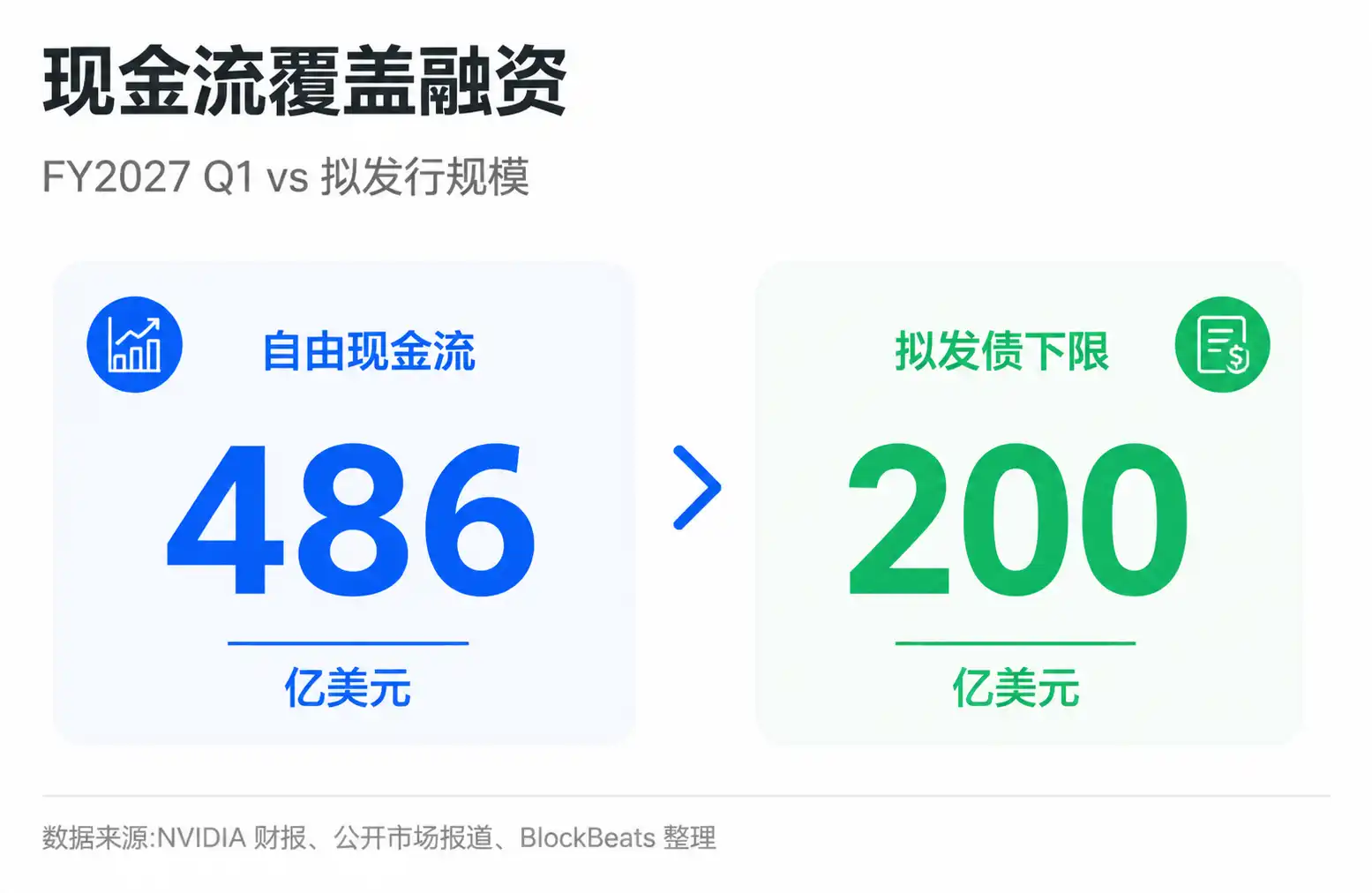
A more reasonable explanation is that Nvidia is locking in a source of long-term funding when its credit is strongest and the market is most willing to lend to it. For a company in an AI infrastructure expansion cycle, data centers, supply chain prepayments, ecosystem investments, and R&D spending are not short-term projects. Their payback periods may span years, even a decade or more. Matching long-term assets with 30-year debt is closer to mature capital management than relying entirely on short-term operating cash flow.

This is also the plain meaning of "capital structure optimization": the company uses not just cash on hand but also appropriately pairs it with low-cost debt. As long as the long-term return generated by the borrowed money is higher than the interest cost, debt is not just a burden; it can also be a tool to improve capital efficiency.

AA Rating Turns Bonds into AI Ammunition

That Nvidia can do this relies on the bond market being willing to lend to it at a low enough cost. The most important variable behind this is the credit rating.

S&P Global Ratings recently upgraded Nvidia to AA, citing reasons including competitive advantages from AI demand, strong cash flow generation capacity, and a robust balance sheet. An AA rating can be understood as a high-credit label in the bond market: investors believe the company has an extremely low default risk, therefore willing to accept lower spreads and longer maturities.

This is key. Bond issuance isn't just about "getting money"; what truly determines the transaction's value is "at what cost, for how long, and in what market window." When a company is in a phase of credit upgrades, rapidly expanding cash flow, and the AI theme is still favored by institutional funds, its bargaining power for long-term funding significantly strengthens.

This also explains why Nvidia is acting at this moment. It's not waiting until cash flow weakens or expansion pressure increases to raise funds; instead, it's reducing future financing uncertainty in advance when the market most recognizes its credit quality. For shareholders, this is more attractive than being forced to finance in a worse environment in the future.

The listed uses of the bond proceeds are also worth considering together: refinancing, AI data center and infrastructure, R&D, supply chain prepayments, strategic investment. Refinancing leans towards financial management, infrastructure and supply chain towards expansion security, and strategic investment towards ecosystem positioning. They collectively point to one fact: Nvidia's capital needs are no longer just about "producing more chips," but about maintaining its position within the entire AI ecosystem.
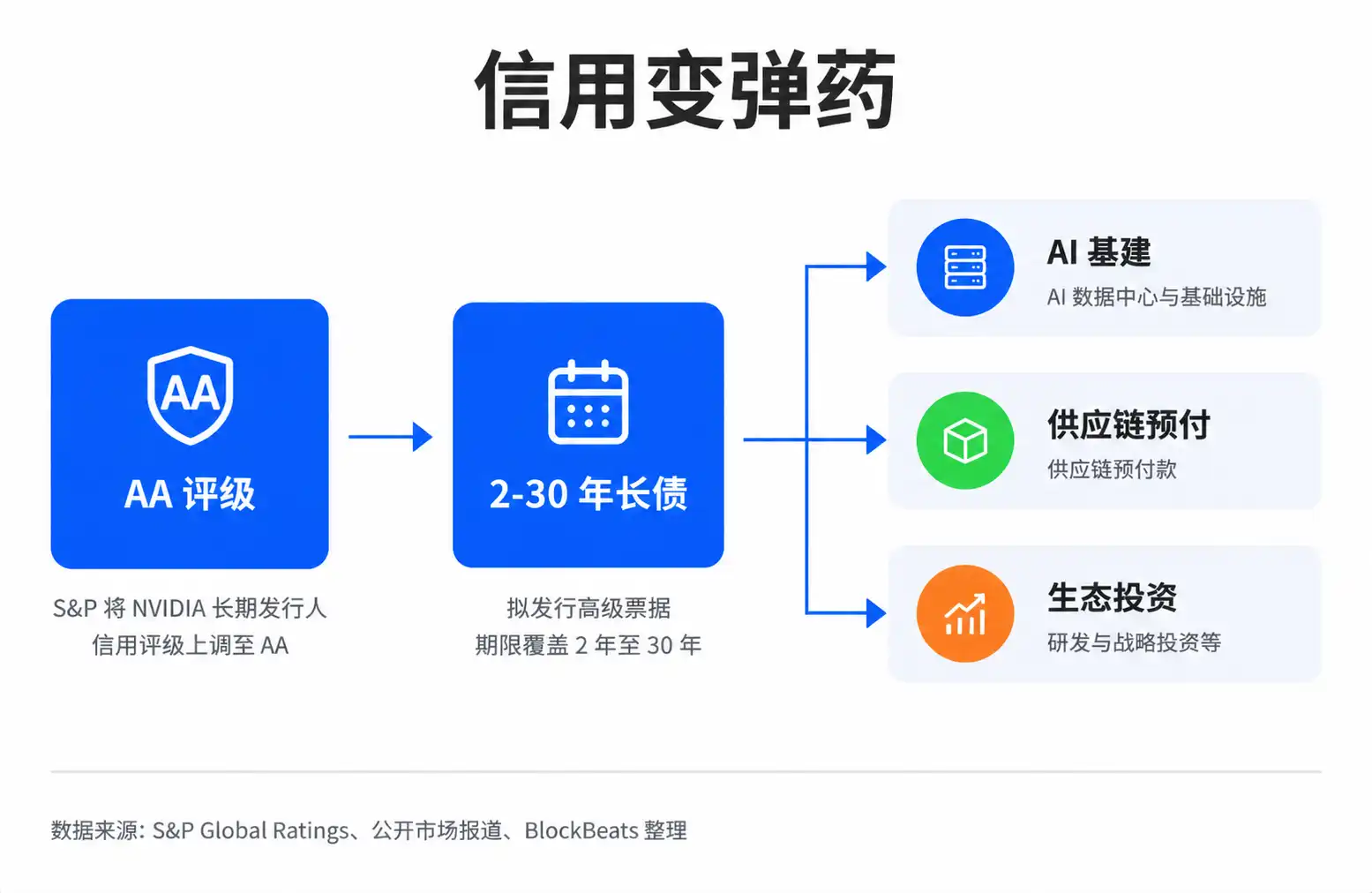
Nvidia sells the most critical computing power tools of the AI era, but it also needs to ensure its customers, supply chain, infrastructure, and ecosystem partners can keep up. The more important this role becomes, the more its capital allocation resembles a platform company, not just a hardware company.

Borrowing Is More Aligned with Shareholder Interests Than Issuing Shares

For NVDA shareholders, this bond issuance has another direct implication: the company is reserving ammunition for long-term expansion while maintaining shareholder returns.

Nvidia's last quarter not only had strong cash flow but also added $80 billion in buyback authorization and raised its dividend. Buybacks and dividends represent the company returning cash directly to shareholders; issuing debt represents using external long-term funds to support future investments. Looking at them together conveys not an "either-or" but the company's attempt to maintain two lines simultaneously: rewarding existing shareholders while not slowing down AI expansion.

If Nvidia chose to raise funds by issuing new shares, existing shareholders would be diluted. Even if the company continues to grow, earnings per share would be reduced. In contrast, the cost of debt is clearer: interest and principal. For a company with extremely strong free cash flow and a high credit rating, this cost is easier to manage.

Of course, this doesn't mean bond issuance is necessarily positive. Debt increases fixed expenses and raises market expectations for capital allocation efficiency. The reason Nvidia can get investors to accept this debt today is that the market believes its future cash flow can cover the interest and that AI infrastructure investments will ultimately translate into revenue and profit. If these two premises change, debt could shift from an efficiency tool to a valuation pressure.

Therefore, what this bond issuance truly changes is how investors observe Nvidia. In the past, the market focused more on GPU demand, gross margins, and revenue growth; now, it must also pay attention to how cash flow is allocated: how much for buybacks and dividends, how much for supply chain and infrastructure, how much for ecosystem investment, and how much is locked in early through debt.

This will make NVDA's valuation anchor more complex. It's no longer just a "profit growth story"; it's also beginning to feature characteristics of a "credit asset" and a "long-term capital allocation platform."

The AI Financing Template for Large Tech Companies Is Taking Shape

Nvidia is not the only company doing this. Alphabet completed a $20 billion bond issuance in February 2026, with maturities also covering multiple series, reportedly with orders once exceeding $100 billion. Meta, Amazon, and other large tech companies are also using debt financing during the AI investment cycle as one tool to support infrastructure spending.
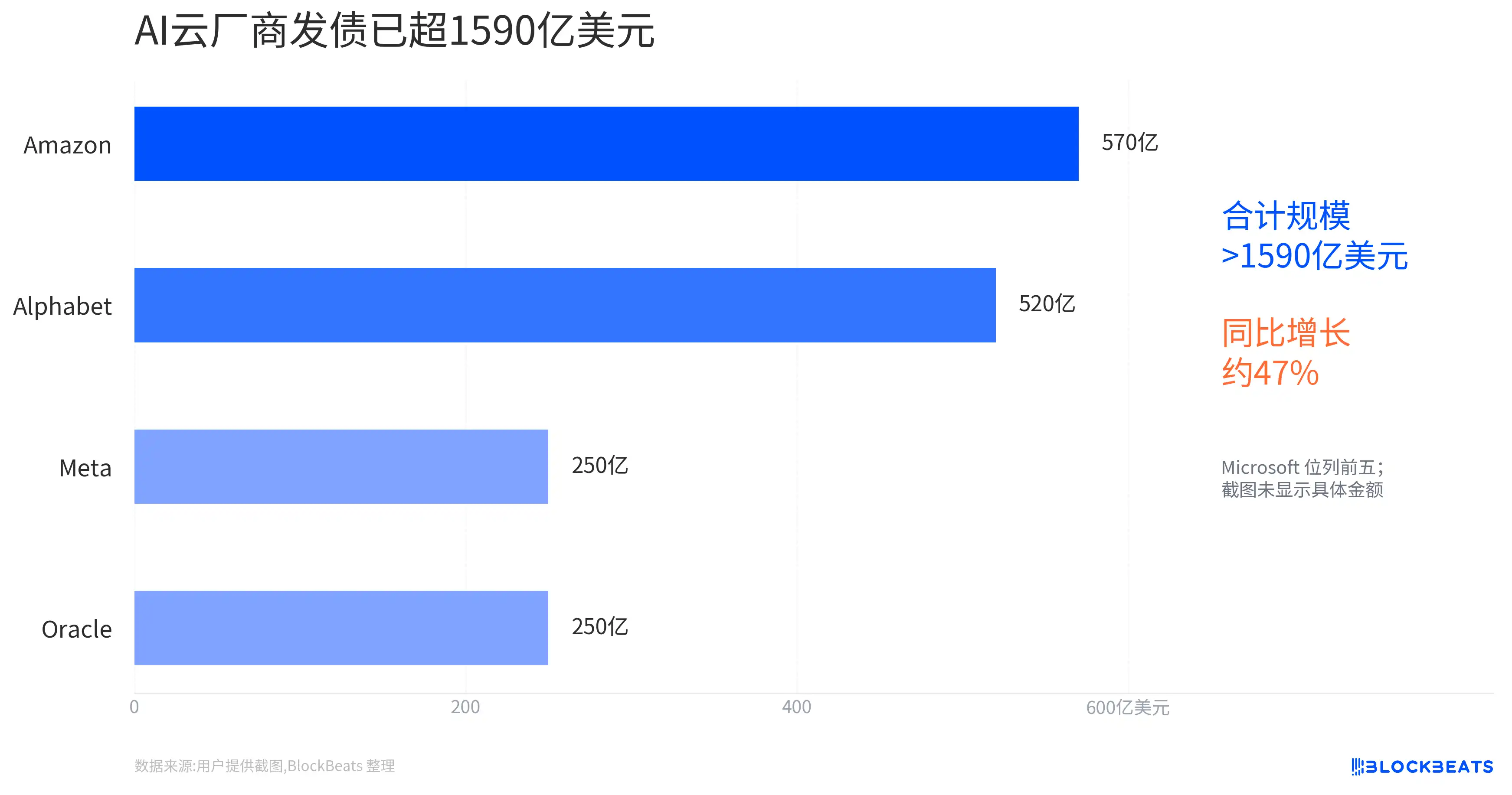
These cases cannot be simply written off as "tech giants are all short of money." A more accurate description is: AI infrastructure has shifted from a light-asset software growth story to a heavy-asset cycle involving data centers, power, chips, networks, and the supply chain. The company that can obtain funds at lower costs and for longer periods will have more room to maneuver in this expansion.

This has two implications for market pricing.

First, debt financing extends the endurance of AI capex (capital expenditure). As long as the bond market is willing to buy, large tech companies don't have to rely entirely on current cash flow to pay for long-term construction. This will support demand expectations for data centers, power, optical communications, semiconductor supply chains, and other areas.

Second, debt financing will also make investors more attentive to the payback period. In the past, the market was willing to pay a high valuation for AI investments because the growth speed was fast enough. But as investments become heavier and financing terms longer, the question becomes: When will these infrastructures generate sufficient returns? If AI application revenue materializes slower than expected, or the commercial return per unit of computing power declines, the market will re-examine whether these debt-supported expansions are too aggressive.

Nvidia's special position is that it sits at the upstream of the AI capital expenditure chain. The more customers invest, the more it benefits; but if the investment returns of the entire industry are questioned, it cannot remain completely insulated. Therefore, this bond issuance both reinforces the market's recognition of its credit and cash flow and embeds it deeper into the narrative of long-cycle AI capital expenditure.

What Remains to Be Tested Is Whether Pricing and Returns Can Coexist

The most important caveat at present is: this is still a "proposed issuance of at least $20 billion"; the final issuance size, coupon, spread, and order book strength remain to be confirmed. Only after the transaction closes can the market more accurately judge at what low cost and for how long bond investors are willing to fund Nvidia.

If the final pricing shows strong demand and long-term spreads remain low, this will further prove that Nvidia is turning its AA credit into an expansion tool. It can not only profit from customers' AI spending but also finance its own long-term positioning at lower costs in the capital market.

But the more important verification later lies not in the bonds themselves, but in the next phase of earnings reports and capital expenditure data. Investors need to see whether Nvidia can continue to maintain strong free cash flow while advancing AI infrastructure, supply chain prepayments, ecosystem investment, and shareholder returns. If these variables can still progress in parallel, bond issuance becomes an amplifier of capital efficiency.

Conversely, if the payback period for future AI infrastructure lengthens, or the company increasingly relies on external financing to sustain expansion, the market's understanding of such debt will change. Then the question will no longer be "Is Nvidia short of cash?" but "Is the return rate on long-cycle AI investments sufficient to support the expectations being front-loaded by today's low-cost funds?"


Perguntas relacionadas

QWhy is Nvidia raising $20 billion through debt issuance despite having very strong cash flow?

ANvidia is issuing debt not because it lacks cash, but as an active capital management strategy to optimize its capital structure. With its strong AA credit rating and robust cash flow, it can lock in low-cost, long-term funding now to support its long-term AI infrastructure expansion, data center build-out, R&D, supply chain prepayments, and strategic investments. Using debt is a cheaper and more shareholder-friendly way to finance these long-duration assets compared to diluting equity, allowing the company to simultaneously fund growth and maintain shareholder returns through buybacks and dividends.

QWhat are the potential benefits for shareholders from Nvidia's debt issuance instead of issuing more stock?

AIssuing debt instead of equity prevents dilution of existing shareholders' ownership. This means current shareholders retain a larger share of the company's future earnings. For a company like Nvidia with strong projected returns and low borrowing costs, using debt is seen as a more efficient way to finance growth. It also allows the company to continue its significant stock buyback program and increased dividends while still funding large-scale, long-term investments, thus balancing shareholder rewards with expansion.

QWhat does the timing of Nvidia's bond issuance indicate about the broader AI investment cycle?

AThe timing signals that the AI capital expenditure (capex) narrative may be entering a new, more mature stage. Large technology firms are shifting from light-asset, software-driven growth to a heavy-asset cycle involving data centers, power, chips, and supply chains. Nvidia, along with other giants like Alphabet and Meta using debt, shows that securing low-cost, long-term capital is becoming a strategic imperative to fuel and extend this infrastructure build-out, making debt financing a key tool for competitive advantage in the AI arms race.

QWhat is the significance of Nvidia's AA credit rating for its recent bond offering?

ANvidia's recent upgrade to an AA credit rating by S&P Global is crucial. It acts as a 'high-credit label' in the bond market, indicating extremely low perceived default risk. This allows Nvidia to borrow large sums at very low interest rates and with long maturities (like 30-year bonds). The strong rating means investors are willing to accept lower returns for the perceived safety, giving Nvidia significant pricing power and the ability to secure favorable long-term funding to support its strategic, multi-year AI investments.

QWhat are the key risks or future tests associated with Nvidia's use of long-term debt to fund AI expansion?

AThe main risk is whether the future returns from AI infrastructure investments will justify the current use of cheap, long-term debt. If AI application revenue grows slower than expected, or if the return on invested capital for these heavy assets declines, the debt could become a burden rather than an efficiency tool. The market will closely watch Nvidia's ability to maintain its strong free cash flow while executing its expansion plans. The key test is whether the AI capex cycle's actual profitability can support the growth expectations that are being pre-funded by the bond market.

Leituras Relacionadas

The Shutdown of Claude Mythos Revealed the True Cost of Renting AI to Me

The sudden shutdown of Claude Mythos this week starkly highlights a critical, often overlooked risk for founders: when your core capability relies entirely on someone else's platform, your fate is not in your own hands. The key question becomes: who truly owns the intelligence your product depends on? For years, the debate around open-source models focused on cost. Now, the evidence is clear: fine-tuned open-source models can achieve frontier-level quality for specific, mission-critical tasks at a fraction of the cost. However, the deeper issue is control. Relying on a third-party API is like renting; it works until the landlord changes the rules, raises the rent, or asks you to leave—as Mythos experienced. The lesson is not to stop using frontier models—they are incredible infrastructure. The goal is ownership. Ownership means starting with a powerful open-source model and shaping it around what makes your company unique: your data, workflows, domain expertise, and definition of "good." Over time, the model becomes less generic and more reflective of your business, creating durable value. The optimistic conclusion is that AI's future doesn't hinge on one superior model. There is no single frontier. The frontier includes proprietary models, models fine-tuned on company-specific knowledge, specialized models for narrow problems, and intelligent routers orchestrating model ensembles. The most interesting development is not models getting smarter, but intelligence becoming increasingly customizable. The winning companies will be those that transform intelligence into a unique, owned asset. Looking ahead, the vision is not one model dominating all, but many teams owning the part of the frontier that matters most to them.

marsbitHá 19m

The Shutdown of Claude Mythos Revealed the True Cost of Renting AI to Me

marsbitHá 19m

Tiger Research: U.S. Strategic Bitcoin Reserve - Should the Market Be Happy or Disappointed?

Tiger Research analyzes the evolution of U.S. legislative efforts regarding a strategic Bitcoin reserve, concluding the market impact is limited in the short term but potentially positive long-term. The core event was a March 2025 executive order by former President Trump, which designated confiscated Bitcoin as a strategic reserve and promised not to sell existing holdings (approx. 190k BTC). As it contained no mandate to purchase new Bitcoin, the market reacted negatively, with prices dropping 5.7%. Legislative history shows a significant retreat from initial ambitions. The 2024 "BITCOIN Act" proposed mandatory purchases of 1 million BTC over five years. Reintroduced in 2025, it stalled due to high fiscal costs, concerns over dollar hegemony, and opposition from the Treasury Secretary. The current frontrunner, the 2026 "American Retirement and Monetary Advancement (ARMA) Act," is a compromise. It lacks any purchase requirement, instead focusing on consolidating existing government-held Bitcoin and legally prohibiting its sale for at least 20 years. While ARMA has higher passage odds due to bipartisan support and no purchase mandate, its immediate market effect is neutral. It eliminates potential government selling pressure but creates no new demand. The long-term significance is that formally establishing Bitcoin as a national reserve asset in law could later reignite debates on mandatory purchases. Therefore, the path to a government buyer is longer than initially priced by the market, but the directional narrative remains intact.

marsbitHá 22m

Tiger Research: U.S. Strategic Bitcoin Reserve - Should the Market Be Happy or Disappointed?

marsbitHá 22m

US Stock Market Trend (June 16): SpaceX Rises 42% in Two Days, New Fed Chairman Takes Office Today

**U.S. Stocks Trend (June 16): SpaceX Soars 42% in Two Days, New Fed Chair Takes Office Today** Markets surged on Monday following former President Trump's social media announcement of a completed U.S.-Iran deal to reopen the Strait of Hormuz, pending a June 19 signing. The news triggered a broad risk-on rally: oil prices crashed, tech stocks soared, bond yields fell, and defensive sectors lagged. **Market Performance:** The Nasdaq jumped 3.07%, led by semiconductor stocks like Micron (+9.2%). The S&P 500 gained 1.65%, and the Dow rose 0.92% to a record high. However, the Russell 2000 small-cap index underperformed (+0.72%). SpaceX continued its hot streak, rising another 5% pre-market after disclosures of large buys by an Australian billionaire and Cathie Wood's ARK. Boeing also rallied on the transportation optimism. Conversely, energy stocks like Chevron fell over 3% on the oil price plunge, with other defensive sectors also selling off. The day's action showed a clear rotation of funds from energy/defensive plays into AI and tech narratives. **Macro & Outlook:** The VIX fear index fell 8.37%. Treasury yields declined, and WTI crude dropped over 5%. Attention now shifts to a packed schedule: the Bank of Japan is widely expected to hike rates to 1.0% on Tuesday. The Fed's June meeting concludes Wednesday, marking new Chair Wash's debut. While rates are expected to hold, his tone on stubborn inflation and the "dot plot" will be crucial for gauging the 2024 rate path. The formal Iran deal signing is set for Friday. **Trend Perspective:** While the peace deal is a genuine positive, Monday's explosive rally may have gotten ahead of itself, pricing in a swift resolution to inflation concerns. The shortened trading week faces a triple test: BoJ tightening, the Fed's policy stance, and deal implementation details. Tech and semiconductors, which led the surge, remain vulnerable to any disappointment from these key events. The real price discovery begins with the central banks' communications this week.

marsbitHá 43m

US Stock Market Trend (June 16): SpaceX Rises 42% in Two Days, New Fed Chairman Takes Office Today

marsbitHá 43m

Xiaohongshu's Second Great Voyage, This Time Sailing Towards AI

Xiaohongshu's Second Voyage: Navigating Towards AI Since ChatGPT's emergence, Xiaohongshu's founder Mao Wenchao has been acutely aware of AI's potential threat, recognizing that the life advice people seek from chatbots overlaps directly with his platform's core business. Founded in 2013 as a PDF shopping guide for Chinese tourists, Xiaohongshu evolved into a massive community where millions share authentic, personal experiences—from product reviews to travel tips. This vast repository of "I've tried this" human judgment became its most valuable asset. However, the rise of AI, which delivers instant answers, challenges the very need for users to sift through numerous personal notes. Fearing its treasure trove of lived experience could become mere training data for others, Xiaohongshu is proactively adapting. In 2026, it established a dedicated AI division (Dots), launched RED Skill to turn user experiences into usable AI tools, and acquired the AI search product "Diandian." Its investments now extend to AI firms like MiniMax and hardware startups, moving upstream to address needs before they even become search queries. The platform's commercialization strategy is also evolving. With a newly acquired payment license and tools like the AIPS model to track consumer decision journeys, Xiaohongshu aims to seamlessly integrate recommendations with transactions, embedding commerce within AI-generated answers. Yet, a critical tension remains. While building smarter machines to organize and leverage its human experiences, Xiaohongshu must prevent AI from drowning out the authentic, flawed, and trustworthy "I've tried this" voices that built its community. Its core challenge is to harness AI's power without letting the map—the machine's perfect, synthesized answer—replace the territory of genuine human experience. This balance between technological advancement and preserving human trust defines its current journey and its future.

marsbitHá 1h

Xiaohongshu's Second Great Voyage, This Time Sailing Towards AI

marsbitHá 1h

Trading

Spot
Futuros

Artigos em Destaque

O que é $S$

Compreender o SPERO: Uma Visão Abrangente Introdução ao SPERO À medida que o panorama da inovação continua a evoluir, o surgimento de tecnologias web3 e projetos de criptomoeda desempenha um papel fundamental na formação do futuro digital. Um projeto que tem atraído atenção neste campo dinâmico é o SPERO, denotado como SPERO,$$s$. Este artigo tem como objetivo reunir e apresentar informações detalhadas sobre o SPERO, para ajudar entusiastas e investidores a compreender as suas bases, objetivos e inovações nos domínios web3 e cripto. O que é o SPERO,$$s$? O SPERO,$$s$ é um projeto único dentro do espaço cripto que procura aproveitar os princípios da descentralização e da tecnologia blockchain para criar um ecossistema que promove o envolvimento, a utilidade e a inclusão financeira. O projeto é concebido para facilitar interações peer-to-peer de novas maneiras, proporcionando aos utilizadores soluções e serviços financeiros inovadores. No seu núcleo, o SPERO,$$s$ visa capacitar indivíduos ao fornecer ferramentas e plataformas que melhoram a experiência do utilizador no espaço das criptomoedas. Isso inclui a possibilidade de métodos de transação mais flexíveis, a promoção de iniciativas impulsionadas pela comunidade e a criação de caminhos para oportunidades financeiras através de aplicações descentralizadas (dApps). A visão subjacente do SPERO,$$s$ gira em torno da inclusão, visando fechar lacunas dentro das finanças tradicionais enquanto aproveita os benefícios da tecnologia blockchain. Quem é o Criador do SPERO,$$s$? A identidade do criador do SPERO,$$s$ permanece algo obscura, uma vez que existem recursos publicamente disponíveis limitados que fornecem informações detalhadas sobre o(s) seu(s) fundador(es). Esta falta de transparência pode resultar do compromisso do projeto com a descentralização—uma ética que muitos projetos web3 partilham, priorizando contribuições coletivas em vez de reconhecimento individual. Ao centrar as discussões em torno da comunidade e dos seus objetivos coletivos, o SPERO,$$s$ incorpora a essência do empoderamento sem destacar indivíduos específicos. Assim, compreender a ética e a missão do SPERO é mais importante do que identificar um criador singular. Quem são os Investidores do SPERO,$$s$? O SPERO,$$s$ é apoiado por uma diversidade de investidores que vão desde capitalistas de risco a investidores-anjo dedicados a promover a inovação no setor cripto. O foco desses investidores geralmente alinha-se com a missão do SPERO—priorizando projetos que prometem avanço tecnológico social, inclusão financeira e governança descentralizada. Essas fundações de investidores estão tipicamente interessadas em projetos que não apenas oferecem produtos inovadores, mas que também contribuem positivamente para a comunidade blockchain e os seus ecossistemas. O apoio desses investidores reforça o SPERO,$$s$ como um concorrente notável no domínio em rápida evolução dos projetos cripto. Como Funciona o SPERO,$$s$? O SPERO,$$s$ emprega uma estrutura multifacetada que o distingue de projetos de criptomoeda convencionais. Aqui estão algumas das características-chave que sublinham a sua singularidade e inovação: Governança Descentralizada: O SPERO,$$s$ integra modelos de governança descentralizada, capacitando os utilizadores a participar ativamente nos processos de tomada de decisão sobre o futuro do projeto. Esta abordagem promove um sentido de propriedade e responsabilidade entre os membros da comunidade. Utilidade do Token: O SPERO,$$s$ utiliza o seu próprio token de criptomoeda, concebido para servir várias funções dentro do ecossistema. Esses tokens permitem transações, recompensas e a facilitação de serviços oferecidos na plataforma, melhorando o envolvimento e a utilidade gerais. Arquitetura em Camadas: A arquitetura técnica do SPERO,$$s$ suporta modularidade e escalabilidade, permitindo a integração contínua de funcionalidades e aplicações adicionais à medida que o projeto evolui. Esta adaptabilidade é fundamental para manter a relevância no panorama cripto em constante mudança. Envolvimento da Comunidade: O projeto enfatiza iniciativas impulsionadas pela comunidade, empregando mecanismos que incentivam a colaboração e o feedback. Ao nutrir uma comunidade forte, o SPERO,$$s$ pode melhor atender às necessidades dos utilizadores e adaptar-se às tendências do mercado. Foco na Inclusão: Ao oferecer taxas de transação baixas e interfaces amigáveis, o SPERO,$$s$ visa atrair uma base de utilizadores diversificada, incluindo indivíduos que anteriormente podem não ter participado no espaço cripto. Este compromisso com a inclusão alinha-se com a sua missão abrangente de empoderamento através da acessibilidade. Cronologia do SPERO,$$s$ Compreender a história de um projeto fornece insights cruciais sobre a sua trajetória de desenvolvimento e marcos. Abaixo está uma cronologia sugerida que mapeia eventos significativos na evolução do SPERO,$$s$: Fase de Conceituação e Ideação: As ideias iniciais que formam a base do SPERO,$$s$ foram concebidas, alinhando-se de perto com os princípios de descentralização e foco na comunidade dentro da indústria blockchain. Lançamento do Whitepaper do Projeto: Após a fase conceitual, um whitepaper abrangente detalhando a visão, os objetivos e a infraestrutura tecnológica do SPERO,$$s$ foi lançado para atrair o interesse e o feedback da comunidade. Construção da Comunidade e Primeiros Envolvimentos: Esforços ativos de divulgação foram feitos para construir uma comunidade de primeiros adotantes e investidores potenciais, facilitando discussões em torno dos objetivos do projeto e angariando apoio. Evento de Geração de Tokens: O SPERO,$$s$ realizou um evento de geração de tokens (TGE) para distribuir os seus tokens nativos a apoiantes iniciais e estabelecer liquidez inicial dentro do ecossistema. Lançamento da dApp Inicial: A primeira aplicação descentralizada (dApp) associada ao SPERO,$$s$ foi lançada, permitindo que os utilizadores interagissem com as funcionalidades principais da plataforma. Desenvolvimento Contínuo e Parcerias: Atualizações e melhorias contínuas nas ofertas do projeto, incluindo parcerias estratégicas com outros players no espaço blockchain, moldaram o SPERO,$$s$ em um jogador competitivo e em evolução no mercado cripto. Conclusão O SPERO,$$s$ é um testemunho do potencial do web3 e das criptomoedas para revolucionar os sistemas financeiros e capacitar indivíduos. Com um compromisso com a governança descentralizada, o envolvimento da comunidade e funcionalidades inovadoras, abre caminho para um panorama financeiro mais inclusivo. Como em qualquer investimento no espaço cripto em rápida evolução, potenciais investidores e utilizadores são incentivados a pesquisar minuciosamente e a envolver-se de forma ponderada com os desenvolvimentos em curso dentro do SPERO,$$s$. O projeto demonstra o espírito inovador da indústria cripto, convidando a uma exploração mais aprofundada das suas inúmeras possibilidades. Embora a jornada do SPERO,$$s$ ainda esteja a desenrolar-se, os seus princípios fundamentais podem, de facto, influenciar o futuro de como interagimos com a tecnologia, as finanças e uns com os outros em ecossistemas digitais interconectados.

69 Visualizações TotaisPublicado em {updateTime}Atualizado em 2024.12.17

O que é $S$

O que é AGENT S

Agent S: O Futuro da Interação Autónoma no Web3 Introdução No panorama em constante evolução do Web3 e das criptomoedas, as inovações estão constantemente a redefinir a forma como os indivíduos interagem com plataformas digitais. Um projeto pioneiro, o Agent S, promete revolucionar a interação humano-computador através do seu framework aberto e agente. Ao abrir caminho para interações autónomas, o Agent S visa simplificar tarefas complexas, oferecendo aplicações transformadoras em inteligência artificial (IA). Esta exploração detalhada irá aprofundar-se nas complexidades do projeto, nas suas características únicas e nas implicações para o domínio das criptomoedas. O que é o Agent S? O Agent S é um framework aberto e agente, especificamente concebido para abordar três desafios fundamentais na automação de tarefas computacionais: Aquisição de Conhecimento Específico de Domínio: O framework aprende inteligentemente a partir de várias fontes de conhecimento externas e experiências internas. Esta abordagem dupla capacita-o a construir um rico repositório de conhecimento específico de domínio, melhorando o seu desempenho na execução de tarefas. Planeamento ao Longo de Longos Horizontes de Tarefas: O Agent S emprega planeamento hierárquico aumentado por experiência, uma abordagem estratégica que facilita a decomposição e execução eficientes de tarefas intrincadas. Esta característica melhora significativamente a sua capacidade de gerir múltiplas subtarefas de forma eficiente e eficaz. Gestão de Interfaces Dinâmicas e Não Uniformes: O projeto introduz a Interface Agente-Computador (ACI), uma solução inovadora que melhora a interação entre agentes e utilizadores. Utilizando Modelos de Linguagem Multimodais de Grande Escala (MLLMs), o Agent S pode navegar e manipular diversas interfaces gráficas de utilizador de forma fluida. Através destas características pioneiras, o Agent S fornece um framework robusto que aborda as complexidades envolvidas na automação da interação humana com máquinas, preparando o terreno para uma infinidade de aplicações em IA e além. Quem é o Criador do Agent S? Embora o conceito de Agent S seja fundamentalmente inovador, informações específicas sobre o seu criador permanecem elusivas. O criador é atualmente desconhecido, o que destaca ou o estágio nascente do projeto ou a escolha estratégica de manter os membros fundadores em anonimato. Independentemente da anonimidade, o foco permanece nas capacidades e no potencial do framework. Quem são os Investidores do Agent S? Como o Agent S é relativamente novo no ecossistema criptográfico, informações detalhadas sobre os seus investidores e financiadores não estão explicitamente documentadas. A falta de informações disponíveis publicamente sobre as fundações de investimento ou organizações que apoiam o projeto levanta questões sobre a sua estrutura de financiamento e roteiro de desenvolvimento. Compreender o apoio é crucial para avaliar a sustentabilidade do projeto e o seu impacto potencial no mercado. Como Funciona o Agent S? No núcleo do Agent S reside uma tecnologia de ponta que lhe permite funcionar eficazmente em diversos ambientes. O seu modelo operacional é construído em torno de várias características-chave: Interação Humano-Computador Semelhante: O framework oferece planeamento avançado em IA, esforçando-se para tornar as interações com computadores mais intuitivas. Ao imitar o comportamento humano na execução de tarefas, promete elevar as experiências dos utilizadores. Memória Narrativa: Utilizada para aproveitar experiências de alto nível, o Agent S utiliza memória narrativa para acompanhar os históricos de tarefas, melhorando assim os seus processos de tomada de decisão. Memória Episódica: Esta característica fornece aos utilizadores orientações passo a passo, permitindo que o framework ofereça suporte contextual à medida que as tarefas se desenrolam. Suporte para OpenACI: Com a capacidade de funcionar localmente, o Agent S permite que os utilizadores mantenham o controlo sobre as suas interações e fluxos de trabalho, alinhando-se com a ética descentralizada do Web3. Fácil Integração com APIs Externas: A sua versatilidade e compatibilidade com várias plataformas de IA garantem que o Agent S possa integrar-se perfeitamente em ecossistemas tecnológicos existentes, tornando-o uma escolha apelativa para desenvolvedores e organizações. Estas funcionalidades contribuem coletivamente para a posição única do Agent S no espaço cripto, à medida que automatiza tarefas complexas e em múltiplos passos com mínima intervenção humana. À medida que o projeto evolui, as suas potenciais aplicações no Web3 podem redefinir a forma como as interações digitais se desenrolam. Cronologia do Agent S O desenvolvimento e os marcos do Agent S podem ser encapsulados numa cronologia que destaca os seus eventos significativos: 27 de Setembro de 2024: O conceito de Agent S foi lançado num artigo de pesquisa abrangente intitulado “Um Framework Agente Aberto que Usa Computadores como um Humano”, mostrando a base para o projeto. 10 de Outubro de 2024: O artigo de pesquisa foi disponibilizado publicamente no arXiv, oferecendo uma exploração aprofundada do framework e da sua avaliação de desempenho com base no benchmark OSWorld. 12 de Outubro de 2024: Uma apresentação em vídeo foi lançada, proporcionando uma visão visual das capacidades e características do Agent S, envolvendo ainda mais potenciais utilizadores e investidores. Estes marcos na cronologia não apenas ilustram o progresso do Agent S, mas também indicam o seu compromisso com a transparência e o envolvimento da comunidade. Pontos-Chave Sobre o Agent S À medida que o framework Agent S continua a evoluir, várias características-chave destacam-se, sublinhando a sua natureza inovadora e potencial: Framework Inovador: Concebido para proporcionar um uso intuitivo de computadores semelhante à interação humana, o Agent S traz uma abordagem nova à automação de tarefas. Interação Autónoma: A capacidade de interagir autonomamente com computadores através de GUI significa um avanço em direção a soluções computacionais mais inteligentes e eficientes. Automação de Tarefas Complexas: Com a sua metodologia robusta, pode automatizar tarefas complexas e em múltiplos passos, tornando os processos mais rápidos e menos propensos a erros. Melhoria Contínua: Os mecanismos de aprendizagem permitem que o Agent S melhore a partir de experiências passadas, aprimorando continuamente o seu desempenho e eficácia. Versatilidade: A sua adaptabilidade em diferentes ambientes operacionais, como OSWorld e WindowsAgentArena, garante que pode servir uma ampla gama de aplicações. À medida que o Agent S se posiciona no panorama do Web3 e das criptomoedas, o seu potencial para melhorar as capacidades de interação e automatizar processos significa um avanço significativo nas tecnologias de IA. Através do seu framework inovador, o Agent S exemplifica o futuro das interações digitais, prometendo uma experiência mais fluida e eficiente para os utilizadores em diversas indústrias. Conclusão O Agent S representa um ousado avanço na união da IA e do Web3, com a capacidade de redefinir a forma como interagimos com a tecnologia. Embora ainda esteja nas suas fases iniciais, as possibilidades para a sua aplicação são vastas e cativantes. Através do seu framework abrangente que aborda desafios críticos, o Agent S visa trazer interações autónomas para o primeiro plano da experiência digital. À medida que avançamos mais profundamente nos domínios das criptomoedas e da descentralização, projetos como o Agent S desempenharão, sem dúvida, um papel crucial na formação do futuro da tecnologia e da colaboração humano-computador.

678 Visualizações TotaisPublicado em {updateTime}Atualizado em 2025.01.14

O que é AGENT S

Como comprar S

Bem-vindo à HTX.com!Tornámos a compra de Sonic (S) simples e conveniente.Segue o nosso guia passo a passo para iniciar a tua jornada no mundo das criptos.Passo 1: cria a tua conta HTXUtiliza o teu e-mail ou número de telefone para te inscreveres numa conta gratuita na HTX.Desfruta de um processo de inscrição sem complicações e desbloqueia todas as funcionalidades.Obter a minha contaPasso 2: vai para Comprar Cripto e escolhe o teu método de pagamentoCartão de crédito/débito: usa o teu visa ou mastercard para comprar Sonic (S) instantaneamente.Saldo: usa os fundos da tua conta HTX para transacionar sem problemas.Terceiros: adicionamos métodos de pagamento populares, como Google Pay e Apple Pay, para aumentar a conveniência.P2P: transaciona diretamente com outros utilizadores na HTX.Mercado de balcão (OTC): oferecemos serviços personalizados e taxas de câmbio competitivas para os traders.Passo 3: armazena teu Sonic (S)Depois de comprar o teu Sonic (S), armazena-o na tua conta HTX.Alternativamente, podes enviá-lo para outro lugar através de transferência blockchain ou usá-lo para transacionar outras criptomoedas.Passo 4: transaciona Sonic (S)Transaciona facilmente Sonic (S) no mercado à vista da HTX.Acede simplesmente à tua conta, seleciona o teu par de trading, executa as tuas transações e monitoriza em tempo real.Oferecemos uma experiência de fácil utilização tanto para principiantes como para traders experientes.

1.3k Visualizações TotaisPublicado em {updateTime}Atualizado em 2026.06.02

Como comprar S

Discussões

Bem-vindo à Comunidade HTX. Aqui, pode manter-se informado sobre os mais recentes desenvolvimentos da plataforma e obter acesso a análises profissionais de mercado. As opiniões dos utilizadores sobre o preço de S (S) são apresentadas abaixo.

活动图片