BP Price Soars 300% in 2 Weeks: What Is Backpack Betting On?

Foresight NewsPublicado em 2026-06-15Última atualização em 2026-06-15

Resumo

"BP, the native token of the Backpack exchange, surged over 300% in two weeks to $0.475, driven by the launch of its new regulated stock brokerage and asset tokenization arm, Backpack Securities. The platform enables users to trade U.S. stocks and tokenize them on Solana, with the SpaceX tokenized stock (SPCX) generating significant on-chain volume. This expansion into bridging traditional finance with DeFi aligns with the RWA narrative. BP's unique tokenomics, where 25% was airdropped at TGE with zero allocation to the team, and a staking mechanism allowing conversion to equity upon a company IPO, underpins its value proposition. Over 66% of the circulating supply is currently staked."


Author: Ma He, Foresight News


On June 15, the exchange token of Backpack, BP, surged over 30% again within 24 hours, currently quoted at $0.475, with a market cap of $118.48 million and an FDV of $473.94 million. BP has skyrocketed significantly from around $0.16 in early June this year, peaking above $0.48.
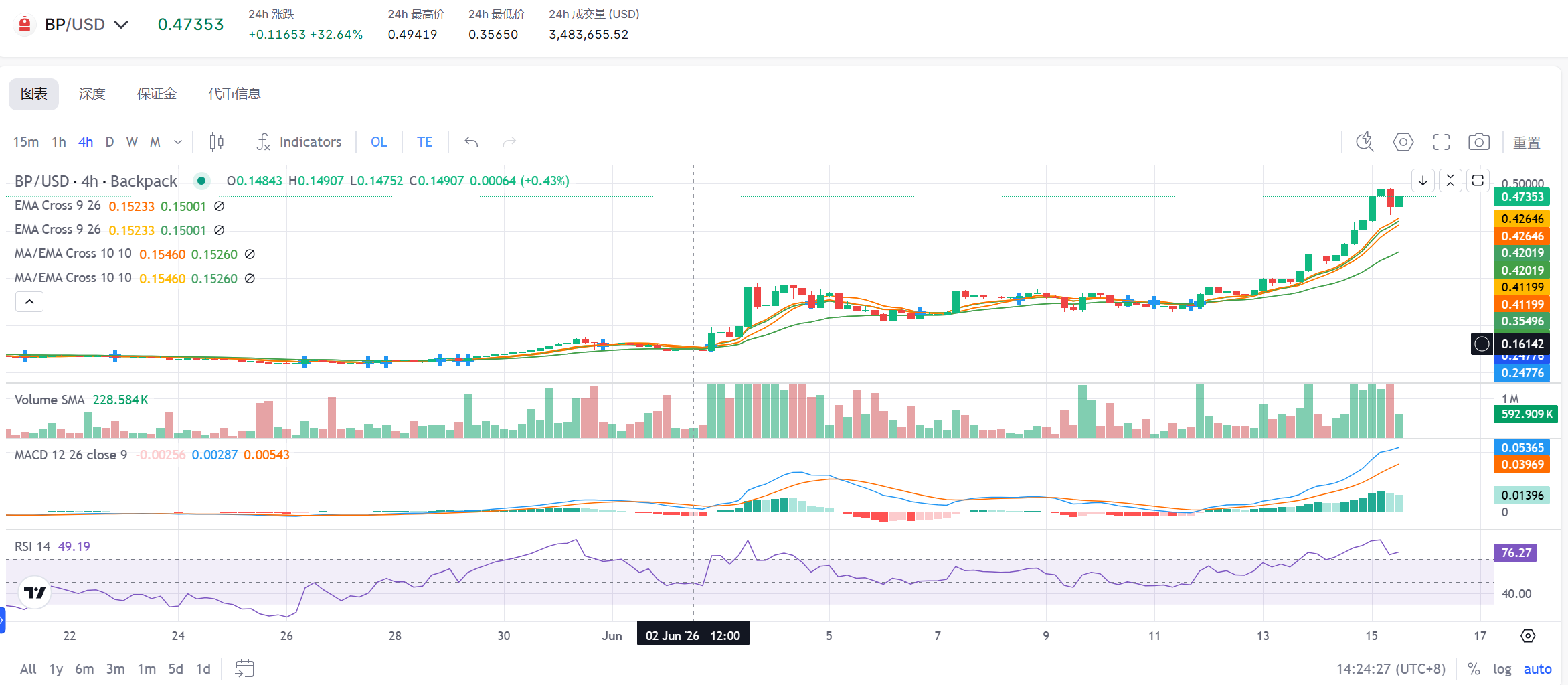


The immediate driving force behind this rally comes from the platform's latest breakthrough in traditional U.S. stock brokerage and asset tokenization services.


Entering U.S. Stock Brokerage and Tokenization Business


In March 2026, BP completed its TGE on Solana, with a total supply of 1 billion tokens and an initial circulating supply of 250 million. After listing, the price briefly hit a high before quickly retracing, with a single-day maximum drop exceeding 40%, filling the market with profit-taking pressure. For several weeks thereafter, the price consolidated at lower levels until the turn-around in early June.


On June 2, Backpack announced the launch of the Backpack Securities platform, which will offer regulated U.S. stock brokerage services while also supporting the tokenization of traditional stocks for circulation on the blockchain, enabling seamless conversion between traditional securities and on-chain assets. The brokerage services are planned for a gradual rollout in June, with initial tokenized products launched on the Solana ecosystem through a partnership with Sunrise. BP surged over 80% in a single day, rapidly climbing from the $0.14-0.15 range to around $0.27, with its market cap approaching $70 million at one point.


On June 12, the same day SpaceX listed on NASDAQ, its tokenized product SPCX went live on Solana. BP subsequently rose approximately 27% within the next 24 hours, reaching above $0.347. This token is pegged 1:1 to real SpaceX shares, supports 24/7 on-chain trading, and can be redeemed to a traditional securities account via Backpack's brokerage account, achieving interoperability between on-chain and off-chain assets. On its first day, the product generated approximately $35-38 million in on-chain trading volume across DEXs like Jupiter and Raydium. According to the latest official data, the total on-chain trading volume for SPCX exceeded $86 million.
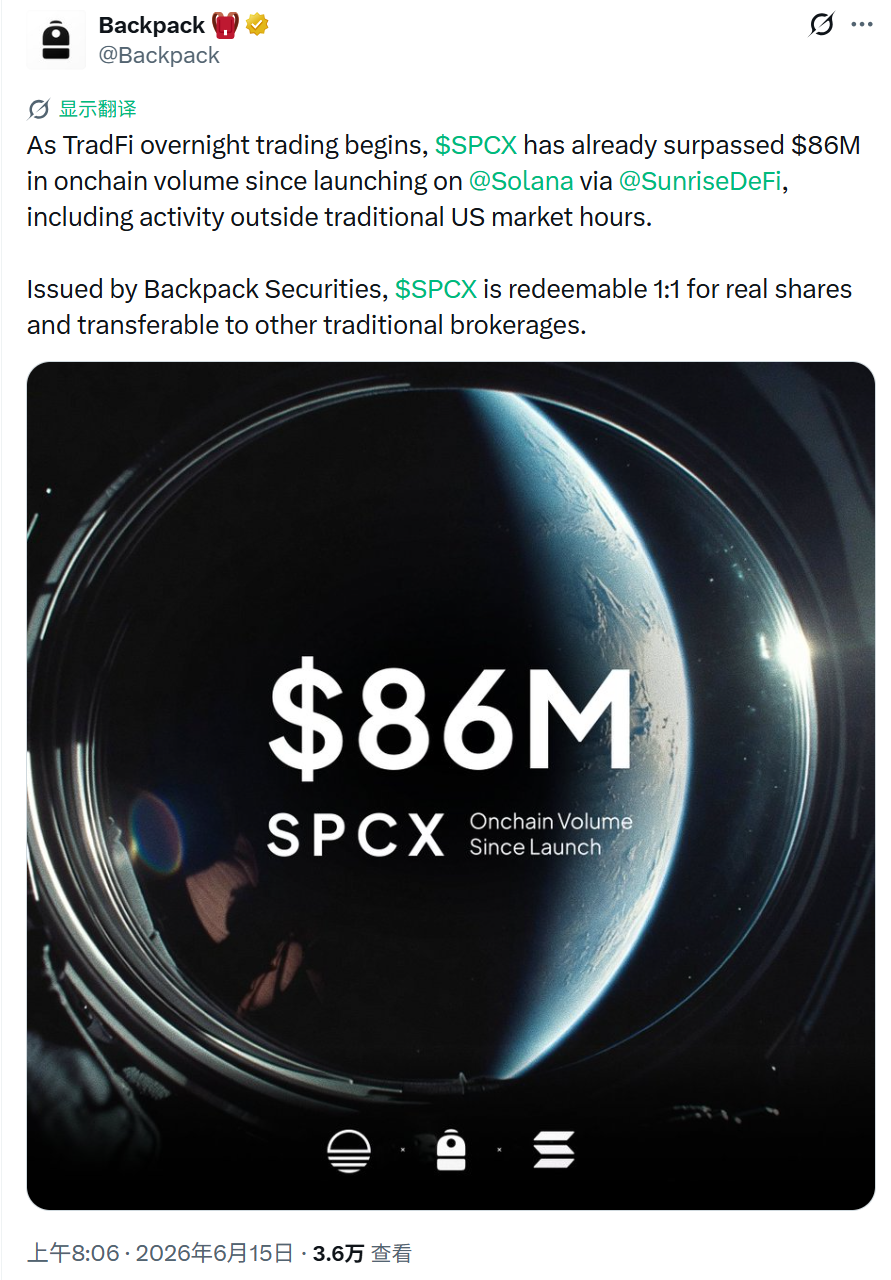


Backpack is building a bridge between traditional U.S. stocks and Solana DeFi. Users can not only trade crypto assets on the platform but also access real stocks through the same account, and tokenize some of those assets for on-chain use, trading, or composability. This path aligns well with the current RWA narrative and has also provided the BP token with clearer use cases and demand support.
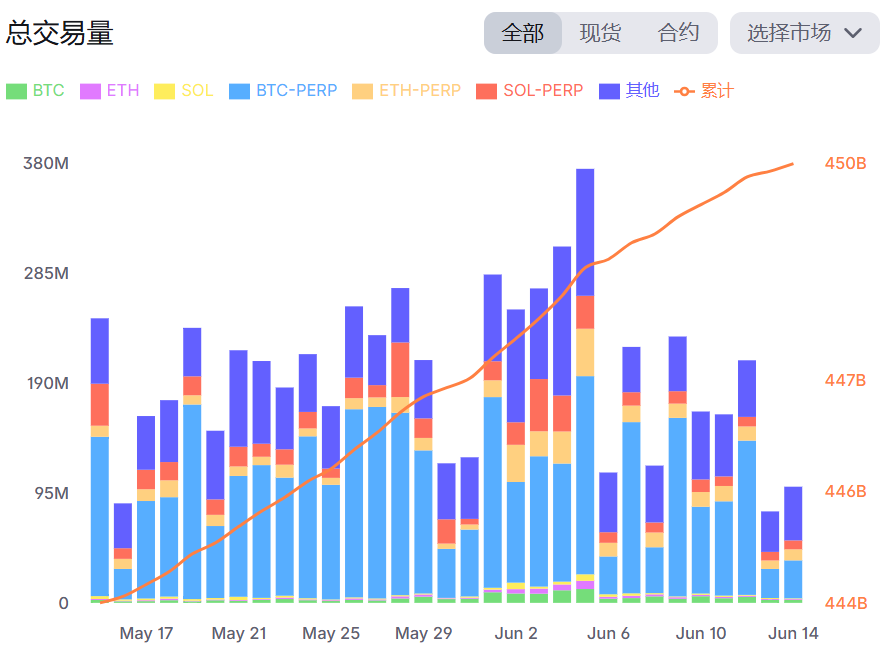


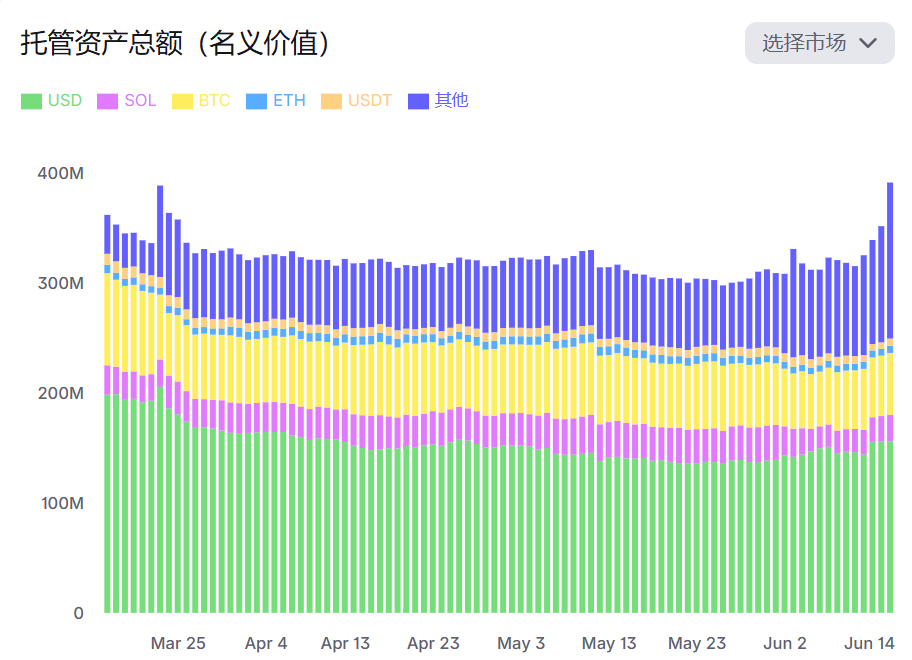
BP's rise this round stems more from the substantial expansion of the platform's business rather than short-term hype. Currently, its official website shows that Backpack's Total Custodied Assets (nominal value) has rebounded to $390 million.

Team Receives Zero Tokens Unless the Company Goes Public


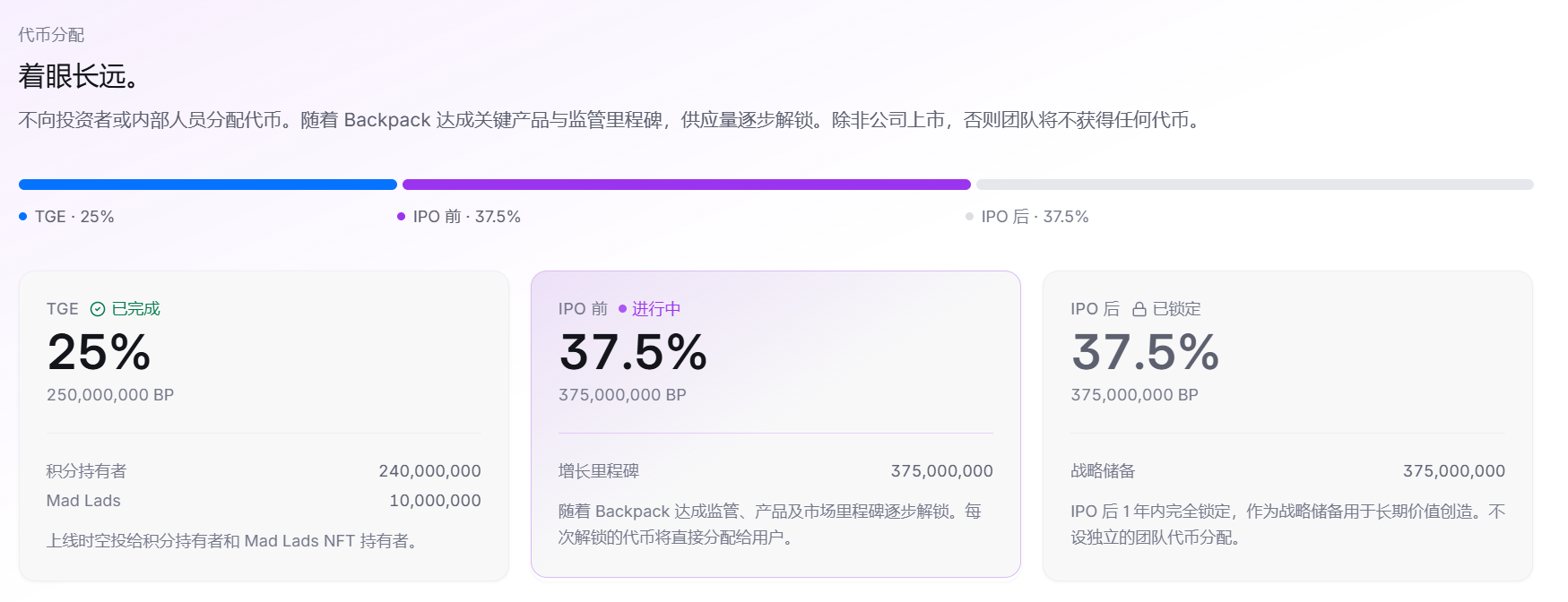
Supporting the development of the above business is the BP token and its unique economic structure launched by Backpack as early as March. The total supply of 1 billion tokens is divided into three phases: The TGE phase allocates 25% (250 million tokens) entirely to community users via airdrop, with approximately 240 million given to Points Program participants and 10 million to Mad Lads NFT holders. At launch, the team, founders, and investors received zero token allocation; The Pre-IPO phase allocates 37.5%, tied to growth triggers like regulatory milestones and product launches, and continues distribution to users upon unlocking; The Post-IPO phase allocates 37.5% to the company treasury, locked for at least one year post-IPO, with the team benefiting only through equity, not directly from tokens.


The most notable mechanism is the equity conversion design: Users staking BP for at least 1 year gain the right to convert their tokens into company equity upon an IPO or acquisition, with the base unlock bonus increasing with holding time up to the 4th year.


Additionally, staking grants benefits such as tiered trading fee discounts, extra yield on USD collateral, free wire transfers, and priority access to the Backpack Card. Currently, about 66% (approximately 165 million tokens) of the circulating supply is staked.


Although the airdrop process was technically smooth, it sparked community discussion. Supporters argued that the "no insider TGE allocation" model was quite radical, and the points system genuinely rewarded trading and ecosystem participation; criticism centered on the relatively strict Sybil filtering mechanism, which led to some long-term users having their points invalidated and receiving less than expected, as well as noticeable profit-taking during the post-listing price correction. CEO Armani Ferrante publicly denied allegations related to team OTC selling.


These controversies affected market sentiment in the short term, but as real products like Backpack Securities land, the focus is gradually shifting from distribution details to the platform's long-term growth and the token's actual utility. Against the backdrop of the platform's expansion into U.S. stock brokerage and tokenization services, the long-term alignment value of BP's staking and equity mechanisms is being re-examined.


Perguntas relacionadas

QWhat is the primary driver behind the recent surge in Backpack Exchange's BP token price?

AThe primary driver behind the recent surge in BP token price is the platform's expansion into traditional U.S. stock brokerage and asset tokenization services, particularly the launch of Backpack Securities and the tokenization of SpaceX shares (SPCX).

QWhat key feature of the BP token's economic structure aims to align long-term user and platform interests?

AA key feature is the equity conversion design: users who stake BP for at least one year gain the right to convert their tokens into company equity during an IPO or acquisition, with the conversion bonus increasing up to the fourth year of staking.

QWhat was a significant immediate market reaction following the launch of the tokenized SpaceX (SPCX) product?

AA significant immediate market reaction was that BP's price rose approximately 27% within 24 hours after the SPCX tokenized product launched on Solana on June 12, coinciding with SpaceX's Nasdaq IPO.

QAccording to the article, what portion of the initially circulating BP token supply was allocated to the team, founders, and investors at TGE (Token Generation Event)?

AAccording to the article, 0% of the BP tokens were allocated to the team, founders, and investors at the TGE. The entire initial circulating supply of 250 million tokens (25% of total supply) was airdropped to the community.

QWhat is the total supply of BP tokens and what percentage is designated for the 'Post-IPO' stage to be held in the company treasury?

AThe total supply of BP tokens is 1 billion. 37.5% of the total supply is designated for the 'Post-IPO' stage and will enter the company treasury, locked for at least one year after an IPO.

Leituras Relacionadas

SharpLink CEO: How to Understand Ethereum Developers Just Exceeded 1 Million?

SharpLink CEO reflects on the milestone of Ethereum surpassing 1 million historical developers, emphasizing that this figure represents the largest pool of technical talent ever assembled around an open, permissionless blockchain network. While approximately 232,000 developers remain active, the key question for the crypto industry is not which chain is fastest, but where the best builders choose to build long-term. Ethereum's advantage lies in a decade-long accumulation of infrastructure, standards, tools, liquidity, and a cohesive culture, making it the default operating system for programmable finance. This developer base is tackling complex challenges: the Glamsterdam upgrade aims to enhance scalability while preserving core principles; synchronous composability seeks to unify Rollup ecosystems; and significant efforts are underway for post-quantum security. Ethereum's deeper network effects stem from composability and shared standards (like the EVM and Solidity), creating a flywheel of more developers, tools, and liquidity. Three reinforcing strengths cement Ethereum's lead: credible neutrality (secured by ~900k validators), a modular architecture with interconnected Rollups, and a culture that attracts top researchers. The ecosystem is consolidating as the trusted coordination layer for internet-native finance, favored by large institutions valuing security and liquidity. The future of Ethereum is being built by this global community of founders and architects.

链捕手Há 15m

SharpLink CEO: How to Understand Ethereum Developers Just Exceeded 1 Million?

链捕手Há 15m

A Clod of Chinese Soil Chokes Two Japanese Giants

"Chinese Soil Chokes Japanese Giants" The production of a key electronic specialty gas, tungsten hexafluoride (WF6), vital for manufacturing AI chips, was halted by two leading Japanese producers—Kanto Denka and Central Glass. Their shutdown was not due to a technological failure but a sudden, critical shortage of a raw material they had long taken for granted: ultra-high-purity (6N-grade) tungsten powder, which is almost entirely sourced from China. Following a quiet Chinese export announcement in January 2026, tungsten powder shipments to Japan dropped to zero for months. Despite frantic efforts, Japanese companies found no viable alternative; imported powder was three times more expensive and lacked the required purity. Their existing stockpiles were exhausted by mid-2026. WF6 is essential for depositing tungsten into the microscopic contact holes of High Bandwidth Memory (HBM) chips, which are crucial for advanced processors like those from Nvidia. While Japanese firms had mastered producing ultra-pure WF6 gas, their entire supply chain relied on China's 6N tungsten powder—a dependency now revealed as a fatal vulnerability. China's dominance in this "soil" results from decades of painstaking R&D by companies like Xiamen Tungsten and China Tungsten & Hightech. They overcame immense technical hurdles, such as separating chemically similar molybdenum from tungsten, to achieve mass production of the world's purest tungsten powder. With their primary suppliers gone, Kanto Denka and Central Glass announced a permanent halt to WF6 production starting July 1, 2026. This immediately created a supply crisis for major semiconductor manufacturers like Samsung and SK Hynix, forcing them to urgently seek and certify new Chinese suppliers for WF6 itself. The reversal marks a dramatic shift: China has moved from exporting low-value raw materials to controlling the high-purity foundation of a critical global tech supply chain, upending a long-established industrial hierarchy.

marsbitHá 46m

A Clod of Chinese Soil Chokes Two Japanese Giants

marsbitHá 46m

Without Tencent, What's Left for Suiyuan?

The article centers on the crucial question posed in the title: what is Seyond Technology really worth if its dominant customer, Tencent, were to stop purchasing its AI chips? As the last of China's "Four AI Chip Dragons" to secure approval for a public listing, Seyond's IPO filing reveals a profound and controversial dependency. In 2025, 74.9% to over 80% of its revenue came from Tencent. The piece argues that this extreme customer concentration is not merely a vulnerability but a strategic outcome of China's AI industry evolution. It contrasts Seyond's path with its peers (Moore Thread, Biren Technology, and MetaX), noting that while others raced to market with ambitious stories, Seyond focused first on securing and delivering for a major client. Its explosive revenue growth—with Q1 2026 up 1474.85% year-on-year—is driven by concentrated orders from Tencent, which itself faces massive, escalating AI compute demands for products like its Yuanbao and Hunyuan models. The relationship is framed as a deliberate, symbiotic cultivation of a supply chain. As both a major shareholder (20.26%) and primary client, Tencent is actively fostering Seyond to build a controllable, stable alternative to NVIDIA, similar to how global tech giants historically nurtured key suppliers. The high switching costs—involving software stacks and deployed systems—create a deep "ecological moat" for Seyond within Tencent's ecosystem. The analysis positions the AI chip landscape in three tiers: NVIDIA as the global leader, Huawei's Ascend as the state-backed player, and commercial firms like Seyond competing for market orders. Seyond is increasingly seen as "Tencent's compute foundation," with its product roadmap closely aligned with the tech giant's needs. The conclusion is that the industry's metric for success is shifting from fundraising and technical specs to real orders, delivery capability, and ecosystem binding. Seyond's value, therefore, lies not just in its chips but in holding a massive, multi-year procurement order from China's largest internet company—a tangible asset arguably more telling than any technical whitepaper in the current climate. The core insight is that for domestic chips, the ultimate challenge isn't just catching up technologically with NVIDIA, but earning the trust, scenarios, and recurring orders from a major anchor client.

marsbitHá 1h

Without Tencent, What's Left for Suiyuan?

marsbitHá 1h

Trading

Spot
Futuros
活动图片