Morgan Stanley Launches Two More Crypto ETFs, Shatters Market with 0.14% Fee Rate

marsbitPublicado em 2026-07-30Última atualização em 2026-07-30

Resumo

Morgan Stanley launched two new crypto ETFs, the Morgan Stanley Ethereum Trust (MSSE) and the Morgan Stanley Solana Trust (MSOL), which debuted with a combined trading volume of $38 million. MSSE saw net inflows of $5.15 million, while MSOL saw high trading volume but no net new shares. Both products offer staking rewards. Morgan Stanley is competing aggressively on price, charging a total management and staking fee of just 0.14%, significantly undercutting major competitors like Bitwise, Grayscale, and BlackRock in both the Ethereum and Solana ETF sectors. While these new funds face the challenge of catching up to the substantial assets and liquidity of established first-mover ETFs, analysts note Morgan Stanley's distinct advantage lies in its vast wealth management network, which includes thousands of financial advisors and trillions in client assets, potentially allowing it to tap into a much broader mainstream investor base.

Original author: Oluwapelumi Adejumo

Original compilation: Saoirse, Foresight News

Morgan Stanley's newly launched Ethereum and Solana exchange-traded products saw a combined trading volume of $38 million on their debut day. This Wall Street institution has swiftly established a foothold in two major cryptocurrency fund tracks previously dominated by early entrants.

Morgan Stanley Ethereum Trust (MSSE) traded 933,715 shares on Tuesday, attracting a net inflow of $5.15 million; Morgan Stanley Solana Trust (MSOL) traded 951,216 shares with a volume of approximately $19 million, but did not see an increase in outstanding shares. Both products are listed on the NYSE Arca exchange, with an opening price of around $20 per share.

Data from market intelligence firm SoSoValue shows that total inflows into U.S. Ethereum-related funds that day were approximately $14.5 million, with MSSE accounting for over one-third of that inflow. BlackRock's staking-enabled ETHB saw an inflow of $5.9 million, while BlackRock's larger spot Ethereum fund ETHA added $3.5 million.
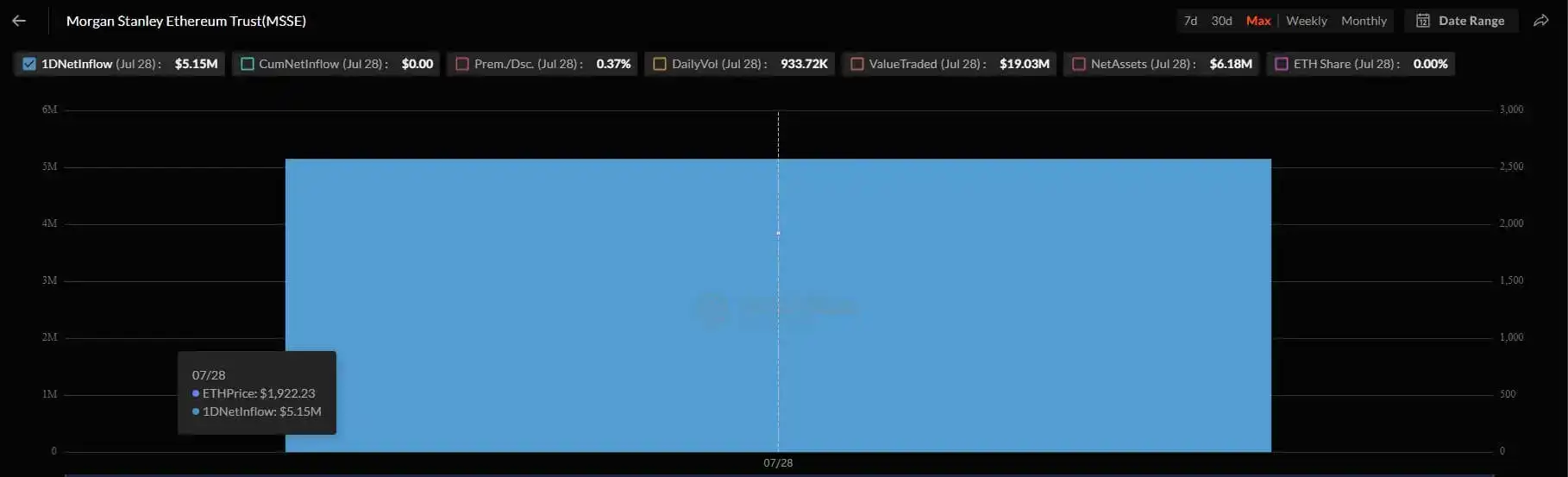
Performance of Morgan Stanley Ethereum Fund on its first day (Source: SoSoValue)

The situation was the opposite for the Solana track. Investors heavily redeemed the BSOL fund from Bitwise, with mainstream Solana funds experiencing a net outflow of $18.1 million overall.

The contrasting debut performances of the two products serve as an early test of how much market share the latecomer Morgan Stanley can capture. Most secondary market trading of MSSE ultimately translated into new assets under management; while MSOL saw comparable trading activity in the secondary market, it failed to attract new capital inflows in an environment where the broader Solana fund category faced widespread outflows.

Morgan Stanley Investment Management launched these two products on July 28th, expanding its cryptocurrency product line. The firm had already launched the Morgan Stanley Bitcoin Trust (MSBT) in April of this year. Despite the Bitcoin ETF track being led by BlackRock and Fidelity, MSBT's assets under management had surpassed $400 million by the time of this report.

These new products go beyond simple spot cryptocurrency asset allocation, with both supporting staking of the underlying assets. Morgan Stanley has officially entered the increasingly competitive fray among fund issuers vying over how much staking yield they can pass on to investors.

Morgan Stanley Wages Price War with Comprehensive Fee Rates Lower Than Competitors

In both the Ethereum and Solana tracks, Morgan Stanley's combined cost of management fees plus staking revenue share is among the lowest in the industry, positioning it competitively.

MSSE and MSOL charge an annual product management fee of 0.14%; Morgan Stanley itself does not take any share of the staking rewards, with the custodian and staking service provider collectively taking only 5% of the total staking rewards. All remaining rewards, before deductions for other fees and distributions, are retained in the trust accounts. This fee structure provides a significant advantage over a host of established competitors.

Solana ETF Industry Fee Comparison

Bitwise's BSOL has a management fee of 0.20%, with a service provider share of staking rewards at 6%; Grayscale's GSOL has a management fee of 0.19% and a service provider share of 7%; Franklin Templeton's SOEZ takes an 8% share of staking rewards; 21Shares has the lowest staking share at 10%, while Fidelity takes 15%, and VanEck and Farside Investors take as high as 25%.

Management and Staking Fees of Solana Exchange-Traded Funds (Source: Farside Investors)

Ethereum ETF Industry Fee Comparison

The disparity in industry fees is equally evident: Grayscale's low-cost Ethereum product charges a management fee of 0.15% and a staking share of 6%; BlackRock's ETHB has a regular management fee of 0.25% and a staking share of 10%; 21Shares' TETH takes a 25% staking share, while Grayscale's flagship Ethereum Trust ETHE takes a 23% staking share.

Custody and Staking Fees of Ethereum ETFs (Source: Farside Investors)

BlackRock has introduced a limited-time promotion: for the first $2.5 billion in assets under management over a 12-month period starting in March, the management fee is reduced to 0.12%, superficially lower than Morgan Stanley's rate in the short term, but the product's regular fee remains at 0.25%.

Therefore, Morgan Stanley's competition extends beyond simple ETF management fee comparisons. For crypto funds that support staking, the final yield investors receive also depends on two key factors: the proportion of the fund's assets participating in network staking, and how much of the staking rewards are retained by various intermediary institutions.

MSSE Rules: Under normal market conditions, 50% to 80% of the Ethereum holdings will be used for staking, with the prospectus setting an 80% upper limit. The staking ratio can be flexibly adjusted based on redemption demand, on-chain unlocking periods, and market liquidity. MSOL employs a more aggressive staking strategy: the trust can stake up to 100% of its Solana tokens; to meet daily redemptions and ensure liquidity, a portion of tokens will be held un-staked.

Net staking rewards for both funds will be distributed monthly in cash, with a minimum guaranteed distribution on a quarterly basis. Rewards are first accumulated in Ethereum or Solana tokens, then the trust sells an equivalent amount of cryptocurrency for cash to distribute to fund shareholders.

This model allows ordinary investors to earn staking rewards through a traditional brokerage account, without needing to custody crypto tokens themselves or directly interface with blockchain validator nodes.

Channel Distribution Tests the First-Mover Advantages of Established Products

Despite having a clear fee advantage, Morgan Stanley still needs to catch up with the scale and liquidity that established funds have accumulated over months or even years; the gap remains significant. Bitwise BSOL has accumulated net inflows of $892 million, contributing the vast majority to the total $1.12 billion across all Solana ETFs tracked by Farside; BlackRock's spot Ethereum ETHA has attracted $11.4 billion, and its staking-enabled ETHB has also accumulated $529 million.

Established funds possess longer trading histories and stable investor bases. Fee advantages cannot immediately erase these first-mover benefits. However, Morgan Stanley holds its own unique channel barriers.

Bloomberg Intelligence analyst Eric Balchunas commented that, leveraging Morgan Stanley's scale and reach, these two new products represent the most significant new supply since the launch of Ethereum and Solana ETFs. The company has nearly 16,000 financial advisors managing a combined $2.6 trillion in client assets; by the end of 2025, Morgan Stanley Wealth Management's total client assets reached $7.4 trillion, serving over 20 million clients.

Morgan Stanley has clearly identified cryptocurrencies and asset tokenization as key expansion areas, facilitating client access to crypto products across multiple channels like the ETRADE securities platform, corporate employee wealth management, and financial advisors. Supporting infrastructure is being rolled out continuously: ETRADE fully launched spot trading for Bitcoin, Ethereum, and Solana this month; Morgan Stanley has also partnered with Galaxy Digital, allowing qualified high-net-worth clients to exchange their crypto holdings for shares of spot crypto ETFs.

Leveraging this vast offline wealth management network, MSSE and MSOL can reach ordinary wealth management clients, not just native investors deeply entrenched in the crypto space — which constituted the early client base for most competitors.


Perguntas relacionadas

QWhat are the names of the two new cryptocurrency exchange-traded products launched by Morgan Stanley, and what is their unique fee structure?

AThe two new products are the Morgan Stanley Ethereum Trust (MSSE) and the Morgan Stanley Solana Trust (MSOL). They have a unique fee structure of a 0.14% annual product management fee, with Morgan Stanley itself taking no portion of the staking rewards. Only 5% of the staking rewards are taken by the custodian and staking service providers combined, leaving the majority for the trust.

QHow did the two Morgan Stanley crypto ETPs perform in terms of trading volume and net inflows on their first day of trading?

AOn their first trading day, the Morgan Stanley Ethereum Trust (MSSE) saw 933,715 shares traded, attracting $5.15 million in net inflows. The Morgan Stanley Solana Trust (MSOL) saw 951,216 shares traded, with a trading volume of approximately $19 million, but it did not attract any new capital as it did not create new shares. The combined first-day trading volume for both products was $38 million.

QHow does Morgan Stanley's staking strategy differ between its Ethereum Trust (MSSE) and its Solana Trust (MSOL)?

AFor the MSSE, under normal market conditions, 50% to 80% of the Ethereum holdings can be used for staking, with 80% set as the upper limit. The staking ratio can be adjusted flexibly. In contrast, the MSOL employs a more aggressive staking strategy, where the trust can stake up to 100% of its Solana tokens, though some tokens are reserved unstaked to handle redemptions and ensure liquidity.

QAccording to the article, what is a key distribution channel advantage that Morgan Stanley possesses for its new crypto products?

AA key distribution advantage is Morgan Stanley's extensive wealth management network. The firm has nearly 16,000 financial advisors managing $2.6 trillion in client assets and a total wealth management client asset base of $7.4 trillion covering over 20 million clients. This allows MSSE and MSOL to reach traditional wealth clients rather than just crypto-native investors.

QHow does Morgan Stanley's combined fee (management + staking reward share) for its new ETPs compare to major competitors in the Ethereum and Solana ETF space?

AMorgan Stanley's combined cost is among the lowest in the industry. For Solana ETFs, competitors like Bitwise (BSOL) charge a 0.20% fee and take 6% of staking rewards, while VanEck and Farside take 25%. For Ethereum ETFs, competitors like BlackRock's ETHB charge a regular 0.25% fee and take 10% of staking rewards, while 21Shares's TETH takes 25%. Morgan Stanley's 0.14% fee with only a 5% staking reward cut provides a significant cost advantage.

Leituras Relacionadas

Now the Greatest Regret Is to My Family: Crypto Experts Took a Stumble in the Stock Market

Summary: This article examines the significant losses recently suffered by cryptocurrency traders and influencers who ventured into the stock market, specifically by heavily investing in AI-related and semiconductor storage stocks. The narrative centers on the dramatic reversal in the Korean and US equity markets in late July, with stocks like SK Hynix and related leveraged ETFs experiencing historic plunges, erasing massive gains. The analysis highlights several key factors behind the "flip." Traders, accustomed to crypto's high volatility and frustrated by a stagnant market, chased the apparent momentum in AI-themed equities. Many made fatal mistakes: applying high-leverage strategies common in crypto (e.g., 2x ETFs, on-chain perpetual contracts) to stocks, and failing to understand the distinct rules of different stock markets (like Korean pre-market trading). This led to widespread liquidations, especially when a thin Korean pre-market trade triggered a cascading flash crash on a decentralized exchange. Post-crash reflections from prominent figures reveal deep regret and self-criticism. They acknowledge misjudging their expertise, overestimating their edge against sophisticated institutional players, and the dangers of leverage. The article concludes that while such setbacks are part of trading, surviving long-term requires recognizing one's limitations and the inherent risks of cross-market strategies.

marsbitHá 44m

Now the Greatest Regret Is to My Family: Crypto Experts Took a Stumble in the Stock Market

marsbitHá 44m

US Senate Makes Important Amendments to "Conflict of Interest" Section of Cryptocurrency Bill

The U.S. Senate has taken a key step regarding the CLARITY Act, which could shape the future of the U.S. crypto market. On July 29, Senators Tom Tillis and Ruben Gallego finalized amendments to the bill's "conflict of interest" rules, one of its most contentious aspects. The bipartisan bill aims to tighten restrictions on high-level federal officials' ties to digital assets. The new text, crafted as an alternative to a White House-endorsed ethics code, is expected to impose stricter rules limiting officials' ability to issue or directly participate in digital asset projects. However, with Congress entering an August recess and the revised text not yet reviewed by much of the Senate, the bill's timeline is uncertain. Senate Majority Leader John Thune indicated a procedural vote could occur between July 29 and August 1 but expressed doubt the full bill could pass before the break. The House-approved CLARITY Act, passed in July 2025, has been under Senate negotiation for over a year. Key goals of the CLARITY Act include clarifying jurisdictional boundaries between the SEC and CFTC, setting rules for digital commodity spot markets, and addressing topics like stablecoin yields, DeFi, and illicit financing. The stablecoin yield provisions could significantly impact U.S.-based DeFi protocols, exchanges, and issuers, affecting their global competitiveness. The outcome is being closely watched by both the U.S. and global digital asset markets.

cryptonews.ruHá 1h

US Senate Makes Important Amendments to "Conflict of Interest" Section of Cryptocurrency Bill

cryptonews.ruHá 1h

Pavel Durov Designated as a Terrorist in Russia. What Does This Mean for Telegram Users?

Pavel Durov, the founder of Telegram, has been added to Russia's list of terrorists and extremists by Rosfinmonitoring, as published on July 30. The entry includes his name and date of birth. The designation follows an announcement by the Russian Federal Security Service (FSB) on July 29, which charged Durov with aiding terrorist activity. The FSB alleges that a Telegram dating bot named "DaiVinchik" was used to recruit 46 individuals for attacks on police and arson, orchestrated by Ukrainian special services. The FSB also accuses Telegram's administration of failing to remove channels and bots used by Ukrainian intelligence and extremist groups. Durov is reportedly subject to an international arrest warrant. Inclusion on the Rosfinmonitoring list leads to significant restrictions: the freezing of Durov's bank accounts and assets, severe limitations on financial transactions, and a ban on election participation, media interaction, and event organization. Transfers to his accounts may be considered terrorism financing. For ordinary Russian Telegram users, purchasing Telegram Premium is not classified as financing terrorism, according to an IT expert. General use of the messenger—messaging, managing channels—does not automatically make a user a participant in extremist activity. There has been no official decision to ban Telegram itself. It is noted that French authorities are also investigating Durov over allegations of inadequate measures against criminal activity on the platform and insufficient cooperation with law enforcement. Durov denies all charges.

cryptonews.ruHá 1h

Pavel Durov Designated as a Terrorist in Russia. What Does This Mean for Telegram Users?

cryptonews.ruHá 1h

Trading

Spot
活动图片