Fed Turns Hawkish, Wall Street Capitulates, Citi Stands as 'Last Holdout': Insists on Resuming Rate Cuts in October

marsbitPublicado em 2026-06-22Última atualização em 2026-06-22

Resumo

Amid a surprisingly hawkish shift from the Fed and most of Wall Street capitulating on rate cut expectations, Citigroup stands as a notable outlier, holding firm to its forecast for monetary easing to restart this October. Following the June FOMC meeting, where the "dovish bias" was removed and the dot plot shifted dramatically, markets priced in nearly 37bps of tightening for 2026. Major banks like Deutsche Bank and Goldman Sachs revised their calls, predicting rate hikes as soon as September. Citigroup, however, maintains a baseline scenario for a 25bps rate cut in October, followed by two more cuts in December and January 2027. Its counter-consensus view rests on three key arguments: 1) Plunging oil prices are eliminating a major inflation upside risk. 2) Rising initial jobless claims are mirroring seasonal weakening patterns seen in 2024-2025, signaling a labor market cool-down. 3) The strong core PCE is an "outlier," heavily influenced by AI-related prices and equity market gains rather than broad consumer price pressures, with other inflation metrics showing more moderation. While Wall Street largely "surrenders" to the hawkish Fed narrative, with Deutsche Bank forecasting two hikes and Goldman Sachs warning of potential back-to-back moves, Citigroup remains the "last holdout," betting that disinflationary forces will pave the way for cuts before year-end.

As the Federal Reserve surprisingly turned significantly hawkish and mainstream Wall Street institutions successively withdrew their easing expectations, Citigroup has insisted on a contrarian view, believing that rate cuts within the year are still highly probable, with its baseline scenario locking in a resumption of the easing cycle in October.

At the June FOMC meeting, 9 out of 18 Fed officials projected rate hikes this year in their dot plots, far exceeding market and analyst expectations. In the post-meeting statement, Chair Walsh formally removed the "easing bias" language and refused to provide any forward guidance. Impacted by this shock, the swap market swiftly brought forward expectations for the first rate hike from March 2027 to October this year. The market is currently pricing in about 37 basis points of hikes for the remainder of the year, with the 2-year Treasury yield posting its largest single-day gain since March after the meeting.

Faced with this hawkish shock, Wall Street institutions have changed their stances one after another. In its latest research report, Deutsche Bank officially withdrew its easing forecast, now expecting the Fed to hike rates by 50 basis points cumulatively in September and December, pushing the rate to 4.1%, and warning that action could come as early as July. Goldman Sachs Vice Chairman and former Dallas Fed President Rob Kaplan warned that if inflation data remains stubborn, the Fed could restart rate hikes as early as autumn, most likely in a series of 2 to 3 consecutive actions.

In contrast, the team led by Andrew Hollenhorst at Citigroup has maintained its baseline forecast that starkly differs from the market: the next move will be a rate cut, not a hike. The baseline scenario is a 25 basis point cut in October, followed by another 25 basis point cut each in December and January 2027. Citi's core arguments are as follows: a sharp drop in oil prices is removing the main upside risk to inflation; the trend of rising initial jobless claims is replicating the seasonal weakening patterns seen in 2024 and 2025; and among various inflation indicators, core PCE is increasingly appearing as an "outlier," with its strength reflecting more the impact of stock price gains rather than broad consumer price pressures.

Citi's First Logic: Falling Oil Prices Are Removing Inflation Upside Risk

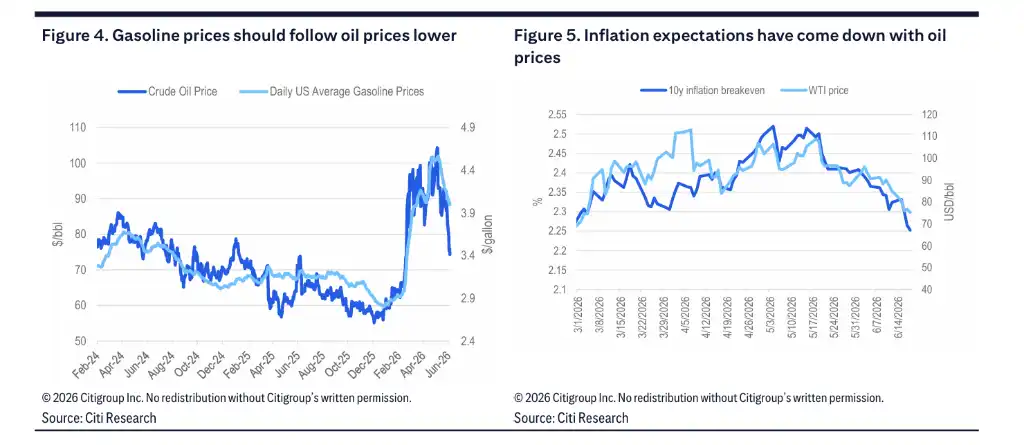
The first core argument underpinning Citi's insistence on rate cut forecasts stems from the rapid decline in oil prices. The bank believes that lower oil prices will lead to a decrease in gasoline prices, thereby removing a major source of the previous inflationary uptick. Market-based inflation expectations have already fallen in sync with oil prices, with the 10-year inflation breakeven rate dropping to levels seen before the outbreak of conflict.

Citi suggests that if Fed officials had more time to digest this latest change in energy prices, the hawkish tone of this FOMC meeting would have been significantly milder. The bank argues that as the effect of lower oil prices gradually manifests in the data, inflation figures in the coming months will trend towards moderation, helping to push more Fed officials towards a more dovish stance before September and create conditions for rate cuts before the year-end.
Citi's Second Logic: Labor Market Weakness Signals Replicate Past Seasonal Patterns

Citi's second core argument focuses on early signs of weakness emerging in the labor market.

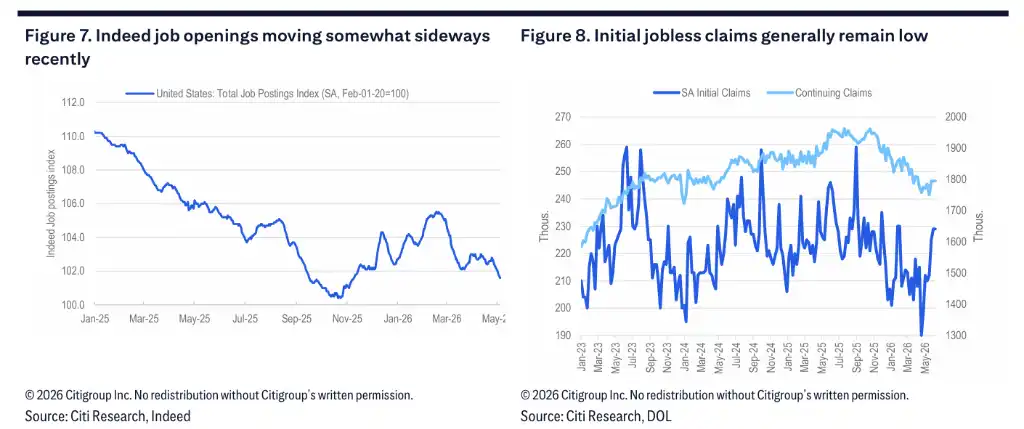
Both initial and continuing jobless claims have shown an upward trend for several consecutive weeks. Citi notes that this pattern also appeared in both 2024 and 2025, subsequently leading to a series of weaker monthly employment reports and rising unemployment rates. A rising unemployment rate is a key driver behind Citi's expectation for Fed rate cuts this year. The bank expects initial jobless claims for the week of June 20 to remain around 224,000, with continuing claims rising slightly to 1.813 million, and the 4-week moving average to continue climbing. While the absolute levels are still not high, if the rising trend persists, it would align with the view of a gradually weakening labor market.

Regarding the overall economy, Citi's tracking forecast for Q2 GDP growth is 2.5%. On the consumption front, the May retail sales control group data showed a 0.7% month-over-month increase, indicating ongoing resilience. However, growth in real disposable income has slowed to nearly zero, and the savings rate remains low, suggesting that risks of a slowdown in spending growth are accumulating.
Citi's Third Logic: Core PCE is an 'Outlier,' The Inflation Picture is Not Unified

The third pillar of Citi's contrarian stance lies in questioning the core PCE data itself.

The May core CPI month-over-month reading was only 0.21%, showing moderation. However, Citi expects the upcoming May core PCE month-over-month reading to be as high as 0.37%, indicating a significant divergence between the two. Citi believes the current strength of core PCE has specific reasons: this measure is highly influenced by AI-related prices and is directly boosted by stock market gains—May PPI data showed a 4.8% month-over-month surge in portfolio management fees, mainly reflecting the rebound in stock prices from early April lows to early May highs, rather than genuine price pressures on the consumer side.
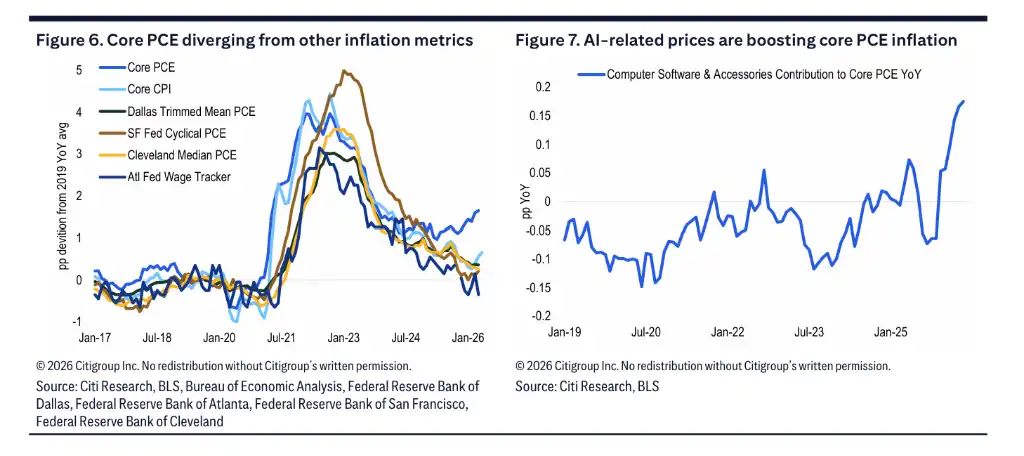
Looking at cross-sectional comparisons, the Dallas Fed's Trimmed Mean PCE, the San Francisco Fed's Cyclical Core PCE, the Cleveland Fed's Median PCE, and core CPI all show more moderate inflation trends than core PCE. Citi argues that core PCE is increasingly becoming an "outlier" among various inflation indicators, rather than a reliable signal of broad consumer price pressures.

Citi expects that as AI-related prices level off in the second half of the year, the gap between core PCE and core CPI will gradually narrow, and the overall inflation trend will become more supportive of policy easing. Under its forecast path, the year-over-year growth rate of core PCE is expected to gradually decline from the current level around 3.3% to the 2.1%-2.2% range around mid-2027.

Wall Street 'Capitulation': Deutsche Bank Forecasts Two Hikes, Goldman Sachs Warns of Serial Tightening

However, faced with Walsh's hawkish shock, Wall Street institutions have been changing their positions. Deutsche Bank's Chief US Economist Matthew Luzzetti's team clarified in a research report that the main reasons for their earlier delay in raising forecasts were two major uncertainties: the high degree of economic uncertainty stemming from the Iran situation, and the lack of clarity regarding new Fed Chair Walsh's monetary policy reaction function. The outcome of the June FOMC meeting resolved both these concerns at once.

Deutsche Bank significantly raised its inflation forecasts, lifting its expectations for year-end 2026 and 2027 core PCE to 3.2% and 2.5%, respectively. It updated its baseline forecast to: the Fed will hike rates twice in September and December, totaling 50 basis points, raising the rate to 4.1%; thereafter, it will remain on hold throughout 2027, only starting to cut rates in the first half of 2028. Deutsche Bank also warned of hawkish risks: if Chair Walsh has publicly committed to "fixing" the price stability issue and the Committee does not act promptly, its credibility could be tested—this implies a rate hike could come as early as July, and if the goal is to fully undo the easing effect generated by last year's consecutive rate cuts, the total hike for the year might need to be expanded to 75 basis points.

Goldman Sachs Vice Chairman Rob Kaplan explicitly stated that if inflation data fails to cool from now until September, a rate hike in autumn would be a "wise move." He particularly emphasized that the Fed's policy adjustments rarely occur as isolated, single actions; rate changes typically unfold in a series of 2 to 3 moves: "If they act in September, you need to be prepared, there could be one or two more hikes." Kaplan's warning, based on historical experience from navigating multiple monetary policy cycles, serves as a wake-up call for the market.


Perguntas relacionadas

QWhat is Citigroup's main prediction for the Federal Reserve's monetary policy in 2026, and when does it expect the first action?

ACitigroup's main prediction is that the next move by the Federal Reserve will be a rate cut, not a hike. Their baseline scenario is for a 25-basis-point rate cut to restart the easing cycle in October 2026.

QWhat are the three core arguments presented by Citigroup to support its dovish rate cut forecast?

ACitigroup's three core arguments are: 1) Falling oil prices are eliminating a major upside risk to inflation. 2) Early signs of labor market weakening, following seasonal patterns seen in 2024 and 2025, are emerging. 3) The strength of the core PCE inflation measure is viewed as an 'outlier,' driven more by stock prices and AI-related costs rather than broad consumer price pressures.

QHow did Deutsche Bank revise its Federal Reserve policy forecast following the June FOMC meeting, and what was its rationale?

ADeutsche Bank revised its forecast to predict two 25-basis-point rate hikes in September and December 2026, raising the policy rate to 4.1%. Their rationale was that the June FOMC meeting dispelled two key uncertainties: the economic uncertainty from the Iran situation and the unclear policy reaction function of the new Fed Chair, Walsh. They also warned of a risk of earlier action in July.

QWhat warning did former Dallas Fed President Rob Kaplan give regarding the potential path of Federal Reserve policy?

ARob Kaplan warned that if inflation data does not cool by autumn, a rate hike in the fall would be a 'prudent move.' He emphasized that Fed policy adjustments rarely happen in isolation and typically come in a series of 2 to 3 moves, suggesting that a hike in September could be followed by one or two more.

QAccording to Citigroup, why is the core PCE inflation measure currently considered an 'outlier' and less reliable?

ACitigroup considers the core PCE an 'outlier' because its current strength is seen as special and not reflective of broad consumer price pressures. They argue it is highly influenced by AI-related prices and is directly boosted by rising stock prices (e.g., a surge in portfolio management fees in PPI data), unlike other measures like core CPI, trimmed-mean PCE, or median PCE, which show more moderate inflation.

Leituras Relacionadas

Report Interpretation: J.P. Morgan Details Micron's Pre-Earnings Sentiment, Current Hardware Sector Dynamics

Morgan Stanley analyst Joshua Meyers' report (June 21, 2026) highlights key trends in the hardware and semiconductor sector ahead of Micron's earnings. The core takeaways are: 1. **Micron & Memory:** Memory remains a high-conviction long theme, driven by strong AI demand and rising ASPs. However, investor focus is shifting to the sustainability of Micron's >80% gross margins and the specifics of potential new long-term supply agreements (SCAs). 2. **Hardware Supply Chain:** AI-related demand for servers, networking, and storage remains robust, but company performance is diverging. Celestica (CLS) shows improved margin confidence, Western Digital and Seagate benefit from pricing, Fabrinet (FN) sees predictable AI optics growth, and Teradyne (TER) anticipates a new Google customer. 3. **AI Capex & WFE Forecasts:** JPMorgan increased its Wafer Fab Equipment (WFE) market growth forecasts to 28% in 2026 and 29% in 2027. AI infrastructure financing is evolving, with higher project-level debt reducing constraints on capex expansion. The report signals that while the AI-driven hardware cycle is strong, the market is entering a phase focused on execution verification (e.g., Micron's SCA details, Fabrinet's ramp with Amazon) and valuation sustainability. Key near-term signals include Micron's guidance, Arista Networks' outlook, and the pace of demand normalization post potential tariff-related pull-ins.

marsbitHá 28m

Report Interpretation: J.P. Morgan Details Micron's Pre-Earnings Sentiment, Current Hardware Sector Dynamics

marsbitHá 28m

Research Report Analysis: The Fed's New Chair's Debut – New Leader, But Same Script?

Report Analysis: Federal Reserve's New Chair Debut – A New Captain, But the Same Script? Morgan Stanley's chief global economist Seth B. Carpenter analyzes the first FOMC meeting under new Fed Chair Kevin Warsh in a June 21 report. Warsh deliberately avoided providing forward guidance on interest rates, aligning with his philosophy. However, market expectations for a rate hike this year were reinforced. Key signals lie elsewhere: inflation may fall more than expected, and quantitative tightening (QT) could be more aggressive than anticipated. The FOMC's "dot plot" suggests only one rate hike in 2026. Carpenter argues that if inflation undershoots forecasts, the logic for even a single hike weakens, especially as projections indicate potential rate cuts in 2027. On QT, Warsh's stance is clear. Carpenter notes that measures like halving the Treasury's account balance could shrink the Fed's balance sheet by around $500 billion with minimal market impact. Combined with adjustments to reserve interest and liquidity rules, the ultimate QT scale may exceed expectations, though its market effect might be less disruptive unless the Fed actively sells Mortgage-Backed Securities (MBS). While Warsh initiated a review of the Fed's policy framework, the 2% inflation target remains intact for now. The report concludes that the market may be overestimating the significance of reduced forward guidance and the near-term rate hike risk, while potentially underestimating the scope and manageable nature of the coming balance sheet reduction. The key debates will hinge on upcoming core PCE data, the specifics of the QT path, and the framework review's findings.

marsbitHá 39m

Research Report Analysis: The Fed's New Chair's Debut – New Leader, But Same Script?

marsbitHá 39m

Critical Game Week: BTC Retracement Confirmation vs. HYPE Support Battle | Guest Analysis

This weekly analysis outlines a critical juncture for BTC and HYPE markets, focusing on key price level confirmations. **BTC Analysis:** BTC is at a pivotal point after a five-wave rally from the June 5th low of $59,100. The price has broken below a short-term rising channel's lower boundary, with the current move seen as a pullback to test this breakdown. Failure to reclaim this level could lead to a retest of the $59,000-$60,000 support zone. The core scenario hinges on this channel retest outcome. * **Key Levels:** Resistance at $64,500-$65,000 (channel boundary) and $69,500-$70,500. Support at $59,000-$60,000 and $55,000. * **Strategy:** A core bearish stance is maintained (20% short from last week), with short-term plans for tactical trades. Three detailed contingency plans (A/B/C) are provided for short positions on resistance tests or breakdowns, emphasizing strict stop-loss discipline. **HYPE Analysis:** HYPE shows strong momentum but is currently in a corrective phase after hitting a new high of $76.94. The price is retesting the crucial $64-$66 support area. * **Key Levels:** Resistance near $77 and $80-$82. Support at $64-$66 and $52-$54. * **Strategy:** The short-term approach is "buy on dips, avoid chasing rallies." A long position is considered only if clear stabilization signals appear at the $64-$66 or deeper $52-$54 support zones, with tight risk controls. **General Risk Management:** A standardized trailing stop-loss protocol is emphasized: set initial stop, breakeven at +1% profit, then trail stops upward to lock in gains. *Disclaimer: All analysis is presented as a personal trading framework, not investment advice. Market conditions are complex and require dynamic adjustment.*

marsbitHá 52m

Critical Game Week: BTC Retracement Confirmation vs. HYPE Support Battle | Guest Analysis

marsbitHá 52m

Research Report Interpretation: Citi Attends AWS Summit, Bullish on Cloud Business Acceleration but Data Governance Remains Key Variable

Citi analyst Tyler Radke's team attended the AWS New York Summit (June 17-18), engaging with over 10 clients and partners. In a June 19 report, they highlighted the summit's focus on scaling agent AI for enterprise deployment. Citi maintains a "Buy" rating on Amazon, forecasting AWS revenue growth to accelerate to 37% in FY27 from 30% in FY26, noting this estimate may be conservative. Key takeaways: 1. **AWS Strategy Shift:** AWS is moving from proof-of-concepts to scalable deployment. New offerings like AWS Context (building enterprise knowledge graphs), Amazon Quick (cross-application AI assistant), and security tool Continuum address core enterprise pain points for AI adoption. 2. **Data Infrastructure Beneficiaries:** Data infrastructure companies like Snowflake, Elastic, Oracle, and ClickHouse are seen as direct beneficiaries of scaling AI workloads, as evidenced by strong growth and use cases presented. 3. **Critical Role of Data Governance:** As AI agents scale from hundreds to thousands, effective data governance becomes the key variable for deploying AI in core business processes. AWS Context represents AWS's strategic extension from providing compute/models to offering a data governance infrastructure layer. The report emphasizes that without solving data governance, AI will remain confined to pilot projects. The investment thesis focuses on AWS revenue acceleration and data infrastructure vendors' growth, while monitoring signals like AWS's quarterly revenue growth, Bedrock AgentCore task volume, and pricing impacts on companies like Elastic.

marsbitHá 59m

Research Report Interpretation: Citi Attends AWS Summit, Bullish on Cloud Business Acceleration but Data Governance Remains Key Variable

marsbitHá 59m

Crucial Week of Contention: BTC Tests Support and HYPE's Key Level Battle | Special Analysis

**Market Enters Critical Week: Bitcoin Pullback Test and HYPE Support Battle** The market enters a crucial phase of contention this week. The marginal shifts in Federal Reserve policy expectations continue to dictate the pricing rhythm for risk assets. Meanwhile, in the crypto market, following a period of sideways consolidation, the divergence between bulls and bears is becoming concentrated at key price levels. **Bitcoin (BTC) Analysis & Strategy** * **Technical View:** The 4-hour chart suggests BTC is in a five-wave structure since the June 5th low near $59,100. Price action shows a short-term rising channel. The recent drop below this channel's lower boundary is now being followed by a pullback attempt (wave 40-41). The outcome of this retest is critical. * **This Week's Outlook:** The core focus is whether BTC can reclaim and hold above the channel's lower boundary. * **Bullish Scenario:** A successful hold could lead to a continued rebound, potentially challenging the $69,500 - $70,500 resistance zone. * **Bearish Scenario:** Failure to hold may trigger a renewed test of the $59,000 - $60,000 core support area, with $55,000 as a deeper support level. * **Operational Strategy:** The author maintains a 20% mid-term short position initiated last week near $64,500, based on a model signaling a shift to a bearish structure. Short-term tactics involve using 30% capital for potential "spread" trades, with three contingency plans (A, B, C) outlined for reacting to resistance tests, breakouts, or support breakdowns. **HYPE Analysis & Strategy** * **Technical View:** On the 4-hour chart, HYPE shows strong momentum, having recently broken to a new high since January. The current pullback presents a clear three-wave correction structure, bringing the price back to the critical $64 - $66 support zone. * **This Week's Outlook:** The focus is on the battle for the $64 - $66 support area. * **Bullish Scenario:** Holding this support could signal a continuation of the uptrend from the June 10th low, leading to new highs. * **Bearish Scenario:** A breakdown could extend the correction, potentially testing the deeper $52 - $54 support band. * **Operational Strategy:** The recommended short-term approach is "buy on dips, avoid chasing rallies." A light long position (under 30% capital) could be considered if HYPE shows stabilization signals at the $64-$66 or $52-$54 support zones, confirmed by model signals. Strict stop-loss discipline is emphasized. **General Risk Management:** A strict trailing stop-loss protocol is advised: set an initial stop; move to breakeven at +1% profit; lock in profits progressively thereafter. *Disclaimer: All analysis is presented as the author's personal technical perspective and trading log, not as investment advice. Markets are complex and dynamic; risk control is paramount.*

Odaily星球日报Há 59m

Crucial Week of Contention: BTC Tests Support and HYPE's Key Level Battle | Special Analysis

Odaily星球日报Há 59m

Trading

Spot
Futuros
活动图片