Are Altcoins Soaring? Is the Bull Market Back?

marsbitPublicado em 2026-04-17Última atualização em 2026-04-17

Resumo

Recent days have seen significant volatility in altcoins while Bitcoin remained relatively stable. Some low-market-cap tokens, with circulations under $20 million, surged by several hundred percent within days—without fundamental improvements, ecosystem breakthroughs, or new institutional inflows. This is not a true altseason. The Altseason Index stands at 34, and Bitcoin dominance is at 58.5%, indicating the market is still in a "Bitcoin season." The altcoin market cap has shrunk by ~40% since its peak in December 2024, falling to around $700 billion. This severe decline has made it cheaper for large holders to accumulate significant portions of circulating supply, enabling price manipulation. A case in point is SIREN, where a single entity allegedly controlled up to 88% of the circulating supply. Such concentration allows a small group to dictate price movements. Additionally, deeply negative funding rates (as low as -0.3% every 8 hours, annualized to -328%) force short sellers to pay high fees, accelerating liquidations and further fueling upward price spikes. On-chain activity, like a 97% weekly increase in BSC DEX volume, suggests excitement, but it is largely driven by existing capital, not new inflows. Institutional flows into altcoin ETFs (like those for Solana and XRP) have been weak or negative, indicating caution rather than rotation into altcoins. This rally is a signal of structural fragility, not broad bullish momentum. Until Bitcoin dominance falls ...

While Bitcoin has been holding steady these past few days, the altcoin season has seen a long-absent surge of intense volatility.

Tokens with a circulating market cap of less than $20 million have doubled, tripled, or even increased fivefold within a few days, with some approaching tenfold gains. There were no major developments, no ecosystem breakthroughs, no new institutional entries—the price was simply pushed up.

There's a ready explanation for this phenomenon: altcoins are high-Beta assets; when Bitcoin rises, alts run even faster. This holds true statistically but doesn't tell the whole story. High Beta can explain why alts outperform Bitcoin, but it can't explain the dozens-of-times difference in gains. That multiple comes from something else.

The Altcoin Season Index currently sits at 34, and the BTC Dominance rate is 58.5%. Both numbers tell you that this market is still quite a distance from a true altcoin season. Yet, in this market devoid of an alt season, certain tokens are moving with the intensity of one.

From December 2024 to April 2026, the total market capitalization of altcoins (excluding Bitcoin and Ethereum) shrank from a peak of approximately $1.16 trillion to around $700 billion, evaporating nearly 40%. When the market cap shrinks sufficiently, the rules of the game change. Price is no longer determined by market consensus but by who holds enough chips.

This is a vulnerability created by oversold conditions, not a signal from a bull market.

Altcoins Have Simply Fallen Too Much

The blockchain space has the concept of a 51% attack—controlling more than half of a network's hash rate allows one to alter records, double-spend tokens, and rewrite history. The capital version of this is logically simpler; it requires no technology, no computing power, just money. And in this cycle, the altcoin market, with its nearly 40% evaporation in market cap, has proportionally lowered the entry barrier by 40%.

As of early April 2026, the total altcoin market cap is approximately $700 billion, down about 40% from its peak of ~$1.16 trillion in December 2024. Using end-2025 as a cutoff point, the decline is about 44%. The two measurements use different time nodes, but the direction is consistent: the overall size of this market has nearly halved.
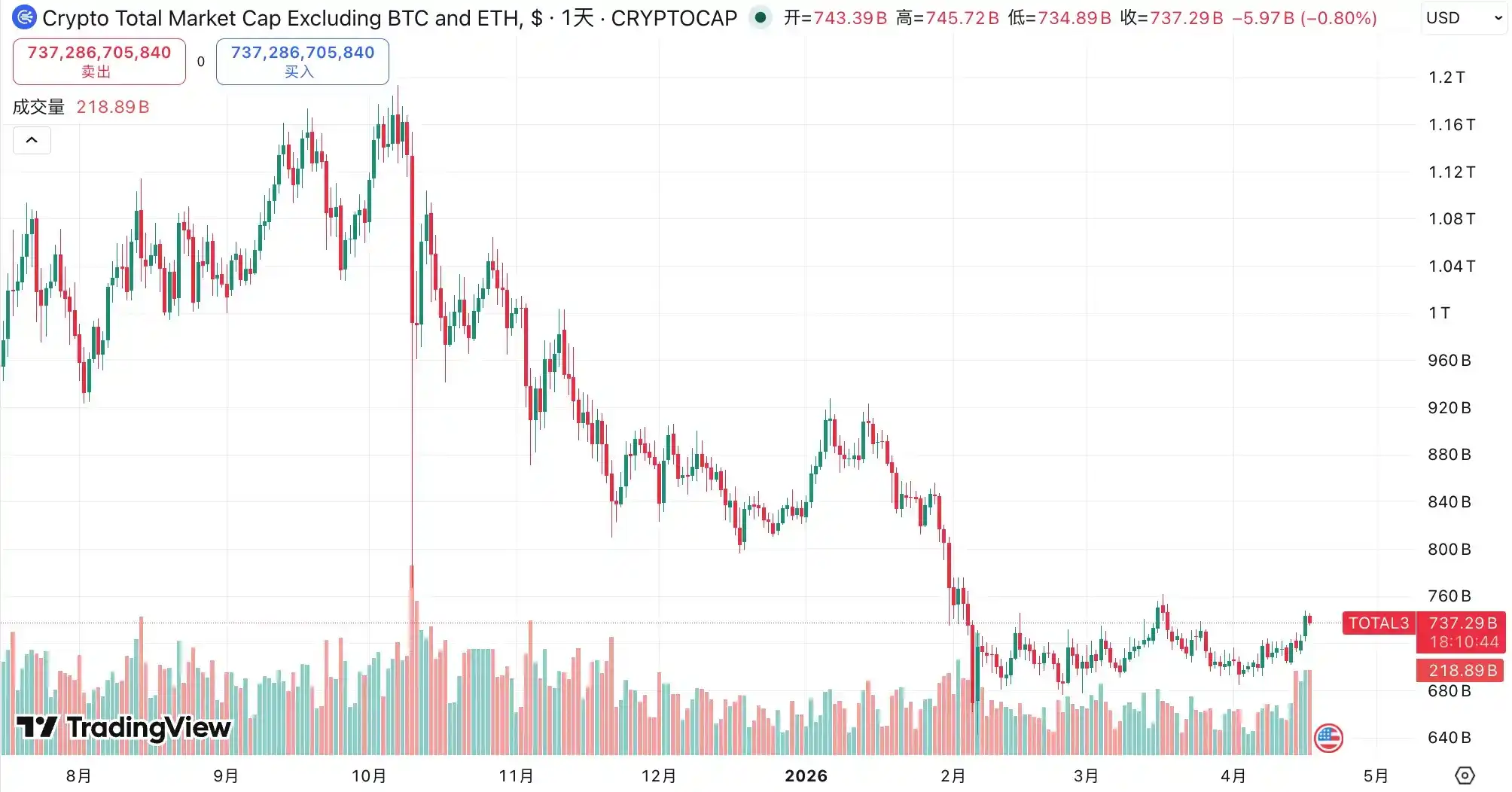
What does a halved market cap mean? $10 million represents 2% of the circulating supply in a market with a $500 million market cap, but 20% in a market with a $50 million market cap. The threshold has been lowered tenfold, but the amount of money hasn't changed. After being oversold, the cost of controlling the market becomes calculable. And if it's calculable, it's executable.

The recent sharp rise of the SIREN token provides a case study. SIREN experienced a rapid pump in late March, drawing significant attention. On March 24th, on-chain analyst EmberCN issued a warning: a single entity potentially controlled up to 88% of SIREN's circulating supply, worth approximately $1.8 billion at the time. As the news spread, SIREN plummeted from $2.56 to $0.79 that day, a drop of over 70%. During the rapid price exodus, almost no one could exit at a reasonable price because that price was never formed by the market in the first place.
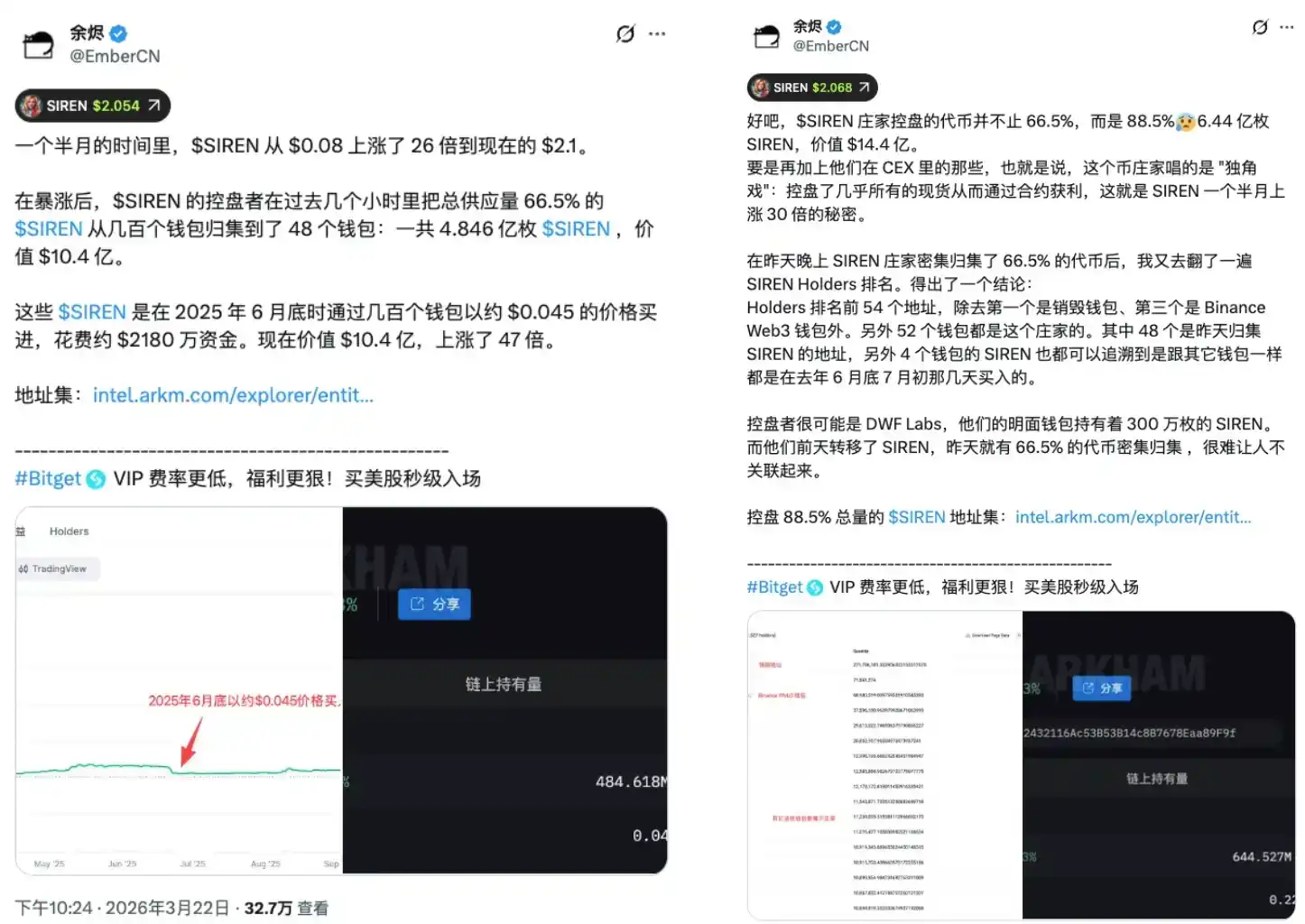
A conservative estimate suggests 48 wallets hold about 66.5% of the circulating chips. Even by this most conservative measure, an extremely limited set of addresses already possesses the structural conditions to control the price direction. From the moment the price was formed, the symmetry of this game was broken. Retail traders, bringing money they thought was participating in a free market, entered a container with a pre-set exit path.

SIREN is not an isolated case, nor a black swan; it is the structural norm for oversold altcoins. The deeper the fall, the less money is needed, and the easier it is to be hijacked. Being oversold isn't a discount; it's fragility. And this cycle's overall 40% market decline means this fragility has systematically expanded across the entire market.

Shorts Are the Fuel

If the story ended there, the logic would be one-directional: whales lock up supply, pump the price, dump on retail, and the price crashes. But the行情 of ultra-low market cap alts usually has another layer of structure superimposed on it: shorts become the kindling for the fire.

During SIREN's rapid price increase, the funding rate touched -0.2989% per 8 hours, annualized at approximately -328%. Translated, this means that shorting SIREN and holding the position requires paying the long side about 0.3% of the principal every 8 hours as a funding fee. Holding for a month, this fee alone could devour over 25% of the principal, not even counting the paper losses from the rising price.
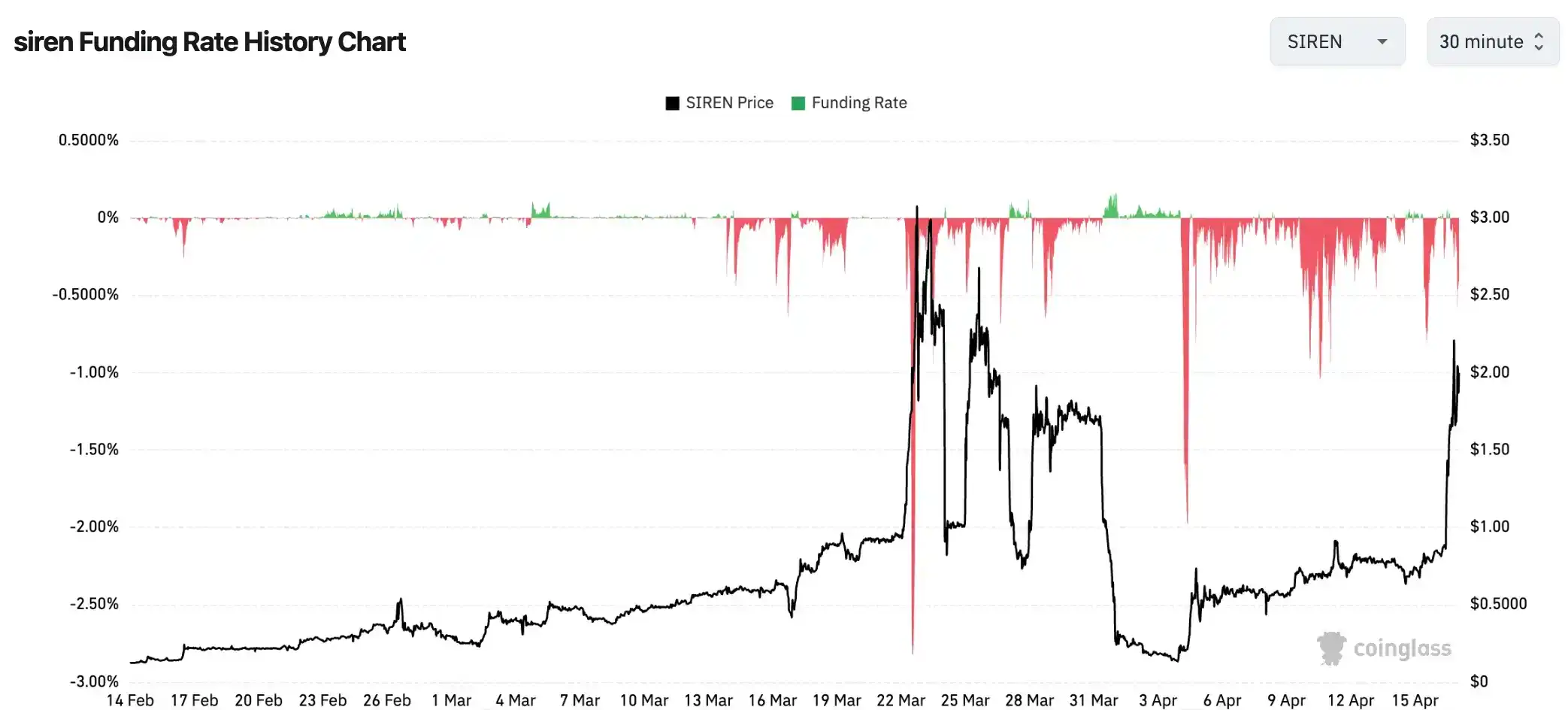
This number is not uncommon in small-cap alt markets. Some tokens have seen funding rates as low as -0.4579% per 8 hours during extreme moves, annualized at roughly -501%. At this level, short sellers face not the risk of being wrong on direction, but the certainty of being slowly ground down by a machine. Even if the eventual direction is correct, they are depleted before the right day arrives.

You see an altcoin pump 80% and decide to short it, waiting for a pullback. Every short position you open pays an interest payment to the opposing long side. Meanwhile, if the price continues to rise and hits your liquidation price, the system automatically buys back at market price to close your position. This forced buying further pushes the price higher.

The传导链 of a short squeeze operates like this: Price rises -> Shorts show paper losses -> Paper losses hit forced liquidation levels -> System automatically buys to close positions at market price -> This buying pushes price higher -> More shorts are triggered -> A new wave of buying arrives. In thin, low-liquidity, small-cap markets, each order can cause a much larger price move, making the chain reaction far more efficient than in large-cap assets.

There is an often-overlooked asymmetry here. Someone who sees a token surge 90% and decides to short it typically believes they are making a probabilistically correct judgment: "It has to pull back after rising so much." But in a market highly concentrated and locked up by holdings, this judgment must contend not only with the price direction but also with a funding fee bleeding 0.3% of principal every 8 hours, plus the chain reaction triggered by forced buying once liquidation levels are hit. This game is asymmetric from the start.

Extreme negative funding rates are the dashboard reading of this machine. Shorts have accumulated, ammunition is loaded, and accelerating the pump now means the people on the other side have only two choices: get liquidated or FOMO in and buy high. Both choices add fuel to the price. This isn't a rise formed by market consensus; it's a one-sided consumption event with a pre-designed structure.

A Bustling Market Without New Money

BSC chain's weekly DEX volume is up 97% year-over-year; the Altcoin Season Index is 34/100; BTC Dominance is 58.5%. These three numbers can be true simultaneously, and are simultaneously contradictory.

The on-chain heat is indeed scorching, but the latter two numbers tell you this market is still in "Bitcoin Season"—fewer than half of the major altcoins are outperforming Bitcoin, dominant capital is highly concentrated in Bitcoin, far from the point of diffusion. But the three numbers also point to the same reality: this is存量资金 accelerating their circulation, not new money entering. The hustle and bustle is real, but hustle and bustle does not equal expansion.

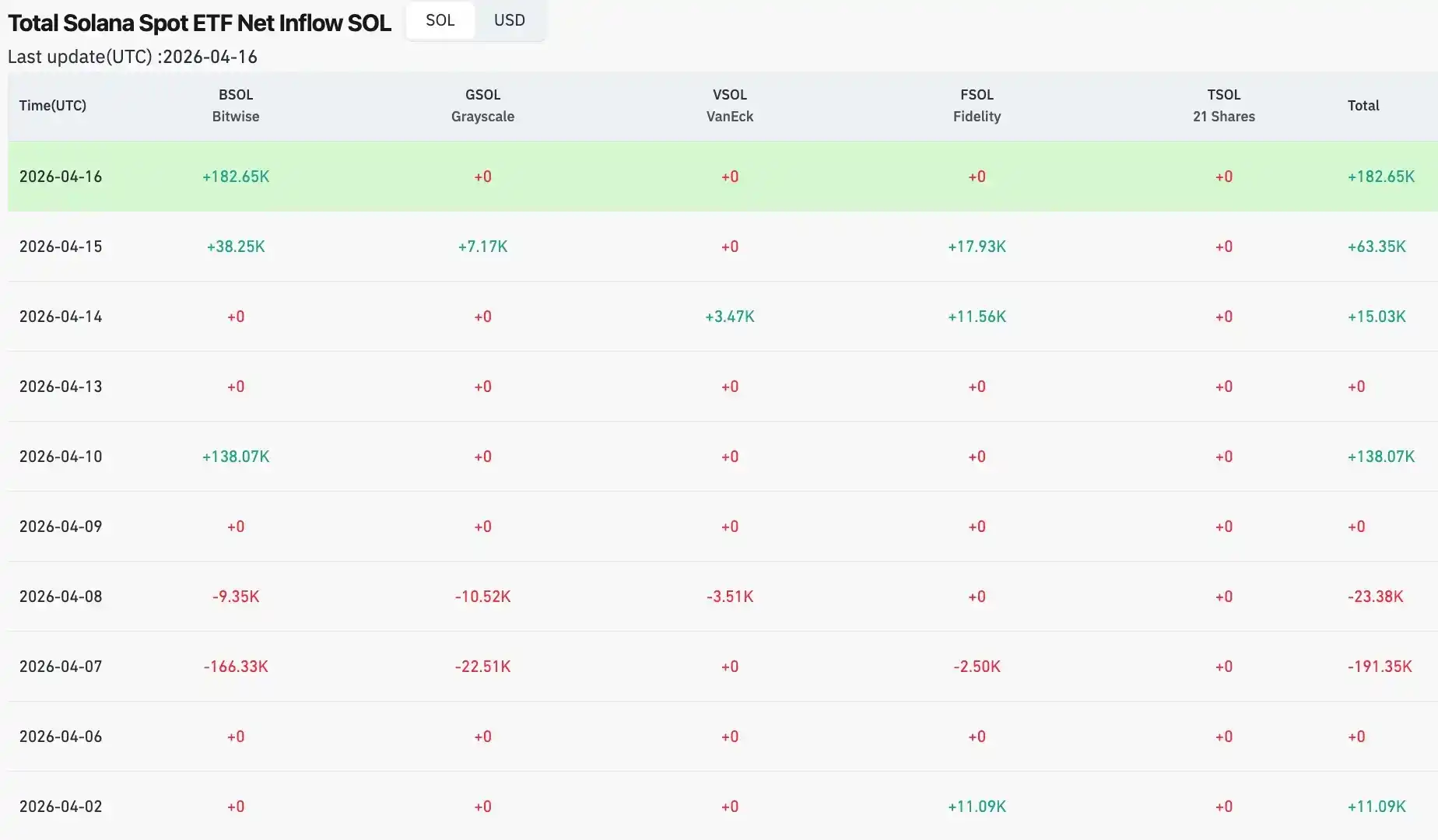
Institutional fund flows provide corroboration. In early April, net inflows for the Solana ETF fell to zero in a single day, after recording a net outflow of $6.2 million on March 30th. The XRP ETF saw continuous net outflows at the start of the month, with only a微量 inflow of about $64.6k on April 2nd. The Ethereum ETF, while seeing a single-day net inflow of $120 million on April 6th, had already experienced an outflow of $71 million the previous day. The overall pattern of institutional funds towards alts is观望, not rotation.
Comparing this to the true altcoin season of 2021 reveals a structural gap. That cycle, from the beginning of the year to May, BTC Dominance fell from over 70% to below 40%, touching a low of around 39%. The rotation of funds between Bitcoin and alts was clear, and the Altcoin Season Index once exceeded 90. That was a全面扩张 driven by泛滥的宏观流动性, with the afterglow of DeFi Summer still warm, retail FOMO entering en masse, stablecoin issuance rapidly expanding同期, and incremental funds continuously pouring into the entire ecosystem. Today's score of 34 and 58.5% dominance paint a different picture; the engine is just warming up, far from running at full speed.

There is also a variable unique to this cycle. Institutional money entering the market via ETFs follows an internal asset allocation logic, not the emotional logic of the crypto market. Institutions are doing "adjust Bitcoin allocation to X%", not "alt season is coming, load up on alts". Structurally, this capital will not spontaneously rotate into the alt market unless explicit instructions are given. This is the most fundamental structural difference between 2021 and 2026. The money that came in 2021 included a large amount of retail capital that went "wherever was hot". Today's institutional money is anchor-style, with a fixed path, not drifting with market sentiment.

The +97% on-chain volume hustle is real, but a market without new money is zero-sum. Every winner's gain corresponds to another player's loss; the total size of the pool hasn't grown.存量博弈 doesn't necessarily mean a crash, but it defines the structure of the game. The热闹 belongs only to those already in the field, those who already hold chips. Those who come in later are typically using their own money to complete the last mile of someone else's exit.

Epilogue

Returning to the data from the beginning: Bitcoin rose about 0.85% in four days, while a few small-cap tokens multiplied several times over the same period. Now you have a framework. Bitcoin's rise is one thing—the macro environment is catching its breath, institutional money is testing the waters, the market is waiting for the next clear signal. The altcoin暴拉 is another thing—low market caps post-overfall create structural vulnerabilities, small amounts of capital leverage price in thin liquidity containers, and extreme negative funding rates turn shorts into fuel for longs. These two things happening simultaneously does not mean they are telling the same story.

Altcoin Season Index 34, BTC Dominance 58.5%. By the historical standards of 2021, this machine hasn't even finished its warm-up procedure. BTC Dominance needs to fall from 58% towards the ~39% seen back then, institutional funds need to expand from "Bitcoin allocation" to "crypto asset portfolio allocation", incremental funds need to持续流入 instead of cashing out at highs. None of these are things a single price surge can solve.

There are two types of people in this machine: those who know for whom it is running, and those who are the fuel required for its operation.

BTC's rise is the signal; the altcoin暴拉 is the echo. Distinguishing between these two things is necessary to make choices in this market that aren't pre-designed by the machine.

Perguntas relacionadas

QWhat is the main reason behind the recent sharp price increases in some small-cap altcoins, according to the article?

AThe main reason is that the altcoin market has experienced a nearly 40% decline in total market cap, making it cheaper for entities to accumulate large portions of a token's supply and manipulate its price, rather than a signal of a true bull market.

QWhat does the article suggest is the role of short sellers in these altcoin price surges?

AShort sellers act as fuel for the price surges. Extremely negative funding rates force them to pay high fees to longs, and if the price continues to rise, their forced liquidations create automatic buy orders that further push the price up in a cascading effect.

QWhat key metric does the article use to argue that a true 'altcoin season' has not yet arrived?

AThe article cites the Altcoin Season Index, which is at 34/100, and the Bitcoin Dominance rate, which is at 58.5%, as indicators that the market is still in a 'Bitcoin season' and far from a broad-based altcoin rally.

QHow does the source of new capital in this cycle differ from the 2021 cycle, according to the article?

AIn the 2021 cycle, new capital included a large amount of retail 'FOMO' money that flowed to wherever was hot. In the current cycle, capital is primarily from institutions via ETFs, which follow internal asset allocation logic (e.g., 'allocate X% to Bitcoin') and are not easily rotated into altcoins based on market sentiment.

QWhat is the article's final conclusion about the relationship between Bitcoin's price action and the altcoin surges?

AThe article concludes that Bitcoin's rise is a potential signal of macro improvement, while the altcoin surges are an 'echo'—a result of structural vulnerabilities and manipulation in a low-liquidity, oversold market, and that the two phenomena are not telling the same story.

Leituras Relacionadas

Trading

Spot
Futuros

Artigos em Destaque

O que é BITCOIN

Compreender o HarryPotterObamaSonic10Inu (ERC-20) e a Sua Posição no Espaço Cripto Nos últimos anos, o mercado de criptomoedas assistiu a um aumento na popularidade das moedas meme, cativando não apenas os traders, mas também aqueles que procuram envolvimento comunitário e valor de entretenimento. Entre estes tokens únicos está o HarryPotterObamaSonic10Inu (ERC-20), um projeto intrigante que mistura referências culturais no tecido das criptomoedas. Este artigo explora os principais aspetos do HarryPotterObamaSonic10Inu, examinando os seus mecanismos, a sua ética orientada pela comunidade e o seu envolvimento com o vasto panorama cripto. O que é o HarryPotterObamaSonic10Inu (ERC-20)? Como o nome sugere, o HarryPotterObamaSonic10Inu é uma moeda meme construída na blockchain Ethereum, classificada sob o padrão ERC-20. Ao contrário das criptomoedas tradicionais, que podem enfatizar a utilidade prática ou o potencial de investimento, este token prospera no valor de entretenimento e na força da sua comunidade. O projeto visa promover um ambiente onde utilizadores envolvidos possam reunir-se, partilhar ideias e participar em atividades inspiradas por diversos fenómenos culturais. Uma característica notável do HarryPotterObamaSonic10Inu é a zero taxa sobre transações. Este elemento atraente visa encorajar a negociação e o envolvimento da comunidade, isento de encargos adicionais que podem desencorajar os traders de pequena escala. A oferta total da moeda está fixada em mil milhões de tokens, uma cifra que marca a sua intenção de manter uma circulação substancial dentro da comunidade. Criador do HarryPotterObamaSonic10Inu (ERC-20) As origens do HarryPotterObamaSonic10Inu estão um pouco envoltas em mistério; os detalhes sobre o criador permanecem desconhecidos. O desenvolvimento deste token carece de uma equipa identificável ou de um plano explícito, o que não é raro no setor das moedas meme. Em vez disso, o projeto surgiu de forma orgânica, com o seu progresso a depender fortemente do entusiasmo e da participação da sua comunidade. Investidores do HarryPotterObamaSonic10Inu (ERC-20) No que diz respeito a investimentos externos e apoios, o HarryPotterObamaSonic10Inu também permanece ambíguo. O token não lista quaisquer fundações de investimento conhecidas ou apoio organizacional significativo. Em vez disso, o “sangue vital” do projeto é a sua comunidade de base, que informa o seu crescimento e sustentabilidade através da ação coletiva e do envolvimento no espaço cripto. Como Funciona o HarryPotterObamaSonic10Inu (ERC-20)? Como uma moeda meme, o HarryPotterObamaSonic10Inu opera principalmente fora dos quadros tradicionais que muitas vezes governam o valor dos ativos. Existem vários aspetos distintivos que definem como o projeto funciona: Transações Sem Taxas: Sem taxas sobre transações, os utilizadores podem comprar e vender o token livremente, sem a preocupação de custos ocultos. Envolvimento da Comunidade: O projeto prospera na interação da comunidade, aproveitando plataformas de redes sociais para criar entusiasmo e facilitar a participação. Discussões, partilha de conteúdo e envolvimento são elementos cruciais que ajudam a expandir o seu alcance e a fomentar a lealdade entre os apoiantes. Sem Utilidade Prática: Deve ser notado que o HarryPotterObamaSonic10Inu não oferece utilidade concreta dentro do ecossistema financeiro. Em vez disso, é classificado como um token principalmente para entretenimento e atividades comunitárias. Referência Cultural: O token incorpora de forma inteligente elementos da cultura popular para atrair interesse, conectando-se tanto com entusiastas de memes como com seguidores de criptomoedas. HarryPotterObamaSonic10Inu exemplifica como as moedas meme operam de forma diferente de projetos de criptomoedas mais tradicionais, entrando no mercado como construções sociais inovadoras em vez de ativos utilitários. Linha do Tempo do HarryPotterObamaSonic10Inu (ERC-20) A história do HarryPotterObamaSonic10Inu é marcada por vários marcos notáveis: Criação: O token surgiu de um meme viral, capturando a imaginação de muitos entusiastas de criptomoedas. Datas específicas de criação não estão disponíveis, sublinhando a sua ascensão orgânica. Listagem em Exchanges: O HarryPotterObamaSonic10Inu conseguiu entrar em várias exchanges, permitindo um acesso e negociação mais fáceis pela comunidade. Iniciativas de Envolvimento da Comunidade: Atividades contínuas direcionadas a melhorar a interação comunitária, incluindo concursos, campanhas em redes sociais e geração de conteúdo por fãs e defensores. Planos de Expansão Futura: O roteiro do projeto inclui o lançamento de uma coleção de NFTs, mercadorias e um site de eCommerce relacionado aos seus temas culturais, envolvendo ainda mais a comunidade e tentando adicionar mais dimensões ao seu ecossistema. Pontos-Chave sobre o HarryPotterObamaSonic10Inu (ERC-20) Natureza Orientada pela Comunidade: O projeto prioriza a contribuição coletiva e a criatividade, assegurando que o envolvimento dos utilizadores está na vanguarda do seu desenvolvimento. Classificação como Moeda Meme: Representa o epítome da criptomoeda baseada em entretenimento, destacando-se dos veículos de investimento tradicionais. Sem Afiliação Direta com o Bitcoin: Apesar da semelhança no nome do ticker, o HarryPotterObamaSonic10Inu é distinto e não tem qualquer relação com o Bitcoin ou outras criptomoedas estabelecidas. Foco na Colaboração: O HarryPotterObamaSonic10Inu é projetado para criar um espaço de colaboração e partilha de histórias entre os seus detentores, proporcionando uma via para a criatividade e o fortalecimento da comunidade. Perspectivas Futuras: A ambição de expandir além da sua premissa inicial para NFTs e mercadorias delineia um caminho para o projeto potencialmente entrar em avenidas mais mainstream dentro da cultura digital. À medida que as moedas meme continuam a capturar a imaginação da comunidade cripto, HarryPotterObamaSonic10Inu (ERC-20) destaca-se devido aos seus laços culturais e abordagem centrada na comunidade. Embora possa não se encaixar no molde típico de um token orientado para utilidade, a sua essência reside na alegria e camaradagem fomentadas entre os seus apoiantes, destacando a natureza em evolução das criptomoedas em uma era cada vez mais digital. À medida que o projeto continua a desenvolver-se, será importante observar como as dinâmicas comunitárias influenciam a sua trajetória no panorama em constante mudança da tecnologia blockchain.

1.1k Visualizações TotaisPublicado em {updateTime}Atualizado em 2024.12.03

O que é BITCOIN

Como comprar BTC

Bem-vindo à HTX.com!Tornámos a compra de Bitcoin (BTC) simples e conveniente.Segue o nosso guia passo a passo para iniciar a tua jornada no mundo das criptos.Passo 1: cria a tua conta HTXUtiliza o teu e-mail ou número de telefone para te inscreveres numa conta gratuita na HTX.Desfruta de um processo de inscrição sem complicações e desbloqueia todas as funcionalidades.Obter a minha contaPasso 2: vai para Comprar Cripto e escolhe o teu método de pagamentoCartão de crédito/débito: usa o teu visa ou mastercard para comprar Bitcoin (BTC) instantaneamente.Saldo: usa os fundos da tua conta HTX para transacionar sem problemas.Terceiros: adicionamos métodos de pagamento populares, como Google Pay e Apple Pay, para aumentar a conveniência.P2P: transaciona diretamente com outros utilizadores na HTX.Mercado de balcão (OTC): oferecemos serviços personalizados e taxas de câmbio competitivas para os traders.Passo 3: armazena teu Bitcoin (BTC)Depois de comprar o teu Bitcoin (BTC), armazena-o na tua conta HTX.Alternativamente, podes enviá-lo para outro lugar através de transferência blockchain ou usá-lo para transacionar outras criptomoedas.Passo 4: transaciona Bitcoin (BTC)Transaciona facilmente Bitcoin (BTC) no mercado à vista da HTX.Acede simplesmente à tua conta, seleciona o teu par de trading, executa as tuas transações e monitoriza em tempo real.Oferecemos uma experiência de fácil utilização tanto para principiantes como para traders experientes.

3.7k Visualizações TotaisPublicado em {updateTime}Atualizado em 2025.03.21

Como comprar BTC

O que é $BITCOIN

OURO DIGITAL ($BITCOIN): Uma Análise Abrangente Introdução ao OURO DIGITAL ($BITCOIN) OURO DIGITAL ($BITCOIN) é um projeto baseado em blockchain que opera na rede Solana, com o objetivo de combinar as características dos metais preciosos tradicionais com a inovação das tecnologias descentralizadas. Embora partilhe um nome com o Bitcoin, frequentemente referido como “ouro digital” devido à sua percepção como uma reserva de valor, o OURO DIGITAL é um token separado projetado para criar um ecossistema único dentro da paisagem Web3. O seu objetivo é posicionar-se como um ativo digital alternativo viável, embora os detalhes sobre as suas aplicações e funcionalidades ainda estejam em desenvolvimento. O que é o OURO DIGITAL ($BITCOIN)? OURO DIGITAL ($BITCOIN) é um token de criptomoeda explicitamente projetado para uso na blockchain Solana. Em contraste com o Bitcoin, que fornece um papel amplamente reconhecido como armazenamento de valor, este token parece focar em aplicações e características mais amplas. Aspectos notáveis incluem: Infraestrutura Blockchain: O token é construído na blockchain Solana, conhecida pela sua capacidade de lidar com transações de alta velocidade e baixo custo. Dinâmicas de Oferta: O OURO DIGITAL tem um fornecimento máximo limitado a 100 quatrilhões de tokens (100P $BITCOIN), embora os detalhes sobre o seu fornecimento circulante ainda não tenham sido divulgados. Utilidade: Embora as funcionalidades precisas não estejam explicitamente delineadas, existem indicações de que o token poderia ser utilizado para várias aplicações, potencialmente envolvendo aplicações descentralizadas (dApps) ou estratégias de tokenização de ativos. Quem é o Criador do OURO DIGITAL ($BITCOIN)? Neste momento, a identidade dos criadores e da equipa de desenvolvimento por trás do OURO DIGITAL ($BITCOIN) permanece desconhecida. Esta situação é típica entre muitos projetos inovadores no espaço da blockchain, particularmente aqueles alinhados com finanças descentralizadas e fenómenos de moedas meme. Embora tal anonimato possa fomentar uma cultura orientada pela comunidade, intensifica as preocupações sobre governança e responsabilidade. Quem são os Investidores do OURO DIGITAL ($BITCOIN)? As informações disponíveis indicam que o OURO DIGITAL ($BITCOIN) não tem apoiantes institucionais conhecidos ou investimentos proeminentes de capital de risco. O projeto parece operar num modelo peer-to-peer focado no apoio e adoção da comunidade, em vez de rotas de financiamento tradicionais. A sua atividade e liquidez estão principalmente situadas em exchanges descentralizadas (DEXs), como a PumpSwap, em vez de plataformas de negociação centralizadas estabelecidas, destacando ainda mais a sua abordagem de base. Como Funciona o OURO DIGITAL ($BITCOIN) A mecânica operacional do OURO DIGITAL ($BITCOIN) pode ser elaborada com base no seu design de blockchain e nas características da rede: Mecanismo de Consenso: Ao aproveitar o exclusivo proof-of-history (PoH) da Solana combinado com um modelo de proof-of-stake (PoS), o projeto assegura uma validação eficiente das transações, contribuindo para o alto desempenho da rede. Tokenomics: Embora mecanismos deflacionários específicos não tenham sido extensivamente detalhados, o vasto fornecimento máximo de tokens implica que pode atender a microtransações ou casos de uso de nicho que ainda estão por definir. Interoperabilidade: Existe o potencial para integração com o ecossistema mais amplo da Solana, incluindo várias plataformas de finanças descentralizadas (DeFi). No entanto, os detalhes sobre integrações específicas permanecem não especificados. Cronologia de Eventos Chave Aqui está uma cronologia que destaca marcos significativos relacionados ao OURO DIGITAL ($BITCOIN): 2023: O lançamento inicial do token ocorre na blockchain Solana, marcado pelo seu endereço de contrato. 2024: O OURO DIGITAL ganha visibilidade ao tornar-se disponível para negociação em exchanges descentralizadas como a PumpSwap, permitindo que os utilizadores o negociem contra SOL. 2025: O projeto testemunha atividade de negociação esporádica e potencial interesse em envolvimentos liderados pela comunidade, embora não tenham sido documentadas parcerias ou avanços técnicos notáveis até ao momento. Análise Crítica Forças Escalabilidade: A infraestrutura subjacente da Solana suporta altos volumes de transações, o que pode aumentar a utilidade do $BITCOIN em vários cenários de transação. Acessibilidade: O potencial preço de negociação baixo por token pode atrair investidores de retalho, facilitando uma participação mais ampla devido a oportunidades de propriedade fracionada. Riscos Falta de Transparência: A ausência de apoiantes, desenvolvedores ou um processo de auditoria publicamente conhecidos pode gerar ceticismo em relação à sustentabilidade e confiabilidade do projeto. Volatilidade do Mercado: A atividade de negociação depende fortemente do comportamento especulativo, o que pode resultar em volatilidade significativa dos preços e incerteza para os investidores. Conclusão O OURO DIGITAL ($BITCOIN) surge como um projeto intrigante, mas ambíguo, dentro do ecossistema em rápida evolução da Solana. Embora tente aproveitar a narrativa do “ouro digital”, a sua divergência do papel estabelecido do Bitcoin como reserva de valor sublinha a necessidade de uma diferenciação mais clara da sua utilidade pretendida e estrutura de governança. A aceitação e adoção futuras dependerão provavelmente da abordagem da atual opacidade e da definição mais explícita das suas estratégias operacionais e económicas. Nota: Este relatório abrange informações sintetizadas disponíveis até outubro de 2023, e desenvolvimentos podem ter ocorrido além do período de pesquisa.

92 Visualizações TotaisPublicado em {updateTime}Atualizado em 2025.05.13

O que é $BITCOIN

Discussões

Bem-vindo à Comunidade HTX. Aqui, pode manter-se informado sobre os mais recentes desenvolvimentos da plataforma e obter acesso a análises profissionais de mercado. As opiniões dos utilizadores sobre o preço de BTC (BTC) são apresentadas abaixo.

活动图片