Hash Global Founder: Why I Also Chose to Liquidate All My ETH?

链捕手Publicado em 2026-05-28Última atualização em 2026-05-28

Resumo

Title: Hash Global Founder Explains Why He Sold All His ETH The author (Hash Global founder) has liquidated his entire ETH holdings, despite acknowledging that the potential U.S. CLARITY Act (clarifying ETH as a decentralized digital commodity) is a significant regulatory positive. His core argument is that this regulatory clarity should not be conflated with granting ETH a "monetary premium" akin to Bitcoin (BTC) or gold. He disputes the thesis that ETH's valuation framework should shift from network revenue to a monetary/store-of-value logic. The market continues to value ETH based on concrete metrics like network fees, DeFi activity, staking yield, and ecosystem competition—essentially as a productive infrastructure/platform asset. BTC's narrative as "digital gold" is simpler and more suited for monetary premium. The author identifies several key reservations: 1) Legal classification solves compliance for institutions but doesn't automatically create long-term store-of-value demand. 2) ETH's "yield-bearing" advantage over BTC/gold may diminish as DeFi and Real-World Assets (RWA) tokenize traditional assets like gold and treasuries, which can also generate yield on-chain. 3) Future monetary premium will likely remain with BTC, physical gold, and potentially tokenized gold, while ETH serves as the core settlement infrastructure for these assets. 4) Ethereum's value-capture mechanism remains unresolved, especially with Layer-2 scaling; ecosystem growth does not guarantee p...

Author: HashGlobal KK, Founder of Hash Global

Compiled by: Jiahuan, ChainCatcher

The author has liquidated all ETH holdings. This article was published on May 24.
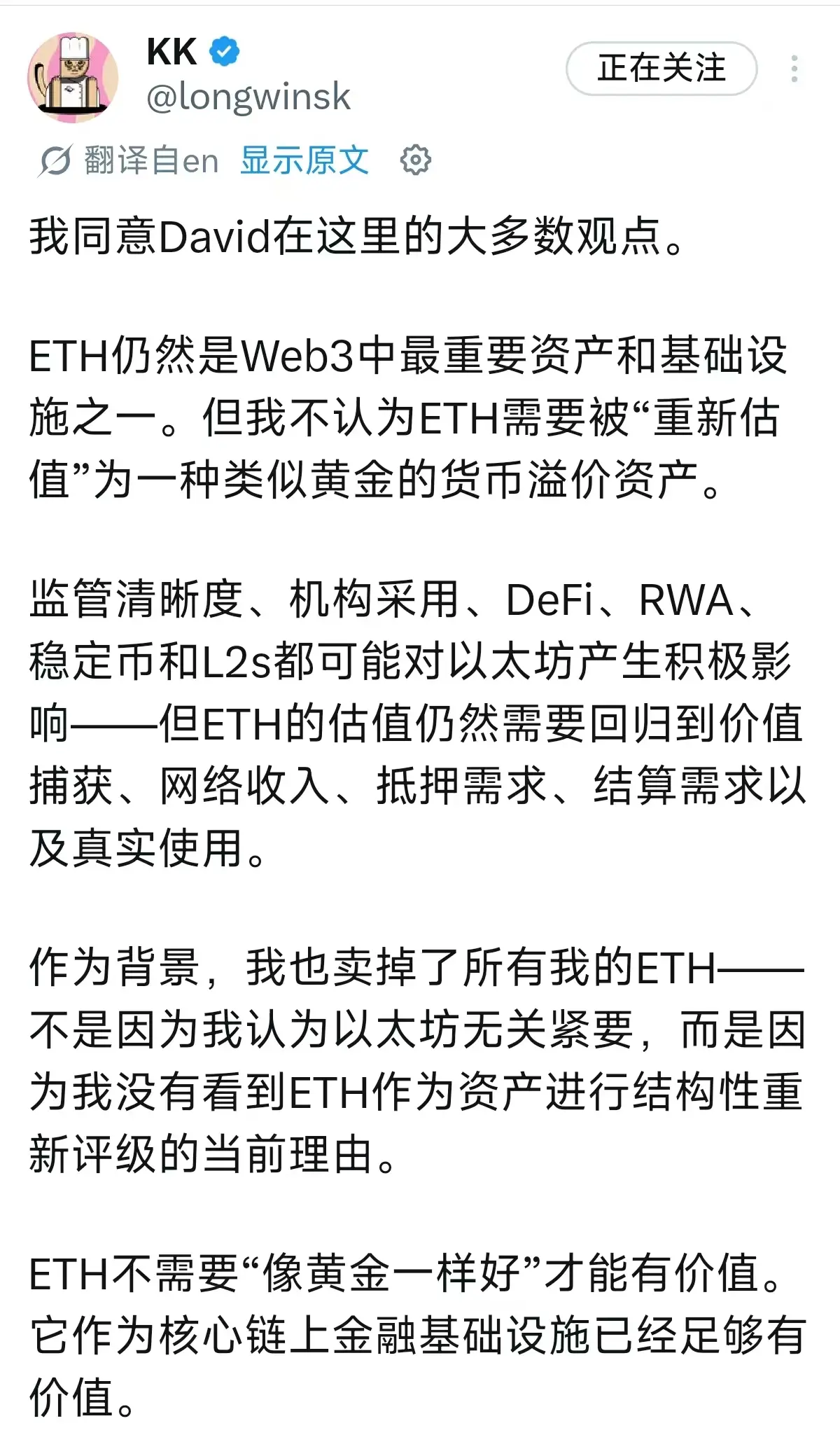
Recently, I read an article arguing that if the U.S. CLARITY Act passes, Ethereum will become the biggest winner.

Its core argument is that ETH may become the only asset in the U.S. regulatory framework that combines the attributes of a "decentralized digital commodity" and a "programmable smart contract platform." Therefore, ETH's valuation framework should shift from a network revenue logic to a monetary premium logic similar to BTC, gold, or even sovereign reserve assets.

I find this perspective enlightening, but the conclusion may be overly extended.

This is not to say I am bearish on ETH or deny the positive impact of CLARITY.

On the contrary, regulatory clarity is undoubtedly a major positive for ETH. It will reduce compliance concerns for institutional allocation to ETH and help further develop ETFs, custody services, staking, institutional DeFi, RWA, and on-chain settlement businesses.

However, regulatory clarity is not equivalent to a monetary premium.

CLARITY may solve ETH's "regulatory discount" issue, but it will not automatically open up valuation spaces associated with gold, real estate, or global reserve assets.

These are two entirely different matters and should be analyzed separately.

1. The Market Hasn't Bought This Logic Yet

If ETH were truly viewed by the market as "programmable gold" or an "interest-bearing monetary asset," its valuation should be closer to BTC's.

But that's not the case.

When evaluating ETH, the market still focuses on specific metrics:

  • Ethereum mainnet revenue;
  • DeFi activity;
  • Whether stablecoins and RWAs are primarily settled within the Ethereum ecosystem;
  • Value flow from L2s to L1;
  • ETH staking yield;
  • Inflows into ETH ETFs;
  • Competition from ecosystems like Solana, BNB Chain, and Base.

These are essentially valuation logics for network assets, platform assets, and ecosystem assets.

BTC is different. It has no cash flow, no application ecosystem, and no need to discuss network revenue. Its logic is simple: 21 million supply, non-sovereign, censorship-resistant, digital gold. People may disagree with this narrative, but it's simple, clear, and easy to disseminate.

ETH's narrative is much more complex. ETH serves as gas fees, a staking asset, DeFi collateral, L2 settlement asset, and infrastructure for institutional on-chain finance. While multiple functions are advantageous, monetary premiums typically require an extremely simple narrative.

Complexity is beneficial for ecosystem development but doesn't necessarily contribute to forming a monetary premium like gold and BTC.

2. Legal Classification Is Just an Entry Ticket

The original article makes a crucial leap: because ETH may be legally recognized as a decentralized digital commodity, it should enter the valuation framework of top-tier monetary premium assets.

I believe this inference is problematic.

Legal classification addresses issues like: Can institutions hold it compliantly? Can they trade it compliantly? Can they custody it compliantly? Can they develop related products compliantly?

Monetary premium addresses issues like: Is the global market willing to hold it as a long-term store of wealth?

These are two different questions.

Gold has a monetary premium not because any single law classifies it as such, but because millennia of historical consensus, physical scarcity, central bank reserve demand, and geopolitical safe-haven attributes have collectively formed immense consensus.

BTC has a monetary premium not because it can execute smart contracts, but because it is simple enough, pure enough, and resembles "digital gold" enough.

For ETH to gain a monetary premium, regulatory classification alone is insufficient. It must also prove that global capital is willing to hold ETH as a long-term store of value, not merely as a critical on-chain financial infrastructure asset.

There is still a significant gap between these two states.

3. DeFi Will Undermine ETH's "Sole Yield-Bearing" Narrative

The original article emphasizes an advantage of ETH: ETH can generate yield through staking, while BTC and gold cannot.

While this holds some truth today, the situation may change in the coming years.

With the development of DeFi and RWA, many assets will be tokenized in the future. Gold, treasury bonds, money market funds, real estate funds, income rights, commodities, and stock ETFs can all enter the on-chain financial system as tokens.

Once these assets are on-chain, they will also gain new capabilities:

  • Can be used as collateral;
  • Can be lent/borrowed;
  • Can be used for market making;
  • Can be combined into structured yield products;
  • Can be integrated with DeFi protocols;
  • Can form closed-loop on-chain capital flows with stablecoins.

Therefore, in the future, ETH will not be the only "yield-bearing" asset.

Tokenized gold integrated with DeFi can also generate on-chain yield. Tokenized treasury bonds and money market funds inherently have baseline yields. Tokenized real estate funds and other RWAs can generate cash flows.

By then, the question will no longer be "ETH can generate yield, gold cannot."

The real questions will become: Who is the better collateral? Which has lower volatility? Whose yield source is clearer? Who has higher regulatory acceptance? Who is more suitable for institutional balance sheets? Who is more likely to be held long-term by global capital?

From this perspective, ETH may not have an advantage compared to tokenized gold, tokenized treasury bonds, or tokenized money market funds.

ETH's staking yield comes from network security mechanisms, not traditional risk-free returns. It carries protocol risk, validator risk, slashing risk, liquid staking protocol risk, regulatory risk, and price volatility risk.

For institutions, ETH staking is certainly a valuable feature, but it should not be equated directly with "superior to gold."

4. Monetary Premium Belongs to BTC, Gold, and Tokenized Gold

I tend to believe that future monetary premiums will primarily belong to BTC, gold, and potentially tokenized gold.

BTC's positioning is clear: digital gold.

Gold's positioning is also clear: the traditional world's most important non-sovereign store of value.

If tokenized gold develops, the situation could be very attractive. It would inherit gold's historical credibility while gaining on-chain liquidity, composability, and collateral capability. In this scenario, gold's monetary premium might not flow to ETH; instead, it might be further strengthened due to tokenized gold.

This isn't necessarily bad for ETH. These tokenized assets also need on-chain infrastructure and can be issued, traded, and collateralized on Ethereum or Ethereum L2s.

However, this means ETH is more of an infrastructure asset than the ultimate monetary premium asset.

Infrastructure certainly has value. But infrastructure valuations typically revert to usage metrics, revenue, network effects, and value capture, not direct analogies to gold's total market cap, real estate's monetary premium, or global reserve asset pools.

5. Ethereum's Value Capture Problem Remains Unresolved

The original article posits that CLARITY will widen the gap between ETH and other smart contract platforms, with other L1s potentially entering a second-tier valuation while ETH remains in the first tier.

This judgment also requires caution.

The real world won't choose blockchains based solely on U.S. regulatory classifications.

Different countries, assets, and institutions will select underlying networks based on various factors:

  • Cost;
  • Performance;
  • Compliance interfaces;
  • KYC/AML requirements;
  • Local regulatory attitudes;
  • Ecosystem resources;
  • Liquidity;
  • Relationships with asset issuers and service providers;
  • Whether a permissioned environment is needed.

Many RWA, stablecoin, and payment scenarios won't necessarily choose the Ethereum mainnet. They might choose L2s, app-chains, consortium chains, or other L1s that better fit local regulations and business needs.

More importantly, even with significant activity within the Ethereum ecosystem, there's no guarantee that ETH can capture value proportionally.

As we've seen in recent years, while L2s expand the Ethereum ecosystem, they also raise a question: once L2s scale, how much value truly flows back to ETH?

If substantial transaction volume occurs on L2s with declining fees, and the application layer and L2s themselves capture more user value, while the ETH mainnet only handles final settlement and security, then ETH's value capture ability remains to be proven.

We cannot assume that ETH's value appreciates synchronously with Ethereum ecosystem growth.

That's why I believe ETH's valuation must return to specific questions like network revenue, settlement demand, collateral demand, staking yield, and ecosystem value flow.

6. Using Ethereum ≠ Buying ETH

Another distinction needs to be made: institutional entry into on-chain finance does not mean they will allocate ETH as a core asset.

Institutions might:

  • Use the Ethereum network;
  • Use Ethereum L2s;
  • Issue tokenized funds;
  • Use stablecoins for settlement;
  • Use on-chain custody and compliant transfer tools;
  • Use DeFi or permissioned DeFi;
  • Indirectly access on-chain finance through service providers.

None of these require them to purchase large amounts of ETH.

Just as enterprises heavily using cloud services don't necessarily buy shares of the cloud service company, institutions using blockchain infrastructure don't necessarily need to hold the underlying token long-term.

For ETH to transform from a "network being used" to an "asset held long-term," a clear value capture mechanism is required.

If such a mechanism remains unclear, the market will continue to evaluate ETH based on revenue, fees, staking yield, and ecosystem growth.

7. Grand Narratives Can't Support Valuation Anymore

In the last cycle, the market was willing to assign valuation based on grand narratives.

"World computer," "internet of value," "global settlement layer," "foundation of decentralized finance"—these narratives were very powerful. Ethereum was undoubtedly the most important representative.

But the market has changed.

Investors are increasingly asking: Where is the revenue? Where are the users? Where is the value capture? Where is the real demand? What's the regulatory path? Where's the closed-loop business logic?

As we've emphasized repeatedly in recent years, Web3 cannot remain at the vision stage; it must ultimately return to fundamental value and basic business logic.

Can it generate profit? Can it provide a better user experience? Can it create real economic value? If these questions cannot be answered, even the grandest narratives will struggle to sustain valuation long-term.

The same applies to ETH.

While it is certainly one of the most important Web3 infrastructures, to command a higher valuation, the market may need to see:

  • Re-growth of DeFi;
  • Recovery of mainnet revenue;
  • Clearer value flow from L2s to L1;
  • Real settlement demand for stablecoins and RWAs within the Ethereum ecosystem;
  • Sustained growth in ETH collateral demand;
  • Institutions not just using Ethereum, but genuinely needing to hold ETH.

None of this can be automatically achieved through a single piece of legislation.

8. CLARITY's True Significance Is Fixing the Regulatory Discount

Therefore, I prefer to view CLARITY's impact on ETH as reducing the regulatory discount, not unlocking a multi-trillion-dollar monetary premium revaluation potential.

ETH indeed faced regulatory uncertainty in the past. If U.S. regulators more clearly recognize ETH's commodity status, that would be a significant positive.

However, this would shift ETH from a "network asset with regulatory tail risk" to a "network asset with clearer regulation."

That is already significant.

But it doesn't mean ETH will automatically become a substitute for gold, BTC, or global reserve assets.

If the market continues to evaluate ETH based on network revenue, staking yield, L2 value flow, DeFi activity, RWA settlement volume, and institutional usage, then ETH's valuation will remain constrained by fundamentals.

This isn't necessarily bad. High-quality infrastructure assets deserve high value. But they are not equivalent to monetary premium assets.

9. My Stance on ETH

I still believe ETH is one of the most important assets in the digital asset industry.

Its long-term value stems from the following aspects: First, it is the most important open smart contract network.

Second, it is the key settlement layer for DeFi, stablecoins, RWAs, and on-chain finance.

Third, from a regulatory perspective, it is one of the most defensible decentralized infrastructures.

Fourth, it has accumulated long-term recognition from developers, applications, assets, and institutions.

Fifth, as Web3 enters large-scale commercial applications, it may become an extremely important underlying trust and settlement asset.

However, this value is more akin to infrastructure value, network value, ecosystem value, and collateral value.

It may enjoy some scarcity premium, regulatory clarity premium, and network effect premium, but not necessarily the pure monetary premium enjoyed by BTC or gold.

ETH possesses significant long-term value, but its valuation framework should not be mistakenly substituted.

10. CLARITY Benefits ETH, But Don't Treat ETH Like Gold

My core judgment on this matter is straightforward:

CLARITY benefits ETH, but this doesn't mean ETH should be valued like gold.

Regulatory clarity is a positive, but it is not equivalent to a monetary premium.

ETH is an extremely important on-chain financial infrastructure asset, but it may not become the ultimate store of value for global wealth.

In the future, those truly enjoying monetary premiums will likely still be mainly BTC, gold, and potentially tokenized gold and other high-credit stores of value. ETH is more likely to serve as the core infrastructure for on-boarding, circulating, collateralizing, settling, and compositing these assets.

This position is already important enough; there's no need to force ETH into a "superior to gold" narrative.

A more robust valuation framework for ETH might be: regulatory clarity drives discount repair; institutional entry drives increased demand; DeFi, RWA, stablecoins, and L2 ecosystems determine network usage; network revenue, collateral demand, and value flow determine long-term valuation; monetary premium can be considered an optimistic scenario but should not be the base assumption.

These are my main reservations regarding the ETH revaluation thesis.

The Web3 industry often extrapolates real positives into huge valuation stories. While imagination is valuable, returning to fundamental questions is more critical.

What problem does this asset actually solve? Who will hold it long-term? What are the returns and risks of holding it? Where does its value truly come from? If the ecosystem develops, will the value indeed accrue to this token?

If these questions cannot be answered clearly, regulatory classification alone will struggle to support a genuine valuation leap.


Perguntas relacionadas

QAccording to the author, why is the view that the CLARITY Act could grant Ethereum a 'monetary premium' flawed?

AThe author argues that while regulatory clarity (CLARITY Act) is a significant positive for ETH by removing a 'regulatory discount' and enabling institutional adoption, it does not automatically confer a 'monetary premium.' A monetary premium, like that enjoyed by Bitcoin and gold, stems from long-term historical consensus, perceived scarcity, and global acceptance as a store of value. ETH's valuation is still tied to network-specific fundamentals like revenue, DeFi activity, and staking yields, not the simpler, scarcity-driven narrative of a monetary asset.

QWhat key distinction does the author make between Bitcoin's and Ethereum's core valuation narratives?

AThe author distinguishes Bitcoin's valuation as based on a simple, scarcity-driven 'digital gold' or monetary premium narrative (non-sovereign, censorship-resistant, fixed supply). In contrast, Ethereum's valuation is tied to its role as a 'network asset' or 'platform asset,' focused on complex fundamentals like network revenue, DeFi activity, staking yields, L2 value flow, and competition—metrics more akin to infrastructure valuation than pure monetary store-of-value.

QHow does the author suggest the rise of DeFi and tokenized real-world assets (RWA) could undermine the narrative of ETH being a unique 'yield-bearing' asset?

AThe author posits that as DeFi and RWA develop, many traditional assets (like gold, Treasury bonds, real estate funds) will be tokenized. These tokenized assets can also generate yield through lending, market-making, and integration with DeFi protocols. Therefore, ETH's 'yield-bearing' feature will not be unique. Furthermore, compared to tokenized sovereign debt or money market funds, ETH's staking yield carries protocol and volatility risks, making it potentially less attractive for institutional balance sheets seeking stable returns.

QWhat is the author's primary concern regarding Ethereum's value capture, especially in relation to Layer 2 solutions (L2s)?

AThe author's concern is that even if the Ethereum ecosystem grows significantly (e.g., through L2s, RWA, DeFi), it's not guaranteed that value will proportionally accrue to the ETH token itself. If high-volume, low-fee transactions occur on L2s, and applications/L2 tokens capture more user value, while Ethereum mainnet only handles final settlement and security, then ETH's value capture mechanism remains unproven and potentially weak.

QWhat does the author conclude is the most realistic impact of the CLARITY Act on Ethereum's valuation, as opposed to granting it a monetary premium?

AThe author concludes that the CLARITY Act's true impact on ETH should be viewed as a 'repair of the regulatory discount,' not an unlocking of trillion-dollar monetary premium potential. It moves ETH from being a 'network asset with regulatory tail risk' to a 'network asset with clearer regulation.' This is a major positive that facilitates institutional use and product development, but ETH's valuation will still be constrained by its fundamental metrics like network income, staking demand, and ecosystem growth, not by a direct re-rating to gold/Bitcoin-like monetary asset status.

Leituras Relacionadas

End of the 'Gray Era' for Hong Kong and US Stock Trading Accounts: Where Can Your Money Go Now?

Hong Kong and US stock “grey account opening era” ends, where can your money go? In a coordinated regulatory crackdown starting May 22nd, Hong Kong's SFC and China's securities regulator have targeted the previously common but legally ambiguous practice of mainland Chinese investors opening accounts with Hong Kong brokers to trade Hong Kong and US stocks. The SFC issued a stern circular after a review of 12 brokerages, citing major deficiencies including inadequate due diligence, acceptance of suspicious or forged documents, and weak management of cross-border relationships. New requirements mandate mainland clients to submit a written declaration confirming their investment funds originate from *outside* mainland China, the account has never been closed for using suspicious documents, and agreeing to information disclosure. Brokers must immediately close accounts opened with suspicious documents and dormant accounts. Simultaneously, Chinese authorities launched a two-year campaign to rectify illegal cross-border securities activities. Key internet brokers like Futu, Tiger Brokers, and Longbridge are facing penalties, with existing accounts allowed only to sell/withdraw funds, not add new ones. The impact is immediate. Reports from social media and financial news outlets confirm that individuals traveling to Hong Kong to open accounts are now required to sign the new declaration. However, even after signing, applications are frequently rejected. The declaration shifts compliance responsibility to the client and acts as a filter, as most mainland investors' funds do not legally meet the "from outside China" criterion. Major brokers like Futu and Tiger have stopped accepting new mainland clients. A few, such as uSmart Securities, Fosun Wealth, and Cheerful Investment, still offer limited channels, but approvals have tightened significantly. Crucially, funding must now come exclusively from the investor's own bank account in Hong Kong or a qualified jurisdiction, blocking previous workarounds like using money changers or stablecoins. For mainland investors, compliant pathways still exist but are narrower. Individuals with overseas status (students, work visa holders) and verifiable offshore funds may still qualify. Official channels like Stock Connect, QDII, and the Cross-boundary Wealth Management Connect remain fully compliant options, albeit with product and quota limitations. On-chain alternatives exist but carry their own regulatory uncertainties and often exclude mainland users. The crackdown signals the end of the lax expansion period for Hong Kong brokers targeting mainland clients. While investment opportunities persist, the era of easy, low-compliance access is over. Investors must now carefully assess their eligibility and understand that signing the new declaration carries personal legal liability.

Odaily星球日报Há 31m

End of the 'Gray Era' for Hong Kong and US Stock Trading Accounts: Where Can Your Money Go Now?

Odaily星球日报Há 31m

SpaceX's $1.75 Trillion IPO: A Quick Guide to 17 Related Stocks

**Title: SpaceX's $1.75 Trillion IPO: Analysis of 17 Related Stocks** SpaceX is set to IPO on Nasdaq with a $1.75 trillion valuation. The real value driver is Starlink, contributing 61% of Q1 revenue with high margins. Its valuation heavily depends on future execution, including user growth despite falling ARPU. Key stocks have already surged pre-IPO. Tesla (TSLA, +10%) is a primary beneficiary due to deep integration with SpaceX in chip design and AI. Rocket Lab (RKLB, +89%) is seen as a "mini-SpaceX," but faces risk from potential Neutron rocket delays. AST SpaceMobile (ASTS) competes in the same satellite-to-phone market as Starlink. Firefly (FLY, +70%) is a strong government contractor in lunar services. Partners like EchoStar (SATS), Planet Labs (PL), and T-Mobile (TMUS) will see revaluation. Suppliers like Qualcomm (QCOM, +57%) are critical ecosystem "picks and shovels." Investment vehicles like DXYZ (+80%) hold significant SpaceX stakes but trade at high premiums, which may collapse post-IPO. Redwire (RDW) is highlighted as an under-the-radar "pick and shovel" play in space components, with growth in defense contracts and microgravity pharmaceuticals. The article warns that much of the positive news is already priced in, and a post-IPO sell-off is possible. Large IPOs often underperform initially. Key risks include Starship delays, ARPU decline, and unforeseen black swan events affecting Elon Musk or space operations. Investors are advised to focus on companies with solid fundamentals and manage overall sector exposure carefully.

marsbitHá 33m

SpaceX's $1.75 Trillion IPO: A Quick Guide to 17 Related Stocks

marsbitHá 33m

Conversation with VanEck CEO: Memory Chip Stocks Are a Bubble, Bitcoin Will Stay but Token Ecosystems Will Disappear

In this podcast, VanEck CEO Jan van Eck discusses his investment outlook centered on three key long-term ("10-year macro") themes: AI-driven compute demand, India's economic rise, and excessive government debt in developed nations. Regarding AI and semiconductors, van Eck believes Nvidia has transformed into a foundational "host" for AI infrastructure, possessing deep moats in software, scale, and power efficiency, making it a core holding. However, he views the recent surge in memory chip stocks as a bubble driven by temporary supply-demand imbalances and pricing power, lacking Nvidia's competitive durability. On asset management, he emphasizes that while ETFs are scale-driven tools, the decisions on which ETFs to own and how to allocate remain highly active. He expresses greatest concern over fixed-income market illiquidity and the risk of a loss of confidence in government debt sustainability. Van Eck is bullish on gold's long-term role as a global monetary alternative and highlights the dramatic policy-driven growth in nuclear energy investment. He is strongly positive on India due to its demographic trends and pro-business reforms. Discussing crypto, he labels 2026 the "year of the corporate-controlled chain," where traditional finance adopts blockchain's best features (like 24/7 operation and programmability) but retains control. He predicts a permanent "crypto winter" for many projects, with only Bitcoin, stablecoins, and the core blockchain concept surviving long-term. He sees the U.S. stablecoin bill as marginally impactful, enabling tech firms to compete with, but not replace, banks. Finally, he views the upcoming SpaceX IPO as a significant, positive liquidity event for markets and advises investors to maintain a long-term, macro perspective when making asset allocation decisions.

marsbitHá 45m

Conversation with VanEck CEO: Memory Chip Stocks Are a Bubble, Bitcoin Will Stay but Token Ecosystems Will Disappear

marsbitHá 45m

Trading

Spot
Futuros

Artigos em Destaque

O que é ETH 2.0

ETH 2.0: Uma Nova Era para o Ethereum Introdução ETH 2.0, amplamente conhecido como Ethereum 2.0, marca uma atualização monumental à blockchain do Ethereum. Esta transição não é meramente uma mudança estética; visa melhorar fundamentalmente a escalabilidade, segurança e sustentabilidade da rede. Com uma mudança do mecanismo de consenso em Proof of Work (PoW), intensivo em energia, para um Proof of Stake (PoS) mais eficiente, o ETH 2.0 promete uma abordagem transformadora ao ecossistema blockchain. O que é ETH 2.0? ETH 2.0 é um conjunto de atualizações distintas e interconectadas focadas na otimização das capacidades e desempenho do Ethereum. Esta reformulação foi projetada para abordar desafios críticos que o mecanismo atual do Ethereum enfrentou, particularmente em relação à velocidade das transações e à congestão da rede. Objetivos do ETH 2.0 Os principais objetivos do ETH 2.0 giram em torno da melhoria de três aspectos centrais: Escalabilidade: Com o objetivo de melhorar significativamente o número de transações que a rede pode manejar por segundo, o ETH 2.0 procura ultrapassar a limitação atual de aproximadamente 15 transações por segundo, alcançando potencialmente milhares. Segurança: Medidas de segurança melhoradas são integrais ao ETH 2.0, especialmente através da resistência aprimorada contra ciberataques e da preservação do ethos descentralizado do Ethereum. Sustentabilidade: O novo mecanismo PoS foi projetado não apenas para melhorar a eficiência, mas também para reduzir drasticamente o consumo de energia, alinhando a estrutura operacional do Ethereum com considerações ambientais. Quem é o Criador do ETH 2.0? A criação do ETH 2.0 pode ser atribuída à Ethereum Foundation. Esta organização sem fins lucrativos, que desempenha um papel crucial no apoio ao desenvolvimento do Ethereum, é liderada pelo co-fundador notável Vitalik Buterin. A sua visão de um Ethereum mais escalável e sustentável tem sido a força motriz por trás desta atualização, envolvendo contribuições de uma comunidade global de desenvolvedores e entusiastas dedicados a melhorar o protocolo. Quem são os Investidores do ETH 2.0? Embora os detalhes sobre os investidores do ETH 2.0 não tenham sido tornados públicos, é sabido que a Ethereum Foundation recebe apoio de várias organizações e indivíduos no espaço da blockchain e tecnologia. Esses parceiros incluem firmas de capital de risco, empresas de tecnologia e organizações filantrópicas que compartilham um interesse mútuo em apoiar o desenvolvimento de tecnologias descentralizadas e infraestrutura de blockchain. Como Funciona o ETH 2.0? ETH 2.0 é notável por introduzir uma série de características chave que o diferenciam do seu predecessor. Proof of Stake (PoS) A transição para um mecanismo de consenso PoS é uma das mudanças de destaque do ETH 2.0. Ao contrário do PoW, que depende da mineração intensiva em energia para a verificação de transações, o PoS permite que os utilizadores validem transações e criem novos blocos de acordo com a quantidade de ETH que apostam na rede. Isso leva a uma maior eficiência energética, reduzindo o consumo em aproximadamente 99,95%, tornando o Ethereum 2.0 uma alternativa consideravelmente mais ecológica. Shard Chains As shard chains são outra inovação crítica do ETH 2.0. Estas cadeias menores operam em paralelo com a cadeia principal do Ethereum, permitindo que várias transações sejam processadas simultaneamente. Esta abordagem melhora a capacidade geral da rede, abordando preocupações de escalabilidade que têm atormentado o Ethereum. Beacon Chain No coração do ETH 2.0 está a Beacon Chain, que coordena a rede e gere o protocolo PoS. Ela atua como uma espécie de organizador: supervisiona os validadores, garante que as shards permaneçam conectadas à rede e monitora a saúde geral do ecossistema blockchain. Linha do Tempo do ETH 2.0 A jornada do ETH 2.0 tem sido marcada por vários marcos chave que traçam a evolução desta atualização significativa: Dezembro de 2020: O lançamento da Beacon Chain marcou a introdução do PoS, preparando o caminho para a migração para o ETH 2.0. Setembro de 2022: A conclusão de “The Merge” representa um momento crucial em que a rede Ethereum fez a transição com sucesso de um quadro PoW para um PoS, anunciando uma nova era para o Ethereum. 2023: O lançamento esperado das shard chains visa melhorar ainda mais a escalabilidade da rede Ethereum, solidificando o ETH 2.0 como uma plataforma robusta para aplicações e serviços descentralizados. Características Chave e Benefícios Escalabilidade Melhorada Uma das vantagens mais significativas do ETH 2.0 é a sua escalabilidade melhorada. A combinação de PoS e shard chains permite que a rede expanda a sua capacidade, permitindo que acomode um volume de transações muito maior em comparação com o sistema legado. Eficiência Energética A implementação do PoS representa um enorme passo em direção à eficiência energética na tecnologia blockchain. Ao reduzir drasticamente o consumo de energia, o ETH 2.0 não só reduz os custos operacionais, mas também se alinha mais estreitamente com os objetivos globais de sustentabilidade. Segurança Aprimorada Os mecanismos atualizados do ETH 2.0 contribuem para uma segurança melhorada em toda a rede. O uso do PoS, juntamente com medidas de controle inovadoras estabelecidas através das shard chains e da Beacon Chain, assegura um maior grau de proteção contra potenciais ameaças. Custos Mais Baixos para os Utilizadores À medida que a escalabilidade melhora, os efeitos sobre os custos de transação também serão evidentes. Aumentada a capacidade e reduzida a congestão, espera-se que isso se traduza em taxas mais baixas para os utilizadores, tornando o Ethereum mais acessível para transações do dia a dia. Conclusão ETH 2.0 marca uma evolução significativa no ecossistema da blockchain do Ethereum. Ao abordar questões fundamentais como a escalabilidade, o consumo de energia, a eficiência das transações e a segurança geral, a importância desta atualização não pode ser subestimada. A transição para o Proof of Stake, a introdução das shard chains e o trabalho fundamental da Beacon Chain são indicativos de um futuro em que o Ethereum pode atender à crescente demanda do mercado descentralizado. Em uma indústria movida pela inovação e progresso, o ETH 2.0 representa um testemunho das capacidades da tecnologia blockchain em pavimentar o caminho para uma economia digital mais sustentável e eficiente.

100 Visualizações TotaisPublicado em {updateTime}Atualizado em 2024.12.03

O que é ETH 2.0

O que é ETH 3.0

ETH3.0 e $eth 3.0: Uma Análise Profunda do Futuro do Ethereum Introdução No ambiente em rápida evolução da criptomoeda e da tecnologia blockchain, o ETH3.0, frequentemente denotado como $eth 3.0, emergiu como um tema de considerável interesse e especulação. O termo abrange dois conceitos principais que merecem esclarecimento: Ethereum 3.0: Esta representa uma potencial atualização futura destinada a aumentar as capacidades da atual blockchain do Ethereum, focando especialmente na melhoria da escalabilidade e desempenho. ETH3.0 Meme Token: Este distinto projeto de criptomoeda procura aproveitar a blockchain do Ethereum na criação de um ecossistema centrado em memes, promovendo o envolvimento na comunidade de criptomoedas. Compreender esses aspectos do ETH3.0 é essencial não apenas para entusiastas de criptomoedas, mas também para aqueles que observam as tendências tecnológicas mais amplas no espaço digital. O que é ETH3.0? Ethereum 3.0 Ethereum 3.0 é promovido como uma atualização proposta para a rede Ethereum já estabelecida, que tem sido a espinha dorsal de muitas aplicações descentralizadas (dApps) e contratos inteligentes desde a sua criação. As melhorias vislumbradas concentram-se principalmente na escalabilidade—integrando tecnologias avançadas como sharding e provas de conhecimento zero (zk-proofs). Essas inovações tecnológicas visam facilitar um número sem precedentes de transações por segundo (TPS), potencialmente alcançando milhões, abordando assim uma das limitações mais significativas enfrentadas pela tecnologia blockchain atual. A melhoria não é meramente técnica, mas também estratégica; visa preparar a rede Ethereum para uma adoção generalizada e utilidade em um futuro marcado por uma maior demanda por soluções descentralizadas. ETH3.0 Meme Token Em contraste com o Ethereum 3.0, o ETH3.0 Meme Token aventura-se por um domínio mais leve e divertido, combinando a cultura dos memes da internet com a dinâmica das criptomoedas. Este projeto permite que os usuários comprem, vendam e negociem memes na blockchain do Ethereum, proporcionando uma plataforma que fomenta o envolvimento da comunidade através da criatividade e interesses compartilhados. O ETH3.0 Meme Token visa demonstrar como a tecnologia blockchain pode interseccionar com a cultura digital, criando casos de uso que são tanto divertidos quanto financeiramente viáveis. Quem é o Criador do ETH3.0? Ethereum 3.0 A iniciativa em direção ao Ethereum 3.0 é impulsionada principalmente por um consórcio de desenvolvedores e pesquisadores dentro da comunidade Ethereum, notavelmente incluindo Justin Drake. Conhecido por suas percepções e contribuições para a evolução do Ethereum, Drake tem sido uma figura proeminente nas discussões sobre a transição do Ethereum para uma nova camada de consenso, referida como “Beam Chain”. Esta abordagem colaborativa ao desenvolvimento significa que o Ethereum 3.0 não é fruto de um único criador, mas sim uma manifestação da engenhosidade coletiva focada no avanço da tecnologia blockchain. ETH3.0 Meme Token Os detalhes sobre o criador do ETH3.0 Meme Token são atualmente indetectáveis. A natureza dos tokens de meme frequentemente leva a uma estrutura mais descentralizada e impulsionada pela comunidade, o que poderia explicar a falta de atribuição específica. Isso alinha-se com a ethos da comunidade de criptomoedas mais ampla, onde a inovação geralmente surge de esforços colaborativos em vez de esforços individuais. Quem são os Investidores do ETH3.0? Ethereum 3.0 O apoio ao Ethereum 3.0 provém principalmente da Fundação Ethereum, juntamente com uma comunidade entusiástica de desenvolvedores e investidores. Esta associação fundacional proporciona um grau significativo de legitimidade e melhora as perspectivas de uma implementação bem-sucedida, uma vez que aproveita a confiança e credibilidade construída ao longo de anos de operações de rede. Em um clima em rápida mudança no mundo das criptomoedas, o apoio da comunidade desempenha um papel crucial no impulso ao desenvolvimento e adoção, posicionando o Ethereum 3.0 como um sério candidato a futuros avanços na blockchain. ETH3.0 Meme Token Embora as fontes atualmente disponíveis não forneçam informações explícitas sobre as fundações ou organizações de investimento que apoiam o ETH3.0 Meme Token, é indicativo do modelo típico de financiamento para tokens de meme, que frequentemente depende de apoio base e engajamento da comunidade. Os investidores em tais projetos costumam consistir em indivíduos motivados pelo potencial de inovação impulsionada pela comunidade e pelo espírito de cooperação encontrado dentro da comunidade cripto. Como Funciona o ETH3.0? Ethereum 3.0 As características distintivas do Ethereum 3.0 residem em sua proposta de implementação de sharding e tecnologia zk-proof. Sharding é um método de partição da blockchain em partes menores e gerenciáveis ou “shards”, que podem processar transações simultaneamente em vez de sequencialmente. Esta descentralização do processamento ajuda a prevenir congestionamentos e garante que a rede permaneça responsiva mesmo sob carga pesada. A tecnologia de prova de conhecimento zero (zk-proof) contribui com outra camada de sofisticação ao permitir a validação de transações sem revelar os dados subjacentes envolvidos. Este aspecto não apenas melhora a privacidade, mas também aumenta a eficiência geral da rede. Há também conversas sobre a incorporação de uma Máquina Virtual Ethereum de conhecimento zero (zkEVM) nesta atualização, amplificando ainda mais as capacidades e utilidade da rede. ETH3.0 Meme Token O ETH3.0 Meme Token distingue-se ao capitalizar sobre a popularidade da cultura dos memes. Estabelece um mercado para que os usuários participem da negociação de memes, não apenas para entretenimento, mas também para potencial ganho econômico. Ao integrar recursos como staking, provisão de liquidez e mecanismos de governança, o projeto fomenta um ambiente que incentiva a interação e participação da comunidade. Ao oferecer uma mistura única de entretenimento e oportunidade econômica, o ETH3.0 Meme Token visa atrair um público diversificado, variando de entusiastas de criptomoedas a conhecedores casuais de memes. Cronologia do ETH3.0 Ethereum 3.0 11 de novembro de 2024: Justin Drake sugere a próxima atualização do ETH 3.0, centrada nas melhorias de escalabilidade. Este anúncio sinaliza o início de discussões formais sobre a futura arquitetura do Ethereum. 12 de novembro de 2024: A proposta antecipada para Ethereum 3.0 deve ser revelada no Devcon em Bangkok, preparando o cenário para um feedback mais amplo da comunidade e potenciais próximos passos no desenvolvimento. ETH3.0 Meme Token 21 de março de 2024: O ETH3.0 Meme Token é oficialmente listado no CoinMarketCap, marcando sua entrada no domínio público das criptomoedas e aumentando a visibilidade de seu ecossistema baseado em memes. Pontos Chave Em conclusão, Ethereum 3.0 representa uma evolução significativa dentro da rede Ethereum, focando em superar limitações quanto à escalabilidade e desempenho através de tecnologias avançadas. As atualizações propostas refletem uma abordagem proativa às futuras demandas e usabilidade. Por outro lado, o ETH3.0 Meme Token encapsula a essência da cultura impulsionada pela comunidade no espaço das criptomoedas, aproveitando a cultura dos memes para criar plataformas envolventes que incentivam a criatividade e participação dos usuários. Compreender os distintos propósitos e funcionalidades do ETH3.0 e $eth 3.0 é fundamental para qualquer pessoa interessada nos desenvolvimentos contínuos dentro do espaço cripto. Com ambas as iniciativas a pavimentar caminhos únicos, elas sublinham coletivamente a natureza dinâmica e multifacetada da inovação em blockchain.

100 Visualizações TotaisPublicado em {updateTime}Atualizado em 2024.12.03

O que é ETH 3.0

Como comprar ETH

Bem-vindo à HTX.com!Tornámos a compra de Ethereum (ETH) simples e conveniente.Segue o nosso guia passo a passo para iniciar a tua jornada no mundo das criptos.Passo 1: cria a tua conta HTXUtiliza o teu e-mail ou número de telefone para te inscreveres numa conta gratuita na HTX.Desfruta de um processo de inscrição sem complicações e desbloqueia todas as funcionalidades.Obter a minha contaPasso 2: vai para Comprar Cripto e escolhe o teu método de pagamentoCartão de crédito/débito: usa o teu visa ou mastercard para comprar Ethereum (ETH) instantaneamente.Saldo: usa os fundos da tua conta HTX para transacionar sem problemas.Terceiros: adicionamos métodos de pagamento populares, como Google Pay e Apple Pay, para aumentar a conveniência.P2P: transaciona diretamente com outros utilizadores na HTX.Mercado de balcão (OTC): oferecemos serviços personalizados e taxas de câmbio competitivas para os traders.Passo 3: armazena teu Ethereum (ETH)Depois de comprar o teu Ethereum (ETH), armazena-o na tua conta HTX.Alternativamente, podes enviá-lo para outro lugar através de transferência blockchain ou usá-lo para transacionar outras criptomoedas.Passo 4: transaciona Ethereum (ETH)Transaciona facilmente Ethereum (ETH) no mercado à vista da HTX.Acede simplesmente à tua conta, seleciona o teu par de trading, executa as tuas transações e monitoriza em tempo real.Oferecemos uma experiência de fácil utilização tanto para principiantes como para traders experientes.

3.1k Visualizações TotaisPublicado em {updateTime}Atualizado em 2025.03.21

Como comprar ETH

Discussões

Bem-vindo à Comunidade HTX. Aqui, pode manter-se informado sobre os mais recentes desenvolvimentos da plataforma e obter acesso a análises profissionais de mercado. As opiniões dos utilizadores sobre o preço de ETH (ETH) são apresentadas abaixo.

活动图片