Seeking Alpha's Hot Article: Why Might the U.S. Stock Market Crash in June?

marsbitPublicado em 2026-06-04Última atualização em 2026-06-04

Resumo

In a recent Seeking Alpha article, financial professor and analyst Damir Tokic argues that the US stock market may be poised for a significant crash in June 2026. The core thesis centers on a "mega-bubble" in equities, particularly within the technology sector, which has driven the S&P 500 to near-record valuations, with a Shiller P/E ratio exceeding 40—a level comparable to the 2000 dot-com bubble. Tokic identifies two primary catalysts for a potential collapse. First, he points to unsustainable market exuberance fueled by what he terms the "Trump Stimulus"—massive AI capital expenditure by tech giants, which he believes is politically driven and cannot last. Second, and more urgently, he highlights the escalating Iran war as a critical threat. The ongoing closure of the Strait of Hormuz has created a severe global energy supply crunch. Strategic petroleum reserves are projected to hit critically low operational levels by June, potentially causing oil prices to spike above $200 per barrel and triggering a severe, supply-driven inflationary shock. This scenario, Tokic warns, would force the Federal Reserve's hand. Despite currently maintaining a dovish bias, the Fed would likely be compelled to officially pivot to a hawkish stance at its June FOMC meeting to combat soaring inflation and bond yields. He contends that such a shift—or even a failure to act, which would destroy Fed credibility—could be the trigger that punctures the market bubble. The resulting downturn, he con...

Author: Damir Tokic, Finance Professor, Seeking Alpha Analyst

Led by technology stocks, the S&P 500 is approaching its highest historical valuation, signaling the formation of a massive bubble. Simultaneously, the war in Iran is highly likely to trigger an inflationary shock, leading to a surge in oil prices and higher U.S. Treasury yields. The escalating situation seems to be increasing the probability of this pessimistic prediction becoming a reality. Despite the Fed maintaining a dovish official bias for now, the market has already begun pricing in rate hikes. Therefore, the Fed's official shift to a hawkish stance in June could very well serve as the catalyst that pricks this bubble.

President Trump attending the swearing-in ceremony for the new Federal Reserve Chair

Does the Ceasefire Only Benefit Tech Stocks?

The following shows the performance of the S&P 500 Index (SPY) over the past three months since the outbreak of the Iran war:

  • Since February 27, the S&P 500 has risen by 10%.

  • The Technology sector (XLK) has gained over 37%.

  • The second-best performer is the Consumer Discretionary sector (XLY), which rose only 3%. It's important to note that Amazon (AMZN) constitutes 27% of XLY's weighting, and its stock price has increased by 28%; Tesla (TSLA) constitutes 20% of XLY's weighting, and its stock price has risen by 8%. Both companies are essentially tech firms and members of the "Magnificent 7" (Mag 7).

So, what is the core issue now? Did the ceasefire in the Iran war provide an absolute benefit only to the tech sector, especially semiconductors (SMH)?

In my view, the answer is no. The market has blindly assumed the war is over. More importantly, it assumed we could escape an inflationary shock and the demand-destroying recession that would follow. Therefore, this became a green light for speculators to go on a rampage, re-inflating the bubble.

However, it must be pointed out that the current bubble is not like the 2000 dot-com bubble. That bubble was driven entirely by expectations and the uncontrolled expansion of P/E multiples. The 2026 bubble is much worse! It is built on "backward-looking" realized profits and the naive expectation that these profits will continue indefinitely. Specifically, the mega-cap companies have poured $770 billion into AI capital expenditures. Clearly, these profits are concentrated in the primary beneficiaries of this spending, mainly semiconductor companies like Micron Technology (MU).

However, the Shiller P/E (CAPE) ratios for 2000 and 2026 are almost neck and neck, both remaining above 40x. This means the severity of the 2026 bubble is already on par with that of 2000.

But, the profits of the tech giants cannot be sustained indefinitely. AI capital expenditure growth is likely to slow and eventually decline. When will this tipping point occur?

In my opinion, this $770 billion in AI capital expenditure can be traced back to that meeting between tech executives and President Trump early in his second term. At that meeting, President Trump, sitting next to Mark Zuckerberg, asked him how much Meta planned to spend on AI capex. Zuckerberg replied, "Sorry, I'm not prepared... I'm not sure which number you want."

Therefore, I believe that this $770 billion AI capital expenditure is essentially a 'Trump stimulus' imposed on the private sector, and it is unsustainable. If Democrats win the upcoming midterm elections, this trend is likely to reverse.

Thus, the market's euphoric reaction after the Iran war ceasefire is just part of the 'Trump stimulus' and likely represents a final blow-off rally. The question now is, where is the peak of this surge, and what will trigger the crash?
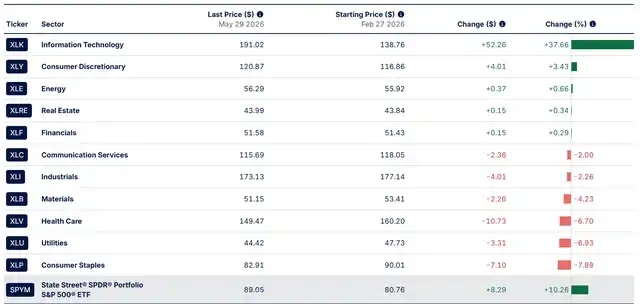
SPY Sector Performance (Data Source: SSGA.COM)

Iran War Escalation and Inflationary Shock

Now let's shift our focus back to the Iran war. This is a crucial variable because it has a high potential to trigger a classic systemic shock that could completely pop the bubble.

A classic bubble burst typically follows this trajectory: 1) Inflation accelerates, 2) The Fed raises interest rates, 3) A recession triggers a bear market.

Let's first examine inflation. Inflation can be demand-driven or supply-driven.

Demand-driven inflation is initially favorable for the market because businesses have pricing power, often accompanied by an "overheating" economy where companies initially see revenue and profit growth. The Fed then curbs demand by raising rates, but this ultimately leads to higher unemployment and a recession.

In contrast, supply-driven inflation is significantly negative for the market from the outset because businesses lose pricing power—this often occurs in a weak or stagflationary economic environment. The Fed is forced to raise rates even as the economy is weak, inevitably leading to a deeper recession.

The Iran war is triggering a destructive supply-side inflation because it is causing a global energy shortage, as well as food shortages due to fertilizer shortages and many other derivative product and chemical shortages.

Fundamentally, Iran has closed the Strait of Hormuz, and this closure has persisted for three months. During these three months, the global economy has been tapping strategic petroleum reserves to fill the lost oil gap. These reserves are expected to reach critical operational levels in June.

If Iran does not immediately reopen the Strait of Hormuz, the global economy will face its most severe energy shock ever. Due to the very real physical shortage, crude oil prices could surge to over $200 per barrel until demand is completely destroyed, leading prices to fall back down. The destruction of demand directly corresponds to a recession.

This is precisely why Trump is acutely aware of the severity of the situation. For the past two months, he has been trying to negotiate with Iran to reopen the Strait of Hormuz but to no avail.

Currently, reaching a deal with Iran seems almost impossible for three reasons:

  • First, Iran wants to retain control of the Strait of Hormuz even after reopening it, which crosses a U.S. red line;

  • Second, Iran refuses to negotiate on the nuclear issue and most likely does not want any nuclear deal, which is another U.S. red line;

  • Third, even if Trump compromises on Iran's terms to reopen the strait and reaches some deal, Israel would likely block it, as Israel sees a nuclear-armed Iran as an existential threat.

So, what is the actual situation on the ground now?

My take is that Trump's likelihood of striking a last-minute deal with Iran to prevent an inflationary shock is becoming increasingly higher.

However, Israel absolutely does not approve of such a deal. Because part of an Iran deal would involve a ceasefire on all fronts, including Lebanon. Israel could outright veto this deal by directly attacking Lebanon. For Israel, this is also an existential issue, given the very real threat posed by its neighbor, Hezbollah.

Currently, we are facing a potential for major escalation.

Reports indicate Iran has now severed all contact with the U.S., meaning all negotiations have stalled. Not only that, but Iran has also completely blockaded the Strait of Hormuz and is threatening to further close the Bab al-Mandab Strait. If this happens, over 30% of the world's energy supply would simply vanish—a true disaster.

Although Trump claims he has spoken with both Israel and Hezbollah, and even suggests negotiations with Iran are still ongoing—and just these statements have been enough to push tech stocks to new all-time highs—there has been no official confirmation of these claims to date.

The June Crash

Therefore, the probability of a crash erupting in June is becoming increasingly high. Global oil inventories will hit critical levels in June. Once they fall below that line, crude oil (CL1:COM) prices will skyrocket due to a real supply shortage, and it will become very difficult to "talk down" prices with mere words.

The consequence will be that bond yields will also soar as inflation expectations rise and fiscal concerns drive real rates higher. Moreover, when inflation spikes, trying to 'jawbone' the bond market sell-off will become futile.

Most crucially, the Federal Reserve will have to respond at its June FOMC meeting. This could very well be the final trigger that pops the bubble. Specifically, the Fed's official stance in its Summary of Economic Projections (SEP) still signals that the next move will be a rate cut, maintaining a dovish policy bias.

However, the federal funds futures market has already priced in a tightening bias. Currently, the market is pricing in over a 50% probability of one rate hike by December 2026, and potentially even two hikes.

The Fed will then be forced to align with market expectations, making an official hawkish shift at the June meeting. This alone could burst the bubble instantly. Furthermore, even if the Fed insists on maintaining a dovish bias, as it would completely lose market credibility, the 10-year Treasury yield could skyrocket, triggering an even greater systemic shock.

Investment Implications

The S&P 500's Shiller P/E ratio is approaching a new all-time high, well above 40x, forming a mega-bubble. An inflationary shock triggered by the Iran war could pop it at any moment, and the Fed's official pivot to hawkishness in June might be the fatal bullet. Investors should prepare for a major pullback, potentially as severe as the bear markets of 2000 and 2008. Remember, all bubbles eventually burst.

Perguntas relacionadas

QAccording to the author, why might the US stock market crash in June 2026?

AThe author posits a potential June 2026 crash due to a convergence of factors: a massive bubble in US equities, particularly in tech, driven by the 'Trump stimulus' of forced AI capital expenditure; an imminent inflationary supply shock as global strategic oil reserves hit critical levels due to the Iran war's closure of the Strait of Hormuz; and the Federal Reserve's likely official pivot to a hawkish stance at its June FOMC meeting in response, which could be the trigger that pops the bubble.

QHow does the 2026 stock market bubble differ from the 2000 dot-com bubble, as described in the article?

AThe 2026 bubble is described as worse than the 2000 bubble. While both have similarly high Shiller P/E ratios above 40, the 2000 bubble was driven by speculation and multiple expansion on future expectations. In contrast, the 2026 bubble is built on 'backward-looking' realized profits from an unsustainable $770 billion AI capital expenditure boom, which the author characterizes as a 'Trump stimulus' plan forced onto private companies. The market naively expects these extraordinary profits to continue indefinitely.

QWhat is the primary risk associated with the Iran war that could trigger a market crash?

AThe primary risk is a severe, supply-driven inflationary shock. The prolonged closure of the Strait of Hormuz by Iran is depleting global strategic oil reserves, which are projected to reach a critical operational level in June. This could cause a physical shortage, potentially sending crude oil prices soaring above $200 per barrel. Such a supply shock would force the Fed to hike rates into a weakening economy, leading to a deep recession and bursting the stock market bubble.

QWhat role does the Federal Reserve play in the author's crash scenario?

AThe Federal Reserve is seen as the potential catalyst or 'trigger' for the crash. Currently, the Fed maintains an officially dovish bias. However, the market has already priced in a tightening shift. The author argues that the Fed will be forced to officially pivot hawkish at its June FOMC meeting in response to spiking inflation and bond yields from the Iran war crisis. This official shift could instantly pop the bubble. Even if the Fed remains dovish, it would lose all credibility, causing Treasury yields to surge and triggering a systemic crisis.

QWhat does the author suggest is the nature of the $770 billion AI capital expenditure, and why is it seen as unsustainable?

AThe author characterizes the $770 billion AI capital expenditure as an unsustainable 'Trump stimulus plan' imposed on private companies, originating from a meeting early in Trump's second term. He suggests this spending is politically driven and not based on organic, sustainable business demand. The article implies that a potential Democratic victory in the upcoming midterm elections could reverse this trend, leading to a slowdown and eventual decline in AI capital spending, undermining the profits propping up the tech bubble.

Leituras Relacionadas

SpaceX, OpenAI, Anthropic: The Three AI Giants Racing for IPO, Which One Is Worth Betting On?

SpaceX, OpenAI, and Anthropic are poised for historic IPOs within weeks, potentially raising a combined $180 billion—a sum exceeding the entire internet bubble's fundraising. The hosts of the Limitless Podcast argue this isn't just individual company financing but an unprecedented capital concentration for AI infrastructure, driven by an insatiable need for compute, data centers, power, and chips. SpaceX's IPO is notable for reportedly changing market index rules to allow faster inclusion, potentially funneling trillions in passive retirement funds into its stock, despite its unproven space-based data center business model. In contrast, Anthropic demonstrates explosive growth, with ARR reportedly hitting $45 billion and approaching profitability, fueled by strong enterprise adoption of products like Claude Code. Google's separate $80 billion raise highlights the immense capital pressure, even for giants. The discussion acknowledges bubble risks but leans optimistic. The hosts contend the massive spending is building essential physical infrastructure for the next technological era. A key bottleneck isn't capital but the real-world limits of chip manufacturing and construction speed. As long as demand for AI compute outstrips supply, this investment cycle represents a foundational build-out rather than a purely financial bubble. All three companies are seen as foundational bets on the future, with Anthropic often cited as the most immediately compelling due to its proven revenue trajectory.

marsbitHá 59m

SpaceX, OpenAI, Anthropic: The Three AI Giants Racing for IPO, Which One Is Worth Betting On?

marsbitHá 59m

From 'Old Guys' to 'New Favorites': How AI Is Revaluing Old Infrastructure from Dell to Nokia?

From "Vintage Tech" to "New AI Darlings": How AI Revalues Old Infrastructure One year ago, tech giants like Dell, Nokia, Cisco, and Western Data were seen as slow-growth, low-valuation stories, far from the AI spotlight dominated by players like Nvidia. Now, these legacy tech stocks are gaining market attention, sparking debate on whether this is genuine industry revaluation or a temporary narrative. As AI moves from model parameters to real-world data centers, the market is recognizing companies with proven delivery and infrastructure capabilities. This shift marks a change in the AI investment thesis: from pure model and GPU focus to the complex systems engineering required for deployment. Companies like Dell, HPE, and Corning are being revalued not for being "sexy" AI innovators, but for their decades of accumulated expertise in supply chains, enterprise delivery, and infrastructure—assets that have become critical in the AI buildout phase. The revaluation is unfolding across three key infrastructure lines: 1. **Servers & System Integration:** Dell and HPE are emerging as crucial system integrators or "general contractors" for AI data centers, translating GPU orders into complete, deployable server racks integrated with power, cooling, and networking. 2. **Networking & Connectivity:** AI's scale demands robust high-speed connections. Corning (fiber optics), Nokia (AI-RAN, 6G), and Cisco (data center switches) are gaining importance for enabling efficient data transfer within and between AI clusters. 3. **Storage:** Beyond high-speed memory (HBM/DRAM), the AI data explosion is driving demand for high-capacity hard drives (HDDs) from companies like Western Digital and Seagate to handle training data, logs, and cold storage cost-effectively. For this revaluation to be substantive and not just a narrative, three criteria are key: 1) Concrete AI-related order and revenue growth (e.g., Dell's AI server sales), 2) Upward revisions to company financial guidance, and 3) Sustainable improvements in profit quality, not just top-line revenue spikes. In essence, AI's transition to a real construction phase is re-pricing "old assets" against "new demand." The opportunity, however, is selective. Only those legacy firms that are demonstrably integrated into the capital expenditure chains of data center and enterprise AI deployment are likely to experience a true "logic re-rating" rather than just a temporary valuation bounce.

marsbitHá 1h

From 'Old Guys' to 'New Favorites': How AI Is Revaluing Old Infrastructure from Dell to Nokia?

marsbitHá 1h

The Merger of Codex and ChatGPT Marks the Beginning of a Major Reshuffle in Programming Tools

OpenAI is shifting its strategic focus from ChatGPT to Codex, merging them along with the browser tool Atlas into a unified desktop super-app. This move signals an internal belief that Codex, originally a programming tool, represents the next evolution of AI more than conversational models like ChatGPT. Over the past year, Codex's weekly active users have surged past 5 million. The key distinction is that while ChatGPT answers questions, Codex executes tasks. Enterprises increasingly value this ability to get work done over simply receiving advice. Consequently, Codex is attracting professionals beyond developers, including analysts, bankers, marketers, and product managers. OpenAI's reorganization and increased investment in Codex stem from recognizing that the future of AI competition lies in execution capabilities, not just conversation. The company is launching role-specific plugins (e.g., for data analysis, sales, design) to transform Codex into a broad knowledge work platform that automates and redefines white-collar workflows. Beyond being a tool, Codex reflects OpenAI's ambition to redefine software. New features like "Sites"—which generates interactive websites from documents—and collaborative "Annotations" aim to create a paradigm where the AI understands the goal and handles the tools and steps, functioning more like a digital colleague than traditional software. The ultimate goal is a unified experience where the user cares only about the completed task.

marsbitHá 1h

The Merger of Codex and ChatGPT Marks the Beginning of a Major Reshuffle in Programming Tools

marsbitHá 1h

Interpreting Investment Opportunities in the Age of Great Navigation, Invesco Great Wall Fund Releases '2026 Report on Chinese Enterprises Going Global'

Invesco Great Wall Fund has released its "2026 China Corporate Globalization Report," titled "The 'Great Navigation Era' of Chinese Enterprises." The report analyzes the new trends and investment opportunities as Chinese companies expand globally, moving from simple product exports to comprehensive overseas operations involving services, branding, and local production. Driven by factors like trade friction, the pursuit of higher profit margins abroad, and policy support, globalization is becoming essential for Chinese companies. The report outlines an evolution: from early product export ("Globalization 1.0") to the current "Globalization 2.0," characterized by overseas capacity, capital goods investment, consumer brand expansion, and service exports. Chinese firms' competitive advantages are highlighted, including a vast engineer talent pool, low-cost and robust infrastructure, and complete industrial clusters. Specific sectors with significant出海 potential are identified: * **Capital Goods** (e.g., engineering machinery, power equipment): Benefiting from global demand, especially in Belt & Road markets and the AI-driven power grid upgrade cycle. * **Consumer Brands**: Transitioning from cost to brand advantage, leveraging供应链 efficiency. * **Technology & Innovation**: Including AI applications, optical modules within global tech supply chains, and new energy vehicles focusing on local production. * **Pharmaceuticals**: Chinese biotech firms are becoming preferred partners for global pharma, with potential for breakthrough drugs in areas like oncology and weight loss. The report concludes that corporate globalization represents a sustained, core theme for China's capital markets, though companies must navigate challenges like geopolitics and localization.

marsbitHá 1h

Interpreting Investment Opportunities in the Age of Great Navigation, Invesco Great Wall Fund Releases '2026 Report on Chinese Enterprises Going Global'

marsbitHá 1h

Trading

Spot
Futuros

Artigos em Destaque

O que é $S$

Compreender o SPERO: Uma Visão Abrangente Introdução ao SPERO À medida que o panorama da inovação continua a evoluir, o surgimento de tecnologias web3 e projetos de criptomoeda desempenha um papel fundamental na formação do futuro digital. Um projeto que tem atraído atenção neste campo dinâmico é o SPERO, denotado como SPERO,$$s$. Este artigo tem como objetivo reunir e apresentar informações detalhadas sobre o SPERO, para ajudar entusiastas e investidores a compreender as suas bases, objetivos e inovações nos domínios web3 e cripto. O que é o SPERO,$$s$? O SPERO,$$s$ é um projeto único dentro do espaço cripto que procura aproveitar os princípios da descentralização e da tecnologia blockchain para criar um ecossistema que promove o envolvimento, a utilidade e a inclusão financeira. O projeto é concebido para facilitar interações peer-to-peer de novas maneiras, proporcionando aos utilizadores soluções e serviços financeiros inovadores. No seu núcleo, o SPERO,$$s$ visa capacitar indivíduos ao fornecer ferramentas e plataformas que melhoram a experiência do utilizador no espaço das criptomoedas. Isso inclui a possibilidade de métodos de transação mais flexíveis, a promoção de iniciativas impulsionadas pela comunidade e a criação de caminhos para oportunidades financeiras através de aplicações descentralizadas (dApps). A visão subjacente do SPERO,$$s$ gira em torno da inclusão, visando fechar lacunas dentro das finanças tradicionais enquanto aproveita os benefícios da tecnologia blockchain. Quem é o Criador do SPERO,$$s$? A identidade do criador do SPERO,$$s$ permanece algo obscura, uma vez que existem recursos publicamente disponíveis limitados que fornecem informações detalhadas sobre o(s) seu(s) fundador(es). Esta falta de transparência pode resultar do compromisso do projeto com a descentralização—uma ética que muitos projetos web3 partilham, priorizando contribuições coletivas em vez de reconhecimento individual. Ao centrar as discussões em torno da comunidade e dos seus objetivos coletivos, o SPERO,$$s$ incorpora a essência do empoderamento sem destacar indivíduos específicos. Assim, compreender a ética e a missão do SPERO é mais importante do que identificar um criador singular. Quem são os Investidores do SPERO,$$s$? O SPERO,$$s$ é apoiado por uma diversidade de investidores que vão desde capitalistas de risco a investidores-anjo dedicados a promover a inovação no setor cripto. O foco desses investidores geralmente alinha-se com a missão do SPERO—priorizando projetos que prometem avanço tecnológico social, inclusão financeira e governança descentralizada. Essas fundações de investidores estão tipicamente interessadas em projetos que não apenas oferecem produtos inovadores, mas que também contribuem positivamente para a comunidade blockchain e os seus ecossistemas. O apoio desses investidores reforça o SPERO,$$s$ como um concorrente notável no domínio em rápida evolução dos projetos cripto. Como Funciona o SPERO,$$s$? O SPERO,$$s$ emprega uma estrutura multifacetada que o distingue de projetos de criptomoeda convencionais. Aqui estão algumas das características-chave que sublinham a sua singularidade e inovação: Governança Descentralizada: O SPERO,$$s$ integra modelos de governança descentralizada, capacitando os utilizadores a participar ativamente nos processos de tomada de decisão sobre o futuro do projeto. Esta abordagem promove um sentido de propriedade e responsabilidade entre os membros da comunidade. Utilidade do Token: O SPERO,$$s$ utiliza o seu próprio token de criptomoeda, concebido para servir várias funções dentro do ecossistema. Esses tokens permitem transações, recompensas e a facilitação de serviços oferecidos na plataforma, melhorando o envolvimento e a utilidade gerais. Arquitetura em Camadas: A arquitetura técnica do SPERO,$$s$ suporta modularidade e escalabilidade, permitindo a integração contínua de funcionalidades e aplicações adicionais à medida que o projeto evolui. Esta adaptabilidade é fundamental para manter a relevância no panorama cripto em constante mudança. Envolvimento da Comunidade: O projeto enfatiza iniciativas impulsionadas pela comunidade, empregando mecanismos que incentivam a colaboração e o feedback. Ao nutrir uma comunidade forte, o SPERO,$$s$ pode melhor atender às necessidades dos utilizadores e adaptar-se às tendências do mercado. Foco na Inclusão: Ao oferecer taxas de transação baixas e interfaces amigáveis, o SPERO,$$s$ visa atrair uma base de utilizadores diversificada, incluindo indivíduos que anteriormente podem não ter participado no espaço cripto. Este compromisso com a inclusão alinha-se com a sua missão abrangente de empoderamento através da acessibilidade. Cronologia do SPERO,$$s$ Compreender a história de um projeto fornece insights cruciais sobre a sua trajetória de desenvolvimento e marcos. Abaixo está uma cronologia sugerida que mapeia eventos significativos na evolução do SPERO,$$s$: Fase de Conceituação e Ideação: As ideias iniciais que formam a base do SPERO,$$s$ foram concebidas, alinhando-se de perto com os princípios de descentralização e foco na comunidade dentro da indústria blockchain. Lançamento do Whitepaper do Projeto: Após a fase conceitual, um whitepaper abrangente detalhando a visão, os objetivos e a infraestrutura tecnológica do SPERO,$$s$ foi lançado para atrair o interesse e o feedback da comunidade. Construção da Comunidade e Primeiros Envolvimentos: Esforços ativos de divulgação foram feitos para construir uma comunidade de primeiros adotantes e investidores potenciais, facilitando discussões em torno dos objetivos do projeto e angariando apoio. Evento de Geração de Tokens: O SPERO,$$s$ realizou um evento de geração de tokens (TGE) para distribuir os seus tokens nativos a apoiantes iniciais e estabelecer liquidez inicial dentro do ecossistema. Lançamento da dApp Inicial: A primeira aplicação descentralizada (dApp) associada ao SPERO,$$s$ foi lançada, permitindo que os utilizadores interagissem com as funcionalidades principais da plataforma. Desenvolvimento Contínuo e Parcerias: Atualizações e melhorias contínuas nas ofertas do projeto, incluindo parcerias estratégicas com outros players no espaço blockchain, moldaram o SPERO,$$s$ em um jogador competitivo e em evolução no mercado cripto. Conclusão O SPERO,$$s$ é um testemunho do potencial do web3 e das criptomoedas para revolucionar os sistemas financeiros e capacitar indivíduos. Com um compromisso com a governança descentralizada, o envolvimento da comunidade e funcionalidades inovadoras, abre caminho para um panorama financeiro mais inclusivo. Como em qualquer investimento no espaço cripto em rápida evolução, potenciais investidores e utilizadores são incentivados a pesquisar minuciosamente e a envolver-se de forma ponderada com os desenvolvimentos em curso dentro do SPERO,$$s$. O projeto demonstra o espírito inovador da indústria cripto, convidando a uma exploração mais aprofundada das suas inúmeras possibilidades. Embora a jornada do SPERO,$$s$ ainda esteja a desenrolar-se, os seus princípios fundamentais podem, de facto, influenciar o futuro de como interagimos com a tecnologia, as finanças e uns com os outros em ecossistemas digitais interconectados.

69 Visualizações TotaisPublicado em {updateTime}Atualizado em 2024.12.17

O que é $S$

O que é AGENT S

Agent S: O Futuro da Interação Autónoma no Web3 Introdução No panorama em constante evolução do Web3 e das criptomoedas, as inovações estão constantemente a redefinir a forma como os indivíduos interagem com plataformas digitais. Um projeto pioneiro, o Agent S, promete revolucionar a interação humano-computador através do seu framework aberto e agente. Ao abrir caminho para interações autónomas, o Agent S visa simplificar tarefas complexas, oferecendo aplicações transformadoras em inteligência artificial (IA). Esta exploração detalhada irá aprofundar-se nas complexidades do projeto, nas suas características únicas e nas implicações para o domínio das criptomoedas. O que é o Agent S? O Agent S é um framework aberto e agente, especificamente concebido para abordar três desafios fundamentais na automação de tarefas computacionais: Aquisição de Conhecimento Específico de Domínio: O framework aprende inteligentemente a partir de várias fontes de conhecimento externas e experiências internas. Esta abordagem dupla capacita-o a construir um rico repositório de conhecimento específico de domínio, melhorando o seu desempenho na execução de tarefas. Planeamento ao Longo de Longos Horizontes de Tarefas: O Agent S emprega planeamento hierárquico aumentado por experiência, uma abordagem estratégica que facilita a decomposição e execução eficientes de tarefas intrincadas. Esta característica melhora significativamente a sua capacidade de gerir múltiplas subtarefas de forma eficiente e eficaz. Gestão de Interfaces Dinâmicas e Não Uniformes: O projeto introduz a Interface Agente-Computador (ACI), uma solução inovadora que melhora a interação entre agentes e utilizadores. Utilizando Modelos de Linguagem Multimodais de Grande Escala (MLLMs), o Agent S pode navegar e manipular diversas interfaces gráficas de utilizador de forma fluida. Através destas características pioneiras, o Agent S fornece um framework robusto que aborda as complexidades envolvidas na automação da interação humana com máquinas, preparando o terreno para uma infinidade de aplicações em IA e além. Quem é o Criador do Agent S? Embora o conceito de Agent S seja fundamentalmente inovador, informações específicas sobre o seu criador permanecem elusivas. O criador é atualmente desconhecido, o que destaca ou o estágio nascente do projeto ou a escolha estratégica de manter os membros fundadores em anonimato. Independentemente da anonimidade, o foco permanece nas capacidades e no potencial do framework. Quem são os Investidores do Agent S? Como o Agent S é relativamente novo no ecossistema criptográfico, informações detalhadas sobre os seus investidores e financiadores não estão explicitamente documentadas. A falta de informações disponíveis publicamente sobre as fundações de investimento ou organizações que apoiam o projeto levanta questões sobre a sua estrutura de financiamento e roteiro de desenvolvimento. Compreender o apoio é crucial para avaliar a sustentabilidade do projeto e o seu impacto potencial no mercado. Como Funciona o Agent S? No núcleo do Agent S reside uma tecnologia de ponta que lhe permite funcionar eficazmente em diversos ambientes. O seu modelo operacional é construído em torno de várias características-chave: Interação Humano-Computador Semelhante: O framework oferece planeamento avançado em IA, esforçando-se para tornar as interações com computadores mais intuitivas. Ao imitar o comportamento humano na execução de tarefas, promete elevar as experiências dos utilizadores. Memória Narrativa: Utilizada para aproveitar experiências de alto nível, o Agent S utiliza memória narrativa para acompanhar os históricos de tarefas, melhorando assim os seus processos de tomada de decisão. Memória Episódica: Esta característica fornece aos utilizadores orientações passo a passo, permitindo que o framework ofereça suporte contextual à medida que as tarefas se desenrolam. Suporte para OpenACI: Com a capacidade de funcionar localmente, o Agent S permite que os utilizadores mantenham o controlo sobre as suas interações e fluxos de trabalho, alinhando-se com a ética descentralizada do Web3. Fácil Integração com APIs Externas: A sua versatilidade e compatibilidade com várias plataformas de IA garantem que o Agent S possa integrar-se perfeitamente em ecossistemas tecnológicos existentes, tornando-o uma escolha apelativa para desenvolvedores e organizações. Estas funcionalidades contribuem coletivamente para a posição única do Agent S no espaço cripto, à medida que automatiza tarefas complexas e em múltiplos passos com mínima intervenção humana. À medida que o projeto evolui, as suas potenciais aplicações no Web3 podem redefinir a forma como as interações digitais se desenrolam. Cronologia do Agent S O desenvolvimento e os marcos do Agent S podem ser encapsulados numa cronologia que destaca os seus eventos significativos: 27 de Setembro de 2024: O conceito de Agent S foi lançado num artigo de pesquisa abrangente intitulado “Um Framework Agente Aberto que Usa Computadores como um Humano”, mostrando a base para o projeto. 10 de Outubro de 2024: O artigo de pesquisa foi disponibilizado publicamente no arXiv, oferecendo uma exploração aprofundada do framework e da sua avaliação de desempenho com base no benchmark OSWorld. 12 de Outubro de 2024: Uma apresentação em vídeo foi lançada, proporcionando uma visão visual das capacidades e características do Agent S, envolvendo ainda mais potenciais utilizadores e investidores. Estes marcos na cronologia não apenas ilustram o progresso do Agent S, mas também indicam o seu compromisso com a transparência e o envolvimento da comunidade. Pontos-Chave Sobre o Agent S À medida que o framework Agent S continua a evoluir, várias características-chave destacam-se, sublinhando a sua natureza inovadora e potencial: Framework Inovador: Concebido para proporcionar um uso intuitivo de computadores semelhante à interação humana, o Agent S traz uma abordagem nova à automação de tarefas. Interação Autónoma: A capacidade de interagir autonomamente com computadores através de GUI significa um avanço em direção a soluções computacionais mais inteligentes e eficientes. Automação de Tarefas Complexas: Com a sua metodologia robusta, pode automatizar tarefas complexas e em múltiplos passos, tornando os processos mais rápidos e menos propensos a erros. Melhoria Contínua: Os mecanismos de aprendizagem permitem que o Agent S melhore a partir de experiências passadas, aprimorando continuamente o seu desempenho e eficácia. Versatilidade: A sua adaptabilidade em diferentes ambientes operacionais, como OSWorld e WindowsAgentArena, garante que pode servir uma ampla gama de aplicações. À medida que o Agent S se posiciona no panorama do Web3 e das criptomoedas, o seu potencial para melhorar as capacidades de interação e automatizar processos significa um avanço significativo nas tecnologias de IA. Através do seu framework inovador, o Agent S exemplifica o futuro das interações digitais, prometendo uma experiência mais fluida e eficiente para os utilizadores em diversas indústrias. Conclusão O Agent S representa um ousado avanço na união da IA e do Web3, com a capacidade de redefinir a forma como interagimos com a tecnologia. Embora ainda esteja nas suas fases iniciais, as possibilidades para a sua aplicação são vastas e cativantes. Através do seu framework abrangente que aborda desafios críticos, o Agent S visa trazer interações autónomas para o primeiro plano da experiência digital. À medida que avançamos mais profundamente nos domínios das criptomoedas e da descentralização, projetos como o Agent S desempenharão, sem dúvida, um papel crucial na formação do futuro da tecnologia e da colaboração humano-computador.

655 Visualizações TotaisPublicado em {updateTime}Atualizado em 2025.01.14

O que é AGENT S

Como comprar S

Bem-vindo à HTX.com!Tornámos a compra de Sonic (S) simples e conveniente.Segue o nosso guia passo a passo para iniciar a tua jornada no mundo das criptos.Passo 1: cria a tua conta HTXUtiliza o teu e-mail ou número de telefone para te inscreveres numa conta gratuita na HTX.Desfruta de um processo de inscrição sem complicações e desbloqueia todas as funcionalidades.Obter a minha contaPasso 2: vai para Comprar Cripto e escolhe o teu método de pagamentoCartão de crédito/débito: usa o teu visa ou mastercard para comprar Sonic (S) instantaneamente.Saldo: usa os fundos da tua conta HTX para transacionar sem problemas.Terceiros: adicionamos métodos de pagamento populares, como Google Pay e Apple Pay, para aumentar a conveniência.P2P: transaciona diretamente com outros utilizadores na HTX.Mercado de balcão (OTC): oferecemos serviços personalizados e taxas de câmbio competitivas para os traders.Passo 3: armazena teu Sonic (S)Depois de comprar o teu Sonic (S), armazena-o na tua conta HTX.Alternativamente, podes enviá-lo para outro lugar através de transferência blockchain ou usá-lo para transacionar outras criptomoedas.Passo 4: transaciona Sonic (S)Transaciona facilmente Sonic (S) no mercado à vista da HTX.Acede simplesmente à tua conta, seleciona o teu par de trading, executa as tuas transações e monitoriza em tempo real.Oferecemos uma experiência de fácil utilização tanto para principiantes como para traders experientes.

1.2k Visualizações TotaisPublicado em {updateTime}Atualizado em 2026.06.02

Como comprar S

Discussões

Bem-vindo à Comunidade HTX. Aqui, pode manter-se informado sobre os mais recentes desenvolvimentos da plataforma e obter acesso a análises profissionais de mercado. As opiniões dos utilizadores sobre o preço de S (S) são apresentadas abaixo.

活动图片