The WeChat Agent is really coming.
WeChat Open Platform released a piece of content about guidelines for WeChat AI developers.
The guidelines state that, in order to provide users with a more intelligent interactive experience and help users more agilely discover and use Mini Program services, WeChat Open Platform provides developers with the capability to easily access the WeChat AI ecosystem, while fully respecting developers' rights and autonomous choices.
After access, Mini Programs will have the opportunity to be recommended and called by WeChat AI. Mini Programs that have not completed access will be unable to be called by WeChat AI.
The platform provides two access modes. Automatic mode: authorize the platform to read the Mini Program source code during review, requiring no additional development investment. Development mode: developers can independently and personally develop based on their Mini Program's business characteristics.
On the same day, Meituan officially announced it was the first to access the WeChat AI ecosystem. As a pilot team, Meituan had previously jointly developed and tested access with the WeChat team. In the future, users will be able to call Meituan Waimai and other local life services through WeChat AI.
Life service platforms like Ctrip and Tongcheng also announced access to WeChat one after another.
A few days earlier, Tencent Customer Service stated that WeChat was cooperating with mobile phone manufacturers like Huawei, Xiaomi, Honor, OPPO, and vivo to launch A2A Assistant capabilities, and several manufacturers have already completed access.
Users can initiate WeChat audio/video calls or send messages to specific friends through the corresponding mobile phone system's AI assistant.
This isn't the first news about WeChat AI. As early as March this year, foreign media reported that Tencent was advancing a highly confidential AI Agent project within WeChat.
On June 2nd, foreign media released news that Tencent was testing a prototype of a built-in WeChat AI Agent, with the compliance review process potentially starting as soon as this month. On the day the report was published, Tencent's stock price closed up 10.5%, with its market value increasing by over HKD 300 billion in a single day, marking the largest single-day gain since January 2021.
WeChat AI might just be Tencent's ultimate answer for the second half of the AI era.
01
The Contours of WeChat AI
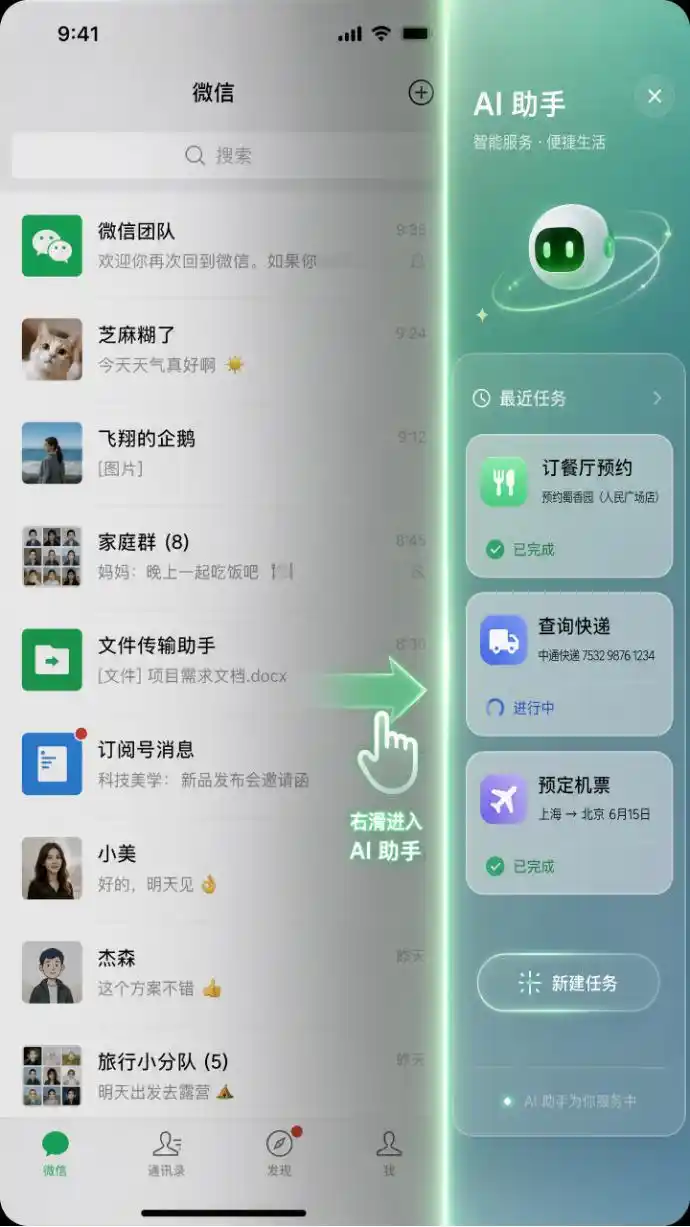
According to sources who have seen early demonstrations, users can swipe right on the WeChat main interface to bring up the AI Agent's conversation window. After users input commands, the Agent will automatically call Mini Programs within the WeChat ecosystem to complete tasks like screening, ordering, and booking.
For example, if you say "Help me order a cup of coffee under 30 yuan, not too sweet, that I can pick up nearby," the Agent will automatically call Mini Programs within WeChat to help you filter coffee shops, match taste and price, and even complete the ordering process.
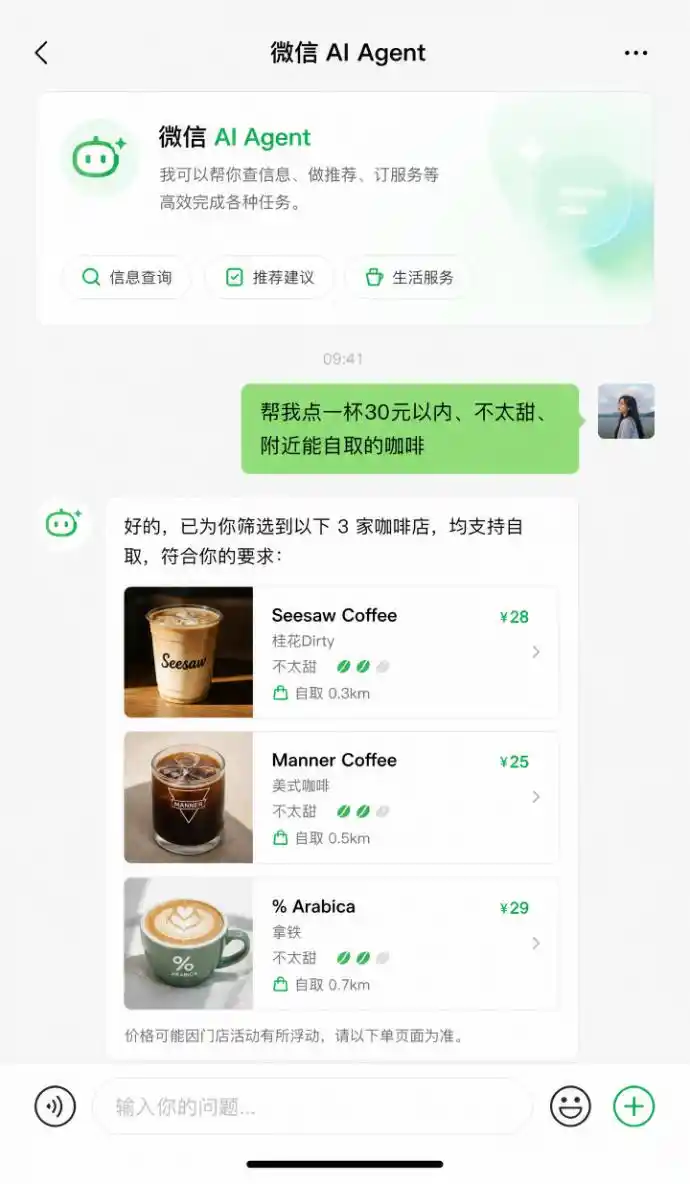
Just from the description, it doesn't seem much different from AI chatbots like Doubao and Qianwen.
But the special thing here is that WeChat AI has command and control authority over the entire WeChat ecosystem.
Tencent clearly stated in its 2025 annual report that the goal is to build next-generation Agentic services within the WeChat ecosystem, connecting Mini Programs, content, social, and payment capabilities. As of March 31, 2026, the combined MAU of Weixin and WeChat reached 1.432 billion.
This means that once WeChat AI goes live, for better or worse, it is destined to be a super app.
There are millions of Mini Programs within WeChat, covering daily life scenarios like ride-hailing, food delivery, ticket booking, and grocery shopping. Almost all major domestic internet services have a Mini Program entry within this ecosystem.
The core capability of WeChat AI is enabling AI to call the service and transactional capabilities within these Mini Programs, completing the full closed loop from cognition to decision-making to execution.
So how will it do it?
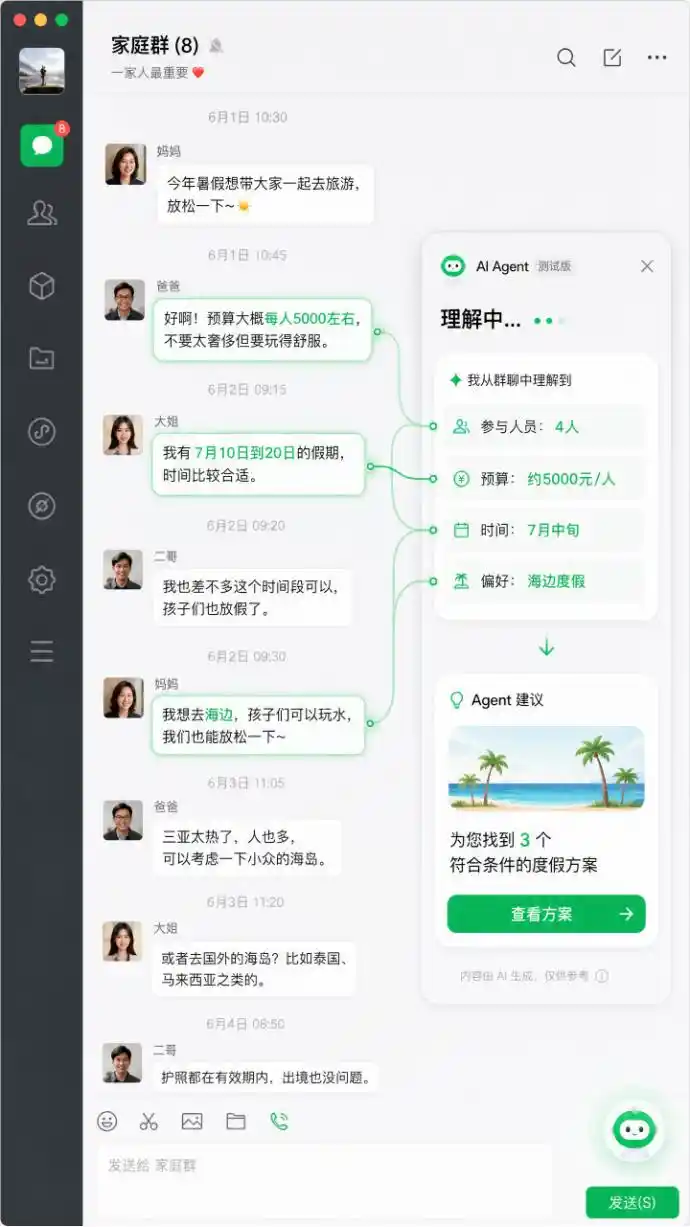
First is understanding user intent. When a user says "Help me book a restaurant," it means something completely different in a family group chat versus a work group chat.
Who is participating, who can make the final decision, what's the budget, what are the dietary restrictions, what step is the task at—these are all contextual factors the Agent needs to understand. The difficulty lies in the fact that tasks within WeChat naturally span time; a family group discussion about summer vacation might intermittently last for several days.
Then there's tool calling.
The Agent needs to take action, use "Search" to look up information, use Mini Programs to complete queries and price comparisons, use WeChat Pay to complete transactions, and use Service Notifications to give feedback to users.
According to QuestMobile's "2026 Panoramic Ecological Traffic Spring Report," Mini Programs' DAU has exceeded 900 million, covering several hundred verticals.
The toolbox is big enough now; the question is, can WeChat AI use it effectively?
Tencent revealed some technical details in a paper published on March 18th. The WeChat team developed UI-Oceanus, a world model specifically designed for the Mini Program ecosystem. Its purpose is to predict the outcomes of operations. The Agent finds a button, but what happens when it clicks? Where will the page jump to? What window will pop up? Will the payment process initiate?
Humans have intuition about these things when operating apps; the Agent lacks this intuition, so it must learn from data.
Game AI learns "how the character will move when this key is pressed"; the Mini Program world model learns "how the page will change when this button is clicked."
Training directly in real Mini Program environments is too slow and unstable, so UI-Oceanus automatically simulates operations and page changes, generating 5 million samples. This allows the Agent to learn how to operate Mini Programs in a virtual environment before migrating to real scenarios.
Then there's the cost issue. If each scenario triggers inference at an entry point with 1.4 billion MAU, the cost is astronomical. Tencent needs to balance using smaller models for basic tasks and calling stronger models for complex tasks. This multi-model scheduling capability must both ensure effectiveness and control costs.
Finally, there's ecosystem coordination.
There are too many Mini Programs in WeChat—service quality, interface stability, merchant cooperation, payment processes, recommendation ranking, benefit distribution—each item alone could be discussed at length.
For the AI Agent to handle tasks for users, it must actually succeed, not just promise smoothly and then get lost halfway through ordering.
So WeChat AI is actually a very complex engineering project; it must face a variety of complex scenarios. It also needs to understand natural language, call Mini Programs, handle payments, manage context, and coordinate the ecosystem.
The contours of WeChat AI are clear; it's just that this product will be much larger than we imagine.
02
Why WeChat is Best Suited to Host this Agent
The richer the context, the better AI can understand your true intent, and the more accurate the decisions it makes.
And WeChat just happens to be Tencent's largest context container.
WeChat has relationship chains. The social relationships, chat histories, and group conversations of its 1.4 billion users are all context. WeChat has Mini Programs. The millions of Mini Programs covering service scenarios are also context.
WeChat has payments. Users' spending habits, payment records, transaction preferences—these are also context.
WeChat has content. Official accounts, Channels, information flow in Moments—these are similarly context.
Recently, Tencent launched many AI products, such as Yuanbao, ima, WorkBuddy, and Marvis, which may seem independent. In reality, they are all accumulating capabilities for WeChat AI.
Behind this is an internal Tencent mechanism called Co-Design.
Simply put, Co-Design means product teams and model teams design and optimize together.
The traditional approach is for the model team to train the model first, then hand it off to the product team to use. The product team finds problems, gives feedback, and the model team adjusts.
This process is slow, and often results in situations where "the model is strong but the product is not user-friendly."
The Co-Design approach is different. The Yuanbao team tells the Hunyuan team how users actually ask questions and what problems they encounter in real scenarios. The Hunyuan team optimizes specific model capabilities based on this real feedback.
After optimization, the Yuanbao team immediately tests it, discovers new issues, and the cycle continues.
This process is bidirectional and synchronous. Products provide real data and feedback to models; models provide stronger capabilities to products.
Why is this effective? Because the most essential difference between the LLM era and past AI is generalization.
Before LLMs, building a translation product only required preparing translation data; building a Go program only required preparing Go data.
But today is different. Even if you just want to build a Coding Agent, you still need the model to have chatting, searching, instruction-following, and reasoning abilities. So ultimately, it becomes a very complex interdisciplinary problem.
The Co-Design between Tencent and Yuanbao is precisely to give the Hunyuan model strong chatting and searching abilities. Such abilities can then be migrated to other products like ima and WorkBuddy. The abilities trained by one product can make other products better.
Specifically, Yuanbao handles real-world Prompt distribution. The questions users ask in Yuanbao are relatively vague, maybe just one or two sentences, with constant follow-ups.
The multi-turn dialogue and intent understanding abilities trained from these scenarios can be directly migrated to WeChat AI's contextual understanding when handling group chat tasks.
WorkBuddy accumulates data from office collaboration scenarios.
It understands the semantics of corporate scenarios like document structures, meeting minutes, and task assignments. These abilities can let WeChat AI know how to extract key information and identify decision points when handling tasks.
ima builds up search capabilities. It trains the model on how to transform vague query intent into precise search strategies, and how to filter effective information from massive results. These abilities can let WeChat AI perform a round of information screening and intent clarification before calling Mini Programs, so it won't waste time and tokens calling all possible Mini Programs, but will only call the few that are useful.
Marvis trains task decomposition and tool scheduling abilities.
Marvis breaks down user instructions into multiple subtasks, scheduling different Agents to manipulate files, systems, and applications. This set of task orchestration and multi-Agent collaboration abilities can let WeChat AI know how to string together Mini Program calls, payment processes, and message notifications when facing cross-scenario tasks like "Help me order coffee and then notify my colleague."
These products provide different data, but this data can diffuse and migrate between each other, forming a network-like system. The data trained by one product can, through pre-training and post-training generalization mechanisms, improve the performance of another product.
WeChat AI is now at the center of an AI network.
It doesn't need to start from scratch; it can directly call these already-verified capabilities.
More importantly, WeChat itself is a complete ecosystem. It has relationship chains, Mini Programs, the transaction closed loop of WeChat Pay, and the content ecosystem of Official Accounts and Channels. These are things other Agent products lack.
03
How Big is WeChat AI's Stage?
All of this is currently implemented through A2A.
A2A stands for Agent-to-Agent.
It is an open protocol that specifies how AI agents from different manufacturers communicate, call each other's capabilities, and ensure security. The counterpart is the GUIAgent route, which involves letting AI recognize interfaces by "screen reading" like a human and then operate WeChat through "simulated clicks."
Tencent chose A2A over GUI, a decision based on deep consideration.
During Tencent's Q1 earnings call in May, an analyst asked Tencent President Martin Lau, "How do you view the long-term potential or potential disruption from operating system-level agents, including those from iOS, Android, or mobile phone manufacturers?"
Martin Lau replied, "From an operating system perspective, there are a few different things mixed in here. There are true operating systems, like iOS and Android, and then there are applications that try to pretend to be operating systems. If you are an operating system like iOS or Android, you want to ensure the ecosystem is well-protected and carefully curated, and give applications reasonable permissions. You can have an agent that tries to serve users, but you need permission from different applications. Otherwise, as an operating system, you are essentially preying on different applications, which is not the best way to manage an operating system."
Martin Lau meant that using an operating system's Agent to control applications is possible, but it cannot be done without the application's authorization; otherwise, it is preying on the application.
Put more bluntly, Tencent does not accept GUI agents, only A2A.
Over the past two years, mobile phone manufacturers tried using GUI to externally integrate with WeChat.
Honor's YOYO promoted "sending a WeChat red packet with one sentence." Xiaomi's smart home products featured "Xiao Ai automatically connecting WeChat calls." When you tell your phone "Send a 10-yuan red packet to XX," the AI assistant executes in the background: unlock, click the WeChat icon, search for XX, click the plus sign, click red packet, input 10, initiate payment.
This behavior was quickly banned by WeChat.
In April 2025, WeChat Security Center issued an announcement prohibiting third-party tools from bypassing WeChat's security technical measures to illegally obtain or utilize WeChat end-user data.
ByteDance's Doubao Phone met the same fate.
In December 2025, the Doubao Phone Assistant technical preview was released, with the core selling point being "AI directly operates across apps." Soon, many users reported their WeChat accounts being forced offline, with system prompts about abnormal login environments. Tencent stated this triggered WeChat's existing security risk control policies.
Regarding WeChat AI, Honor was the first brand to complete WeChat A2A adaptation. Currently, some Honor models already support this feature. Users can wake up YOYO and directly give voice commands, such as sending WeChat messages, making WeChat voice calls, or video calls.
A Tencent insider commented that any mobile phone agent that cannot call WeChat is not a true system-level Agent. Tencent will definitely open this door; it's just a matter of time.
WeChat is willing to allow mobile phone manufacturers' Agents limited ability to call WeChat capabilities through controlled protocols like A2A, but will not allow external Agents to enter WeChat via screen reading and simulated clicking.
This shows that, ultimately, Tencent still wants to control the calling rights and rule-setting authority for the WeChat ecosystem.
Speaking of Doubao, this leads to another question: Will WeChat AI charge fees?
Doubao has 345 million MAU, and recently there were rumors it would start charging for some features. WeChat has 1.4 billion MAU; the pressure is only greater.
Moreover, WeChat AI has to serve so many people; if every scenario triggers inference, the cost will be astronomical.
The previously reported Tencent plan to invest 10 billion in DeepSeek can be explained as securing model supply and a cost base.
Tencent's self-developed Hunyuan large model needs technical allies, and the WeChat ecosystem needs low-cost inference capabilities even more. DeepSeek's low-cost training approach恰好 aligns with the needs of massive user scenarios like WeChat AI.
On June 2nd, Tencent also announced that the call prices for the DeepSeek-V4 series on the Tencent Cloud platform would be fully aligned with DeepSeek's official prices, with users bearing no cloud platform premium.
All these clues hint that Tencent wants to deeply bind with DeepSeek, and the WeChat Agent is likely the first answer after this binding.
Use small models for basic tasks—low cost, fast speed. Call strong models for complex tasks—good effect, high accuracy. This multi-model scheduling capability must both ensure effectiveness and control costs.
As a WeChat user, if WeChat AI can truly succeed in completing a task in one go, I am willing to pay for this capability.
For example, helping me book a flight ticket, find a restaurant, or remind me who this person is who has been lying in my Moments friend list for so long without any chat history. I think these features are very valuable.
More importantly, WeChat AI faces not only individual users but also enterprise users. Enterprise automation, intelligent customer service, intelligent marketing—these scenarios have stronger demand for AI and higher willingness to pay.
WeChat AI's stage is actually very large. How large exactly? The answer is, as large as the WeChat ecosystem is, that's how large WeChat AI's stage is.
Tencent's Chief AI Scientist and Head of the Hunyuan Large Model, Yao Shunyu, gave a longer-term judgment at the Tencent Cloud AI Industry Application Conference on June 5th.
He believes AI is a long-term game, not a short-term window. He criticized the "make money quickly and retire in two years" mentality of some Silicon Valley practitioners, emphasizing that the current state is like "PCs in the 1970s," and new product opportunities will continuously emerge in the future.
This judgment恰恰 explains why Tencent is willing to invest such high costs in WeChat AI. Yao Shunyu specifically emphasized that "practical value is greater than leaderboard value." He believes AI methodology is already highly mature; the real difficulty lies in finding "good problems" to solve, not pursuing numbers on leaderboards.
WeChat AI aims to solve precisely such "good problems."
How to let these 1.4 billion users feel the value brought by AI in their daily lives.
There's no flashy technique or leaderboard chasing here. Only by solving this good problem can Tencent truly enter the second half of the AI era.
This article is from the WeChat public account "直面AI" (ID: faceaibang), author: Miao Zheng, editor: Wang Jing