Claiming the "Happy Horse": Alibaba's AI Lays Out the "Eight Trigrams Formation"

marsbitPublicado em 2026-04-11Última atualização em 2026-04-11

Resumo

Alibaba has officially claimed the "HappyHorse" (HappyHorse-1.0) AI video generation model, which recently topped the global benchmark on Artificial Analysis with an Elo score of 1357. Developed by Alibaba’s ATH (Alibaba Token Hub) innovation unit, the model is notable for its ability to generate high-definition video with synchronized audio and sound effects from text input, significantly improving motion coherence and reducing production time and cost. This launch is part of a broader acceleration in Alibaba’s AI strategy. In late March and early April, the company released three flagship models in quick succession: Qwen3.5-Omni, Wan2.7-Image, and Qwen3.6-Plus. The latter broke global daily call volume records with 1.4 trillion tokens processed shortly after release. Alibaba has also undergone significant organizational restructuring to support its AI ambitions. In March, it established the ATH business group, led by CEO Wu Yongming, to integrate AI development, cloud services, and application deployment. Further changes in April included forming a group-level technology committee and consolidating the Tongyi Lab into a dedicated AI model division. The company is investing heavily in AI, with plans to spend over 380 billion RMB on cloud and AI infrastructure over three years. Its self-developed GPUs have already seen mass production. While the market has responded positively to these moves, challenges remain in balancing centralized control with operational flexibility a...

By | Tingtong Tech (ID:tingtongtech), Author | Chen Ke, Editor | Rao Yan

Just as the market thought the AI video generation battlefield would still be a showdown between ByteDance and Kuaishou, a "dark horse" has joined the game.

Without any预告, without any paper, without any official account, a mysterious video generation model named HappyHorse topped the overseas evaluation platform Artificial Analysis, becoming the new technical throne.

The shockwave this "three-noes" product caused in the AI circle was no less than when AlphaGo defeated Lee Sedol. However, all the "technical fingerprints" and personnel change clues in the market pointed to the same origin: Alibaba. However, Alibaba did not admit it initially when the news broke.

After the market "speculated" for a few days, on April 10th, Alibaba finally claimed HappyHorse, stating it is a model developed by its ATH (Alibaba Token Hub) Innovation Business Unit.

For Alibaba, the "Happy Horse" is not the most eye-catching news this year. In fact, prior to this, whether it was the "triple release" of three flagship models at the end of March, or Qwen3.6Plus breaking the global call volume record, or the restructuring of the technical command, Alibaba's series of actions, like a "hat-trick," showed the market a new way of running.

More interestingly, this wave of密集 releases happened恰好 after researchers like Lin Junyang, Yu Bowen, and Hui Binyuan from the Tongyi Lab left in early March. Previously, the outside world was once deeply concerned about Alibaba's AI progress, and the capital market was also questioning. However, Alibaba quickly made the market look at it differently with the rapid iteration of products and market performance.

The industry jokingly called this the turning point for Alibaba's AI from "scattered" to "systematic"; others said that this time Alibaba is not是为了守住 the old territory of e-commerce, but to expand its territory on the AI map.

The final outcome, the market still cannot give an answer. But undoubtedly, for Alibaba, this is ultimately a gamble.

The stakes are not only huge amounts of money but also the company's "next ten years." Now, Alibaba has placed its heaviest bet in this gamble. Next, it depends on whether Alibaba has more "Happy Horses" breaking out and how far these "Happy Horses" can run.

-01- The Emergence of "Happy Horse"

"Whose model is this anyway?"

That's the answer global AI investors and practitioners wanted to know over the past few days.

In a blind test on the third-party platform Artificial Analysis, HappyHorse-1.0 (Happy Horse) topped the text-to-video track with an Elo score of 1357, leaving other video models far behind.

Insiders even called HappyHorse's emergence a "dimensionality reduction strike" in the video model world.

The reason is simple: HappyHorse not only solved the hard problem of motion logic where previous AI videos "moved like PowerPoint slides," but more importantly, it integrated synchronized audio and video generation. Input a script, and it can not only output high-definition footage but also同步生成 sound effects and even background music that fit the scene.

Public reports stated that "Happy Horse" has extremely bright efficiency metrics, taking only about 38 seconds to generate a 5-second 1080P video on a high-end graphics card. This saves not just time, but also computing power costs. It is rumored that its后续 pricing will be user-friendly, and it will open up some open-source capabilities, potentially reducing post-production costs by more than 50%.
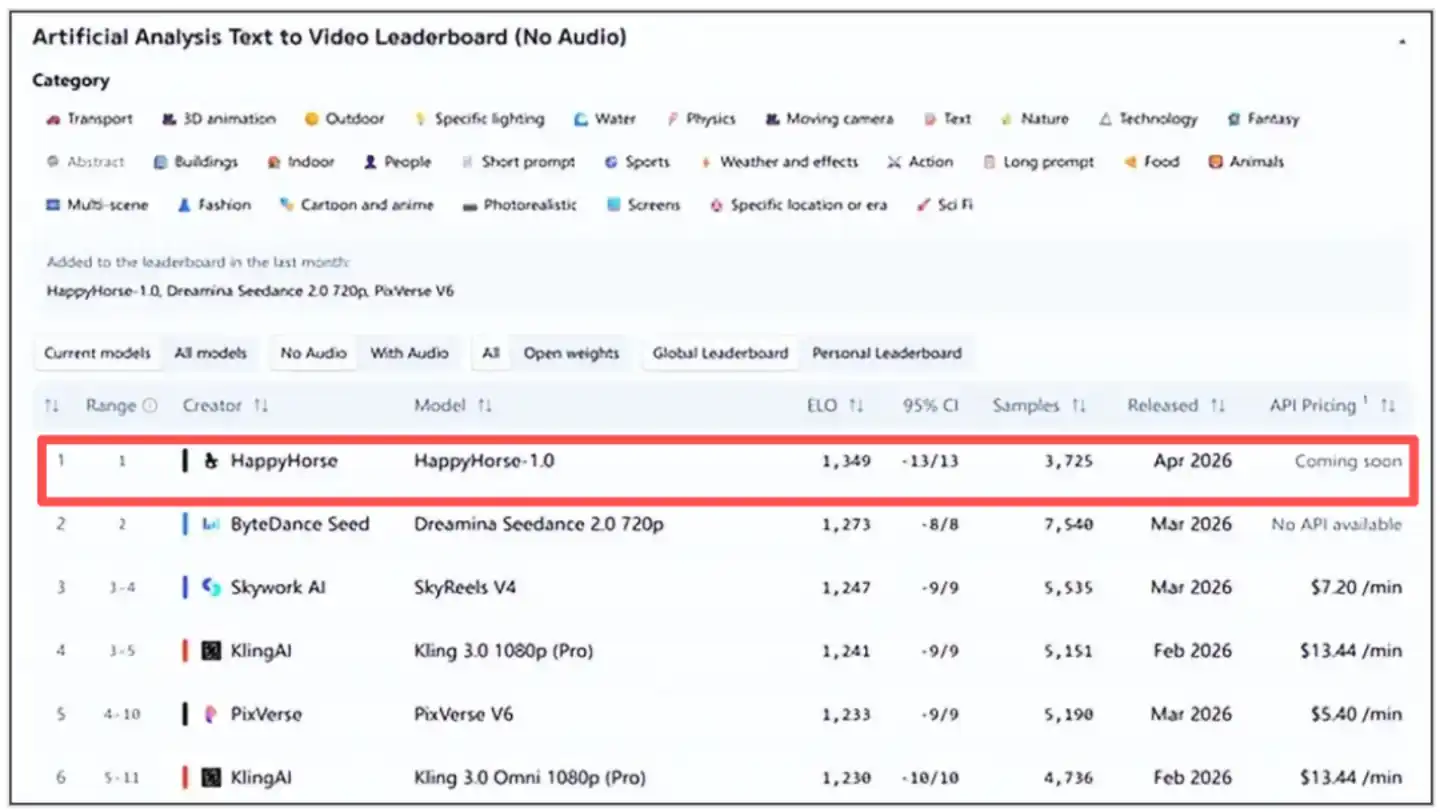
Figure: HappyHorse ranking on Artificial Analysis

Source: Internet

Over the past few days, because the "Happy Horse" was unclaimed, the market was full of curiosity about the origin of this "horse," leading the tech community to collectively play "Sherlock Holmes" to dig into its background.

At that time, many analyses pointed out that "Happy Horse" was an Alibaba product.

The analysis indicated two main evidence chains: first, the technical path displayed by HappyHorse has a very high affinity with the architecture of the Wan 2.6 series just released by Alibaba's Tongyi Lab; second, the return of key figures, Zhang Di, known as the "Father of Kling," who returned to Alibaba at the end of 2025, might have led the team to complete this product in just five months.

After the market "detectived" for a few days, on April 10th, Alibaba finally confirmed that the HappyHorse video model is a model developed by its innovation business unit and is currently in internal testing, with the API interface expected to be launched on April 30th.

It is said that the ATH Innovation Business Unit has launched an exploration plan for a new interactive方式 in the AI era, and HappyHorse is part of this exploration direction. More products will be launched陆续.
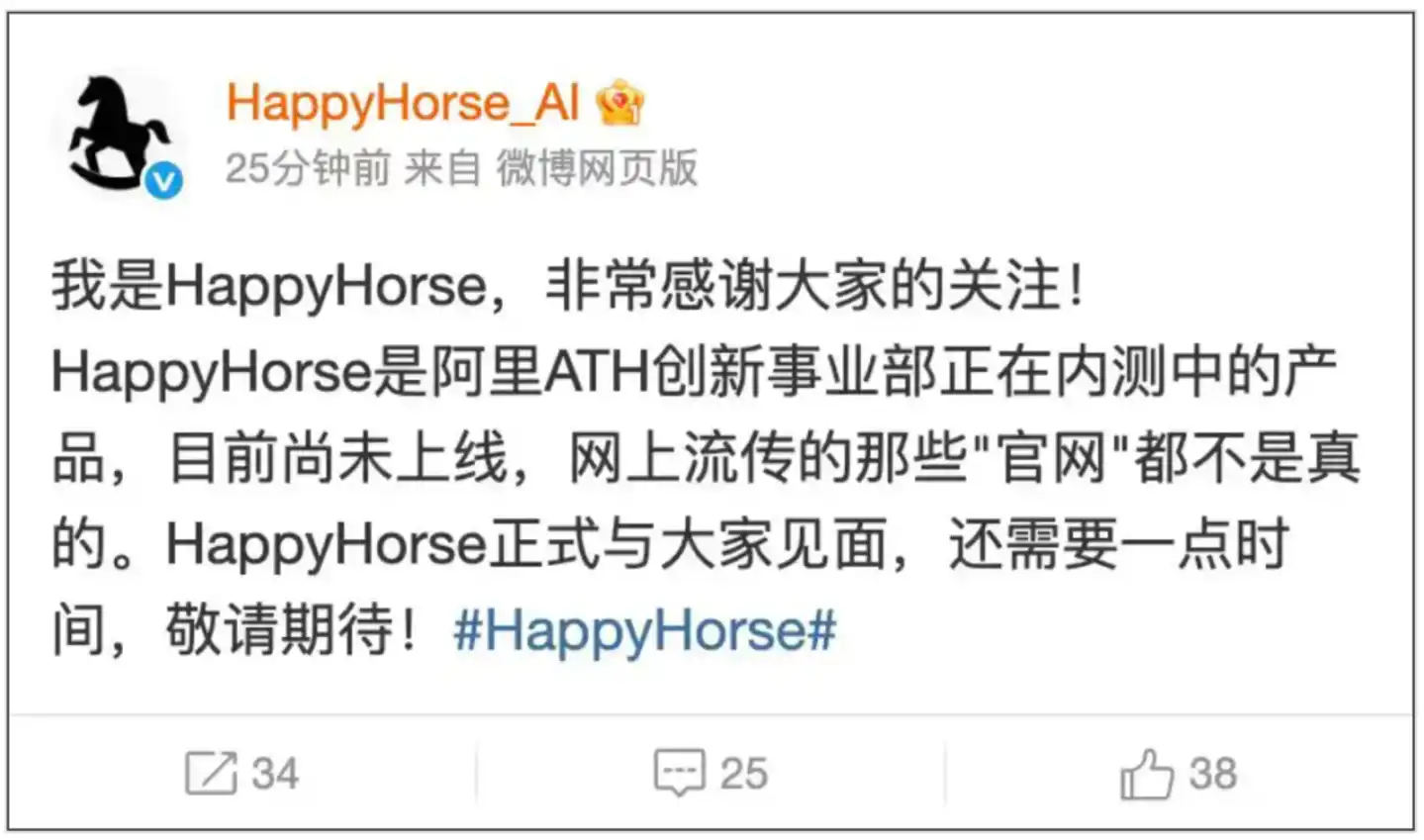
Figure: Alibaba confirms HappyHorse as its product

Source: Weibo 《Tingtong Tech》 Screenshot

At the same time, news indicated that the product was not completed by Zhang Di's team but by Zheng Bo's team from ATH.

Zheng Bo is an Alibaba Group Vice President. Public information shows that Zheng Bo holds a Ph.D. from the Tsinghua University Computer Science Department and joined Alibaba in September 2017. He has served as the head of Taobao Search and Recommendation Algorithms, CTO of Alimama, and head of algorithm technology for Taotian Group. His main research areas include large models, multimodal AI, decision intelligence, deep learning, advertising algorithms, and engine optimization.

This "claiming" news was not surprising to the market. Many analyses pointed out that the emergence of the "Happy Horse" means that Alibaba has completed a leap from "catching up" to "leading" in the multimodal field.

More importantly, this is not just a simple technical muscle show but a strategic "surprise attack" by Alibaba.

In the past, although Qwen was aligned internationally in text models, it rarely had products that captured user mindshare in the AI video track, which has the shortest path to commercialization. The performance of "Happy Horse"验证了 that Alibaba is maintaining a fast offensive pace in full-stack AI.

The market pointed out that the birth of "Happy Horse" accelerates the process of AI video generation moving from the laboratory to commercialization, becoming the "new quality productive forces" for the content industry.

An AI creator, Lin Shao, told 《Tingtong Tech》 that with the rapid iteration of "Happy Horse" and Seedance 2.0, AI video is transforming from a "toy" to a "tool".

Particularly important is that "Happy Horse" has changed the overall industry landscape of AI video large models, marking the entry of the AI video track into a new stage of multi-power melee.

More analyses pointed out that the impact on the former AI video "leader" Kling AI is especially obvious. Lin Shao直言, "Under the influence of Seedance 2.0 and Happy Horse, a 'double strangulation' pattern has formed against Kling AI."

-02- Alibaba's AI Formation

In fact, besides the "Happy Horse," Alibaba has明显 accelerated the推进 speed of its full-stack AI products in the past period.

From late March to early April 2026, Alibaba's Tongyi Lab completed a "triple release" of the full-modal large model Qwen3.5-Omni, the image generation model Wan2.7-Image, and the large language model Qwen3.6-Plus at a "daily update" pace.

This also allowed Alibaba to achieve全方位 matrix coverage of the underlying foundation (Qwen), vertical applications (Coding), and multimodal video (HappyHorse/Wanxiang).

According to a report by China National Radio, Qwen3.6Plus performed on par with or even surpassed competitors with 2 to 3 times larger parameter scales in programming capability evaluations. Just one day after its release, the model rushed to the top of the OpenRouter daily chart, with daily call volume breaking 1.4 trillion Tokens, setting a global record.
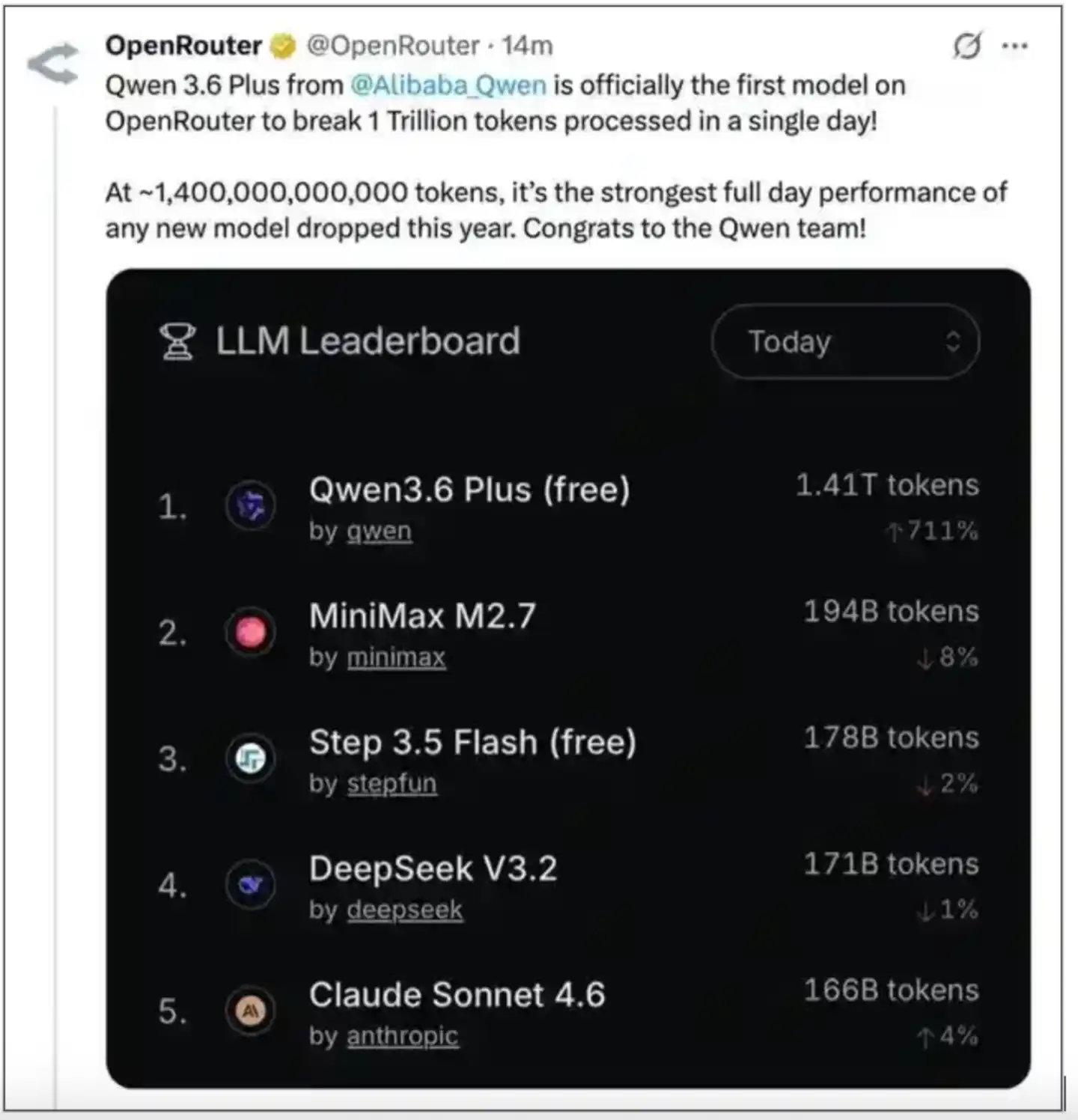
Figure: Qwen3.6Plus tops the OpenRouter daily chart

Source: Internet

Many analyses believe that this density and speed恍惚间让人看到当年阿里在电商领域“碾压一切”的气势 (vaguely reminds people of Alibaba's "crushing everything" momentum in the e-commerce field back in the day).

Actually, Alibaba's offensive is far more than just quickly deploying troops to seize positions.

Public information shows that the Qwen series has already produced multiple data points. As of January 2026, the cumulative downloads of the Tongyi Qianwen series models on the Hugging Face platform had exceeded 700 million, making it the most downloaded open-source AI series on the platform. By February, this number had exceeded 1 billion.

Performance on the C-end is同样亮眼. Public data shows that the monthly active users of the Qwen App have exceeded 300 million. By the end of February, nearly 140 million users had completed their first AI shopping through the Qwen App's智能体 function.

Call volume data also tells a story. According to the latest data from OpenRouter, the global call volume of Chinese AI large models has surpassed that of the US for five consecutive weeks, and two of the top three are models from Alibaba's Qwen 3.6 series.

This strategy is also being validated by the market. Alibaba's latest financial report data shows that Alibaba Cloud revenue increased by 36% year-on-year, and AI-related product revenue has achieved triple-digit year-on-year growth for the tenth consecutive quarter.

Of course, in the view of the market, Alibaba's ambition is far more than just making a few good models.

Judging from Alibaba's various actions in 2026, Alibaba is trying to重塑 its commercial底色, shifting from "selling goods" to "selling Tokens."

At Alibaba's earnings conference in March, Alibaba Group CEO Wu Yongming stated that in the future, relying on the full-stack AI capability of "large model + cloud + chip," and the comprehensive integration with Alibaba's business ecosystem, Alibaba will continue to exert efforts in both AI to B and to C directions.

Wu Yongming used "full-stack AI capability" to summarize Alibaba's core competitiveness, with chips and cloud computing as the AI infrastructure layer, and Token Hub as the main line, composed of large models, MaaS business, and ToB+ToC applications forming the AI model and application layer.

This system also nests chips, computing power, models, and applications layer by layer, forming a complete closed loop from the bottom to the front end.

This means that in the past, Alibaba's e-commerce story was about GMV and user growth; the cloud business story was about infrastructure and customer scale. Now, Alibaba is telling a new story, the full-stack AI story of "large model + cloud + chip".

-03- The Key to the "Sudden" Acceleration

Whether it is the emergence of the "Happy Horse" or the sudden acceleration of the Qwen series, the market has raised a question: Hasn't Alibaba's AI capability always been there? Why does it feel like this is a "sudden"爆发?

One of the key answers is "system."

In the past, Alibaba's AI could be described as "scattered." Damo Academy did research, Alibaba Cloud built platforms, and Taotian Group developed applications. Each had its own turf, inevitably leading to internal friction. Superficially, it looked like multiple points were blooming and advancing separately, but in reality, it wasted resources and was inefficient in coordination.

But all this was broken.

The change began this spring.

On March 16th, Alibaba established the Alibaba Token Hub (ATH) business group, personally led by CEO Wu Yongming. It includes the Tongyi Lab, MaaS business line, Qianwen business unit, Wukong business unit, and AI Innovation business unit, covering the complete chain from basic model R&D to personal and enterprise AI applications.

In the view of the market, the establishment of ATH is precisely about dismantling departmental barriers from the top-level design, eliminating the situation where model R&D, computing power supply, and application落地各自为战. The core logic is also very clear: "create Tokens, deliver Tokens, apply Tokens,"打通 the computing power layer, model layer, and application layer.

But this is not enough.

On April 8th, Alibaba conducted an even deeper organizational restructuring. Wu Yongming announced the establishment of a technology committee at the group level, with himself serving as the leader. Zhou Jingren serves as the Chief AI Architect of the technology committee, Li Feifei is responsible for Alibaba Cloud technology and AI cloud infrastructure construction, and Wu Zeming is responsible for the group's business technology platform and AI inference platform construction.

At the same time, the Tongyi Lab was officially upgraded to the "Tongyi Large Model Business Unit,"全面负责 by Zhou Jingren. This upgrade marks the shift of AI technology from R&D-oriented to full-scale commercial use.

Coupled with Li Feifei taking up the role of Alibaba Cloud CTO and Wu Zeming focusing on his group CTO work, Alibaba's AI governance architecture has formed a clear troika: the group technology committee is responsible for top-level design, the ATH business group is responsible for the business closed loop, and the Tongyi Large Model Business Unit is responsible for core R&D.

A series of system integrations also directly contributed to the recent "hat-trick" of密集 model releases.

Beyond organizational changes, the hardest force driving acceleration is money and resources.

For this AI battle, Alibaba's capital investment has reached the point of不计成本. In the latest quarterly report, Alibaba's free cash flow plummeted by 71% year-on-year. Where did the money go? There are two answers: one is burned on instant retail, and the other is burned on AI.

In the talent war, Alibaba also acted出击 quickly. Although it experienced the departure of people like Lin Junyang, it is understood that the personnel scale and technical梯队 of the Tongyi Lab were not substantially impacted.

Wu Yongming also responded in an internal letter that they will continue to increase AI R&D investment and the efforts to absorb outstanding talent. Additionally, the return of former Kuaishou VP and Kling technical负责人 Zhang Di in November 2025 is also a trophy of Alibaba's talent grab.

Especially in terms of the computing power base, in early 2025, Alibaba announced it would invest over 380 billion yuan in the next three years for云 and AI hardware infrastructure construction. In terms of T-Head's self-developed GPU chips, mass production has been achieved规模化. As of the end of February, cumulative deliveries had reached 470,000 units. This also means that Alibaba is摆脱 external dependence in computing power.

However, with such a big fanfare of burning money, does the capital market really buy it?

At least, judging from the current stock price reaction, the signal given by the market is that under the concept of organizational adjustment and "Happy Horse," Alibaba's stock price rose accordingly.

Of course, there are also different voices in the market.

E-commerce expert Cao Lei said that Alibaba also faces several challenges: how to balance centralization and business flexibility to avoid the technology committee becoming a "rubber stamp"; additionally, two major架构 adjustments in a short period may cause employee adaptation issues, affecting team stability.

Although the outcome is not yet determined, one fact is that Alibaba has shown sufficient sincerity in undertaking full-stack AI entrepreneurship.

This is a豪赌, concerning Alibaba's next ten years. And in the new round of organizational restructuring and ecological synergy, whether more "Happy Horses" will emerge is still worth waiting for the market.

(Header image generated by AI.)

(Disclaimer: This article is for information exchange only and does not constitute any investment reference advice.)


Perguntas relacionadas

QWhat is HappyHorse and why did it cause a stir in the AI community?

AHappyHorse is a video generation model developed by Alibaba's ATH Innovation Business Unit. It caused a stir because it unexpectedly topped the global evaluation platform Artificial Analysis with an Elo score of 1357, outperforming other video models. It was notable for its ability to generate high-definition videos with synchronized audio and sound effects from a script, significantly improving motion logic and efficiency.

QHow did the market initially react to HappyHorse before Alibaba confirmed it as their product?

ABefore Alibaba's confirmation, the market was highly curious and engaged in detective work to identify the origin of HappyHorse. Technical communities analyzed evidence such as its architectural similarities to Alibaba's Wan 2.6 series and the return of key personnel like Zhang Di, leading to widespread speculation that it was an Alibaba product.

QWhat organizational changes has Alibaba made to accelerate its AI development?

AAlibaba established the Alibaba Token Hub (ATH) business group, led by CEO Wu Yongming, to integrate AI efforts across research, platform, and application layers. They also set up a group-level technology committee with Wu Yongming as head, appointed key leaders like Zhou Jingren as Chief AI Architect, and upgraded the Tongyi Lab to the Tongyi Large Model Business Unit to focus on commercial scaling.

QWhat are some key achievements of Alibaba's AI models as mentioned in the article?

AAlibaba's Qwen3.6Plus model topped the OpenRouter daily chart with over 1.4 trillion token calls in a day, setting a global record. The Qwen series surpassed 1 billion downloads on Hugging Face, and the Qwen App reached 300 million monthly active users, with nearly 140 million users completing their first AI-powered shopping through it.

QWhat challenges does Alibaba face in its AI strategy according to the article?

AAlibaba faces challenges in balancing centralized control with business flexibility, ensuring the technology committee does not become a mere formality. Additionally, rapid organizational changes may cause employee adaptation issues and affect team stability. The company is also making significant financial investments, with free cash flow dropping 71% year-over-year, primarily due to spending on AI and instant retail.

Leituras Relacionadas

First Batch of Keynote Speakers and Partners Announced! Web2+3 Summit: Defining the Next Generation of Digital Economy

Web2+3 Summit: Defining the Next Generation of Digital Economy The 6th BEYOND International Technology Innovation Expo (BEYOND Expo 2026), Asia's largest tech and ecosystem exhibition, is launching a dedicated Web2+3 stage for the first time. Co-hosted by BEYOND Expo and ChainNeXT Group, the Web3 Summit will take place from May 28–30, 2026. Against the backdrop of accelerating global tech integration, the boundaries between Web2 and Web3 are rapidly blurring. With clearer global regulations for blockchain-driven internet (Web3) and the special issuance of a Hong Kong dollar stable币 license by the Hong Kong SAR government on April 10, 2026, Web3's decentralized principles are quickly merging with traditional industries (Web2) such as e-commerce, finance, and artificial intelligence. Focused on blockchain-driven digital economy elements, the summit will center on three core principles—implementability, commercial viability, and compliance. It will bring together top Web3 experts to discuss key integration areas like stablecoin payment finance (PayFi), real-world asset tokenization (RWA), and decentralized AI (DeAI), unveiling new opportunities for industrial innovation. The first wave of confirmed speakers includes Jack Kong (Director of Hong Kong Cyberport, Chairman of Nano Labs), Yat Siu (Chairman of Animoca Brands), Michael Wu (Co-founder & CEO of Amber Group), Michael Heinrich (Co-founder & CEO of 0G), and Art Abal (Co-founder of Vana). More Web3 ecosystem pioneers, AI, and fintech experts will be announced soon. Core forum topics include: - Web2+DeAI: New AI Paradigms Driven by Decentralized Infrastructure - Web2+RWA: Real-World Asset Tokenization and Global Liquidity - Web2+PayFi: Cross-Border Payments and Financial Innovation Powered by Crypto Infrastructure - Web2+3 AI: Autonomous Agents and the Crypto Economy - Web2+3 Wealth: On-Chain and Off-Chain Integrated Investment Ecosystems - Web2+3 Commerce: A New Landscape for Global Trade Driven by Stablecoins Additional agenda details will be released in the near future.

marsbitHá 4h

First Batch of Keynote Speakers and Partners Announced! Web2+3 Summit: Defining the Next Generation of Digital Economy

marsbitHá 4h

Trading

Spot
Futuros

Artigos em Destaque

O que é $S$

Compreender o SPERO: Uma Visão Abrangente Introdução ao SPERO À medida que o panorama da inovação continua a evoluir, o surgimento de tecnologias web3 e projetos de criptomoeda desempenha um papel fundamental na formação do futuro digital. Um projeto que tem atraído atenção neste campo dinâmico é o SPERO, denotado como SPERO,$$s$. Este artigo tem como objetivo reunir e apresentar informações detalhadas sobre o SPERO, para ajudar entusiastas e investidores a compreender as suas bases, objetivos e inovações nos domínios web3 e cripto. O que é o SPERO,$$s$? O SPERO,$$s$ é um projeto único dentro do espaço cripto que procura aproveitar os princípios da descentralização e da tecnologia blockchain para criar um ecossistema que promove o envolvimento, a utilidade e a inclusão financeira. O projeto é concebido para facilitar interações peer-to-peer de novas maneiras, proporcionando aos utilizadores soluções e serviços financeiros inovadores. No seu núcleo, o SPERO,$$s$ visa capacitar indivíduos ao fornecer ferramentas e plataformas que melhoram a experiência do utilizador no espaço das criptomoedas. Isso inclui a possibilidade de métodos de transação mais flexíveis, a promoção de iniciativas impulsionadas pela comunidade e a criação de caminhos para oportunidades financeiras através de aplicações descentralizadas (dApps). A visão subjacente do SPERO,$$s$ gira em torno da inclusão, visando fechar lacunas dentro das finanças tradicionais enquanto aproveita os benefícios da tecnologia blockchain. Quem é o Criador do SPERO,$$s$? A identidade do criador do SPERO,$$s$ permanece algo obscura, uma vez que existem recursos publicamente disponíveis limitados que fornecem informações detalhadas sobre o(s) seu(s) fundador(es). Esta falta de transparência pode resultar do compromisso do projeto com a descentralização—uma ética que muitos projetos web3 partilham, priorizando contribuições coletivas em vez de reconhecimento individual. Ao centrar as discussões em torno da comunidade e dos seus objetivos coletivos, o SPERO,$$s$ incorpora a essência do empoderamento sem destacar indivíduos específicos. Assim, compreender a ética e a missão do SPERO é mais importante do que identificar um criador singular. Quem são os Investidores do SPERO,$$s$? O SPERO,$$s$ é apoiado por uma diversidade de investidores que vão desde capitalistas de risco a investidores-anjo dedicados a promover a inovação no setor cripto. O foco desses investidores geralmente alinha-se com a missão do SPERO—priorizando projetos que prometem avanço tecnológico social, inclusão financeira e governança descentralizada. Essas fundações de investidores estão tipicamente interessadas em projetos que não apenas oferecem produtos inovadores, mas que também contribuem positivamente para a comunidade blockchain e os seus ecossistemas. O apoio desses investidores reforça o SPERO,$$s$ como um concorrente notável no domínio em rápida evolução dos projetos cripto. Como Funciona o SPERO,$$s$? O SPERO,$$s$ emprega uma estrutura multifacetada que o distingue de projetos de criptomoeda convencionais. Aqui estão algumas das características-chave que sublinham a sua singularidade e inovação: Governança Descentralizada: O SPERO,$$s$ integra modelos de governança descentralizada, capacitando os utilizadores a participar ativamente nos processos de tomada de decisão sobre o futuro do projeto. Esta abordagem promove um sentido de propriedade e responsabilidade entre os membros da comunidade. Utilidade do Token: O SPERO,$$s$ utiliza o seu próprio token de criptomoeda, concebido para servir várias funções dentro do ecossistema. Esses tokens permitem transações, recompensas e a facilitação de serviços oferecidos na plataforma, melhorando o envolvimento e a utilidade gerais. Arquitetura em Camadas: A arquitetura técnica do SPERO,$$s$ suporta modularidade e escalabilidade, permitindo a integração contínua de funcionalidades e aplicações adicionais à medida que o projeto evolui. Esta adaptabilidade é fundamental para manter a relevância no panorama cripto em constante mudança. Envolvimento da Comunidade: O projeto enfatiza iniciativas impulsionadas pela comunidade, empregando mecanismos que incentivam a colaboração e o feedback. Ao nutrir uma comunidade forte, o SPERO,$$s$ pode melhor atender às necessidades dos utilizadores e adaptar-se às tendências do mercado. Foco na Inclusão: Ao oferecer taxas de transação baixas e interfaces amigáveis, o SPERO,$$s$ visa atrair uma base de utilizadores diversificada, incluindo indivíduos que anteriormente podem não ter participado no espaço cripto. Este compromisso com a inclusão alinha-se com a sua missão abrangente de empoderamento através da acessibilidade. Cronologia do SPERO,$$s$ Compreender a história de um projeto fornece insights cruciais sobre a sua trajetória de desenvolvimento e marcos. Abaixo está uma cronologia sugerida que mapeia eventos significativos na evolução do SPERO,$$s$: Fase de Conceituação e Ideação: As ideias iniciais que formam a base do SPERO,$$s$ foram concebidas, alinhando-se de perto com os princípios de descentralização e foco na comunidade dentro da indústria blockchain. Lançamento do Whitepaper do Projeto: Após a fase conceitual, um whitepaper abrangente detalhando a visão, os objetivos e a infraestrutura tecnológica do SPERO,$$s$ foi lançado para atrair o interesse e o feedback da comunidade. Construção da Comunidade e Primeiros Envolvimentos: Esforços ativos de divulgação foram feitos para construir uma comunidade de primeiros adotantes e investidores potenciais, facilitando discussões em torno dos objetivos do projeto e angariando apoio. Evento de Geração de Tokens: O SPERO,$$s$ realizou um evento de geração de tokens (TGE) para distribuir os seus tokens nativos a apoiantes iniciais e estabelecer liquidez inicial dentro do ecossistema. Lançamento da dApp Inicial: A primeira aplicação descentralizada (dApp) associada ao SPERO,$$s$ foi lançada, permitindo que os utilizadores interagissem com as funcionalidades principais da plataforma. Desenvolvimento Contínuo e Parcerias: Atualizações e melhorias contínuas nas ofertas do projeto, incluindo parcerias estratégicas com outros players no espaço blockchain, moldaram o SPERO,$$s$ em um jogador competitivo e em evolução no mercado cripto. Conclusão O SPERO,$$s$ é um testemunho do potencial do web3 e das criptomoedas para revolucionar os sistemas financeiros e capacitar indivíduos. Com um compromisso com a governança descentralizada, o envolvimento da comunidade e funcionalidades inovadoras, abre caminho para um panorama financeiro mais inclusivo. Como em qualquer investimento no espaço cripto em rápida evolução, potenciais investidores e utilizadores são incentivados a pesquisar minuciosamente e a envolver-se de forma ponderada com os desenvolvimentos em curso dentro do SPERO,$$s$. O projeto demonstra o espírito inovador da indústria cripto, convidando a uma exploração mais aprofundada das suas inúmeras possibilidades. Embora a jornada do SPERO,$$s$ ainda esteja a desenrolar-se, os seus princípios fundamentais podem, de facto, influenciar o futuro de como interagimos com a tecnologia, as finanças e uns com os outros em ecossistemas digitais interconectados.

69 Visualizações TotaisPublicado em {updateTime}Atualizado em 2024.12.17

O que é $S$

O que é AGENT S

Agent S: O Futuro da Interação Autónoma no Web3 Introdução No panorama em constante evolução do Web3 e das criptomoedas, as inovações estão constantemente a redefinir a forma como os indivíduos interagem com plataformas digitais. Um projeto pioneiro, o Agent S, promete revolucionar a interação humano-computador através do seu framework aberto e agente. Ao abrir caminho para interações autónomas, o Agent S visa simplificar tarefas complexas, oferecendo aplicações transformadoras em inteligência artificial (IA). Esta exploração detalhada irá aprofundar-se nas complexidades do projeto, nas suas características únicas e nas implicações para o domínio das criptomoedas. O que é o Agent S? O Agent S é um framework aberto e agente, especificamente concebido para abordar três desafios fundamentais na automação de tarefas computacionais: Aquisição de Conhecimento Específico de Domínio: O framework aprende inteligentemente a partir de várias fontes de conhecimento externas e experiências internas. Esta abordagem dupla capacita-o a construir um rico repositório de conhecimento específico de domínio, melhorando o seu desempenho na execução de tarefas. Planeamento ao Longo de Longos Horizontes de Tarefas: O Agent S emprega planeamento hierárquico aumentado por experiência, uma abordagem estratégica que facilita a decomposição e execução eficientes de tarefas intrincadas. Esta característica melhora significativamente a sua capacidade de gerir múltiplas subtarefas de forma eficiente e eficaz. Gestão de Interfaces Dinâmicas e Não Uniformes: O projeto introduz a Interface Agente-Computador (ACI), uma solução inovadora que melhora a interação entre agentes e utilizadores. Utilizando Modelos de Linguagem Multimodais de Grande Escala (MLLMs), o Agent S pode navegar e manipular diversas interfaces gráficas de utilizador de forma fluida. Através destas características pioneiras, o Agent S fornece um framework robusto que aborda as complexidades envolvidas na automação da interação humana com máquinas, preparando o terreno para uma infinidade de aplicações em IA e além. Quem é o Criador do Agent S? Embora o conceito de Agent S seja fundamentalmente inovador, informações específicas sobre o seu criador permanecem elusivas. O criador é atualmente desconhecido, o que destaca ou o estágio nascente do projeto ou a escolha estratégica de manter os membros fundadores em anonimato. Independentemente da anonimidade, o foco permanece nas capacidades e no potencial do framework. Quem são os Investidores do Agent S? Como o Agent S é relativamente novo no ecossistema criptográfico, informações detalhadas sobre os seus investidores e financiadores não estão explicitamente documentadas. A falta de informações disponíveis publicamente sobre as fundações de investimento ou organizações que apoiam o projeto levanta questões sobre a sua estrutura de financiamento e roteiro de desenvolvimento. Compreender o apoio é crucial para avaliar a sustentabilidade do projeto e o seu impacto potencial no mercado. Como Funciona o Agent S? No núcleo do Agent S reside uma tecnologia de ponta que lhe permite funcionar eficazmente em diversos ambientes. O seu modelo operacional é construído em torno de várias características-chave: Interação Humano-Computador Semelhante: O framework oferece planeamento avançado em IA, esforçando-se para tornar as interações com computadores mais intuitivas. Ao imitar o comportamento humano na execução de tarefas, promete elevar as experiências dos utilizadores. Memória Narrativa: Utilizada para aproveitar experiências de alto nível, o Agent S utiliza memória narrativa para acompanhar os históricos de tarefas, melhorando assim os seus processos de tomada de decisão. Memória Episódica: Esta característica fornece aos utilizadores orientações passo a passo, permitindo que o framework ofereça suporte contextual à medida que as tarefas se desenrolam. Suporte para OpenACI: Com a capacidade de funcionar localmente, o Agent S permite que os utilizadores mantenham o controlo sobre as suas interações e fluxos de trabalho, alinhando-se com a ética descentralizada do Web3. Fácil Integração com APIs Externas: A sua versatilidade e compatibilidade com várias plataformas de IA garantem que o Agent S possa integrar-se perfeitamente em ecossistemas tecnológicos existentes, tornando-o uma escolha apelativa para desenvolvedores e organizações. Estas funcionalidades contribuem coletivamente para a posição única do Agent S no espaço cripto, à medida que automatiza tarefas complexas e em múltiplos passos com mínima intervenção humana. À medida que o projeto evolui, as suas potenciais aplicações no Web3 podem redefinir a forma como as interações digitais se desenrolam. Cronologia do Agent S O desenvolvimento e os marcos do Agent S podem ser encapsulados numa cronologia que destaca os seus eventos significativos: 27 de Setembro de 2024: O conceito de Agent S foi lançado num artigo de pesquisa abrangente intitulado “Um Framework Agente Aberto que Usa Computadores como um Humano”, mostrando a base para o projeto. 10 de Outubro de 2024: O artigo de pesquisa foi disponibilizado publicamente no arXiv, oferecendo uma exploração aprofundada do framework e da sua avaliação de desempenho com base no benchmark OSWorld. 12 de Outubro de 2024: Uma apresentação em vídeo foi lançada, proporcionando uma visão visual das capacidades e características do Agent S, envolvendo ainda mais potenciais utilizadores e investidores. Estes marcos na cronologia não apenas ilustram o progresso do Agent S, mas também indicam o seu compromisso com a transparência e o envolvimento da comunidade. Pontos-Chave Sobre o Agent S À medida que o framework Agent S continua a evoluir, várias características-chave destacam-se, sublinhando a sua natureza inovadora e potencial: Framework Inovador: Concebido para proporcionar um uso intuitivo de computadores semelhante à interação humana, o Agent S traz uma abordagem nova à automação de tarefas. Interação Autónoma: A capacidade de interagir autonomamente com computadores através de GUI significa um avanço em direção a soluções computacionais mais inteligentes e eficientes. Automação de Tarefas Complexas: Com a sua metodologia robusta, pode automatizar tarefas complexas e em múltiplos passos, tornando os processos mais rápidos e menos propensos a erros. Melhoria Contínua: Os mecanismos de aprendizagem permitem que o Agent S melhore a partir de experiências passadas, aprimorando continuamente o seu desempenho e eficácia. Versatilidade: A sua adaptabilidade em diferentes ambientes operacionais, como OSWorld e WindowsAgentArena, garante que pode servir uma ampla gama de aplicações. À medida que o Agent S se posiciona no panorama do Web3 e das criptomoedas, o seu potencial para melhorar as capacidades de interação e automatizar processos significa um avanço significativo nas tecnologias de IA. Através do seu framework inovador, o Agent S exemplifica o futuro das interações digitais, prometendo uma experiência mais fluida e eficiente para os utilizadores em diversas indústrias. Conclusão O Agent S representa um ousado avanço na união da IA e do Web3, com a capacidade de redefinir a forma como interagimos com a tecnologia. Embora ainda esteja nas suas fases iniciais, as possibilidades para a sua aplicação são vastas e cativantes. Através do seu framework abrangente que aborda desafios críticos, o Agent S visa trazer interações autónomas para o primeiro plano da experiência digital. À medida que avançamos mais profundamente nos domínios das criptomoedas e da descentralização, projetos como o Agent S desempenharão, sem dúvida, um papel crucial na formação do futuro da tecnologia e da colaboração humano-computador.

485 Visualizações TotaisPublicado em {updateTime}Atualizado em 2025.01.14

O que é AGENT S

Como comprar S

Bem-vindo à HTX.com!Tornámos a compra de Sonic (S) simples e conveniente.Segue o nosso guia passo a passo para iniciar a tua jornada no mundo das criptos.Passo 1: cria a tua conta HTXUtiliza o teu e-mail ou número de telefone para te inscreveres numa conta gratuita na HTX.Desfruta de um processo de inscrição sem complicações e desbloqueia todas as funcionalidades.Obter a minha contaPasso 2: vai para Comprar Cripto e escolhe o teu método de pagamentoCartão de crédito/débito: usa o teu visa ou mastercard para comprar Sonic (S) instantaneamente.Saldo: usa os fundos da tua conta HTX para transacionar sem problemas.Terceiros: adicionamos métodos de pagamento populares, como Google Pay e Apple Pay, para aumentar a conveniência.P2P: transaciona diretamente com outros utilizadores na HTX.Mercado de balcão (OTC): oferecemos serviços personalizados e taxas de câmbio competitivas para os traders.Passo 3: armazena teu Sonic (S)Depois de comprar o teu Sonic (S), armazena-o na tua conta HTX.Alternativamente, podes enviá-lo para outro lugar através de transferência blockchain ou usá-lo para transacionar outras criptomoedas.Passo 4: transaciona Sonic (S)Transaciona facilmente Sonic (S) no mercado à vista da HTX.Acede simplesmente à tua conta, seleciona o teu par de trading, executa as tuas transações e monitoriza em tempo real.Oferecemos uma experiência de fácil utilização tanto para principiantes como para traders experientes.

905 Visualizações TotaisPublicado em {updateTime}Atualizado em 2025.03.21

Como comprar S

Discussões

Bem-vindo à Comunidade HTX. Aqui, pode manter-se informado sobre os mais recentes desenvolvimentos da plataforma e obter acesso a análises profissionais de mercado. As opiniões dos utilizadores sobre o preço de S (S) são apresentadas abaixo.

活动图片